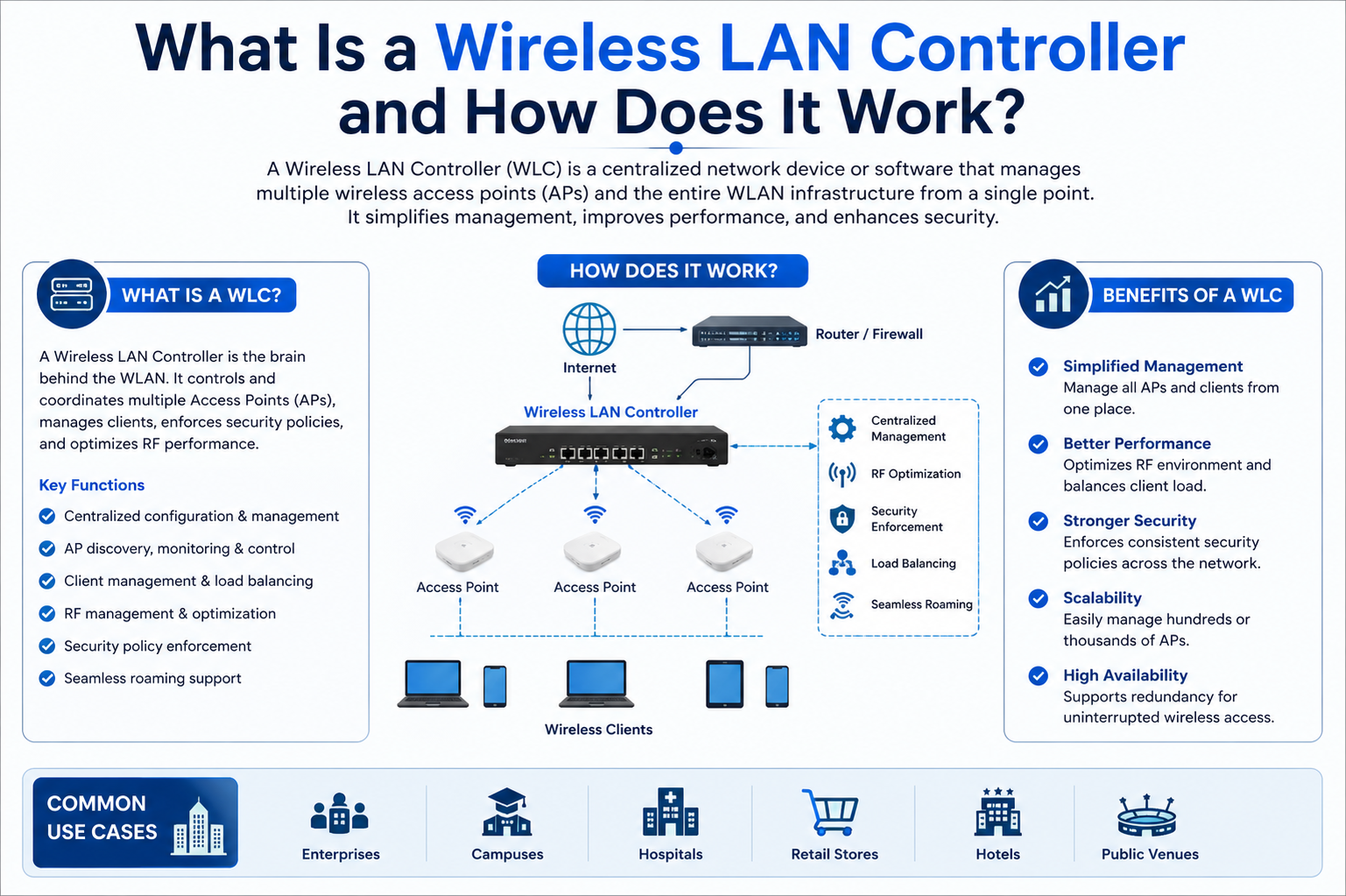
A Wireless LAN Controller is a core component in modern wireless networking environments where many access points are deployed to provide seamless connectivity. As organizations grow, the number of wireless devices and users also increases, making it difficult to manage each access point individually. A controller-based architecture solves this challenge by introducing a centralized system that governs all wireless access points in a unified manner. This approach ensures that network policies remain consistent, performance is optimized, and troubleshooting becomes significantly easier.
The importance of a Wireless LAN Controller becomes more visible in environments where uninterrupted connectivity is critical. Large enterprises, educational campuses, healthcare facilities, and public venues depend on stable wireless networks to support communication, data access, and operational systems. Without centralized management, maintaining such networks would require excessive manual effort and increase the chances of configuration errors.
Core Architecture of a Wireless LAN Controller System
A Wireless LAN Controller system is built around two main components: the controller itself and the lightweight access points. The controller acts as the brain of the network, while the access points function as extensions that provide wireless coverage. These access points are often referred to as lightweight because they do not store complex configurations locally. Instead, they rely on the controller for instructions and operational parameters.
When deployed, access points establish a secure connection with the controller through the wired network infrastructure. Once connected, they receive configuration details such as network names, security settings, radio frequencies, and power levels. This architecture allows the network to remain flexible and scalable, as new access points can be added without complex manual configuration.
The controller also maintains a global view of the entire wireless environment. It continuously monitors the status of all connected access points, connected devices, and traffic conditions. This centralized visibility enables real-time optimization and proactive issue detection.
How Access Points Join the Controller
The process of an access point joining a Wireless LAN Controller is automated to simplify deployment. When an access point is powered on and connected to the network, it searches for a controller using predefined discovery methods. Once it finds a compatible controller, it establishes a secure communication channel.
After authentication, the controller pushes the required configuration to the access point. This includes wireless network identifiers, security credentials, and operational parameters. The access point then transitions into service mode and begins broadcasting wireless signals according to the controller’s instructions.
This automated joining process reduces manual intervention and ensures consistency across all access points in the network. It also allows administrators to scale the network quickly without needing to configure each device individually.
Centralized Configuration and Policy Management
One of the most powerful aspects of a Wireless LAN Controller is centralized configuration management. Instead of logging into each access point separately, administrators can define policies and settings directly on the controller. These settings are then automatically applied across all connected access points.
This includes wireless network names, authentication methods, encryption standards, and bandwidth allocation rules. Any change made at the controller level is instantly propagated to all devices, ensuring uniformity throughout the network.
This centralized approach significantly reduces administrative workload and minimizes the risk of inconsistent configurations. It also improves compliance with organizational security standards, as policies can be enforced globally.
Radio Frequency Management and Optimization
Wireless networks operate in shared frequency bands, which makes them susceptible to interference. A Wireless LAN Controller plays a crucial role in managing radio frequency usage to ensure optimal performance.
The controller continuously monitors the wireless environment and adjusts access point settings to minimize interference. It can dynamically change channels, adjust transmission power, and balance signal coverage to avoid overlapping signals. This process helps maintain stable connections and reduces network congestion.
In addition, the controller can detect environmental changes such as new interference sources or increased user density. Based on this information, it automatically recalibrates the network to maintain performance levels.
Load Balancing and User Distribution
In high-density environments, multiple users often attempt to connect to the same access point, which can lead to congestion and reduced performance. A Wireless LAN Controller addresses this issue through load balancing mechanisms.
The controller distributes connected clients across multiple access points based on signal strength, current load, and availability. This ensures that no single access point becomes overloaded while others remain underutilized.
By balancing the user load efficiently, the controller improves overall network responsiveness and ensures a consistent user experience, even during peak usage periods.
Roaming and Seamless Connectivity
One of the key benefits of a Wireless LAN Controller-based network is seamless roaming. In environments where users move frequently, such as campuses or large buildings, maintaining uninterrupted connectivity is essential.
The controller enables devices to switch between access points without dropping the connection. It achieves this by coordinating authentication and session management across all access points. As a user moves, the controller ensures that the transition between access points is smooth and invisible to the user.
This capability is particularly important for real-time applications such as voice calls, video conferencing, and streaming services, where interruptions can severely impact user experience.
Security Management and Enforcement
Security is a fundamental aspect of any wireless network, and a Wireless LAN Controller provides robust tools to enforce it. The controller ensures that all access points adhere to consistent security policies, including encryption standards and authentication methods.
It can integrate with external authentication systems to verify user identities before granting network access. Additionally, the controller monitors network activity for suspicious behavior and can isolate or block unauthorized devices.
By centralizing security management, the controller reduces vulnerabilities that may arise from inconsistent configurations across multiple access points.
Scalability and Network Expansion
As organizations grow, their networking needs also expand. A Wireless LAN Controller supports this growth by making it easy to add new access points to the network. Once a new access point is connected, it automatically joins the controller and receives its configuration.
This plug-and-play capability allows networks to scale efficiently without requiring extensive manual setup. Whether adding a few access points or expanding across multiple locations, the controller ensures that all devices operate under the same policies and standards.
This scalability makes controller-based wireless networks suitable for both medium-sized businesses and large enterprises with complex infrastructure requirements.
Deployment Models of Wireless LAN Controllers
Wireless LAN Controllers can be deployed in different ways depending on organizational needs. Traditional deployments involve physical hardware controllers installed within the network infrastructure. These are often used in large enterprises where dedicated hardware provides high performance and reliability.
Another model is virtual controllers, where the controller software runs on virtual machines or cloud environments. This approach offers greater flexibility and reduces dependency on physical hardware.
Cloud-based controllers are also becoming increasingly popular. In this model, the controller is hosted in the cloud and managed remotely. This eliminates the need for on-site controller hardware and simplifies management for distributed networks.
Each deployment model offers different advantages, and organizations choose based on scalability, cost, and operational requirements.
Monitoring and Troubleshooting Capabilities
A Wireless LAN Controller provides powerful monitoring tools that allow administrators to view real-time network performance. This includes information about connected devices, signal strength, bandwidth usage, and access point status.
When issues arise, the controller helps identify the root cause quickly by providing detailed logs and analytics. This reduces downtime and improves network reliability.
Administrators can also set alerts for specific conditions such as high traffic load or device failures. These proactive monitoring features ensure that potential problems are addressed before they impact users.
Advantages of Using a Wireless LAN Controller
The use of a Wireless LAN Controller offers numerous advantages, including simplified management, improved performance, enhanced security, and better scalability. It reduces the complexity of managing large wireless networks and ensures consistent configuration across all devices.
It also improves user experience by enabling seamless roaming, efficient load balancing, and optimized signal management. Additionally, centralized control reduces operational costs by minimizing manual configuration and maintenance efforts.
Limitations and Considerations
Despite its advantages, a Wireless LAN Controller also has certain limitations. It introduces a dependency on a central system, meaning that controller failure can impact the entire network if proper redundancy is not in place.
Initial deployment costs can also be higher compared to standalone access point systems. Additionally, configuration and management require technical expertise, especially in large-scale environments.
However, these limitations are often addressed through redundant controller setups, cloud-based solutions, and improved automation tools.
Advanced Traffic Management in Wireless LAN Controllers
A Wireless LAN Controller plays a crucial role in managing network traffic efficiently across multiple access points. In large wireless environments, thousands of devices may be connected at the same time, generating varying levels of data traffic. Without proper control, this can lead to congestion, delays, and poor performance. The controller continuously analyzes traffic flow and distributes bandwidth intelligently based on demand and priority.
It can prioritize critical applications such as voice calls, video conferencing, and business applications over less important traffic like file downloads or background updates. This ensures that essential services always receive sufficient bandwidth to function smoothly. By managing traffic at a centralized level, the controller maintains balance across the entire wireless network and prevents performance bottlenecks.
Quality of Service (QoS) Implementation
Quality of Service is an important feature in a Wireless LAN Controller that ensures different types of network traffic are handled according to their importance. The controller assigns priority levels to various applications and devices, allowing time-sensitive data to be transmitted without delay.
For example, voice and video traffic require low latency to function properly, while email or file transfers can tolerate slight delays. The controller identifies these differences and allocates resources accordingly. This intelligent traffic handling improves user experience and ensures that critical applications perform reliably even under heavy network load.
QoS also helps in maintaining consistent performance across multiple users by preventing any single application from consuming excessive bandwidth. This is especially useful in environments with high user density.
Client Management and Device Tracking
A Wireless LAN Controller maintains detailed information about all connected devices in the network. This includes device type, connection strength, bandwidth usage, and session duration. By tracking this information, the controller can make informed decisions about resource allocation and network optimization.
It can also identify inactive or unauthorized devices and take appropriate action, such as disconnecting them or restricting access. This level of control improves both security and efficiency within the network.
Client management also helps administrators understand usage patterns, allowing them to optimize network design and improve coverage in high-demand areas.
Dynamic Channel Assignment
Wireless networks operate on multiple channels, and improper channel distribution can lead to interference and reduced performance. A Wireless LAN Controller uses dynamic channel assignment to automatically allocate the best available channels to each access point.
It continuously monitors the wireless environment to detect interference from neighboring networks or electronic devices. Based on this analysis, it adjusts channel assignments to minimize overlap and maximize signal clarity.
This dynamic approach ensures that wireless communication remains stable even in environments with high interference levels, such as office buildings or urban areas.
Automatic Power Control Mechanism
Another important function of a Wireless LAN Controller is automatic power control. Access points transmit signals at specific power levels, and if these levels are not properly managed, they can cause interference or coverage gaps.
The controller continuously evaluates the network environment and adjusts the transmission power of each access point accordingly. In densely populated areas, it may reduce power to prevent overlapping signals, while in larger open areas, it may increase power to extend coverage.
This intelligent power adjustment helps maintain optimal signal strength and reduces unnecessary interference between access points.
Fast Roaming Techniques for Mobile Users
In environments where users frequently move between different areas, such as campuses, hospitals, or warehouses, fast roaming is essential. A Wireless LAN Controller enables fast roaming by maintaining continuous authentication and session management across access points.
When a user moves from one access point to another, the controller ensures that the transition happens instantly without requiring re-authentication. This allows devices to maintain active sessions without interruption.
Fast roaming is especially important for real-time applications like video calls and voice communication, where even a short disconnection can affect user experience.
Wireless Intrusion Detection and Prevention
Security threats in wireless networks can come from unauthorized devices or malicious activities. A Wireless LAN Controller includes intrusion detection and prevention capabilities that continuously monitor network activity.
It can identify suspicious behavior such as rogue access points, unauthorized connections, or abnormal traffic patterns. Once detected, the controller can automatically take action, such as isolating the device, blocking access, or alerting administrators.
This proactive security approach helps protect the network from external threats and ensures a safe wireless environment for users.
Role of Controller in Network Redundancy and Failover
To ensure uninterrupted connectivity, Wireless LAN Controller systems often include redundancy and failover mechanisms. In case the primary controller fails, a backup controller automatically takes over control of the network.
This ensures that access points continue to operate without disruption and users remain connected. Redundancy is critical in environments where network downtime can lead to significant operational issues.
Failover systems are designed to be seamless, meaning users do not experience noticeable interruptions during the transition between controllers.
Integration with Wired Network Infrastructure
A Wireless LAN Controller does not operate in isolation; it is closely integrated with the wired network infrastructure. It communicates with switches, routers, and authentication servers to ensure smooth data flow between wireless and wired segments.
This integration allows seamless communication between devices on different parts of the network. It also enables centralized policy enforcement across both wired and wireless connections, ensuring consistency throughout the entire infrastructure.
By bridging the gap between wired and wireless systems, the controller creates a unified networking environment.
Cloud-Based Wireless LAN Controller Systems
Modern networking has introduced cloud-based Wireless LAN Controllers, which offer remote management capabilities. Instead of being physically installed on-site, the controller is hosted in a cloud environment and accessed through the internet.
This model provides greater flexibility, especially for organizations with multiple locations. Administrators can manage all access points from a single cloud dashboard without needing physical access to each site.
Cloud-based controllers also simplify updates, monitoring, and scaling, making them an attractive option for businesses with distributed networks.
Energy Efficiency and Resource Optimization
A Wireless LAN Controller contributes to energy efficiency by optimizing how access points operate. It can put access points into low-power mode during periods of low activity and reactivate them when demand increases.
This reduces unnecessary power consumption and extends the lifespan of network hardware. It also helps organizations reduce operational costs while maintaining reliable connectivity.
Resource optimization ensures that network capacity is used efficiently without overloading equipment or wasting energy.
Challenges in Wireless LAN Controller Deployment
While Wireless LAN Controllers offer many benefits, their deployment can present certain challenges. Proper configuration requires technical expertise, and incorrect setup can lead to performance issues.
In large-scale environments, the initial cost of implementing controller-based systems can be high. Additionally, reliance on a central controller means that proper redundancy planning is necessary to avoid network disruptions.
Despite these challenges, the long-term benefits in terms of scalability, performance, and security often outweigh the initial complexity.
Future of Wireless LAN Controller Technology
The future of Wireless LAN Controller technology is moving toward greater automation, artificial intelligence integration, and cloud-based management. Intelligent controllers are being developed to automatically optimize networks based on real-time data and user behavior.
Machine learning algorithms can predict traffic patterns and adjust network settings proactively. This reduces the need for manual intervention and improves overall efficiency.
As wireless networks continue to expand with the growth of smart devices and Internet of Things ecosystems, Wireless LAN Controllers will become even more advanced and essential.
Role of Wireless LAN Controller in Enterprise Environments
In enterprise environments, a Wireless LAN Controller serves as the backbone of wireless communication systems. Large organizations often operate across multiple floors, buildings, or even cities, and maintaining consistent wireless connectivity across such a wide area requires centralized coordination. The controller ensures that every access point follows the same configuration standards, security rules, and performance policies, creating a unified and predictable network experience.
Enterprises rely heavily on uninterrupted connectivity for day-to-day operations such as communication, cloud applications, data sharing, and customer service systems. The controller helps maintain this continuity by intelligently managing resources and adapting to changing network demands. As employee numbers increase or new departments are added, the controller allows seamless expansion without disrupting existing infrastructure.
Wireless LAN Controller in Educational Institutions
Educational campuses represent one of the most common use cases for Wireless LAN Controllers due to the high number of users and devices connecting simultaneously. Students, teachers, administrative staff, and guests all require stable wireless access for learning platforms, online resources, and communication tools.
A controller-based system ensures that access points spread across classrooms, libraries, dormitories, and outdoor areas are managed efficiently. It balances user load during peak hours, such as lecture times, and ensures fair bandwidth distribution. It also allows institutions to enforce content filtering policies and access restrictions, helping maintain a secure and productive learning environment.
With centralized control, IT departments in educational institutions can quickly deploy updates, manage authentication systems, and monitor network usage patterns without physically accessing each access point.
Wireless LAN Controller in Healthcare Systems
Healthcare environments demand extremely reliable and secure wireless networks because they support critical systems such as patient monitoring, electronic health records, and medical communication tools. A Wireless LAN Controller plays a vital role in ensuring uninterrupted connectivity for these systems.
It prioritizes medical applications over general network traffic, ensuring that life-critical data is transmitted without delay. The controller also enforces strict security measures to protect sensitive patient information and comply with regulatory requirements.
In hospitals, where mobility is high and devices frequently move between wards, fast roaming becomes essential. The controller enables seamless handoffs between access points, ensuring that medical staff remain connected at all times while using mobile devices or monitoring equipment.
Wireless LAN Controller in Public Venues and Smart Cities
Public venues such as stadiums, airports, shopping malls, and transportation hubs require robust wireless infrastructure to handle thousands of simultaneous users. A Wireless LAN Controller is essential in these environments to manage high-density connectivity.
It ensures that users receive fair access to network resources while preventing congestion in heavily used areas. The controller dynamically adjusts access point performance based on crowd density and usage patterns.
In smart city environments, controllers are used to manage public Wi-Fi networks, IoT devices, and connected infrastructure. They help integrate multiple services such as traffic monitoring, public safety systems, and digital information services into a unified wireless ecosystem.
Wireless LAN Controller and Internet of Things (IoT) Integration
The rise of Internet of Things devices has significantly increased the complexity of wireless networks. A Wireless LAN Controller helps manage this complexity by providing centralized control over a large number of connected devices.
IoT devices such as sensors, smart meters, surveillance cameras, and automated systems require stable and secure connectivity. The controller ensures that these devices are properly authenticated, assigned appropriate network resources, and monitored continuously.
It can also segment IoT traffic from regular user traffic to improve performance and enhance security. This separation prevents interference and ensures that critical IoT systems operate without disruption.
Automation and Artificial Intelligence in Wireless LAN Controllers
Modern Wireless LAN Controllers are increasingly incorporating automation and artificial intelligence to improve network management. These intelligent systems analyze network behavior in real time and make automatic adjustments to optimize performance.
For example, AI-driven controllers can detect unusual traffic patterns, predict network congestion, and adjust bandwidth allocation before issues occur. They can also optimize access point placement and configuration based on user density and movement patterns.
Automation reduces the need for manual intervention, allowing network administrators to focus on strategic planning rather than routine maintenance tasks. This leads to more efficient and responsive network operations.
Energy Management and Sustainable Networking
Energy efficiency has become an important consideration in modern network design, and Wireless LAN Controllers contribute significantly to sustainable networking practices. They can automatically adjust access point activity based on network demand.
During periods of low usage, access points can be placed into energy-saving modes or temporarily deactivated. When demand increases, they are automatically reactivated to maintain coverage.
This dynamic energy management reduces power consumption and operational costs while maintaining consistent network availability. It also supports environmental sustainability goals by minimizing unnecessary energy usage.
Security Enhancements Through Centralized Control
Security remains one of the strongest advantages of using a Wireless LAN Controller. Centralized control allows organizations to enforce consistent security policies across all access points and connected devices.
The controller ensures that encryption protocols are up to date and that unauthorized devices are blocked from accessing the network. It also monitors for suspicious behavior such as repeated failed login attempts or unusual traffic spikes.
Advanced security features include guest network isolation, role-based access control, and integration with authentication servers. These measures help protect sensitive data and reduce the risk of cyber threats.
Network Visibility and Analytics
A Wireless LAN Controller provides detailed visibility into network performance through real-time analytics. Administrators can view information such as user activity, bandwidth usage, signal strength, and device distribution.
This data helps identify performance issues, optimize network design, and improve user experience. For example, if a particular area shows weak signal coverage, additional access points can be deployed or existing ones can be adjusted.
Analytics also support long-term planning by revealing usage trends and peak demand periods. This allows organizations to scale their infrastructure more effectively.
Fault Detection and Self-Healing Capabilities
Modern Wireless LAN Controllers often include self-healing capabilities that help maintain network stability. If an access point fails or experiences issues, the controller can automatically redistribute its load to nearby access points.
It can also detect hardware or connectivity failures and alert administrators immediately. In some cases, it can automatically restart or reconfigure affected devices to restore functionality.
This proactive approach minimizes downtime and ensures continuous network availability even in the event of unexpected failures.
Hybrid and Multi-Controller Architectures
Large organizations may use hybrid or multi-controller architectures to improve redundancy and performance. In such setups, multiple controllers work together to manage different parts of the network.
This distributed approach ensures that no single controller becomes a bottleneck. It also provides failover support, allowing one controller to take over if another fails.
Multi-controller systems are especially useful in geographically distributed organizations where different locations require independent but coordinated network management.
Wireless LAN Controller in Cloud-Driven Networks
Cloud-driven networking has transformed the way Wireless LAN Controllers are deployed and managed. Cloud-based controllers allow administrators to manage networks from anywhere using centralized dashboards.
This approach eliminates the need for on-site hardware controllers and simplifies maintenance. Updates, monitoring, and configuration changes can be performed remotely, reducing operational complexity.
Cloud integration also enables better scalability, as new locations and access points can be added without major infrastructure changes.
Importance of Firmware and Software Updates
Keeping a Wireless LAN Controller updated is essential for maintaining security and performance. Regular firmware updates ensure that the system is protected against vulnerabilities and equipped with the latest features.
The controller simplifies the update process by distributing firmware upgrades to all connected access points automatically. This ensures consistency across the network and reduces the risk of compatibility issues.
Automated update management also reduces downtime and administrative effort, making network maintenance more efficient.
Wireless LAN Controller and Network Scalability in Modern Infrastructure
Scalability is one of the most important advantages of a Wireless LAN Controller in modern networking environments. As organizations grow, their wireless demands expand rapidly due to increasing users, devices, and applications. A controller-based system allows this expansion to happen smoothly without requiring major redesigns of the existing network.
When new access points are added, they automatically connect to the controller and receive pre-defined configurations. This eliminates the need for manual setup and ensures that the entire network remains consistent. Whether an organization is expanding within a single building or across multiple locations, the controller ensures that all access points function under a unified management system.
This scalability is particularly valuable for businesses experiencing rapid growth, as it allows network infrastructure to evolve in line with operational needs without disrupting ongoing services.
Wireless LAN Controller and Seamless User Experience
A key objective of any wireless network is to provide a smooth and uninterrupted user experience. A Wireless LAN Controller contributes significantly to this goal by managing connectivity in the background without requiring user interaction.
Users are able to move freely within a coverage area while maintaining stable connections. The controller handles transitions between access points, ensuring that sessions remain active and data flow continues without interruption.
This seamless experience is especially important for modern applications such as cloud services, video conferencing, online collaboration tools, and real-time communication platforms. By reducing connection drops and latency, the controller improves overall productivity and user satisfaction.
Load Distribution in High-Density Environments
In environments where a large number of users connect simultaneously, such as stadiums, conferences, or transport hubs, network congestion can become a serious issue. A Wireless LAN Controller addresses this challenge by distributing user connections intelligently across available access points.
It evaluates factors such as signal strength, current load, and device capacity before assigning users to specific access points. This prevents any single access point from becoming overloaded while others remain underutilized.
Balanced load distribution ensures consistent performance even under heavy usage conditions. It also improves response times and reduces delays, creating a more stable wireless environment for all users.
Adaptive Network Behavior and Real-Time Adjustments
A Wireless LAN Controller continuously monitors network conditions and adapts in real time to changes in usage patterns. This adaptive behavior allows the network to respond dynamically to fluctuations in demand.
For example, during peak usage hours, the controller may adjust bandwidth allocation or optimize access point performance to handle increased traffic. During quieter periods, it may reduce power consumption or reconfigure resources to improve efficiency.
This real-time adaptability ensures that the network remains efficient and responsive under all conditions. It also reduces the need for manual intervention by network administrators.
Wireless LAN Controller and Application Awareness
Modern Wireless LAN Controllers are capable of recognizing different types of applications running on the network. This application awareness allows them to prioritize traffic based on its importance and sensitivity.
For example, streaming services, voice communication, and business-critical applications may be given higher priority compared to background downloads or non-essential traffic. This ensures that important applications receive the necessary bandwidth and low latency required for optimal performance.
Application-aware networking enhances the overall quality of service and ensures that users experience consistent performance across different types of applications.
Device Classification and Smart Network Control
A Wireless LAN Controller is capable of identifying and classifying connected devices based on their type and behavior. It can distinguish between smartphones, laptops, IoT devices, and guest users.
Once classified, the controller applies appropriate policies to each device category. For example, corporate devices may receive full network access, while guest devices may be restricted to internet-only access.
This smart classification improves security and ensures that each type of device operates within defined network boundaries. It also helps optimize resource allocation based on device requirements.
Wireless LAN Controller in Multi-Site Organizations
Organizations with multiple branches or locations benefit significantly from Wireless LAN Controllers. Centralized management allows IT teams to control all wireless networks from a single interface, regardless of geographic location.
This unified control simplifies policy enforcement, monitoring, and troubleshooting across different sites. Changes made at the central level can be applied consistently across all branches, ensuring uniform network behavior.
Multi-site management also improves efficiency by reducing the need for on-site technical support at each location.
Wireless LAN Controller and Guest Network Management
Many organizations provide guest Wi-Fi access to visitors, clients, or customers. A Wireless LAN Controller simplifies the management of guest networks by creating isolated and secure access environments.
Guest users can be provided with temporary credentials or captive portal authentication, ensuring controlled access to the internet without compromising internal network security.
The controller can also enforce bandwidth limits for guest users, preventing them from affecting the performance of core business applications.
Policy Enforcement and Compliance Management
In regulated industries, maintaining compliance with security and operational standards is critical. A Wireless LAN Controller helps enforce organizational policies consistently across the entire wireless network.
It ensures that encryption standards, authentication methods, and access controls are uniformly applied. This reduces the risk of policy violations and enhances overall network governance.
Compliance management becomes easier because administrators can implement changes centrally rather than configuring individual devices separately.
Wireless LAN Controller and Disaster Recovery Support
Network resilience is an important consideration for any organization, and Wireless LAN Controllers contribute to disaster recovery planning. In the event of network failures or disruptions, controller-based systems can quickly restore connectivity by reassigning access point roles or switching to backup systems.
Redundant controllers and backup configurations ensure that wireless services remain operational even during hardware failures or unexpected outages.
This resilience is critical for organizations that rely heavily on continuous connectivity for business operations.
Optimization of Wireless Coverage Areas
A Wireless LAN Controller helps optimize wireless coverage by analyzing signal distribution across different areas. It can identify weak coverage zones and adjust access point settings accordingly.
This may include increasing signal strength, repositioning load distribution, or adjusting channel assignments to improve coverage quality.
Optimized coverage ensures that users receive consistent connectivity throughout the entire environment, reducing dead zones and improving overall network reliability.
Wireless LAN Controller and Mobile Workforce Support
With the rise of mobile work environments, employees increasingly rely on wireless connectivity to perform tasks from different locations within an organization. A Wireless LAN Controller supports this mobility by ensuring stable and continuous connections.
Employees using laptops, tablets, or mobile devices can move between different areas without losing access to network resources. This enhances productivity and allows for more flexible working arrangements.
The controller ensures that mobile users experience the same level of connectivity quality regardless of their location within the network.
Integration with Security Information Systems
Wireless LAN Controllers can integrate with broader security systems such as intrusion detection systems, firewalls, and identity management platforms. This integration enhances overall network security by providing a unified defense strategy.
It allows for centralized monitoring of threats and coordinated responses to security incidents. For example, if a suspicious device is detected, the controller can work with security systems to isolate and block it automatically.
This integrated approach strengthens network protection and reduces response times to potential threats.
Wireless LAN Controller and Future Network Evolution
The evolution of wireless networking continues to move toward more intelligent, automated, and cloud-based systems. Wireless LAN Controllers are adapting to these changes by incorporating advanced technologies such as artificial intelligence, machine learning, and predictive analytics.
Future controllers will be capable of self-optimizing networks without human intervention, making decisions based on real-time data and predictive modeling.
This evolution will lead to more efficient, secure, and self-managing wireless networks that require minimal manual configuration.
Conclusion
A Wireless LAN Controller is a central element in modern wireless networking that brings order, efficiency, and intelligence to complex Wi-Fi environments. By managing multiple access points from a single point of control, it eliminates the challenges of manual configuration and ensures that all parts of the network operate in a coordinated manner. This centralized approach improves consistency, reduces administrative effort, and enhances overall reliability.
One of the most important strengths of a Wireless LAN Controller is its ability to optimize performance automatically. It continuously monitors network conditions, balances user loads, manages radio frequencies, and adjusts power levels to maintain stable connectivity. These functions ensure that users experience smooth and uninterrupted wireless access even in high-density or high-traffic environments.
Security is another key advantage, as the controller enforces uniform policies across the entire network. It helps protect sensitive data, restrict unauthorized access, and monitor network activity for potential threats. This makes it especially valuable in environments where data protection and compliance are critical.
The scalability offered by Wireless LAN Controllers also makes them essential for growing organizations. Whether expanding within a single site or across multiple locations, new access points can be integrated quickly without disrupting existing operations. This flexibility supports long-term growth and evolving network demands.
Overall, a Wireless LAN Controller transforms wireless networking from a collection of independent devices into a unified, intelligent system. It enhances performance, strengthens security, simplifies management, and ensures a reliable user experience, making it a foundational technology in modern wireless infrastructure.