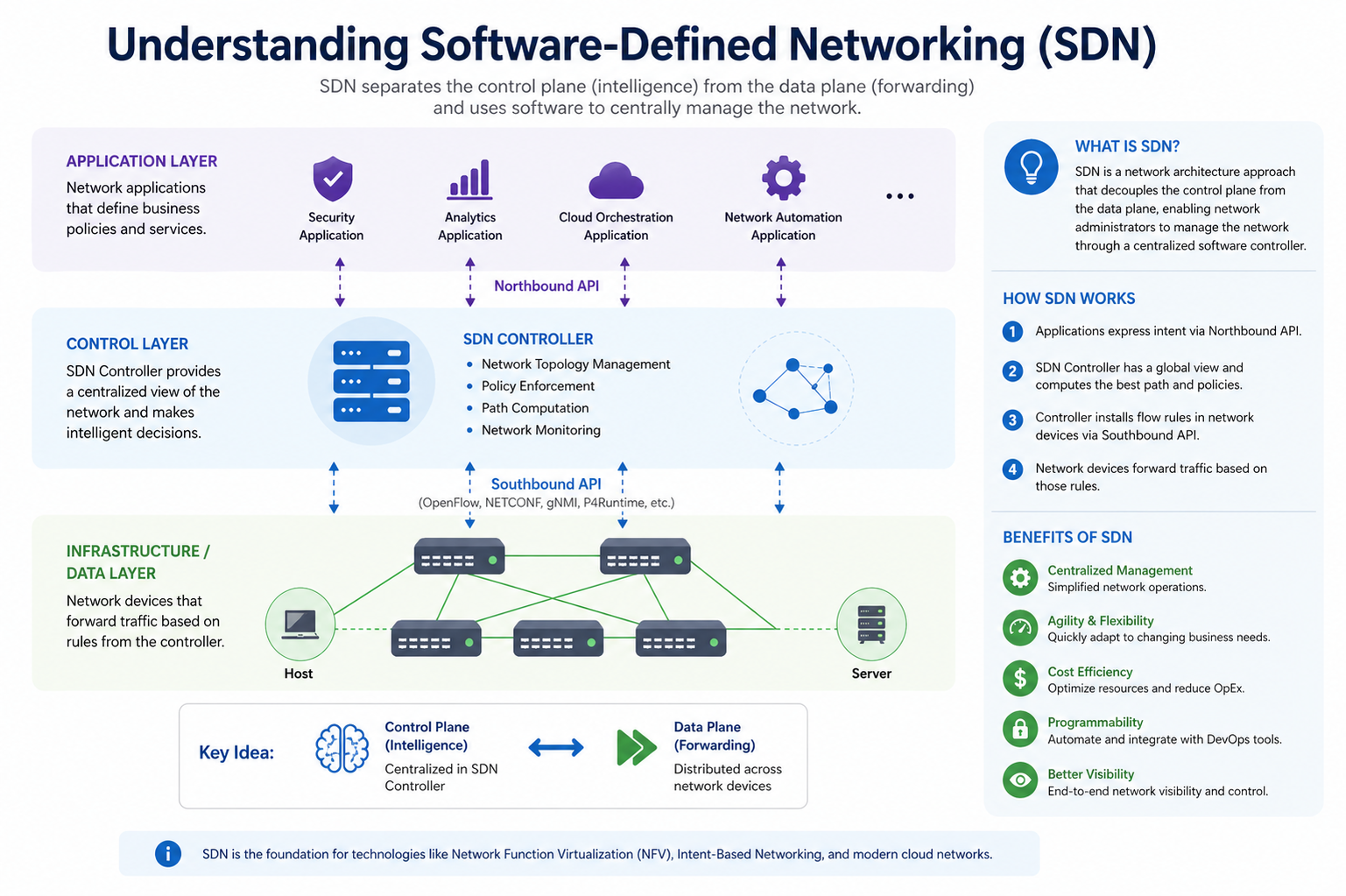
Software-Defined Networking represents a major transformation in the way modern computer networks are designed, operated, and maintained. It introduces a shift from traditional hardware-centric networking toward a more intelligent, software-driven model where control and decision-making are centralized. This change is not just technical but architectural, fundamentally altering how network resources are managed and optimized in real time. SDN is widely used in environments where flexibility, scalability, and automation are essential, especially in large data-driven systems.
Traditional Networking Challenges and the Need for SDN
In conventional networking systems, each device such as routers, switches, and gateways operates independently, making its own forwarding decisions based on pre-configured rules. While this decentralized approach worked for smaller and simpler networks, it becomes increasingly inefficient as networks grow in size and complexity. Managing each device manually requires significant time, effort, and technical expertise. Even small changes in network policy often require reconfiguration of multiple devices, increasing the risk of errors and inconsistencies.
As organizations began to rely more heavily on cloud computing, real-time applications, and large-scale data processing, the limitations of traditional networking became more visible. Networks needed to become more adaptable, programmable, and responsive to changing demands. This growing need for agility led to the development of Software-Defined Networking, which addresses these limitations by introducing centralized intelligence and programmable control.
Core Concept of Software-Defined Networking
At its core, SDN is based on the idea of separating the network’s decision-making process from the actual movement of data. Instead of each device independently deciding how to forward traffic, SDN centralizes this logic in a software-based controller. This controller has a global view of the entire network, enabling it to make optimized decisions based on real-time conditions.
The actual devices in the network, such as switches, focus only on forwarding data according to instructions received from the controller. This separation of roles simplifies network management and creates a more flexible and programmable infrastructure. It allows administrators to define network behavior through software applications rather than manually configuring individual hardware devices.
Separation of Control Plane and Data Plane
A fundamental principle of SDN is the separation between the control plane and the data plane. The control plane is responsible for making decisions about where traffic should go, while the data plane handles the actual movement of packets based on those decisions.
In traditional systems, both planes are tightly integrated within each device, which limits flexibility. In SDN, the control plane is moved to a centralized controller, while the data plane remains distributed across network devices. This architectural change allows for more efficient decision-making and easier network management, as policies can be updated centrally and applied across the entire network instantly.
Role of the SDN Controller
The SDN controller acts as the brain of the entire network. It maintains a complete view of all connected devices, traffic patterns, and network conditions. Based on this global understanding, it determines how data should flow through the network to achieve optimal performance, security, and efficiency.
The controller communicates with network devices using standardized protocols and continuously updates their forwarding rules. This ensures that the network behaves in accordance with centrally defined policies. The controller can also respond dynamically to changes such as congestion, device failures, or security threats by rerouting traffic or adjusting configurations automatically.
Northbound and Southbound Interfaces
Communication within SDN architecture is made possible through two key interfaces known as northbound and southbound interfaces. The northbound interface connects the SDN controller to applications and services that define network behavior. These applications may include security tools, traffic management systems, or performance monitoring tools. Through this interface, developers and administrators can express high-level network requirements without dealing with low-level device configurations.
The southbound interface connects the controller to the physical and virtual network devices. It is responsible for transmitting instructions from the controller to switches and routers, ensuring that forwarding rules are correctly implemented. This separation of interfaces contributes to the modular and flexible nature of SDN architecture.
Centralized Network Intelligence and Visibility
One of the most powerful features of SDN is centralized visibility. Since the controller has a global view of the entire network, it can analyze traffic patterns, detect bottlenecks, and identify inefficiencies much more effectively than individual devices operating in isolation.
This visibility allows for smarter decision-making. For example, if certain paths in the network become congested, the controller can redirect traffic through alternative routes to maintain performance. It can also detect unusual behavior that may indicate security threats and take immediate action to isolate affected areas of the network.
Programmability and Network Automation
SDN introduces programmability into networking, meaning that network behavior can be defined and modified using software applications. This is a major shift from traditional networking, where changes require manual configuration of each device.
With SDN, network administrators can create automated rules that control how traffic is handled under different conditions. For example, bandwidth allocation can be dynamically adjusted based on application priority, or security policies can be automatically enforced when new devices connect to the network. This level of automation reduces operational complexity and increases efficiency.
Flexibility and Dynamic Adaptation
Modern networks must adapt quickly to changing conditions such as fluctuating traffic loads, new application demands, or unexpected failures. SDN provides this flexibility by allowing real-time updates to network behavior without requiring physical changes to infrastructure.
This adaptability is especially useful in environments such as cloud computing and data centers, where workloads can change rapidly. Instead of manually reconfiguring devices, SDN allows administrators to adjust policies instantly through software, ensuring consistent performance and reliability.
Improved Resource Utilization
Another important advantage of SDN is efficient resource utilization. Since the controller has complete awareness of network conditions, it can allocate resources such as bandwidth and routing paths more effectively. This helps prevent underutilization or overloading of network components.
By intelligently distributing traffic, SDN ensures that all available resources are used optimally. This leads to better performance, reduced latency, and improved overall network efficiency.
Security Enhancements in SDN
Security is a critical aspect of modern networks, and SDN offers several improvements in this area. Centralized control allows security policies to be applied consistently across the entire network. Instead of relying on individual devices to enforce security rules, SDN ensures that all devices follow the same centrally defined policies.
In addition, SDN enables faster detection and response to security threats. Since the controller monitors all network traffic, it can quickly identify unusual patterns or potential attacks. Once a threat is detected, the controller can immediately isolate affected segments or redirect traffic to prevent damage.
Scalability in Large-Scale Networks
Scalability is another key advantage of SDN. As organizations grow, their network requirements also expand. Traditional networks often struggle to scale efficiently due to the complexity of managing numerous devices.
SDN simplifies this process by allowing new devices and services to be integrated into the network without significant manual configuration. The centralized controller automatically manages these additions, ensuring that the network continues to operate smoothly even as it expands.
Separation of Hardware and Software
One of the defining characteristics of SDN is the separation of hardware and software. In traditional networking, hardware devices often contain embedded control logic, making them tightly coupled and less flexible. SDN removes this dependency by shifting control functions to software-based systems.
This separation allows hardware devices to become simpler and more standardized, while software handles complex decision-making processes. As a result, networks become easier to upgrade, maintain, and modify without requiring expensive hardware replacements.
SDN Fundamentals
Software-Defined Networking introduces a revolutionary approach to network design by centralizing control, separating functions, and enabling programmability. It addresses the limitations of traditional networking by providing greater flexibility, automation, and efficiency. Through its architecture, SDN allows networks to become more responsive to modern demands, supporting dynamic environments such as cloud computing and large-scale data processing.
As networks continue to evolve, SDN plays a critical role in shaping the future of connectivity by making systems more intelligent, adaptable, and easier to manage at scale.
Architecture Layers of Software-Defined Networking (SDN)
Software-Defined Networking is built on a layered architecture that clearly separates responsibilities into different functional levels. This layered structure is what makes SDN flexible, scalable, and easier to manage compared to traditional networking systems. Each layer has a specific role, and together they create a coordinated system where decisions, communication, and data movement are handled efficiently through software control.
Application Layer and Network Services
The highest level of SDN architecture is the application layer, where network applications and services operate. This layer is responsible for defining what the network should do rather than how it should do it. Applications in this layer can include traffic management systems, security enforcement tools, load balancing systems, and monitoring applications.
These applications communicate their requirements to the SDN controller using high-level instructions. Instead of configuring individual devices, administrators and developers define policies such as prioritizing certain types of traffic, blocking malicious activity, or optimizing bandwidth usage. The application layer essentially translates business needs into network behavior requirements.
Because of this abstraction, network management becomes much simpler. Developers do not need to understand low-level hardware configurations. Instead, they can focus on creating intelligent applications that influence network behavior through the controller.
Control Layer and Centralized Decision Making
The control layer sits at the heart of SDN architecture and is responsible for making all major decisions about how data flows through the network. This layer is implemented in the SDN controller, which acts as the central intelligence of the entire system.
The controller maintains a global view of the network, including all connected devices, traffic patterns, and current network conditions. Based on this information, it calculates optimal paths for data transmission and determines how resources should be allocated. It then communicates these decisions to the underlying infrastructure devices.
This centralized approach eliminates the need for each device to make independent decisions, which significantly reduces complexity and increases efficiency. It also allows the network to respond quickly to changes such as congestion, failures, or new application demands.
Infrastructure Layer and Data Forwarding
The infrastructure layer, also known as the data layer, consists of physical and virtual network devices such as switches, routers, and access points. Unlike traditional networks, these devices do not make independent decisions about traffic routing. Instead, they simply follow instructions received from the SDN controller.
Their primary function is to forward data packets based on flow rules defined by the control layer. These rules specify how different types of traffic should be handled, including their destination paths and priority levels. Because the intelligence is removed from the devices, they become simpler, more efficient, and easier to manage.
This separation also improves performance because devices can focus entirely on fast packet forwarding without the overhead of complex decision-making processes.
Communication Between Layers
For SDN to function effectively, there must be smooth communication between its layers. This communication is handled through standardized interfaces that ensure consistent interaction between applications, controllers, and devices.
The interaction between the application layer and control layer allows network policies to be translated into actionable instructions. Meanwhile, the communication between the control layer and infrastructure layer ensures that these instructions are executed correctly across the network. This structured communication flow is essential for maintaining coordination and efficiency.
Flow-Based Forwarding Mechanism
One of the key operational concepts in SDN is flow-based forwarding. Instead of handling individual packets independently, SDN groups traffic into flows based on shared characteristics such as source, destination, or application type.
Each flow is assigned specific rules by the controller, which determine how packets belonging to that flow should be handled. These rules are installed in network devices, allowing them to forward traffic efficiently without needing to analyze each packet in detail.
This approach improves performance and reduces processing overhead, especially in large-scale networks where millions of packets are transmitted every second.
Dynamic Network Configuration
SDN enables dynamic configuration of networks, meaning changes can be applied in real time without manual intervention on individual devices. When network conditions change, the controller can immediately update flow rules and adjust traffic paths accordingly.
For example, if a particular link becomes congested, the controller can reroute traffic through alternative paths to maintain performance. Similarly, if a new application requires higher bandwidth, the controller can allocate additional resources automatically. This dynamic adaptability is one of the strongest advantages of SDN.
Network Virtualization in SDN
SDN also plays an important role in network virtualization, where physical network resources are abstracted into virtual networks. These virtual networks operate independently while sharing the same physical infrastructure.
Through SDN, multiple virtual networks can be created on a single physical network, each with its own policies, configurations, and security rules. This is particularly useful in environments like cloud computing, where different users or applications require isolated network environments.
Virtualization improves resource utilization and allows infrastructure to be shared efficiently without compromising performance or security.
Role of APIs in SDN Ecosystem
Application Programming Interfaces play a crucial role in SDN by enabling communication between different layers and components. They allow applications to interact with the SDN controller and request specific network behaviors.
Through these interfaces, developers can build advanced network applications without needing direct access to hardware devices. This makes SDN highly programmable and supports innovation in network services. APIs also ensure consistency and standardization across different SDN implementations.
Traffic Engineering and Optimization
SDN provides powerful capabilities for traffic engineering, which involves controlling how data flows through the network to optimize performance. Since the controller has a complete view of the network, it can make intelligent routing decisions based on current conditions.
It can balance traffic loads across multiple paths, avoid congested links, and prioritize critical applications. This leads to better utilization of network resources and improved user experience. Traditional networks often struggle with such optimization due to their decentralized nature.
Fault Detection and Recovery
Another important feature of SDN is its ability to quickly detect and respond to network failures. Because the controller continuously monitors the entire network, it can immediately identify issues such as link failures or device malfunctions.
Once a problem is detected, the controller can automatically reroute traffic to avoid the affected area. This reduces downtime and ensures continuous network availability. In traditional networks, such recovery processes often require manual intervention and take significantly longer.
Security Policy Enforcement in SDN Architecture
Security in SDN is enforced centrally through the controller, which ensures that consistent policies are applied across the entire network. Instead of configuring security rules on individual devices, administrators define policies once, and the controller distributes them throughout the system.
This centralized approach makes it easier to manage access control, detect threats, and enforce compliance. It also allows for real-time updates to security policies in response to emerging threats or vulnerabilities.
Scalability and Distributed Deployment
SDN architecture is designed to support both small and large-scale networks. As network size increases, additional controllers or distributed controller systems can be introduced to maintain performance and reliability.
This scalability ensures that SDN can be used in environments ranging from small enterprise networks to large global data centers. The architecture is flexible enough to grow with increasing demands without losing efficiency or control.
SDN Architecture Understanding
The architecture of Software-Defined Networking is built on clear separation of layers, centralized intelligence, and programmable control. By dividing responsibilities into application, control, and infrastructure layers, SDN simplifies network management while improving flexibility and performance.
This structured design allows networks to operate more intelligently, adapt dynamically to changing conditions, and scale efficiently as demands grow. SDN architecture represents a significant evolution in networking, enabling systems that are more responsive, automated, and easier to manage in modern digital environments.
Working Principles of Software-Defined Networking (SDN)
Software-Defined Networking operates on a set of well-defined principles that together enable centralized control, programmable behavior, and dynamic adaptability of modern networks. These principles reshape how data is managed and transmitted, moving away from rigid hardware-based decision-making toward flexible software-driven intelligence. Understanding these working principles is essential to grasp how SDN functions in real-world environments.
Centralized Control Logic
One of the most important working principles of SDN is centralized control. In traditional networking systems, each device independently decides how to handle traffic, which often leads to inconsistent behavior and complex management. SDN removes this independence by shifting all decision-making logic to a central controller.
This controller acts as the brain of the network, maintaining a complete view of all devices, links, and traffic flows. By having this global perspective, it can make optimized decisions that improve efficiency and reduce congestion. Instead of managing multiple devices separately, administrators manage the entire network through this centralized system.
Global Network Visibility
SDN operates on the principle of complete network visibility. The controller continuously collects information from all connected devices, including traffic statistics, link status, and performance metrics. This real-time data allows the controller to understand the overall state of the network at any moment.
With this visibility, the system can detect issues early, identify performance bottlenecks, and adjust routing decisions dynamically. This is a major improvement over traditional networks, where devices only have a limited local view of the network.
Flow-Based Data Handling
Another key principle of SDN is flow-based data handling. Instead of processing individual packets in isolation, SDN groups packets into flows based on shared characteristics such as source address, destination address, or application type.
Each flow is treated as a single unit and assigned specific forwarding rules by the controller. These rules determine how all packets in that flow should be handled throughout the network. This approach simplifies processing at the device level and improves overall efficiency.
Flow efficiency increases as packet processing shifts from per-packet decisions to per-flow rules\text{Flow efficiency increases as packet processing shifts from per-packet decisions to per-flow rules}Flow efficiency increases as packet processing shifts from per-packet decisions to per-flow rules
By reducing repetitive decision-making at each device, flow-based handling allows networks to operate faster and with lower computational overhead.
Separation of Control and Data Functions
A fundamental principle of SDN is the strict separation between control functions and data forwarding functions. The control function determines how traffic should move, while the data function is responsible for actually moving the packets.
In SDN, the control function is centralized in the controller, while the data function remains distributed across network devices. This separation ensures that devices do not need to perform complex decision-making, allowing them to focus purely on fast and efficient packet forwarding.
This principle is what makes SDN highly flexible and programmable, as changes in network behavior can be implemented centrally without modifying individual devices.
Programmability of Network Behavior
SDN introduces the principle of programmability, where network behavior is defined through software rather than hardware configuration. Administrators and developers can write policies that determine how traffic should be handled under different conditions.
These policies can control routing, bandwidth allocation, security enforcement, and load balancing. Once defined, they are automatically applied across the network through the SDN controller. This eliminates the need for manual configuration and reduces the chances of human error.
Programmability also allows networks to evolve quickly in response to changing business or application requirements.
Dynamic Adaptation to Network Conditions
Another key principle of SDN is dynamic adaptation. The network continuously adjusts itself based on real-time conditions such as traffic load, device failures, or security threats.
If congestion occurs on a particular path, the controller can immediately reroute traffic through alternative paths. If a new device joins the network, it can be automatically configured and integrated without manual intervention.
This dynamic behavior ensures that the network remains efficient and resilient under varying conditions.
Policy-Driven Management
SDN operates on a policy-driven model, meaning that network behavior is defined through high-level policies rather than device-level configurations. These policies describe what should happen in the network, not how it should be implemented.
For example, a policy might specify that video traffic should be prioritized over regular data traffic. The SDN controller then translates this policy into specific forwarding rules and applies them across the network.
This abstraction simplifies network management and allows administrators to focus on business objectives rather than technical details.
Automation of Network Operations
Automation is a core working principle of SDN. Many routine tasks such as traffic routing, configuration updates, and security enforcement are handled automatically by the controller.
This reduces the need for manual intervention and significantly improves operational efficiency. Automation also ensures consistency, as policies are applied uniformly across all devices in the network.
It minimizes human error and allows networks to respond quickly to changes without delay.
Real-Time Decision Making
SDN systems are designed to make real-time decisions based on current network conditions. The controller continuously analyzes incoming data and adjusts network behavior instantly when needed.
For example, if a sudden spike in traffic is detected, the controller can immediately redistribute loads to prevent congestion. This real-time responsiveness is crucial in environments where performance and reliability are critical.
Abstraction of Network Complexity
Another important principle of SDN is abstraction. The complexity of physical network infrastructure is hidden from users and applications. Instead of dealing with hardware-specific configurations, users interact with a simplified logical view of the network.
This abstraction allows developers and administrators to focus on high-level network goals without worrying about underlying hardware details. It makes network design more intuitive and easier to manage.
Scalable Control Mechanisms
SDN is designed to support scalable control mechanisms that can handle both small and large networks efficiently. As the network grows, additional controllers or distributed control systems can be introduced to maintain performance.
This scalability ensures that SDN can be used in a wide range of environments, from small enterprise systems to large global infrastructures.
Security-Centric Control Approach
Security is deeply integrated into SDN principles. Since the controller has full visibility of the network, it can enforce security policies consistently across all devices.
It can also detect unusual patterns, identify potential threats, and take immediate action to isolate affected areas. This centralized security approach improves response time and reduces vulnerabilities.
Interoperability and Standard Communication
SDN relies on standardized communication protocols to ensure interoperability between different components. This allows devices from different vendors to work together seamlessly under a unified control system.
Standard communication ensures that the controller can manage diverse network environments without compatibility issues.
Continuous Monitoring and Feedback Loop
SDN operates through a continuous feedback loop where the controller constantly monitors the network and adjusts its decisions based on updated information.
This loop ensures that the network remains optimized at all times. Monitoring data is collected, analyzed, and used to refine future decisions, creating an intelligent self-adjusting system.
SDN Working Principles
The working principles of Software-Defined Networking are based on centralization, programmability, automation, and real-time adaptability. These principles collectively transform traditional static networks into intelligent and responsive systems.
By separating control from data handling, enabling flow-based processing, and introducing policy-driven automation, SDN creates a network environment that is more efficient, flexible, and easier to manage. It represents a shift toward fully software-driven networking where intelligence and control are centralized for maximum performance and scalability.
Advantages of Software-Defined Networking (SDN)
Software-Defined Networking offers a wide range of advantages that make it a powerful alternative to traditional networking models. One of its most significant benefits is simplified network management. Since control is centralized in a single controller, administrators can manage the entire network from one point instead of configuring each device individually. This reduces complexity and makes network operations much more efficient.
Another major advantage is improved flexibility. SDN allows network behavior to be modified through software-based policies rather than hardware changes. This means organizations can quickly adapt their networks to changing demands such as increased traffic, new applications, or shifting business requirements without redesigning physical infrastructure.
SDN also improves scalability. As networks grow, new devices and services can be added without major manual configuration. The centralized controller automatically integrates new components into the existing system, ensuring smooth expansion without disruption.
Enhanced Performance and Efficiency
SDN improves overall network performance by optimizing how traffic flows across the system. Since the controller has a global view of the network, it can intelligently route data through the most efficient paths. This helps reduce congestion, balance loads, and improve response times for applications.
Efficiency is further enhanced through automation. Many repetitive tasks such as routing updates, configuration changes, and traffic management are handled automatically by the controller. This reduces human effort and ensures consistent performance across the entire network.
Stronger Security and Centralized Policy Enforcement
Security is significantly strengthened in SDN due to centralized control. Instead of configuring security rules on each individual device, policies are defined once and applied throughout the entire network. This ensures consistency and reduces the chances of configuration errors.
The SDN controller can also monitor network activity in real time, making it easier to detect unusual behavior or potential security threats. Once a threat is identified, the system can quickly isolate affected areas or redirect traffic to prevent damage. This rapid response capability improves overall network safety.
Cost Effectiveness and Resource Optimization
SDN helps reduce operational costs by minimizing the need for expensive hardware upgrades and manual management. Since control functions are handled through software, organizations can use simpler and more cost-effective networking devices.
Resource utilization is also improved because the controller can distribute traffic efficiently across available network paths. This ensures that bandwidth and hardware resources are used optimally, avoiding waste and improving overall system performance.
Challenges of Software-Defined Networking (SDN)
Despite its many advantages, SDN also comes with certain challenges. One of the primary concerns is the dependency on the central controller. If the controller fails or becomes unavailable, it can affect the entire network’s operation. To address this, redundancy and backup controllers are often required, which adds complexity.
Another challenge is security risks associated with centralization. Since the controller has full control over the network, it becomes a critical target for cyberattacks. If compromised, the entire network could be affected. Therefore, strong security measures are essential to protect the controller.
Scalability at extremely large levels can also become complex if not properly designed. While SDN is inherently scalable, poorly implemented architectures may face performance bottlenecks in massive deployments.
Implementation Complexity
Implementing SDN requires careful planning and expertise. Organizations may need to redesign their existing network infrastructure or integrate SDN gradually with traditional systems. This transition can be challenging, especially for large enterprises with legacy systems.
Additionally, compatibility between different devices and vendors can sometimes create integration issues. Even though standard protocols exist, ensuring seamless communication across diverse environments may require additional configuration and testing.
Real-World Applications of SDN
SDN is widely used in modern data centers where large amounts of traffic need to be managed efficiently. It helps in optimizing resource usage and ensuring high performance for cloud-based applications.
In enterprise networks, SDN simplifies management and improves security by allowing centralized policy enforcement. It is also used in telecommunications networks to manage large-scale infrastructure and support dynamic service delivery.
SDN plays a significant role in cloud computing environments, where resources need to be allocated dynamically based on demand. It ensures smooth communication between virtual machines and applications while maintaining efficiency.
Future of Software-Defined Networking
The future of SDN is closely linked with advancements in automation, artificial intelligence, and cloud technologies. As networks continue to grow in complexity, SDN is expected to become even more intelligent and self-managing.
Integration with AI and machine learning will further enhance SDN’s ability to predict traffic patterns, detect anomalies, and optimize network performance automatically. This will lead to more autonomous networks that require minimal human intervention.
SDN is also expected to play a key role in next-generation technologies such as 5G networks and Internet of Things ecosystems, where massive connectivity and real-time responsiveness are essential.
Software-Defined Networking
Software-Defined Networking represents a fundamental shift in how modern networks are designed and managed. By separating control from data handling and centralizing decision-making, SDN introduces a more flexible, efficient, and programmable approach to networking. It simplifies management, enhances performance, and improves security through centralized control and automation.
While challenges such as security risks, implementation complexity, and dependency on controllers exist, the benefits of SDN far outweigh its limitations when properly designed and deployed. Its ability to adapt dynamically, scale efficiently, and support automation makes it a key technology for the future of networking.
As digital systems continue to evolve, SDN will remain an essential foundation for building intelligent, responsive, and highly efficient network infrastructures that support modern applications and services.
Conclusion
Software-Defined Networking represents a major evolution in the field of computer networking by shifting control from hardware-based systems to software-driven intelligence. It introduces a clear separation between the control plane and data plane, allowing networks to be managed centrally through a controller that has a complete view of the entire infrastructure. This approach simplifies network management, reduces complexity, and enables faster decision-making across the system.
One of the most important outcomes of SDN is its ability to make networks more flexible and adaptable. Changes in traffic patterns, application demands, or security requirements can be handled dynamically without manually configuring each device. This level of agility is essential in modern environments such as cloud computing, data centers, and large-scale enterprise systems where conditions change frequently and rapidly.
SDN also enhances performance by optimizing traffic flow and improving resource utilization. With centralized control, data can be routed through the most efficient paths, reducing congestion and improving overall network speed. Automation further strengthens efficiency by reducing manual tasks and minimizing human errors in configuration and management.
Security is another key strength of SDN, as policies can be applied consistently across the entire network from a single control point. Real-time monitoring and centralized visibility make it easier to detect threats and respond quickly to potential attacks, improving the overall resilience of the system.
Although SDN introduces certain challenges such as controller dependency and implementation complexity, its advantages in scalability, flexibility, and automation make it a powerful foundation for modern networking. As technology continues to advance, SDN is expected to play an even greater role in shaping intelligent, adaptive, and highly efficient network infrastructures that support the growing demands of the digital world.