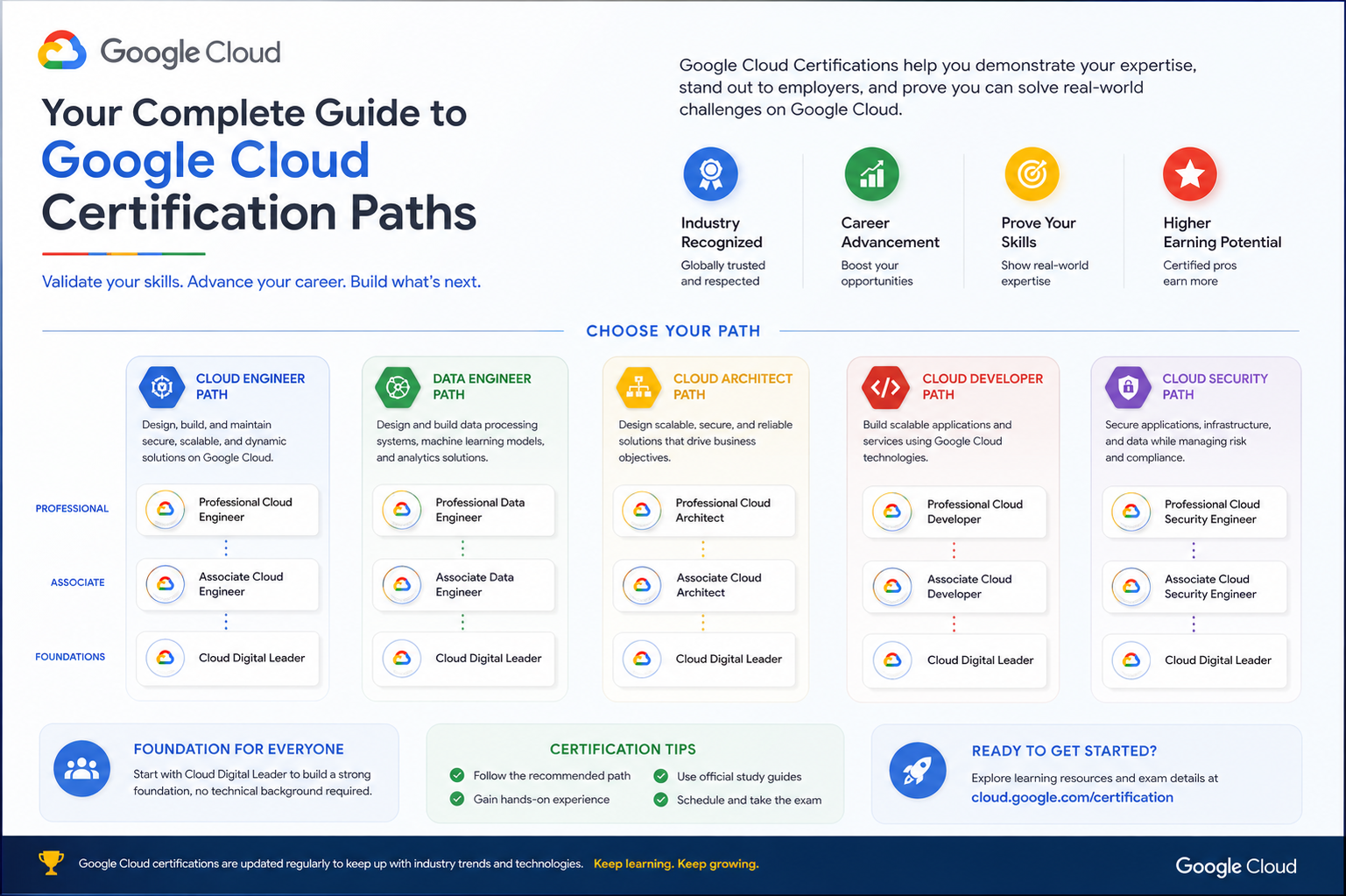
Google Cloud certifications are designed to help individuals systematically build cloud computing skills and validate their ability to work with modern cloud technologies. These certifications are not just about passing an exam but about developing real-world understanding of cloud infrastructure, services, and solutions that organizations use today. The certification paths are structured in a way that supports gradual learning, starting from basic concepts and progressing toward advanced technical expertise.
Importance of Google Cloud Certifications
Google Cloud certifications hold strong value in today’s technology-driven world because they reflect practical, job-ready skills. As more businesses move their operations to the cloud, there is a growing demand for professionals who can design, deploy, and manage cloud systems efficiently. These certifications help learners stand out by proving they understand both theoretical concepts and hands-on cloud applications.
Another important aspect is career mobility. Certified professionals often find better opportunities in roles related to cloud engineering, data engineering, cloud architecture, and security. The certifications act as a structured learning path, making it easier for individuals to grow step by step rather than trying to learn everything at once without direction.
Overview of the Certification Structure
The certification structure is designed in layers, allowing learners to progress according to their experience level. It generally starts with foundational knowledge, moves into associate-level practical skills, and then advances into professional-level expertise. Each stage builds on the previous one, ensuring that learners develop both confidence and capability over time.
This structure also ensures that individuals do not feel overwhelmed. Instead of jumping directly into complex systems, learners first understand the basics of cloud computing, then gradually move toward designing and managing real-world cloud solutions. This step-by-step approach makes the learning process more effective and sustainable.
Foundational Level Understanding
At the foundational stage, the focus is on introducing learners to the core principles of cloud computing. This includes understanding what cloud technology is, how cloud services are delivered, and why organizations rely on cloud infrastructure. Learners are also introduced to basic concepts such as compute resources, storage systems, and networking fundamentals.
This level is particularly useful for beginners who may not have prior experience in IT or cloud environments. It builds awareness of how cloud platforms operate and how they support modern applications. The goal is not deep technical mastery but rather a strong conceptual base that prepares learners for more advanced topics.
In addition to technical concepts, the foundational level also introduces learners to key ideas like cloud security basics and cost management principles. Understanding these areas early helps learners develop a more complete picture of how cloud systems function in real business environments.
Associate Level Skill Development
After building a foundation, learners move into the associate level, where practical skills become the main focus. At this stage, individuals begin working more directly with cloud tools and services. They learn how to configure resources, manage cloud environments, and implement solutions based on real-world requirements.
This level is important because it bridges the gap between theory and practice. Learners are expected to understand how different services work together and how to solve technical problems using cloud solutions. Hands-on experience becomes essential, as it helps reinforce the concepts learned at the foundational stage.
Typical tasks at this level may include deploying virtual machines, managing storage systems, configuring networks, and monitoring system performance. These activities help learners develop confidence in working with cloud platforms in a practical setting.
Developing Real-World Problem Solving Skills
One of the key goals at the associate level is to improve problem-solving ability. Cloud environments often require quick decision-making and efficient troubleshooting. Learners are trained to analyze issues, identify root causes, and apply appropriate solutions using cloud tools.
This stage also introduces the concept of scalability and reliability. Learners begin to understand how cloud systems handle large workloads and maintain performance under varying conditions. These concepts are essential for building efficient and stable applications in real-world environments.
Introduction to Cloud Roles and Responsibilities
As learners progress, they also start to understand different roles within cloud computing. For example, cloud engineers focus on building and maintaining infrastructure, while cloud developers work on creating applications that run on cloud platforms. Cloud administrators handle system management and operational tasks.
Understanding these roles helps learners identify career paths that align with their interests and strengths. It also provides clarity on how different professionals collaborate within cloud-based projects in organizations.
Transitioning Toward Advanced Learning
The shift from associate to professional level marks a significant step in the certification journey. At this point, learners are expected to have a solid understanding of cloud fundamentals and practical experience with cloud services. The focus now moves toward designing complex systems and optimizing performance at scale.
This transition requires deeper technical knowledge and the ability to work with large-scale architectures. Learners are introduced to advanced concepts such as distributed systems, high availability design, and automated deployment strategies. These topics are critical for managing enterprise-level cloud environments.
Importance of Hands-On Practice
Hands-on practice plays a crucial role throughout the entire certification journey, but it becomes especially important at higher levels. Working directly with cloud platforms helps learners understand how theoretical concepts are applied in real environments.
Practical experience also helps in building confidence. Many cloud concepts can seem complex when learned only through reading, but they become much clearer when applied in actual scenarios. This is why labs, simulations, and project-based learning are essential components of preparation.
Common Challenges Faced by Learners
Many learners face challenges during their certification journey, especially when transitioning from basic to more advanced topics. One common difficulty is understanding abstract cloud concepts without enough practical exposure. Another challenge is managing the wide range of services and tools available within cloud platforms.
Time management can also be an issue, especially for working professionals who are balancing study with other responsibilities. Consistency is key in overcoming these challenges. Regular practice and structured learning schedules can significantly improve progress.
Effective Preparation Strategies
Successful preparation for cloud certifications requires a balanced approach. Learners should focus on both theory and practice, ensuring they understand concepts while also applying them in real environments. Breaking down topics into smaller sections can make learning more manageable.
Another effective strategy is to build small projects that simulate real-world use cases. This helps reinforce learning and improves problem-solving skills. Reviewing mistakes and revisiting difficult topics also plays an important role in strengthening understanding.
Consistency is more important than intensity. Studying regularly, even for short periods, often produces better results than irregular long study sessions. Over time, this approach builds strong retention and deeper comprehension.
Building Confidence Through Experience
As learners gain more experience, their confidence in handling cloud systems naturally increases. This confidence is important not only for passing certification exams but also for performing effectively in real job roles.
Experience helps learners move beyond memorization and toward true understanding. Instead of simply recalling information, they begin to think critically about how systems work and how different components interact within cloud environments.
Long-Term Career Value of Certifications
Google Cloud certifications provide long-term value by supporting continuous career growth. As cloud technology continues to expand, professionals with validated skills remain in high demand. These certifications can open doors to roles in multiple industries, including technology, finance, healthcare, and retail.
They also support career flexibility. Certified professionals can move between roles such as development, operations, architecture, and data engineering depending on their interests and experience. This adaptability is a major advantage in a rapidly changing job market.
Continuous Improvement in Cloud Skills
Cloud computing is constantly evolving, which means learning does not stop after earning a certification. Professionals are encouraged to keep updating their knowledge and exploring new services and features as they are introduced.
Continuous improvement ensures that skills remain relevant and aligned with industry needs. It also allows professionals to take on more advanced responsibilities over time, contributing to long-term career development and growth.
Advancing Beyond Associate Level Understanding
After gaining solid hands-on experience at the associate level, learners naturally move toward deeper and more complex cloud concepts. This stage is less about learning how individual services work and more about understanding how entire systems are designed, connected, and optimized at scale. The focus shifts toward architecture, performance, reliability, and automation, which are essential for enterprise-level cloud solutions.
At this point, learners are expected to think like system designers rather than just users of cloud services. Instead of simply deploying resources, they begin to evaluate how different components interact, how failures are handled, and how systems can remain stable under heavy demand. This change in mindset is a major step in becoming a cloud professional.
Developing Architectural Thinking
Architectural thinking is one of the most important skills at advanced levels of cloud learning. It involves designing systems that are not only functional but also efficient, secure, and scalable. Learners start understanding how to choose the right services based on workload requirements rather than using tools randomly.
This includes decisions such as selecting the appropriate compute options, designing storage strategies, and planning network layouts that support performance and security. It also involves considering redundancy and failover mechanisms to ensure systems remain available even during failures.
At this stage, learners also begin to understand trade-offs. Every design decision has advantages and limitations, and cloud professionals must evaluate these carefully. For example, increasing performance may increase cost, while improving security may add complexity. Learning how to balance these factors is a key part of advanced cloud expertise.
Understanding Scalable System Design
Scalability is a core concept in cloud computing, and it becomes especially important at higher certification levels. Scalable systems are designed to handle increasing workloads without affecting performance or stability. This requires careful planning and the use of cloud-native principles.
Learners begin to understand horizontal and vertical scaling strategies, load balancing techniques, and distributed system design. These concepts allow systems to grow efficiently as user demand increases. The goal is to ensure that applications remain responsive and reliable even under heavy traffic.
Cloud environments provide tools that automatically manage scaling, but professionals must understand how and when to use these tools effectively. This includes setting rules for automatic scaling, monitoring system performance, and predicting usage patterns.
Reliability and High Availability Concepts
Reliability becomes a major focus at advanced stages of cloud learning. Systems must be designed in a way that minimizes downtime and ensures continuous availability. This is especially important for business-critical applications that cannot afford interruptions.
Learners explore concepts such as redundancy, failover systems, and multi-zone deployments. These strategies ensure that if one part of a system fails, another can take over without affecting users. High availability design is a key skill for cloud architects and engineers.
Understanding failure scenarios is also important. Instead of assuming systems will always work perfectly, professionals learn to design for failure. This mindset helps in building stronger and more resilient cloud architectures.
Security in Advanced Cloud Environments
Security becomes more complex and layered at higher certification levels. Instead of basic security principles, learners focus on advanced identity management, access control strategies, and data protection methods.
Cloud professionals must understand how to secure data both at rest and in transit. They also need to design systems that restrict access based on roles and responsibilities. Identity and access management becomes a critical part of system design.
In addition, security monitoring and threat detection are important aspects of cloud environments. Professionals must be able to identify unusual activity and respond quickly to potential threats. This requires both technical knowledge and awareness of security best practices.
Automation and Infrastructure Management
Automation is another key concept in advanced cloud learning. Instead of manually managing resources, professionals use automation tools to deploy, configure, and manage cloud infrastructure. This improves efficiency and reduces the chances of human error.
Infrastructure as code is an important idea at this level. It allows cloud environments to be defined using code, making them easier to replicate and manage. This approach also supports version control and consistency across different environments.
Automation also plays a role in monitoring and maintenance. Cloud systems can be configured to automatically respond to certain conditions, such as scaling resources or restarting services when needed. Understanding how to design these automated processes is essential for advanced cloud professionals.
Performance Optimization Techniques
As systems grow in size and complexity, performance optimization becomes increasingly important. Cloud professionals must ensure that applications run efficiently without unnecessary delays or resource usage.
This involves analyzing system behavior, identifying bottlenecks, and making improvements where needed. Techniques such as caching, load distribution, and query optimization are commonly used to enhance performance.
Monitoring tools play a key role in this process. They provide insights into system activity, allowing professionals to make informed decisions about optimization strategies. Continuous performance tuning is often required in dynamic cloud environments.
Data Management and Processing at Scale
Advanced cloud certifications also involve working with large volumes of data. Professionals must understand how to store, process, and analyze data efficiently in cloud environments.
This includes working with structured and unstructured data, as well as understanding data pipelines and processing workflows. Data consistency, availability, and durability are key considerations when designing storage systems.
Cloud platforms offer specialized tools for data processing, and professionals must learn how to integrate these tools into larger systems. The goal is to ensure that data can be accessed and processed quickly and reliably, even at large scales.
Networking in Cloud Architecture
Networking is another critical area in advanced cloud learning. Cloud networks are more complex than traditional networks because they involve virtual environments, distributed systems, and global connectivity.
Professionals must understand how to design secure and efficient network architectures. This includes setting up virtual networks, managing traffic flow, and ensuring secure communication between services.
Network performance can significantly impact application behavior, so understanding latency, bandwidth, and routing is essential. Cloud networking also involves hybrid and multi-cloud scenarios, where systems operate across different environments.
Monitoring and Operational Management
Monitoring is essential for maintaining healthy cloud systems. Professionals must be able to track system performance, detect issues early, and respond quickly to incidents.
Cloud environments provide various monitoring tools that collect metrics, logs, and alerts. Understanding how to interpret this data is a key skill for cloud engineers and architects.
Operational management also includes maintaining system stability, performing updates, and ensuring compliance with organizational policies. These responsibilities require both technical knowledge and strong attention to detail.
Real-World Application of Cloud Skills
At advanced stages, learners begin applying their skills to real-world scenarios. This includes designing systems for businesses, optimizing existing cloud environments, and solving complex technical challenges.
Practical application is essential because it helps bridge the gap between learning and professional work. Real-world scenarios often involve unpredictable challenges that require critical thinking and adaptability.
Working on projects also helps learners build a portfolio of experience, which can be valuable for career advancement. It demonstrates the ability to apply knowledge effectively in professional environments.
Building Professional Confidence
As learners gain more advanced skills, their confidence in handling cloud systems continues to grow. They become more comfortable making design decisions, solving technical problems, and managing complex environments.
This confidence is important because cloud roles often require independent thinking and responsibility. Professionals are expected to make decisions that can impact system performance, security, and reliability.
With experience, learners also become more efficient in identifying solutions and implementing improvements. This ability to work independently is a key trait of successful cloud professionals.
Preparing for Professional-Level Certifications
The transition toward professional-level certifications requires focused preparation. Learners must strengthen their understanding of advanced topics and gain more practical experience with cloud systems.
Preparation at this stage often involves working on complex projects, studying architectural patterns, and reviewing real-world case studies. The goal is to develop a deep understanding of how large-scale systems are designed and maintained.
Consistency and practice remain important, but the emphasis shifts toward problem-solving and system design thinking. Learners are expected to analyze scenarios and choose the best possible solutions based on requirements.
Long-Term Growth in Cloud Careers
Advanced cloud learning opens the door to long-term career growth in technology fields. Professionals with strong cloud skills are often involved in designing critical systems and supporting digital transformation initiatives.
As organizations continue to expand their use of cloud technologies, the demand for skilled professionals continues to grow. This creates opportunities for career advancement, specialization, and leadership roles in cloud-related fields.
Continuous learning remains essential, as cloud technologies evolve rapidly. Staying updated with new tools, services, and best practices ensures long-term success and relevance in the industry.
Deep Dive into Professional-Level Google Cloud Expertise
At the professional level, Google Cloud certifications move beyond general system understanding and focus heavily on advanced architecture, enterprise-scale design, and strategic decision-making. This stage is intended for individuals who already have significant hands-on experience and are ready to take ownership of complex cloud environments. The emphasis is no longer just on using services but on designing solutions that meet business goals, technical constraints, and long-term scalability requirements.
Professionals at this stage are expected to think in terms of complete ecosystems rather than isolated components. Every decision they make impacts performance, cost, reliability, and security across an entire organization’s cloud infrastructure. This is where cloud computing becomes both a technical and strategic discipline.
Enterprise Architecture and System Design Mastery
One of the core areas at the professional level is enterprise architecture. This involves designing large-scale systems that support thousands or even millions of users while maintaining stability and efficiency. Professionals must understand how to build systems that can evolve over time without requiring complete redesigns.
Architectural decisions often include selecting between different compute models, designing multi-region deployments, and planning hybrid or multi-cloud strategies. These systems must be resilient enough to handle failures while maintaining seamless user experience. The ability to visualize how all components interact is essential for success at this level.
A strong focus is placed on modular design. Systems are built in a way that allows individual components to be updated or replaced without disrupting the entire architecture. This flexibility is crucial for organizations that need to adapt quickly to changing business needs or technological advancements.
Strategic Decision-Making in Cloud Solutions
At the professional stage, decision-making goes beyond technical correctness and includes business alignment. Cloud professionals must evaluate how their architectural choices impact cost efficiency, operational performance, and organizational goals.
For example, choosing between managed services and custom-built solutions involves trade-offs between control, flexibility, and maintenance effort. Professionals must be able to justify these decisions clearly based on both technical and business requirements.
Cost optimization also becomes a major responsibility. Cloud resources must be used efficiently to avoid unnecessary spending while still maintaining high performance and reliability. This requires continuous analysis and adjustment of system usage patterns.
Advanced Security Architecture
Security at the professional level is significantly more complex than at earlier stages. It is no longer limited to basic access control but extends to designing secure systems from the ground up. Professionals must ensure that every layer of the architecture follows strict security principles.
This includes identity-based access management, encryption strategies, secure communication channels, and detailed audit logging. Security must be embedded into the architecture rather than added as an afterthought.
Zero-trust architecture becomes an important concept at this level. It assumes that no part of the system is automatically trusted, even within internal networks. Every request must be verified, authenticated, and authorized before access is granted.
Professionals are also responsible for ensuring compliance with industry regulations and organizational policies. This requires a deep understanding of governance frameworks and security standards.
Cloud Infrastructure Automation at Scale
Automation becomes a critical skill in professional cloud environments. Managing large-scale infrastructure manually is inefficient and prone to errors, so professionals rely heavily on automated systems for deployment, configuration, and maintenance.
Infrastructure as code plays a central role in this process. It allows entire environments to be defined using structured templates, making them easier to replicate and manage consistently. This approach also supports version control, enabling teams to track changes and roll back when necessary.
Automated pipelines are used to deploy applications and infrastructure updates efficiently. These pipelines ensure that changes are tested, validated, and implemented in a controlled manner. This reduces downtime and improves system reliability.
High-Performance System Optimization
At the professional level, performance optimization becomes more sophisticated. It is not just about improving speed but about ensuring consistent performance under varying workloads and conditions.
Professionals analyze system metrics to identify inefficiencies and bottlenecks. They use advanced monitoring tools to gain insights into how systems behave under different scenarios. Based on this data, they implement improvements in architecture, configuration, or resource allocation.
Caching strategies, distributed processing, and load balancing techniques are commonly used to improve performance. However, the choice of optimization method depends heavily on the specific requirements of the system.
Large-Scale Data Engineering and Analytics
Data plays a central role in modern cloud environments, and professionals are often responsible for designing systems that handle massive volumes of information. This includes data ingestion, processing, storage, and analysis.
At this level, data pipelines must be highly efficient and scalable. They need to process both real-time and batch data while maintaining accuracy and reliability. Professionals must also ensure that data is structured in a way that supports business intelligence and analytics.
Data governance becomes increasingly important. This includes managing data quality, ensuring compliance, and controlling access to sensitive information. Proper data management is essential for making informed business decisions.
Advanced Networking and Hybrid Cloud Systems
Networking at the professional level involves designing complex systems that connect multiple environments, including on-premises infrastructure and cloud platforms. Hybrid cloud architectures are common in large organizations, requiring seamless integration between different systems.
Professionals must understand advanced networking concepts such as virtual private networks, interconnect solutions, traffic routing strategies, and latency optimization. These elements ensure secure and efficient communication across distributed systems.
Network design also plays a key role in performance and reliability. Poorly designed networks can lead to bottlenecks, security risks, and system failures. Therefore, careful planning and continuous monitoring are essential.
Reliability Engineering and Fault Tolerance
Reliability engineering is a major responsibility at the professional level. Systems must be designed to continue operating even when components fail. This requires a deep understanding of fault tolerance and redundancy strategies.
Professionals implement multi-zone and multi-region architectures to ensure high availability. If one region experiences issues, traffic can be redirected to another without affecting users. This level of resilience is critical for mission-critical applications.
Disaster recovery planning is also an essential part of reliability engineering. Professionals must ensure that systems can be restored quickly in the event of major failures, minimizing downtime and data loss.
Operational Excellence and System Governance
Operational excellence involves maintaining systems in a stable, efficient, and well-managed state. Professionals are responsible for ensuring that cloud environments run smoothly on a daily basis while meeting performance and security standards.
This includes monitoring system health, managing updates, handling incidents, and enforcing organizational policies. Governance frameworks help ensure that resources are used appropriately and consistently across teams.
Documentation and process standardization are also important. Clear guidelines help teams work efficiently and reduce the risk of misconfiguration or errors.
Real-World Enterprise Problem Solving
At this stage, cloud professionals are often involved in solving complex enterprise-level problems. These challenges may include migrating large-scale systems to the cloud, optimizing existing architectures, or designing entirely new platforms.
Each problem requires a tailored approach based on business needs, technical constraints, and available resources. Professionals must be able to analyze situations deeply and propose effective, scalable solutions.
Collaboration is also important, as cloud projects often involve multiple teams, including developers, security specialists, and business stakeholders. Clear communication ensures that solutions align with overall organizational goals.
Leadership and Technical Responsibility
Professional-level cloud roles often come with leadership responsibilities. Individuals are expected to guide technical teams, make architectural decisions, and influence the direction of cloud strategies within organizations.
This requires not only technical expertise but also strong communication and decision-making skills. Professionals must be able to explain complex concepts in simple terms to non-technical stakeholders.
They also play a key role in mentoring others, sharing knowledge, and helping teams adopt best practices. This contributes to overall organizational growth and technical maturity.
Long-Term Impact of Professional Certification
Achieving professional-level certification represents a significant milestone in a cloud career. It demonstrates the ability to handle complex systems and make high-impact decisions in real-world environments.
This level of expertise often leads to senior roles such as cloud architect, senior engineer, or technical lead. These positions involve greater responsibility and influence within organizations.
Beyond career advancement, professional certification also supports continuous learning. Cloud technology evolves rapidly, and professionals must stay updated to remain effective in their roles.
Evolving with Cloud Technology Trends
The cloud industry is constantly changing, with new tools, services, and methodologies emerging regularly. Professionals must continuously adapt to these changes to maintain their expertise.
This includes learning about emerging technologies such as artificial intelligence integration, serverless computing, and advanced automation frameworks. Staying current ensures that solutions remain efficient and competitive.
Continuous evolution is a defining characteristic of successful cloud professionals. Those who embrace learning and adaptation are best positioned for long-term success in the field.
Specialized Google Cloud Certification Areas
Beyond general associate and professional certifications, Google Cloud also offers specialized paths that focus on specific technical domains. These are designed for individuals who want to deepen their expertise in targeted areas such as data engineering, cloud security, networking, machine learning, and DevOps practices.
Specializations are important because modern cloud systems are not limited to general infrastructure anymore. Organizations require experts who can solve highly specific problems and optimize advanced workloads. For example, a data engineer focuses on building scalable pipelines for processing large datasets, while a security engineer ensures that cloud environments remain protected against evolving threats.
Each specialization requires a strong understanding of both core cloud concepts and domain-specific knowledge. This combination makes professionals highly valuable because they can address complex challenges that generalists may not be equipped to handle.
Understanding the Data Engineering Path
Data engineering is one of the most in-demand specialization areas in cloud computing. It focuses on designing systems that collect, transform, and analyze large volumes of data efficiently.
Professionals in this field work with data pipelines, storage systems, and analytics tools to ensure that data flows smoothly across different stages. They are responsible for making data accessible, reliable, and ready for business use.
This role requires strong knowledge of distributed systems, database management, and data processing frameworks. The ability to design scalable pipelines is essential because data volumes continue to grow rapidly across industries.
Cloud Security Specialization Focus
Security specialization is another critical area within cloud certification paths. As organizations move more sensitive workloads to the cloud, protecting data and systems becomes increasingly important.
Cloud security professionals focus on identity management, access control, encryption, and threat detection. They design systems that prevent unauthorized access while ensuring legitimate users can operate efficiently.
A key part of this role is understanding compliance requirements. Different industries have strict rules about how data must be stored and protected. Security specialists ensure that cloud systems meet these standards without compromising performance.
Networking Specialization in Cloud Environments
Networking specialization focuses on designing and managing complex cloud networks. These professionals ensure that systems can communicate efficiently and securely across different environments.
They work with virtual networks, routing systems, load balancers, and hybrid connectivity solutions. Their goal is to create network architectures that are fast, reliable, and scalable.
In large organizations, networking experts often deal with global systems that connect multiple regions and data centers. This requires deep technical understanding and careful planning to avoid latency and performance issues.
Machine Learning and AI in Cloud Platforms
Machine learning specialization focuses on building intelligent systems that can analyze data and make predictions. Cloud platforms provide powerful tools that allow developers to train, deploy, and manage machine learning models at scale.
Professionals in this area work with large datasets, model training pipelines, and prediction systems. They must understand both data science principles and cloud infrastructure concepts.
This specialization is becoming increasingly important as organizations adopt artificial intelligence to improve decision-making, automate processes, and enhance customer experiences.
DevOps and Automation Expertise
DevOps specialization focuses on improving collaboration between development and operations teams. It emphasizes automation, continuous integration, and continuous deployment practices.
Professionals in this area design pipelines that allow software to be developed, tested, and deployed quickly and reliably. Automation reduces manual effort and improves consistency across environments.
This role also involves monitoring system performance and ensuring that applications remain stable after deployment. DevOps engineers play a key role in maintaining operational efficiency in cloud environments.
Effective Preparation Strategies for Certification Success
Preparing for Google Cloud certifications requires a structured and disciplined approach. Simply reading material is not enough; practical experience is essential for success.
One effective strategy is to break down learning into manageable sections and focus on one topic at a time. This prevents overload and improves understanding. Consistent daily practice is more effective than irregular study sessions.
Hands-on labs are also extremely valuable. They allow learners to apply concepts in real environments, which helps reinforce theoretical knowledge. Working directly with cloud tools builds confidence and problem-solving ability.
Importance of Practice-Based Learning
Cloud computing is a practical field, and certification exams often test real-world scenarios rather than memorized facts. This is why practice-based learning is so important.
Building small projects helps learners understand how different services work together. For example, creating a simple web application on the cloud can teach concepts related to storage, compute, networking, and security all at once.
Experimenting with different configurations also helps learners understand cause-and-effect relationships within cloud systems. This type of learning is much more effective than passive reading.
Common Mistakes During Preparation
Many learners make the mistake of focusing only on theory without enough hands-on experience. This can lead to difficulty when faced with scenario-based exam questions.
Another common mistake is trying to learn too many topics at once. Cloud computing is broad, and attempting to cover everything quickly often leads to confusion. A focused and step-by-step approach works better.
Ignoring real-world use cases is also a problem. Understanding how cloud systems are used in actual businesses helps connect theory with practical application.
Exam Readiness and Time Management
Time management plays an important role in certification success. During exams, learners must be able to analyze questions quickly and choose the best possible solution.
Practicing under timed conditions helps improve speed and accuracy. It also reduces stress during the actual exam.
Understanding question patterns is equally important. Many questions are scenario-based and require careful analysis rather than direct answers. Developing this skill comes from consistent practice and exposure to different problem types.
Building a Strong Cloud Portfolio
A strong portfolio is one of the best ways to demonstrate cloud skills. It shows practical experience and problem-solving ability beyond certification exams.
Projects included in a portfolio can range from simple applications to complex system designs. The key is to demonstrate understanding of cloud services and architecture principles.
A well-documented portfolio helps in job applications and interviews. It provides proof of real-world experience and technical capability.
Career Opportunities in Cloud Computing
Cloud certifications open doors to a wide range of career opportunities. These include roles such as cloud engineer, solutions architect, data engineer, security specialist, and DevOps engineer.
Each role has its own responsibilities, but all require strong understanding of cloud platforms and services. As organizations continue to adopt cloud technologies, demand for skilled professionals continues to grow.
Cloud careers also offer flexibility. Professionals can move between different roles as they gain experience and explore new areas of interest.
Industry Demand and Skill Relevance
The demand for cloud skills is increasing across industries such as finance, healthcare, retail, and technology. Organizations are shifting from traditional infrastructure to cloud-based systems to improve efficiency and scalability.
This shift creates continuous demand for certified professionals who can design, manage, and optimize cloud environments. Skills remain relevant for many years due to the ongoing expansion of cloud technology.
Staying updated with new tools and services ensures long-term relevance in the industry. Continuous learning is essential for maintaining competitiveness.
Long-Term Skill Development Strategy
Cloud computing is not a one-time learning field. It requires continuous improvement and adaptation to new technologies. Professionals must regularly update their knowledge to stay effective.
A long-term strategy includes revisiting core concepts, practicing new tools, and exploring advanced topics over time. This ensures steady growth and deeper understanding.
Engaging with real-world projects and staying active in learning environments helps maintain skill sharpness and technical confidence.
Building Confidence Through Experience
Confidence in cloud computing comes from consistent practice and real-world exposure. As learners work on more projects and solve more problems, their ability to handle complex systems improves naturally.
This confidence is important in professional roles where decisions impact system performance and business outcomes. Experience helps professionals make informed and effective choices.
Over time, cloud professionals develop strong analytical and technical thinking skills that allow them to approach problems systematically.
Future of Cloud Certification Paths
Cloud certification paths continue to evolve as technology advances. New services, tools, and methodologies are regularly introduced to meet industry needs.
Future learning paths are expected to focus more on automation, artificial intelligence integration, and advanced security systems. Professionals will need to adapt to these changes to remain relevant.
The overall direction of cloud computing is toward more intelligent, automated, and scalable systems. Certification paths will continue to reflect these trends, ensuring that professionals are prepared for future challenges.
Conclusion
Google Cloud certification paths provide a structured and progressive way to build real-world cloud computing expertise. Starting from foundational concepts and moving through associate and professional levels, each stage is designed to strengthen both theoretical understanding and practical skills. This gradual progression ensures that learners develop confidence step by step rather than being overwhelmed by advanced topics too early.
As learners advance, they gain deeper knowledge in system design, scalability, security, networking, automation, and data management. These skills are not only important for passing certification exams but are also essential for working effectively in real cloud environments. The ability to design, manage, and optimize cloud systems becomes a key professional advantage.
Specialized certifications further allow individuals to focus on specific domains such as data engineering, security, machine learning, networking, and DevOps. This specialization helps professionals align their skills with industry demands and career goals, making them more valuable in competitive job markets.
Overall, Google Cloud certification paths are more than just learning milestones; they represent a continuous journey of skill development and career growth. With consistent practice, hands-on experience, and ongoing learning, individuals can build strong expertise that remains relevant in the rapidly evolving cloud computing industry.