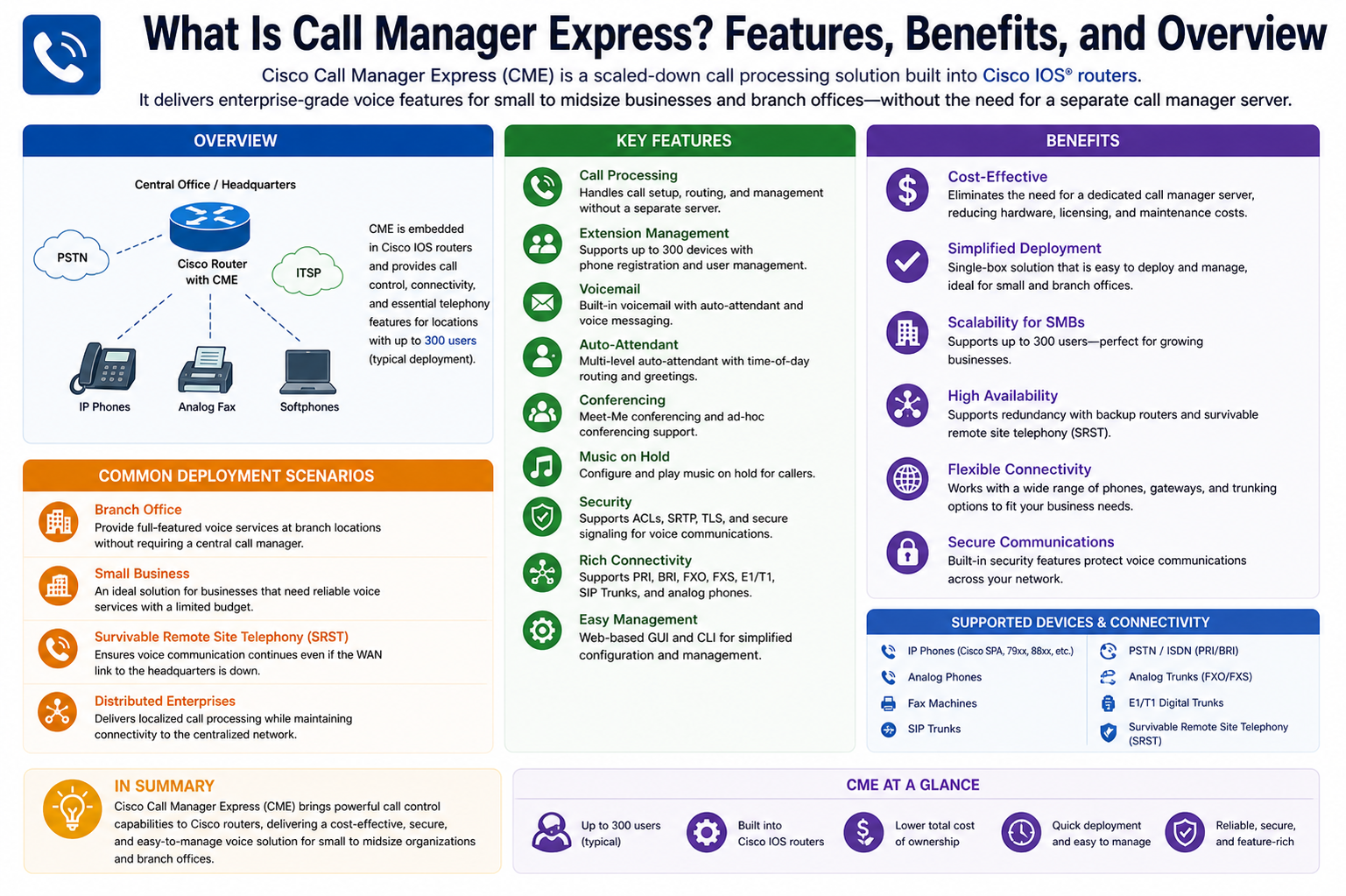
Call Manager Express is a built-in voice processing and call control solution designed for Cisco Integrated Services Routers. It provides essential telephony services for small to medium-sized organizations that need reliable voice communication without deploying a full-scale call management server. It enables IP-based voice communication by allowing phones to register directly with the router, which then handles call routing, signaling, and basic telephony features within a local network environment. This makes it a cost-effective and efficient solution for businesses that require stable internal communication systems with simplified infrastructure.
Architecture of Call Manager Express
The architecture of Call Manager Express is based on a router-centric model where the Cisco router acts as both the network device and the call control agent. Unlike centralized enterprise systems, this model keeps voice processing within the local network, reducing dependency on external servers. The router runs specialized software that manages IP phone registrations, call signaling, and feature execution. This integrated approach simplifies deployment and reduces hardware requirements while maintaining core telephony functionality.
The system typically consists of IP phones, a Cisco router with voice capabilities, optional voice gateways for PSTN connectivity, and optional voicemail systems. IP phones communicate directly with the router using signaling protocols, while the router handles all call processing tasks. This architecture is especially useful in branch offices or small organizations where simplicity and cost control are priorities.
Call Control and Signaling Protocols
Call Manager Express supports multiple signaling protocols to ensure compatibility with different types of IP phones and communication systems. The most commonly used protocols include SCCP (Skinny Client Control Protocol) and SIP (Session Initiation Protocol). SCCP is a lightweight Cisco proprietary protocol that allows tight integration between IP phones and the router, while SIP is an open-standard protocol widely used in modern VoIP systems.
These protocols handle the exchange of call setup information, call teardown, and feature activation. The router interprets these signals and manages call sessions accordingly. This ensures smooth communication between devices and maintains consistent call quality across the network.
Core Features of Call Manager Express
Call Manager Express provides a wide range of essential voice communication features that support daily business operations. It includes call forwarding, call transfer, call hold, call park, and call pickup functionalities. These features allow users to manage incoming and outgoing calls efficiently within an organization.
It also supports conferencing capabilities, enabling multiple participants to join a single call. This is particularly useful for internal meetings and collaborative discussions. Additionally, it provides automated attendant services that help route calls to the appropriate extensions based on user input.
Voicemail integration is another important feature, allowing users to receive voice messages when they are unavailable. The system also supports speed dial configurations, intercom functionality, and basic call queuing, making it a comprehensive solution for small-scale communication needs.
Dial Plan and Call Routing
A critical component of Call Manager Express is its dial plan configuration. The dial plan defines how calls are routed within the system and how different extensions and external numbers are handled. It determines the structure of phone numbers, call patterns, and routing rules.
Call routing in Call Manager Express is managed locally by the router. When a user dials a number, the system analyzes the dial plan and determines whether the call should remain internal or be routed to an external network such as PSTN. This ensures efficient call handling and reduces unnecessary network traffic.
The flexibility of dial plan configuration allows administrators to customize numbering schemes based on organizational requirements. This is particularly useful for businesses with multiple departments or locations.
Deployment and Configuration Process
Deploying Call Manager Express involves configuring the Cisco router to support voice services and registering IP phones to the system. The process begins with enabling voice functionality on the router, followed by setting up IP addressing, VLAN segmentation for voice traffic, and protocol selection for phone communication.
Once the basic setup is complete, IP phones are connected to the network and automatically or manually registered with the router. Each phone is assigned an extension number, which allows it to participate in the internal communication system.
Administrators then configure call features, dial plans, and routing rules based on business requirements. The system is designed to be relatively straightforward compared to large-scale enterprise solutions, making it suitable for IT environments with limited resources.
Integration with Voice Gateways and PSTN
Call Manager Express can be integrated with voice gateways to enable communication between IP-based systems and traditional telephone networks. This allows businesses to connect to PSTN (Public Switched Telephone Network) for external calls.
The router manages the conversion between VoIP and traditional telephony signals, ensuring seamless communication between internal users and external contacts. This integration is essential for organizations that still rely on conventional phone lines for external communication.
Voice gateways also help manage call quality and routing efficiency by directing traffic through the most appropriate channels based on configuration rules.
Security in Call Manager Express
Security is an important aspect of Call Manager Express, especially since it handles voice traffic over IP networks. The system includes authentication mechanisms to ensure that only authorized devices can register with the router. IP phones must be properly configured and verified before they are allowed to participate in the network.
Encryption protocols can also be used to protect voice data during transmission. This helps prevent unauthorized access and ensures privacy in business communications. Additionally, network segmentation through VLANs is often implemented to isolate voice traffic from general data traffic, improving both performance and security.
Performance and Reliability
Call Manager Express is designed to provide reliable voice communication within small to medium-sized environments. Since it operates locally on a router, it reduces dependency on external servers and minimizes latency. This results in faster call setup times and improved voice quality.
However, its performance is limited by the processing capacity of the router. As a result, it is best suited for environments with a moderate number of users and calls. For larger organizations, more advanced solutions may be required to handle higher call volumes.
Despite these limitations, Call Manager Express is highly reliable when deployed within its intended scope. It is widely used in branch offices where consistent and stable communication is essential.
Scalability and Limitations
While Call Manager Express offers flexibility and ease of deployment, it has certain scalability limitations. It is designed for smaller environments and may not support very large numbers of users or complex call routing requirements. The number of supported IP phones and concurrent calls depends on the router model and available resources.
As organizations grow, they may eventually need to transition to more advanced systems that offer centralized management and higher scalability. However, within its intended range, Call Manager Express provides a stable and efficient communication platform.
Troubleshooting and Maintenance
Maintaining Call Manager Express involves monitoring system performance, verifying phone registrations, and ensuring proper configuration of dial plans and routing rules. Common issues may include registration failures, call drops, or misconfigured extensions.
Troubleshooting typically involves checking network connectivity, verifying IP configurations, and reviewing router logs for errors. Proper documentation and structured configuration practices help reduce the likelihood of issues and simplify maintenance.
Regular updates to router firmware and configuration backups are also important to ensure system stability and recovery in case of failures.
Use Cases of Call Manager Express
Call Manager Express is commonly used in small offices, remote branch locations, retail stores, and educational institutions. It is ideal for environments that require internal communication systems without the complexity of enterprise-level infrastructure.
It is particularly useful for organizations that already use Cisco networking equipment, as it integrates seamlessly into existing setups. Businesses that prioritize cost efficiency and simplicity often choose this solution for their voice communication needs.
Advanced Features of Call Manager Express
Call Manager Express also includes several advanced features that enhance its functionality beyond basic telephony services. These features are designed to improve communication efficiency and provide users with more control over their calling experience. One of the key advanced capabilities is call forwarding based on different conditions such as busy lines, no answer, or unreachable extensions. This ensures that important calls are never missed and are redirected appropriately within the organization.
Another important feature is call park and call retrieve, which allows users to place a call on hold at one extension and retrieve it from another. This is particularly useful in office environments where employees move between different locations. The system also supports intercom functionality, enabling instant communication between predefined extensions without the need for dialing full numbers.
Call Manager Express also supports music on hold, which plays audio to callers while they wait. This improves the caller experience and gives a more professional impression of the organization. Additionally, it allows customized greetings and announcements through the auto-attendant feature, helping to guide callers to the correct department or extension.
Voicemail and Messaging Integration
Voicemail is an essential component of Call Manager Express, allowing users to receive and manage voice messages when they are unavailable to answer calls. The system can integrate with external voicemail solutions or built-in Cisco voicemail systems depending on the configuration.
When a call is not answered, the system automatically redirects it to voicemail, where the caller can leave a message. Users can then access their voicemail through their IP phone, email integration, or remote access methods. This ensures that communication is not interrupted even when users are offline or busy.
Some configurations also allow voicemail-to-email functionality, where voice messages are converted into audio files and sent directly to the user’s email inbox. This improves accessibility and ensures that messages can be reviewed from multiple devices.
Quality of Service (QoS) in Call Manager Express
Quality of Service plays a critical role in ensuring clear and uninterrupted voice communication. Call Manager Express relies on QoS mechanisms to prioritize voice traffic over other types of network data. This ensures that voice packets are transmitted with minimal delay, jitter, and packet loss.
QoS settings are typically configured on the Cisco router to classify and prioritize voice traffic. This includes marking voice packets with high priority and allocating sufficient bandwidth for real-time communication. By doing so, the system maintains consistent call quality even in networks with heavy data usage.
Without proper QoS configuration, users may experience issues such as poor audio quality, echo, or delayed conversations. Therefore, QoS is an essential part of any Call Manager Express deployment.
Network Design Considerations
Designing a network for Call Manager Express requires careful planning to ensure optimal performance. Voice traffic should be separated from data traffic using VLANs (Virtual Local Area Networks). This separation helps reduce congestion and improves security by isolating voice communication.
Proper IP addressing schemes must also be implemented to ensure smooth communication between devices. DHCP can be used to automatically assign IP addresses to phones, while static configurations may be used for critical devices.
Bandwidth planning is another important factor. Since voice communication is sensitive to delays, sufficient bandwidth must be allocated to support concurrent calls. Network administrators must also consider redundancy and failover mechanisms to maintain communication in case of hardware or network failures.
Device Registration and Management
In Call Manager Express, IP phones must register with the router before they can be used for communication. This registration process involves authentication and configuration exchange between the phone and the system.
Each phone is assigned a unique extension number, which is used for internal calling. Administrators can manage these devices through command-line interface (CLI) or graphical configuration tools provided by Cisco systems.
Device management includes adding new phones, updating configurations, and removing inactive devices. Proper management ensures that the system remains organized and functions efficiently as the organization grows.
Call Routing to External Networks
Call Manager Express is capable of routing calls to external networks such as PSTN through integrated voice gateways. This allows users to make and receive external calls using traditional telephone networks.
The router determines whether a call should remain internal or be routed externally based on dial plan rules. When an external call is detected, it is forwarded to the voice gateway, which converts the VoIP signal into a format compatible with PSTN.
This integration ensures that organizations can maintain connectivity with external clients, partners, and customers while still using an IP-based internal communication system.
Security Enhancements and Access Control
Security in Call Manager Express is strengthened through multiple layers of protection. Access control lists (ACLs) are used to restrict unauthorized access to the system. Only trusted devices and IP addresses are allowed to communicate with the router.
Authentication mechanisms ensure that only registered IP phones can connect to the system. This prevents unauthorized devices from accessing voice services. In some deployments, encryption protocols such as Secure RTP (SRTP) are used to protect voice traffic during transmission.
Network administrators also implement monitoring tools to detect unusual activity and prevent potential security threats. These measures help maintain the integrity and confidentiality of voice communication.
System Monitoring and Diagnostics
Monitoring Call Manager Express is essential for maintaining system health and performance. Administrators use diagnostic commands and monitoring tools to track call activity, device status, and network performance.
Logs generated by the router provide valuable information about system events, errors, and call details. These logs help identify issues such as failed registrations, call drops, or configuration errors.
Real-time monitoring allows administrators to quickly respond to problems and ensure minimal disruption to communication services. Regular diagnostics also help in optimizing system performance and identifying potential upgrades.
Scalability Planning for Growing Businesses
While Call Manager Express is designed for smaller environments, it can still support gradual growth if properly planned. Organizations can add new IP phones, extensions, and features as needed within the limits of the router’s capacity.
However, scalability is dependent on hardware resources such as CPU, memory, and voice processing capabilities. As the number of users increases, performance must be carefully monitored to avoid degradation in call quality.
For businesses experiencing rapid growth, migration strategies to larger unified communication systems may be considered in the future. However, within its scope, Call Manager Express provides a flexible foundation for expanding communication needs.
Common Challenges and Limitations
Despite its advantages, Call Manager Express has certain limitations that must be considered. One of the main challenges is its dependency on router hardware, which limits scalability and processing power. It is not suitable for very large enterprises with high call volumes.
Another limitation is its relatively basic feature set compared to advanced unified communication platforms. While it covers essential telephony functions, it may lack advanced collaboration tools found in enterprise systems.
Configuration complexity can also be a challenge for beginners, as it requires knowledge of networking, voice protocols, and Cisco command-line interface. Proper training is often needed for effective deployment and management.
Best Practices for Implementation
Successful implementation of Call Manager Express requires following best practices in network design and configuration. Proper VLAN segmentation should always be used to separate voice and data traffic. QoS should be enabled to ensure high call quality.
Regular backups of configuration files are essential to prevent data loss in case of system failure. Administrators should also keep firmware updated to ensure compatibility and security improvements.
Documentation of dial plans, extensions, and configurations helps in troubleshooting and system management. Additionally, continuous monitoring ensures that performance remains stable over time.
Call Manager Express Deployment Models
Call Manager Express can be deployed in different models depending on the size of the organization and its communication requirements. The most common deployment model is the standalone branch office setup, where a single Cisco router handles all voice services for a small location. In this model, IP phones register directly with the router, and all call processing is handled locally without reliance on external call control systems.
Another deployment model involves multi-site environments where each branch office runs its own instance of Call Manager Express. These sites can be interconnected using WAN links, allowing internal communication between different locations. This approach is useful for organizations with distributed teams that still require localized control over their voice systems.
Hybrid deployment is also possible, where Call Manager Express operates alongside other Cisco unified communication systems. In such cases, CME handles local call processing while integrating with centralized systems for advanced features like enterprise-wide directory services or global call routing.
Integration with Data Networks
Call Manager Express operates within an IP-based infrastructure, making it highly dependent on proper data network design. Voice traffic shares the same physical network as data traffic but is logically separated to ensure performance and stability.
Integration with data networks requires careful planning of routing protocols, switching configurations, and bandwidth allocation. Since voice communication is sensitive to delay, even minor network inefficiencies can affect call quality. Therefore, network design must prioritize low latency and minimal packet loss.
Switches used in CME environments often support Power over Ethernet (PoE), which allows IP phones to receive both power and data through a single cable. This simplifies installation and reduces hardware complexity.
Role of IP Phones in Call Manager Express
IP phones are the primary endpoints in a Call Manager Express system. They act as communication devices that register with the router and enable users to make and receive calls. Each IP phone is assigned a unique extension number that identifies it within the system.
These phones communicate with the router using signaling protocols and rely on it for call control functions. Once registered, they can access features such as call hold, transfer, voicemail, and conferencing.
Modern IP phones used with Call Manager Express often include additional capabilities such as display screens, programmable buttons, and directory access. These features enhance usability and improve overall user experience in business environments.
Configuration of Extensions and Directory Numbers
Extensions, also known as directory numbers, are a fundamental part of Call Manager Express configuration. Each user or device is assigned a unique extension that allows internal communication within the organization.
The configuration of extensions involves defining numbering patterns, assigning devices, and linking features such as voicemail and call forwarding. Administrators must ensure that numbering schemes are logical and scalable to accommodate future growth.
Directory numbers also play a key role in call routing decisions. When a call is placed, the system uses these numbers to determine the destination and apply appropriate dial plan rules.
Call Admission Control and Bandwidth Management
Call Admission Control (CAC) is an important mechanism used in Call Manager Express to manage network resources efficiently. It ensures that the number of active calls does not exceed the available bandwidth, preventing network congestion and maintaining call quality.
When bandwidth limits are reached, CAC may block additional calls or reroute them through alternative paths. This prevents degradation of existing calls and ensures stable communication across the network.
Bandwidth management is closely tied to CAC and involves monitoring and controlling how much network capacity is allocated to voice traffic. Proper configuration ensures that voice services remain reliable even during peak usage periods.
Redundancy and Failover Mechanisms
Although Call Manager Express is typically deployed in smaller environments, redundancy is still an important consideration. Basic failover mechanisms can be implemented to ensure continuity of service in case of router failure or network issues.
One common approach is to configure secondary routers or backup call agents that take over in case the primary system becomes unavailable. IP phones can be configured with multiple server addresses to support automatic failover.
Redundant power supplies and backup network links can also be used to improve system reliability. These measures help minimize downtime and ensure continuous communication services.
Customization and Feature Configuration
Call Manager Express allows administrators to customize various features based on organizational requirements. This includes configuring call behavior, setting up automated responses, and defining user-specific settings.
Auto-attendant menus can be customized to guide callers through different options, such as reaching specific departments or individuals. Ring patterns, call durations, and forwarding rules can also be adjusted to match business workflows.
This level of customization allows organizations to tailor the communication system to their specific operational needs without requiring additional software or hardware.
Troubleshooting Common Issues
Troubleshooting Call Manager Express involves identifying and resolving issues related to connectivity, configuration, or network performance. One common issue is IP phone registration failure, which may occur due to incorrect IP settings or network misconfigurations.
Call quality issues such as jitter, delay, or dropped calls are often related to insufficient bandwidth or improper QoS configuration. Reviewing network settings and adjusting priority rules can help resolve these problems.
Another common issue involves incorrect dial plan configuration, which may result in failed call routing or misdirected calls. Careful review of numbering patterns and routing rules is necessary to fix such issues.
Maintenance and System Updates
Regular maintenance is essential to ensure the smooth operation of Call Manager Express. This includes updating router firmware, reviewing configurations, and monitoring system performance.
Firmware updates often include bug fixes, security improvements, and feature enhancements. Applying these updates helps maintain system stability and compatibility with newer devices.
Configuration backups should be performed regularly to prevent data loss. In case of system failure, backups allow quick restoration of services with minimal downtime.
Performance Optimization Techniques
Optimizing Call Manager Express performance involves fine-tuning both network and system configurations. One of the most important techniques is proper QoS implementation to prioritize voice traffic over other data.
Reducing unnecessary network traffic and ensuring efficient bandwidth utilization also improves performance. Administrators should regularly monitor system load and adjust configurations as needed.
Using efficient dial plans and minimizing complex routing rules can also contribute to faster call processing and improved system responsiveness.
Future Trends in Call Manager Express
While Call Manager Express is a mature technology, it continues to evolve with advancements in networking and communication systems. Integration with cloud-based services is becoming increasingly common, allowing hybrid communication environments.
Modern trends also include improved support for SIP-based communication, enhanced security features, and better integration with unified communication platforms. These developments help extend the relevance of Call Manager Express in modern IT environments.
As organizations continue to adopt digital communication tools, CME is expected to remain a valuable solution for localized voice communication needs.
Security Architecture in Call Manager Express
Security in Call Manager Express is built through multiple layers that protect both signaling and voice traffic. Since the system operates over an IP network, it is exposed to typical network-based threats such as unauthorized access, eavesdropping, and spoofing attempts. To address these risks, CME uses authentication mechanisms that ensure only trusted IP phones and devices can register with the system.
Access control is enforced at the router level, where administrators define which devices and IP ranges are permitted to communicate with the voice system. This reduces the risk of unauthorized endpoints joining the network. In more secure deployments, encrypted signaling and media streams can be enabled using protocols such as Secure RTP (SRTP), which helps protect voice conversations from interception.
Network segmentation is another key security practice. Voice VLANs are commonly implemented to isolate voice traffic from general data traffic. This separation not only enhances security but also improves performance by reducing congestion and limiting exposure to potential threats from other parts of the network.
User Experience and Operational Efficiency
Call Manager Express is designed to provide a straightforward user experience while maintaining essential business communication features. IP phones registered with the system allow users to perform everyday tasks such as making calls, transferring conversations, and accessing voicemail with minimal complexity.
From an operational standpoint, the system reduces the need for specialized infrastructure, which simplifies management for IT teams. Employees benefit from consistent communication tools across the organization, while administrators can manage the system using centralized router configurations.
The simplicity of the interface and feature set makes CME suitable for environments where users may not require advanced collaboration tools but still need reliable voice communication. This balance between usability and functionality is one of its key strengths.
Administration and Control Mechanisms
Administrators manage Call Manager Express primarily through the Cisco router’s command-line interface. This allows for precise control over system behavior, including phone registration, extension assignment, dial plan configuration, and feature activation.
The administrative model is highly structured, requiring a clear understanding of voice networking concepts. While this may present a learning curve, it provides granular control over the system. Administrators can fine-tune call routing rules, adjust bandwidth usage, and monitor active sessions in real time.
Control mechanisms also include user-level restrictions, which allow administrators to define what features are available to specific extensions. This ensures that the communication system aligns with organizational policies and operational requirements.
Performance Under Load Conditions
Call Manager Express is capable of handling multiple simultaneous calls, but its performance is directly influenced by the hardware capabilities of the Cisco router on which it runs. As call volume increases, system resources such as CPU and memory become critical factors in maintaining stability.
Under moderate load conditions, CME performs efficiently, delivering clear voice quality and stable call connections. However, when the system approaches its capacity limits, administrators must carefully monitor performance indicators to avoid degradation.
Load balancing is generally limited in CME environments, so proper planning during deployment is essential. This includes estimating the number of users, expected call volume, and future growth requirements to ensure the system remains within operational limits.
Comparative Position in Unified Communications
Call Manager Express occupies a specific position within the broader unified communications ecosystem. It is designed for simplicity and localized control rather than enterprise-wide communication management.
Compared to larger systems, CME offers fewer advanced collaboration features, but it excels in environments where ease of deployment and cost efficiency are more important than complex functionality. It serves as a practical alternative for organizations that do not require centralized call control across multiple global locations.
Its integration with Cisco networking equipment also makes it a natural choice for organizations already invested in Cisco infrastructure, allowing them to extend voice capabilities without introducing entirely new systems.
Common Configuration Mistakes
Improper configuration is one of the most frequent causes of issues in Call Manager Express environments. One common mistake is incorrect dial plan setup, which can lead to call routing failures or misdirected calls.
Another issue arises from improper VLAN configuration, where voice and data traffic are not properly separated. This can result in poor call quality and network congestion. Similarly, insufficient bandwidth allocation often leads to jitter and delays in voice communication.
Failure to properly register IP phones is another common problem, usually caused by misconfigured IP settings or authentication errors. Addressing these issues requires careful attention to configuration details and adherence to best practices during deployment.
Optimization Strategies for Long-Term Stability
Maintaining long-term stability in Call Manager Express requires ongoing optimization. Regular monitoring of network performance helps identify potential bottlenecks before they affect users. Adjusting QoS settings ensures that voice traffic continues to receive priority over other network data.
Periodic review of dial plans and configuration settings helps eliminate inefficiencies and outdated entries. Keeping firmware up to date ensures compatibility with newer devices and improves overall system reliability.
Proper documentation of all configurations is also essential. It allows administrators to quickly troubleshoot issues and maintain consistency across the system as it evolves.
Limitations in Modern Communication Environments
While Call Manager Express remains effective for small and medium-sized deployments, it has limitations in modern, highly distributed communication environments. It lacks some of the advanced collaboration features found in cloud-based unified communication platforms, such as integrated messaging, video conferencing at scale, and global directory synchronization.
Its dependence on physical router hardware also limits flexibility compared to cloud-native solutions. As organizations increasingly adopt remote and hybrid work models, CME may not fully meet the demands of highly mobile workforces without additional integration.
Despite these limitations, it continues to be widely used in environments where simplicity, control, and local management are prioritized.
Future Outlook of Call Manager Express
The future of Call Manager Express is closely tied to the evolution of IP-based communication systems. While newer cloud solutions are gaining popularity, CME continues to serve as a reliable on-premise option for organizations that prefer local control over their communication infrastructure.
Future developments are likely to focus on improved SIP integration, enhanced security features, and better interoperability with hybrid communication systems. This will allow CME to remain relevant in environments that combine traditional networking with modern cloud services.
Its role is expected to shift toward supporting hybrid architectures where local call processing coexists with centralized cloud-based communication tools.
Conclusion
Call Manager Express is a practical and efficient voice communication solution designed for small to medium-sized business environments. It delivers essential telephony services such as call routing, voicemail, conferencing, and dial plan management within a lightweight router-based architecture. Its simplicity, cost-effectiveness, and integration with Cisco networking equipment make it a strong choice for localized communication needs.
Although it has limitations in scalability and advanced collaboration features compared to enterprise-grade or cloud-based systems, it remains highly valuable in branch offices, small organizations, and environments where reliability and control are more important than complex functionality.
With proper configuration, network design, and ongoing maintenance, Call Manager Express can provide stable and high-quality voice communication services. It continues to be a relevant solution in modern networking scenarios where efficient, on-premise voice control is required.