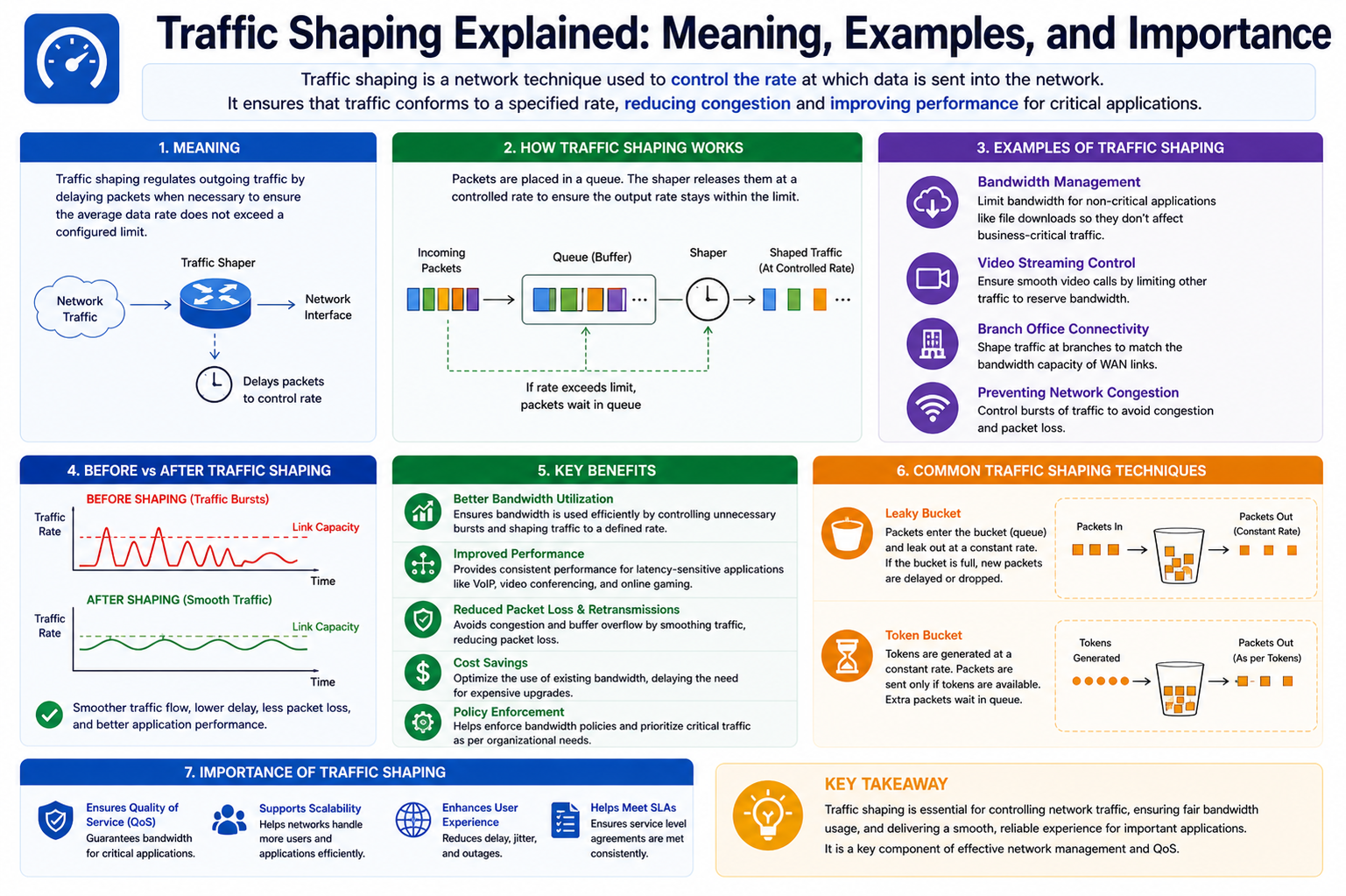
Traffic shaping is a fundamental concept in computer networking that focuses on controlling how data flows across a network. It ensures that network resources are used efficiently by regulating the speed and volume of data transmission. Instead of allowing unrestricted data flow, which can lead to congestion and poor performance, traffic shaping introduces structured control mechanisms that smooth out the delivery of packets over time. This results in a more stable and predictable network experience for users and applications.
Deeper Understanding of Traffic Shaping
Traffic shaping is not just about slowing down data; it is about organizing it intelligently. Networks carry multiple types of traffic at the same time, including emails, video calls, streaming content, file downloads, and background updates. Without control, these activities can compete for bandwidth and cause delays or interruptions. Traffic shaping ensures that each type of traffic is handled according to its importance and urgency.
In practice, this means that time-sensitive applications such as voice calls or video conferencing are given higher priority compared to less urgent activities like downloading large files. By doing so, the network maintains quality of service and reduces latency issues that can disrupt communication.
How Traffic Shaping Mechanisms Operate
Traffic shaping works by using buffering and scheduling techniques. When data enters a network faster than it can be transmitted, it is temporarily stored in a queue. Instead of discarding excess data, the system holds it and releases it gradually based on predefined rules.
One of the most widely used methods involves rate control, where the network sets a maximum allowable data transfer speed for certain types of traffic. If the data exceeds this limit, it is delayed rather than dropped. This ensures smoother flow and prevents sudden spikes in usage.
Another important aspect is burst control. Networks often allow short bursts of high-speed data transmission but regulate sustained high usage. This helps balance performance during short-term demand surges without overwhelming the system.
Common Algorithms Used in Traffic Shaping
Traffic shaping relies on mathematical models and algorithms to manage data flow efficiently. Two widely used approaches are the leaky bucket and token bucket algorithms.
The leaky bucket algorithm treats data like water in a bucket with a small hole at the bottom. Data enters the bucket at varying speeds, but it leaks out at a constant rate. If too much data arrives too quickly, the bucket overflows, and excess data is delayed or discarded depending on system design. This method ensures a steady output rate.
The token bucket algorithm works differently by generating tokens at a fixed rate. Each token represents permission to send a certain amount of data. If enough tokens are available, data can be transmitted immediately. If not, it must wait until tokens accumulate. This approach allows more flexibility while still controlling average traffic flow.
Types of Traffic Shaping
Traffic shaping can be implemented in different ways depending on network requirements. One common type is inbound shaping, which controls data coming into a network. This is useful for managing downloads or external data requests.
Outbound shaping controls data leaving a network. This is often used by organizations to regulate how much data employees or systems send out, ensuring that upstream bandwidth is not overloaded.
There is also application-based shaping, where specific software or services are prioritized. For example, video conferencing tools may be given higher priority than background software updates.
Real-World Applications of Traffic Shaping
Traffic shaping is widely used in both public and private networks. Internet service providers use it to manage overall network load among millions of users. During peak hours, they may limit bandwidth for certain non-essential services to ensure that critical services remain functional.
In corporate environments, traffic shaping is essential for maintaining productivity. Businesses often rely on cloud applications, communication tools, and internal databases. Without traffic control, heavy downloads or non-work-related usage could slow down essential services.
In gaming networks, traffic shaping helps reduce lag by prioritizing real-time data exchange between players and servers. This ensures smoother gameplay even when network conditions are not ideal.
Streaming platforms also depend heavily on traffic shaping to deliver uninterrupted video playback. By adjusting data rates based on network conditions, they prevent buffering and maintain video quality.
Importance of Traffic Shaping in Modern Networks
As digital communication continues to grow, networks are handling more traffic than ever before. Traffic shaping plays a critical role in ensuring that this growth does not lead to instability.
One of its most important benefits is congestion control. When too many users try to access the same resources simultaneously, networks can become overloaded. Traffic shaping distributes this load more evenly over time, preventing bottlenecks.
Another key advantage is improved user experience. By prioritizing important traffic, users experience fewer delays and interruptions. This is especially important for real-time services such as online meetings and live broadcasts.
Traffic shaping also improves fairness. Instead of allowing a small number of users or applications to consume all available bandwidth, it ensures balanced distribution among all users.
Challenges and Limitations of Traffic Shaping
Despite its advantages, traffic shaping is not without challenges. One of the main issues is complexity. Designing an effective traffic shaping policy requires detailed knowledge of network behavior and usage patterns. Incorrect configuration can lead to poor performance or unnecessary delays.
Another limitation is potential latency. While traffic shaping improves overall stability, it can introduce small delays for non-priority traffic. In some cases, users may experience slower download speeds or delayed responses.
There is also the challenge of dynamic traffic patterns. Modern networks are highly unpredictable, and traffic demands can change rapidly. Maintaining optimal shaping rules requires continuous monitoring and adjustment.
Role of Traffic Shaping in Quality of Service
Traffic shaping is closely connected to the concept of Quality of Service. Quality of Service refers to the overall performance level of a network, especially in terms of reliability, speed, and latency. By controlling traffic flow, shaping ensures that high-priority services maintain consistent performance even under heavy load.
This is particularly important for services that require real-time communication. Without traffic shaping, even minor network congestion could result in poor audio quality, dropped video calls, or delayed responses.
Traffic Shaping vs Traffic Policing
It is important to distinguish traffic shaping from traffic policing. While both techniques manage network traffic, they work differently. Traffic shaping delays excess data and smooths out transmission rates, whereas traffic policing typically drops or marks packets that exceed allowed limits.
This difference makes traffic shaping more user-friendly, as it avoids sudden data loss and instead controls flow in a more gradual manner.
Traffic Shaping in Large Scale Networks
In large-scale networks such as those used by enterprises, cloud platforms, and global service providers, traffic shaping becomes even more critical. These environments handle massive volumes of data from thousands or even millions of users at the same time. Without proper control, network congestion would be unavoidable, leading to slow performance, packet loss, and service interruptions.
Traffic shaping in such environments is designed to operate at multiple layers. It is not limited to a single device or router but is distributed across the entire network infrastructure. This layered approach ensures that data is controlled at entry points, within internal systems, and at exit points. The goal is to maintain smooth communication between servers, data centers, and end users regardless of demand spikes.
Traffic Prioritization and Bandwidth Allocation
One of the most important aspects of traffic shaping is prioritization. Not all network traffic has the same level of importance. For example, a live video conference is far more sensitive to delays than an email download. Traffic shaping allows network administrators to assign priority levels to different types of traffic.
Bandwidth allocation works hand in hand with prioritization. Each application or service may be assigned a specific portion of available bandwidth. Critical services are given guaranteed minimum bandwidth, while less important activities share the remaining capacity. This ensures that essential operations continue without interruption even when the network is heavily loaded.
Dynamic Traffic Control in Modern Systems
Modern networks are highly dynamic, meaning traffic conditions change constantly. To handle this, advanced traffic shaping systems use real-time monitoring and adaptive control mechanisms. These systems continuously analyze network usage patterns and adjust shaping rules accordingly.
For example, if a sudden surge in video streaming traffic is detected, the system may temporarily reduce bandwidth for non-essential background processes. Once the demand decreases, the restrictions are relaxed automatically. This adaptive behavior helps maintain optimal performance without manual intervention.
Machine learning is increasingly being integrated into traffic shaping systems. By analyzing historical data, these systems can predict traffic patterns and proactively adjust settings before congestion occurs. This predictive capability significantly improves efficiency and reduces network strain.
Traffic Shaping in Cloud Computing Environments
Cloud computing platforms rely heavily on traffic shaping to manage resources efficiently. Since cloud services are shared among many users, ensuring fair and stable performance is essential. Traffic shaping helps distribute computing and network resources in a balanced manner.
In cloud environments, traffic shaping is often combined with virtualization techniques. Each virtual machine or container may have its own defined bandwidth limits. This prevents a single user or application from consuming excessive resources and affecting others.
Additionally, cloud providers use traffic shaping to optimize data transfer between regions and data centers. This ensures that global services remain responsive regardless of user location.
Impact on Streaming and Media Services
Streaming services are one of the most visible beneficiaries of traffic shaping. These platforms must deliver high-quality audio and video content in real time, which requires consistent data flow. Any disruption can lead to buffering or reduced quality.
Traffic shaping allows these services to adjust video quality dynamically based on available bandwidth. If network conditions are strong, high-definition streams are delivered. If conditions weaken, the system reduces quality temporarily to maintain uninterrupted playback.
This adaptive streaming model depends heavily on traffic shaping to balance quality and performance. Without it, users would frequently experience interruptions during playback.
Traffic Shaping in Mobile Networks
Mobile networks face unique challenges due to fluctuating signal strength and varying user density. Traffic shaping plays a key role in managing these conditions. Mobile operators use it to ensure fair usage among users in crowded areas such as stadiums, cities, and public events.
When too many users connect to a single tower, bandwidth is distributed based on priority and demand. Real-time services like voice calls are prioritized over background data transfers. This ensures that essential communication remains stable even in congested environments.
Traffic shaping also helps mobile networks manage data caps and fair usage policies. Users who exceed certain limits may experience reduced speeds, ensuring balanced usage across the network.
Security Aspects of Traffic Shaping
Beyond performance optimization, traffic shaping also contributes to network security. Unusual traffic patterns can often indicate malicious activity such as denial-of-service attacks. By monitoring and controlling traffic flow, shaping systems can help detect and mitigate such threats.
For example, if a sudden surge of traffic is detected from a specific source, the system can temporarily throttle or restrict that traffic. This prevents overload and protects the rest of the network from disruption.
Traffic shaping also helps reduce the impact of accidental network floods caused by misconfigured applications or software errors.
Difference Between Traffic Shaping and Traffic Engineering
Although they are related, traffic shaping and traffic engineering serve different purposes. Traffic shaping focuses on controlling the rate of data flow at a granular level, often at the device or application level. Traffic engineering, on the other hand, deals with optimizing the overall path that data takes across a network.
Traffic engineering ensures that data travels through the most efficient routes, while traffic shaping ensures that the amount of data being sent or received does not exceed network capacity. Together, they provide a comprehensive approach to network optimization.
Challenges in Implementing Traffic Shaping
Implementing traffic shaping effectively requires careful planning. One of the main challenges is identifying which traffic should be prioritized. In complex networks, thousands of applications may be running simultaneously, making classification difficult.
Another challenge is maintaining fairness. While prioritization is necessary, it must not completely restrict lower-priority traffic. Balancing fairness and performance requires continuous tuning of shaping rules.
Scalability is also a concern. As networks grow, traffic shaping systems must be able to handle increasing volumes of data without becoming a bottleneck themselves.
Future of Traffic Shaping Technologies
The future of traffic shaping is closely tied to advancements in artificial intelligence and automation. Intelligent systems are being developed that can automatically classify traffic types with high accuracy and adjust policies in real time.
Edge computing is also influencing traffic shaping. By processing data closer to the source, networks can reduce latency and improve responsiveness. Traffic shaping at the edge ensures that only necessary data is transmitted to central systems, reducing overall load.
With the rise of 5G and beyond, traffic shaping will become even more important. Higher speeds and increased device connectivity will require more sophisticated control mechanisms to maintain stability and performance.
Advanced Traffic Shaping Techniques
As networks have evolved, traffic shaping has also become more sophisticated. Traditional methods that simply delay or queue packets are no longer sufficient for modern high-speed and highly diverse network environments. Advanced traffic shaping techniques now combine multiple layers of control, including application awareness, behavioral analysis, and real-time adaptability.
Application-aware traffic shaping is one of the most important advancements. Instead of treating all data equally, modern systems can identify specific applications generating traffic. This allows the network to apply different rules depending on whether the traffic comes from video streaming, cloud storage, messaging services, or background system updates. By recognizing application types, the system can make smarter decisions about prioritization and bandwidth distribution.
Behavior-based shaping goes even further by analyzing how users and applications typically behave over time. If a system detects unusual patterns, such as a sudden spike in data usage or irregular access behavior, it can automatically adjust traffic flow rules to maintain stability and prevent overload.
Role of Traffic Shaping in Enterprise Digital Transformation
Enterprises undergoing digital transformation rely heavily on stable and efficient networks. As organizations shift toward cloud-based systems, remote work environments, and real-time collaboration tools, the demand for reliable network performance increases significantly. Traffic shaping plays a central role in supporting this transformation.
In modern workplaces, employees use multiple cloud applications simultaneously, including document sharing platforms, video conferencing tools, and project management systems. Without traffic shaping, these services could compete for bandwidth and degrade performance. By prioritizing business-critical applications, organizations ensure smooth operations and uninterrupted communication.
Traffic shaping also supports hybrid work models by optimizing remote connectivity. Employees working from different locations rely on consistent access to company resources, and shaping ensures that essential data flows remain stable regardless of network conditions.
Traffic Shaping in Internet Backbone Infrastructure
At the backbone level of the internet, traffic shaping becomes a critical component of global data management. Internet backbone networks carry enormous volumes of traffic between countries, data centers, and service providers. Even minor inefficiencies at this level can have widespread effects.
Traffic shaping in backbone infrastructure focuses on balancing long-distance data flows and preventing congestion at major routing points. Since data often travels through multiple networks before reaching its destination, shaping ensures that no single link becomes overloaded.
This global-level traffic control is essential for maintaining internet stability. It allows different service providers to exchange data efficiently while ensuring that end users experience consistent performance regardless of geographic location.
Impact of Traffic Shaping on Latency and Performance
One of the key performance metrics affected by traffic shaping is latency. Latency refers to the time it takes for data to travel from source to destination. While traffic shaping helps reduce congestion, it can sometimes introduce small delays due to buffering and queue management.
However, these delays are usually intentional and controlled. By smoothing out traffic flow, shaping prevents sudden congestion spikes that would otherwise cause much larger delays. In most cases, the trade-off between slight intentional delay and overall network stability is highly beneficial.
Performance improvement is most noticeable in real-time applications. Without traffic shaping, applications like voice calls or online gaming would suffer from jitter, packet loss, and inconsistent performance. With shaping in place, these services maintain a steady and predictable data flow.
Traffic Shaping and Fair Usage Policies
Many service providers implement fair usage policies to ensure that all users receive equitable access to network resources. Traffic shaping is the primary mechanism used to enforce these policies.
Instead of completely blocking users who exceed usage limits, traffic shaping gradually reduces their bandwidth. This approach is less disruptive and allows continued access to services at reduced speeds. It also prevents a small number of heavy users from degrading the experience of others on the same network.
Fair usage enforcement through traffic shaping is particularly important in shared environments such as public Wi-Fi networks, mobile data services, and large enterprise systems.
Energy Efficiency and Traffic Shaping
An often-overlooked benefit of traffic shaping is its contribution to energy efficiency. By controlling data flow and reducing unnecessary network congestion, systems can operate more efficiently and consume less power.
Network devices such as routers and switches use less processing power when traffic is evenly distributed rather than handled in sudden bursts. This can lead to reduced energy consumption across large-scale infrastructures, especially in data centers where thousands of devices operate simultaneously.
Efficient traffic management also reduces the need for repeated data transmissions caused by packet loss or retransmission errors, further lowering overall energy usage.
Traffic Shaping in Emerging Technologies
Emerging technologies such as the Internet of Things, autonomous systems, and augmented reality place new demands on network infrastructure. These technologies require continuous, low-latency communication between devices, making traffic shaping more important than ever.
In IoT environments, thousands of small devices continuously send and receive data. Traffic shaping ensures that this constant stream does not overwhelm the network. It prioritizes critical sensor data while managing less important background communication.
In autonomous systems, such as self-driving vehicles, traffic shaping plays a role in ensuring that real-time sensor and control data is transmitted without delay. Even minor disruptions could affect system performance, making precise traffic control essential.
Adaptive Quality Control Through Traffic Shaping
Modern traffic shaping systems often integrate adaptive quality control mechanisms. These systems adjust the quality of service dynamically based on current network conditions. Instead of maintaining fixed rules, they continuously optimize performance in real time.
For example, during periods of high congestion, video streaming services may automatically reduce resolution to maintain smooth playback. Once network conditions improve, the quality is restored. This dynamic adjustment ensures consistent user experience without manual intervention.
Adaptive systems rely heavily on continuous monitoring and feedback loops. By analyzing network performance metrics, they can instantly respond to changes and maintain optimal data flow.
Human Impact and User Experience
From a user perspective, traffic shaping is often invisible, yet it significantly affects everyday digital experiences. Whether browsing the internet, attending online classes, or streaming entertainment, users benefit from smoother and more reliable connections.
Without traffic shaping, networks would be far more unpredictable. Websites could load inconsistently, video calls could freeze frequently, and online services could become unreliable during peak hours. By maintaining balance, traffic shaping ensures that digital interactions remain seamless and frustration-free.
Evolving Role of Traffic Shaping in the Future Internet
As global internet usage continues to expand, traffic shaping will remain a foundational technology. Future networks will likely rely on fully automated and intelligent shaping systems that require minimal human intervention.
With advancements in edge computing, artificial intelligence, and ultra-fast connectivity technologies, traffic shaping will evolve from simple rate control into a fully adaptive network intelligence system. These systems will not only manage traffic but also predict demand, prevent congestion before it occurs, and optimize global data distribution in real time.
Traffic Shaping in Data Centers and High Performance Computing
In modern data centers, traffic shaping is a key mechanism that ensures smooth operation of thousands of servers working simultaneously. These environments handle enormous volumes of data every second, including user requests, database transactions, cloud storage synchronization, and application processing. Without proper traffic control, internal congestion could severely impact performance and reliability.
Traffic shaping in data centers is often implemented at both hardware and software levels. High-speed routers and switches enforce bandwidth limits, while software-defined networking systems dynamically adjust traffic policies based on workload demand. This combination allows data centers to maintain consistent performance even during peak usage periods.
In high performance computing environments, where complex simulations and scientific computations are running, traffic shaping ensures that inter-server communication remains efficient. Large datasets are frequently exchanged between nodes, and any delay or packet loss can slow down the entire computation process. Controlled traffic flow helps maintain synchronization across distributed systems.
Traffic Shaping in Virtualized and Containerized Systems
Virtualization and containerization have changed the way modern computing resources are managed. Multiple virtual machines or containers often run on a single physical server, each generating its own network traffic. Traffic shaping is essential in these environments to prevent resource contention.
Each virtual instance can be assigned specific bandwidth limits and priorities. This ensures that no single application or virtual machine monopolizes network resources. For example, a database server running in one container may be given higher priority than a background logging service in another container.
In cloud-native environments, traffic shaping is often integrated with orchestration tools that automatically manage resource allocation. This allows systems to scale dynamically while maintaining stable network performance.
Traffic Shaping and User Behavior Management
Traffic shaping not only manages technical performance but also indirectly influences user behavior. When certain types of traffic are prioritized or limited, users naturally adjust how they interact with digital services.
For example, if large file downloads are slowed during peak hours, users may schedule them for off-peak times. Similarly, if streaming quality adjusts based on network load, users become more aware of bandwidth usage. This indirect influence helps distribute network demand more evenly throughout the day.
Organizations also use traffic shaping to encourage productive use of networks. By prioritizing business applications over entertainment platforms, companies can reduce non-essential traffic during working hours.
Quality of Experience vs Quality of Service
Traffic shaping contributes to both Quality of Service and Quality of Experience, but these concepts are slightly different. Quality of Service focuses on technical performance metrics such as bandwidth, latency, and packet loss. It is measured from a network perspective.
Quality of Experience, on the other hand, focuses on how users perceive performance. Even if technical metrics are acceptable, poor application behavior can lead to dissatisfaction. Traffic shaping helps bridge this gap by ensuring that applications perform smoothly from the user’s perspective.
For instance, a video call may technically have sufficient bandwidth, but if packets arrive irregularly, users may still experience choppy audio or video. Traffic shaping smooths this flow, improving overall user satisfaction.
Traffic Shaping in Government and Public Infrastructure Networks
Government and public infrastructure networks also rely heavily on traffic shaping. These networks support essential services such as emergency communication systems, public administration platforms, healthcare databases, and educational resources.
During critical situations, such as natural disasters or emergencies, traffic shaping can prioritize communication between emergency responders and control centers. This ensures that vital information is transmitted without delay, even when networks are under heavy load.
Public Wi-Fi systems in libraries, transportation hubs, and educational institutions also use traffic shaping to ensure fair access among users. It prevents any single user from consuming excessive bandwidth and degrading service quality for others.
Traffic Shaping and Cybersecurity Integration
In modern cybersecurity frameworks, traffic shaping is often combined with threat detection systems. By analyzing traffic patterns, security tools can identify anomalies that may indicate cyberattacks, such as distributed denial-of-service attacks or unauthorized access attempts.
When suspicious activity is detected, traffic shaping mechanisms can automatically limit or redirect traffic to reduce impact. This helps protect critical systems from overload and ensures continued availability of services.
Additionally, shaping can be used to isolate malicious traffic without completely shutting down legitimate services. This selective control is an important part of modern defensive network strategies.
Traffic Shaping in Content Delivery Networks
Content delivery networks rely on distributed servers to deliver content efficiently to users around the world. Traffic shaping plays a crucial role in managing how content is distributed across these servers.
By controlling the flow of data between origin servers and edge nodes, traffic shaping ensures that no single server becomes overloaded. It also helps balance demand based on geographic location, ensuring that users receive content from the nearest and least congested server.
This improves loading times, reduces latency, and enhances the overall performance of global web services.
Economic Impact of Traffic Shaping
Traffic shaping also has significant economic implications. By optimizing network usage, organizations can reduce the need for expensive infrastructure upgrades. Efficient bandwidth utilization means that existing resources can support more users and applications without additional investment.
For service providers, traffic shaping helps manage operational costs while maintaining service quality. It also enables tiered service models, where users can choose different levels of bandwidth and performance based on their needs.
In the broader digital economy, stable and efficient networks support productivity, e-commerce, remote work, and digital innovation.
Ethical Considerations in Traffic Shaping
While traffic shaping is essential for network management, it also raises ethical considerations. One concern is transparency. Users may not always be aware that their traffic is being prioritized or limited, which can lead to concerns about fairness.
Another issue is net neutrality, which is the principle that all internet traffic should be treated equally. In some cases, aggressive traffic shaping may conflict with this principle if certain services are consistently prioritized over others.
Balancing performance optimization with fairness and transparency is an ongoing challenge for network administrators and policymakers.
Traffic Shaping and Future Network Evolution
As networks continue to evolve, traffic shaping will become more intelligent and autonomous. Future systems are expected to use advanced predictive analytics to anticipate traffic patterns before they occur. This will allow networks to proactively adjust capacity and prevent congestion in advance.
Integration with artificial intelligence will enable self-optimizing networks that continuously learn from usage patterns. These systems will automatically adjust priorities, detect anomalies, and optimize performance without human intervention.
With the expansion of ultra-low latency technologies and global connectivity improvements, traffic shaping will remain a core component of digital infrastructure.
Traffic Shaping in Artificial Intelligence Driven Networks
As networks become more intelligent, traffic shaping is increasingly integrated with artificial intelligence systems. AI-driven networks do not rely solely on fixed rules; instead, they learn from real-time data and continuously improve how traffic is managed. This allows networks to adapt instantly to changing conditions without human intervention.
In such systems, traffic shaping is no longer just about limiting or delaying packets. It becomes a decision-making process where the system evaluates thousands of variables such as user behavior, application type, network congestion levels, and historical patterns. Based on this analysis, it dynamically adjusts how traffic is prioritized and distributed.
AI-powered traffic shaping is especially useful in environments with unpredictable demand. For example, during major online events or sudden spikes in user activity, the system can automatically reallocate resources to maintain stability. This ensures that critical services continue to function smoothly even under extreme load conditions.
Traffic Shaping in 5G and Next Generation Networks
The introduction of 5G technology has significantly increased the complexity and speed of data networks. With ultra-low latency and massive device connectivity, traffic management has become more challenging than ever. Traffic shaping plays a vital role in ensuring that these high-speed networks operate efficiently.
In 5G environments, traffic shaping is used to support different types of services such as enhanced mobile broadband, massive machine-type communications, and ultra-reliable low-latency communication. Each of these categories has unique requirements, and traffic shaping ensures that they do not interfere with each other.
For example, autonomous vehicles require extremely low latency for real-time decision-making, while IoT sensors may only need periodic data transmission. Traffic shaping ensures that both types of traffic coexist without disruption.
Role of Traffic Shaping in Smart Cities
Smart cities rely heavily on interconnected systems that manage transportation, energy, public safety, and communication. Traffic shaping is essential in ensuring that all these systems operate efficiently and reliably.
In traffic management systems, real-time data from sensors and cameras is constantly transmitted to control centers. Traffic shaping ensures that this critical information is prioritized over less urgent data. Similarly, in smart energy grids, shaping helps manage communication between power distribution units and monitoring systems.
By ensuring smooth data flow across urban infrastructure, traffic shaping contributes to safer, more efficient, and more responsive cities.
Traffic Shaping and Edge Computing Integration
Edge computing has introduced a new dimension to traffic management by processing data closer to the source rather than relying entirely on centralized data centers. Traffic shaping plays a key role in managing the flow of data between edge devices and core networks.
By filtering and prioritizing data at the edge, unnecessary traffic is reduced before it reaches central systems. This not only improves response times but also reduces overall network congestion. Edge-based traffic shaping is especially important for applications that require real-time processing, such as industrial automation and augmented reality.
Traffic Shaping in Financial Systems
Financial systems depend on extremely fast and reliable data transmission. Even a slight delay in transaction processing can have significant consequences. Traffic shaping ensures that financial data flows smoothly between banks, trading platforms, and payment systems.
In high-frequency trading environments, where millions of transactions occur in fractions of a second, traffic shaping helps maintain stability and prevent data bottlenecks. It ensures that critical financial messages are transmitted with minimal delay, while less urgent data is handled in the background.
Environmental Impact of Efficient Traffic Management
Efficient traffic shaping also contributes indirectly to environmental sustainability. By optimizing data flow, networks reduce unnecessary processing and energy consumption. Data centers, which consume large amounts of electricity, benefit from smoother traffic patterns that reduce workload spikes.
This leads to lower cooling requirements and reduced hardware stress, extending the lifespan of equipment. As global digital usage continues to grow, such efficiencies play an important role in reducing the environmental footprint of technology infrastructure.
Challenges in Future Traffic Shaping Systems
Despite its advancements, traffic shaping faces ongoing challenges. One major issue is the increasing complexity of network environments. With billions of connected devices, managing traffic efficiently requires extremely sophisticated systems.
Another challenge is maintaining fairness while optimizing performance. As systems become more automated, ensuring transparency and preventing bias in traffic prioritization becomes more difficult.
Security also remains a concern, as attackers may attempt to manipulate traffic patterns to bypass shaping rules or disrupt services. Future systems must be capable of detecting and responding to such threats in real time.
Conclusion
Traffic shaping is a foundational technology that supports the stability, efficiency, and fairness of modern digital networks. From simple rate control mechanisms to advanced AI-driven systems, it has evolved into a highly intelligent and adaptive process.
It plays a crucial role across all levels of networking, including enterprise systems, cloud platforms, mobile networks, smart cities, financial systems, and global internet infrastructure. By controlling the flow of data, it ensures that critical applications receive the resources they need while maintaining balance across the entire network.
As technology continues to advance, traffic shaping will become even more intelligent, predictive, and automated. It will not only manage congestion but also anticipate network demands, prevent failures before they occur, and optimize performance in real time.
Ultimately, traffic shaping is essential for maintaining a reliable digital world. It ensures that communication remains smooth, services remain accessible, and networks remain stable even as global data usage continues to grow exponentially.