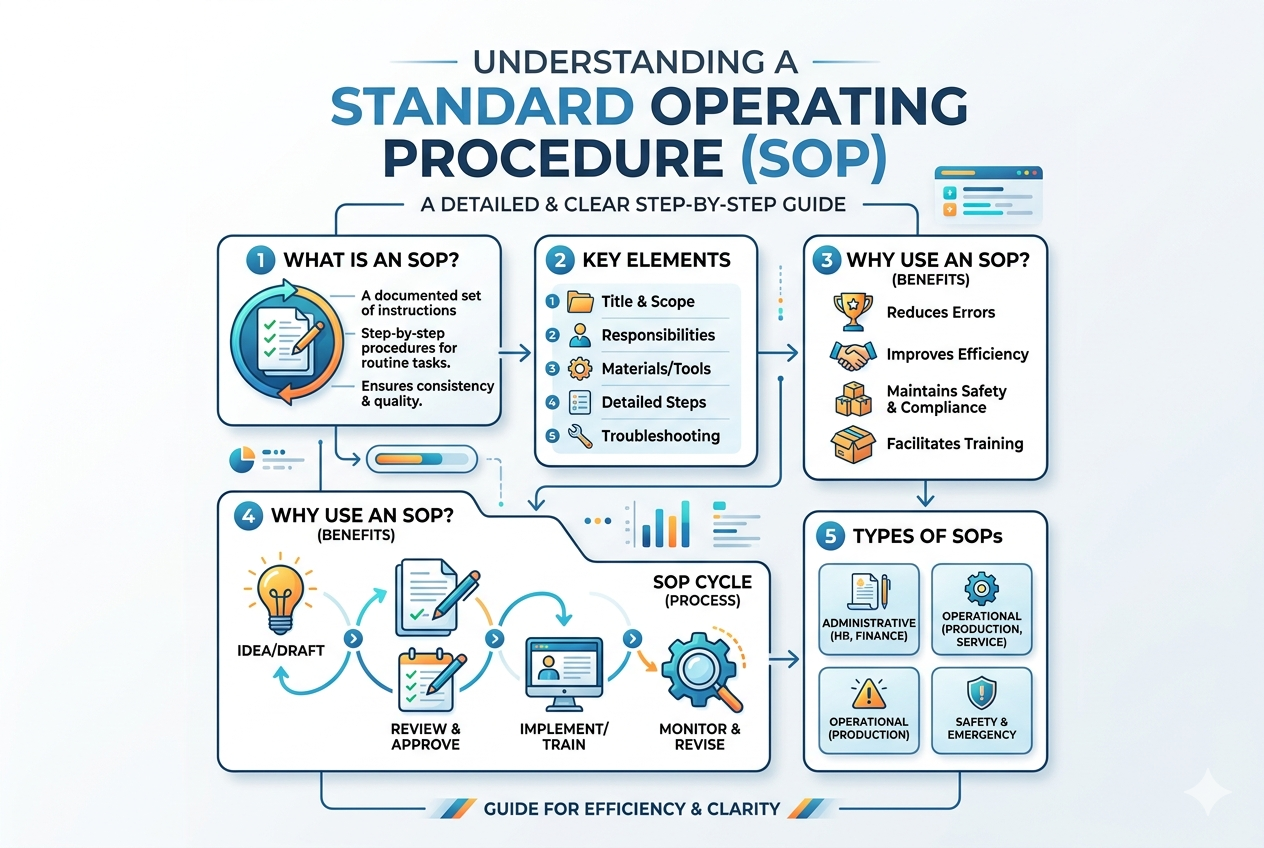
A Standard Operating Procedure, commonly referred to as an SOP, is a formalized written document that explains in precise detail how a specific task, process, or set of operations should be carried out within an organization. It serves as an authoritative guide that ensures activities are performed consistently, correctly, and efficiently regardless of who performs them. SOPs are designed to remove uncertainty from routine work by providing clear instructions that standardize behavior, reduce variation, and maintain quality across all levels of an organization. In essence, an SOP is a blueprint for operational consistency, transforming complex or repetitive tasks into structured and manageable workflows.
The fundamental concept behind SOPs
At the heart of every SOP lies the principle of standardization. Organizations often consist of multiple individuals working on similar tasks, and without clear instructions, each person may develop their own method of completing work. This leads to inconsistency, inefficiency, and sometimes even serious errors. SOPs eliminate this problem by ensuring that every individual follows the same approved procedure. This creates uniformity in output, improves coordination, and ensures that results remain predictable and reliable. The concept is not limited to large corporations; even small teams benefit significantly from having structured procedures in place.
An SOP is not simply a list of instructions. It is a carefully constructed document based on analysis, experience, and optimization of a process. It reflects the best known method for completing a task efficiently while minimizing risk and maximizing quality. Because of this, SOPs are often developed by subject matter experts who understand the process deeply and can identify the most effective steps involved.
Purpose and importance of SOPs
The purpose of a Standard Operating Procedure extends beyond simple instruction. It plays a crucial role in maintaining operational discipline within an organization. One of its most important functions is ensuring consistency. When tasks are performed the same way every time, organizations can guarantee a stable level of quality. This consistency is especially important in industries where precision is essential, such as healthcare, manufacturing, aviation, and information technology.
Another key purpose of SOPs is to improve efficiency. When employees know exactly what steps to follow, they spend less time figuring out how to perform tasks and more time executing them. This reduces delays and increases productivity. SOPs also help reduce errors because they eliminate guesswork. When instructions are clear and structured, the likelihood of mistakes decreases significantly.
SOPs also play an important role in training and onboarding. New employees often face a learning curve when joining an organization. Instead of relying solely on verbal explanations or informal guidance, they can refer to SOPs to understand how tasks should be performed. This accelerates the learning process and helps new staff become productive more quickly.
Key components of a Standard Operating Procedure
A well-structured SOP typically contains several essential components that ensure clarity and usability. It usually begins with a clear statement of purpose, explaining why the procedure exists and what it aims to achieve. This is followed by the scope, which defines where and when the SOP should be applied.
Another important component is responsibility, which identifies who is responsible for performing each part of the process. This ensures accountability and prevents confusion regarding roles. The main body of the SOP consists of step-by-step instructions that describe the process in a logical and sequential manner. Each step is written in clear, simple language to ensure it can be easily understood and followed.
Additional sections may include safety precautions, required tools or resources, quality standards, and troubleshooting guidelines. These elements help ensure that the procedure is not only effective but also safe and reliable.
Types of SOPs in organizations
SOPs can vary depending on their purpose and the nature of the work involved. One common type is technical SOPs, which are used in industries like IT, engineering, and manufacturing. These SOPs focus on detailed technical processes such as system configurations, machine operations, or software procedures.
Another type is administrative SOPs, which deal with office-related tasks such as documentation, communication, scheduling, and reporting. These procedures help maintain order and efficiency in daily administrative operations.
There are also safety SOPs, which are designed to ensure safe working conditions. These are particularly important in industries where employees are exposed to physical, chemical, or environmental hazards. Safety SOPs outline precautions, emergency procedures, and protective measures to prevent accidents.
Finally, there are operational SOPs, which cover general business processes such as customer service, production workflows, and quality control. These are among the most widely used SOPs in organizations of all sizes.
The process of creating an SOP
Developing an SOP requires careful planning and detailed understanding of the process being documented. The first step is identifying the task or process that needs standardization. Once identified, the process is analyzed thoroughly to understand each step involved.
Input from experienced employees is often essential during this stage, as they provide practical insights that may not be visible in theoretical analysis. After gathering information, the process is broken down into logical steps and organized in a sequential order.
The next step is drafting the SOP in clear and simple language. It is important to avoid unnecessary complexity and ensure that instructions are easy to follow. Once the draft is completed, it is reviewed by relevant stakeholders to ensure accuracy and completeness.
Testing is also an important part of SOP development. The procedure is often applied in real conditions to ensure it works as intended. Based on feedback, necessary adjustments are made before final approval.
Implementation and usage of SOPs
Once an SOP is finalized, it must be properly implemented within the organization. This involves training employees on how to use the document and ensuring that it is accessible whenever needed. SOPs are often stored in centralized systems or manuals so that employees can easily refer to them during work.
Effective implementation also requires monitoring. Organizations must ensure that employees are actually following the procedures outlined in the SOPs. Regular audits or reviews may be conducted to verify compliance and identify areas for improvement.
Over time, SOPs become an integral part of daily operations. They guide behavior, shape workflows, and influence decision-making. When properly implemented, they create a structured environment where tasks are performed smoothly and efficiently.
Benefits of Standard Operating Procedures
The benefits of SOPs are extensive and impact multiple aspects of an organization. One of the most significant benefits is consistency. By ensuring that every task is performed in the same way, SOPs help maintain uniform quality across all outputs.
Another major benefit is improved efficiency. SOPs eliminate unnecessary steps, reduce confusion, and streamline workflows. This allows employees to complete tasks faster and with greater accuracy.
SOPs also enhance accountability. Since responsibilities are clearly defined, it becomes easier to identify who is responsible for each task. This reduces misunderstandings and improves overall discipline within the organization.
In addition, SOPs support compliance with industry regulations and standards. Many industries require strict adherence to guidelines, and SOPs provide documented proof that these requirements are being met.
They also contribute to knowledge preservation. When processes are documented, valuable organizational knowledge is retained even if employees leave. This ensures continuity and reduces dependency on individual expertise.
Challenges in using SOPs
Despite their many advantages, SOPs also present certain challenges. One common issue is resistance to change. Employees who are used to informal methods may find it difficult to adapt to structured procedures.
Another challenge is maintaining updates. As processes evolve, SOPs must be regularly revised. If they are not kept up to date, they can become outdated and less effective.
Poorly written SOPs can also create confusion rather than clarity. If instructions are too complex or unclear, they may be difficult to follow. This highlights the importance of proper documentation skills and regular review.
Best practices for effective SOPs
To ensure SOPs are effective, they should be written in simple and clear language. They should focus on practicality rather than unnecessary detail. Visual clarity, logical structure, and step-by-step formatting all contribute to better usability.
Regular review and updates are also essential. SOPs should evolve alongside organizational changes to remain relevant. Involving employees in the development process can also improve accuracy and acceptance.
Training is another key factor. Employees should not only have access to SOPs but also understand how to use them effectively. Proper training ensures that procedures are followed correctly.
Conclusion
A Standard Operating Procedure is a foundational element of any organized system that values consistency, efficiency, and quality. It acts as a guiding framework that defines how tasks should be performed in a structured and reliable manner. By standardizing processes, SOPs eliminate confusion, reduce errors, and enhance productivity across all levels of an organization.
Beyond simple instruction, SOPs represent organizational discipline and knowledge preservation. They ensure that work is not dependent on individual habits but on clearly defined and optimized procedures. This makes organizations more resilient, scalable, and capable of maintaining high standards over time.
While challenges such as resistance to change and the need for regular updates exist, the benefits far outweigh the difficulties. When properly designed, implemented, and maintained, SOPs become powerful tools that support growth, stability, and operational excellence. In any environment where consistency and quality matter, SOPs are not just useful—they are essential.