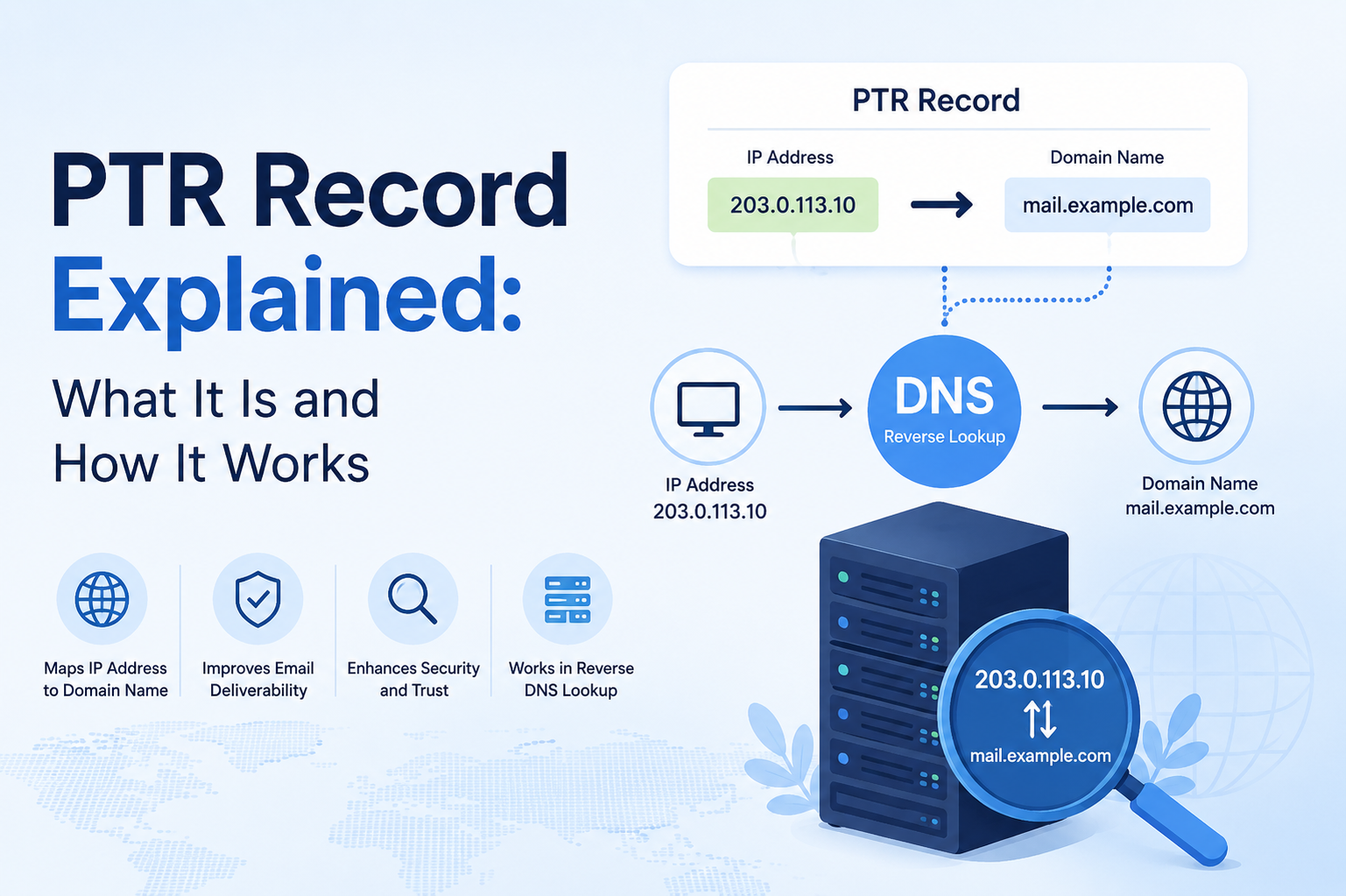
A PTR record, commonly known as a Pointer Record, is a crucial part of the Domain Name System (DNS) that performs reverse mapping between IP addresses and domain names. While most DNS records translate domain names into IP addresses so users can access websites easily, PTR records work in the opposite direction. They translate an IP address back into a readable domain name. This process is called reverse DNS lookup.
The internet depends heavily on DNS to function smoothly, and PTR records add an important layer of verification and trust. Without PTR records, it would be more difficult for systems to confirm whether an IP address truly belongs to a legitimate domain. This makes PTR records especially important in areas like email delivery, cybersecurity, and server authentication.
Although end users rarely interact directly with PTR records, they play a hidden but essential role in maintaining the stability and reliability of online communication systems.
Understanding the Core Concept of PTR Records
To understand PTR records clearly, it is important to first understand how standard DNS works. Normally, when a user enters a website address, DNS converts that domain into an IP address so the browser can load the correct server. This is known as forward DNS resolution.
PTR records do the reverse. Instead of starting with a domain name, they start with an IP address and return the associated domain name if one exists. This reverse mapping is what makes PTR records unique and valuable in network systems.
PTR records are stored in a special part of DNS called the reverse DNS zone. This zone is structured differently from normal DNS zones and is designed specifically for IP-to-domain mapping. When a system requests a reverse lookup, it queries this zone to find the matching domain.
How PTR Records Work in Real Network Communication
When a device connects to a server, the server may want to verify the identity of the incoming connection. One way it does this is by performing a reverse DNS lookup using the IP address of the connecting device.
The server sends a request to the DNS system asking, “Which domain is associated with this IP address?” If a PTR record exists, the DNS system responds with the domain name linked to that IP.
For example, if a mail server receives a connection from an IP address, it may perform a reverse lookup. If the PTR record returns a valid domain name that matches the expected mail server identity, the connection is considered more trustworthy. If there is no PTR record or if the result does not match, the connection may be treated with suspicion.
This process happens in seconds and is usually invisible to users, but it is extremely important for backend verification systems.
Structure of PTR Records in DNS Systems
PTR records are stored in a reversed format of IP addresses. This is because reverse DNS zones are structured in a way that requires IP addresses to be flipped before being stored.
Instead of storing the IP address in its normal order, DNS stores it in reverse order under a special domain structure used for reverse lookups. This allows the DNS system to efficiently locate the correct record when a query is made.
Each PTR record contains a mapping between the reversed IP address and a fully qualified domain name. When queried, it returns the hostname associated with that IP, if it exists.
This structure ensures that reverse lookups are consistent and standardized across the internet.
Importance of PTR Records in Email Systems
One of the most important uses of PTR records is in email authentication. Email servers rely heavily on reverse DNS lookups to verify whether an incoming email is legitimate.
When an email is received, the receiving server checks the sender’s IP address and performs a reverse lookup. If the PTR record exists and matches the sending domain, the email is more likely to be accepted. If there is no PTR record or if it does not match the expected domain, the email may be marked as spam or rejected completely.
This mechanism helps prevent email spoofing, where attackers attempt to send emails pretending to be from trusted sources. PTR records add an extra layer of trust by ensuring that the sending IP address is properly associated with a valid domain.
For businesses and organizations, having correctly configured PTR records is essential to ensure reliable email delivery and avoid communication issues.
Role of PTR Records in Network Security
PTR records also contribute to network security by helping identify the source of IP addresses. Security systems often analyze incoming traffic and perform reverse DNS lookups to determine whether the traffic is coming from a trusted or suspicious source.
If an IP address resolves to a known and legitimate domain, it is more likely to be trusted. If it does not resolve or returns an unexpected domain, it may trigger security alerts.
This helps security systems detect potential threats such as bot activity, spoofing attempts, or unauthorized access. While PTR records alone are not enough to guarantee security, they provide valuable information that supports other security measures.
In cybersecurity environments, PTR records are often used alongside firewalls, intrusion detection systems, and authentication protocols to build a stronger defense system.
PTR Records in Server Identification and Logging
PTR records are also widely used in server logging and system monitoring. When servers record incoming connections, they often log IP addresses. However, IP addresses alone can be difficult to interpret, especially in large systems.
By using reverse DNS lookups, administrators can convert IP addresses into domain names, making logs easier to read and analyze. This helps identify where traffic is coming from and makes troubleshooting more efficient.
For example, if unusual traffic is detected, administrators can perform a reverse lookup to determine whether the IP belongs to a known service or an unknown source. This makes PTR records an important tool in network diagnostics and system monitoring.
How PTR Records Are Managed and Assigned
PTR records are not usually managed by domain owners. Instead, they are controlled by the organization that owns the IP address block. This is typically an internet service provider or hosting provider.
When a business uses a server or cloud service, they may need to request the provider to configure PTR records for their IP addresses. This ensures that the reverse DNS mapping is correctly set up.
Proper configuration requires that the PTR record matches the hostname assigned to the server. If the forward DNS record and reverse DNS record do not align, it can cause verification issues and reduce trust in the system.
Because of this, maintaining consistency between DNS records is very important for system reliability.
Common Problems with PTR Records
One of the most common issues with PTR records is misconfiguration. If the PTR record does not match the actual domain name of the server, it can lead to authentication failures. This is especially problematic for email servers, where mismatched PTR records can cause emails to be rejected.
Another common issue is missing PTR records. Some IP addresses may not have reverse DNS entries configured at all. This can reduce trust in the system and cause certain services to block or limit connections from that IP.
DNS propagation delays can also cause temporary issues. When a PTR record is updated, it may take time for the changes to spread across all DNS servers. During this period, different systems may return different results.
These issues highlight the importance of proper DNS management and regular monitoring.
PTR Records and Their Limitations
Although PTR records are useful, they are not perfect. One limitation is that they depend on correct configuration by the IP address owner. If the provider does not set up PTR records properly, reverse DNS lookups will fail.
Another limitation is that PTR records can be manipulated in some cases. While they are useful for verification, they should not be the only factor used to determine trust. Security systems usually combine PTR records with other checks to make more accurate decisions.
PTR records also do not provide detailed information about the user behind an IP address. They only map the IP to a domain, not to an individual or device.
Despite these limitations, PTR records remain an important part of DNS infrastructure.
Best Practices for PTR Record Usage
To ensure proper functioning of PTR records, consistency between forward and reverse DNS should always be maintained. The hostname in the PTR record should match the domain name associated with the IP address.
Regular audits should be conducted to ensure that PTR records are accurate and up to date. Any changes in infrastructure, such as server migrations or IP changes, should be reflected in DNS settings immediately.
It is also important to avoid generic or unclear hostnames. Clear naming conventions help improve trust and make system analysis easier.
Proper coordination with hosting providers is also essential, since they are responsible for managing reverse DNS settings.
Conclusion
PTR records are a fundamental part of the DNS ecosystem that enable reverse mapping from IP addresses to domain names. Although they operate behind the scenes, their impact on internet communication is significant.
They play a key role in email authentication, helping prevent spam and spoofing by verifying sender identity. They also support network security by assisting in traffic analysis and threat detection. In addition, they improve system monitoring and troubleshooting by making logs easier to interpret.
While PTR records have limitations and must be properly configured to function correctly, they remain an essential component of modern networking. Their ability to provide reverse verification adds an important layer of trust and reliability to digital communication systems.
In a world where secure and accurate data exchange is critical, PTR records continue to serve as a silent but powerful mechanism that supports the stability and integrity of the internet.