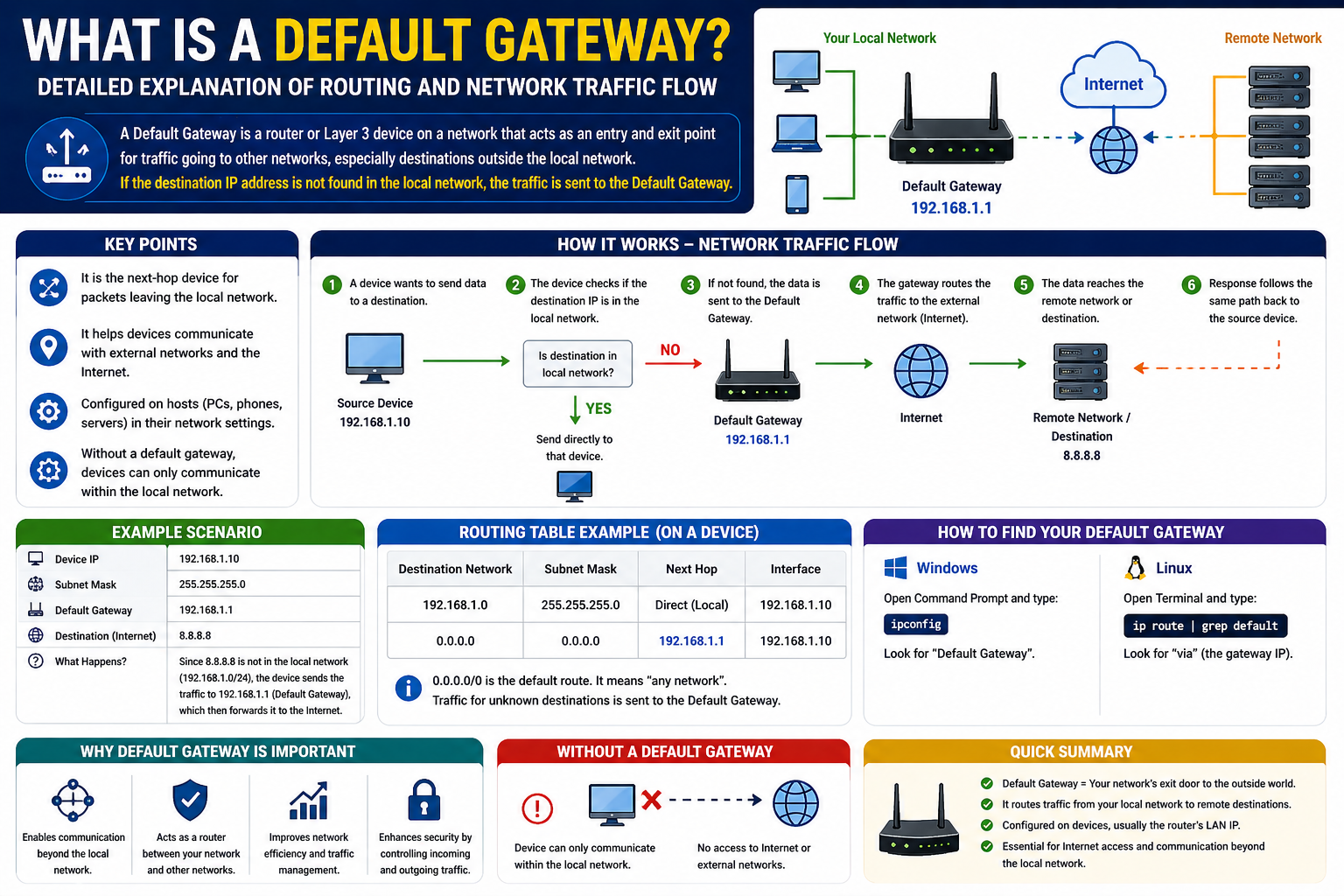
A default gateway plays a central role in how modern computer networks function because it enables communication between different networks. Without it, devices would only be able to talk to others within the same local network, which would severely limit connectivity. The default gateway essentially acts as an intermediary that connects a private network, such as a home or office LAN, to external networks like the internet or other remote systems. Every time a device sends data to an address outside its local subnet, that traffic is directed toward the default gateway, which then takes responsibility for forwarding it further.
In practical networking environments, the default gateway is the first and most important step in inter-network communication. It ensures that devices do not need to know the full path to every possible destination on the internet. Instead, they rely on the gateway to handle external routing decisions. This significantly simplifies network design and reduces the complexity required on individual devices.
Routing Process
Routing is the process of moving data packets from one network to another until they reach their final destination. The default gateway is deeply involved in this process because it is the first hop for any traffic leaving a local network. When a device sends a packet, it checks whether the destination IP is within its own subnet. If it is not, the packet is forwarded to the default gateway.
Once the gateway receives the packet, it examines the destination address and consults its routing information to determine where the packet should go next. This process continues across multiple routers until the packet reaches its intended destination. Each router along the path performs a similar decision-making process, ensuring efficient delivery of data across complex global networks.
Routing Table and Default Route
Every network device that performs routing maintains a routing table. This table contains information about known network paths and how to reach them. If a device does not have a specific route for a destination, it uses a special entry called the default route. The default gateway is associated with this default route.
The default route acts as a fallback path. Instead of dropping unknown traffic, the device forwards it to the default gateway for further processing. This ensures that even if a device does not have detailed routing information, it can still communicate beyond its local network. The routing table is constantly used to make fast decisions about where data should be sent next.
How Devices Choose Gateway
Devices determine which gateway to use based on their network configuration. This configuration can be manually set by a user or automatically assigned by a network service. In most modern networks, devices receive gateway information through automatic configuration systems, which ensure consistency across all connected devices.
When a device starts communicating, it compares the destination IP address with its own subnet range. If the destination is outside its local network, the device immediately forwards the packet to the configured default gateway. This decision-making process happens within milliseconds and is completely transparent to the user.
Relationship with IP Addressing and Subnet Mask
The default gateway works closely with IP addressing and subnet masks. The subnet mask helps determine whether a destination IP address is local or remote. It defines the range of IP addresses that belong to the same network segment. If a destination address falls outside this range, the default gateway is used.
This relationship is critical because incorrect subnet mask configuration can lead to improper routing decisions. For example, if the subnet mask is too broad or too narrow, devices may incorrectly assume that a destination is local when it is not, or vice versa. In both cases, network communication can fail or become unstable.
ARP and Gateway Communication
Before a device can send data to the default gateway, it must first determine the gateway’s physical address. This is done using a process that maps IP addresses to hardware addresses. When a device knows the gateway’s IP but not its physical address, it sends a request asking for the corresponding hardware identity.
Once the gateway responds, the device stores this information temporarily so it can send data efficiently without repeating the lookup process. This mapping is essential because network communication requires both logical addressing and physical delivery mechanisms.
NAT Role
In many networks, the default gateway also performs address translation. This is especially common in home and business networks that use private IP addresses internally. When devices send traffic to the internet, the gateway modifies the source address so that external networks can properly respond.
This process allows multiple devices within a private network to share a single public IP address. Without this function, large numbers of devices would require unique public addresses, which is not practical given global IP limitations. The gateway ensures seamless translation between internal and external communication.
DHCP Role
Automatic configuration of default gateways is typically handled by a network service that assigns IP addresses and related settings to devices. This service ensures that every device receives the correct gateway information without manual configuration.
When a device connects to a network, it sends a request for configuration details. The service responds with an IP address, subnet mask, and default gateway information. This automated process reduces errors and simplifies network management, especially in large environments where hundreds or thousands of devices may connect.
Home vs Enterprise Gateways
In home networks, the default gateway is usually a single router that connects directly to an internet service. It handles all routing, address translation, and basic security functions. These devices are simple to manage and typically operate automatically.
In enterprise environments, the default gateway is often part of a more complex infrastructure. Multiple routers, firewalls, and load balancers may work together to handle traffic between internal networks and external systems. These environments require higher performance, redundancy, and advanced configuration options to support large-scale operations.
Virtual Gateways and Cloud
Modern computing environments often use virtualized network components. In cloud-based systems, the default gateway may not be a physical device but rather a virtual routing function. These virtual gateways perform the same tasks as traditional hardware devices but operate within software-defined environments.
This approach allows networks to scale dynamically and adjust routing behavior without physical hardware changes. It is widely used in cloud computing platforms and large distributed systems where flexibility and scalability are essential.
Security Role
The default gateway is a critical security point in any network because all external traffic passes through it. As a result, it is often protected with firewall rules, filtering systems, and monitoring tools. These protections help prevent unauthorized access, malicious traffic, and data breaches.
Since it serves as the entry and exit point of a network, securing the gateway is essential for maintaining overall network integrity. Any compromise at this level can affect the entire network infrastructure.
Performance Considerations
The performance of a default gateway directly impacts the speed and reliability of network communication. If the gateway becomes overloaded, all connected devices may experience delays or connectivity issues. This is why capacity planning is important in both small and large networks.
Efficient routing, sufficient processing power, and proper bandwidth allocation are key factors in maintaining gateway performance. In high-demand environments, specialized hardware or load-balanced systems are often used to distribute traffic effectively.
Common Misconfigurations
One of the most common network issues involves incorrect gateway configuration. If a device is assigned the wrong gateway IP, it will not be able to reach external networks. Similarly, mismatched subnet masks can prevent proper routing decisions.
Another frequent issue occurs when multiple gateways are incorrectly configured on a single device without proper routing rules. This can cause unpredictable behavior and intermittent connectivity problems.
Advanced Troubleshooting
When diagnosing gateway-related issues, the first step is usually verifying connectivity between the device and the gateway. If communication fails at this stage, the problem is likely within the local network.
Further troubleshooting involves checking routing tables, verifying IP configuration, and ensuring that physical network connections are stable. In more complex environments, administrators may also inspect firewall rules, VLAN configurations, and routing policies to identify deeper issues.
Real World Example Flow
When a user opens a website, the device first checks whether the website server is within the local network. Since it is not, the request is sent to the default gateway. The gateway then determines the best path to the destination and forwards the request through multiple networks.
The response from the server follows a similar path back, eventually reaching the gateway and then the original device. This entire process happens within seconds and is repeated millions of times across global networks every day.
Importance in Modern Internet Connectivity
The default gateway is one of the most important building blocks of modern internet communication because it makes it possible for everyday devices to access external services without needing to understand complex routing paths. When you open a website, stream a video, or send a message online, your device is not directly connected to those remote servers. Instead, it relies on the default gateway to carry the traffic out of the local network and into larger interconnected networks that form the internet.
Without a default gateway, networks would be isolated islands. Devices could only communicate within the same subnet, which would eliminate access to external websites, cloud services, and remote systems. The gateway removes this limitation by acting as a bridge between private networks and the wider internet, making global communication seamless and efficient.
Packet Forwarding Behavior
When a device sends data, it breaks the information into smaller units called packets. Each packet contains the source address, destination address, and the actual data being transmitted. The device first checks whether the destination is local or external. If the destination is external, the packet is forwarded to the default gateway.
The gateway then examines the packet and determines where it should go next. It does not necessarily send the packet directly to the final destination. Instead, it passes the packet to another router closer to the destination. This chain of forwarding continues until the packet reaches its target system. This method ensures efficient use of network paths and allows large-scale communication across global networks.
Role in Subnet Communication
In networks divided into multiple subnets, the default gateway is essential for communication between different segments. Each subnet typically has its own gateway that handles traffic going outside that subnet. When a device wants to communicate with another device in a different subnet, it sends the data to its default gateway, which then routes it appropriately.
This structure helps organize large networks into smaller, manageable segments while still allowing communication between them. It also improves security and performance by controlling how traffic flows between different parts of a network.
Gateway as a Traffic Control Point
The default gateway is not just a forwarding device; it also acts as a control point for network traffic. It can filter data, apply rules, and manage how packets move in and out of the network. This makes it an important tool for enforcing network policies.
For example, organizations can configure gateways to block certain types of traffic, restrict access to specific websites, or prioritize important data such as business applications. This ensures that network resources are used efficiently and securely.
Load Handling and Network Efficiency
As all outbound and inbound traffic passes through the default gateway, it must be capable of handling significant amounts of data. In high-traffic environments, gateways are designed to manage multiple simultaneous connections without slowing down the network.
If the gateway becomes overloaded, users may experience slow internet speeds, delays in communication, or even complete loss of connectivity. To prevent this, network administrators carefully choose hardware or software solutions that match the expected traffic load. In larger systems, multiple gateways may be used to distribute traffic and maintain performance.
Gateway Failover Mechanisms
To ensure uninterrupted connectivity, many networks use failover mechanisms for default gateways. This means that if the primary gateway fails, a backup gateway automatically takes over its responsibilities. This process happens without user intervention and helps maintain continuous network access.
Failover systems are especially important in business environments where downtime can lead to productivity loss or financial impact. Redundant gateways ensure that even if one device stops working, the network remains functional.
Impact on Latency and Speed
The default gateway can influence network performance, especially in terms of latency. Since all external traffic passes through it, the efficiency of the gateway directly affects how quickly data is transmitted.
A well-optimized gateway reduces delays by quickly processing and forwarding packets. On the other hand, a poorly configured or overloaded gateway can introduce noticeable lag. Factors such as processing power, network congestion, and routing efficiency all contribute to overall performance.
Firewall Integration at Gateway Level
In many networks, firewalls are integrated directly into or alongside the default gateway. This allows security checks to happen at the point where traffic enters or leaves the network. Every packet passing through the gateway can be inspected, filtered, or blocked based on predefined security rules.
This integration provides strong protection against unauthorized access and malicious activity. It also helps prevent harmful traffic from entering the internal network while ensuring safe communication with external systems.
Role in Cloud and Hybrid Networks
In cloud-based and hybrid environments, the concept of a default gateway still applies but in a more virtualized form. Instead of physical hardware, routing functions may be handled by software-defined networking systems. These virtual gateways perform the same core function of directing traffic between networks.
This allows organizations to connect on-premise systems with cloud infrastructure seamlessly. It also enables dynamic scaling, where network capacity can be adjusted based on demand without changing physical hardware.
Gateway and DNS Relationship
Although the default gateway and domain name system (DNS) serve different purposes, they work together to enable internet communication. The default gateway handles the actual movement of data packets between networks, while DNS translates domain names into IP addresses.
When you enter a website address, DNS resolves it into an IP address, and then the default gateway ensures that the request reaches that destination. Both systems are essential for smooth and user-friendly internet access.
Security Risks and Protection
Because the default gateway is a central point of network traffic, it can become a target for cyberattacks if not properly secured. Attackers may try to intercept traffic, manipulate routing information, or overload the gateway with malicious requests.
To prevent these risks, strong security measures are applied at the gateway level. These include encryption, access controls, intrusion detection systems, and continuous monitoring. Proper security ensures that data passing through the gateway remains safe and trustworthy.
Gateway in Wireless Networks
In wireless networks, the default gateway performs the same role as in wired networks but handles traffic from Wi-Fi connected devices. Routers in wireless setups typically serve as both access points and gateways, managing communication for all connected devices.
This allows smartphones, laptops, and smart devices to access external networks without any additional configuration. The gateway ensures that wireless traffic is properly routed and managed just like wired connections.
Network Segmentation and Gateway Use
Large networks often use segmentation to improve performance and security. Each segment or VLAN may have its own default gateway. This helps control how traffic flows between different departments or systems within an organization.
By separating network segments, administrators can apply different rules, monitor traffic more effectively, and reduce congestion. The default gateway ensures that communication between these segments remains controlled and efficient.
Scalability Considerations
As networks grow, the role of the default gateway becomes even more important. It must be able to scale with increasing traffic demands without becoming a bottleneck. Scalable gateway solutions are designed to handle growth by supporting higher bandwidth, more connections, and advanced routing capabilities.
In enterprise and cloud environments, scalability is achieved through distributed gateway systems that balance traffic across multiple nodes. This ensures consistent performance even as network usage increases.
Core Understanding
The default gateway is a foundational element of networking that enables communication beyond local networks. It handles packet forwarding, routing decisions, and traffic management while also contributing to security and performance. Whether in small home networks or large enterprise systems, it remains essential for ensuring smooth and reliable connectivity.
By acting as the bridge between internal devices and external networks, the default gateway makes modern digital communication possible.
Gateway in Enterprise Network Design
In enterprise environments, the default gateway is not just a simple routing device but a carefully designed part of the overall network architecture. Large organizations often use multiple gateways to handle traffic between internal departments, branch offices, and external services. These gateways are strategically placed to ensure that data flows efficiently while maintaining security and performance standards.
Enterprise gateways are often integrated with advanced networking components such as firewalls, load balancers, and intrusion prevention systems. This integration allows them to perform multiple roles at once, including routing traffic, filtering malicious data, and balancing network loads. As a result, the default gateway becomes a central control point in enterprise network design rather than just a simple exit route.
Multi-Gateway Environments
Some large networks use more than one default gateway to improve redundancy and performance. In such setups, multiple gateways are configured to share traffic or act as backups for each other. If one gateway becomes unavailable, another automatically takes over without disrupting network connectivity.
This approach ensures high availability, which is critical for businesses that rely heavily on uninterrupted internet access and internal communication systems. Multi-gateway configurations also help distribute network load, reducing the chances of congestion and improving overall responsiveness.
Role in Virtual Private Networks (VPNs)
Default gateways also play an important role in Virtual Private Networks. When a VPN connection is established, traffic from a device is often routed through a secure gateway before reaching external networks. This ensures that data is encrypted and protected from unauthorized access during transmission.
In remote access scenarios, the gateway acts as the entry point into a secure corporate network. Employees working from remote locations connect through a VPN gateway, which authenticates their connection and directs traffic safely into internal systems.
Gateway Address Allocation Methods
The default gateway address is assigned in different ways depending on the network environment. In small networks, it is often manually configured during setup. In larger or dynamic environments, it is automatically assigned through network services that manage IP distribution.
Automatic allocation ensures consistency and reduces configuration errors. It also allows networks to scale easily because new devices can join without requiring manual setup for each individual system. This is especially useful in environments with frequent device changes or large numbers of users.
Gateway in IPv4 and IPv6 Networks
The concept of a default gateway exists in both IPv4 and IPv6 networks, although the addressing structure differs. In IPv4, gateways are identified using standard dotted-decimal notation. In IPv6, they use a more complex hexadecimal format designed for a much larger address space.
Despite these differences, the core function remains the same in both protocols. The gateway continues to serve as the forwarding point for traffic that needs to leave the local network and reach external destinations.
Routing Priority and Decision Making
When multiple routes are available, network devices use routing priority rules to decide whether to send traffic directly or through the default gateway. Specific routes defined in the routing table always take priority over the default route. Only when no specific route exists does the device use the default gateway.
This decision-making process ensures that traffic follows the most efficient path possible. It prevents unnecessary use of the gateway for internal communication and reduces overall network load.
Impact of Incorrect Gateway Configuration
Incorrect configuration of the default gateway can lead to serious network issues. If a device is assigned an incorrect gateway address, it may lose access to external networks completely. In some cases, it may still communicate within the local network but fail to reach the internet or other subnets.
Even small errors in configuration, such as incorrect IP ranges or mismatched subnet settings, can disrupt communication. This is why careful configuration and verification are essential when setting up network devices.
Gateway and Network Address Translation in Detail
Network Address Translation is often performed at the gateway level to allow multiple devices within a private network to share a single public IP address. This process modifies packet headers so that external networks can properly route responses back to the correct internal device.
Without this function, large-scale private networks would require a vast number of public IP addresses, which is not practical. The gateway ensures efficient use of limited IP resources while maintaining seamless communication.
Monitoring and Logging at Gateway Level
Modern gateways often include monitoring and logging features that track network activity. These logs provide valuable insights into traffic patterns, security threats, and performance issues. Network administrators use this information to diagnose problems and optimize network performance.
By analyzing gateway logs, administrators can identify unusual traffic behavior, detect potential security breaches, and improve overall network efficiency. This makes the gateway not only a routing device but also a key monitoring point.
Gateway Role in Quality of Service (QoS)
Quality of Service is a network feature that prioritizes certain types of traffic over others. The default gateway often plays a major role in implementing QoS policies. For example, voice or video traffic may be given higher priority than standard data transfers to ensure smooth communication.
By managing traffic priorities, the gateway helps maintain consistent performance for critical applications even when the network is under heavy load. This is especially important in business environments where real-time communication is essential.
Gateway in Mobile and IoT Networks
In mobile networks and Internet of Things environments, gateways are used to connect small devices to larger network infrastructures. IoT devices often rely on a central gateway to communicate with cloud services or control systems.
These gateways act as intermediaries that translate and forward data from low-power devices to more powerful network systems. This ensures that even small sensors and devices can participate in large-scale network communication.
Energy and Resource Efficiency
Efficient gateway design contributes to overall network resource optimization. By intelligently routing traffic, gateways reduce unnecessary data transmission and prevent congestion. This improves both energy efficiency and performance, especially in large-scale systems where thousands of devices are connected.
Well-designed gateways minimize processing overhead and ensure that only relevant traffic is forwarded across networks. This helps maintain a balance between performance and resource usage.
Gateway Evolution in Modern Networking
The role of the default gateway has evolved significantly with advancements in networking technology. In earlier systems, gateways were simple routing devices with limited functionality. Today, they are complex systems that integrate routing, security, monitoring, and traffic management.
With the rise of cloud computing, virtualization, and software-defined networking, gateways have become more flexible and scalable. They can now be deployed as physical devices, virtual machines, or fully cloud-based services depending on the network architecture.
Troubleshooting Advanced Gateway Issues
Advanced gateway issues often require deeper analysis beyond basic connectivity checks. Problems such as routing loops, asymmetric routing, or misconfigured policies can lead to complex network behavior that is difficult to diagnose.
In such cases, administrators analyze routing tables, inspect firewall rules, and monitor packet flows to identify the root cause. Tools like packet analyzers and network monitoring systems are commonly used to trace traffic and understand how it moves through the gateway.
Gateway Dependency in Cloud Services
Many cloud-based applications depend heavily on default gateways for connectivity. When cloud services communicate with on-premise systems, the gateway ensures that data is securely and efficiently routed between environments.
Any disruption in gateway performance can directly affect cloud application availability and responsiveness. This makes gateway reliability a critical factor in hybrid cloud architectures.
Final Understanding of Gateway Importance
The default gateway is far more than just a network exit point. It is a multifunctional system that handles routing, security, traffic management, and network optimization. Its role spans from small home networks to global enterprise infrastructures.
By ensuring that data can move between different networks efficiently and securely, the default gateway remains one of the most essential components of modern networking.
Gateway in Distributed Systems
In distributed systems, the default gateway plays a crucial role in connecting multiple independent nodes that may be spread across different physical locations or cloud regions. These systems rely on continuous communication between services, databases, and applications, and the gateway ensures that data packets are correctly routed between these distributed components. Without a properly functioning gateway, distributed architectures would struggle to maintain synchronization and coordination between nodes.
The gateway in such environments is often designed to handle high volumes of traffic with low latency. It must quickly determine the best route for data while maintaining reliability across unstable or variable network conditions. This makes it a foundational component in systems that depend on real-time processing and global data distribution.
Role in Edge Computing
In edge computing environments, the default gateway is placed closer to the data source rather than centralized data centers. Edge devices such as sensors, smart machines, and local processing units rely on gateways to handle communication with cloud platforms or central servers. This reduces latency and improves response times by processing or filtering data locally before sending it further.
Edge gateways often perform additional tasks such as data aggregation, filtering unnecessary information, and making local decisions. This reduces network congestion and ensures that only meaningful data is transmitted to higher-level systems.
Traffic Segmentation and Control
The default gateway is also essential for controlling how traffic flows between different segments of a network. By separating traffic into defined paths, it helps maintain order and prevents unnecessary congestion. This segmentation ensures that internal communication remains efficient while external communication is properly managed.
In complex environments, gateways enforce rules that determine which types of traffic can move between networks. This allows organizations to create structured communication paths that improve both performance and security.
Protocol Handling at Gateway Level
Gateways are responsible for handling different network protocols and ensuring compatibility between systems. When data moves between networks that use different protocols or configurations, the gateway acts as a translator that adapts the communication format.
This capability is essential in heterogeneous network environments where multiple systems and technologies coexist. It ensures that devices with different configurations can still communicate effectively without compatibility issues.
Scalability in Modern Networks
As networks continue to grow in size and complexity, the default gateway must scale accordingly. Scalability ensures that the gateway can handle increasing amounts of traffic without degrading performance. This is achieved through advanced hardware, distributed systems, and load balancing techniques.
Modern networks often use multiple interconnected gateways to distribute traffic and avoid bottlenecks. This distributed approach allows systems to grow without sacrificing efficiency or reliability.
Fault Tolerance and Reliability
Fault tolerance is an important aspect of gateway design. A reliable gateway system must continue operating even if part of the network fails. This is achieved through redundancy, failover mechanisms, and backup routing paths.
If one gateway becomes unavailable, another can immediately take over its responsibilities. This ensures continuous connectivity and prevents service interruptions, which is critical in business and mission-critical environments.
Gateway and Network Optimization
The default gateway contributes significantly to overall network optimization. By intelligently directing traffic, it ensures that data follows the most efficient paths. This reduces unnecessary network load and improves overall performance.
Optimization also involves balancing traffic loads and preventing congestion. In advanced systems, gateways use algorithms to dynamically adjust routing decisions based on current network conditions.
Security Enforcement at the Gateway
Security is one of the most important functions of a default gateway. It acts as the first line of defense against external threats by filtering incoming and outgoing traffic. Only authorized data is allowed to pass through, while suspicious or malicious traffic is blocked.
Gateways often include security features such as intrusion detection, access control, and encryption support. These mechanisms help protect the internal network from attacks and unauthorized access attempts.
Gateway in Hybrid Network Models
Hybrid networks combine on-premise infrastructure with cloud-based systems. In such environments, the default gateway plays a key role in connecting both worlds. It ensures that data can move securely and efficiently between local systems and cloud platforms.
This integration allows organizations to take advantage of cloud scalability while still maintaining control over internal systems. The gateway ensures smooth communication between these different environments.
Importance in Everyday Usage
Even though users may not directly interact with the default gateway, it is constantly working in the background during everyday activities. Whether browsing websites, using mobile apps, or streaming content, all external communication depends on the gateway.
It ensures that user requests reach their destinations and that responses are returned correctly. Without it, even basic internet activities would not function properly.
Performance Bottlenecks and Solutions
A poorly configured or overloaded gateway can become a major bottleneck in a network. When too many devices rely on a single gateway without sufficient capacity, delays and packet loss may occur.
To solve this, network designers use strategies such as upgrading hardware, distributing traffic across multiple gateways, or optimizing routing configurations. These improvements help maintain smooth and efficient communication.
Gateway Lifecycle in Network Operations
The default gateway goes through a continuous lifecycle in network operations. It is configured during network setup, actively manages traffic during operation, and is monitored for performance and security throughout its use. Over time, it may be upgraded or replaced to meet changing network demands.
Proper lifecycle management ensures that the gateway remains effective and aligned with the evolving requirements of the network.
Future of Default Gateways
As networking technology continues to evolve, the role of the default gateway is also changing. With the rise of artificial intelligence, automation, and software-defined networking, gateways are becoming more intelligent and adaptive.
Future gateways are expected to make real-time routing decisions based on predictive analysis, traffic patterns, and security threats. This will make networks more efficient, secure, and responsive to changing conditions.
Conclusion
The default gateway is a fundamental component of all modern networks, responsible for connecting local systems to external networks and enabling global communication. It handles routing decisions, manages traffic flow, enforces security policies, and ensures that data reaches its intended destination efficiently.
From small home networks to large enterprise systems and cloud environments, the default gateway remains essential for maintaining connectivity. It works silently in the background, directing data across complex pathways that form the backbone of the internet.
Understanding how the default gateway functions helps in diagnosing network issues, designing efficient systems, and improving overall connectivity. It is not just a technical configuration detail but a core element that makes modern digital communication possible.