A log periodic antenna is a highly versatile type of directional antenna designed to operate over a wide range of frequencies. Its structure consists of multiple elements of varying lengths arranged in a precise geometric pattern. These elements are connected in such a way that different parts of the antenna become active at different frequencies, allowing it to maintain consistent performance across a broad spectrum. This makes it especially useful in applications such as television reception, spectrum monitoring, and communication systems that require multi-band functionality. The ability to handle wide frequency ranges without significant redesign is one of its strongest advantages, making it a preferred choice in both commercial and industrial communication setups.
Microstrip Patch Antenna
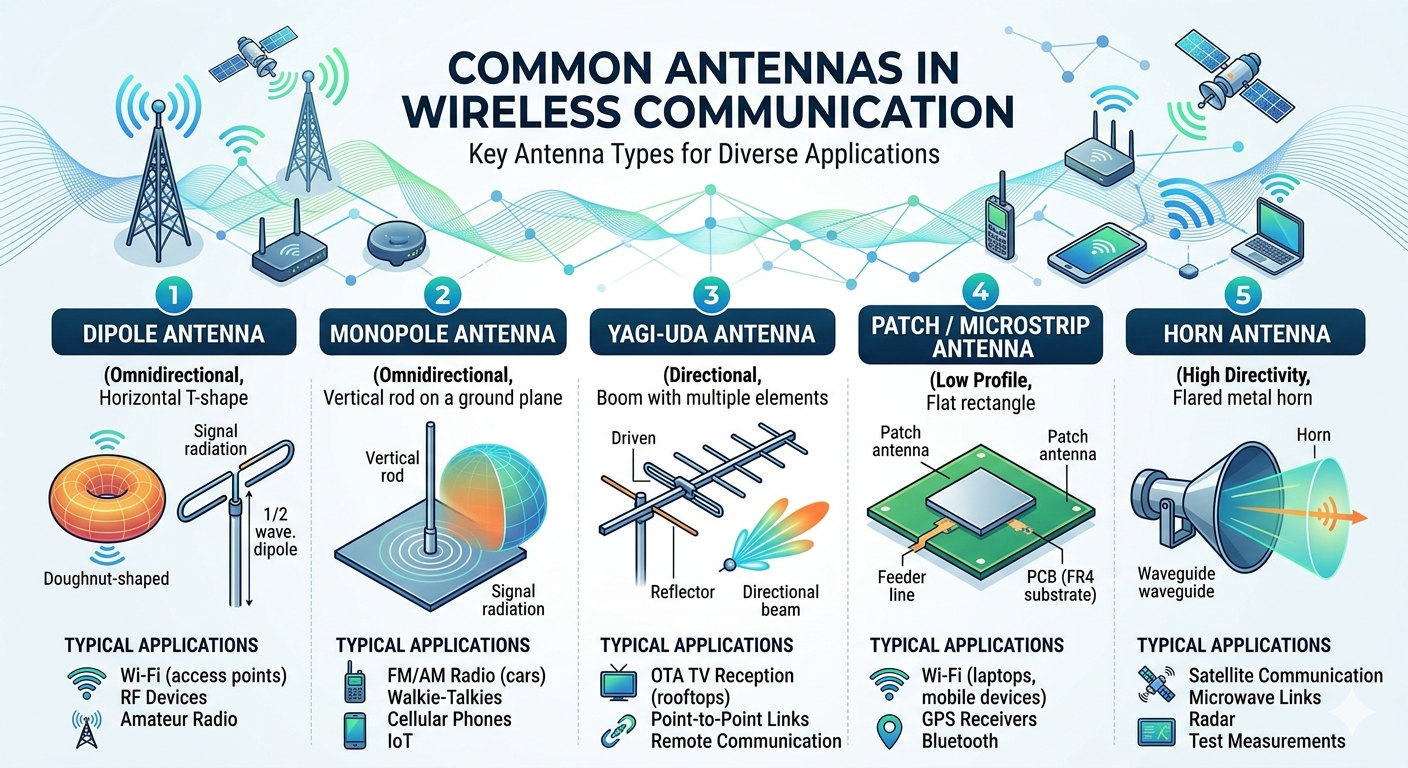
Microstrip patch antennas are flat, lightweight antennas that are widely used in modern wireless communication devices. They are constructed using a metallic patch placed on a dielectric substrate with a ground plane on the opposite side. Their compact structure allows them to be easily integrated into circuit boards, which is why they are common in smartphones, GPS receivers, wearable devices, and wireless sensors. Despite their small size, they are capable of providing efficient performance for high-frequency applications. Their low profile and ease of fabrication make them highly suitable for modern compact electronic systems where space is a critical factor.
Loop Antenna
Loop antennas are formed by creating a closed loop of wire or conductive material. They are categorized based on size, typically small loops and large loops, each serving different purposes. Small loop antennas are mainly used for receiving signals and are valued for their directional properties, which help in locating signal sources. Large loop antennas, on the other hand, can transmit and receive signals more efficiently. They are commonly used in AM radio systems and portable communication devices. Their simplicity, low cost, and ability to function effectively in noisy environments make them a practical choice for various communication applications.
Horn Antenna
Horn antennas are shaped like a flared waveguide that gradually expands outward, allowing electromagnetic waves to spread smoothly into space. This design minimizes signal reflection and enhances directivity, making horn antennas highly efficient for microwave and radio frequency applications. They are widely used in radar systems, satellite communication, and radio astronomy. One of their key advantages is their ability to handle high power levels while maintaining low signal distortion. Their predictable radiation pattern also makes them valuable as reference antennas in measurement systems and testing environments.
Parabolic Reflector Antenna
Parabolic reflector antennas use a curved dish surface to collect and focus electromagnetic waves onto a single focal point where the receiver or transmitter is placed. This design enables extremely high gain and narrow beamwidth, allowing long-distance communication with minimal signal loss. These antennas are commonly used in satellite communication, deep-space probes, television broadcasting, and radar systems. The precision of signal focus provided by the parabolic structure ensures strong and stable communication links even over vast distances. Their performance is highly dependent on accurate alignment and structural precision.
Phased Array Antenna
Phased array antennas consist of multiple individual antenna elements that work together to form a single system. Unlike traditional antennas, they do not rely on physical movement to change direction. Instead, they adjust the phase of the signal fed to each element, allowing the beam to be electronically steered in different directions. This technology enables rapid beam switching and precise targeting, making it essential in modern radar systems, military applications, and advanced communication networks. Phased arrays are also used in satellite tracking and emerging 5G infrastructure due to their flexibility and speed.
Slot Antenna
A slot antenna is created by cutting a narrow slot in a metallic surface, allowing it to radiate electromagnetic waves. It operates as the complement of a dipole antenna and shares similar radiation characteristics. Slot antennas are commonly used in aircraft, spacecraft, and radar systems due to their low profile and aerodynamic design. They are especially useful in environments where protruding antenna structures would be impractical. Their ability to be integrated into metal surfaces makes them valuable in stealth and embedded communication systems.
Spiral Antenna
Spiral antennas are designed in a spiral shape and are known for their wideband and circular polarization properties. They are capable of operating over a broad frequency range without significant changes in performance. This makes them suitable for applications such as satellite communication, electronic warfare, and direction-finding systems. Their symmetrical structure allows them to maintain consistent radiation patterns, and their polarization characteristics help reduce signal degradation caused by environmental factors.
Whip Antenna
A whip antenna is a simple, flexible rod-like antenna commonly used in portable and mobile communication devices. It is typically mounted on vehicles, handheld radios, and walkie-talkies. Its length is usually a fraction of the wavelength of the signal it is designed to transmit or receive. Whip antennas are valued for their durability, ease of use, and omnidirectional radiation pattern. They are particularly effective in situations where mobility and ruggedness are important.
Array Antenna
Array antennas are systems made up of multiple individual antennas arranged in a specific geometric pattern. These elements work together to improve signal strength, directivity, and overall performance. By adjusting the phase and amplitude of each element, array antennas can shape and steer the radiation pattern. They are widely used in advanced radar systems, satellite communication, and wireless base stations. Their scalability allows engineers to design systems ranging from small compact arrays to large, high-performance installations.
Reflector Antenna
Reflector antennas use one or more reflective surfaces to direct radio waves toward a desired direction. The most common form is the parabolic reflector, but other shapes like corner reflectors also exist. These antennas are highly efficient in focusing energy and reducing signal loss. They are used in applications that require high gain and directional precision, such as satellite communication, radio telescopes, and microwave links. Their ability to concentrate energy makes them ideal for long-distance transmission.
Traveling Wave Antenna
Traveling wave antennas operate by allowing electromagnetic waves to travel along their structure rather than being confined to a standing wave pattern. This results in wideband performance and reduced signal reflection. They are often used in high-frequency communication systems, including long-distance radio links and military applications. Their ability to handle a broad range of frequencies makes them useful in environments where signal conditions vary significantly.
Dielectric Resonator Antenna
Dielectric resonator antennas use ceramic or dielectric materials instead of traditional metal conductors to radiate electromagnetic waves. They are highly efficient at microwave frequencies and are widely used in modern wireless communication systems. These antennas offer low loss, compact size, and high radiation efficiency. They are commonly found in satellite receivers, radar systems, and advanced communication devices where performance and miniaturization are essential.
Planar Inverted-F Antenna
The planar inverted-F antenna is a compact antenna design commonly used in mobile devices. It is a variation of the monopole antenna that includes a horizontal element and a grounded section, allowing it to operate efficiently in limited space. This type of antenna is widely used in smartphones, tablets, and wireless communication modules due to its low profile and reliable performance. Its design supports integration into compact electronic systems without compromising signal quality.
Biconical Antenna
A biconical antenna consists of two cone-shaped conductors placed tip to tip. It is known for its wide bandwidth and uniform radiation pattern. This type of antenna is commonly used in electromagnetic compatibility testing, broadband communication systems, and laboratory measurements. Its ability to operate over a wide frequency range makes it valuable for applications requiring consistent performance across multiple bands.
Ferrite Rod Antenna
Ferrite rod antennas are commonly used in AM radio receivers. They consist of a coil of wire wrapped around a ferrite core, which enhances magnetic field reception. These antennas are highly effective for low-frequency signal reception and are widely used in compact radio devices. Their small size and directional sensitivity make them suitable for portable and household electronics.
Vivaldi Antenna
The Vivaldi antenna is an ultra-wideband antenna known for its smooth, exponentially tapered structure. It is designed to operate over a very broad frequency range, which makes it extremely useful in modern communication systems that require flexibility across multiple bands. Its shape allows electromagnetic waves to transition gradually from guided waves to free-space radiation, reducing signal reflection and distortion. This antenna is commonly used in radar imaging, microwave sensing, and advanced wireless systems where wide bandwidth and high resolution are essential. Its planar design also allows it to be manufactured using printed circuit board techniques, making it suitable for compact and high-performance electronic systems.
Fractal Antenna
Fractal antennas use repeating geometric patterns to create a compact structure that can operate efficiently across multiple frequency bands. The unique property of self-similarity in fractal shapes allows these antennas to support multiband and broadband communication within a small physical size. This makes them especially useful in mobile phones, satellite systems, and wireless networking devices. Their ability to compress long electrical lengths into small physical spaces allows engineers to design highly efficient antennas without increasing device size. Fractal antennas are also valued for their ability to maintain consistent performance even when operating conditions change.
Cavity-Backed Antenna
A cavity-backed antenna is designed with a resonant cavity placed behind the radiating element. This structure helps control the direction of radiation and reduces unwanted back radiation. It is commonly used in applications that require high precision and controlled signal patterns, such as radar systems and aerospace communication. The cavity improves impedance matching and enhances efficiency, making the antenna more stable in demanding environments. These antennas are particularly useful when signal accuracy and directional control are more important than size reduction.
Smart Antenna
Smart antennas are advanced systems that use signal processing techniques to dynamically adjust their radiation patterns. Unlike traditional antennas, they can automatically steer beams toward desired users while minimizing interference from other sources. This capability significantly improves signal quality and network efficiency. Smart antennas are widely used in modern cellular networks, including 4G and 5G systems, where they help increase capacity and reduce congestion. They rely on algorithms and multiple antenna elements to continuously optimize performance based on real-time conditions.
MIMO Antenna Systems
MIMO, or multiple-input multiple-output antenna systems, use multiple transmitting and receiving antennas to improve communication performance. By sending multiple data streams simultaneously, MIMO systems significantly increase data throughput and reliability. They are a fundamental technology in modern wireless communication standards, including Wi-Fi and mobile networks. MIMO antennas help reduce signal fading and improve coverage in complex environments such as urban areas. Their ability to enhance both speed and stability makes them essential in high-speed communication infrastructure.
RFID Antenna
RFID antennas are used in radio frequency identification systems to communicate with tags attached to objects. These antennas transmit and receive signals that enable automatic identification and tracking without physical contact. They are widely used in logistics, retail, access control, and inventory management systems. RFID antennas are designed to operate at specific frequency bands depending on the application, and they can be tuned for short-range or long-range communication. Their efficiency and reliability make them a key component in modern tracking technologies.
Traveling Wave Slot Antenna
The traveling wave slot antenna is an advanced variation of slot-based designs where electromagnetic waves travel along a slotted surface rather than forming standing waves. This structure allows for wideband operation and improved radiation efficiency. It is often used in high-frequency applications such as radar systems and satellite communication. The continuous nature of wave propagation in this design reduces losses and improves signal consistency. Its integration into metallic surfaces also makes it useful in aerospace and defense technologies.
Dielectric Lens Antenna
A dielectric lens antenna uses a shaped dielectric material to focus or collimate electromagnetic waves. It works similarly to optical lenses but for radio and microwave frequencies. These antennas are capable of producing highly directional beams with low distortion. They are commonly used in millimeter-wave communication systems, radar imaging, and satellite links. Their ability to control wave propagation with high precision makes them valuable in advanced sensing and communication technologies where accuracy is critical.
Conformal Antenna
Conformal antennas are designed to fit the shape of the surface on which they are mounted. Instead of protruding structures, they are integrated into curved surfaces such as aircraft fuselages, missiles, or wearable devices. This design reduces aerodynamic drag and improves stealth characteristics in military applications. Conformal antennas are also used in modern transportation and aerospace systems where maintaining the shape of the structure is important. Their flexibility in design allows engineers to embed antennas seamlessly into complex surfaces.
Metamaterial Antenna
Metamaterial antennas use artificially engineered materials that exhibit unique electromagnetic properties not found in nature. These materials allow for unusual control over wave propagation, enabling compact and highly efficient antenna designs. Metamaterial-based antennas can achieve improved gain, reduced size, and enhanced bandwidth. They are used in cutting-edge communication systems, including next-generation wireless networks and advanced radar systems. Their ability to manipulate electromagnetic waves at a fundamental level makes them a significant innovation in antenna technology.
PIFA with Enhanced Design
The planar inverted-F antenna can be further enhanced using advanced design techniques to improve bandwidth and efficiency. These improvements often involve modifying the geometry or adding additional elements to optimize performance across multiple frequency bands. Enhanced PIFA designs are widely used in smartphones and compact wireless devices where space is limited but performance requirements are high. Their adaptability makes them suitable for evolving communication standards that demand multi-frequency support in a single device.
Helical Array Antenna
A helical array antenna combines multiple helical elements to improve gain and directivity. Each helix works together to produce a stronger and more focused signal. This type of antenna is often used in satellite tracking and deep-space communication systems where stable circular polarization is required. The array configuration enhances signal strength while maintaining the inherent advantages of helical structures, such as wide bandwidth and reliable performance under changing orientation conditions.
Slot Array Antenna
Slot array antennas consist of multiple slots arranged in a pattern on a conductive surface. These slots work together to produce a controlled radiation pattern with high efficiency. They are commonly used in radar systems, aircraft communication, and high-frequency microwave applications. The array structure allows for precise control of beam direction and shape, making them suitable for advanced scanning and detection systems.
Loop Stick Antenna
The loop stick antenna is an improved version of the ferrite rod antenna, designed for better sensitivity and directionality. It is widely used in AM radio receivers and portable communication devices. Its structure enhances magnetic field reception while maintaining compact size. This makes it ideal for handheld electronics where space is limited but signal clarity is important.
End-Fire Antenna
End-fire antennas are designed to radiate energy along the axis of the antenna structure. This results in a highly directional beam that is useful for point-to-point communication. They are commonly used in microwave links and long-distance communication systems. Their ability to focus energy in a single direction improves efficiency and reduces interference from unwanted signals.
Extended Types
The diversity of communication antennae reflects the growing complexity of modern wireless systems. Each specialized design addresses specific challenges such as bandwidth limitations, size constraints, signal direction, and environmental conditions. From compact embedded antennas in mobile devices to highly sophisticated phased arrays and metamaterial-based systems, antenna technology continues to evolve rapidly. This evolution supports advancements in global communication networks, space exploration, defense systems, and everyday wireless connectivity, making antennas one of the most critical components in modern technology.
Aperture Antenna
An aperture antenna is a type of antenna that radiates electromagnetic waves through an opening or physical aperture in a conductive surface. The size and shape of the aperture directly influence the directionality and efficiency of the signal. These antennas are widely used in microwave and radar systems where controlled beam patterns are essential. They are often embedded in waveguides or metallic surfaces to guide energy toward a specific direction. Their ability to focus energy makes them suitable for high-frequency communication systems, especially in aerospace, defense, and scientific applications.
Waveguide Antenna
Waveguide antennas use hollow metallic structures to guide electromagnetic waves from a source to a radiating aperture. The waves travel through the waveguide with minimal loss, making this type highly efficient for high-frequency applications. They are commonly used in radar systems, satellite communication, and microwave transmission. Waveguide antennas are known for their ability to handle high power levels while maintaining stable performance. Their structure ensures low interference and precise signal delivery, which is important in long-range and high-accuracy communication systems.
Corner Reflector Antenna
A corner reflector antenna consists of a dipole or driven element placed in front of two reflective surfaces arranged at an angle, typically forming a corner shape. This configuration enhances signal directionality and gain by reflecting waves toward a preferred direction. It is widely used in television reception, point-to-point communication, and measurement systems. The design improves signal strength while reducing unwanted radiation in other directions, making it efficient for applications requiring focused transmission.
Cassegrain Antenna
The Cassegrain antenna uses a combination of a primary parabolic reflector and a secondary hyperbolic reflector to focus electromagnetic waves. This dual-reflector system allows for more compact designs while maintaining high gain and efficiency. It is commonly used in satellite communication, radio telescopes, and deep-space tracking systems. The feed system is placed behind the main reflector, reducing structural complexity and improving performance stability. This configuration is especially valuable in systems where precision and space efficiency are critical.
Gregorian Antenna
The Gregorian antenna is similar to the Cassegrain design but uses a concave secondary reflector instead of a convex one. This modification helps improve signal quality and reduce aberrations in the reflected waves. It is widely used in radio astronomy, satellite communication, and advanced radar systems. The design allows for better control of beam shaping and improved overall efficiency, making it suitable for high-performance applications where signal clarity is essential.
Leaky Wave Antenna
A leaky wave antenna operates by allowing electromagnetic waves to gradually “leak” from a guiding structure as they travel along it. This controlled leakage produces a continuous radiation pattern along the antenna length. These antennas are known for their ability to scan beams electronically by changing frequency. They are used in radar systems, imaging applications, and advanced wireless communication technologies. Their unique operation provides frequency-dependent beam steering without mechanical movement.
Dielectric Waveguide Antenna
Dielectric waveguide antennas use non-metallic dielectric materials to guide and radiate electromagnetic waves. These antennas are highly efficient at millimeter-wave and terahertz frequencies. They are commonly used in advanced communication systems, sensing technologies, and imaging devices. Their low-loss characteristics and ability to operate at very high frequencies make them suitable for next-generation wireless networks and scientific applications.
Slot Waveguide Antenna
A slot waveguide antenna combines the principles of waveguides and slot radiation. Slots are cut into the waveguide surface, allowing energy to leak out in a controlled manner. This design provides high efficiency and precise beam control. It is widely used in radar systems and microwave communication. The structure supports high-power transmission while maintaining stable radiation characteristics, making it ideal for demanding environments.
Microstrip Array Antenna
A microstrip array antenna consists of multiple microstrip patch elements arranged in a specific pattern to enhance gain and directivity. These arrays are widely used in wireless communication, satellite systems, and radar applications. By combining multiple radiating elements, the antenna can produce stronger signals and improved coverage. Their planar structure allows easy integration into modern electronic systems, making them essential in compact high-performance devices.
Reconfigurable Antenna
Reconfigurable antennas are advanced antennas capable of dynamically changing their operating frequency, radiation pattern, or polarization. This adaptability is achieved using switches, tunable materials, or electronic control systems. They are widely used in cognitive radio systems, military communication, and modern wireless networks. Their flexibility allows a single antenna to perform multiple functions, reducing the need for multiple dedicated antennas.
Wearable Antenna
Wearable antennas are designed to be integrated into clothing or wearable devices. They are made using flexible materials that allow them to bend and conform to the human body. These antennas are used in health monitoring systems, fitness trackers, and military communication gear. Their design focuses on comfort, durability, and stable performance even during movement. They represent an important step in integrating communication technology into everyday life.
Chip Antenna
Chip antennas are extremely small antennas designed for compact electronic devices. They are typically made using ceramic materials and are mounted directly onto circuit boards. These antennas are widely used in smartphones, Bluetooth devices, IoT sensors, and wireless modules. Despite their small size, they are capable of providing efficient performance at specific frequency bands. Their compact nature makes them ideal for modern miniaturized electronics.
Optical Antenna
Optical antennas operate at optical frequencies and are used to manipulate light instead of radio waves. They are often designed at the nanoscale and are used in advanced scientific and communication applications. Optical antennas play a key role in nanophotonics, optical sensing, and high-resolution imaging. Their ability to interact with light at extremely small scales opens new possibilities in data transmission and optical computing.
Plasma Antenna
A plasma antenna uses ionized gas instead of solid metal to transmit and receive signals. When activated, the plasma acts as a conductive medium for electromagnetic waves. These antennas can be turned on and off electronically, offering stealth and low detectability. They are used in advanced military and research applications. Their unique properties allow for reduced radar cross-section and improved adaptability in dynamic environments.
Liquid Antenna
Liquid antennas use conductive liquids such as saline or liquid metal to form the radiating element. Their shape can be dynamically changed, allowing for reconfigurable performance. These antennas are useful in adaptive communication systems and experimental wireless technologies. Their flexibility allows engineers to explore new designs that are not possible with traditional solid materials.
Advanced Antenna Types
Advanced antenna designs continue to push the boundaries of communication technology by offering higher efficiency, adaptability, and integration with modern systems. From nanoscale optical antennas to flexible wearable and liquid-based structures, these innovations reflect the growing demand for smarter, more compact, and highly efficient communication solutions. As wireless technology evolves, antenna design will continue to play a central role in shaping the future of global connectivity.
Smart Reconfigurable Intelligent Surface (RIS) Antenna Systems
Reconfigurable intelligent surface antenna systems represent an emerging advancement in wireless communication where surfaces are engineered to actively control electromagnetic waves. These surfaces are made up of many small elements that can independently adjust how they reflect, absorb, or refract signals. Instead of generating signals like traditional antennas, they intelligently manipulate existing signals in the environment. This allows for improved coverage, reduced signal loss, and better energy efficiency. They are considered a key technology for future wireless networks because they can enhance communication in crowded or obstructed environments by dynamically shaping the propagation of radio waves.
Massive MIMO Antenna Systems
Massive MIMO antenna systems extend the concept of traditional MIMO by using a very large number of antenna elements at base stations. This allows simultaneous communication with multiple users over the same frequency spectrum. The result is significantly increased capacity, improved reliability, and better spectral efficiency. These systems are essential in modern cellular networks such as 5G and future 6G technologies. By using advanced signal processing, massive MIMO can focus energy precisely toward users, reducing interference and improving overall network performance in dense urban environments.
Millimeter Wave Antennas
Millimeter wave antennas operate at extremely high frequencies, typically between 30 GHz and 300 GHz. These antennas are crucial for ultra-fast wireless communication systems because they can carry large amounts of data. However, they require highly directional designs due to their limited propagation range and sensitivity to obstacles. They are widely used in 5G networks, high-speed wireless backhaul, and advanced radar systems. Their ability to support very high data rates makes them a foundation for next-generation communication technologies.
Terahertz Antennas
Terahertz antennas operate at frequencies between microwave and infrared bands. They are used in cutting-edge research and experimental communication systems. These antennas are capable of extremely high data transmission speeds, making them promising for future wireless networks. They are also used in imaging, spectroscopy, and security scanning applications. However, their development is still in progress due to challenges in signal attenuation and material limitations at such high frequencies.
Nano Antennas
Nano antennas are extremely small antennas designed to interact with light and electromagnetic waves at the nanoscale. They are used in optical communication, biomedical sensing, and nanotechnology research. These antennas operate at optical frequencies and are often made from metallic nanostructures. Their ability to manipulate light at such small scales opens possibilities for ultra-fast communication systems and highly sensitive detection technologies.
Carbon Nanotube Antennas
Carbon nanotube antennas are made using cylindrical nanostructures composed of carbon atoms. These antennas are lightweight, flexible, and capable of operating at a wide range of frequencies. They are being explored for use in miniaturized communication devices, sensors, and advanced electronic systems. Their excellent electrical conductivity and mechanical strength make them a promising material for future antenna technologies.
Graphene Antennas
Graphene antennas utilize graphene, a single layer of carbon atoms arranged in a hexagonal lattice. Graphene has exceptional electrical and thermal properties, allowing antennas made from it to operate efficiently at terahertz frequencies. These antennas are highly tunable, meaning their performance can be adjusted electronically. They are being studied for use in ultra-fast communication systems, flexible electronics, and advanced sensing applications.
Biomedical Implanted Antennas
Biomedical implanted antennas are designed to operate inside the human body for medical monitoring and treatment purposes. They are used in devices such as pacemakers, glucose monitors, and neural interfaces. These antennas must be highly compact, safe, and efficient while operating in complex biological environments. Their design focuses on minimizing power consumption and ensuring reliable communication with external devices.
Underwater Communication Antennas
Underwater antennas are specially designed to operate in aquatic environments where radio wave propagation is highly limited. They often use very low frequencies or acoustic-based communication methods. These antennas are used in submarine communication, underwater exploration, and oceanographic research. Their design must account for signal absorption and scattering in water, making them highly specialized compared to terrestrial antennas.
Directional Beamforming Antennas
Directional beamforming antennas are systems that concentrate signal energy in specific directions using multiple antenna elements and signal processing techniques. This improves signal strength, reduces interference, and enhances communication efficiency. Beamforming is widely used in modern wireless networks, radar systems, and satellite communication. It allows precise targeting of receivers, improving both performance and energy efficiency.
Adaptive Antennas
Adaptive antennas can automatically adjust their parameters based on environmental conditions and signal requirements. They continuously monitor incoming signals and modify their radiation pattern to optimize performance. These antennas are widely used in military communication, mobile networks, and smart wireless systems. Their ability to adapt in real time helps maintain strong and stable communication even in challenging conditions.
Holographic Antennas
Holographic antennas use the principle of wave interference to create highly controlled radiation patterns. They are designed using metasurfaces that manipulate electromagnetic waves at a very fine scale. These antennas are lightweight and capable of producing highly directional beams with minimal power loss. They are considered a promising technology for future satellite communication and advanced wireless systems.
Flexible Printed Antennas
Flexible printed antennas are manufactured using conductive inks printed onto flexible materials such as plastic or fabric. These antennas can bend, stretch, and conform to different shapes without losing performance. They are widely used in wearable electronics, smart clothing, and IoT devices. Their low cost and ease of production make them ideal for large-scale deployment in modern wireless applications.
Energy Harvesting Antennas
Energy harvesting antennas are designed to capture ambient electromagnetic energy from the environment and convert it into usable electrical power. They are used in low-power devices such as sensors and IoT systems to reduce or eliminate the need for batteries. These antennas play an important role in sustainable wireless technology by enabling self-powered communication systems.
Emerging Antenna Technologies
The evolution of antenna technology continues to move toward smarter, smaller, and more adaptive systems. Emerging designs such as intelligent surfaces, nanoscale structures, and energy-harvesting systems represent the future of wireless communication. These advanced antenna types are not only improving data transmission and network efficiency but also enabling entirely new applications in medicine, space exploration, and smart environments. As communication demands increase, antenna innovation will remain at the core of global connectivity development.
Reconfigurable Intelligent Surface Antenna Systems
Reconfigurable intelligent surface antenna systems are an advanced form of wireless technology that does not behave like a traditional antenna in the usual sense. Instead of actively generating signals, these surfaces manipulate existing electromagnetic waves in the environment. They are made up of many small controllable elements that can adjust how signals are reflected or directed. This allows communication systems to reshape signal paths dynamically, improving coverage and reducing dead zones. These systems are considered important for future wireless networks because they can enhance signal strength in difficult environments such as dense cities or indoor spaces without requiring additional power-hungry base stations.
Massive MIMO Antenna Systems
Massive MIMO antenna systems use a very large number of antenna elements at a single base station to communicate with multiple users at the same time. This structure significantly increases data capacity and improves network efficiency. Each antenna element works together with advanced signal processing techniques to direct energy precisely toward users while minimizing interference. These systems are widely used in modern mobile networks, especially in high-density areas where many devices are connected simultaneously. Their ability to support high-speed communication and stable connections makes them a key technology in current and future wireless standards.
Millimeter Wave Antennas
Millimeter wave antennas operate at very high frequencies and are capable of transmitting large amounts of data at extremely fast speeds. Because these waves have shorter wavelengths, they require highly directional antenna designs to maintain strong signal quality. They are commonly used in next-generation mobile networks and high-speed wireless systems. However, their signals can be easily blocked by obstacles such as walls or buildings, which makes careful antenna placement and beam control very important. Despite these challenges, they play a major role in enabling ultra-fast communication technologies.
Terahertz Antennas
Terahertz antennas operate in a frequency range between microwave and infrared signals. These antennas are still in the experimental and research stage but are expected to play a major role in future communication systems. They can support extremely high data transmission rates, far beyond current wireless technologies. They are also used in imaging and security scanning systems because of their ability to detect materials without harmful radiation. The main challenge in this technology is managing signal loss and developing suitable materials that can operate efficiently at such high frequencies.
Nano Antennas
Nano antennas are extremely small antennas designed to interact with light and electromagnetic waves at the nanoscale level. These antennas are often used in scientific research, optical communication, and biomedical sensing. Their small size allows them to operate at optical frequencies, making them suitable for high-speed data transmission systems in future technologies. Nano antennas also play a role in detecting biological and chemical changes at a very small scale, which makes them valuable in medical diagnostics and nanotechnology applications.
Carbon Nanotube Antennas
Carbon nanotube antennas are made from cylindrical carbon structures that have excellent electrical conductivity and mechanical strength. These antennas are lightweight, flexible, and capable of operating across a wide range of frequencies. They are being studied for use in compact electronic devices, sensors, and advanced communication systems. Their unique material properties allow them to be integrated into flexible and miniature devices, making them a strong candidate for future wearable and nanoscale technologies.
Graphene Antennas
Graphene antennas use a single layer of carbon atoms arranged in a hexagonal structure. Graphene is known for its exceptional electrical, thermal, and mechanical properties, which make it ideal for high-performance antenna design. These antennas are highly tunable, meaning their operating characteristics can be adjusted electronically. They are expected to play a major role in terahertz communication systems, ultra-fast data networks, and flexible electronic devices. Their potential for miniaturization and efficiency makes them one of the most promising innovations in antenna research.
Biomedical Implanted Antennas
Biomedical implanted antennas are designed to operate inside the human body for medical monitoring and treatment purposes. They are used in devices such as pacemakers, insulin monitors, and neural implants. These antennas must be extremely small, safe, and reliable while functioning in complex biological environments. They enable wireless communication between implanted devices and external monitoring systems, improving patient care and reducing the need for invasive procedures. Their design focuses on safety, low power consumption, and stable performance within biological tissues.
Underwater Communication Antennas
Underwater communication antennas are designed to function in aquatic environments where traditional radio signals do not travel effectively. They often rely on very low-frequency signals or alternative methods such as acoustic waves. These antennas are used in submarine communication, underwater exploration, and oceanographic research. Their design must overcome challenges such as high signal absorption and scattering in water. Despite these limitations, they are essential for deep-sea communication and underwater data transmission systems.
Directional Beamforming Antennas
Directional beamforming antennas use multiple antenna elements and signal processing techniques to focus signals in specific directions. This improves signal strength, reduces interference, and increases communication efficiency. Beamforming is widely used in modern wireless networks, radar systems, and satellite communication. By directing energy precisely toward the receiver, these antennas improve performance while reducing wasted energy. This technology is especially important in environments with many competing signals.
Adaptive Antennas
Adaptive antennas are intelligent systems that automatically adjust their radiation patterns based on changing signal conditions. They continuously analyze the environment and modify their behavior to improve performance. These antennas are widely used in mobile communication, military systems, and smart wireless networks. Their ability to adapt in real time helps maintain stable communication even in noisy or rapidly changing environments.
Holographic Antennas
Holographic antennas use advanced surface structures to control electromagnetic waves through interference patterns. They are lightweight and capable of producing highly directional beams with excellent efficiency. These antennas are being developed for use in satellite communication and next-generation wireless systems. Their ability to manipulate waves at a fine level allows for compact and efficient antenna designs that could replace traditional bulky systems in the future.
Flexible Printed Antennas
Flexible printed antennas are created using conductive materials printed onto flexible substrates such as plastic or fabric. These antennas can bend and stretch while maintaining their performance, making them ideal for wearable devices and smart textiles. They are widely used in healthcare monitoring, fitness tracking, and Internet of Things devices. Their low cost and adaptability make them suitable for large-scale production in modern electronic systems.
Energy Harvesting Antennas
Energy harvesting antennas capture electromagnetic energy from the environment and convert it into usable electrical power. This allows small electronic devices to operate without traditional batteries. They are commonly used in wireless sensors, IoT devices, and remote monitoring systems. By reducing the need for external power sources, these antennas contribute to more sustainable and self-sufficient communication networks.
Conclusion
Communication antenna technology has evolved from simple wire-based structures into highly advanced, intelligent, and adaptive systems. Each type of antenna is designed to meet specific requirements such as frequency range, size, directionality, and application environment. Traditional designs like dipole and horn antennas laid the foundation for wireless communication, while modern innovations such as massive MIMO, smart surfaces, and nanoscale antennas are shaping the future of global connectivity. Today, antennas are not just signal transmitters and receivers but intelligent systems that can adapt, optimize, and even harvest energy. As communication demands continue to grow, antenna technology will remain at the core of innovation in mobile networks, satellite systems, medical devices, and emerging digital technologies.