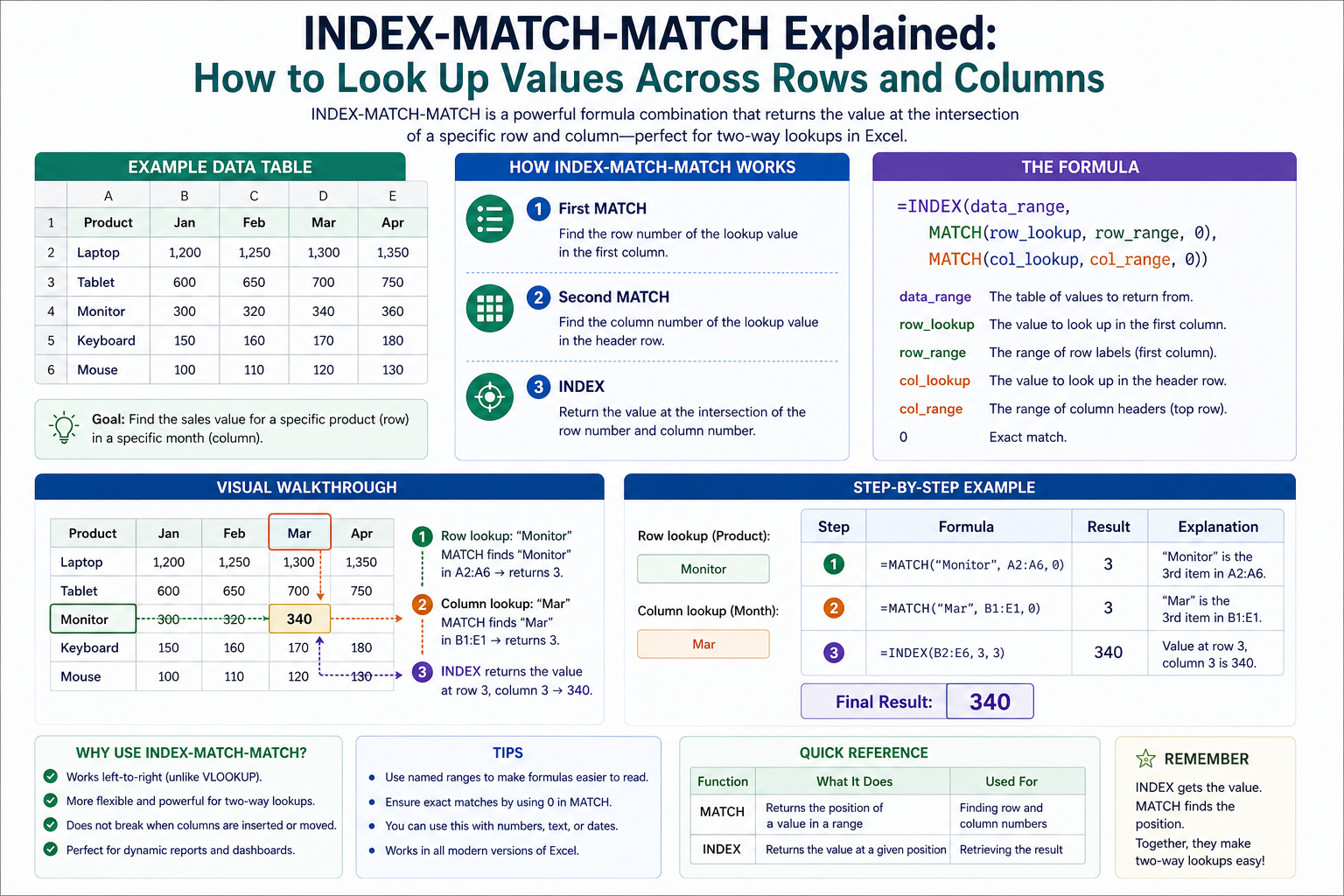
INDEX-MATCH-MATCH is a structured lookup technique designed to retrieve values from a two-dimensional dataset by matching both row and column criteria. It is commonly used when data is arranged in a grid format, where row labels represent one category and column headers represent another category. Instead of relying on fixed cell references, this method dynamically identifies positions, making it more flexible and reliable for changing datasets.
At its core, this method answers a simple question: find the value where a specific row and a specific column intersect. The strength of this approach lies in its ability to perform accurate lookups even when the structure of the data changes, such as when new rows or columns are added or removed.
Breaking Down the INDEX Function
The INDEX function is the foundation of this method. It is responsible for returning a value from a specific position inside a defined range. Instead of searching for data based on labels, INDEX works with numeric positions.
To understand it better, imagine a dataset arranged in rows and columns. INDEX does not care about names or labels directly. Instead, it needs to know two things: the row number and the column number. Once these are provided, it returns the value located at that exact intersection.
This positional approach is what makes INDEX extremely powerful. However, on its own, it is not practical because manually determining row and column numbers in large datasets is inefficient. This is where MATCH functions become essential.
Understanding the MATCH Function
MATCH is a lookup tool that finds the position of a specific value within a range. Unlike INDEX, which retrieves values, MATCH only returns the position of a match.
For example, if you search for a product name in a list, MATCH does not return the product details. Instead, it returns the position where that product appears in the list.
There are two important aspects of MATCH:
First, it searches for a lookup value within a defined range. Second, it returns the relative position of that value within that range.
This positional output is what allows MATCH to connect with INDEX. When MATCH is used twice, once for rows and once for columns, it becomes possible to locate any value in a two-dimensional structure.
Why Two MATCH Functions Are Needed
In a standard dataset, data is organized in a matrix form where rows represent one category and columns represent another. To extract a value, both dimensions must be identified.
One MATCH function is used to identify the correct row by searching within the row labels. The second MATCH function identifies the correct column by searching within the column headers.
This dual matching system ensures that the exact intersection point can be determined without relying on fixed cell references.
Thinking Like a Data System Designer
At this stage, INDEX-MATCH-MATCH is no longer just a formula but a design pattern for structured data access. The real mastery comes when you stop thinking in terms of “finding a value” and start thinking in terms of “designing a retrieval system.”
In real environments, data is not static. It grows, shifts, gets cleaned, and is reused across reports. A well-designed lookup system anticipates this behavior instead of reacting to it. INDEX-MATCH-MATCH fits into this mindset because it separates logic into independent components that can adapt to change.
Building Stable Data Architecture Around It
In professional workflows, the reliability of INDEX-MATCH-MATCH depends heavily on how the dataset is structured. Clean architecture means consistent headers, unique row identifiers, and predictable formatting rules.
When the structure is stable, the lookup system becomes almost self-sustaining. The formula does not need constant maintenance because it is anchored to logical labels rather than physical positions.
This is why experienced analysts often prioritize dataset design before writing any formulas. The formula is only as strong as the structure it relies on.
Reducing Dependency on Manual Adjustments
One of the biggest advantages of INDEX-MATCH-MATCH in long-term systems is reduced manual intervention. Once properly set up, it does not require constant updates when new data is added.
This is especially important in reporting environments where data is updated frequently, such as weekly sales reports or monthly performance dashboards.
Instead of adjusting formulas repeatedly, the system continues to function as long as the structure remains consistent.
Understanding Logical Boundaries in Data
A critical concept in advanced usage is defining clear boundaries for lookup ranges. These boundaries act as the “working zone” for MATCH functions.
If boundaries are too wide, unnecessary data may be scanned, reducing efficiency. If they are too narrow, valid data may be excluded, causing errors.
Balancing these boundaries is part of designing an efficient lookup system. It ensures that MATCH functions operate within predictable and controlled areas.
How INDEX-MATCH-MATCH Supports Data Scalability
Scalability is one of the key reasons this method remains widely used. As datasets grow, the same structure can continue to function without rewriting logic.
New rows can be added to the bottom of a dataset, and new columns can be appended to the right, while the lookup logic remains unchanged.
This makes it suitable for systems that evolve over time, such as financial tracking models, inventory systems, and performance dashboards.
How INDEX-MATCH-MATCH Works Together
When combined, the structure follows a logical sequence. First, the row MATCH function determines the row position. Then, the column MATCH function determines the column position. Finally, INDEX uses these two positions to retrieve the final value.
This process can be visualized as navigating a grid. The first MATCH moves vertically to locate the correct row. The second MATCH moves horizontally to locate the correct column. The intersection of these two movements identifies the final result.
The key advantage of this system is that it does not depend on static cell references. Instead, it dynamically calculates positions based on matching values.
Concept of Two-Dimensional Lookup
INDEX-MATCH-MATCH is essentially a two-dimensional lookup method. Traditional lookup methods typically search in one direction, either vertically or horizontally. However, real-world data often requires both directions simultaneously.
For example, consider a scenario where you have sales data organized by product names in rows and months in columns. If you want to find the sales of a specific product in a specific month, you need both the product name and the month name to locate the correct value.
This is exactly what INDEX-MATCH-MATCH accomplishes. It bridges the gap between two dimensions and allows precise data extraction from a grid.
Step-by-Step Logical Flow of the Formula
The process of INDEX-MATCH-MATCH can be broken down into a logical sequence of steps.
First, the system identifies the row position using the first MATCH function. This involves scanning through a list of row labels until the correct match is found.
Second, it identifies the column position using the second MATCH function. This involves scanning through column headers to locate the correct match.
Third, the INDEX function receives both numeric positions and retrieves the value at their intersection.
This step-by-step flow ensures accuracy and flexibility, especially in dynamic datasets where positions may shift over time.
Why INDEX-MATCH-MATCH Is More Flexible Than Basic Lookups
One of the major advantages of this method is its adaptability. In many datasets, columns may be rearranged or new data may be inserted. Traditional lookup methods that rely on fixed positions can break in such cases.
However, INDEX-MATCH-MATCH relies entirely on matching labels rather than fixed positions. This means even if the structure changes, as long as the labels remain consistent, the formula continues to work correctly.
This makes it highly reliable for long-term use in evolving datasets.
Understanding Exact Match Behavior
In most practical applications, MATCH is used in exact match mode. This ensures that the function looks for an exact match rather than an approximate one.
Exact matching is crucial because it guarantees precision. In datasets where labels must match perfectly, even a small mismatch can lead to incorrect results.
By using exact match behavior, INDEX-MATCH-MATCH ensures that only precise matches are used in calculations.
Common Real-World Structure of Data
To better understand this method, imagine a dataset where rows represent products and columns represent months. Each cell contains sales values.
If you want to find the sales of a specific product in a specific month, you would first locate the product name in the row labels. Then you would locate the month in the column headers. Finally, you would extract the value at their intersection.
This type of structure is very common in business reporting, financial analysis, and performance tracking systems.
Advantages of Using Position-Based Lookup Logic
The biggest advantage of INDEX-MATCH-MATCH is its independence from fixed cell references. Since it works with positions derived from labels, it remains stable even when data expands or shifts.
Another advantage is clarity in logic. Each part of the formula has a specific role: one handles rows, one handles columns, and one retrieves values. This separation makes it easier to understand and debug.
Additionally, it allows more complex data retrieval scenarios compared to simpler lookup methods.
Error Sensitivity and Precision
Because INDEX-MATCH-MATCH relies on exact label matching, it is sensitive to spelling differences, extra spaces, or formatting inconsistencies. Even a small mismatch can prevent the formula from working correctly.
This makes data consistency extremely important when using this method. Clean and standardized labels ensure reliable results and reduce the chance of errors.
How the Logic Feels in Practice
From a practical perspective, INDEX-MATCH-MATCH behaves like a coordinate system. One MATCH finds the vertical coordinate, and the other finds the horizontal coordinate. INDEX then uses these coordinates to pinpoint a single value.
This coordinate-like behavior is what makes the method intuitive once understood. Instead of thinking in terms of cells, you begin thinking in terms of intersections.
Transition Toward Advanced Understanding
Once the basic concept is understood, INDEX-MATCH-MATCH can be extended into more advanced applications. These include dynamic ranges, multiple criteria lookups, and integration with other logical functions.
The foundational idea, however, always remains the same: match row position, match column position, and retrieve the intersecting value.
INDEX-MATCH-MATCH is a structured method for two-dimensional lookup that combines positional matching with dynamic data retrieval. It uses one MATCH function to locate a row, another MATCH function to locate a column, and the INDEX function to return the final value.
Its strength lies in flexibility, accuracy, and adaptability to changing datasets, making it one of the most reliable approaches for working with structured grid-based data.
Building the Complete Logical Structure
Once the core idea is clear, the next step is understanding how INDEX-MATCH-MATCH is actually constructed in a real scenario. The full logic is built in layers, where each part plays a specific role in narrowing down the final result.
At the highest level, the formula works like this: INDEX is the main engine that returns the final value, while the two MATCH functions act as position finders. One MATCH finds the correct row position, and the other MATCH finds the correct column position.
This structure creates a system where the final output is not manually referenced but dynamically calculated based on matching labels.
Understanding the Role of the Row MATCH
The first MATCH function is responsible for identifying the correct row. It scans through a vertical list of labels, such as product names, employee names, or categories.
It compares the lookup value with each item in the list until it finds an exact match. Once found, it returns the relative position of that match within the range.
This position is not the actual row number in the dataset but a relative index within the selected range. That distinction is important because INDEX uses relative positioning inside its defined array.
Understanding the Role of the Column MATCH
The second MATCH function performs a similar task, but horizontally. It searches across column headers such as months, years, regions, or metrics.
Just like the row MATCH, it returns the position of the matched column header within the selected range.
Together, these two MATCH functions create a coordinate system that defines exactly where the target value is located.
How INDEX Combines Both Positions
Once both positions are identified, the INDEX function brings everything together. It takes three main inputs: the data range, the row position, and the column position.
Using these inputs, INDEX navigates directly to the intersection point and returns the value stored there.
This is the moment where the lookup becomes complete. Instead of searching step by step manually, the formula calculates the exact position mathematically.
Why Relative Positioning Matters
A key concept in INDEX-MATCH-MATCH is relative positioning. Both MATCH functions return positions relative to their respective ranges, not absolute worksheet coordinates.
This means the formula is independent of where the data is placed on the sheet. As long as the ranges are defined correctly, the formula will work regardless of location.
This is one of the reasons why this method is considered more stable than position-dependent lookup techniques.
Visualizing the Process as a Grid Navigation System
A helpful way to understand this method is to imagine a grid. The row MATCH acts like moving down a list until the correct label is found. The column MATCH acts like moving across a header row until the correct column is identified.
Once both movements are complete, you arrive at a single intersection point. INDEX then retrieves the value at that point.
This grid-based thinking makes the logic easier to visualize and apply in real datasets.
Importance of Matching Accuracy
Because MATCH relies on exact comparisons, accuracy in data labels becomes critical. Even small inconsistencies such as extra spaces, inconsistent capitalization, or spelling variations can cause mismatches.
When a match fails, the entire formula breaks because INDEX receives incorrect or missing position values.
This is why clean data structure is essential when using this method effectively.
How the Formula Handles Dynamic Data
One of the strongest advantages of INDEX-MATCH-MATCH is its ability to handle dynamic datasets. When new rows or columns are added, the formula continues to work without modification as long as the defined ranges include the new data.
This is because the MATCH functions search within ranges rather than fixed positions. As long as the lookup values exist in the updated ranges, the system automatically adjusts.
This makes it highly suitable for evolving datasets such as monthly reports, inventory tables, or performance dashboards.
Understanding the Separation of Logic Layers
The structure of INDEX-MATCH-MATCH can be broken into three logical layers.
The first layer is input identification, handled by the two MATCH functions.
The second layer is position mapping, where row and column positions are determined.
The third layer is value retrieval, handled by INDEX.
This separation makes the formula easier to understand and debug compared to more rigid lookup systems.
Why This Method Is More Reliable Than Fixed Lookups
Traditional lookup methods often depend on static column numbers. If a column is moved or inserted, the formula breaks or returns incorrect results.
In contrast, INDEX-MATCH-MATCH does not depend on fixed column positions. Instead, it searches for column headers dynamically, which makes it resistant to structural changes.
This adaptability is one of the main reasons it is widely used in professional data analysis.
Common Real-Life Use Scenarios
This method is frequently used in business environments where data is structured in tables with multiple dimensions.
For example, in financial reports, rows might represent expense categories while columns represent months. INDEX-MATCH-MATCH can retrieve any expense value for any month without rewriting formulas.
In HR systems, rows might represent employees and columns might represent performance metrics or evaluation periods. The same logic applies.
In inventory systems, products and time periods can be mapped in the same way.
Understanding the Flow of Calculation
When the formula is executed, the process happens in a specific order. First, the row MATCH is calculated. Then, the column MATCH is calculated. Finally, INDEX uses both results.
This sequential evaluation ensures that the final output depends entirely on the correctness of both lookup stages.
If either MATCH fails, the entire formula cannot complete successfully.
How Errors Typically Occur
Most errors in INDEX-MATCH-MATCH come from mismatched ranges or inconsistent data. If the row range does not align with the INDEX array, or if the column range does not match the structure of the data, incorrect results or errors can occur.
Another common issue is missing values in the lookup lists. If the target label does not exist in the range, MATCH returns an error, which then propagates to INDEX.
Understanding these failure points is important for building reliable formulas.
Concept of Flexible Data Referencing
One of the most powerful ideas behind this method is flexible referencing. Instead of pointing directly to a fixed cell, the formula points to meaning-based labels.
This means the system is not dependent on physical structure but on logical structure. As long as the labels remain consistent, the data can be reorganized without breaking the logic.
This approach is especially useful in dynamic reporting systems where structure changes frequently.
Why Two MATCH Functions Are Essential
A single MATCH can only solve one dimension of the problem. It can either find a row or a column, but not both simultaneously.
Because real-world data often exists in two dimensions, two separate MATCH functions are required. One handles vertical alignment, and the other handles horizontal alignment.
Together, they fully define a coordinate system for data retrieval.
Understanding Intersection Logic
At its core, INDEX-MATCH-MATCH is about finding intersections. Every value in a table exists at the intersection of a row and a column.
The formula simply automates the process of identifying that intersection based on user-defined criteria.
Once this concept is understood, the method becomes much easier to apply across different datasets.
Transition Toward Advanced Applications
After mastering the basic structure, this technique can be extended into more complex scenarios such as multiple criteria lookups, dynamic column selection, and integration with logical conditions.
However, all advanced applications still rely on the same foundation: one MATCH for rows, one MATCH for columns, and INDEX for retrieval.
Moving Beyond Basic Lookups
Once the fundamental structure of INDEX-MATCH-MATCH is clear, the next level is understanding how it behaves in more complex and realistic data environments. In real datasets, values are rarely perfectly clean, structures often expand, and conditions may change dynamically. This is where deeper understanding of how the formula reacts becomes important.
At this stage, the focus shifts from “how it works” to “how to make it reliable under all conditions.”
Understanding Dependency Between Components
INDEX-MATCH-MATCH is not a single calculation but a chain of dependencies. The INDEX function depends entirely on the outputs of both MATCH functions. If either MATCH fails, the entire system breaks.
This dependency chain is important because it means troubleshooting must always begin at the MATCH level, not at INDEX. INDEX itself rarely causes issues; it simply returns what it is given.
So the real intelligence of the system lies in how well the two MATCH functions are constructed.
Common Failure Point: Missing Matches
One of the most frequent issues occurs when the lookup value does not exist in the dataset. When this happens, MATCH cannot find a position and returns an error.
Since INDEX requires numeric positions, any error from MATCH automatically propagates and causes the entire formula to fail.
This is why ensuring complete and accurate lookup lists is critical before applying this method in production-level datasets.
Data Consistency as a Core Requirement
INDEX-MATCH-MATCH is extremely sensitive to inconsistencies in data formatting. Even though it is powerful, it does not interpret meaning—it only compares exact text or values.
Common inconsistencies include extra spaces, hidden characters, mismatched spelling, or inconsistent naming conventions.
For example, “Sales 2024” and “Sales2024” are treated as completely different values.
Because of this strict matching behavior, clean data preparation becomes a necessary step before using the formula effectively.
How Partial Mismatches Break Logic
Unlike fuzzy search systems, MATCH does not guess or approximate results in exact match mode. This means even a small difference leads to failure.
This strict behavior ensures accuracy but requires discipline in data entry and structuring.
In professional environments, this is handled by standardizing naming conventions across all datasets before applying lookup formulas.
Handling Large-Scale Tables Efficiently
In large datasets with hundreds or thousands of rows and columns, INDEX-MATCH-MATCH becomes especially valuable. Instead of manually adjusting references, the formula automatically adapts to the defined ranges.
However, performance considerations become important at scale. Since two MATCH functions are evaluated each time, extremely large datasets may experience slower recalculation times compared to simpler lookups.
Even so, the trade-off is usually worth it because of the flexibility gained.
Dynamic Column and Row Expansion
One of the strongest advantages of this method is its ability to handle expansion. When new rows or columns are added, the formula continues to work as long as the ranges include the new data.
This is particularly useful in reports that grow over time, such as monthly financial tracking or yearly performance analysis.
Instead of rewriting formulas, the structure automatically adapts to include new entries.
Concept of Logical Independence from Layout
INDEX-MATCH-MATCH does not depend on physical layout. This means the position of columns or rows in the worksheet does not matter as long as the lookup ranges are correctly defined.
This logical independence is what makes the method robust in environments where data structure changes frequently.
For example, even if columns are reordered, the formula still finds the correct column by matching its header name rather than relying on position.
Understanding Nested Calculation Behavior
When executed, the formula is evaluated from the inside out. Both MATCH functions are calculated first, producing numeric positions. Then INDEX uses these results to extract the final value.
This nested behavior is important for understanding debugging flow. If something goes wrong, checking each MATCH individually helps isolate the issue.
This step-by-step evaluation structure makes troubleshooting more systematic compared to flat lookup methods.
Improving Reliability with Structured Data Design
To maximize reliability, datasets should be designed with consistent structure from the beginning. Row labels should be unique and stable, and column headers should remain standardized.
This reduces the chance of mismatches and ensures that MATCH functions always return valid positions.
Good structure design is often more important than the formula itself when working with large datasets.
Error Propagation Behavior
A key concept in this system is error propagation. If MATCH returns an error, INDEX cannot process it and will also return an error.
This cascading effect means that one small issue can break the entire result.
Understanding this helps in designing fallback systems or validation steps before applying the formula in critical reports.
How to Think in Terms of Coordinates
At an advanced level, INDEX-MATCH-MATCH should be thought of as a coordinate system rather than a formula. One MATCH defines the vertical coordinate, and the other defines the horizontal coordinate.
INDEX then acts like a pointer that retrieves the value at that coordinate intersection.
This mental model simplifies complex datasets into navigable grids.
Scalability in Business Reporting Systems
In real-world reporting systems, data often spans multiple dimensions such as time, region, product, and category. INDEX-MATCH-MATCH can be adapted to handle these structures by extending or modifying lookup logic.
While more advanced methods may be used for multi-dimensional analysis, the core idea remains the same: identify positions and retrieve intersecting values.
This scalability makes it a foundational concept in data analysis workflows.
Performance Considerations in Large Models
Although powerful, the method involves two separate searches each time it runs. In extremely large datasets, this can add processing overhead.
However, modern systems handle this efficiently in most cases, and the flexibility benefits usually outweigh performance concerns.
Optimization can be achieved by limiting lookup ranges instead of referencing entire columns or rows unnecessarily.
Debugging Strategy for Complex Formulas
When issues arise, a systematic approach is required. The first step is to test each MATCH function independently to ensure it returns the expected position.
Once both MATCH functions are confirmed to work correctly, the INDEX function can be tested with static values.
This layered debugging approach helps isolate problems quickly and reduces confusion in complex datasets.
Understanding Why It Is Considered Advanced Logic
INDEX-MATCH-MATCH is considered advanced because it separates logic into modular components. Instead of relying on a single built-in search mechanism, it constructs a custom lookup system using positional logic.
This modularity gives users full control over how data is searched and retrieved.
It also allows customization that is not possible with simpler lookup methods.
Real Mastery Comes from Structural Thinking
True understanding of INDEX-MATCH-MATCH comes when it is no longer seen as a formula, but as a structured retrieval system.
Once this mindset is developed, users can adapt it to almost any dataset layout or analytical requirement.
The ability to think in terms of intersections, positions, and dynamic references is what separates basic usage from advanced mastery.
Extending INDEX-MATCH-MATCH into Advanced Use Cases
At an advanced level, INDEX-MATCH-MATCH is not limited to simple row-and-column retrieval. It becomes a flexible framework for solving complex data retrieval problems where conditions may change, datasets may grow, and structures may not remain fixed.
One of the most powerful extensions is using dynamic references, where both row and column inputs are derived from other calculations or user inputs. This allows the lookup system to respond automatically to changing criteria without rewriting formulas.
For example, instead of manually selecting a column like “January” or “February,” the column can be determined based on a selected year or condition elsewhere in the dataset.
Multi-Layer Logical Integration
In real-world scenarios, INDEX-MATCH-MATCH is often combined with other logical structures. This includes conditional logic, error handling systems, and dynamic filtering approaches.
By integrating additional logic before the MATCH functions are evaluated, the lookup system can become context-aware. This means it can adjust its behavior based on rules rather than fixed inputs.
For example, a system can be designed to only search within a subset of data based on a selected category before performing the final lookup.
Improving Performance Through Range Optimization
One important optimization technique is limiting the size of lookup ranges. Instead of referencing entire rows or columns, defining precise data boundaries reduces unnecessary calculations.
Smaller, well-defined ranges allow MATCH functions to operate more efficiently, especially in large datasets with thousands of entries.
This not only improves performance but also reduces the chance of unintended matches from unrelated data outside the intended range.
Avoiding Structural Fragility
Although INDEX-MATCH-MATCH is highly flexible, poor dataset design can still introduce fragility. One common issue is inconsistent range alignment between row labels, column headers, and the main data array.
If these ranges are not properly aligned, the returned position from MATCH may not correctly correspond to the structure of the INDEX array.
Ensuring that all ranges originate from the same structured table layout is essential for maintaining accuracy.
Building Robust Lookup Systems
In advanced applications, INDEX-MATCH-MATCH is often part of a larger data validation system. Before performing the final lookup, inputs are typically validated to ensure they exist in the dataset.
This prevents unnecessary errors and ensures smoother execution. In some systems, fallback values are also used so that missing data does not break the entire calculation flow.
This transforms the lookup process from a simple retrieval method into a controlled data access system.
Using INDEX-MATCH-MATCH for Dynamic Reporting
One of the most common real-world applications is in dynamic reporting dashboards. In these systems, users can select different filters such as time period, region, or category, and the results update automatically.
INDEX-MATCH-MATCH plays a key role by acting as the retrieval engine that responds to these selections. Because it is based on labels rather than fixed positions, it adapts instantly to changes in input conditions.
This makes it ideal for interactive reporting environments.
Understanding Structural Independence
A major strength of this method is structural independence. This means the formula does not depend on where data is physically located in a sheet.
Instead, it depends on logical relationships between labels and values. As long as the structure of labels remains consistent, the physical arrangement can change without affecting results.
This independence is what makes it reliable in long-term data systems where layouts evolve over time.
Combining Multiple Criteria Conceptually
Although INDEX-MATCH-MATCH traditionally uses one row and one column condition, it can be conceptually extended to handle multiple conditions by modifying how MATCH inputs are generated.
For example, multiple conditions can be combined into a single logical lookup value before being passed into MATCH. This allows more complex filtering behavior while still maintaining the same core structure.
This approach keeps the system scalable while preserving its original logic framework.
Error Handling Strategies in Advanced Systems
In professional applications, error handling becomes an important part of the system design. Instead of allowing errors to appear directly, they are often managed through fallback logic.
This ensures that missing or invalid data does not break reports or dashboards. Instead, a controlled output is displayed, such as a default value or a blank result.
This improves usability and prevents confusion in decision-making environments.
Why INDEX-MATCH-MATCH Remains Relevant
Even with modern lookup tools and advanced database functions, INDEX-MATCH-MATCH remains widely used because of its transparency and control.
It allows users to clearly understand how results are derived, since each step is explicitly defined. Unlike automated systems that hide logic behind abstraction, this method exposes every stage of the lookup process.
This makes it easier to audit, debug, and adapt to specific analytical needs.
Key Strengths Summarized
The strength of INDEX-MATCH-MATCH lies in its flexibility, accuracy, and adaptability. It works across two dimensions, responds dynamically to structural changes, and maintains logical independence from physical layout.
It also provides clear separation of roles: MATCH handles positioning, while INDEX handles retrieval.
This separation creates a clean and scalable lookup architecture.
Final Conceptual Understanding
At its highest level, INDEX-MATCH-MATCH is not just a formula but a structured retrieval system based on coordinates. It transforms data lookup from a static reference process into a dynamic position-based navigation system.
Instead of asking “what is in this cell,” it asks “where do these conditions intersect,” and then retrieves the value at that intersection.
This shift in thinking is what makes the method powerful in analytical environments.
Conclusion
INDEX-MATCH-MATCH is a highly flexible two-dimensional lookup technique that combines positional matching with dynamic value retrieval. By using one MATCH function to identify a row and another to identify a column, it constructs a coordinate system that INDEX uses to extract precise results.
Its real strength lies in adaptability. It remains stable even when datasets expand, columns shift, or structures evolve, as long as labels remain consistent.
From basic lookups to advanced reporting systems, it serves as a reliable foundation for structured data analysis.
In essence, INDEX-MATCH-MATCH transforms data retrieval into a logical mapping system where intersections define answers, making it one of the most powerful and enduring methods for working with structured tables.