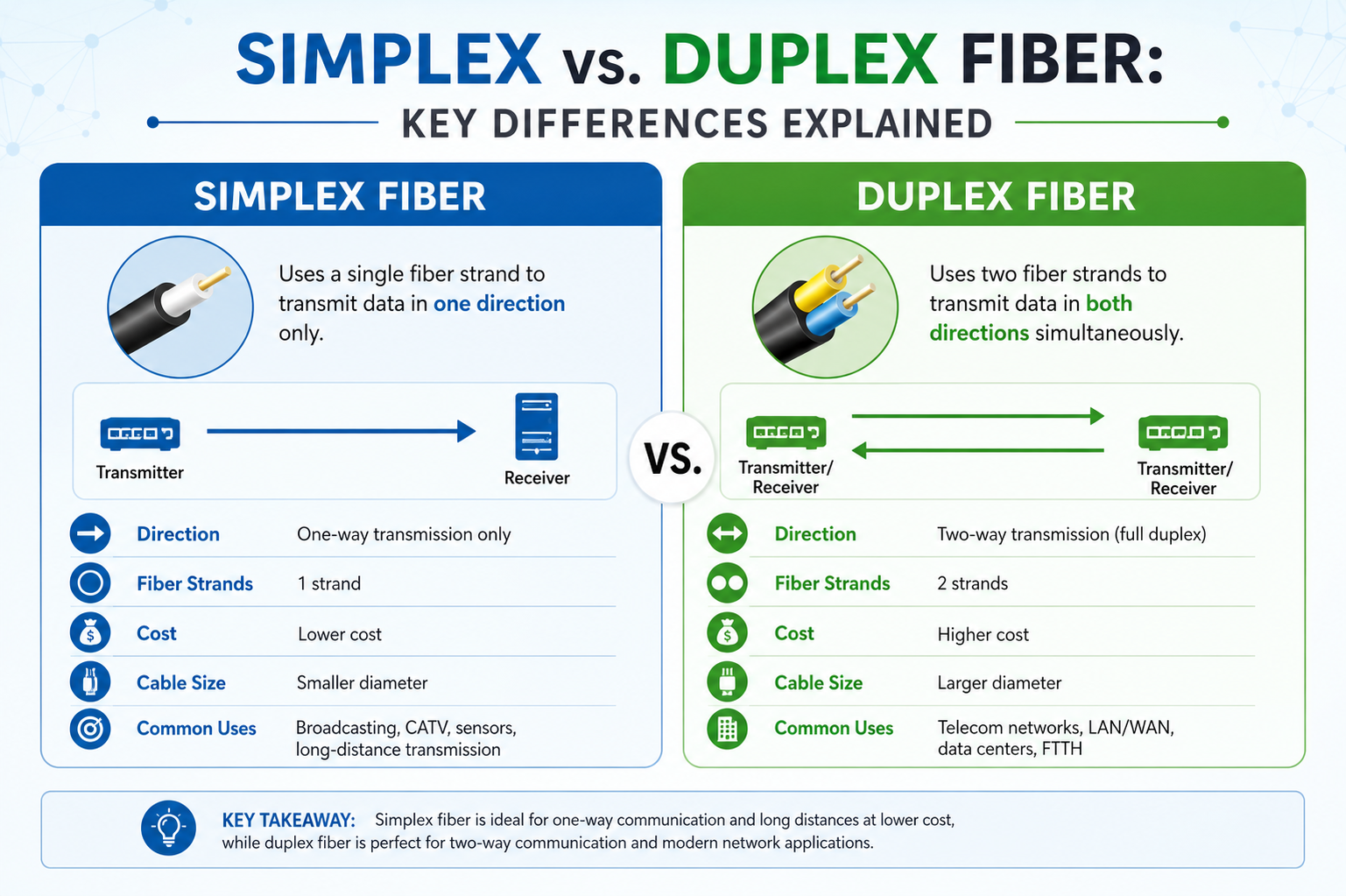
Fiber optic communication is widely used for transmitting data at high speed over long distances, and understanding the difference between simplex and duplex fiber is essential for selecting the right setup for a network.
Simplex Fiber refers to a type of fiber optic cable that allows data transmission in only one direction. In this setup, information flows from the sender to the receiver without any return path on the same fiber. It is typically used in applications where communication is one-way, such as monitoring systems or broadcast transmissions.
Duplex Fiber, on the other hand, supports two-way communication. It consists of two fibers working together, one for sending data and the other for receiving it. This allows simultaneous transmission and reception of data, making it suitable for applications that require interactive communication, such as computer networks and telecommunications.
The main distinction between the two lies in their communication capability. Simplex fiber is designed for unidirectional data flow, while duplex fiber enables bidirectional communication. Duplex systems generally offer greater flexibility and are more commonly used in modern networking environments where real-time data exchange is necessary.
Part 1 continue in 2500 words plz do 1 space between para and headings
Simplex Fiber in Detail
Simplex fiber is the most basic form of fiber optic communication system, designed to carry data in a single direction only. In this type of setup, one fiber strand is dedicated entirely to transmitting data from one point to another without the capability of sending information back through the same path. This unidirectional flow makes simplex fiber straightforward in design and highly efficient for specific applications where feedback or two-way communication is not required.
In a simplex configuration, the transmitter is placed at one end of the fiber and the receiver at the other. Once data is sent, it travels through the fiber optic cable in the form of light pulses and reaches the destination without any return signal path. This simplicity in structure reduces complexity in network design and often lowers the chances of signal interference or configuration errors.
Simplex fiber is commonly used in environments where monitoring, broadcasting, or one-way data delivery is sufficient. For example, it can be found in digital signage systems, sensor data transmission, and certain industrial monitoring setups. In these cases, data is only required to flow in one direction, making simplex fiber an efficient and cost-effective solution.
Another important aspect of simplex fiber is its physical construction. It typically consists of a single optical fiber strand within a protective jacket. Despite its simplicity, it still maintains the high-speed and low-loss characteristics of fiber optic technology, allowing data to travel over long distances with minimal degradation.
One of the key advantages of simplex fiber is its cost efficiency. Since it uses only one strand, it requires less material compared to duplex systems. This can make it attractive for large-scale deployments where only one-way communication is necessary. However, its limitation lies in the inability to support interactive communication, which restricts its use in modern bidirectional networks.
Duplex Fiber in Detail
Duplex fiber is designed to support two-way communication by using two separate fiber strands. One strand is responsible for transmitting data, while the other is dedicated to receiving data. This allows simultaneous exchange of information between two devices, enabling real-time communication.
The structure of duplex fiber is more advanced compared to simplex fiber. Typically, the two strands are paired together within a single cable assembly, making installation easier while maintaining organized cable management. Each strand operates independently, ensuring that sending and receiving processes do not interfere with each other.
Duplex fiber plays a crucial role in modern networking systems where interaction between devices is essential. It is widely used in computer networks, telecommunication systems, data centers, and internet infrastructure. These environments require continuous data exchange, which makes duplex fiber the preferred choice.
There are two types of duplex communication methods in fiber systems: full duplex and half duplex. In full duplex mode, data can be sent and received simultaneously without any delay. This is the most common and efficient form used in fiber optic networks. Half duplex, on the other hand, allows communication in both directions but not at the same time, meaning devices must take turns sending and receiving data.
The major strength of duplex fiber lies in its ability to support interactive communication. This makes it suitable for applications such as video conferencing, online gaming, cloud computing, and enterprise networking. These systems rely heavily on fast and continuous two-way data flow.
Although duplex fiber is more complex than simplex fiber, it offers significantly higher functionality. The trade-off comes in the form of slightly higher installation costs and more complex network design. However, these disadvantages are often outweighed by its performance benefits in modern communication systems.
Key Structural Differences Between Simplex and Duplex Fiber
The fundamental difference between simplex and duplex fiber lies in the number of fiber strands used and the direction of data flow. Simplex fiber uses a single strand and supports only one-way communication, while duplex fiber uses two strands to enable two-way communication.
In simplex fiber, the absence of a return path means that data can only travel from sender to receiver. In duplex fiber, the presence of two separate channels allows simultaneous sending and receiving of data. This structural difference significantly impacts how each system is used in real-world applications.
Another important distinction is in cable design. Simplex fiber cables are simpler and lighter because they contain only one fiber core. Duplex cables are slightly thicker due to the inclusion of two fibers, but they are still designed to remain compact and manageable.
The installation process also differs between the two. Simplex fiber is easier to install due to its single-line configuration, whereas duplex fiber requires careful alignment of both transmitting and receiving strands to ensure proper communication.
Performance Comparison
When comparing performance, duplex fiber generally outperforms simplex fiber in most modern applications. This is mainly because duplex systems allow real-time two-way communication, which is essential for interactive networks.
Simplex fiber performs well in scenarios where only one-directional data transfer is required. Since it does not handle return signals, there is no delay caused by bidirectional coordination. However, this also limits its functionality in dynamic environments.
Duplex fiber, especially in full duplex mode, provides high efficiency and speed in communication. It reduces latency by allowing simultaneous data flow, which is critical for time-sensitive applications such as financial transactions and video streaming.
Signal quality in both systems remains high because fiber optics inherently support low-loss transmission. However, duplex systems are more capable of handling complex communication loads due to their dual-channel structure.
Applications of Simplex Fiber
Simplex fiber is commonly used in systems where simplicity and one-way communication are sufficient. It is often found in broadcast systems where information is transmitted from a central source to multiple endpoints without requiring feedback.
It is also used in industrial environments for sensor monitoring, where devices send data to a central control system. Since the sensors do not require responses, simplex fiber is an efficient choice.
Another application includes security systems where cameras or monitoring devices transmit video data to a recording unit. In such cases, the data flow is unidirectional, making simplex fiber suitable.
Simplex fiber is also used in signage and display systems where content is sent from a media player to screens across different locations. The lack of need for return communication simplifies system design.
Applications of Duplex Fiber
Duplex fiber is widely used in modern communication systems that require constant interaction between devices. One of its primary applications is in computer networking, where devices must both send and receive data continuously.
It is also heavily used in telecommunication systems, including telephone networks and internet infrastructure. These systems depend on real-time communication, making duplex fiber essential.
Data centers rely on duplex fiber to manage large volumes of data traffic between servers and storage systems. The ability to handle simultaneous data flow ensures efficient performance and reduced latency.
In enterprise environments, duplex fiber supports internal communication systems, cloud computing services, and collaborative platforms. These applications require high-speed and reliable two-way data transfer.
Advantages of Simplex Fiber
Simplex fiber offers several advantages, particularly in terms of simplicity and cost efficiency. Its single-strand design makes it easier to install and maintain compared to more complex systems.
It is also less expensive due to reduced material usage. This makes it a practical option for applications that do not require bidirectional communication.
Another advantage is reduced configuration complexity. Since there is only one data path, network setup and troubleshooting are generally more straightforward.
Disadvantages of Simplex Fiber
Despite its advantages, simplex fiber has limitations. The most significant drawback is the inability to support two-way communication. This restricts its use in modern interactive systems.
It is not suitable for applications that require real-time feedback or data exchange between devices.
Its usage is therefore limited to specific scenarios where one-way communication is sufficient.
Advantages of Duplex Fiber
Duplex fiber offers greater flexibility and functionality. Its ability to support simultaneous two-way communication makes it ideal for modern networking environments.
It improves efficiency by allowing continuous data exchange without waiting for transmission cycles.
It also supports higher performance applications such as video conferencing, cloud services, and large-scale data transfers.
Disadvantages of Duplex Fiber
The main disadvantage of duplex fiber is its higher cost compared to simplex fiber. It requires more material and slightly more complex installation.
Network design can also be more complicated due to the need to manage two separate data paths.
However, these disadvantages are generally outweighed by its performance benefits.
Choosing Between Simplex and Duplex Fiber
The choice between simplex and duplex fiber depends on the specific requirements of the application. If the system requires only one-way communication, simplex fiber is sufficient and cost-effective.
However, if the application involves interactive communication or real-time data exchange, duplex fiber is the better choice.
Factors such as budget, performance requirements, and scalability should be considered when selecting between the two.
In modern networking environments, duplex fiber is more commonly used due to its versatility and ability to support advanced communication systems.
Real-World Importance of Simplex Fiber
Simplex fiber plays a quiet but important role in many communication and monitoring systems where simplicity is more valuable than complexity. In real-world environments, not every system requires constant back-and-forth communication. Many setups only need data to move in one direction, and in such cases, simplex fiber becomes a practical and efficient choice.
In industrial automation systems, for example, machines and sensors often send status information to a central control unit. These sensors do not need instructions sent back through the same channel. Instead, they simply report readings such as temperature, pressure, or motion. Simplex fiber is ideal here because it ensures stable and uninterrupted data flow without the need for a return path.
In broadcasting systems, simplex fiber is also widely used. Television networks, radio stations, and digital signage systems frequently transmit content from a central source to multiple locations. Since the content only needs to be delivered and not responded to, simplex communication is sufficient. This reduces system complexity and allows large-scale distribution with fewer technical requirements.
Simplex fiber is also useful in security surveillance systems. In many setups, cameras transmit video footage to a recording or monitoring station. The camera does not need feedback from the receiver; it only needs to send data continuously. This makes simplex fiber a natural fit for such applications, ensuring consistent video transmission without interruption.
Even in scientific and environmental monitoring systems, simplex fiber is commonly applied. Weather stations, remote sensors, and research equipment often collect data and send it to a central database. These systems are designed for observation rather than interaction, making one-way communication both practical and efficient.
The real strength of simplex fiber in these situations lies in its stability. Since there is only one direction of data flow, there is less chance of signal conflict or synchronization issues. This makes it highly reliable for systems that prioritize consistent data delivery over interaction.
Real-World Importance of Duplex Fiber
Duplex fiber has become the backbone of modern communication systems because it supports the kind of interaction that today’s digital world demands. Almost every system that involves real-time communication relies on duplex fiber in some form.
In computer networking, duplex fiber is essential for enabling communication between devices such as computers, servers, and routers. When a user sends a request to a server, and the server responds back instantly, both actions occur simultaneously through duplex channels. This back-and-forth exchange is critical for browsing websites, accessing cloud services, and running applications.
Telecommunication systems also heavily depend on duplex fiber. Phone calls, video calls, and messaging services all require continuous two-way communication. Duplex fiber allows both parties to speak and listen at the same time, creating a smooth and natural communication experience.
In data centers, duplex fiber is used to handle massive amounts of data traffic between servers and storage systems. Modern cloud platforms rely on constant data synchronization, backups, and retrieval processes. Without duplex fiber, these operations would be slower and less efficient.
Financial systems are another important area where duplex fiber is essential. Stock trading platforms and banking networks require real-time updates and instant transaction processing. Even a small delay in communication can lead to significant issues in financial environments, making duplex fiber a critical component.
Online gaming and streaming services also rely on duplex fiber. Multiplayer games require players to send and receive data continuously, while streaming platforms need constant communication between servers and users to maintain video quality and reduce buffering.
The importance of duplex fiber in these systems lies in its ability to handle simultaneous communication. This ensures that modern applications can function smoothly without delays or interruptions, which is essential in today’s fast-paced digital environment.
Technical Working Difference Between Simplex and Duplex Fiber
From a technical perspective, the difference between simplex and duplex fiber is based on how optical signals are transmitted through the fiber strands.
In simplex fiber, a single optical strand carries light signals in one direction only. The transmitter converts electrical signals into light pulses, which travel through the fiber and are received at the destination. Since there is no second strand, the system cannot send signals back through the same path.
In duplex fiber, two separate strands are used. One strand handles transmission from device A to device B, while the second strand handles transmission from device B to device A. This separation ensures that signals do not interfere with each other, allowing smooth and simultaneous communication.
The use of light as a transmission medium in both systems ensures high-speed data transfer with minimal loss. However, duplex fiber takes advantage of parallel communication paths, making it more efficient for interactive systems.
The connectors used in duplex fiber are often designed in paired formats to ensure correct alignment of transmitting and receiving channels. This reduces installation errors and ensures proper communication between devices.
Cost and Maintenance Differences
Cost is an important factor when choosing between simplex and duplex fiber systems. Simplex fiber is generally more affordable because it uses fewer materials and has a simpler structure. This makes it suitable for large deployments where budget efficiency is important and only one-way communication is needed.
Duplex fiber, while more expensive, provides greater value in environments that require advanced communication. The additional cost comes from the second fiber strand and more complex connectors. However, this investment is justified by the increased functionality and performance.
In terms of maintenance, simplex fiber is easier to manage due to its simple design. Troubleshooting is straightforward since there is only one communication path. If an issue occurs, it is easier to identify and resolve.
Duplex fiber requires slightly more attention during maintenance because it involves two communication channels. Technicians must ensure that both transmitting and receiving strands are functioning correctly. However, modern systems are designed to minimize these challenges through standardized cabling and labeling.
Scalability and Future Use
When considering long-term scalability, duplex fiber is generally more suitable for future expansion. As communication needs grow, systems often require more complex data exchange capabilities. Duplex fiber already supports this level of communication, making it a future-ready solution.
Simplex fiber, while efficient for basic tasks, has limited scalability in modern networking environments. As systems evolve to require more interaction, simplex setups often need to be upgraded or replaced with duplex configurations.
The growing demand for cloud computing, artificial intelligence, and real-time communication technologies further increases the importance of duplex fiber. These technologies rely heavily on continuous two-way data flow, making duplex systems the standard in modern infrastructure.
Performance in High-Traffic Networks
In high-traffic networks, duplex fiber shows a clear advantage. Since it can handle simultaneous data transmission and reception, it reduces congestion and improves overall network performance. This is especially important in environments where thousands of devices are communicating at the same time.
Simplex fiber, by contrast, is not designed for high-traffic interactive systems. While it can handle large amounts of one-way data efficiently, it lacks the ability to support dynamic communication between multiple devices.
This makes duplex fiber the preferred choice for enterprise networks, internet service providers, and large-scale communication infrastructures.
Installation Process of Simplex Fiber
The installation of simplex fiber is relatively straightforward due to its single-strand design. This simplicity makes it easier for technicians to deploy in environments where basic one-way communication is required. The process typically begins with planning the network route, ensuring that the fiber cable can be laid without unnecessary bends or physical stress that could affect signal quality.
Once the route is determined, the fiber cable is carefully installed along the designated path. Since simplex fiber contains only one optical strand, handling is easier compared to more complex fiber systems. The cable is then connected using appropriate connectors that match the transmission and receiving equipment at both ends.
After physical installation, testing is performed to ensure that light signals are transmitting correctly from the source to the destination. This includes checking signal strength and verifying that there is no significant loss along the fiber path. Because simplex systems are unidirectional, testing is usually simpler and faster.
In most cases, simplex fiber installations require minimal configuration. Once the connection is established, data transmission can begin without complex setup procedures. This makes it highly suitable for projects that require quick deployment and low maintenance overhead.
Installation Process of Duplex Fiber
The installation of duplex fiber is more structured due to its dual-strand design. Each fiber strand must be correctly aligned to ensure proper communication between transmitting and receiving devices. This requires careful planning during the installation phase.
Technicians first identify the communication points and determine the direction of data flow for each device. One fiber strand is designated for sending data, while the other is assigned for receiving data. Proper labeling and organization are essential to avoid connection errors.
During installation, the two strands are usually bundled together within a single cable for convenience. However, each strand must be carefully connected to the correct port on networking equipment. Any mismatch can lead to communication failure or data loss.
After installation, extensive testing is conducted to ensure both channels are functioning properly. This includes verifying that data can be transmitted and received simultaneously without interference. Signal quality checks are also performed to ensure optimal performance.
Although duplex fiber installation is more complex than simplex fiber, modern networking standards and pre-terminated cables have made the process much more efficient and reliable.
Signal Transmission in Simplex Fiber
In simplex fiber systems, signal transmission is based on a single direction of light propagation. Electrical signals are converted into light pulses at the transmitter end and sent through the optical fiber to the receiver.
Since there is only one strand, the light travels in one direction without any return path. This ensures that data flows smoothly without interruption or feedback. The receiver then converts the light signals back into electrical signals for processing.
The absence of bidirectional communication simplifies signal management. There is no need to coordinate timing between sending and receiving operations, which reduces the chances of signal conflict.
However, this also means that any form of response or acknowledgment must be handled through a separate system if required. In many applications, this limitation is acceptable because feedback is not necessary.
Signal Transmission in Duplex Fiber
In duplex fiber systems, signal transmission occurs simultaneously in both directions. Each fiber strand is dedicated to a specific direction of communication. One strand carries outgoing signals, while the other carries incoming signals.
This setup allows devices to communicate in real time without waiting for one transmission to finish before starting another. The result is smooth and continuous data exchange.
The separation of transmission paths prevents signal collision and ensures high data integrity. Each channel operates independently, which improves overall system efficiency.
In full duplex mode, both sending and receiving occur at the same time. This is essential for applications like video calls and live data streaming, where delays can significantly impact performance.
Bandwidth Considerations
Bandwidth plays an important role in determining the efficiency of fiber optic systems. In simplex fiber, the entire bandwidth is dedicated to a single direction of communication. This means that all available capacity is used for transmitting data from one point to another.
While this can be efficient for one-way communication, it limits flexibility in systems that require interaction. There is no shared bandwidth for receiving data, which restricts its usage in dynamic environments.
In duplex fiber, bandwidth is effectively divided between two channels. However, because both channels operate simultaneously, the overall communication capacity is significantly enhanced.
This allows duplex systems to handle larger volumes of data more efficiently. The ability to send and receive data at the same time ensures better utilization of network resources.
Latency Differences
Latency refers to the delay between sending and receiving data. In simplex fiber systems, latency is generally low for one-way communication because there is no need to coordinate bidirectional data flow.
However, if a response is required, additional systems must be used, which can introduce delays.
In duplex fiber systems, latency is minimized because communication occurs in both directions simultaneously. Devices can instantly respond to each other without waiting for transmission cycles to complete.
This makes duplex fiber ideal for real-time applications where speed and responsiveness are critical.
Reliability and Stability
Both simplex and duplex fiber systems offer high reliability due to the inherent advantages of fiber optic technology. However, their stability differs based on usage.
Simplex fiber is highly stable in controlled, one-way communication environments. Since there is no return signal, the risk of interference is minimal. This makes it reliable for dedicated transmission tasks.
Duplex fiber, while slightly more complex, offers greater overall system reliability in interactive environments. The separation of transmission paths ensures that signals do not interfere with each other, maintaining consistent performance.
Modern fiber optic materials and protective coatings further enhance durability in both systems, allowing them to operate effectively over long distances and harsh conditions.
Maintenance Requirements
Maintenance of simplex fiber systems is generally simple and less frequent. Since the system involves only one transmission path, troubleshooting is straightforward. If a fault occurs, technicians only need to inspect a single fiber strand.
Cleaning connectors and ensuring proper alignment are usually sufficient to maintain performance. This makes simplex fiber suitable for environments where maintenance resources are limited.
Duplex fiber systems require slightly more attention due to their dual-channel structure. Both transmitting and receiving paths must be checked regularly to ensure balanced performance.
However, standardized testing tools and diagnostic systems make maintenance efficient. In most cases, issues can be quickly identified and resolved without major system downtime.
Security Aspects
Security in fiber optic communication is generally high due to the nature of light-based transmission. However, there are differences between simplex and duplex systems in terms of communication control.
Simplex fiber offers inherent security advantages in one-way communication because there is no return channel. This reduces the possibility of unauthorized interaction through the same medium.
Duplex fiber, while still highly secure, allows two-way communication, which requires additional network security measures such as encryption and authentication protocols.
In modern networks, duplex fiber security is managed through advanced software and hardware systems, ensuring safe and reliable data exchange.
Environmental Suitability
Simplex fiber is well-suited for environments where simplicity and durability are important. It performs well in industrial, outdoor, and remote monitoring applications where basic data transmission is required.
Duplex fiber is better suited for controlled environments such as data centers, offices, and communication hubs where high-speed interaction is essential.
Both systems can operate under a wide range of environmental conditions, but their usage depends on the complexity of communication required.
Advantages of Fiber Optic Communication in General
Fiber optic communication, whether simplex or duplex, offers several advantages that make it superior to traditional copper-based systems. One of the most important benefits is the ability to transmit data at extremely high speeds. Light signals travel through optical fibers with minimal resistance, allowing for faster communication over long distances.
Another key advantage is low signal loss. Fiber optics experience very little attenuation compared to electrical cables, which means data can travel farther without requiring frequent signal boosting. This makes fiber ideal for long-distance communication networks.
Fiber optic systems are also highly resistant to electromagnetic interference. Unlike copper cables, which can be affected by nearby electrical equipment, fiber optics use light instead of electricity. This ensures stable performance even in environments with high electrical noise.
In addition, fiber optic cables offer better security. Since data is transmitted as light inside a cable, it is much harder to tap or intercept compared to traditional electrical signals. This makes fiber a preferred choice for sensitive communication systems.
Durability is another advantage. Fiber cables are lightweight, flexible, and resistant to corrosion. This increases their lifespan and reduces maintenance requirements over time.
Limitations of Fiber Optic Systems
Despite their many advantages, fiber optic systems also have certain limitations. One of the main drawbacks is the cost of installation. Setting up fiber optic networks requires specialized equipment and skilled technicians, which increases overall expenses.
Another limitation is fragility during installation. Although fiber cables are durable once installed, they can be damaged if bent too sharply or handled improperly during setup. This requires careful installation practices.
Repairing fiber optic cables can also be more complex compared to traditional wiring systems. When a fiber line is damaged, specialized tools are needed to locate and fix the issue, which can increase downtime.
Additionally, fiber optic systems require precise alignment of connectors. Even small misalignments can lead to signal loss or reduced performance.
Comparison in Modern Networking Trends
In modern networking, duplex fiber has become the dominant standard due to the increasing demand for real-time communication. Applications such as cloud computing, video conferencing, and online services depend heavily on continuous two-way data exchange.
Simplex fiber, while still useful, is mostly limited to specific use cases where interaction is not required. It continues to be relevant in industries like broadcasting and monitoring systems, but its role in general networking has decreased.
The shift toward duplex systems reflects the evolution of digital communication. As technology advances, systems require more interactivity, speed, and responsiveness, all of which are supported by duplex fiber.
Even in emerging technologies such as artificial intelligence, smart cities, and Internet of Things (IoT), duplex fiber plays a critical role in ensuring seamless data flow between connected devices.
Future of Fiber Optic Technology
The future of fiber optic communication is strongly focused on increasing speed, efficiency, and capacity. Researchers are continuously working on improving fiber materials and transmission techniques to support next-generation networks.
Duplex fiber is expected to remain the foundation of most communication systems due to its ability to handle simultaneous data transfer. As data demands continue to grow, especially with 5G and beyond, fiber networks will become even more important.
Simplex fiber will still have its place in specialized applications, but its usage will likely remain limited to niche environments where simplicity is more important than interaction.
Advancements in fiber technology may also lead to more integrated systems that combine multiple communication modes within a single infrastructure, further improving efficiency.
Choosing the Right Fiber System
Selecting between simplex and duplex fiber depends entirely on the communication requirements of the system. If the application involves only sending data in one direction, simplex fiber is a practical and cost-effective solution.
However, if the system requires real-time interaction, data exchange, or continuous communication, duplex fiber is the more appropriate choice.
Factors such as budget, scalability, performance needs, and future expansion should all be considered when making this decision. In most modern scenarios, duplex fiber is preferred due to its flexibility and ability to support advanced networking demands.
Understanding the specific role of each system helps organizations build efficient and reliable communication infrastructures that match their operational needs.
Conclusion
Simplex and duplex fiber optic systems represent two different approaches to data communication, each designed for specific purposes. Simplex fiber focuses on simplicity and one-way data transmission, making it suitable for basic applications such as broadcasting, monitoring, and sensor-based systems. Its straightforward structure allows for easy installation, lower cost, and stable performance in environments where feedback is not required.
Duplex fiber, on the other hand, is built for modern communication needs. By enabling two-way data transmission through separate fiber strands, it supports real-time interaction, high-speed networking, and complex digital applications. This makes it essential for computer networks, telecommunications, data centers, and cloud-based systems.
While simplex fiber remains valuable in certain specialized use cases, duplex fiber has become the backbone of today’s global communication infrastructure. Its ability to handle simultaneous sending and receiving of data ensures efficiency, speed, and reliability in an increasingly connected world.
Ultimately, the choice between simplex and duplex fiber depends on the nature of the application. Simplex fiber is ideal for simplicity and cost-effectiveness, while duplex fiber is essential for performance-driven, interactive systems. Together, they highlight the versatility of fiber optic technology in meeting diverse communication needs across industries.