Python is one of the most widely used programming languages in the world because of its readability, flexibility, and simplicity. It supports multiple programming paradigms, including procedural programming, functional programming, and object-oriented programming. Among these, object-oriented programming has become especially important for building scalable and maintainable software systems.
Object-oriented programming, commonly called OOP, is a style of programming that organizes software around objects instead of functions and logic alone. Objects represent real-world entities and contain both data and behavior. In Python, objects are created from classes, which act as templates or blueprints.
As software applications become larger and more complex, developers need ways to structure code efficiently. Without proper organization, programs become difficult to read, maintain, and extend. Object-oriented programming solves many of these problems by allowing developers to group related data and functionality together.
One of the main reasons OOP is popular is because it promotes code reuse. Instead of rewriting the same functionality repeatedly, developers can create reusable structures that save time and reduce errors. This becomes extremely important in enterprise systems, web applications, automation tools, and large-scale software projects.
Within object-oriented programming, developers frequently use relationships between classes to organize behavior. Two of the most important relationships are composition and inheritance. Understanding these concepts deeply helps developers create software that is flexible, scalable, and easy to maintain.
Although composition and inheritance are often discussed together, they are fundamentally different approaches to software design. Many beginner programmers confuse the two concepts because both involve classes interacting with other classes. However, the purpose and structure of each relationship are very different.
Inheritance focuses on specialization. Composition focuses on collaboration. Inheritance creates a hierarchy between classes, while composition combines smaller parts to build larger systems. Both approaches are useful, but choosing the correct one depends entirely on the relationship being modeled.
To fully understand these concepts, it is important to first understand how classes and objects work in Python. Once the foundation is clear, the differences between composition and inheritance become much easier to recognize.
Understanding Classes and Objects
A class is a blueprint used to create objects. It defines the attributes and methods that objects of that type will contain. Attributes store data, while methods define behavior.
For example, imagine a class representing a student. The student may have attributes such as name, age, grade, and student ID. The class may also contain methods like attend_class, submit_assignment, or calculate_average.
When a class is used to create an actual instance, that instance is called an object. Multiple objects can be created from the same class, each containing different data.
Python makes class creation straightforward and readable. Developers define classes using the class keyword and initialize object data using the init method.
Objects are central to object-oriented programming because they allow developers to model real-world systems more naturally. A banking application may contain account objects, customer objects, and transaction objects. A gaming application may contain player objects, enemy objects, and inventory objects.
Using objects helps organize data and functionality together. Instead of having unrelated variables and functions scattered throughout a program, developers can encapsulate everything inside logical structures.
Encapsulation improves readability and simplifies maintenance. If developers need to update functionality related to a particular object, they know exactly where that logic belongs.
As projects grow larger, relationships between classes become increasingly important. Some objects rely on other objects internally, while some classes extend existing classes to create specialized behavior. This is where composition and inheritance become essential.
The Importance of Relationships Between Classes
Software systems are rarely made up of isolated objects. Most applications involve many different classes interacting together to accomplish tasks.
For example, an online shopping platform may include customer classes, payment classes, shipping classes, inventory classes, and order classes. These classes must work together efficiently for the system to function properly.
How developers structure these relationships directly impacts code quality. Poorly designed relationships can create tightly coupled systems that become difficult to modify or extend. Well-designed relationships improve flexibility, readability, and maintainability.
Composition and inheritance are two strategies developers use to organize these relationships.
Inheritance allows one class to acquire behavior from another class. Composition allows one object to contain another object as part of its structure.
Although both approaches provide code reuse and organization, they solve different design problems. Understanding their strengths and weaknesses is one of the most important skills in object-oriented programming.
Before diving deeply into inheritance, it helps to explore composition first because composition often mirrors real-world systems more naturally.
What Is Class Composition?
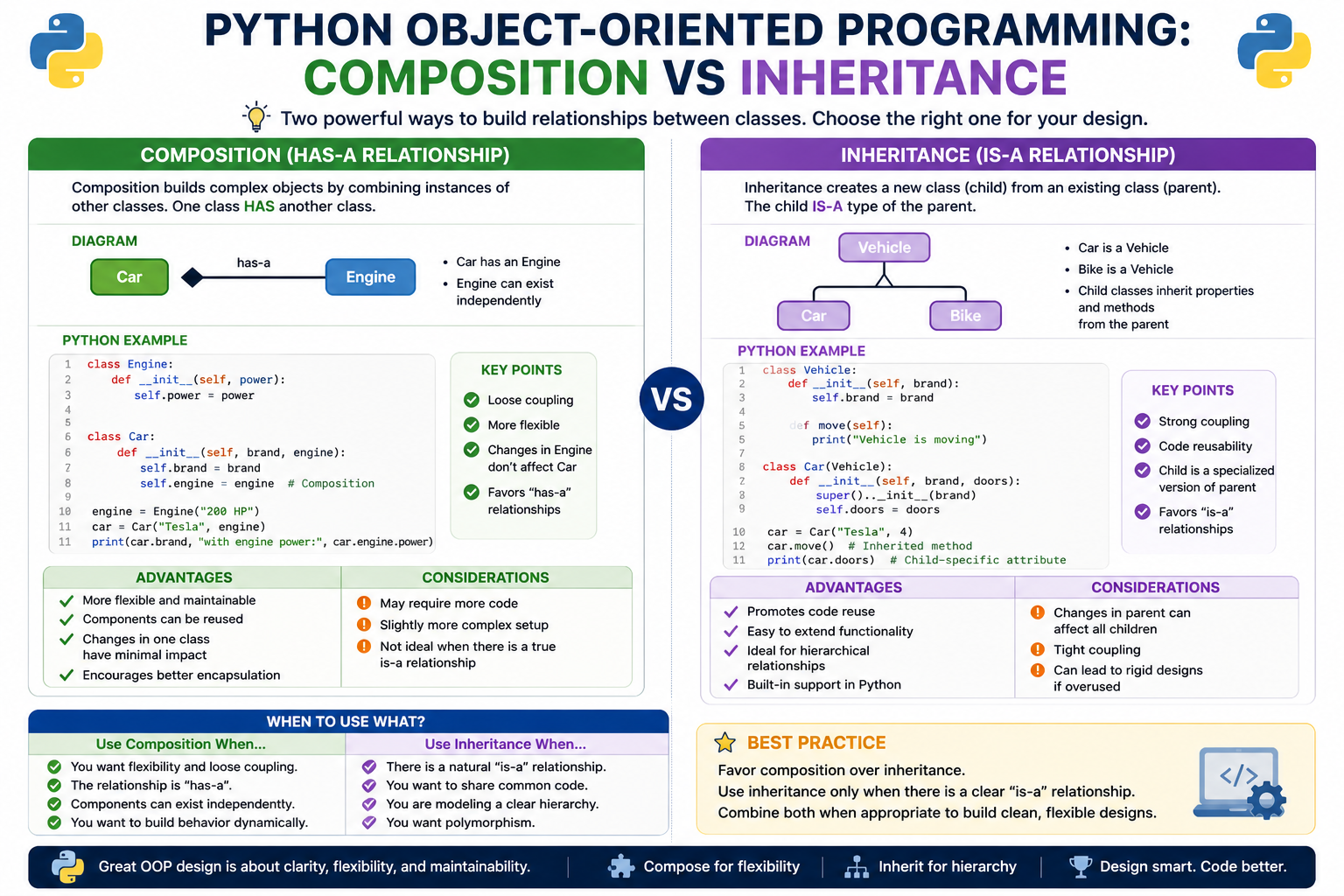
Composition occurs when one class contains another class as one of its attributes. In simple terms, composition represents a has-a relationship.
For example, a car has an engine. A computer has memory. A company has employees. These relationships represent ownership or containment rather than specialization.
In programming, composition allows developers to combine smaller objects together to create larger systems.
Instead of placing all functionality inside one massive class, developers break systems into smaller components with focused responsibilities. These components then work together through composition.
This design approach encourages modularity. Each class handles a specific task independently while collaborating with other classes when necessary.
For example, an Employee object may contain a Payroll object, a Benefits object, and a Schedule object. Each component manages its own responsibility separately.
The Employee class does not need to calculate taxes directly because the Payroll class handles that functionality. It does not need to determine insurance eligibility because the Benefits class manages that behavior.
This separation keeps classes smaller, cleaner, and easier to understand.
Composition is heavily used in Python because Python emphasizes simplicity and maintainability. Many modern frameworks and libraries rely on composition internally to organize complex systems.
How Composition Reflects Real-World Design
One reason composition is so intuitive is because it mirrors how real-world systems are structured.
Consider a smartphone. A smartphone contains a camera, battery, processor, screen, and operating system. None of these components are smartphones themselves, but together they create a complete device.
Similarly, software systems are often collections of smaller specialized components working together.
This approach makes applications easier to expand. If developers want to upgrade functionality, they can replace or modify individual components without redesigning the entire system.
For instance, a payment processing system may contain different payment gateway objects. Developers can swap one gateway for another without changing the entire application architecture.
Composition also promotes reusability. A single component can be reused in multiple systems without duplication.
A Logger class may be used in web applications, desktop applications, and automation tools simultaneously. Because it remains independent, it can integrate into many different environments easily.
This modularity is one of the biggest reasons composition is highly valued in modern software engineering.
Fields and Methods in Composition
To understand composition properly, developers must understand how fields and methods interact inside classes.
Fields are variables associated with an object. These fields store information related to that object.
Methods are functions associated with a class. They define what the object can do.
In composition, one of the fields inside a class is another object.
For example, imagine a Library class. The library may contain a Catalog object responsible for storing and searching books.
The Library object delegates catalog-related tasks to the Catalog object instead of handling everything internally.
This delegation is important because it keeps responsibilities separated.
If the catalog system changes later, developers only need to modify the Catalog class rather than rewriting the entire library application.
Delegation through composition reduces complexity and improves maintainability.
Loose Coupling and Flexibility
One of the biggest advantages of composition is loose coupling.
Loose coupling means components depend on each other as little as possible. When systems are loosely coupled, developers can modify one component without heavily affecting others.
This flexibility is extremely valuable in large applications.
For example, consider a notification system that supports email alerts, SMS messages, and push notifications.
Instead of hardcoding every notification type into one massive class, developers can create separate notification classes. The application can then compose the appropriate notification object depending on the situation.
This allows the application to support new notification methods later without major architectural changes.
Loose coupling also improves testing. Developers can test smaller components independently without initializing entire systems.
This makes debugging easier and helps developers identify problems more quickly.
Composition therefore encourages maintainable and scalable software design.
Runtime Flexibility in Composition
Another major advantage of composition is runtime flexibility.
With composition, objects can change their internal behavior dynamically while the application is running.
For example, a video game character may switch weapons during gameplay. The weapon object inside the character changes, but the character itself remains the same.
This kind of runtime adaptability is much harder to achieve with inheritance.
Inheritance relationships are fixed when classes are defined. A subclass cannot easily change its parent class dynamically during execution.
Composition allows systems to evolve and adapt more naturally.
This is especially useful in applications with plugin architectures, configurable systems, or dynamically changing requirements.
Modern software development increasingly values flexibility because applications frequently evolve after deployment.
Composition helps developers build systems that can adapt without major restructuring.
The Single Responsibility Principle
Composition aligns strongly with an important software engineering principle called the single responsibility principle.
This principle states that a class should have one primary responsibility.
When classes attempt to handle too many unrelated tasks, they become difficult to understand and maintain.
Composition solves this problem by dividing functionality into smaller focused classes.
For example, instead of creating one enormous User class responsible for authentication, billing, profile management, and messaging, developers can separate those concerns into specialized components.
The User object then composes those components together.
This design keeps code organized and reduces complexity significantly.
Smaller classes are easier to test, easier to debug, and easier to modify safely.
As applications grow larger, maintaining clear responsibilities becomes increasingly important.
Why Composition Is Popular in Modern Development
Modern software engineering increasingly favors composition over inheritance in many situations.
This shift occurred because developers realized that deep inheritance hierarchies often create rigid systems that become difficult to maintain.
Composition provides greater flexibility and modularity.
Frameworks, cloud systems, microservices, and modern web applications often rely heavily on compositional design patterns.
For example, dependency injection systems use composition extensively to assemble application components dynamically.
Frontend frameworks also use compositional structures to combine reusable interface elements.
Composition encourages reusable building blocks rather than tightly coupled class hierarchies.
This approach fits well with agile development because requirements frequently change during software projects.
Developers can modify or replace components more easily without affecting the overall system architecture.
As a result, composition has become one of the most valuable techniques in object-oriented programming.
Common Mistakes When Using Composition
Although composition is powerful, developers can still misuse it.
One common mistake is creating too many unnecessary components. Overengineering can make systems difficult to follow.
Not every piece of logic needs its own class.
Developers should balance modularity with simplicity.
Another mistake is poorly defining responsibilities between components. If multiple classes handle overlapping functionality, the architecture becomes confusing.
Clear boundaries between responsibilities are essential for effective composition.
Developers should also avoid excessive communication between components. If classes constantly depend on each other’s internal details, loose coupling disappears.
Well-designed composition relies on clean interfaces and limited dependencies.
When implemented thoughtfully, composition creates software that is flexible, maintainable, and easy to scale.
Preparing to Understand Inheritance
Before exploring inheritance in detail, it is important to recognize that composition and inheritance are not enemies. Both are valuable tools that solve different design problems.
Composition focuses on assembling systems from collaborating parts. Inheritance focuses on creating specialized versions of existing structures.
Understanding composition first helps developers appreciate why inheritance should be used carefully.
Many beginner programmers overuse inheritance because it initially appears convenient. However, experienced developers learn that composition often provides safer and more adaptable architectures.
Inheritance still remains extremely important in object-oriented programming, especially when modeling true hierarchical relationships.
The key is learning when each approach is appropriate.
In the next section, inheritance will be explored deeply, including superclass relationships, method overriding, polymorphism, and the advantages and limitations of inheritance-based design.
Understanding Class Inheritance in Python
Inheritance is one of the most important features of object-oriented programming. It allows developers to create new classes based on existing ones, making software easier to organize, extend, and maintain. In Python, inheritance provides a way to reuse existing functionality while still allowing customization for specialized behavior.
At its core, inheritance creates a relationship between two classes. One class acts as the parent class, also called the superclass or base class. Another class acts as the child class, also called the subclass or derived class.
The child class automatically gains access to the fields and methods defined in the parent class. This means developers do not need to rewrite common functionality repeatedly. Instead, they can define shared behavior once and reuse it across multiple subclasses.
Inheritance represents an is-a relationship. This concept is extremely important because it helps determine whether inheritance is the correct design choice.
For example, a dog is an animal. A manager is an employee. A truck is a vehicle. These relationships describe specialization rather than ownership.
Understanding this difference helps developers avoid incorrect inheritance structures that can make applications difficult to maintain.
Python makes inheritance very simple to implement, which is one reason object-oriented programming is so popular in the language. Developers can create subclasses with minimal syntax while still gaining powerful functionality.
Inheritance is widely used in frameworks, libraries, enterprise systems, and application architectures because it reduces duplication and promotes consistent behavior.
However, inheritance must be used carefully. Although it offers many advantages, poor inheritance design can create rigid and tightly coupled systems.
To fully understand inheritance, it is important to explore how parent and child classes interact in real applications.
The Relationship Between Parent and Child Classes
A parent class defines common characteristics shared among related objects. Child classes inherit those characteristics and then add their own specialized behavior.
Imagine a software system for a transportation company. Every vehicle may have attributes such as brand, model, speed, and fuel capacity. Instead of rewriting these fields for every vehicle type, developers can create a generic Vehicle class.
Specific vehicle types such as Car, Motorcycle, and Truck inherit from the Vehicle class.
Each subclass automatically receives the common functionality while adding its own unique features.
A Truck class may include cargo capacity. A Motorcycle class may include helmet storage information. A Car class may include passenger seating details.
This structure avoids duplication and keeps the code organized logically.
The parent class acts as a foundation that provides shared functionality for all subclasses.
Inheritance therefore allows developers to build structured hierarchies that mirror conceptual relationships.
How Inheritance Reduces Code Duplication
One of the primary goals of inheritance is code reuse.
Without inheritance, developers may need to duplicate identical methods and attributes across many classes. Repetition increases the likelihood of bugs and makes maintenance more difficult.
For example, suppose multiple employee types all need methods for calculating salaries, tracking attendance, and displaying employee information.
Rather than rewriting those methods for each employee type, developers can place shared functionality inside a parent Employee class.
Specialized subclasses such as FullTimeEmployee, PartTimeEmployee, and Contractor inherit the common methods automatically.
This approach significantly reduces redundancy.
If developers later need to update shared functionality, they only modify the parent class instead of editing every subclass individually.
Centralized maintenance is one of the strongest advantages of inheritance.
It also improves consistency because all subclasses behave according to the same foundational rules.
Constructors and Inheritance
Constructors play an important role in inheritance.
In Python, constructors are typically defined using the init method. When subclasses inherit from parent classes, they often need access to parent initialization logic.
Python provides the super() function to simplify this process.
Using super() allows child classes to call parent constructors and reuse initialization code efficiently.
For example, a parent class may initialize common fields such as name and identification number. The child class can then initialize additional fields specific to its own behavior.
This prevents duplication while preserving flexibility.
Constructors in inheritance hierarchies should be designed carefully to avoid unnecessary complexity.
When inheritance trees become too deep, constructor chains can become difficult to understand and maintain.
This is one reason many developers favor shallow inheritance hierarchies instead of extremely layered structures.
Method Overriding in Inheritance
One of the most powerful inheritance features is method overriding.
Method overriding occurs when a child class replaces a method inherited from the parent class with its own implementation.
This allows subclasses to customize behavior while maintaining a consistent interface.
For example, consider an Animal class with a make_sound method.
Different animal subclasses override that method differently.
A Dog class may produce barking sounds. A Cat class may produce meowing sounds. A Bird class may produce chirping sounds.
Although each implementation differs, all subclasses still support the same method name.
This consistency allows developers to write flexible systems capable of handling many object types uniformly.
Method overriding is closely connected to polymorphism, which is another major concept in object-oriented programming.
Understanding Polymorphism
Polymorphism allows objects of different classes to be treated using a shared interface.
This concept becomes especially powerful when combined with inheritance.
Suppose an application contains multiple payment methods such as credit cards, digital wallets, and bank transfers.
Each payment type may implement a process_payment method differently.
Despite the differences internally, the application can interact with all payment methods using the same method call.
This flexibility simplifies software architecture significantly.
Instead of writing separate logic for every object type, developers can rely on common interfaces.
Polymorphism improves extensibility because new subclasses can integrate into existing systems without requiring major changes.
Inheritance therefore provides not only code reuse but also architectural flexibility through shared interfaces.
Real-World Uses of Inheritance
Inheritance appears frequently in real-world software systems.
User interface frameworks commonly use inheritance. Buttons, labels, menus, and text fields may all inherit from a shared Widget class.
Game engines also rely heavily on inheritance. Characters, enemies, projectiles, and environmental objects may inherit from common entity classes.
Operating systems use inheritance for file systems, processes, and hardware abstractions.
Web frameworks frequently provide base controller classes that developers extend to create custom application behavior.
Scientific computing libraries often define abstract mathematical structures that specialized classes inherit and expand upon.
Inheritance is especially useful whenever multiple objects share stable foundational behavior.
By organizing shared functionality into parent classes, developers reduce duplication and maintain cleaner architectures.
Advantages of Inheritance
Inheritance offers many advantages when used correctly.
One major benefit is improved code reuse. Shared functionality only needs to be written once in the parent class.
This reduces development time and decreases the chance of inconsistencies between related classes.
Inheritance also improves maintainability. Since shared behavior exists in one location, updates automatically affect all subclasses.
Another important advantage is conceptual clarity.
Inheritance structures often mirror real-world classifications naturally. Understanding that a Student is a Person or that a Sedan is a Car immediately clarifies the relationship between objects.
Inheritance also supports extensibility.
Developers can create new subclasses without rewriting foundational functionality. This is especially useful in frameworks where developers customize behavior through subclassing.
Consistency is another important benefit.
All subclasses inherit shared methods and fields, ensuring related objects behave predictably across applications.
Inheritance therefore provides structure, organization, and efficient reuse in object-oriented systems.
The Problem With Excessive Inheritance
Although inheritance is powerful, it becomes dangerous when overused.
One common mistake is creating very deep inheritance hierarchies.
Deep hierarchies increase complexity because developers must trace behavior through multiple parent classes to understand how objects function.
This can make debugging extremely difficult.
Changes in parent classes may also unintentionally break child classes.
For example, modifying a method in a superclass might create unexpected side effects in subclasses relying on previous behavior.
This issue is often called the fragile base class problem.
As inheritance trees grow larger, systems become tightly coupled.
Tightly coupled systems are harder to modify because components depend heavily on each other.
This rigidity can slow development and make applications difficult to evolve over time.
Modern software engineering therefore encourages developers to use inheritance carefully and avoid unnecessary hierarchies.
Incorrect Uses of Inheritance
One of the biggest design mistakes developers make is forcing inheritance relationships where none truly exist.
For inheritance to make sense, the relationship must genuinely represent an is-a relationship.
For example, a car is not an engine. A library is not a book. A company is not an employee.
These relationships represent ownership or containment rather than specialization.
Using inheritance incorrectly often produces awkward and confusing software architectures.
Suppose a developer creates a Car class that inherits from an Engine class simply because cars use engines.
This design is incorrect because a car has an engine rather than being a type of engine.
Composition would be the correct solution in that situation.
Recognizing the difference between ownership and specialization is one of the most important skills in object-oriented design.
Inheritance and Tight Coupling
Inheritance naturally creates tighter coupling between classes.
Subclasses depend heavily on the implementation details of their parent classes.
This dependency can become problematic when systems evolve.
If developers modify the parent class significantly, subclasses may stop functioning correctly.
The more subclasses depend on internal parent behavior, the greater the risk.
Tight coupling reduces flexibility because changing one part of the system impacts many other components.
Composition often avoids this issue because composed objects communicate through smaller, more isolated interfaces.
This is one reason many experienced developers prefer composition for highly dynamic systems.
Inheritance remains useful, but developers should avoid relying on it excessively for unrelated functionality.
Single Inheritance vs Multiple Inheritance
Python supports both single inheritance and multiple inheritance.
Single inheritance occurs when a class inherits from only one parent class.
Multiple inheritance occurs when a class inherits from multiple parent classes simultaneously.
Multiple inheritance can be powerful because it allows developers to combine behavior from several sources.
However, it can also create complexity.
When multiple parent classes define the same method, Python must determine which version should be used.
Python resolves this using a method resolution order system.
Although Python handles multiple inheritance well technically, developers should use it cautiously.
Overusing multiple inheritance can create confusing architectures that are difficult to understand and debug.
Many developers prefer composition over multiple inheritance because composition often achieves similar flexibility with less complexity.
Abstract Base Classes and Interfaces
Inheritance is especially useful for defining abstract structures.
An abstract base class defines a common interface that subclasses must implement.
For example, a Shape class may define methods such as calculate_area and calculate_perimeter without providing full implementations.
Specific subclasses such as Circle, Rectangle, and Triangle implement those methods differently.
This structure ensures consistency across related objects.
Applications can then work with generalized shape objects regardless of their specific types.
Abstract base classes are widely used in frameworks and large-scale software systems because they enforce predictable behavior.
They also support polymorphism effectively by ensuring subclasses follow consistent contracts.
Python includes tools for creating abstract base classes through the abc module.
Inheritance in Frameworks and Libraries
Many Python frameworks rely heavily on inheritance.
Web frameworks often provide base models, controllers, and view classes that developers extend.
GUI frameworks provide widget hierarchies that developers customize through subclassing.
Testing libraries allow developers to inherit test case functionality.
Machine learning libraries define estimator interfaces through inheritance.
Inheritance works especially well in frameworks because frameworks often define stable structures developers extend predictably.
However, modern frameworks increasingly combine inheritance with composition to achieve greater flexibility.
Pure inheritance-based architectures are becoming less common because developers recognize the maintenance challenges associated with deep hierarchies.
Comparing Inheritance and Composition Philosophically
Inheritance and composition reflect two different approaches to software design.
Inheritance focuses on extending existing structures.
Composition focuses on assembling independent components.
Inheritance emphasizes hierarchy and specialization.
Composition emphasizes collaboration and modularity.
Inheritance creates strong relationships between classes.
Composition creates flexible partnerships between objects.
Neither approach is inherently superior. The best choice depends entirely on the problem being solved.
Inheritance works best when relationships are stable, conceptual hierarchies are clear, and subclasses genuinely represent specialized versions of parent classes.
Composition works best when flexibility, modularity, and dynamic behavior are priorities.
Understanding these philosophical differences helps developers make better architectural decisions.
When Inheritance Is the Right Choice
Inheritance is most appropriate when several conditions are true.
First, the relationship must genuinely represent an is-a relationship.
Second, subclasses should share significant common functionality.
Third, the hierarchy should remain relatively stable over time.
Fourth, subclasses should behave consistently according to the expectations established by the parent class.
When these conditions are satisfied, inheritance can simplify development significantly.
For example, mathematical structures, graphical interface elements, and framework abstractions often benefit greatly from inheritance.
The key is using inheritance intentionally rather than automatically.
Developers should think carefully about relationships before introducing inheritance into their architectures.
Preparing to Compare Composition and Inheritance Directly
At this point, both composition and inheritance have been explored independently.
Composition focuses on combining objects together to create larger systems.
Inheritance focuses on extending classes to create specialized hierarchies.
Each approach offers unique strengths and introduces different tradeoffs.
Understanding these differences is essential for building maintainable Python applications.
In the next section, composition and inheritance will be compared directly across flexibility, scalability, maintainability, readability, testing, and real-world architectural decisions.
The discussion will also explore why many experienced developers recommend favoring composition over inheritance in modern software engineering while still recognizing the important role inheritance continues to play in object-oriented programming.
Directly Comparing Composition and Inheritance
Composition and inheritance are two of the most important techniques in object-oriented programming. Both approaches help developers structure applications, reuse functionality, and organize relationships between classes. However, the way they achieve these goals is fundamentally different.
Composition builds larger systems from smaller, independent objects. Inheritance creates specialized classes by extending existing ones. These two strategies represent different philosophies of software design, and understanding the differences between them is critical for creating maintainable Python applications.
Many beginner programmers assume inheritance is automatically superior because it appears to reduce duplication quickly. However, experienced developers often rely more heavily on composition because of its flexibility and scalability.
Neither approach is universally better. The correct choice depends entirely on the relationship between the objects being modeled and the long-term goals of the application.
When developers understand the strengths and weaknesses of both strategies, they can create cleaner architectures that remain manageable even as applications grow larger and more complex.
To fully appreciate these concepts, it is important to compare composition and inheritance across several important software engineering categories.
Flexibility and Adaptability
One of the biggest differences between composition and inheritance is flexibility.
Composition is generally far more flexible than inheritance because objects can be changed dynamically during runtime. Since systems are assembled from smaller components, developers can swap or modify those components without redesigning the entire architecture.
For example, imagine an application that supports multiple payment processors. A shopping cart object may contain a payment processor object internally. Depending on configuration settings, the application may use different processors for different regions or customers.
With composition, developers can replace one payment processor with another easily. The shopping cart itself does not need to change because it only interacts with the processor through a defined interface.
Inheritance does not provide this same level of flexibility. Once a subclass inherits from a parent class, that relationship becomes fixed.
Suppose developers create subclasses for every payment processor type. If requirements change dramatically later, restructuring the hierarchy may become difficult and time-consuming.
This is why composition is often preferred in systems where requirements change frequently.
Modern software applications evolve constantly. Features are added, services are replaced, and architectures shift over time. Composition handles these changes more gracefully because components remain loosely connected.
Inheritance works best when relationships are stable and unlikely to change significantly.
Code Reuse and Duplication Reduction
Both composition and inheritance reduce code duplication, but they do so differently.
Inheritance reduces duplication by placing shared functionality inside a parent class. Subclasses automatically gain access to that functionality.
For example, a Vehicle class may contain methods for starting engines, stopping movement, and tracking fuel usage. Subclasses such as Car and Truck inherit those methods directly.
This structure avoids rewriting identical functionality repeatedly.
Composition reduces duplication by allowing reusable components to be shared across multiple systems.
Instead of inheriting functionality, objects delegate responsibilities to independent helper objects.
For instance, multiple applications may reuse the same Logger component, Authentication component, or Notification component without requiring inheritance relationships.
Inheritance is often simpler when objects share a large amount of truly common behavior.
Composition is often more reusable because components remain independent from specific hierarchies.
In many modern architectures, developers favor reusable services and modular components over large inheritance structures.
Scalability in Large Applications
Scalability is one of the most important concerns in software engineering.
Small applications may function well regardless of architecture choices, but large systems expose design weaknesses quickly.
Composition generally scales better than inheritance in very large applications.
This happens because composition encourages modular systems with isolated responsibilities.
Independent components can evolve separately without heavily affecting unrelated areas of the application.
Inheritance hierarchies, on the other hand, can become increasingly fragile as they grow deeper.
A small change in a parent class may affect dozens of subclasses unexpectedly.
As hierarchies expand, understanding behavior becomes more difficult because functionality spreads across multiple layers of inheritance.
Developers may need to trace methods through several parent classes just to understand how one object behaves.
This complexity increases maintenance costs significantly.
Composition avoids many of these issues because components communicate through smaller interfaces rather than deep hierarchical dependencies.
Microservice architectures, plugin systems, and modern cloud applications often rely heavily on compositional design because modular systems scale more effectively.
Readability and Maintainability
Readable code is easier to maintain, debug, and extend.
Composition often improves readability because each class has a focused responsibility.
Smaller classes are easier to understand than massive inheritance trees.
For example, if a developer sees a User object containing Authentication, Preferences, and Notifications components, the structure is immediately understandable.
Each component handles a specific responsibility independently.
Inheritance can also improve readability when hierarchies remain simple and logical.
A clear hierarchy such as Animal, Mammal, Dog is intuitive because the relationships make conceptual sense.
Problems occur when inheritance becomes excessively deep or poorly organized.
Large inheritance trees force developers to mentally track behavior across many classes simultaneously.
This increases cognitive load and makes debugging more difficult.
Composition therefore tends to produce systems that are easier to reason about over time.
This is one reason experienced developers often favor composition in long-term projects.
Testing and Debugging
Testing is another area where composition offers major advantages.
Because composition creates smaller independent components, developers can test each component individually.
Unit testing becomes much easier when classes have isolated responsibilities.
For example, a Billing component can be tested separately from a User component or Notification component.
This isolation simplifies debugging because developers can pinpoint problems more quickly.
Inheritance can complicate testing because subclasses depend heavily on parent implementations.
A bug in a parent class may affect many subclasses simultaneously.
Testing inheritance hierarchies often requires initializing large portions of the architecture just to verify one behavior.
Mocking dependencies also tends to be easier with composition.
Since composed objects communicate through interfaces, developers can replace real components with mock objects during testing.
Modern testing practices therefore align naturally with compositional design.
This does not mean inheritance is untestable, but composition usually creates cleaner testing boundaries.
Loose Coupling vs Tight Coupling
Coupling refers to how strongly components depend on one another.
Composition promotes loose coupling.
Loose coupling means components interact with minimal dependency on each other’s internal implementation details.
This independence improves maintainability and flexibility.
If one component changes internally, other components usually remain unaffected as long as the public interface stays consistent.
Inheritance naturally creates tighter coupling because subclasses depend directly on parent behavior.
Changes in the parent class may impact all subclasses.
This dependency can become problematic in large applications where parent classes evolve frequently.
Tightly coupled systems are harder to modify safely because changes ripple throughout the architecture.
Loose coupling is considered one of the most important qualities of maintainable software.
Composition supports loose coupling far more naturally than inheritance.
This is one reason many modern software engineering principles recommend favoring composition over inheritance.
The Fragile Base Class Problem
One major issue associated with inheritance is the fragile base class problem.
This occurs when modifications to a parent class unintentionally break subclasses.
For example, suppose developers update a parent method to improve performance. A subclass relying on the previous behavior may suddenly malfunction.
These issues can be difficult to detect because changes in one class create side effects elsewhere.
As inheritance hierarchies grow larger, fragile base class problems become increasingly common.
Composition largely avoids this issue because components interact through smaller, more isolated interfaces.
Changes inside one component usually do not affect unrelated systems directly.
This makes composition safer for applications that evolve continuously over time.
Large enterprise systems especially benefit from architectures that minimize cascading side effects.
Real-World Example of Composition
Consider a streaming platform application.
The platform may contain separate components for authentication, recommendations, billing, playback, subtitles, and analytics.
Each component handles a focused responsibility independently.
The application assembles these components together using composition.
If developers later decide to replace the recommendation engine, they can swap that component without rewriting unrelated systems.
This flexibility is one reason composition is heavily used in large-scale cloud applications.
Modern distributed systems often consist of many independent services collaborating together rather than massive inheritance hierarchies.
Composition naturally supports this modular architecture style.
Real-World Example of Inheritance
Now consider a graphical design application.
The application may contain a base Shape class defining common methods such as draw, resize, and move.
Specific subclasses such as Circle, Rectangle, and Triangle inherit from Shape and implement specialized behavior.
This inheritance hierarchy makes conceptual sense because each subclass truly represents a type of shape.
Shared behavior remains centralized while subclasses customize details appropriately.
Inheritance works extremely well in this kind of stable conceptual hierarchy.
This example demonstrates that inheritance remains valuable when relationships are clear and specialization is genuine.
Favoring Composition Over Inheritance
Many experienced developers recommend favoring composition over inheritance whenever possible.
This recommendation does not mean inheritance is bad.
Instead, it reflects the reality that composition usually creates more flexible and maintainable systems.
Inheritance should be reserved for situations where there is a true is-a relationship and where shared behavior genuinely belongs in a common parent class.
Composition should be considered first when objects collaborate together rather than specialize one another.
This philosophy has become increasingly popular in modern software engineering because applications today evolve rapidly.
Flexible architectures are often more valuable than rigid hierarchical structures.
Python developers especially appreciate composition because Python encourages modular and readable code.
How Python Encourages Composition
Python’s dynamic nature makes composition especially convenient.
Unlike some statically typed languages, Python relies heavily on duck typing.
Duck typing means objects are judged by their behavior rather than their inheritance relationships.
If an object provides the required methods, Python usually allows it to work regardless of class hierarchy.
This flexibility reduces the need for rigid inheritance structures.
Developers can create interchangeable components without forcing them into complex parent-child relationships.
Python frameworks frequently use composition internally for this reason.
Dependency injection, middleware systems, decorators, and plugin architectures all rely heavily on compositional patterns.
Python’s simplicity therefore aligns naturally with modular software design.
Combining Composition and Inheritance Together
Although composition and inheritance are often compared, real-world applications frequently combine both approaches.
A game engine may use inheritance for broad entity categories while using composition for abilities, inventory systems, and physics behaviors.
A web framework may use inheritance for base controller functionality while composing authentication services and database connectors.
This hybrid approach allows developers to leverage the strengths of both techniques.
Inheritance provides structure and consistency.
Composition provides flexibility and modularity.
Experienced developers understand that software design is not about blindly choosing one strategy over another.
The goal is to model relationships accurately while keeping systems maintainable and scalable.
The best architectures often balance both approaches thoughtfully.
Common Beginner Mistakes
New programmers frequently make several mistakes when learning composition and inheritance.
One common mistake is using inheritance simply to reuse code even when no logical is-a relationship exists.
For example, inheriting a Car class from an Engine class is conceptually incorrect because a car has an engine rather than being a type of engine.
Another mistake is creating extremely deep inheritance hierarchies.
Developers sometimes build many layers of subclasses unnecessarily, making systems difficult to understand.
Overengineering with composition can also become problematic.
Creating too many tiny components may introduce unnecessary complexity.
Good software design requires balance.
Developers should focus on clear responsibilities, logical relationships, and maintainable structures rather than blindly following trends or patterns.
Practical experience is essential for developing these instincts.
Design Principles Related to Composition and Inheritance
Several important software engineering principles connect closely to these concepts.
The single responsibility principle encourages keeping classes focused on one task. Composition supports this naturally.
The open-closed principle encourages designing systems that can be extended without modifying existing code. Both inheritance and composition can support this principle.
Dependency inversion encourages depending on abstractions rather than concrete implementations. Composition often works especially well with dependency injection techniques.
The DRY principle promotes reducing duplicated code. Inheritance helps centralize shared functionality effectively.
Understanding these principles helps developers make smarter architectural decisions.
Good object-oriented design is not just about syntax. It is about creating systems that remain understandable, adaptable, and reliable over time.
Learning Through Practice
The best way to understand composition and inheritance is through hands-on practice.
Reading explanations helps build conceptual understanding, but real mastery comes from building projects and experimenting with architectures.
Developers should try creating applications using both approaches.
Refactoring projects from inheritance-heavy structures into compositional designs can be especially educational.
Over time, recognizing when to use each technique becomes more intuitive.
Experienced developers rarely think only about immediate implementation convenience. Instead, they consider how systems will evolve months or years later.
Long-term maintainability is one of the most important goals of software architecture.
Composition and inheritance are tools that help achieve that goal when used thoughtfully.
Conclusion
Composition and inheritance are foundational concepts in Python object-oriented programming. Both approaches help developers organize code, reuse functionality, and model relationships between classes. However, they solve problems in very different ways.
Inheritance creates hierarchical relationships where subclasses specialize parent classes. It works best when there is a clear is-a relationship and when shared behavior belongs naturally in a common superclass. Inheritance simplifies code reuse and provides consistent interfaces across related objects.
Composition builds systems from independent collaborating components. It models has-a relationships and emphasizes modularity, flexibility, and loose coupling. Composition allows applications to adapt more easily as requirements evolve and often produces systems that are easier to maintain and test.
Modern software engineering increasingly favors composition because of its scalability and flexibility. However, inheritance still remains extremely valuable when modeling stable conceptual hierarchies.
The key is understanding the problem being solved rather than blindly choosing one approach.
Good developers recognize when objects should specialize existing behavior and when they should collaborate through composition. They design systems carefully, keeping readability, maintainability, testing, and scalability in mind.
Python provides excellent support for both techniques, making it an ideal language for learning object-oriented programming principles. As developers continue practicing and building real applications, they gradually develop the ability to choose the right architectural approach naturally.
Strong software design is not about following rigid rules. It is about creating systems that remain understandable, adaptable, and reliable long after the original code is written.