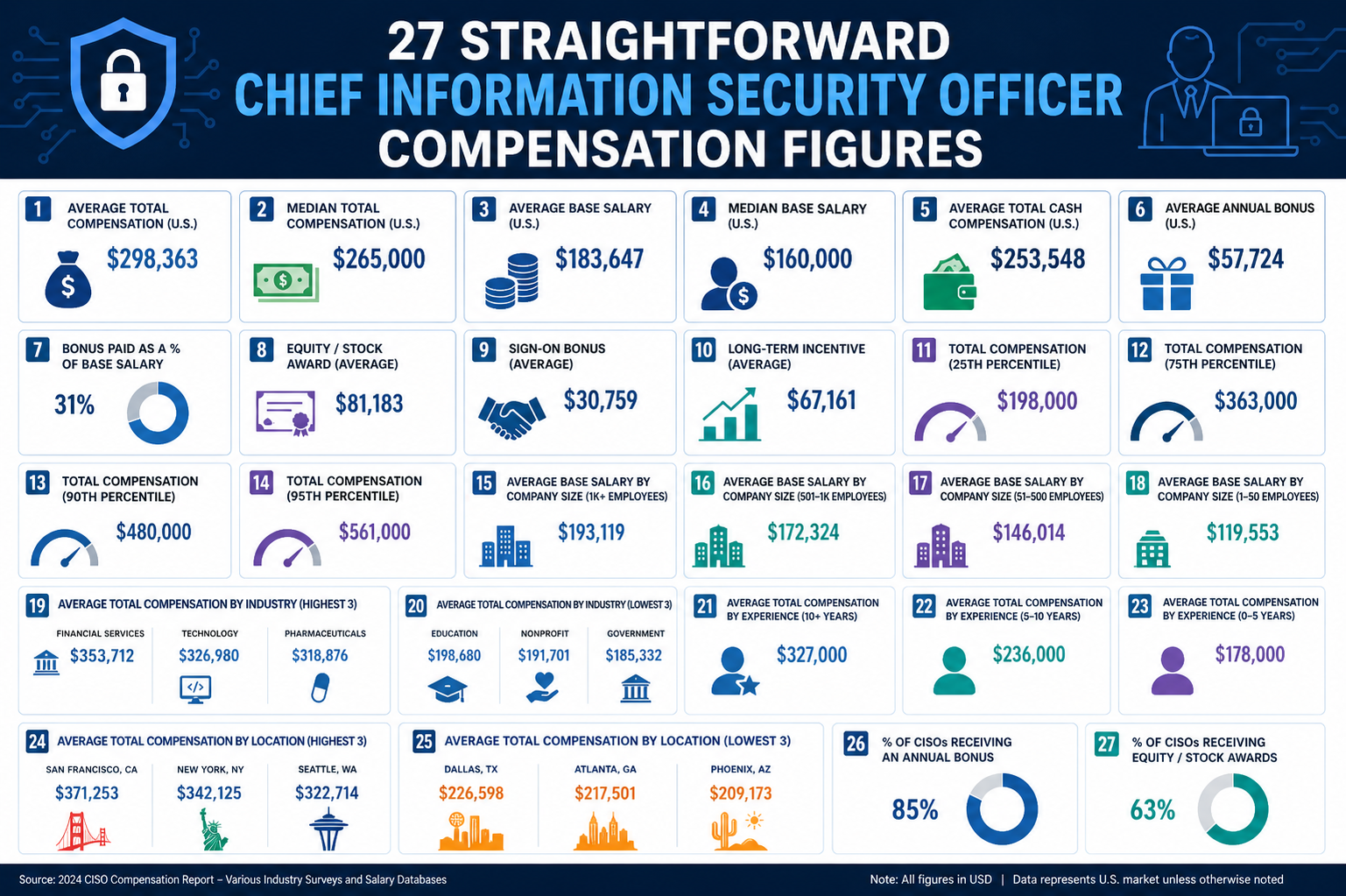
Chief Information Security Officer compensation is no longer limited to a simple fixed salary. In most organizations, the total package is a combination of base pay, annual bonuses, long-term incentives, and non-monetary benefits. The structure is designed to align the CISO’s responsibility with organizational risk exposure. In large enterprises, the base salary is often only a portion of total earnings, with performance-based incentives forming a significant share of income. This structure reflects the strategic importance of cybersecurity leadership in protecting revenue, data, and reputation.
Bonuses are typically tied to measurable security outcomes such as reduction in incident rates, successful audits, compliance achievements, and overall risk management performance. In high-performing companies, these bonuses can significantly increase total annual compensation beyond base salary expectations. Equity or stock options are also common, especially in technology-driven organizations, where long-term value creation is a priority.
Beyond direct financial compensation, CISOs often receive additional perks such as executive healthcare plans, retirement contributions, relocation packages, and enhanced insurance coverage. These benefits reflect the executive-level nature of the role and the high responsibility attached to safeguarding critical digital infrastructure.
Experience-Based Compensation Progression
Compensation for Chief Information Security Officers is strongly influenced by experience level and career progression. Early-stage CISOs, often transitioning from senior security management roles, typically earn lower compensation as they build executive leadership credibility. At this stage, the focus is more on operational expertise and technical leadership rather than enterprise-wide strategic governance.
As professionals gain experience managing larger teams and more complex infrastructures, their compensation increases significantly. Mid-career CISOs are expected to demonstrate not only technical proficiency but also strong business alignment skills. They must translate cybersecurity risk into financial and operational language that executive boards can understand. This ability to bridge technical and business domains directly influences salary growth.
Senior-level CISOs with extensive experience in global enterprises command premium compensation due to their proven track record in handling large-scale cyber threats, regulatory compliance, and crisis management. Their role expands beyond security operations into enterprise risk leadership, making them critical decision-makers within executive teams.
Industry Influence on Salary Levels
The industry in which a Chief Information Security Officer operates plays a major role in determining compensation levels. Highly regulated industries tend to offer higher salaries due to increased risk exposure and compliance requirements. Financial institutions, for example, prioritize cybersecurity at the highest level due to the sensitivity of customer data and financial transactions.
Similarly, healthcare organizations require strong security leadership because of strict data privacy regulations and the critical nature of patient information. In such environments, CISOs are expected to manage complex regulatory frameworks while ensuring uninterrupted service delivery, which justifies higher compensation.
Technology companies also offer competitive salaries, especially when cybersecurity is integral to product development and customer trust. In these organizations, CISOs are often involved in product security, cloud infrastructure protection, and global threat intelligence operations. This expands their role beyond traditional security management, increasing their overall compensation potential.
Other industries such as retail, manufacturing, and logistics offer relatively moderate compensation levels but are rapidly increasing investment in cybersecurity leadership as digital transformation accelerates.
Geographic Impact on Earnings
Location significantly affects Chief Information Security Officer salaries. Organizations based in major financial or technology hubs tend to offer higher compensation due to increased competition for skilled professionals and higher operational costs. In these regions, CISOs are often responsible for managing global teams and complex digital ecosystems, which increases role complexity and pay scales.
In contrast, organizations located in smaller markets or developing regions may offer lower base salaries, although this is often balanced by lower living costs and additional benefits. However, globalization and remote executive leadership have started to reduce geographic disparities, as many CISOs now operate in distributed environments.
International assignments and global oversight roles often come with premium compensation packages. These positions require managing security frameworks across multiple jurisdictions, each with different regulatory requirements, increasing both responsibility and earnings.
Skill Set and Its Effect on Compensation
The skill set of a Chief Information Security Officer has a direct impact on compensation levels. Beyond technical cybersecurity knowledge, modern CISOs are expected to possess strong leadership, strategic planning, and communication abilities. Their role is deeply integrated into executive decision-making processes, requiring them to understand business operations, financial planning, and regulatory compliance.
Advanced expertise in areas such as cloud security, threat intelligence, incident response, and risk management significantly enhances earning potential. Organizations place high value on CISOs who can proactively prevent security breaches rather than simply responding to them after they occur.
Soft skills also play a crucial role. The ability to communicate complex technical risks to non-technical stakeholders, including board members and executives, is essential. CISOs who excel in influencing organizational strategy and fostering a culture of security awareness often receive higher compensation due to their broader impact.
Corporate Size and Organizational Complexity
The size of an organization is one of the most important determinants of CISO compensation. Smaller companies typically operate with limited security infrastructure, resulting in narrower responsibilities and lower salaries. In these environments, CISOs often wear multiple hats, managing both operational security and strategic planning.
Mid-sized companies offer higher compensation as security requirements become more complex. These organizations often face increased regulatory obligations and expanding digital operations, requiring more structured security leadership.
Large enterprises and multinational corporations represent the highest compensation bracket. In these organizations, CISOs oversee vast security ecosystems, including global networks, multiple subsidiaries, and advanced threat landscapes. The complexity of these environments demands highly experienced leadership, which is reflected in substantial compensation packages.
Performance-Based Incentives
Performance incentives are a critical component of modern CISO compensation packages. These incentives are designed to align security outcomes with organizational success. Metrics used to determine performance bonuses often include reduction in security incidents, successful compliance audits, timely incident response, and implementation of advanced security frameworks.
In some organizations, CISOs are also evaluated based on their ability to reduce overall cybersecurity risk exposure, measured through internal risk scoring systems. Strong performance in these areas can lead to substantial bonus payouts, sometimes exceeding a significant portion of base salary.
Long-term incentives such as stock options or restricted stock units further enhance total compensation. These incentives encourage CISOs to focus on long-term security stability and organizational growth rather than short-term operational gains.
Evolving Market Demand for CISOs
The demand for Chief Information Security Officers has increased significantly due to rising cyber threats, digital transformation, and regulatory pressures. Organizations across all industries now recognize cybersecurity as a core business function rather than a technical afterthought.
This growing demand has led to increased competition for experienced CISOs, driving up compensation levels globally. Organizations are willing to invest heavily in security leadership to prevent costly breaches and reputational damage. As a result, compensation packages continue to expand in both scope and value.
Emerging technologies such as artificial intelligence, cloud computing, and Internet of Things systems have further increased the complexity of security environments. CISOs are now expected to manage risks associated with these technologies, adding further value to their role and influencing salary growth.
Future Trends in CISO Compensation
The future of Chief Information Security Officer compensation is expected to continue evolving in response to technological and regulatory changes. As cyber threats become more sophisticated, organizations will increasingly rely on highly skilled security leaders to protect digital assets.
Compensation structures are likely to become more performance-driven, with greater emphasis on measurable security outcomes. Equity-based compensation may also expand, particularly in technology-driven organizations where cybersecurity directly impacts business valuation.
Additionally, the role of the CISO is expected to become more integrated with overall enterprise risk management. This evolution will likely elevate the position further within executive hierarchies, leading to continued growth in compensation levels.
As organizations continue to prioritize digital security, the value of experienced CISOs will remain high, ensuring strong and competitive compensation across industries and regions.
Board-Level Responsibility and Strategic Influence
Chief Information Security Officers operating at senior levels are increasingly expected to interact directly with boards of directors and executive committees. This shift has significantly influenced compensation structures, as the role is no longer purely technical but deeply strategic. CISOs are now responsible for translating cybersecurity risks into business risk language, enabling informed decision-making at the highest level of governance.
In organizations where the CISO regularly reports to the board, compensation tends to be significantly higher. This is due to the elevated accountability associated with protecting shareholder value and maintaining regulatory compliance across complex operational environments. The ability to influence enterprise-wide strategy, investment decisions, and risk appetite directly contributes to increased compensation levels.
Board-facing CISOs are also involved in shaping long-term digital transformation initiatives. Their input affects cloud adoption strategies, data governance frameworks, and enterprise resilience planning. This level of influence positions them as key executive stakeholders rather than operational security managers, further justifying premium compensation packages.
Risk Exposure and Organizational Criticality
Another major factor influencing Chief Information Security Officer compensation is the level of risk exposure within the organization. Companies handling sensitive financial data, intellectual property, or critical infrastructure typically offer higher salaries due to the potential cost of security failures. The higher the potential impact of a cyber incident, the greater the responsibility placed on the CISO.
In industries such as banking, insurance, and capital markets, even minor security breaches can result in significant financial losses and regulatory penalties. As a result, CISOs in these environments are compensated at premium levels to reflect the magnitude of responsibility they carry.
Organizations involved in national infrastructure, energy distribution, and telecommunications also place extremely high value on cybersecurity leadership. In these sectors, security breaches can disrupt essential services, making the role of the CISO mission-critical. Compensation in such environments often reflects the strategic importance of operational continuity and national security considerations.
Cyber Threat Complexity and Evolving Attack Landscape
The increasing sophistication of cyber threats has had a direct impact on CISO compensation. Modern cyberattacks involve advanced persistent threats, ransomware campaigns, and state-sponsored hacking activities. Managing these risks requires highly specialized expertise and continuous adaptation to evolving attack methods.
CISOs are now expected to implement proactive threat detection systems, artificial intelligence-driven security monitoring, and real-time incident response mechanisms. This expanded scope of responsibility increases the value of experienced security leaders who can effectively mitigate emerging threats.
Organizations are willing to pay premium compensation for CISOs who demonstrate strong capabilities in threat intelligence and advanced security architecture design. Their ability to anticipate and prevent complex attacks is considered a critical business advantage.
Regulatory Environment and Compliance Pressure
The global regulatory landscape surrounding cybersecurity has become increasingly complex, contributing to higher compensation for CISOs. Regulations related to data protection, privacy, and cybersecurity compliance vary across regions, requiring organizations to maintain strict adherence to multiple legal frameworks.
CISOs play a central role in ensuring compliance with these regulations, which often include strict reporting requirements, audit obligations, and data protection standards. Failure to comply can result in substantial financial penalties and reputational damage.
As regulatory expectations continue to grow, organizations place greater value on CISOs who can navigate complex compliance environments. This expertise directly influences compensation levels, particularly in multinational corporations operating across multiple jurisdictions.
Leadership of Large Security Teams
The size and structure of security teams under a CISO’s leadership also impact compensation. In smaller organizations, CISOs may oversee compact teams with limited specialization. However, in large enterprises, they are responsible for managing extensive global teams that include security analysts, engineers, architects, and incident response specialists.
Leading large, distributed teams requires advanced leadership skills, operational coordination, and strategic planning capabilities. CISOs must ensure consistent security standards across multiple regions, time zones, and regulatory environments.
The complexity of managing such teams contributes significantly to higher compensation levels. Organizations recognize that effective leadership at this scale is essential for maintaining robust cybersecurity defenses.
Technology Transformation and Digital Expansion
As organizations undergo digital transformation, the role of the CISO expands significantly. Cloud migration, remote work infrastructure, and digital customer engagement platforms have increased the attack surface for most enterprises. This has elevated the importance of cybersecurity leadership at the executive level.
CISOs are now deeply involved in technology strategy, ensuring that security is integrated into every stage of digital development. This includes cloud architecture design, application security, and identity management systems.
Their involvement in technology transformation initiatives directly impacts compensation, as their decisions influence both operational efficiency and risk mitigation. Organizations increasingly view cybersecurity as an enabler of innovation rather than a barrier, further elevating the CISO’s strategic value.
Equity Participation and Wealth Accumulation
In many modern compensation packages, equity plays a significant role in total earnings. CISOs in high-growth companies often receive stock options or restricted stock units as part of their compensation structure. These equity components are designed to align long-term organizational success with executive performance.
In successful companies, equity-based compensation can exceed base salary over time, particularly when stock value appreciates significantly. This creates long-term wealth-building opportunities for CISOs, especially in technology and cybersecurity firms.
Equity participation also encourages retention, as vesting schedules require executives to remain with the organization for extended periods to fully realize financial benefits. This structure benefits both the organization and the executive by aligning long-term interests.
Globalization of Cybersecurity Leadership
The globalization of business operations has increased demand for CISOs with international experience. Organizations operating across multiple countries require security leaders who understand diverse regulatory environments, cultural differences, and regional threat landscapes.
Global CISOs are often responsible for harmonizing security policies across continents while ensuring compliance with local regulations. This requires advanced coordination and strategic oversight capabilities.
As a result, globally experienced CISOs command higher compensation due to the complexity and scale of their responsibilities. Their ability to manage security in diverse environments adds significant value to multinational organizations.
Succession Planning and Executive Stability
Organizations also consider succession planning when determining CISO compensation. Given the critical nature of cybersecurity leadership, companies prioritize stability and continuity in this role. High compensation packages are often used to retain experienced CISOs and reduce turnover risk.
Succession planning responsibilities may also be included in the CISO role, requiring them to develop future security leaders within the organization. This additional responsibility further increases their strategic importance.
Retention-focused compensation structures, including long-term incentives and deferred bonuses, are commonly used to ensure continuity in cybersecurity leadership. These mechanisms reinforce the executive-level importance of the role.
Integration with Enterprise Risk Management
Modern CISOs are increasingly integrated into enterprise risk management frameworks. Rather than operating as isolated security leaders, they now collaborate closely with chief risk officers, chief information officers, and chief financial officers.
This integration ensures that cybersecurity risks are evaluated alongside financial, operational, and strategic risks. The CISO’s input becomes a key component of overall enterprise risk assessments.
This broader integration significantly elevates the role and contributes to higher compensation levels. Organizations recognize that cybersecurity is inseparable from overall business risk, making the CISO a central figure in executive decision-making.
Long-Term Outlook for Compensation Growth
The long-term outlook for Chief Information Security Officer compensation remains strongly positive. As cyber threats continue to evolve and digital transformation accelerates, the demand for highly skilled security leaders is expected to increase further.
Organizations are likely to continue expanding compensation packages to attract and retain top-tier talent. This includes increased base salaries, larger equity allocations, and more performance-based incentives.
The growing importance of cybersecurity in global business strategy ensures that the CISO role will remain one of the most critical and highly compensated executive positions in modern organizations.
CISO Compensation in High-Growth Technology Ecosystems
In high-growth technology environments, Chief Information Security Officer compensation tends to escalate rapidly due to the pace of innovation and the scale of digital exposure. Startups transitioning into mature enterprises often face sudden increases in security requirements as user bases expand and infrastructure becomes more complex. This shift places immediate pressure on security leadership, requiring CISOs to build scalable frameworks from relatively immature systems.
In such ecosystems, compensation is often structured with a lower fixed salary compared to large corporations but significantly higher equity participation. The rationale is that early-stage organizations prioritize long-term value creation over immediate cash compensation. As these companies mature, successful CISOs often see substantial increases in total earnings due to equity appreciation and expanded executive responsibilities.
High-growth technology firms also demand rapid decision-making and agile security strategies. CISOs in these environments are expected to operate with a startup mindset while simultaneously implementing enterprise-grade security controls. This dual expectation increases both workload intensity and compensation potential.
Impact of Digital Transformation on Executive Pay
Digital transformation initiatives have fundamentally reshaped how organizations structure cybersecurity leadership compensation. As businesses shift from legacy systems to cloud-native architectures, the role of the CISO expands into strategic technology governance. This includes oversight of cloud migration, API security, DevSecOps integration, and data architecture redesign.
The increased complexity of digital ecosystems has elevated the importance of security leadership in executive decision-making. CISOs are now required to ensure that security is embedded into digital products from the earliest stages of development rather than being added as a later layer of protection.
This transformation-driven responsibility increases compensation levels because CISOs directly influence both innovation speed and risk exposure. Organizations recognize that poor security integration can slow down digital transformation or lead to costly breaches, making experienced CISOs highly valuable.
Advanced Security Domains and Specialized Expertise
Specialized expertise in advanced security domains significantly impacts Chief Information Security Officer compensation. Areas such as zero-trust architecture, cloud security engineering, identity and access management, and advanced threat hunting are increasingly in demand.
CISOs who possess deep technical understanding of these domains often command higher salaries due to their ability to design and implement next-generation security frameworks. Organizations place premium value on leaders who can bridge the gap between technical architecture and executive strategy.
Additionally, expertise in emerging technologies such as artificial intelligence security, machine learning threat detection, and quantum-resistant encryption is becoming increasingly relevant. CISOs with forward-looking technical knowledge are often compensated at higher levels due to their ability to prepare organizations for future security challenges.
Incident Response Leadership and Crisis Management Value
A significant portion of CISO compensation is influenced by their ability to manage security incidents and crisis situations effectively. Cybersecurity incidents can have immediate and severe financial, operational, and reputational consequences for organizations.
CISOs are expected to lead incident response teams during high-pressure situations, coordinating across technical, legal, and executive functions. Their ability to contain breaches, minimize damage, and restore operations is a critical measure of performance.
Organizations often place substantial financial value on CISOs who demonstrate strong crisis leadership capabilities. Effective incident management can save millions in potential losses, which justifies higher compensation for experienced leaders in this area.
Board Expectations and Executive Accountability
Board expectations for cybersecurity oversight have increased significantly in recent years. Directors now expect detailed reporting on cyber risk posture, threat exposure, and mitigation strategies. This has elevated the CISO role from a technical leadership position to a strategic executive function.
CISOs are often required to present cybersecurity metrics in business terms, linking security performance to financial and operational outcomes. This level of accountability requires strong communication skills and business acumen in addition to technical expertise.
Because of this heightened visibility and accountability, organizations compensate CISOs at higher levels to reflect their influence on enterprise governance. Their decisions directly impact investor confidence, regulatory standing, and long-term business stability.
Talent Scarcity and Competitive Market Dynamics
One of the strongest drivers of CISO compensation growth is global talent scarcity. The demand for experienced cybersecurity leaders continues to outpace supply, creating highly competitive hiring environments.
Organizations often compete aggressively to attract top-tier CISOs, offering enhanced compensation packages that include signing bonuses, relocation incentives, and accelerated equity vesting schedules. This competitive dynamic drives overall salary inflation across industries.
Talent scarcity is particularly acute in specialized sectors such as financial services, healthcare, and critical infrastructure. In these industries, the consequences of inadequate cybersecurity leadership are extremely high, leading to even greater competition for experienced professionals.
Role Expansion Beyond Traditional Cybersecurity
The modern CISO role has expanded far beyond traditional cybersecurity responsibilities. Many CISOs now oversee broader areas such as data governance, privacy compliance, third-party risk management, and digital resilience.
This expansion reflects the growing interconnectedness of cybersecurity with overall business operations. As organizations become more digitally dependent, the CISO’s responsibilities increasingly overlap with other executive functions.
In some cases, CISOs also contribute to product development decisions, ensuring that security is embedded into customer-facing technologies. This expanded scope significantly increases their organizational value and compensation potential.
Performance Measurement and KPI-Driven Compensation
Performance measurement for CISOs has become more structured and data-driven in recent years. Organizations increasingly rely on key performance indicators (KPIs) to evaluate cybersecurity effectiveness. These may include metrics such as mean time to detect threats, incident response time, vulnerability remediation rates, and compliance audit results.
CISOs who consistently achieve strong performance metrics are often rewarded with higher bonuses and accelerated compensation growth. The shift toward KPI-driven evaluation reflects the broader trend of quantifying cybersecurity effectiveness in business terms.
This structured performance evaluation system ensures that compensation is closely aligned with measurable outcomes rather than subjective assessments alone.
Long-Term Organizational Impact and Strategic Value
The long-term impact of a Chief Information Security Officer on organizational success is a major factor in determining compensation. Effective cybersecurity leadership not only prevents financial losses but also enables business growth by building trust with customers, partners, and regulators.
Organizations that maintain strong security postures are better positioned to expand into new markets, adopt new technologies, and maintain operational continuity during disruptions. The CISO plays a central role in enabling this strategic advantage.
As a result, compensation reflects not only immediate operational responsibilities but also long-term organizational value creation. CISOs who contribute to sustained business resilience and growth are often rewarded with higher overall compensation packages.
Future Evolution of Executive Security Compensation
The future of CISO compensation is expected to evolve in line with increasing digital dependency and cyber risk exposure. As organizations continue to integrate advanced technologies, the importance of cybersecurity leadership will continue to grow.
Compensation models are likely to become more dynamic, incorporating real-time performance data, risk-based incentives, and long-term value alignment mechanisms. Equity-based compensation will likely remain a key component, particularly in technology-driven organizations.
Overall, the CISO role is expected to continue rising in strategic importance, ensuring sustained growth in compensation levels across industries and regions.
Regulatory Expansion and Global Compliance Burden
Chief Information Security Officer compensation continues to be heavily influenced by the expanding global regulatory environment. Governments and regulatory bodies across different regions are introducing stricter cybersecurity, privacy, and data protection requirements, which significantly increase organizational compliance responsibilities.
CISOs are now required to interpret and implement complex legal frameworks that vary across jurisdictions. This includes ensuring compliance with data protection laws, cross-border data transfer regulations, and industry-specific security standards. The increasing density of these requirements elevates both workload and accountability.
Because regulatory failure can result in substantial financial penalties and reputational damage, organizations place high value on CISOs who can maintain continuous compliance. This responsibility directly contributes to higher compensation levels, particularly in multinational organizations where regulatory complexity is significantly greater.
Cyber Insurance and Financial Risk Alignment
Cyber insurance has become an important part of enterprise risk management, and CISOs play a key role in securing and maintaining coverage. Insurance providers often evaluate an organization’s cybersecurity maturity before determining premiums, coverage limits, and policy conditions.
CISOs are responsible for ensuring that security controls meet insurer requirements, which may include advanced threat detection, incident response readiness, and data protection standards. Strong cybersecurity leadership can reduce insurance costs and improve coverage terms, creating direct financial value for the organization.
This financial impact strengthens the justification for higher CISO compensation, as their work directly influences organizational risk exposure and insurance economics. In many cases, CISOs are also involved in negotiations with insurers and auditors, further increasing their strategic importance.
Third-Party Risk and Supply Chain Security
Modern organizations depend heavily on external vendors, cloud providers, and third-party service platforms. This interconnected ecosystem introduces significant cybersecurity risk, making third-party risk management a critical responsibility for CISOs.
CISOs must evaluate vendor security postures, enforce contractual security requirements, and continuously monitor external risk exposure. Supply chain vulnerabilities have become a major source of cyberattacks, increasing the importance of this function.
Due to the complexity and scale of third-party ecosystems, organizations increasingly compensate CISOs for their ability to manage external risk effectively. Strong vendor security governance can prevent major breaches, making this a high-value responsibility within the role.
Cloud Security Complexity and Infrastructure Scale
The widespread adoption of cloud computing has significantly transformed the cybersecurity landscape. Organizations now operate across multiple cloud environments, including hybrid and multi-cloud architectures, each with unique security challenges.
CISOs are responsible for ensuring secure configuration, identity management, data protection, and access control across these environments. The complexity of managing distributed infrastructure increases both operational responsibility and strategic importance.
Cloud security expertise is now one of the most valuable skill sets in cybersecurity leadership. CISOs who demonstrate strong capability in managing cloud-native environments often command higher compensation due to the critical nature of this infrastructure.
Artificial Intelligence and Automation in Security Operations
The integration of artificial intelligence and automation into cybersecurity operations has created new expectations for CISOs. Organizations are increasingly adopting AI-driven tools for threat detection, anomaly analysis, and incident response automation.
CISOs must evaluate, implement, and govern these technologies while ensuring they do not introduce new vulnerabilities. This requires a balance between innovation and risk control, making the role more complex than ever before.
The ability to effectively integrate AI into security operations is becoming a differentiating factor in compensation. CISOs who can leverage automation to improve efficiency and reduce response times are highly valued in modern organizations.
Crisis Communication and Stakeholder Management
In the event of a cyber incident, CISOs are often responsible not only for technical response but also for communication with stakeholders. This includes internal leadership teams, employees, customers, regulators, and sometimes the public.
Effective crisis communication is critical to maintaining trust and minimizing reputational damage. CISOs must clearly explain technical issues in non-technical terms while providing reassurance and actionable updates.
This responsibility adds a significant leadership dimension to the role. Organizations recognize that poor communication during a crisis can amplify damage, making skilled CISOs more valuable and better compensated.
Maturity of Cybersecurity Programs and Organizational Lifecycle
The maturity of an organization’s cybersecurity program has a direct impact on CISO compensation. In early-stage organizations, CISOs are often responsible for building security frameworks from the ground up. This includes establishing policies, selecting tools, and defining governance structures.
In more mature organizations, the focus shifts toward optimization, continuous improvement, and advanced threat management. While foundational work is less intensive, strategic oversight becomes more complex at scale.
Both early-stage and mature environments present different challenges, and compensation is adjusted accordingly. Organizations often pay premiums for CISOs who can successfully transition security programs from immature to advanced states.
Mergers, Acquisitions, and Organizational Integration
Mergers and acquisitions introduce significant cybersecurity challenges, as organizations must integrate disparate systems, policies, and infrastructures. CISOs play a central role in ensuring secure integration during these transitions.
This includes evaluating the security posture of acquired entities, harmonizing policies, and mitigating inherited risks. The complexity and urgency of these tasks often require intensive leadership involvement.
Due to the high-risk nature of mergers and acquisitions, CISOs who specialize in this area often receive elevated compensation. Their ability to prevent security gaps during organizational transitions is highly valued.
Data Governance and Privacy Leadership Expansion
Data governance has become a core responsibility for many CISOs as organizations manage increasing volumes of sensitive information. This includes ensuring proper data classification, storage, access control, and lifecycle management.
Privacy regulations have also expanded the CISO’s role into areas traditionally managed by legal or compliance teams. CISOs are now frequently involved in designing privacy frameworks and ensuring adherence to global data protection standards.
This expanded responsibility increases both the scope and strategic importance of the role, contributing to higher compensation levels across industries.
Board Confidence and Investor Relations Impact
Cybersecurity performance has become a key factor in investor confidence and market valuation. High-profile breaches can significantly impact stock prices, customer trust, and long-term business stability.
As a result, CISOs indirectly influence investor relations by maintaining strong security postures and preventing incidents that could damage corporate reputation. Boards increasingly view cybersecurity as a core business risk rather than a technical function.
This elevated importance increases executive-level compensation, as organizations recognize the financial and strategic consequences of cybersecurity leadership.
Global Cybersecurity Talent Evolution and Market Competition
The global cybersecurity talent market continues to evolve, with increasing demand for experienced CISOs across industries. This demand is driven by rising cyber threats, digital expansion, and regulatory pressure.
Organizations are competing not only locally but globally for top cybersecurity leadership talent. This competition has led to continued upward pressure on compensation packages, particularly for executives with proven experience in large-scale environments.
As cybersecurity becomes more central to business success, the value of experienced CISOs continues to grow, reinforcing strong compensation trends across all major industries.
Conclusion
Chief Information Security Officer compensation reflects far more than a standard executive salary; it represents the value organizations place on digital trust, operational resilience, and enterprise risk protection. As cybersecurity has evolved into a core business function, the CISO role has shifted from a technical leadership position to a strategic executive responsibility embedded within board-level decision-making.
Across industries, compensation is shaped by a combination of factors including organizational size, regulatory pressure, industry risk exposure, technological complexity, and global operational scale. Each of these elements adds layers of responsibility that directly influence total earnings potential. In highly regulated or high-risk environments, CISOs are compensated at significantly higher levels due to the potential financial and reputational consequences of security failures.
The modern CISO is expected to operate at the intersection of technology, business strategy, and risk governance. This requires a diverse skill set that includes technical cybersecurity expertise, leadership capability, financial awareness, and strong communication skills. As organizations continue to expand their digital ecosystems, the demand for leaders who can manage complex security environments continues to grow.
Performance-based incentives, equity participation, and long-term compensation structures further reinforce the strategic importance of the role. These mechanisms ensure alignment between organizational success and cybersecurity leadership effectiveness, making compensation not just a reward but also a retention and motivation tool.
Looking forward, the importance of cybersecurity leadership is expected to increase even further as cyber threats become more advanced and digital transformation accelerates globally. This ongoing evolution ensures that CISO compensation will remain competitive, dynamic, and closely tied to measurable business impact.