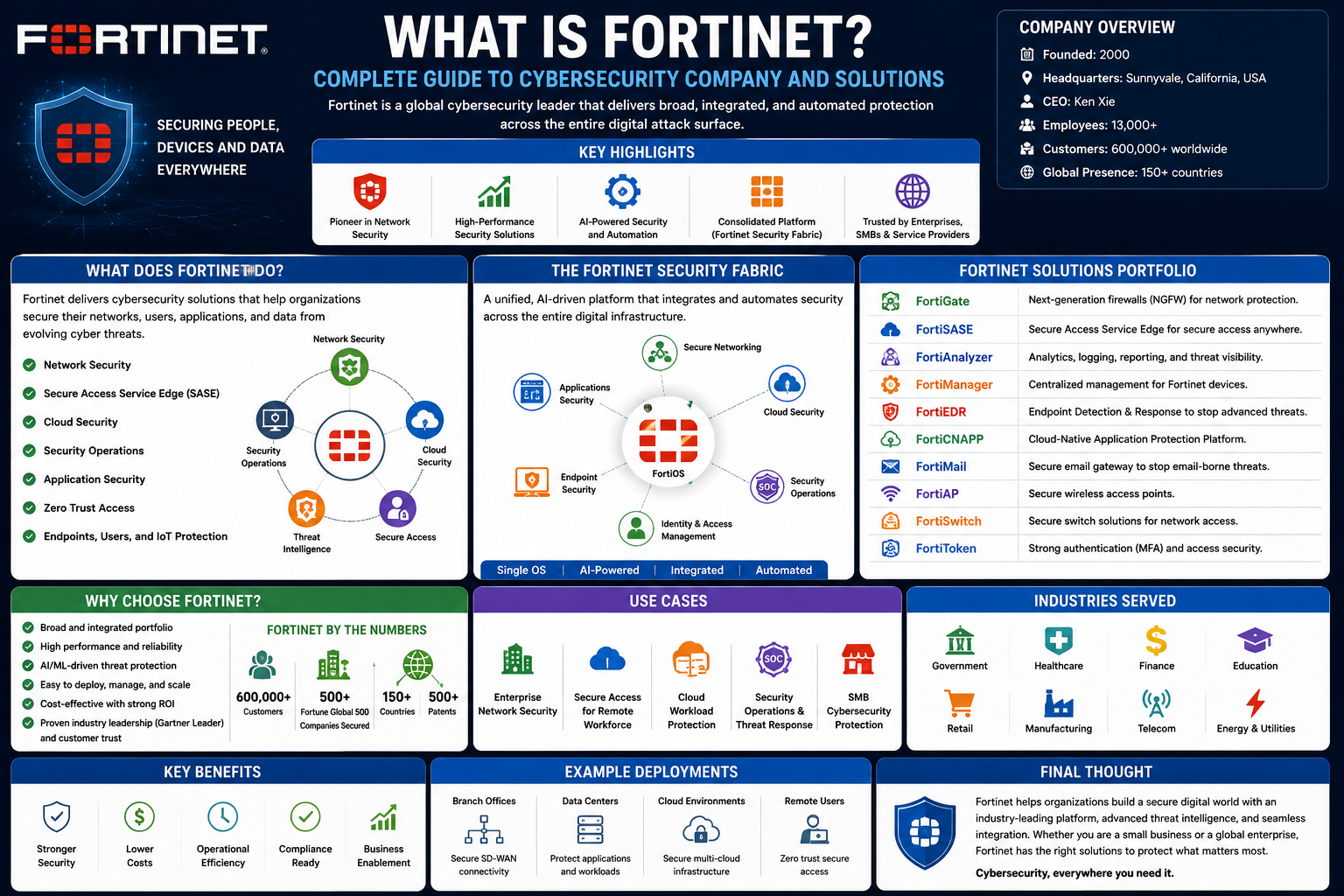
Fortinet is one of the most recognized names in the cybersecurity and network security industry. It is widely associated with firewalls, but its capabilities extend far beyond basic perimeter protection. In modern digital environments, where cyber threats are constantly evolving in speed and complexity, organizations need more than traditional security tools. Fortinet addresses this need by offering a broad, interconnected security ecosystem designed to protect networks, users, applications, and cloud environments.
Over the years, Fortinet has developed into a comprehensive security platform that integrates hardware, software, and cloud-based services. This approach allows organizations to manage security in a more unified and automated way. Instead of relying on separate tools that work independently, Fortinet enables different security components to communicate and respond together in real time. This creates a stronger defense system where threats can be detected faster and handled more efficiently. It also reduces complexity for IT teams, as they no longer need to manage multiple disconnected solutions. By centralizing visibility and control, organizations can improve decision-making and maintain consistent security policies across their entire infrastructure. This level of integration also supports scalability, making it easier for businesses to expand their networks while keeping security tight and coordinated.
Understanding What Fortinet Is
At its core, Fortinet is a cybersecurity company that builds technologies to protect digital infrastructure. While many people first encounter Fortinet through its firewall products, the company actually provides a wide range of security solutions. These include network security devices, endpoint protection, cloud security tools, and centralized management systems.
The most well-known product in its portfolio is the FortiGate firewall. However, Fortinet is not limited to firewalls alone. It operates as a complete security platform designed to protect every layer of an organization’s IT environment. This includes securing internal networks, controlling access points, monitoring cloud workloads, and detecting advanced threats.
Fortinet’s approach is based on the idea that cybersecurity should be integrated rather than fragmented. Instead of using separate tools from different vendors that may not communicate effectively, Fortinet builds products that work together as a unified system.
Fortinet as a Security Ecosystem
One of the defining characteristics of Fortinet is its ecosystem-based design. Rather than offering standalone products, Fortinet builds solutions that connect and share data across the entire security infrastructure. This interconnected system is often referred to as a security fabric. It allows different security tools to work together seamlessly, exchanging threat intelligence and operational data in real time. As a result, security teams gain better visibility into network activity and can respond to incidents more quickly and accurately. This approach also helps reduce security gaps that often occur when multiple unrelated tools are used together. By creating a unified and coordinated environment, Fortinet strengthens overall protection and simplifies the management of complex IT systems across organizations of all sizes.
In a traditional setup, organizations might use one vendor for firewalls, another for endpoint protection, and yet another for cloud security. These systems often operate independently, requiring manual configuration and monitoring. Fortinet changes this model by allowing its tools to communicate with each other automatically.
For example, if a threat is detected on a device within the network, that information can be instantly shared across all connected Fortinet products. The firewall can update its rules, endpoint devices can be protected, and administrators can receive alerts without delay. This reduces response time and improves overall security efficiency.
The ecosystem approach also helps organizations maintain better visibility. Instead of viewing security data from multiple disconnected systems, administrators can access a centralized dashboard that provides a complete picture of network activity.
Key Components of Fortinet’s Security Platform
Fortinet offers a wide range of security solutions that work together within its ecosystem. Each component plays a specific role in protecting different parts of an organization’s infrastructure.
The most prominent component is the next-generation firewall, which provides advanced traffic filtering and deep inspection capabilities. Unlike traditional firewalls, it can analyze applications, users, and content in real time.
Another important part of the ecosystem includes wireless access solutions. These products help secure Wi-Fi networks and prevent unauthorized access points from becoming entry vectors for attackers.
Fortinet also provides endpoint security tools that protect individual devices such as laptops, desktops, and mobile devices. These tools ensure that threats do not enter the network through user devices.
In addition, Fortinet offers security information and event management capabilities. These systems collect and analyze security data from multiple sources to detect suspicious activity and support incident response.
Cloud security is another major component. Fortinet provides tools that help secure workloads across different cloud platforms, ensuring consistent protection whether data is stored on-premises or in the cloud.
Integration with Cloud and External Systems
Modern IT environments often rely on multiple cloud platforms and third-party tools. Fortinet is designed to integrate with these external systems rather than operate in isolation.
It supports integration with major cloud environments, allowing organizations to extend their security policies into cloud infrastructure. This means that workloads running in cloud environments are protected with the same level of security as on-premises systems.
Fortinet also integrates with IT service management platforms and security automation tools. When a threat is detected, the system can automatically generate alerts, create incident tickets, or trigger predefined response actions. This reduces the need for manual intervention and improves response speed.
The ability to exchange data in both directions is a key advantage. Security events can be sent to external systems for analysis, while external systems can also send commands back to Fortinet tools for automated action. This bidirectional communication enables more dynamic and responsive security operations.
Understanding Next-Generation Firewalls
Next-generation firewalls represent a major evolution in network security technology. Traditional firewalls primarily focused on filtering traffic based on rules such as IP addresses, ports, and protocols. While effective in earlier network environments, this approach is not sufficient to handle modern cyber threats.
Next-generation firewalls go beyond basic filtering. They can inspect the content of network traffic, identify applications in use, and detect malicious behavior in real time. This allows them to provide more granular control over network activity.
They also incorporate advanced threat intelligence, which helps them identify known attack patterns and suspicious behavior. Some systems even use machine learning techniques to improve detection accuracy over time.
Another important capability is encrypted traffic inspection. Since much of today’s internet traffic is encrypted, traditional tools may not be able to analyze it effectively. Next-generation firewalls can decrypt and inspect this traffic to ensure that hidden threats are not missed.
Fortinet’s firewall technology is particularly known for its performance and specialized hardware acceleration, which allows it to process large volumes of traffic efficiently without compromising security.
How Fortinet Strengthens Modern Cybersecurity
Fortinet strengthens cybersecurity by combining prevention, detection, and response capabilities into a single integrated system. Instead of reacting to threats after they occur, it enables organizations to proactively identify and mitigate risks.
One of its key strengths is automation. Many security tasks that previously required manual intervention can now be handled automatically. This includes threat detection, policy enforcement, and incident response.
Another strength is centralized visibility. Security teams can monitor all network activity from a single interface, making it easier to identify patterns and detect anomalies.
Scalability is also a major advantage. Fortinet solutions can be used in small businesses as well as large enterprise environments. As organizations grow, additional security components can be added without disrupting the existing infrastructure.
Common Use Cases of Fortinet
Fortinet is used across many industries, including finance, healthcare, government, education, and telecommunications. These sectors require strong security controls due to the sensitive nature of their data.
Small businesses often use Fortinet firewalls to protect their internet connections and internal networks. Larger enterprises use the full security ecosystem to manage complex infrastructures that span multiple locations and cloud platforms.
Organizations also use Fortinet to support remote work environments. With more employees working outside traditional office networks, securing remote access has become essential. Fortinet provides secure connectivity solutions that protect users regardless of their location.
Frequently Asked Questions About Fortinet
Fortinet is often compared to other cybersecurity vendors. One of its main differences is its focus on integration. Instead of offering isolated products, it builds systems that work together seamlessly.
It is also suitable for both small and large organizations. Entry-level solutions are available for smaller environments, while advanced enterprise systems support large-scale operations.
Fortinet does not require organizations to use all of its products to benefit from its firewall technology. However, using multiple components together provides stronger security and automation capabilities.
Professionals interested in Fortinet often pursue specialized certifications that focus on network security, firewall management, and cloud security integration.
Conclusion
Fortinet is much more than a firewall provider. It is a comprehensive cybersecurity ecosystem designed to protect modern digital environments. By integrating multiple security tools into a unified platform, it enables organizations to detect, prevent, and respond to threats more effectively.
Its next-generation firewall technology, combined with cloud integration and automation capabilities, makes it a powerful solution for today’s complex IT landscapes. As cyber threats continue to evolve, Fortinet’s approach of interconnected and intelligent security systems positions it as a key player in the future of network protection.