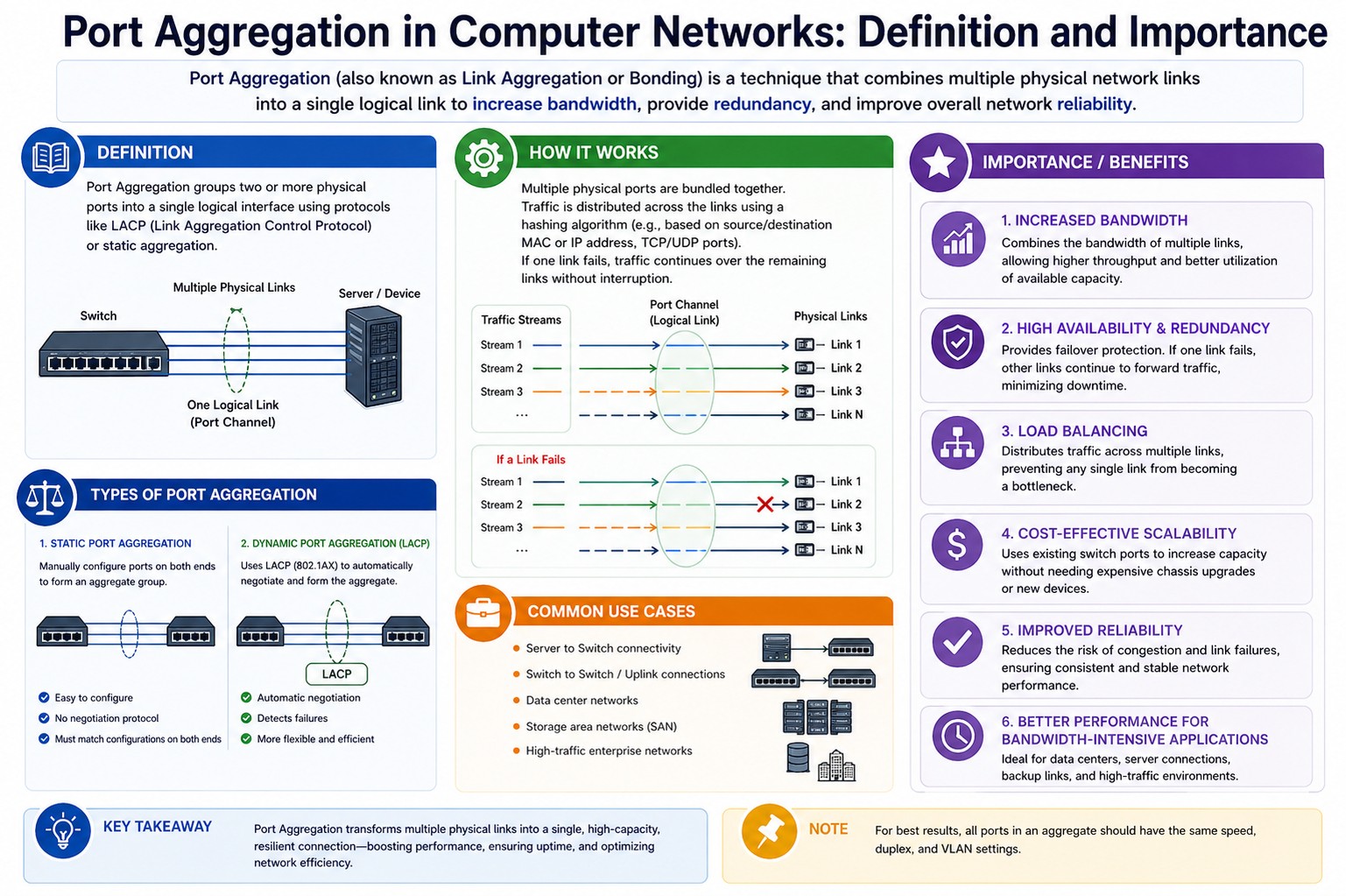
Port aggregation is a foundational technique in modern networking that enhances how data is transmitted across multiple physical connections. Instead of relying on a single network cable or interface, port aggregation allows several ports to operate together as one logical link. This approach is widely used in enterprise environments, data centers, and high-performance computing systems where efficiency, speed, and reliability are essential.
By combining multiple links, networks can achieve greater bandwidth and reduce the risk of bottlenecks. It also ensures that communication remains stable even when individual links experience issues. This makes port aggregation a critical part of scalable and resilient network design.
How Port Aggregation Works
Port aggregation works by grouping multiple physical interfaces into a single logical interface that is managed as one unit. The network device treats all bundled links as a single connection, even though data is distributed across multiple cables internally.
When data is transmitted, it is divided into smaller units and sent across different links in the group. At the receiving end, these packets are reassembled in the correct order. This process happens automatically and is managed by networking protocols or device configurations.
The system ensures that traffic distribution is balanced, preventing overload on a single link. This method also increases efficiency by making full use of available network resources instead of relying on one connection at a time.
Key Components of Port Aggregation
Port aggregation relies on several essential components that work together to ensure smooth operation. The physical ports are the actual hardware interfaces that are combined. These ports must typically have similar speed and configuration to function properly in a group.
The logical interface is the virtual representation of all combined ports. It acts as a single communication channel for higher-level networking tasks. Another important component is the control protocol, which manages how links are grouped, monitored, and maintained.
These components work together to ensure that data flows efficiently while maintaining consistency and reliability across the network.
Static Port Aggregation
Static port aggregation is a manually configured method where network administrators define which ports should be grouped together. Once configured, the system does not dynamically adjust or negotiate link membership.
This method is simple and straightforward, making it suitable for small networks or environments where network topology does not change frequently. However, it lacks flexibility and may require manual intervention if any link fails or changes occur.
Despite its limitations, static aggregation can still be effective in controlled environments where stability is more important than adaptability.
Dynamic Port Aggregation
Dynamic port aggregation uses automated protocols to manage link grouping. One of the most common methods involves negotiation between devices to determine which ports can be combined into a single logical link.
This approach allows the network to automatically detect changes, such as link failures or additions, and adjust accordingly without manual configuration. It provides greater flexibility and is widely used in modern enterprise networks.
Dynamic aggregation improves scalability and reduces administrative effort, making it ideal for large and complex network infrastructures.
Link Aggregation Control Mechanism
A key part of dynamic port aggregation is the control mechanism that manages communication between devices. This system ensures that both ends of a connection agree on how links are grouped and how traffic should be handled.
It continuously monitors link status and performance, allowing the network to respond quickly to any changes. If a link becomes unavailable, the system automatically redistributes traffic across the remaining active links.
This control process ensures consistency, stability, and optimal performance across the aggregated connection.
Load Balancing in Port Aggregation
One of the most important functions of port aggregation is load balancing. This process distributes network traffic across all available links in the aggregation group.
Load balancing ensures that no single link becomes overloaded while others remain underutilized. Instead, traffic is shared based on predefined algorithms such as source and destination addresses, session types, or data flow patterns.
This improves overall network efficiency and reduces delays caused by congestion. It also helps maintain smooth performance during peak usage periods.
Fault Tolerance and Redundancy
Port aggregation significantly improves network reliability through redundancy. If one or more physical links fail, the remaining links continue to carry traffic without interrupting communication.
This failover capability ensures that services remain available even during hardware issues or cable failures. The system automatically detects the failure and reroutes traffic instantly, minimizing downtime.
This level of redundancy is especially important in mission-critical environments where uninterrupted connectivity is essential.
Performance Improvements
One of the main advantages of port aggregation is improved performance. By combining multiple links, the overall bandwidth available for data transmission increases significantly.
This allows networks to handle larger volumes of traffic more efficiently. It also reduces latency by distributing data across multiple paths instead of relying on a single route.
In high-demand environments such as cloud computing and data centers, this performance boost is essential for maintaining speed and responsiveness.
Scalability in Network Design
Port aggregation supports scalable network architecture by allowing administrators to increase bandwidth without replacing existing infrastructure. Instead of upgrading a single link, additional ports can be added to the aggregation group.
This modular approach makes it easier to expand networks as demand grows. It also reduces costs by maximizing the use of existing hardware.
Scalability is a key advantage in environments where data requirements are constantly increasing.
Common Use Cases of Port Aggregation
Port aggregation is widely used in enterprise networks to connect switches, servers, and storage systems. It is especially common in data centers where high-speed communication between devices is required.
It is also used in backbone networks to improve bandwidth between core infrastructure components. Additionally, it supports virtualization environments where multiple virtual machines rely on shared network resources.
These use cases highlight its importance in modern IT infrastructure.
Challenges and Limitations
Despite its advantages, port aggregation also has certain limitations. All ports in a group typically need to have similar speed and configuration, which can restrict flexibility.
Improper configuration can lead to uneven traffic distribution or reduced performance. Additionally, troubleshooting aggregated links can be more complex than managing single connections.
There is also a dependency on compatible hardware and protocols, which may not always be available in older systems.
Best Practices for Implementation
Proper implementation of port aggregation requires careful planning. It is important to ensure that all participating ports are compatible in terms of speed, duplex settings, and configuration.
Monitoring tools should be used to track performance and detect issues early. Network administrators should also regularly review load balancing behavior to ensure optimal traffic distribution.
Using standardized protocols and maintaining consistent configurations across devices helps improve stability and performance.
Security Considerations
While port aggregation primarily focuses on performance and reliability, security is also an important factor. Aggregated links must be properly secured to prevent unauthorized access or data interception.
Network segmentation and access control policies should be applied to logical interfaces just as they are for physical ones. Monitoring traffic patterns can also help detect unusual activity within aggregated links.
Ensuring secure configuration helps maintain the integrity of the entire network.
Troubleshooting Port Aggregation
When issues occur in port aggregation setups, troubleshooting typically involves checking link status, configuration consistency, and traffic distribution.
Common problems include mismatched settings, inactive links, or improper load balancing. Diagnostic tools can help identify which link is causing the issue and whether traffic is being distributed correctly.
A systematic approach to troubleshooting helps restore performance quickly and efficiently.
Future of Port Aggregation in Networking
As network demands continue to grow, port aggregation will remain an important technology. With increasing reliance on cloud computing, virtualization, and high-speed data transfer, the need for efficient link management will only increase.
Future developments may focus on smarter automation, improved load balancing algorithms, and deeper integration with software-defined networking systems.
These advancements will further enhance flexibility, performance, and ease of management in complex network environments.
Traffic Distribution Methods
In port aggregation, traffic distribution plays a crucial role in determining how efficiently the combined links are utilized. The system does not simply split data evenly across all ports in a random manner. Instead, it follows specific algorithms that decide how each data flow is assigned to a particular link.
Common distribution methods include hashing based on source and destination IP addresses, MAC addresses, or even protocol types. This ensures that packets belonging to the same session follow the same path, preventing issues such as packet reordering.
Different devices may use different algorithms, but the primary goal remains the same: to achieve balanced utilization of all active links while maintaining data consistency.
Session-Based Load Handling
Port aggregation systems often manage traffic at the session level rather than individual packet level. This means that a complete communication session between two devices is assigned to one specific link within the aggregation group.
This approach is important because it preserves the order of packets, which is essential for applications such as video streaming, voice communication, and database transactions. If packets were split across multiple links without control, it could lead to delays or errors in reassembly.
Session-based handling ensures stability while still distributing multiple sessions across different links for balance.
Role of Bandwidth Scaling
One of the strongest advantages of port aggregation is its ability to scale bandwidth without replacing existing infrastructure. Instead of upgrading a single high-speed link, multiple standard links can be combined to achieve higher throughput.
For example, several 1 Gbps connections can be aggregated to create a logical connection that approaches multi-gigabit performance. This is particularly useful in environments where upgrading hardware is expensive or impractical.
Bandwidth scaling through aggregation allows organizations to gradually increase capacity as demand grows, making network expansion more flexible and cost-effective.
Network Efficiency Improvements
Port aggregation significantly improves overall network efficiency by ensuring that all available physical links are actively used. Without aggregation, a network might rely heavily on a single connection while other ports remain idle.
By distributing traffic intelligently, aggregation reduces congestion and minimizes delays caused by overloaded links. It also improves response times for applications that rely on fast data transmission.
Efficient utilization of network resources leads to better performance across all connected systems, especially in high-traffic environments.
Impact on Server Connectivity
Servers benefit greatly from port aggregation because they often handle large volumes of simultaneous requests. By using multiple network interfaces combined into a single logical connection, servers can process more data at once.
This improves performance for applications such as web hosting, database management, and cloud services. It also reduces the risk of bottlenecks when multiple clients access the server simultaneously.
In addition, server redundancy is improved because a failure in one link does not interrupt overall connectivity.
Switch-Level Aggregation
Switches play a central role in implementing port aggregation. Many modern switches support this feature directly, allowing multiple ports to be grouped at the hardware level.
Switch-level aggregation ensures faster processing because decisions about traffic distribution are handled efficiently within the device. It also simplifies network design by centralizing control of aggregated links.
This capability is especially important in large networks where multiple devices are interconnected through switching infrastructure.
Aggregation in Data Centers
Data centers are one of the primary environments where port aggregation is heavily used. These facilities require extremely high bandwidth and low latency to support cloud services, virtualization, and large-scale applications.
By combining multiple links, data centers can handle massive traffic loads without experiencing performance degradation. It also allows seamless scaling as new servers and storage systems are added.
In such environments, even small improvements in efficiency can result in significant performance gains across thousands of connected systems.
Redundancy Planning in Aggregated Networks
Redundancy is a critical design principle in port aggregation. Networks are designed so that if one link fails, others automatically take over its workload without interruption.
This is achieved through continuous monitoring of link status. If a failure is detected, the system immediately removes the faulty link from the aggregation group and redistributes traffic.
This automatic recovery mechanism ensures that services remain available even in the presence of hardware issues, making networks more resilient and dependable.
Role of Protocol Compatibility
For port aggregation to function properly, devices on both ends of the connection must support compatible protocols. These protocols manage how links are negotiated, maintained, and monitored.
Without compatibility, aggregation may fail or result in inefficient performance. This is why network administrators must ensure that all devices involved support the same aggregation standards.
Proper protocol alignment ensures smooth communication and prevents configuration conflicts.
Configuration Considerations
Setting up port aggregation requires careful attention to configuration details. All participating ports must have matching settings such as speed, duplex mode, and VLAN assignments.
Incorrect configuration can lead to instability or reduced performance. It is also important to ensure that the aggregation group is properly defined on both ends of the connection.
Regular verification helps maintain consistency and ensures that the aggregation continues to function as intended.
Monitoring and Maintenance
Ongoing monitoring is essential for maintaining the performance of aggregated links. Network administrators often use management tools to track bandwidth usage, link status, and traffic distribution.
Monitoring helps identify potential issues before they affect network performance. It also provides insights into how effectively the aggregation group is being utilized.
Routine maintenance ensures that all links remain operational and properly balanced over time.
Energy Efficiency Considerations
Port aggregation can also contribute to energy efficiency in networking environments. By optimizing the use of existing links, it reduces the need for additional hardware upgrades.
Efficient traffic distribution means that devices operate more effectively without unnecessary strain. In large-scale networks, this can lead to reduced power consumption and lower operational costs.
Although the energy savings may not be the primary goal, they are a valuable secondary benefit.
Application in Virtualization Environments
Virtualization systems rely heavily on network performance because multiple virtual machines share the same physical infrastructure. Port aggregation helps ensure that these virtual environments have sufficient bandwidth.
By combining multiple network interfaces, virtual machines can communicate more efficiently with external systems and other virtual instances.
This improves performance in cloud computing platforms where resource sharing is essential.
Impact on High Availability Systems
High availability systems are designed to remain operational even during failures. Port aggregation supports this goal by providing continuous network connectivity through redundant links.
If one connection fails, the system automatically reroutes traffic through remaining active links. This ensures that critical services remain accessible at all times.
This level of reliability is essential in industries such as finance, healthcare, and telecommunications.
Future Enhancements in Aggregation Technology
Future developments in port aggregation are expected to focus on automation and intelligence. Machine learning techniques may be used to optimize traffic distribution dynamically based on real-time conditions.
Software-defined networking will also play a role in making aggregation more flexible and easier to manage. These advancements will allow networks to adapt more quickly to changing demands.
As technology evolves, port aggregation will continue to be an important part of high-performance networking systems.
Advanced Concepts
Port aggregation is more than just a method of combining links; it is a comprehensive approach to improving network performance, reliability, and scalability. Through intelligent traffic distribution, redundancy, and bandwidth scaling, it enhances the overall efficiency of modern networks.
Its role in data centers, enterprise systems, and cloud environments highlights its importance in today’s digital infrastructure. As networks continue to grow in complexity, port aggregation will remain a key technology for ensuring smooth and reliable communication.
Real-World Implementation Scenarios
Port aggregation is widely implemented in real-world networking environments where performance and reliability are critical. In corporate offices, it is commonly used to connect access switches to core switches, ensuring that internal communication remains fast even when many users are active at the same time.
In service provider networks, it is deployed to handle large volumes of customer traffic. By combining multiple physical links, providers can offer higher-speed services without relying on a single high-capacity connection.
In each scenario, the goal is the same: improve throughput, maintain stability, and ensure continuous service availability.
Enterprise Network Architecture
Within enterprise networks, port aggregation is often a core design element. Large organizations typically have multiple layers of networking, including access, distribution, and core layers. Aggregation links are used between these layers to maintain high-speed communication.
For example, multiple access switches may connect to a distribution switch using aggregated links. This prevents congestion when many users simultaneously access shared resources such as databases, file servers, or cloud applications.
This structured approach ensures that the network remains scalable and efficient as the organization grows.
Role in Campus Networks
Campus networks, such as those used in universities or large institutions, rely heavily on port aggregation to manage thousands of connected devices. Students, staff, and administrative systems all generate continuous traffic.
By using aggregated links between buildings, departments, and central data centers, these networks maintain consistent performance even during peak usage hours.
This setup ensures that educational platforms, online resources, and communication systems remain accessible without delay.
Integration with Modern Switch Technologies
Modern network switches are designed with built-in support for port aggregation, making deployment easier and more efficient. These switches can automatically detect compatible ports and assist in forming aggregation groups.
Advanced switches also provide monitoring tools that display link utilization, errors, and performance statistics in real time. This helps administrators optimize configurations and quickly identify issues.
The integration of aggregation features into hardware has significantly simplified network design and management.
High-Speed Backbone Networks
Backbone networks form the central structure of large-scale communication systems. Port aggregation is commonly used in these backbones to increase capacity between core routers and switches.
By bundling multiple high-speed links, backbone networks can handle massive amounts of data flowing between different regions or data centers.
This ensures that long-distance communication remains fast and reliable, even under heavy load conditions.
Cloud Computing Infrastructure
Cloud computing environments depend heavily on efficient data transfer between servers, storage systems, and virtual machines. Port aggregation plays a key role in maintaining this efficiency.
By combining multiple network interfaces, cloud providers can support high-density workloads and ensure smooth operation of hosted services.
It also helps distribute traffic evenly across physical infrastructure, reducing the risk of overload on individual network paths.
Storage Area Networks and Aggregation
Storage Area Networks (SANs) also benefit from port aggregation. These networks require extremely fast and reliable connections to handle large-scale data storage and retrieval operations.
Aggregated links ensure that storage devices can communicate with servers at high speeds without interruptions. This is especially important for backup systems, database replication, and real-time data processing.
The increased bandwidth provided by aggregation improves both performance and reliability in storage environments.
Performance Optimization Techniques
To maximize the benefits of port aggregation, several optimization techniques are used. One common method is selecting the most appropriate load balancing algorithm based on traffic patterns.
Another technique involves grouping devices with similar performance capabilities to avoid mismatches. Proper cable management and hardware alignment also contribute to better efficiency.
Regular performance analysis helps ensure that the aggregation setup continues to operate at optimal levels.
Common Configuration Mistakes
Despite its advantages, port aggregation can suffer from misconfiguration issues. One common mistake is combining ports with different speeds, which can lead to uneven traffic distribution.
Another issue is incorrect protocol settings, which may prevent links from forming properly. Inconsistent VLAN configurations can also disrupt communication across aggregated links.
These errors highlight the importance of careful planning and validation during setup.
Troubleshooting Techniques in Practice
When issues arise in aggregated networks, systematic troubleshooting is essential. Administrators typically begin by checking physical connectivity, ensuring that all cables and ports are functioning correctly.
Next, they verify configuration settings to confirm that all links belong to the correct aggregation group. Monitoring tools are then used to analyze traffic flow and detect abnormalities.
By following a structured approach, most issues can be identified and resolved efficiently.
Security in Aggregated Environments
Security remains an important consideration even in high-performance network setups. Aggregated links must be protected against unauthorized access and potential attacks.
This includes applying encryption where necessary and ensuring that only trusted devices participate in aggregation groups. Network segmentation can also help isolate sensitive traffic.
Proper security measures ensure that performance improvements do not come at the cost of safety.
Impact on Network Latency
One of the indirect benefits of port aggregation is reduced latency under heavy traffic conditions. By distributing data across multiple links, congestion is minimized, allowing packets to travel more efficiently.
However, it is important to note that aggregation does not always reduce latency for individual sessions, since each session typically uses a single link. Instead, it improves overall network responsiveness by preventing bottlenecks.
This balance makes it suitable for both real-time and bulk data applications.
Scalability in Large Organizations
As organizations grow, their network requirements increase significantly. Port aggregation provides a scalable solution that allows additional links to be added without redesigning the entire network.
This modular approach makes it easier to expand infrastructure gradually. It also ensures that performance improvements can be achieved without major disruptions.
Scalability is one of the key reasons why aggregation is widely adopted in enterprise environments.
Role in Hybrid Network Systems
Modern networks often combine on-premises infrastructure with cloud-based services. Port aggregation helps maintain consistent performance across these hybrid environments.
By providing high-bandwidth connections between local systems and external services, it ensures smooth data transfer regardless of location.
This is especially important for organizations that rely on distributed applications and remote access systems.
Future Trends in Network Aggregation
The future of port aggregation is closely linked with automation and intelligent networking. Artificial intelligence may be used to dynamically adjust traffic distribution based on real-time network conditions.
Software-defined networking will also enhance flexibility by allowing administrators to configure aggregation groups through centralized controllers.
These advancements will make networks more adaptive, efficient, and easier to manage.
Practical Deployment
Port aggregation is a powerful networking technique that plays a vital role in modern infrastructure. Its ability to improve bandwidth, ensure redundancy, and support scalability makes it essential in enterprise, cloud, and data center environments.
Through careful implementation and proper management, it significantly enhances network performance and reliability. As technology continues to evolve, port aggregation will remain a core component of efficient and resilient network design.
Enhancing Overall Network Reliability
Port aggregation significantly strengthens network reliability by eliminating single points of failure at the physical link level. In traditional single-link setups, a cable or port failure can immediately disrupt connectivity. However, in an aggregated setup, multiple links share the traffic load, so the failure of one link does not interrupt communication.
This built-in resilience ensures that critical services continue operating even during hardware faults or maintenance activities. The system automatically reroutes traffic through the remaining active links, maintaining uninterrupted connectivity. This makes port aggregation especially valuable in environments where downtime is not acceptable.
Improving Quality of Service
Quality of Service (QoS) refers to the ability of a network to prioritize certain types of traffic over others. Port aggregation supports QoS by providing more consistent bandwidth availability and reducing congestion.
When traffic is spread across multiple links, high-priority applications such as voice calls, video conferencing, and real-time data processing experience fewer delays. This improves overall user experience and ensures that essential services receive the resources they need.
By reducing congestion and balancing load effectively, aggregation helps maintain stable performance even during peak usage periods.
Supporting High-Bandwidth Applications
Modern applications such as cloud computing, video streaming, online gaming, and large-scale data analytics require high and stable bandwidth. A single network link may not be sufficient to support these demands.
Port aggregation solves this limitation by combining multiple links to create a higher-capacity channel. This allows systems to handle large data transfers efficiently without performance degradation.
As digital services continue to evolve, the demand for bandwidth-intensive applications will continue to grow, making aggregation increasingly important.
Reducing Network Bottlenecks
Network bottlenecks occur when too much data flows through a single point, slowing down overall performance. Port aggregation helps eliminate these bottlenecks by distributing traffic across multiple physical paths.
Instead of relying on one overloaded connection, the system uses several links simultaneously. This ensures smoother data flow and reduces latency caused by congestion.
By preventing bottlenecks at critical points, aggregation improves both speed and consistency across the entire network.
Optimizing Data Center Performance
In data centers, thousands of servers and storage devices communicate constantly. Without efficient link management, network congestion can quickly become a serious issue.
Port aggregation plays a key role in optimizing data center performance by increasing inter-device communication capacity. It ensures that servers can exchange data rapidly and that storage systems can handle large volumes of input/output operations.
This optimization is essential for maintaining service quality in large-scale cloud and enterprise environments.
Supporting Virtualization and Container Systems
Virtualization technologies allow multiple virtual machines to run on a single physical server. These systems rely heavily on network connectivity to communicate with each other and with external resources.
Port aggregation provides the necessary bandwidth to support multiple virtual environments simultaneously. It ensures that virtual machines do not compete for limited network resources, improving performance and stability.
Similarly, container-based systems benefit from aggregated links because they often require fast and flexible communication between distributed services.
Energy and Cost Efficiency Advantages
Port aggregation can contribute to both energy efficiency and cost savings. Instead of upgrading to expensive high-speed hardware, organizations can combine existing links to achieve similar performance improvements.
This approach reduces the need for frequent infrastructure upgrades. It also allows better utilization of existing network equipment, minimizing waste.
From an operational perspective, this makes port aggregation a cost-effective solution for scaling network capacity.
Simplified Network Expansion
As organizations grow, their networking requirements increase. Port aggregation simplifies expansion by allowing additional links to be added to existing groups without redesigning the entire network.
This modular approach makes scaling more flexible and less disruptive. New links can be integrated into the aggregation group to instantly increase bandwidth and performance.
This ease of expansion is one of the main reasons why port aggregation is widely adopted in modern network architectures.
Integration with Modern Network Technologies
Port aggregation works alongside other advanced networking technologies such as virtualization, software-defined networking, and cloud orchestration systems.
These technologies collectively improve automation, control, and flexibility in network management. Aggregation provides the physical foundation for high-speed communication, while software-based systems manage traffic and configuration dynamically.
This integration creates more intelligent and adaptive networks that can respond quickly to changing demands.
Common Misunderstandings About Port Aggregation
One common misunderstanding is that port aggregation increases speed for a single connection. In reality, a single data flow typically uses only one link within the group.
The main benefit comes from distributing multiple flows across different links, improving overall throughput rather than individual session speed.
Another misconception is that aggregation automatically solves all network issues. While it improves performance and reliability, proper configuration and monitoring are still required for optimal results.
Best Practices for Long-Term Stability
To maintain stable performance, it is important to follow best practices when using port aggregation. All links should be consistently configured with matching settings such as speed and duplex mode.
Regular monitoring should be performed to ensure balanced traffic distribution. It is also important to document configurations clearly to avoid errors during maintenance or upgrades.
Using standardized protocols and compatible hardware further enhances long-term stability and reliability.
Evolving Role in Modern Networking
As networks continue to evolve, the role of port aggregation is also expanding. It is no longer just a performance enhancement tool but a critical component of scalable and resilient network design.
With increasing reliance on cloud services, remote work, and data-driven applications, the demand for efficient bandwidth management continues to grow.
Port aggregation will remain a key technology in supporting these modern networking requirements.
Conclusion
Port aggregation is an essential networking technique that improves performance, reliability, and scalability by combining multiple physical links into a single logical connection. It enables efficient bandwidth utilization, reduces congestion, and ensures continuous connectivity even during link failures.
Across enterprise networks, data centers, cloud environments, and virtualization systems, it plays a crucial role in maintaining high-speed and stable communication. Its ability to support load balancing, redundancy, and flexible expansion makes it a foundational element of modern network architecture.
While it requires proper configuration and management, its benefits far outweigh its challenges. As digital infrastructure continues to grow in complexity and scale, port aggregation will remain a vital technology for ensuring efficient, reliable, and future-ready networking systems.