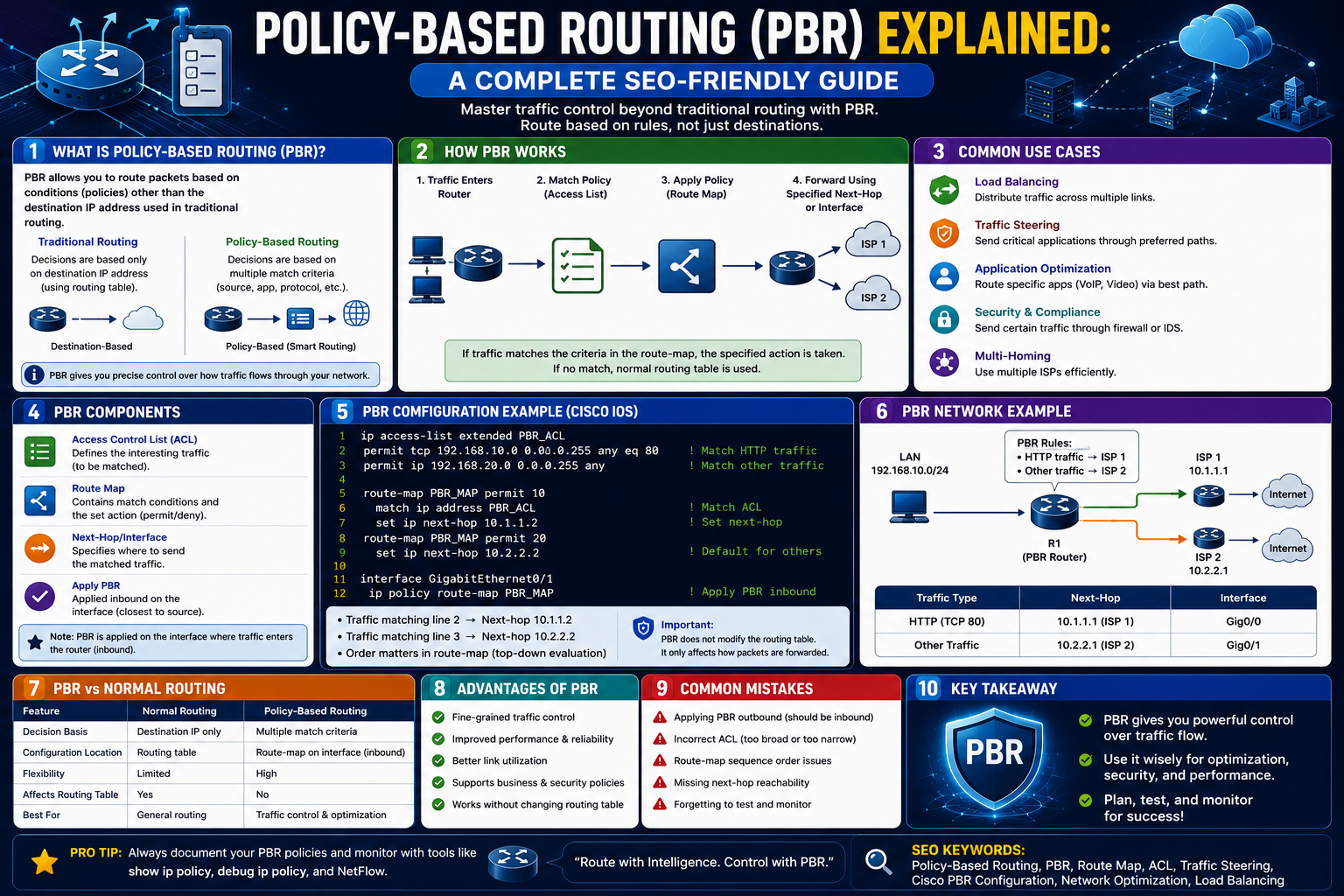
Policy-Based Routing (PBR) is a powerful networking technique that allows administrators to control how data packets move through a network based on predefined rules instead of relying only on standard routing tables. In traditional routing, routers decide the path of traffic based on destination IP addresses and the best available metric. However, this method does not always produce the most efficient or desired path for specific types of traffic. PBR solves this limitation by giving administrators the ability to override default routing decisions and enforce custom traffic-handling rules.
To understand PBR in a simple way, imagine a delivery system. Normally, a package follows a fixed route determined by the postal system, regardless of whether the destination is nearby or far away. This can sometimes create unnecessary delays. Now imagine if urgent local deliveries could skip unnecessary steps and go directly to a nearby distribution point. That is exactly what PBR does for network traffic. It allows certain packets to take a more efficient or controlled route based on rules defined by the network administrator.
What Policy-Based Routing Means
Policy-Based Routing is a method used in computer networks where routing decisions are based on policies rather than only destination addresses. These policies are created using conditions such as source IP address, destination IP address, protocol type, port number, or even application type.
When a packet enters a router, instead of simply checking the routing table, the router first checks whether the packet matches any configured policy. If it matches, the router follows the instructions defined in that policy, such as sending the traffic to a specific next-hop address or interface.
This makes PBR especially useful in environments where certain types of traffic need special handling, such as prioritizing business applications, separating guest traffic, or optimizing WAN links.
Why Policy-Based Routing Is Used
Modern networks often carry a mix of traffic types, including voice, video, web browsing, and internal business applications. Not all traffic should be treated equally. Some data is more sensitive, some requires lower latency, and some can tolerate delays.
PBR is commonly used in situations such as:
- Directing specific traffic through a preferred internet connection
- Sending critical business traffic through a high-performance link
- Routing guest or non-essential traffic through a secondary path
- Balancing traffic across multiple WAN links
- Overriding inefficient default routing decisions
Without PBR, routers would always follow the same best-path logic, which may not always align with business requirements or performance goals.
Basic Concept of How PBR Works
Policy-Based Routing works by applying a set of rules to incoming traffic on a router interface. These rules determine whether the traffic should be treated normally or routed differently.
The process generally follows these steps:
First, the router checks incoming packets against an access control list. This list defines which traffic is considered important or “interesting.” If the packet matches the list, it is passed to the next stage.
Next, a route map evaluates the packet. A route map is a logical structure that works like an if-then statement. If the packet matches the conditions, the router applies an action such as changing the next-hop address.
Finally, the policy is applied to a specific interface. This ensures that any packet entering that interface is evaluated against the defined rules.
Key Components of Policy-Based Routing
PBR is built using three main components:
Access Control List (ACL)
An ACL is used to identify which packets should be affected by the policy. It defines the selection criteria, such as a specific source IP address or range of addresses. Only packets that match the ACL are considered for policy-based routing.
Route Map
A route map is the decision-making part of PBR. It contains conditions and actions. If a packet matches the ACL, the route map defines what should happen next, such as changing the next-hop address or directing traffic to a specific interface.
Interface Policy Application
Once the ACL and route map are configured, they must be applied to a router interface. This tells the router to inspect incoming traffic on that interface and apply the policy rules accordingly.
Example of Policy-Based Routing Behavior
Consider a network where traffic originates from a specific device and normally follows a default path through multiple routers before reaching its destination. In some cases, this path may not be optimal.
With PBR, traffic from that specific device can be redirected through a different path. Instead of following the default route, the router checks the policy, recognizes the source IP address, and sends the traffic to a preferred next-hop router.
This allows network administrators to bypass inefficient routes and improve performance for selected traffic types.
Configuration Process Overview
Implementing Policy-Based Routing involves a structured approach.
First, the administrator defines which traffic should be affected. This is done using an access control list that identifies source addresses or traffic patterns.
Next, a route map is created. The route map links the matched traffic to a specific action, such as assigning a new next-hop address.
After that, the route map is applied to the appropriate router interface. This ensures that incoming traffic is evaluated as soon as it enters the network device.
Once configured, the router begins enforcing the policy immediately for any matching traffic.
In addition to these steps, proper planning is essential before deployment to avoid misrouting or network disruption. Administrators often simulate the policy in a test environment to ensure it behaves as expected. Careful attention is also given to ordering within route maps, as multiple rules may exist and are processed sequentially. Documentation of each policy helps in future troubleshooting and maintenance. It is also important to regularly review and update PBR configurations as network requirements change over time. This ensures that routing decisions remain aligned with organizational goals and continue to deliver optimal performance and reliability.
Verifying Policy-Based Routing
After configuration, it is important to verify that PBR is working correctly. Network administrators typically use verification commands and testing tools to ensure traffic is being routed as expected.
One common method is to check which policies are applied to an interface. This confirms that the router is actively inspecting traffic based on the configured rules.
Another method is to use traceroute tests. By sending traffic from different source addresses, administrators can observe whether the traffic follows the expected path or the default route.
Debugging tools can also be used to monitor real-time packet decisions. These tools show whether traffic is matching the policy or being forwarded normally.
In addition to these methods, administrators often check routing statistics and interface counters to confirm whether the policy is influencing packet flow. Monitoring changes in traffic behavior before and after applying PBR helps validate its effectiveness. It is also useful to perform repeated tests from multiple source devices to ensure the policy is consistent across different scenarios. Logs generated by routers can provide further insight into how packets are processed, especially when troubleshooting unexpected routing behavior. Regular verification ensures that PBR continues to function correctly even after network changes or updates.
Troubleshooting Policy-Based Routing
Like any network feature, PBR can sometimes be misconfigured. Common issues include incorrect ACL definitions, missing route map conditions, or applying the policy to the wrong interface.
If PBR is not working as expected, the first step is to verify the access control list. If the traffic is not matching the ACL, the policy will not be triggered.
Next, the route map should be checked to ensure that correct actions are defined for matched traffic. Even a small error in configuration can prevent proper routing behavior.
Finally, the interface configuration should be reviewed to confirm that the policy is applied in the correct direction. PBR typically works on incoming traffic, so applying it in the wrong direction will result in no effect.
Benefits of Policy-Based Routing
Policy-Based Routing provides several advantages in modern networks. It gives administrators fine control over traffic flow and allows customization beyond traditional routing protocols.
One major benefit is improved network efficiency. Traffic can be directed through optimal paths instead of relying on automatic routing decisions.
Another benefit is better traffic management. Important applications can be prioritized while less critical traffic is routed differently.
PBR also increases flexibility in network design. Administrators can quickly adapt routing behavior without changing the entire routing infrastructure.
In addition, it helps organizations make better use of multiple network links by distributing traffic based on policies rather than static routes.
Another important advantage of PBR is enhanced support for business requirements. Different departments or services within an organization can have customized routing rules based on their needs. This ensures that sensitive or high-priority traffic receives the best possible path through the network. PBR also improves redundancy by allowing traffic to be redirected automatically during link failures or congestion conditions. It supports cost optimization by enabling organizations to route non-critical traffic through cheaper links while reserving high-performance links for essential applications. Overall, PBR helps create a more intelligent, responsive, and efficient network environment.
Conclusion
Policy-Based Routing is an advanced networking technique that enhances control over how data moves through a network. Instead of relying solely on destination-based routing decisions, PBR allows administrators to define specific rules that influence traffic paths based on various conditions.
By using components such as access control lists, route maps, and interface policies, network engineers can customize routing behavior to meet performance, security, and business requirements.
Although it adds complexity to network configuration, the benefits of improved efficiency, flexibility, and traffic control make Policy-Based Routing a valuable tool in modern network environments.