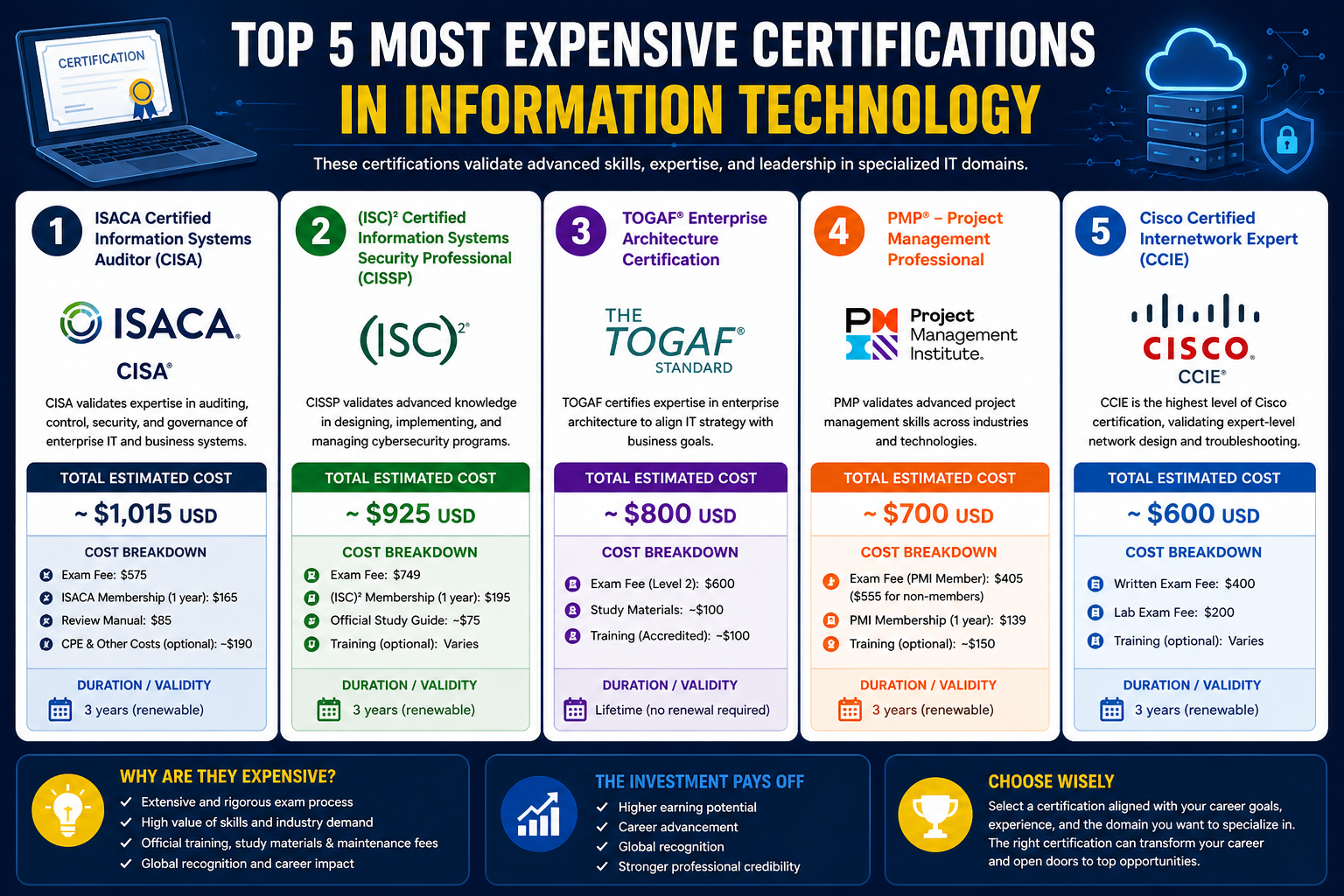
IT certifications play a major role in career growth within the technology industry. They help professionals validate their technical expertise, improve job opportunities, and qualify for higher-paying positions. While many entry-level certifications are relatively affordable, some advanced certifications come with extremely high costs due to their complexity, hands-on requirements, and prestige within the industry.
The most expensive certifications are usually designed for experienced professionals who already possess years of practical experience. These certifications often require multiple exams, practical labs, advanced training courses, and difficult assessments that test both technical knowledge and real-world problem-solving abilities. In many cases, candidates spend months or even years preparing before attempting the final exam.
Despite the high price tags, these certifications can provide strong returns on investment. Certified professionals often gain access to senior-level positions, leadership opportunities, consulting roles, and significantly higher salaries. Many organizations also value these certifications because they demonstrate advanced technical capability and commitment to professional development.
Below are five of the most expensive and prestigious certifications in the IT industry and why they continue to attract experienced professionals around the world.
CCIE Enterprise Infrastructure
The CCIE Enterprise Infrastructure certification is considered one of the most respected networking certifications in the world. It is designed for advanced network engineers who manage large-scale enterprise infrastructures and complex networking environments.
To earn this certification, candidates must first pass a written qualification exam that tests enterprise networking technologies, automation, routing, switching, security, and infrastructure design. After passing the written portion, candidates must complete an extremely challenging hands-on lab exam that lasts several hours.
The lab exam is widely known for its difficulty because it requires candidates to configure, troubleshoot, optimize, and automate enterprise networks under strict time limitations. The exam simulates real-world enterprise environments where engineers must solve advanced networking problems quickly and accurately.
The total certification cost is high because both the written and lab exams require separate fees. If a candidate fails the lab portion, they must pay the full lab fee again for every retake attempt. Many professionals spend additional money on practice labs, training programs, boot camps, and study materials before attempting the certification.
This certification covers modern networking technologies including software-defined networking, network automation, programmability, wireless integration, virtualization, and advanced security concepts. As enterprise networks continue evolving toward automation and cloud integration, the certification remains highly valuable in the networking industry.
Professionals who earn the CCIE Enterprise Infrastructure certification are often viewed as elite networking experts. Many work as senior network engineers, infrastructure architects, consultants, or technical leaders in large organizations and service providers.
Another reason this certification is expensive is the time commitment required for preparation. Candidates often spend hundreds of hours studying networking protocols, troubleshooting scenarios, and automation tools before attempting the lab exam.
Although the certification requires substantial investment, many professionals believe the long-term career benefits outweigh the costs. CCIE-certified engineers frequently qualify for senior technical roles with excellent salaries and global career opportunities.
Oracle Database Certified Master
The Oracle Database Certified Master credential is one of the highest certifications available for database administrators working with Oracle technologies. It focuses on advanced database management, optimization, performance tuning, backup strategies, recovery planning, and high-availability configurations.
Unlike many certification exams that rely primarily on multiple-choice questions, this certification requires candidates to complete practical tasks in a live database environment. Candidates must demonstrate their ability to manage complex Oracle database systems under real-world conditions.
The certification process usually begins with lower-level Oracle certifications before candidates can attempt the master-level credential. In addition to passing prerequisite certifications, candidates are often required to complete advanced training courses that add significantly to the overall cost.
The exam itself is expensive because it is conducted in specialized testing environments that simulate enterprise database operations. Candidates must configure databases, troubleshoot issues, optimize performance, manage security settings, and perform advanced administrative tasks within limited timeframes.
This certification is highly respected among organizations that rely heavily on Oracle database systems. Financial institutions, government agencies, healthcare organizations, and large enterprises frequently use Oracle technologies to manage mission-critical data.
Database professionals pursuing this certification are usually experienced administrators with several years of enterprise database management experience. Many already work in senior technical positions before attempting the certification.
One reason the certification maintains such a high reputation is its strong emphasis on practical skills rather than theoretical knowledge alone. Employers value professionals who can solve real operational problems in high-pressure production environments.
Preparation costs can become substantial because candidates often invest in training labs, official courses, study materials, and specialized practice environments. Retaking the exam also requires additional fees, which increases the overall financial commitment.
Despite the cost, earning this certification can greatly improve career opportunities for database administrators seeking senior leadership or architecture roles within enterprise IT environments.
ITIL Master Certification
The ITIL Master certification represents one of the highest achievements in IT service management. Unlike purely technical certifications focused on networking or databases, ITIL emphasizes aligning IT services with business objectives and improving organizational efficiency.
The path toward becoming an ITIL Master is long and demanding. Candidates typically begin with foundational ITIL certifications before progressing through advanced levels that focus on service strategy, operational improvement, digital transformation, governance, and organizational leadership.
Rather than relying on a single exam, the certification process involves multiple certifications, practical experience requirements, assessments, and advanced modules. The total cost accumulates over time as candidates complete each stage of the certification pathway.
One major reason for the high expense is the amount of training required. Many candidates attend official courses, workshops, and instructor-led programs to prepare for the advanced certification stages. Exam retakes also add to the overall cost if candidates do not pass on their first attempt.
The ITIL Master certification is designed for experienced IT leaders responsible for managing enterprise IT services, service delivery operations, digital transformation projects, and business alignment strategies.
Candidates must demonstrate not only technical understanding but also leadership capabilities, strategic thinking, and practical implementation experience. The certification evaluates how effectively professionals can apply ITIL principles in real business environments.
Organizations value ITIL-certified professionals because effective IT service management directly impacts operational efficiency, customer satisfaction, and business continuity. Companies increasingly depend on stable, reliable, and well-managed IT services to support business growth.
Professionals who earn this certification often move into senior management positions such as IT service managers, operations directors, service delivery leaders, consultants, or digital transformation specialists.
Another reason the certification is expensive is the long-term commitment required to achieve it. Many candidates spend years progressing through the various certification levels before reaching master status.
Although the journey can be costly and time-consuming, the certification remains highly respected within enterprise IT management and service operations worldwide.
Cisco Certified Architect
The Cisco Certified Architect certification has long been recognized as one of the most prestigious and difficult certifications in the networking industry. It was designed for elite-level professionals capable of designing complex enterprise and global network architectures.
Unlike traditional certification exams, this credential required candidates to develop and defend a complete network architecture proposal before a panel of experts. The certification focused heavily on both technical excellence and business strategy.
Candidates were expected to analyze organizational requirements, create scalable infrastructure solutions, evaluate business risks, address security concerns, and justify architectural decisions during formal presentations.
The certification process was extremely expensive because of the advanced assessment model and review board structure. Candidates paid large fees for both the application process and the final evaluation sessions.
This certification was intended for senior architects with extensive industry experience. Most candidates already possessed expert-level networking certifications and had years of experience designing enterprise infrastructures before attempting the architect-level credential.
Only a very small number of professionals worldwide successfully achieved this certification due to its complexity, cost, and demanding evaluation standards. The credential became widely associated with elite-level network architecture expertise.
The certification required a unique combination of deep technical knowledge, communication ability, leadership skills, business understanding, and strategic planning capability. Candidates needed to demonstrate far more than technical configuration skills alone.
Although new applications for the certification are no longer accepted, it remains one of the most respected credentials ever introduced in enterprise networking. Professionals who earned it continue to hold tremendous prestige within the industry.
The certification demonstrated mastery in designing large-scale enterprise solutions involving routing, switching, security, data centers, collaboration systems, cloud integration, and business continuity planning.
Because so few professionals earned the certification, it became highly exclusive and widely recognized across the networking industry.
The Cost of Having No Certification
While advanced certifications can be expensive, not earning certifications at all may create even greater long-term financial consequences. Certifications often open doors to promotions, salary increases, leadership positions, and specialized technical opportunities.
Many employers use certifications as indicators of technical competency and commitment to professional growth. Candidates without certifications may struggle to compete against certified professionals when applying for advanced roles.
In competitive technology industries, certifications can help professionals stand out during hiring processes. They also demonstrate that individuals are willing to invest time and effort into expanding their knowledge and skills.
Certifications frequently lead to higher salaries because organizations value employees who possess verified expertise in critical technologies. Over time, the additional income earned through certifications can significantly exceed the original certification costs.
Another benefit is career flexibility. Certified professionals often have access to more job opportunities across different industries and geographic regions. Employers may trust certified individuals with larger responsibilities, critical infrastructure, and strategic projects.
Certifications can also improve confidence and technical problem-solving ability. The preparation process often exposes professionals to advanced concepts, real-world scenarios, and emerging technologies that improve overall expertise.
For many IT professionals, certifications become long-term career investments rather than short-term expenses. Even costly certifications may provide strong returns through promotions, consulting opportunities, and specialized technical roles.
Professionals who continuously update their certifications also stay current with evolving technologies and industry trends, which is increasingly important in modern IT environments.
Why Expensive Certifications Still Matter
The high cost of advanced certifications reflects the level of expertise they are designed to validate. These certifications are not intended for beginners. Instead, they target experienced professionals responsible for managing enterprise systems, designing critical infrastructure, leading IT operations, or solving highly complex technical problems.
Employers often place significant value on certifications that require practical demonstrations of skill rather than simple theoretical exams. Hands-on assessments help ensure that certified professionals can apply their knowledge effectively in real production environments.
Another reason these certifications remain valuable is industry recognition. Certifications from major technology vendors and service management organizations are recognized worldwide, making them useful for international career growth.
Many organizations also prefer certified professionals because certifications reduce hiring uncertainty. Employers can trust that certified individuals have demonstrated competence according to industry-recognized standards.
Even though preparation can require major financial and personal commitment, professionals often view these certifications as stepping stones toward senior leadership, consulting, or architecture positions.
Conclusion
Advanced IT certifications can require substantial financial investment, extensive preparation, and years of practical experience. Certifications such as CCIE Enterprise Infrastructure, Oracle Database Certified Master, ITIL Master, and Cisco Certified Architect represent some of the most prestigious and demanding credentials in the technology industry.
These certifications are expensive because they validate highly specialized skills, advanced technical expertise, and real-world problem-solving abilities. They often involve difficult exams, practical labs, mandatory training, and strict assessment standards.
Despite the high costs, many professionals pursue these certifications because of the career opportunities they create. Certified individuals frequently gain access to senior technical roles, leadership positions, consulting opportunities, and significantly higher salaries.
For experienced IT professionals looking to advance their careers, these certifications can become valuable long-term investments that strengthen credibility, improve expertise, and increase professional recognition across the technology industry.