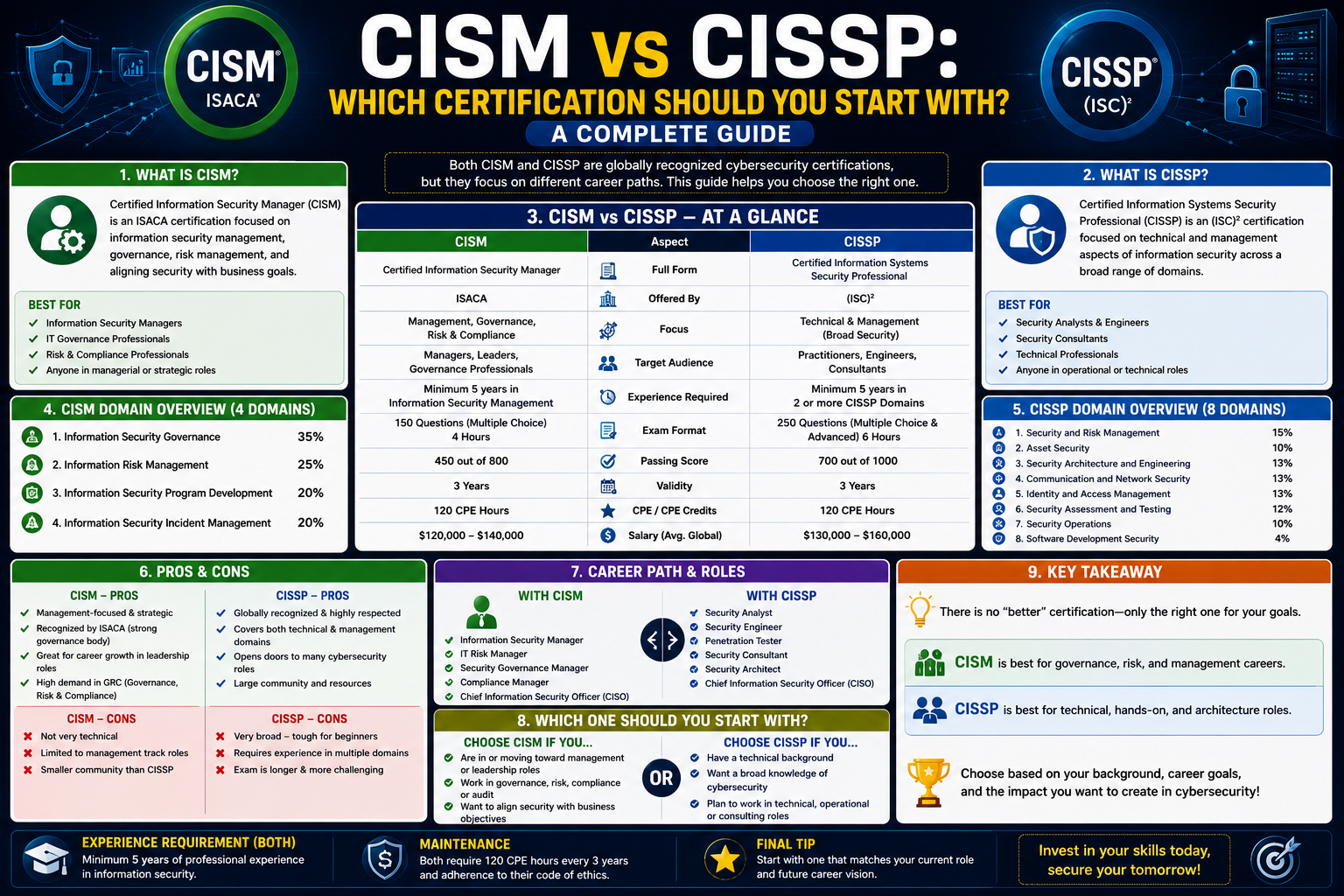
If you are planning a long-term career in cybersecurity, two of the most recognized professional certifications you will eventually encounter are CISSP and CISM. Both are considered advanced-level qualifications and are often held by experienced professionals who work in leadership, architecture, governance, and security management roles. Although they are sometimes mentioned together, they are not interchangeable. Each certification represents a different direction in cybersecurity and supports different career goals.
Understanding the differences between them is important before making a decision. One focuses more on technical security leadership and system-level design, while the other emphasizes management, governance, and business alignment. Choosing the right path depends on how you want your career to develop, the type of work you enjoy, and the responsibilities you aim to take on in the future.
Understanding CISSP and Its Purpose
The CISSP certification is widely recognized in the cybersecurity industry and is designed for professionals who want to work on the technical and strategic side of security. It focuses on building and managing security programs that protect organizations at an enterprise level. Instead of concentrating on one narrow skill, it covers a broad range of security knowledge areas that reflect real-world challenges.
This certification is suitable for individuals who want to design secure systems, manage complex infrastructures, and take part in high-level decision-making related to cybersecurity architecture. It is often pursued by professionals who are already working in roles such as security analysis, system administration, or network engineering and are looking to move into more advanced or leadership positions.
CISSP also emphasizes understanding how different security components work together. This includes risk management, asset protection, communication security, and application security. The goal is to ensure that professionals are capable of thinking beyond individual systems and instead focus on the entire security environment of an organization.
Understanding CISM and Its Purpose
The CISM certification is focused more on management and governance rather than technical implementation. It is designed for professionals who are responsible for planning, managing, and evaluating an organization’s information security program. Instead of focusing on how systems are built or secured at a technical level, it emphasizes how security aligns with business goals.
This certification is ideal for individuals who want to move into leadership roles such as security management, risk governance, and compliance oversight. It is particularly valuable for those who are responsible for making decisions that affect the overall direction of security programs within an organization.
CISM also focuses heavily on risk management and incident handling. Professionals who hold this certification are expected to understand how to evaluate threats, manage security incidents, and ensure that security strategies support business operations effectively. It is more about leadership, coordination, and decision-making than technical configuration or system design.
Key Differences Between CISSP and CISM
Although both certifications are related to cybersecurity, they serve different purposes. CISSP is more technical and broad, covering multiple aspects of cybersecurity knowledge. It prepares professionals to understand how security systems are designed and maintained across large environments. It blends both technical and strategic knowledge.
CISM, on the other hand, is more focused on management. It prepares professionals to lead security teams, manage policies, and align security practices with organizational goals. It is less about how systems work and more about how security is governed.
Another major difference lies in career direction. CISSP is often chosen by professionals who want to remain closer to technical architecture and security engineering roles. CISM is preferred by those who want to move into executive or managerial positions where decision-making and leadership are more important than technical implementation.
Work Experience Expectations
Both certifications require significant professional experience, which makes them more suitable for mid-career or senior professionals rather than beginners.
For CISSP, candidates typically need several years of experience working in different areas of cybersecurity. This experience should cover more than one aspect of security, such as system protection, network defense, or risk management. The goal is to ensure that candidates have practical exposure to real-world security environments before attempting the certification.
For CISM, the experience requirement is more focused on security management. Candidates are expected to have experience in overseeing security programs, managing risks, and handling governance responsibilities. This ensures that individuals taking the certification are already familiar with leadership-level security responsibilities.
For those who are just starting out, these requirements may seem challenging. However, they should be seen as long-term goals rather than immediate barriers. Many professionals begin by gaining experience in IT support, network administration, or junior security roles before progressing toward these certifications.
Career Paths and Opportunities
CISSP is ideal for professionals who want to remain closely involved in the technical side of cybersecurity while still moving into leadership positions. It supports career paths such as security architecture, systems engineering, penetration testing, and security consulting. It is often chosen by individuals who enjoy solving technical problems and designing secure environments.
CISM is better suited for those who want to focus on management and strategy. It supports roles such as security manager, governance lead, risk analyst, and chief information security officer. Professionals in these roles are responsible for guiding security policies, managing teams, and ensuring compliance with organizational and regulatory requirements.
Both certifications can lead to senior-level positions, but the type of leadership differs. CISSP leads more toward technical leadership, while CISM leads more toward organizational and executive leadership.
Salary Expectations and Career Growth
Both certifications are associated with strong earning potential. Professionals with CISSP often receive high salaries due to the technical expertise required and the demand for advanced security skills. This certification is widely respected across industries, making it valuable for career advancement. It is especially beneficial for individuals working in large enterprises where security architecture and risk management are critical responsibilities.
Many organizations prefer CISSP-certified professionals for senior-level positions because they bring a broad understanding of cybersecurity frameworks and practical security implementation. As a result, it can open doors to roles that involve designing secure systems, managing complex infrastructures, and leading security initiatives. Over time, CISSP can also support continuous career growth, as it is recognized globally and remains relevant across different sectors such as finance, healthcare, and technology. This recognition helps professionals build long-term stability and access higher-level opportunities in the cybersecurity field.
CISM holders also earn competitive salaries, particularly in management and leadership roles. Because these roles involve decision-making and organizational responsibility, they are often highly compensated.
However, salary should not be the only factor when choosing between the two. While both certifications can improve earning potential, the real value lies in the career opportunities they unlock. They help professionals move into positions that are not accessible without advanced qualifications and experience.
Exam Structure and Preparation
Both CISSP and CISM exams are challenging and require thorough preparation. They cover multiple areas of cybersecurity knowledge and test both theoretical understanding and practical application.
The exams are structured to assess not only knowledge but also decision-making ability in real-world scenarios. This means candidates must understand how to apply concepts rather than simply memorize information.
Preparation typically involves studying security frameworks, practicing scenario-based questions, and gaining a deep understanding of cybersecurity principles. Many professionals also combine study courses with hands-on experience to improve their chances of success.
Certification Maintenance and Continuing Education
After earning either certification, professionals must maintain their credentials through ongoing education. This ensures that certified individuals stay updated with the latest developments in cybersecurity.
Both certifications require professionals to complete continuing education activities over a fixed period. This may include attending training sessions, participating in industry events, or contributing to cybersecurity projects. The goal is to encourage continuous learning and professional growth.
This requirement reflects the constantly changing nature of cybersecurity. Threats, technologies, and best practices evolve rapidly, so professionals must stay engaged in learning throughout their careers.
Choosing the Right Path
Choosing between CISSP and CISM depends on your long-term career goals. If you enjoy technical problem-solving, system design, and security architecture, CISSP may be the better choice. It allows you to stay closer to the technical foundation of cybersecurity while still progressing into leadership roles. This path is often preferred by professionals who like working directly with security systems, analyzing complex infrastructures, and understanding how different technologies interact to protect an organization. CISSP also helps you build a strong foundation in enterprise security concepts, which can support roles such as security architect, senior analyst, or technical consultant. Over time, it can also position you for higher-level responsibilities where you guide security strategies and make decisions that influence the overall security posture of an organization, without losing touch with the technical side of cybersecurity.
If you are more interested in management, strategy, and organizational decision-making, CISM may be more suitable. It prepares you for roles where you guide teams, manage risks, and align security with business objectives.
In many cases, professionals eventually pursue both certifications. They complement each other and provide a well-rounded understanding of cybersecurity from both technical and managerial perspectives. However, it is not necessary to obtain both at the same time or in a specific order.
Conclusion
CISSP and CISM are both highly respected certifications that can significantly enhance a cybersecurity career. They are not competing qualifications but rather represent different paths within the same field. CISSP focuses on technical security leadership and system design, while CISM focuses on governance, management, and strategic oversight.
The right choice depends on your interests, experience, and long-term career goals. Whether you choose to specialize in technical security or move toward leadership and management, both certifications offer strong opportunities for growth, recognition, and professional development.