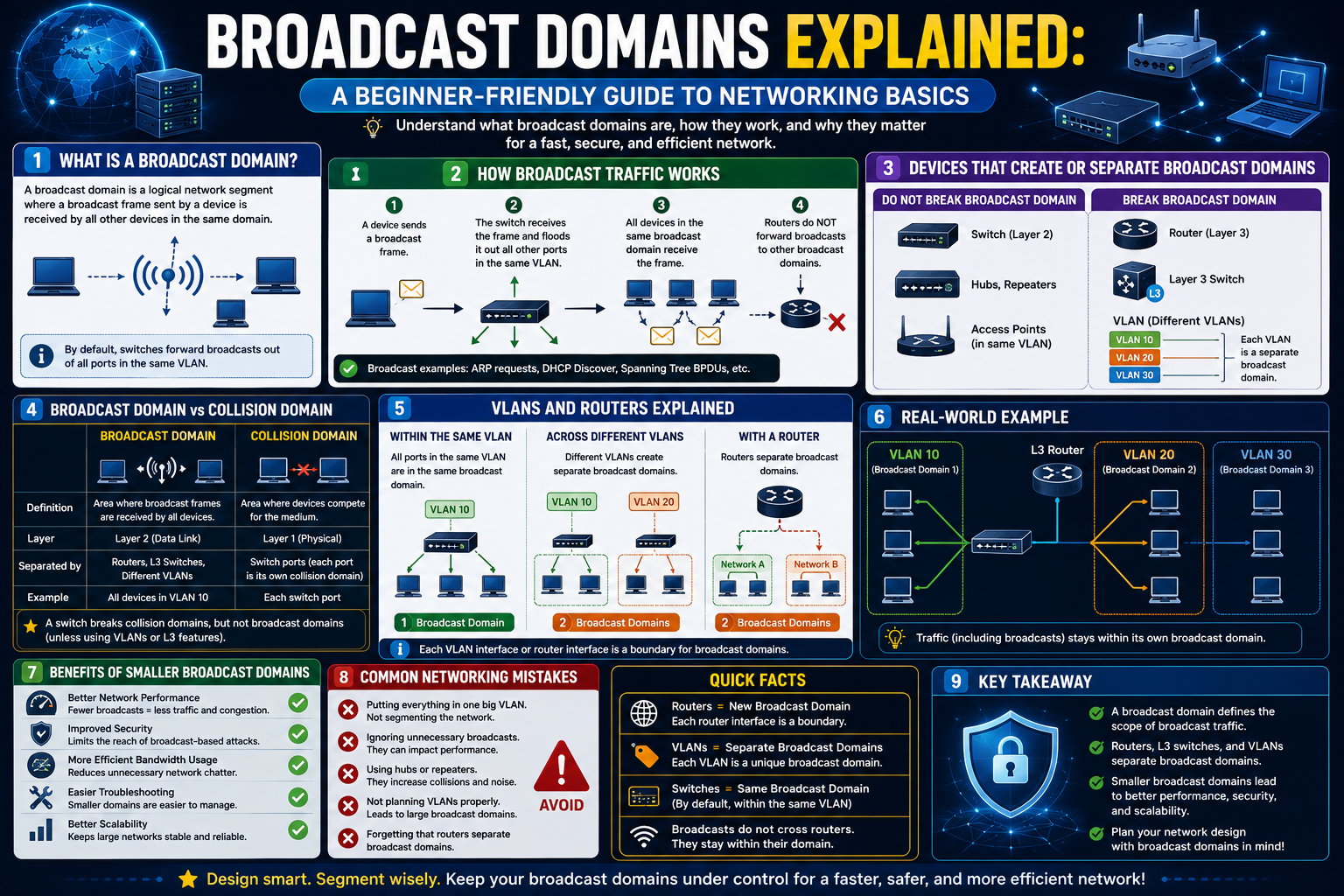
A broadcast domain is one of the fundamental concepts in computer networking that helps define how data flows within a local network. Understanding broadcast domains is essential for anyone studying networking or working with switches, routers, and network design. It explains how devices communicate within a shared network segment and why network segmentation is important for performance and security. In simple terms, a broadcast domain is a logical area in a network where any broadcast sent by a device is received by all other devices within that same area.
In modern networking, broadcast domains are closely related to switches, MAC addresses, and VLANs, which together determine how efficiently data is transmitted and how traffic is controlled.
Understanding the Concept of a Broadcast Domain
A broadcast domain is a section of a network in which all connected devices can receive broadcast messages sent by any device within that same section. A broadcast message is a type of network communication that is delivered to all devices rather than a single destination.
When a device sends a broadcast, it is not targeting a specific recipient. Instead, it sends the message to every device in the network segment. This is useful for certain network operations such as discovering services, locating devices, or requesting configuration details.
However, broadcast traffic is limited to the local broadcast domain and does not naturally travel across routers or different network segments. This limitation helps prevent unnecessary traffic from spreading across large networks.
Role of Layer 2 Switching in Broadcast Domains
A Layer 2 switch plays a central role in managing broadcast domains. It operates at the data link layer and uses MAC addresses to forward traffic within a network. Each device connected to the switch has a unique MAC address assigned to its network interface.
The switch builds a MAC address table by learning which devices are connected to which ports. When a device sends data, the switch checks this table to determine the correct destination port.
If the switch receives a broadcast frame, it does not forward it to a single port. Instead, it forwards the frame to all ports within the same broadcast domain, ensuring every device receives it.
This process allows efficient communication while still supporting necessary broadcast functions.
MAC Addresses and Their Importance
A MAC address is a unique identifier assigned to a network interface card. It is represented in hexadecimal format and is used at the data link layer for communication within a local network.
The switch uses MAC addresses to track where devices are located. When a device sends data to another device, the switch reads the destination MAC address and forwards the data only to the correct port.
However, when the destination MAC address is set to a broadcast value, the switch treats it differently. Instead of forwarding it to one device, it sends the data to every device in the broadcast domain. This ensures that all devices receive important network messages when needed.
Broadcast Frames and How They Work
A broadcast frame is a data packet that is sent to all devices within a network segment. It uses a special destination MAC address that indicates the message is intended for all nodes.
When a switch receives a broadcast frame, it replicates the frame and sends it out through all active ports in the same broadcast domain. Every device connected to those ports receives the frame and processes it.
This process is necessary for certain network functions such as device discovery, network announcements, and address resolution.
The Role of VLANs in Broadcast Domains
Virtual LANs, commonly known as VLANs, are used to divide a physical network into multiple logical broadcast domains. Each VLAN acts as its own independent broadcast domain.
When devices are placed in different VLANs, they cannot receive each other’s broadcast traffic. This separation improves network performance by reducing unnecessary traffic and increases security by isolating different groups of devices.
For example, a company may separate its departments into different VLANs such as finance, HR, and IT. Each VLAN functions as a separate broadcast domain, even though all devices may be connected to the same physical switch.
Broadcast Traffic in Network Communication
Broadcast traffic is essential for many network functions. One of the most common examples is the process of obtaining an IP address dynamically.
When a device connects to a network, it may not have an IP address assigned. In such cases, it sends a broadcast message requesting network configuration information. A server on the network responds with the necessary details, allowing the device to join the network.
Other examples of broadcast usage include service discovery and network announcements. Although useful, excessive broadcast traffic can lead to network congestion.
Broadcast Domains and Network Efficiency
While broadcast communication is necessary, too much of it can negatively affect network performance. When many devices are sending and receiving broadcast messages, it increases network traffic and reduces efficiency.
This is why network designers aim to limit the size of broadcast domains. Smaller broadcast domains help reduce unnecessary traffic and improve overall performance.
Switches and VLANs are commonly used to control the size of broadcast domains and ensure that traffic remains efficient and well-organized.
Broadcast Storms and Network Issues
A broadcast storm occurs when excessive broadcast traffic floods the network. This can happen when there is a loop in the network or when devices continuously generate broadcast messages without control. In such situations, the network becomes overwhelmed because switches keep forwarding broadcast frames across all available ports, causing a continuous cycle of traffic. As the volume increases, it consumes bandwidth and processing power, leading to severe performance degradation. Devices may experience high latency, packet loss, or even become completely unresponsive. In extreme cases, a broadcast storm can bring down an entire network segment, affecting all connected users and services until the issue is resolved.
During a broadcast storm, network performance can degrade significantly. Devices may become slow or unresponsive due to the high volume of traffic.
To prevent this, network administrators use tools such as spanning tree protocols, VLAN segmentation, and proper network design practices to control broadcast traffic.
Why Broadcast Domains Matter in Network Design
Broadcast domains are important because they directly affect how efficiently a network operates. A well-designed network limits broadcast domains to reduce unnecessary traffic and improve performance. When broadcast domains are kept small and properly segmented, devices only receive relevant broadcast messages instead of being overwhelmed by traffic from the entire network. This helps improve bandwidth utilization and ensures that network resources are not wasted on unnecessary data processing.
In larger networks, uncontrolled broadcast traffic can quickly become a problem. Every device within a broadcast domain must process broadcast frames, even if the message is not directly useful to it. As the number of devices increases, the volume of broadcast traffic also increases, which can lead to delays and reduced network performance. By dividing networks into smaller broadcast domains, administrators can control how far broadcast traffic travels and reduce the load on individual devices.
Broadcast domain management also plays a key role in improving scalability. As organizations grow, their networks need to support more users, devices, and services. Proper segmentation ensures that growth does not lead to performance degradation. It also enhances stability because issues in one broadcast domain are less likely to affect others.
Additionally, smaller broadcast domains contribute to better fault isolation. If a network problem occurs in one segment, it is less likely to spread across the entire infrastructure. This makes troubleshooting easier and reduces downtime. Overall, controlling broadcast domains is a key practice in building reliable and efficient network architectures.
By controlling broadcast domains, administrators can ensure that only relevant devices receive broadcast messages. This also improves security because sensitive broadcast information does not spread across the entire network.
In large enterprise environments, proper segmentation of broadcast domains is essential for maintaining scalability and reliability.
How Routers Separate Broadcast Domains
Routers play a key role in separating broadcast domains. Unlike switches, routers do not forward broadcast traffic between networks.
Each interface on a router represents a different broadcast domain. When a broadcast message reaches a router, it is not forwarded to other networks. This behavior helps isolate network segments and control traffic flow.
This separation is one of the key reasons routers are used to connect different networks while maintaining control over broadcast traffic.
Practical Example of a Broadcast Domain
Consider a small office network where multiple computers are connected to a switch. If one computer sends a broadcast message, all other computers connected to that switch will receive it.
If the network is divided into multiple VLANs, each VLAN becomes its own broadcast domain. A broadcast from one VLAN will not reach devices in another VLAN.
This setup allows better control over network traffic and improves overall efficiency.
Conclusion
A broadcast domain is a fundamental concept in networking that defines how broadcast traffic is distributed within a network. It represents a logical area where all devices can receive broadcast messages from one another. Understanding broadcast domains is essential for designing efficient, secure, and scalable networks.
Switches, MAC addresses, VLANs, and routers all play important roles in managing broadcast domains. While broadcasts are necessary for essential network functions, controlling their scope is critical to maintaining performance. By properly designing and segmenting broadcast domains, network administrators can ensure smooth communication, reduced congestion, and improved overall network stability.