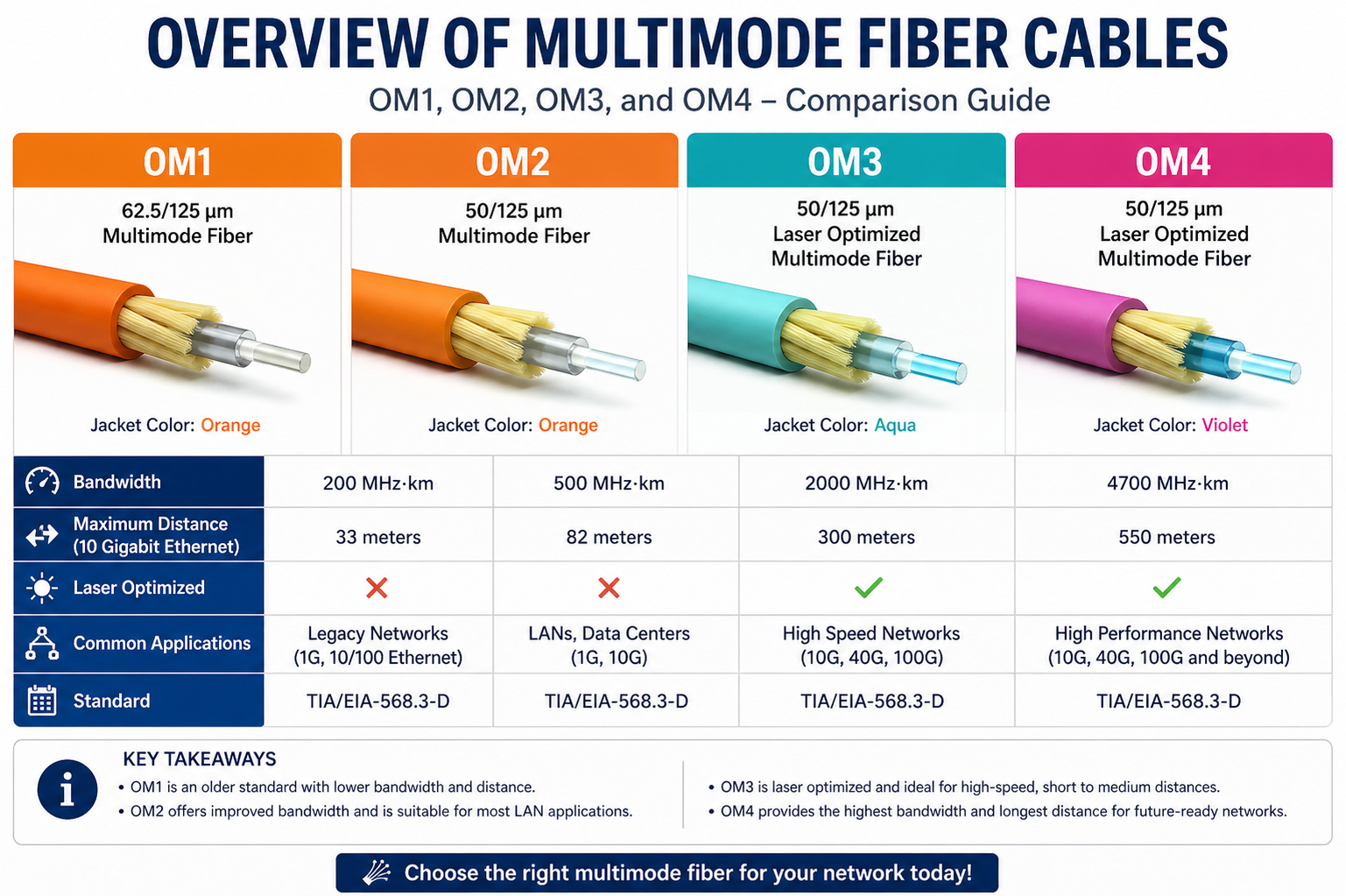
OM1 fiber cable is one of the earliest standards in multimode optical fiber technology, developed to support the growing need for faster and more reliable data transmission compared to traditional copper wiring. It typically features a 62.5-micron core diameter, which allows multiple modes of light to travel through the fiber simultaneously. This design was suitable for early local area networks where data speeds were relatively low and transmission distances were limited.
OM1 was widely used in enterprise and campus networks during the early stages of fiber deployment. It commonly supports data rates up to 1 Gbps over shorter distances and significantly lower speeds over longer runs. Because of its larger core size, OM1 experiences higher modal dispersion, which means that light signals spread out more as they travel, reducing overall performance at higher speeds and over longer distances.
Despite its limitations, OM1 played an important role in transitioning network infrastructures from copper-based systems to fiber-optic communication. It offered improved resistance to electromagnetic interference, greater security in data transmission, and better reliability in environments where copper cables struggled to perform. However, as network demands increased, especially with the rise of internet-based applications and data-heavy systems, OM1 gradually became insufficient for modern requirements.
Today, OM1 is considered outdated for most new installations, but it may still be found in legacy systems where upgrades have not yet been implemented. Its use is generally restricted to low-speed applications or temporary setups where performance demands are minimal.
OM2 Fiber Cable
OM2 fiber cable represents a significant improvement over OM1 and was introduced to address the limitations of earlier multimode fibers. It also uses a 50-micron core diameter in many implementations, although it is still categorized under older multimode standards. The reduced core size compared to OM1 helps decrease modal dispersion, allowing light signals to travel more efficiently.
OM2 supports higher bandwidth and improved transmission distances compared to OM1. It is capable of handling speeds up to 1 Gbps over longer distances and can also support lower-speed applications over extended runs. This makes it a more flexible option for enterprise networks, educational institutions, and data centers that require moderate performance without the need for cutting-edge speed.
One of the key advantages of OM2 fiber is its improved compatibility with evolving networking technologies at the time of its introduction. It allowed organizations to upgrade their infrastructure without completely redesigning their fiber layouts. OM2 also provides better signal stability, making it more reliable in environments with moderate data traffic.
However, OM2 still has limitations when compared to newer fiber types. As network demands continued to grow with the expansion of cloud computing, streaming services, and high-speed data exchange, OM2 began to show performance constraints. Its bandwidth capacity is not sufficient for modern high-speed applications, especially those requiring 10 Gbps or higher transmission rates.
Despite this, OM2 may still be used in certain environments where cost efficiency is a priority and high-speed performance is not critical. It serves as a transitional technology between older and more advanced multimode fibers.
OM3 Fiber Cable
OM3 fiber cable marks a major advancement in multimode fiber technology and is specifically designed for high-speed data transmission. It uses a 50-micron core and is optimized for laser-based transmission systems, particularly vertical-cavity surface-emitting lasers. This optimization allows OM3 to support significantly higher bandwidth and longer transmission distances compared to OM1 and OM2.
One of the most important characteristics of OM3 fiber is its ability to support 10 Gbps speeds over distances up to approximately 300 meters, depending on network conditions and equipment used. This capability makes it highly suitable for modern data centers, enterprise backbone networks, and high-performance computing environments.
OM3 fiber significantly reduces modal dispersion through improved manufacturing techniques and laser optimization. This ensures that light signals maintain their integrity over longer distances, resulting in faster and more reliable data transmission. It also supports backward compatibility with lower-speed applications, making it a versatile choice for evolving network infrastructures.
In practical use, OM3 fiber is often deployed in environments where high-speed connectivity is essential. Data centers rely heavily on OM3 to connect servers, storage systems, and networking equipment. Its ability to handle large volumes of data efficiently makes it ideal for virtualization, cloud computing, and real-time data processing applications.
Another advantage of OM3 is its cost-effectiveness compared to single-mode fiber, while still offering excellent performance for short to medium distances. This balance between cost and capability has made OM3 one of the most widely used multimode fibers in modern networking.
As technology continues to advance, OM3 remains relevant due to its adaptability and strong performance in high-demand environments. However, it is gradually being complemented or replaced by more advanced standards like OM4 in certain high-performance scenarios.
OM4 Fiber Cable
OM4 fiber cable is an enhanced version of OM3 and represents one of the most advanced multimode fiber standards available. It also uses a 50-micron core but is engineered with improved bandwidth capabilities and reduced attenuation, allowing for even greater transmission distances and higher data rates.
OM4 is specifically designed to support 10 Gbps, 40 Gbps, and even 100 Gbps transmission speeds over extended distances compared to OM3. For example, it can support 10 Gbps over distances up to approximately 550 meters, making it highly suitable for large-scale data centers and enterprise backbone networks.
The key improvement in OM4 lies in its optimized laser transmission performance and enhanced modal bandwidth. This allows signals to travel with minimal distortion, ensuring high levels of data integrity even in complex and high-traffic network environments. OM4 also provides better efficiency for parallel optical transmission systems, which are commonly used in modern high-speed networking.
In real-world applications, OM4 fiber is widely used in environments that require extremely high data throughput and low latency. It is commonly deployed in hyperscale data centers, cloud infrastructure facilities, and large enterprise networks where performance is critical. Its ability to handle future-ready speeds makes it a preferred choice for organizations planning long-term infrastructure investments.
OM4 also offers improved flexibility in network design. It allows for greater distance between networking equipment without sacrificing performance, reducing the need for additional hardware such as signal repeaters. This can lead to cost savings and simplified network architecture.
Another important aspect of OM4 fiber is its compatibility with previous multimode standards. While it offers superior performance, it can still operate within systems designed for OM3, making it easier to integrate into existing infrastructures during upgrades.
As digital transformation continues to accelerate, OM4 fiber plays a crucial role in supporting emerging technologies such as artificial intelligence, big data analytics, and high-speed cloud computing. Its high bandwidth capacity ensures that modern applications can operate efficiently without network bottlenecks.
Overall, OM4 represents the peak of multimode fiber evolution, balancing high performance, reliability, and scalability for demanding network environments.
Comparison and Evolution of OM1, OM2, OM3, and OM4 Fiber Cables
The development of multimode fiber cables from OM1 through OM4 reflects the continuous growth of networking demands and the need for higher bandwidth, longer transmission distances, and more reliable data communication. Each generation has been designed to overcome the limitations of its predecessor, resulting in a gradual but significant improvement in performance and efficiency.
OM1, as the earliest standard, was designed for basic networking environments where data transmission needs were relatively low. Its larger core size allowed multiple light paths, but this also introduced higher modal dispersion, which limited its ability to support fast data rates over longer distances. As organizations began to adopt more advanced digital systems, OM1 quickly reached its performance limits, especially in environments requiring stable and high-speed connectivity.
OM2 improved upon this foundation by reducing core-related inefficiencies and increasing bandwidth capacity. While still not suitable for modern high-speed networking demands, OM2 provided a practical upgrade path for organizations transitioning from older systems. It offered better distance support and improved signal stability, making it a more reliable option for medium-performance networks.
The introduction of OM3 marked a major shift in multimode fiber technology. Unlike OM1 and OM2, OM3 was specifically engineered for laser-based transmission, which dramatically increased both speed and efficiency. This advancement allowed networks to move into the 10 Gbps era without requiring a complete switch to single-mode fiber, which is typically more expensive and complex to install. OM3 became a widely adopted solution in data centers and enterprise environments due to its balance of cost and performance.
OM4 further refined this technology by increasing bandwidth capacity and extending transmission distances even more. It was developed in response to growing data traffic demands driven by cloud computing, virtualization, and large-scale digital services. OM4 not only supports higher speeds over longer distances but also ensures better signal integrity, which is essential for mission-critical applications.
The progression from OM1 to OM4 highlights a clear trend: increasing optimization of light transmission and reduction of signal loss. Each new standard improves how efficiently data travels through optical fibers, enabling faster communication between devices and systems. This evolution has been essential in supporting the modern internet infrastructure, which relies heavily on high-speed and high-capacity data transfer.
Bandwidth and Distance Performance Differences
One of the most important differences among OM1, OM2, OM3, and OM4 fibers lies in their bandwidth capacity and transmission distance capabilities. OM1 offers the lowest performance in both categories, making it suitable only for short-distance and low-speed applications. Its bandwidth limitations restrict its ability to handle modern networking requirements.
OM2 provides a moderate improvement, offering higher bandwidth and slightly longer distance support. However, it still falls short when compared to the demands of contemporary high-speed networks. It is generally considered a transitional fiber type rather than a long-term solution for advanced infrastructure.
OM3 introduces a significant leap in performance by supporting much higher bandwidth and enabling 10 Gbps transmission over several hundred meters. This makes it suitable for large-scale environments where both speed and distance are important factors. OM3’s laser optimization plays a key role in reducing signal distortion and maintaining performance consistency.
OM4 extends these capabilities even further, offering the highest bandwidth among multimode fibers. It supports faster data rates over longer distances, making it ideal for modern data centers that require efficient and scalable networking solutions. Its enhanced performance ensures that it can handle future networking demands without requiring immediate infrastructure upgrades.
Core Size and Signal Transmission Characteristics
All multimode fibers use relatively large core sizes compared to single-mode fibers, but the differences in core design still impact performance significantly. OM1 originally used a 62.5-micron core, while OM2, OM3, and OM4 standardized on a 50-micron core.
The reduction in core size from OM1 to OM2 and beyond plays a crucial role in improving signal quality. A smaller core reduces the number of light modes traveling through the fiber, which in turn reduces modal dispersion. This leads to clearer and more stable signal transmission over longer distances.
OM3 and OM4 take advantage of this improved core design while also incorporating advanced manufacturing techniques that further enhance performance. The use of laser-optimized transmission ensures that light signals remain tightly controlled, minimizing loss and distortion.
These improvements in core design and signal handling have allowed modern multimode fibers to achieve performance levels that were previously only possible with more expensive single-mode solutions.
Application Environments and Use Cases
Each multimode fiber type is suited to specific application environments based on its performance characteristics. OM1 is typically found in legacy systems where upgrades have not yet been implemented. It is rarely used in new installations due to its limited capabilities.
OM2 is still used in some enterprise environments, particularly where budget constraints exist and high-speed performance is not a critical requirement. It is often found in smaller networks or secondary infrastructure systems.
OM3 is widely used in modern data centers and enterprise networks. Its ability to support high-speed data transmission makes it ideal for server interconnections, storage networks, and backbone infrastructure. It is particularly valuable in environments where large volumes of data must be processed quickly and efficiently.
OM4 is primarily used in high-performance computing environments, large-scale data centers, and cloud infrastructure systems. It is chosen for its ability to support extremely high data rates and long-distance transmission within complex network architectures. Organizations that require future-proof networking solutions often prefer OM4 due to its scalability and reliability.
Technological Advancements Driving Fiber Evolution
The evolution of multimode fiber technology has been driven by several key advancements in optical communication. One of the most important developments is the use of laser-based transmission, which significantly improves data speed and accuracy compared to older LED-based systems.
Another important advancement is the reduction of modal dispersion through improved fiber design and manufacturing techniques. This has allowed newer fiber types to maintain signal clarity over longer distances, which is essential for modern networking environments.
Improvements in material quality and precision engineering have also contributed to better performance. Modern fibers are designed with tighter tolerances and higher purity materials, reducing signal loss and improving overall efficiency.
These technological advancements have enabled multimode fibers to keep pace with rapidly increasing data demands, particularly in industries that rely heavily on digital communication and cloud-based systems.
Role in Modern Networking Infrastructure
Multimode fiber cables play a crucial role in supporting today’s digital infrastructure. They are widely used in data centers, enterprise networks, educational institutions, and commercial buildings. Their ability to provide high-speed, reliable communication over short to medium distances makes them essential for internal network connectivity.
OM3 and OM4, in particular, have become foundational technologies in modern data centers. They enable efficient communication between servers, storage systems, and networking equipment, ensuring smooth operation of cloud services, streaming platforms, and enterprise applications.
As data consumption continues to grow globally, the importance of high-performance fiber optic systems will only increase. Multimode fibers provide a cost-effective and efficient solution for handling large volumes of data within localized environments.
Future Trends in Multimode Fiber Technology
Although single-mode fiber is often used for long-distance and ultra-high-speed applications, multimode fiber continues to evolve to meet short-range high-speed demands. Future developments are expected to focus on increasing bandwidth density, improving energy efficiency, and supporting even faster transmission rates.
Emerging technologies such as higher-speed Ethernet standards and advanced optical modules will continue to drive demand for improved multimode fiber performance. OM4 currently represents the highest widely adopted standard, but research into next-generation multimode solutions may further extend its capabilities.
In modern networking design, multimode fiber remains a critical component due to its balance of cost, performance, and ease of installation. Its continued evolution ensures that it will remain relevant in data-driven environments for years to come.
Installation and Design Considerations for Multimode Fiber Cables
The installation of multimode fiber cables such as OM1, OM2, OM3, and OM4 requires careful planning and attention to network design principles to ensure optimal performance. Even though these fiber types are more forgiving than single-mode fibers in terms of alignment, improper installation can still lead to signal loss, reduced bandwidth, and network inefficiencies.
One of the most important considerations is cable routing. Fiber cables should be installed in pathways that minimize bending and physical stress. Excessive bending can cause micro-bending or macro-bending losses, which degrade signal quality. OM3 and OM4 fibers, in particular, are designed for high-speed transmission and are more sensitive to installation quality, making proper handling essential.
Another key factor is connector quality and cleanliness. Multimode fiber performance depends heavily on how well connectors are aligned and maintained. Dust, dirt, or scratches on connector end faces can significantly reduce signal strength. Regular inspection and cleaning procedures are essential in maintaining network reliability, especially in high-density environments such as data centers.
Cable length planning is also critical. Each multimode fiber type has specific distance limitations depending on the data rate being used. For example, OM1 and OM2 are suitable only for shorter distances at lower speeds, while OM3 and OM4 support much longer distances at higher speeds. Network designers must carefully calculate these limits to avoid performance degradation.
Proper labeling and documentation of fiber runs is another important aspect of installation. In complex network environments, especially in large enterprises or data centers, accurate documentation helps technicians quickly identify and troubleshoot issues. This reduces downtime and improves maintenance efficiency.
Environmental factors also play a role in fiber installation. Multimode fiber cables should be protected from extreme temperatures, moisture, and physical damage. Although fiber is generally more resistant to electromagnetic interference than copper, it still requires physical protection through proper conduits, trays, or structured cabling systems.
Performance Factors Affecting Multimode Fiber
Several technical factors influence the performance of multimode fiber cables. One of the most significant is modal dispersion, which occurs when multiple light paths travel through the fiber at different speeds. This phenomenon can cause signal distortion and limits the effective bandwidth of the cable.
OM1 and OM2 fibers are more affected by modal dispersion due to their older design structures. In contrast, OM3 and OM4 fibers use laser-optimized technology that significantly reduces this issue, allowing for higher data rates and improved signal clarity.
Attenuation is another important factor. It refers to the gradual loss of signal strength as light travels through the fiber. Lower attenuation values result in better performance over longer distances. OM3 and OM4 fibers are designed with improved materials and manufacturing techniques that reduce attenuation compared to earlier multimode standards.
Bandwidth is also a key performance indicator. It determines how much data can be transmitted through the fiber within a given time period. Higher bandwidth fibers like OM3 and OM4 are capable of supporting modern applications such as high-definition video streaming, cloud computing, and large-scale data transfers.
External factors such as splicing quality and connector types can also influence performance. Poor splicing can introduce signal loss, while incompatible connectors may reduce efficiency. Ensuring standardized components and proper installation practices helps maintain consistent performance across the network.
Network Architecture and Deployment Strategies
Multimode fiber cables are typically used in structured network architectures where high-speed communication is required over short to medium distances. In enterprise environments, they are commonly deployed in backbone networks that connect different floors, buildings, or departments.
In data centers, multimode fiber is used to connect servers, switches, and storage systems. OM3 and OM4 fibers are especially popular in these environments due to their ability to handle high data throughput with low latency. They support modern virtualization and cloud computing workloads that require fast and reliable connectivity.
Hierarchical network design often incorporates multimode fiber in the distribution and access layers. This allows for efficient data flow between core systems and end-user devices. By using multimode fiber in these segments, organizations can balance cost and performance effectively.
Redundancy is another important design consideration. In mission-critical environments, multiple fiber paths are often installed to ensure network availability in case of failure. This approach improves reliability and minimizes downtime.
Scalability is also a key factor in network design. OM3 and OM4 fibers provide flexibility for future upgrades, allowing organizations to increase data rates without replacing the entire cabling infrastructure. This makes them a cost-effective long-term solution.
Advantages of Multimode Fiber Technology
Multimode fiber cables offer several advantages that make them suitable for a wide range of applications. One of the primary benefits is cost efficiency. Compared to single-mode fiber systems, multimode fiber components such as transceivers and connectors are generally less expensive, making them more accessible for medium-range networking projects.
Ease of installation is another advantage. The larger core size of multimode fiber makes alignment easier during splicing and connectorization. This reduces installation time and complexity, especially in large-scale deployments.
Multimode fiber also supports high data rates over short distances, which is ideal for internal network communication. This makes it particularly useful in environments such as office buildings, campuses, and data centers.
Another important benefit is flexibility. Multimode fiber can support a variety of network speeds and protocols, allowing organizations to upgrade their systems without completely replacing existing infrastructure.
Additionally, multimode fiber is immune to electromagnetic interference. This makes it suitable for environments with high electrical noise, such as industrial facilities or areas with heavy machinery.
Limitations of Multimode Fiber
Despite its advantages, multimode fiber also has certain limitations that must be considered. One of the main drawbacks is distance restriction. Compared to single-mode fiber, multimode fiber cannot transmit data over extremely long distances without signal degradation.
Bandwidth limitations are another concern, especially in older types like OM1 and OM2. These fibers cannot support modern high-speed applications efficiently, which limits their use in advanced networking environments.
Modal dispersion remains a technical limitation, even in improved versions like OM3 and OM4, although it is significantly reduced. This effect still places constraints on maximum achievable performance over distance.
Another limitation is future scalability beyond certain speed thresholds. While OM3 and OM4 support high speeds, emerging technologies requiring ultra-high bandwidth may eventually exceed their capabilities, requiring a shift to single-mode solutions.
Maintenance and Troubleshooting in Fiber Networks
Maintaining multimode fiber networks requires regular inspection and testing to ensure optimal performance. Common maintenance activities include cleaning connectors, checking for physical damage, and verifying signal strength using optical testing equipment.
One of the most common issues in fiber networks is signal loss caused by dirty or damaged connectors. Even minor contamination can significantly impact performance, making cleaning procedures essential.
Testing tools such as optical time-domain reflectometers are often used to identify faults within fiber cables. These tools help detect breaks, bends, or other issues that may affect signal transmission.
Proper documentation also plays a key role in troubleshooting. Well-maintained network records allow technicians to quickly locate and resolve issues, reducing downtime and improving efficiency.
Multimode Fiber Evolution
The progression from OM1 to OM4 represents a significant evolution in optical communication technology. Each generation has introduced improvements in speed, bandwidth, and transmission distance, enabling modern networks to support increasingly demanding applications.
OM1 and OM2 laid the foundation for fiber optic communication in early networking systems. OM3 introduced high-speed capabilities suitable for modern data centers, while OM4 further enhanced performance for advanced, high-density environments.
Together, these multimode fiber types continue to play a vital role in global networking infrastructure, supporting everything from enterprise communication to cloud-based services and high-performance computing systems.
Cost Considerations and Economic Impact of Multimode Fiber Deployment
The cost of deploying multimode fiber cables varies depending on the fiber type, installation environment, and overall network requirements. OM1 and OM2 are generally less expensive in terms of initial installation, but their limited performance often leads to higher long-term costs due to frequent upgrades or replacements. These older fiber types are sometimes chosen for budget-constrained projects where high-speed performance is not a priority.
OM3 and OM4, while more expensive initially, provide significantly better value over time. Their ability to support higher data rates and longer transmission distances reduces the need for additional infrastructure upgrades. In modern network planning, this long-term efficiency often outweighs the higher upfront investment.
Another cost-related factor is the pricing of transceivers and networking equipment. OM3 and OM4 fibers are optimized for laser-based systems, which may require more advanced optical modules. However, the improved performance and scalability they provide often justify the investment, especially in data-intensive environments.
Operational costs are also influenced by maintenance requirements. Higher-quality fiber systems tend to require fewer repairs and less frequent troubleshooting, reducing downtime and labor costs. OM4, in particular, is valued in enterprise and data center environments for its stability and reduced maintenance demands.
From an economic perspective, multimode fiber deployment supports the growing demand for high-speed digital infrastructure across industries. It enables businesses to improve productivity, enhance communication systems, and support cloud-based operations, all of which contribute to overall economic efficiency.
Compatibility with Networking Standards and Equipment
Multimode fiber cables are designed to work with a wide range of networking standards, particularly Ethernet protocols. OM1 and OM2 are compatible with older Ethernet standards such as 100 Mbps and 1 Gbps networks, making them suitable for legacy systems.
OM3 and OM4, on the other hand, are fully compatible with modern high-speed Ethernet standards, including 10 Gbps, 40 Gbps, and even 100 Gbps applications when used with appropriate transceivers. This compatibility makes them essential for modern enterprise and data center environments.
Backward compatibility is another important feature of multimode fiber technology. OM3 and OM4 can support lower-speed applications while still maintaining high performance, allowing organizations to gradually upgrade their infrastructure without complete system replacement.
Network switches, routers, and optical transceivers must be carefully matched with the correct fiber type to ensure optimal performance. Using incompatible components can lead to signal loss, reduced efficiency, or complete communication failure.
Standards organizations such as IEEE and TIA define guidelines for multimode fiber usage in Ethernet networks. These standards ensure consistency and interoperability across different manufacturers and systems, making multimode fiber a reliable choice for structured networking environments.
Role in Data Centers and Cloud Infrastructure
Modern data centers rely heavily on multimode fiber cables to support the massive flow of data between servers, storage systems, and networking equipment. OM3 and OM4 fibers are particularly important in these environments due to their high bandwidth and low latency characteristics.
In cloud computing infrastructure, data must be transferred quickly and efficiently between distributed systems. Multimode fiber enables this high-speed communication within localized data center environments, ensuring smooth operation of cloud services.
Hyper-scale data centers, which support global platforms and applications, depend on OM4 fiber to manage extremely high traffic loads. Its ability to support long-distance high-speed transmission within facilities makes it ideal for dense and complex network architectures.
Virtualization technologies also benefit from multimode fiber. Virtual machines and containerized applications require fast data access and communication between physical servers, which is supported effectively by OM3 and OM4 connections.
As data centers continue to expand in size and complexity, the role of multimode fiber becomes even more critical in maintaining performance, scalability, and reliability.
Impact of Multimode Fiber on Modern Communication Systems
Multimode fiber has significantly transformed modern communication systems by enabling faster and more reliable data transfer. It has replaced older copper-based systems in many environments, offering improved speed, reduced interference, and greater efficiency.
In enterprise communication, multimode fiber supports internal networks that connect employees, devices, and systems. This enables seamless collaboration, video conferencing, and data sharing across organizations.
In educational institutions, multimode fiber supports digital learning platforms, online resources, and campus-wide connectivity. It ensures stable and high-speed access to information systems and communication tools.
Healthcare systems also benefit from multimode fiber by enabling fast transmission of medical data, imaging files, and patient records. This improves diagnostic efficiency and supports advanced medical technologies.
In industrial environments, multimode fiber is used for automation systems, control networks, and monitoring applications. Its resistance to electromagnetic interference makes it suitable for harsh operational conditions.
Environmental and Physical Durability Factors
Multimode fiber cables are designed to withstand various environmental conditions, but their performance can still be affected by physical and environmental stress. Temperature variations can influence signal transmission, especially in poorly insulated installations.
Moisture and water exposure can damage fiber cables if they are not properly protected. Therefore, installation in controlled conduits or waterproof environments is essential for long-term reliability.
Physical stress such as pulling, bending, or crushing can also damage fiber integrity. OM3 and OM4 fibers, while more advanced, still require careful handling during installation and maintenance.
Vibration in industrial environments can impact fiber performance over time if cables are not securely installed. Proper mounting and routing techniques help mitigate these risks.
Advancements in protective coatings and cable design have improved the durability of modern multimode fibers, making them more resistant to environmental challenges than earlier versions.
Security Advantages of Multimode Fiber Networks
One of the key advantages of fiber optic communication, including multimode fiber, is enhanced security compared to traditional copper-based systems. Fiber cables do not emit electromagnetic signals, making them extremely difficult to tap without detection.
This makes multimode fiber suitable for secure communication environments such as government institutions, financial systems, and corporate networks. Unauthorized access to fiber data requires physical interference, which is easier to detect and prevent.
OM3 and OM4 networks used in data centers and enterprise systems often include additional security measures such as monitoring systems and physical access controls to further enhance protection.
The inherent security of fiber optics reduces the risk of data breaches caused by electromagnetic eavesdropping, which is a common concern in copper-based networks.
Future Outlook of Multimode Fiber Technology
The future of multimode fiber technology is closely tied to the increasing demand for faster and more efficient data transmission. While single-mode fiber is expanding in long-distance applications, multimode fiber continues to evolve for short-range high-speed environments.
Research is focused on increasing bandwidth capacity and reducing signal loss even further. Improvements in laser technology and fiber design are expected to enhance the performance of future multimode standards beyond OM4.
Emerging applications such as artificial intelligence, edge computing, and real-time analytics will continue to drive demand for high-speed internal networking solutions, ensuring the continued relevance of multimode fiber.
Hybrid networking systems that combine multimode and single-mode fiber are also becoming more common, allowing organizations to optimize performance and cost based on specific requirements.
As digital infrastructure expands globally, multimode fiber will remain a foundational technology in supporting efficient, scalable, and high-speed communication systems.
Conclusion
Multimode fiber cables, including OM1, OM2, OM3, and OM4, represent a clear progression in optical networking technology, shaped by the increasing demand for faster, more reliable, and higher-capacity data transmission. Each type reflects a specific stage in the evolution of network infrastructure, from basic short-distance communication to advanced high-speed data center connectivity.
OM1 and OM2 laid the groundwork for fiber-based networking by introducing improved performance over traditional copper systems, but their limitations in bandwidth and distance made them less suitable for modern requirements. As digital communication expanded, the need for more efficient solutions led to the development of OM3, which introduced laser-optimized transmission and significantly improved speed and distance capabilities.
OM4 further enhanced these improvements by offering higher bandwidth, reduced signal loss, and greater transmission distances, making it ideal for today’s data-intensive environments such as cloud computing platforms, enterprise networks, and large-scale data centers. It represents the most advanced widely adopted multimode standard, capable of supporting modern high-speed applications with strong reliability.
Overall, the evolution of multimode fiber technology highlights the continuous effort to balance performance, cost, and scalability in network design. While newer technologies may continue to emerge, OM3 and OM4 remain essential components of current digital infrastructure, ensuring efficient and stable communication in an increasingly connected world.