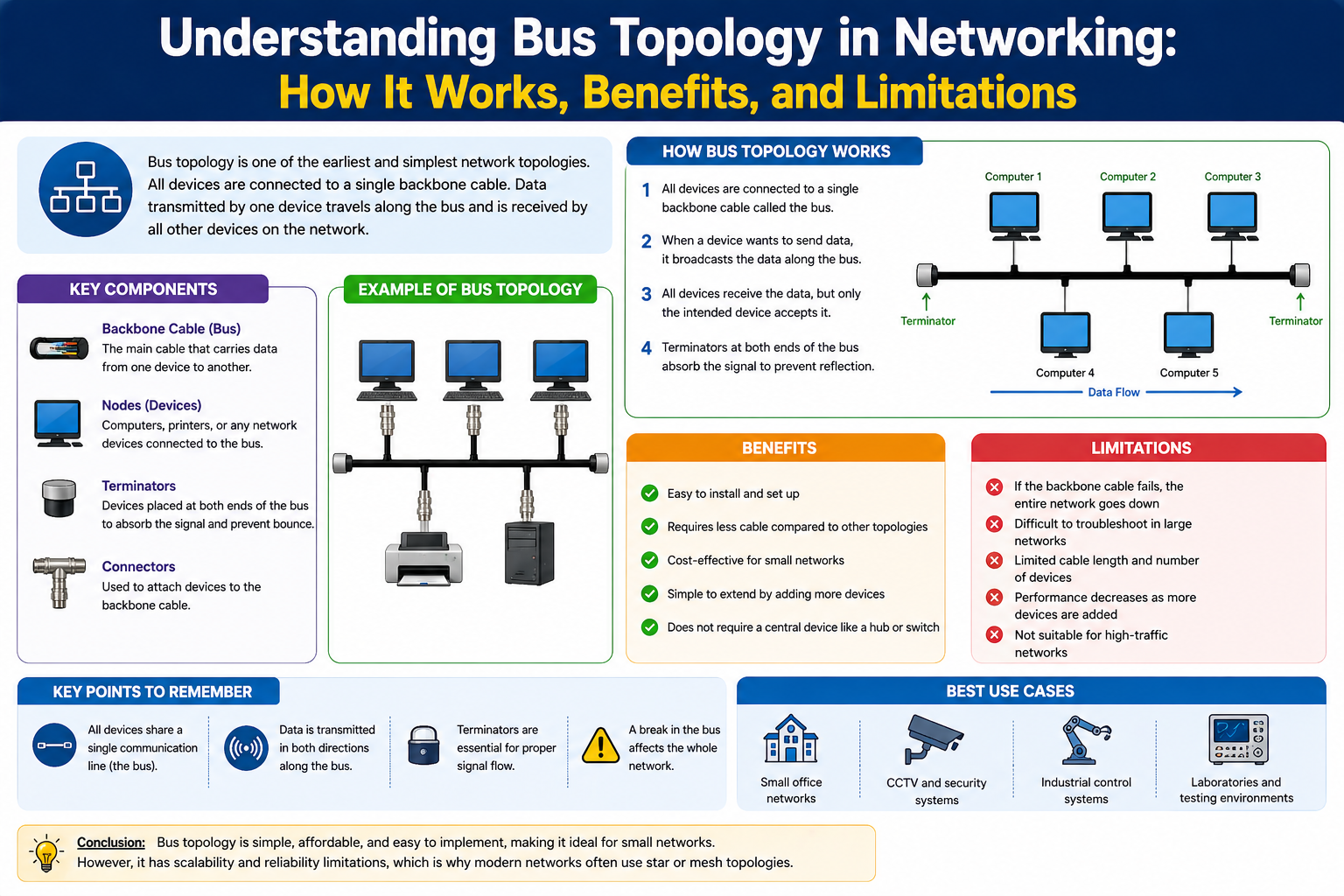
In bus topology, the physical structure revolves around a single communication line known as the backbone cable. All devices, including computers, printers, and other network nodes, are connected directly to this shared cable. The layout is linear in nature, meaning data travels along a straight path from one end of the network to the other. Unlike more complex topologies, there are no central hubs or switches controlling the flow of data. Instead, the backbone itself acts as the primary medium for communication.
The simplicity of this structure makes it easy to design and implement in small-scale environments. However, this same simplicity also introduces limitations when the network grows. Since all devices depend on one cable, the entire system is highly dependent on the integrity of that single line.
Data Transmission Process
In a bus topology, data transmission follows a broadcast method. When a device sends information, the data is placed on the backbone cable and travels in both directions. Every device connected to the network receives the signal, but only the device with the matching address processes and accepts the data.
This process ensures that communication remains possible without requiring complex routing mechanisms. However, because all devices share the same communication path, only one device can successfully transmit data at a time. If two devices attempt to send data simultaneously, a collision may occur, which can lead to data loss or retransmission.
The network relies on a protocol system to manage these transmissions and reduce the chances of conflict. Even with such mechanisms in place, congestion can still become a problem as more devices are added.
Role of Terminators in the Network
Terminators play a critical role in ensuring proper functioning of a bus topology. These small components are placed at both ends of the backbone cable to absorb signals and prevent them from reflecting back into the network. Without terminators, signals would bounce back and forth along the cable, causing interference and disrupting communication.
This reflection could lead to signal distortion, making data unreadable or causing repeated transmission errors. By absorbing the signal energy, terminators help maintain stability and ensure that communication remains clear and accurate.
Advantages in Practical Use
Bus topology offers several practical advantages, especially in environments where simplicity and cost efficiency are important. One of its most notable strengths is its low installation cost. Since it requires only a single main cable, the amount of wiring needed is significantly reduced compared to other network structures.
It is also easy to set up and requires minimal technical expertise. This makes it suitable for small offices, temporary networks, or educational environments where advanced infrastructure is not necessary.
Another benefit is that adding new devices can be relatively straightforward, provided there is available space on the backbone cable. This flexibility allows for basic expansion without major redesign.
Additionally, the system does not require a central device such as a switch or hub, which further reduces hardware requirements and overall complexity.
Limitations and Performance Challenges
Despite its advantages, bus topology has several significant limitations. One of the most critical issues is its dependence on a single cable. If the backbone cable fails or is damaged, the entire network becomes non-functional. This creates a single point of failure, which reduces reliability.
Performance is another major concern. As more devices are added, the amount of traffic on the network increases. Since all devices share the same communication line, data collisions become more frequent, leading to slower performance and delays.
Troubleshooting can also become difficult in larger setups. Identifying the exact location of a fault in the cable or determining which device is causing issues often requires careful inspection of the entire network.
Furthermore, bus topology is not suitable for handling large volumes of data or supporting high-speed communication requirements. Modern networks often require more scalable and efficient designs.
Scalability Issues in Growing Networks
One of the biggest challenges with bus topology is its limited scalability. While it works well for small networks, it does not scale efficiently as the number of connected devices increases. Each additional device adds more load to the shared backbone, increasing the likelihood of congestion and data collisions.
As a result, performance gradually declines as the network expands. Eventually, the system becomes inefficient and may require complete redesign or migration to a more advanced topology.
This limitation makes bus topology unsuitable for modern enterprise environments where large numbers of devices must communicate simultaneously and efficiently.
Security Considerations
From a security perspective, bus topology also presents challenges. Since data is broadcast across the entire network, every device receives the transmitted information. Although only the intended recipient processes it, the exposure of data to all nodes creates potential security risks.
Unauthorized devices connected to the network may be able to intercept data, making it less secure compared to more controlled topologies. There is limited ability to isolate traffic or enforce strict data segmentation, which is a major concern in sensitive environments.
For this reason, bus topology is generally not used in networks where security and privacy are high priorities.
Comparison with Other Topologies
When compared to other network topologies, bus topology stands out for its simplicity but falls behind in performance and reliability. Unlike star topology, which uses a central device to manage communication, bus topology relies entirely on a single shared cable. This makes it more vulnerable to failures.
In comparison to mesh topology, which provides multiple paths for data transmission, bus topology offers only one path. This reduces redundancy and increases risk. Similarly, ring topology, where each device is connected in a closed loop, provides more structured data flow control than bus topology.
While bus topology is cost-effective, it is generally considered outdated for complex or high-performance networking needs.
Real-World Applications
Bus topology was commonly used in early local area networks due to its simplicity and low cost. It was often found in small office setups, early computer labs, and basic networking environments where high-speed communication was not required.
Although it is less common today, it may still be used in certain temporary setups or educational demonstrations to teach fundamental networking concepts. Its straightforward design makes it useful for understanding how data travels across a network.
In modern systems, however, more advanced topologies have largely replaced it due to better performance, reliability, and scalability.
Troubleshooting and Maintenance
Maintaining a bus topology network requires careful attention to the condition of the backbone cable. Since the entire system depends on it, even a small break or fault can disrupt communication across all devices.
Troubleshooting typically involves checking cable continuity, inspecting terminators, and ensuring all connections are secure. Identifying faults may require testing each segment of the cable to locate the problem area.
Regular maintenance is important to prevent unexpected failures. However, as networks grow, maintenance becomes more time-consuming and less efficient compared to other topologies.
Evolution and Modern Relevance
Over time, networking technology has evolved significantly, leading to the decline in the use of bus topology. Modern networks prioritize speed, reliability, and scalability, which are better supported by topologies such as star and hybrid models.
Despite this evolution, bus topology still holds educational value. It helps learners understand basic networking principles such as data transmission, collision handling, and shared communication channels.
Its historical importance lies in being one of the foundational models that influenced the development of more advanced networking systems.
Network Performance in Bus Topology
In a bus topology, network performance is directly influenced by the number of connected devices and the amount of data being transmitted. Since all devices share a single communication channel, the bandwidth is divided among every active node. When the network is lightly used, performance can remain stable and efficient. However, as traffic increases, the shared medium becomes congested, leading to delays and reduced data transfer speeds.
The performance bottleneck occurs because only one device can transmit data at a time. When multiple devices attempt communication simultaneously, collisions occur, forcing retransmission of data packets. This repeated process consumes additional time and resources, further slowing down the network.
Over time, as more devices are added, the degradation in performance becomes more noticeable. This is one of the key reasons why bus topology is not preferred for high-demand or modern enterprise networks.
Data Collision and Its Impact
Data collision is a common issue in bus topology. It happens when two or more devices send data at the same time over the shared backbone cable. Since the signals interfere with each other, the data becomes corrupted and cannot be properly delivered to the intended recipient.
When a collision occurs, devices must wait for a random period before attempting to resend the data. This waiting mechanism reduces the chance of repeated collisions but does not eliminate them entirely. As network activity increases, the frequency of collisions also increases, resulting in slower communication and reduced efficiency.
Collisions not only affect speed but also increase network overhead. The repeated transmission of data consumes bandwidth and processing resources, making the network less efficient overall.
Cable Dependency and Fault Sensitivity
One of the most critical aspects of bus topology is its heavy dependence on the backbone cable. This single cable serves as the main pathway for all network communication. If it becomes damaged, disconnected, or degraded, the entire network is affected.
Even a minor break in the cable can disrupt communication between all connected devices. This makes the system highly sensitive to physical damage and environmental factors such as wear and tear, bending, or accidental cuts.
Unlike more resilient topologies that have multiple paths for data flow, bus topology lacks redundancy. This means there is no backup route for data transmission, making fault tolerance extremely low.
Ease of Installation and Setup
One of the reasons bus topology was widely used in early networking environments is its ease of installation. Setting up this network requires minimal hardware, primarily a single backbone cable and connectors for each device.
The straightforward layout reduces configuration complexity, allowing quick deployment even with limited technical expertise. This simplicity made it popular in early computer labs and small office environments where advanced networking equipment was not available or necessary.
Additionally, the lack of centralized devices like switches or hubs reduces both cost and setup time. This made it an attractive choice for budget-conscious setups.
Maintenance Challenges
While installation is simple, maintenance of a bus topology network can be challenging. Since all devices are connected through a single cable, identifying faults requires careful inspection of the entire network.
If a problem occurs, such as data transmission failure or network downtime, technicians often need to check multiple segments of the cable to locate the issue. This can be time-consuming, especially in larger networks.
Additionally, any change or repair in the network may require temporarily shutting down the entire system. This disrupts normal operations and reduces productivity.
Signal Degradation Over Distance
In bus topology, signal quality tends to degrade as it travels along the backbone cable. This is due to resistance and attenuation, which reduce signal strength over distance.
As the signal weakens, the chances of data corruption increase. To minimize this issue, networks often have length limitations for the backbone cable. Beyond a certain distance, signal boosters or repeaters may be required to maintain communication quality.
However, even with such solutions, performance may still not match that of more advanced topologies designed for long-distance communication.
Network Expansion Limitations
Expanding a bus topology network is not as flexible as other designs. Although new devices can be added by connecting them to the backbone cable, there is a practical limit to how many devices the network can support efficiently.
Each additional device increases network traffic and the likelihood of collisions. Eventually, the network reaches a point where performance becomes unacceptable.
At that stage, expanding further may require redesigning the entire network structure rather than simply adding more nodes.
Security Weaknesses in Shared Communication
Security in bus topology is inherently weak due to its broadcast nature. Since all devices receive transmitted data, there is limited control over who can access the information.
Even though devices are programmed to ignore irrelevant data, the fact that data is visible to all nodes creates potential vulnerabilities. Unauthorized users connected to the network may intercept or monitor traffic without much difficulty.
This lack of privacy control makes bus topology unsuitable for environments where sensitive or confidential data is transmitted regularly.
Cost Efficiency and Resource Use
Despite its limitations, bus topology remains cost-efficient in terms of resource usage. It requires less cabling than most other topologies, which significantly reduces installation costs.
The absence of central networking devices also lowers hardware expenses. For small-scale or temporary networks, this makes it a practical choice when budget constraints are a major concern.
However, while initial costs are low, long-term maintenance and performance issues may offset these savings in larger deployments.
Reliability Concerns
Reliability is one of the weakest aspects of bus topology. Since the entire network depends on a single backbone cable, any failure in that cable results in complete network downtime.
There is no redundancy built into the system, meaning there are no alternative paths for data transmission. This lack of fault tolerance makes it unsuitable for critical systems where continuous connectivity is required.
In contrast, more modern topologies are designed with redundancy to ensure higher reliability and uptime.
Use in Educational Environments
Bus topology is often used in educational settings to demonstrate basic networking concepts. Its simple structure helps learners understand how data flows in a network and how devices communicate over a shared medium.
By studying this topology, students can gain foundational knowledge about collisions, bandwidth sharing, and signal transmission. This understanding is useful before moving on to more complex network designs.
Even though it is not widely used in real-world modern networks, its educational value remains significant.
Technological Obsolescence
With advancements in networking technology, bus topology has gradually become obsolete in most practical applications. Modern networks demand higher speeds, better reliability, and improved scalability, all of which are better supported by other topologies.
Technologies such as star and mesh configurations provide more efficient data handling and fault tolerance. As a result, bus topology is now mostly replaced in enterprise and large-scale systems.
However, its historical role in the development of computer networking remains important.
Bus topology represents a foundational networking structure built on simplicity and shared communication. While it offers advantages such as low cost and easy setup, its limitations in performance, reliability, and scalability significantly restrict its use in modern environments.
It remains an important concept for understanding the evolution of network design and the challenges involved in managing shared communication systems.
Error Handling in Bus Topology
In bus topology, error handling is relatively basic and less efficient compared to modern network structures. When data is transmitted across the backbone cable, there is no centralized system to monitor or correct errors in real time. Instead, devices rely on simple detection mechanisms to identify corrupted or lost data packets.
If an error occurs due to a collision or signal interference, the affected device must request retransmission of the data. This process increases network traffic and adds delay to communication. Since multiple devices share the same transmission medium, repeated errors can quickly reduce overall network efficiency.
The lack of advanced error correction systems makes bus topology more vulnerable in environments where data accuracy is critical.
Bandwidth Utilization
Bandwidth in a bus topology is shared among all connected devices, meaning the available capacity is not dedicated to any single node. This shared usage model works efficiently only when the number of devices is small and network traffic is light.
As more devices become active, the bandwidth gets divided into smaller portions, resulting in slower data transfer speeds. Since only one device can transmit at a time, the effective use of bandwidth is often limited.
This inefficient utilization becomes more noticeable during peak usage periods when multiple devices attempt to communicate simultaneously. In such cases, delays increase and performance drops significantly.
Communication Protocols in Bus Topology
Bus topology relies on simple communication protocols to manage data transmission. These protocols help determine when a device can send data and how to handle collisions when they occur.
One common method is carrier sensing, where a device checks whether the communication channel is free before transmitting. If the channel is busy, the device waits for a random interval before trying again. This reduces but does not eliminate the possibility of collisions.
While these protocols provide basic coordination, they are not as efficient or intelligent as those used in more advanced networking systems. As a result, bus topology is less suitable for high-speed or complex communication environments.
Physical Installation Considerations
Installing a bus topology network requires careful planning of cable layout and device placement. The backbone cable must be installed in a straight or linear path, with devices connected at appropriate intervals.
Proper termination at both ends of the cable is essential to ensure signal stability. Without correct termination, signal reflections can occur, leading to communication errors and network instability.
Physical durability of the cable is also an important consideration. Since the entire network depends on a single line, it must be protected from damage, bending, or environmental exposure.
Impact of Network Traffic Load
Network traffic load has a direct impact on the efficiency of bus topology. Under low traffic conditions, data flows smoothly with minimal delays. However, as traffic increases, the shared communication channel becomes congested.
High traffic levels lead to frequent collisions, retransmissions, and delays. This creates a ripple effect where overall network performance continues to degrade as usage increases.
In environments with unpredictable or heavy traffic, bus topology struggles to maintain stable performance, making it less reliable for modern applications.
Advantages in Temporary Network Setups
Despite its limitations, bus topology can be useful in temporary network setups. Its quick installation process and minimal hardware requirements make it suitable for short-term projects or events.
Since it does not require complex configuration or expensive equipment, it can be deployed rapidly when needed. Once the temporary requirement is over, the network can be dismantled with equal ease.
This flexibility makes it practical for experimental environments or situations where long-term infrastructure is not required.
Environmental and Physical Vulnerabilities
Bus topology is sensitive to physical and environmental factors. Damage to the backbone cable can occur due to accidental cuts, excessive bending, or exposure to harsh conditions.
Even minor physical issues can disrupt communication across the entire network. Environmental factors such as heat, moisture, or electromagnetic interference can also affect signal quality.
Because of these vulnerabilities, careful installation and maintenance are necessary to ensure stable operation.
Network Efficiency in Small Scale Use
In small-scale networks, bus topology can still perform efficiently. With fewer devices and limited traffic, the shared communication channel is not heavily congested.
Under these conditions, data collisions are rare, and transmission speed remains acceptable. This makes it suitable for basic setups where performance demands are low.
However, once the network begins to grow, efficiency declines quickly, limiting its long-term usability.
Upgrade Challenges
Upgrading a bus topology network is not straightforward. Adding new devices may require reconfiguration of the backbone cable and careful adjustment of terminators.
In some cases, expanding the network beyond a certain point becomes impractical. This often forces a complete migration to a different topology rather than incremental upgrades.
This lack of flexibility is one of the major reasons why bus topology has been replaced in modern systems.
Historical Importance in Networking Evolution
Bus topology played an important role in the early development of computer networks. It was one of the first widely used structures for connecting multiple devices in a shared environment.
Its simplicity helped establish fundamental networking concepts such as shared communication channels, data collisions, and broadcast transmission.
Although it is no longer widely used, its influence can still be seen in the design principles of modern networking systems.
Comparison of Efficiency Over Time
Over time, the efficiency of bus topology has been overshadowed by more advanced designs. Early networks benefited from its simplicity, but increasing demand for speed and reliability exposed its weaknesses.
Modern topologies provide better traffic management, redundancy, and scalability, making them more suitable for current technological requirements.
As a result, bus topology has transitioned from a practical solution to a primarily educational concept.
Role in Learning Networking Fundamentals
Bus topology continues to be widely used as a teaching model in networking education. It helps learners understand how shared communication systems operate and how data travels across a network.
By studying its structure and behavior, students gain insight into important networking challenges such as collisions, bandwidth sharing, and signal degradation.
This foundational knowledge is essential for understanding more complex networking systems.
Bus Topology Characteristics
Bus topology is a simple and cost-effective network design based on a single shared communication cable. It offers ease of installation and low resource requirements, making it suitable for small or temporary networks.
However, its limitations in scalability, performance, reliability, and security restrict its use in modern environments. As network demands have evolved, more advanced topologies have replaced it in most practical applications.
Despite this, its role in the history and education of computer networking remains significant, as it provides a clear introduction to fundamental networking principles.
Advanced Working Mechanism of Bus Topology
In bus topology, the advanced working mechanism is based on how efficiently the shared communication channel is managed under different network conditions. Although the structure appears simple, the internal behavior of data flow involves timing, signal coordination, and collision management techniques.
When a device intends to transmit data, it first listens to the network to determine whether the backbone cable is free. If no other device is transmitting, it proceeds to send its data packet. This process helps reduce immediate collisions, but it does not fully eliminate the possibility of overlapping transmissions.
Once the data is placed on the backbone, it travels across the entire length of the cable in both directions. Each device checks the destination address of the data packet. Only the intended recipient accepts and processes the information, while others ignore it. This broadcast nature ensures that communication does not require direct point-to-point connections.
However, because all devices share the same medium, timing becomes extremely important. Even slight delays or synchronization issues can lead to overlapping transmissions, which result in data collisions and retransmission delays.
Propagation Delay and Its Effects
Propagation delay is an important factor in bus topology that affects how quickly data travels across the network. It refers to the time taken for a signal to move from the sender to all other devices on the backbone cable.
In small networks, this delay is almost negligible. However, as the length of the cable increases, propagation delay becomes more noticeable. This can create timing mismatches between devices, increasing the chances of collision.
Devices located at opposite ends of the cable may not detect each other’s transmissions immediately, leading to simultaneous data sending. This increases the probability of interference and reduces overall efficiency.
Network Congestion Behavior
Network congestion in bus topology occurs when too many devices attempt to use the shared communication channel at the same time. Since only one device can transmit at a time, others must wait for their turn.
As congestion increases, waiting times become longer. Devices repeatedly attempt to resend data after random delays, but this does not guarantee smooth communication. Instead, it often results in a cycle of delays and retransmissions.
Over time, heavy congestion leads to noticeable performance degradation. Users experience slow response times, delayed file transfers, and frequent interruptions in communication.
Role of Cable Quality in Performance
The quality of the backbone cable plays a major role in determining the performance of a bus topology network. High-quality cables with proper shielding can reduce signal loss and minimize interference from external sources.
Poor-quality cables, on the other hand, can cause frequent signal degradation. This leads to increased data errors and reduced communication reliability.
Additionally, cable length limitations must be carefully followed. If the cable exceeds recommended distances, signal strength weakens significantly, resulting in unstable network behavior.
Fault Isolation Complexity
One of the major technical challenges in bus topology is fault isolation. When a network failure occurs, identifying the exact location of the problem can be difficult.
Since all devices are connected to a single cable, a fault anywhere in the backbone can affect the entire network. This makes it challenging to determine whether the issue is caused by a device, a connector, or the cable itself.
Technicians often need to inspect the network segment by segment, disconnecting devices one by one to locate the fault. This process is time-consuming and inefficient compared to modern network diagnostics systems.
Impact of Device Density
Device density refers to the number of devices connected to the network. In bus topology, device density has a direct impact on performance and stability.
When only a few devices are connected, communication remains smooth and efficient. However, as more devices are added, the shared bandwidth becomes strained.
Higher device density increases traffic, which leads to more frequent collisions and retransmissions. This reduces overall throughput and makes the network less responsive.
Eventually, the network reaches a saturation point where adding more devices becomes counterproductive.
Synchronization Challenges
Synchronization is another important factor in bus topology. Since all devices share the same communication medium, timing coordination is essential for smooth data transmission.
If devices are not properly synchronized, they may attempt to transmit data simultaneously, leading to collisions. Synchronization issues become more prominent in larger networks where signal delays vary across distances.
Although basic protocols help manage timing, they are not advanced enough to completely eliminate synchronization problems.
Real-World Decline in Usage
In real-world applications, bus topology has significantly declined in usage due to its limitations. Modern networks require high-speed communication, scalability, and fault tolerance, which bus topology cannot effectively provide.
Organizations have gradually replaced it with more advanced structures that offer better performance and reliability. As a result, bus topology is now rarely used in production environments.
Its presence is mostly limited to academic demonstrations, small experimental setups, or legacy systems that have not yet been upgraded.
Hybrid Network Influence
Even though bus topology is not widely used on its own, its principles still influence hybrid network designs. Hybrid networks combine elements from multiple topologies to create more flexible and efficient systems.
In some cases, a bus-like structure may be used within a segment of a larger hybrid network. This allows for cost-effective internal communication while maintaining overall system efficiency.
However, in such cases, the bus segment is usually isolated or supported by more advanced network components to reduce its limitations.
Troubleshooting Methodology
Troubleshooting a bus topology network requires a systematic approach. The first step typically involves checking the physical integrity of the backbone cable. Any visible damage or disconnection must be addressed immediately.
Next, terminators at both ends of the cable are inspected to ensure proper placement and functionality. Faulty terminators can cause signal reflection, leading to network instability.
After that, individual devices are tested to determine whether any of them are causing interference or sending faulty signals. This process continues until the root cause of the problem is identified.
Due to the shared nature of the network, troubleshooting can be complex and time-consuming, especially in larger setups.
Long-Term Maintenance Requirements
Long-term maintenance of bus topology requires continuous monitoring of the physical infrastructure. Since the entire network depends on a single cable, regular inspections are necessary to ensure its condition remains intact.
Environmental factors such as temperature changes, humidity, and physical stress can gradually degrade the cable over time. Preventive maintenance helps reduce the risk of sudden failures.
However, even with proper maintenance, the inherent design limitations of bus topology cannot be completely overcome.
Educational Value in Modern Networking
Despite its practical limitations, bus topology continues to hold educational value in modern networking courses. It provides a clear and simple model for understanding how shared communication systems operate.
By studying bus topology, learners can grasp essential concepts such as data broadcasting, collision detection, and bandwidth sharing. These foundational ideas are important for understanding more complex network architectures.
It also helps students appreciate why modern networks evolved toward more advanced and efficient designs.
Technological Transition and Replacement
The transition away from bus topology has been driven by the increasing demand for faster and more reliable networks. As digital communication became more complex, the limitations of bus topology became more apparent.
New technologies introduced alternative designs that solved many of its weaknesses. These newer systems offer better scalability, improved fault tolerance, and higher data transmission speeds.
As a result, bus topology has been largely replaced in modern networking environments.
Conceptual Importance in Networking Theory
From a theoretical perspective, bus topology remains an important concept in networking science. It represents one of the simplest forms of network communication and serves as a baseline for understanding more complex systems.
Its structure highlights fundamental challenges such as shared resource management and collision handling. These concepts are still relevant in modern networking technologies, even though the physical design has changed.
Understanding bus topology helps build a strong foundation for studying advanced network architectures.
Conclusion
Bus topology is one of the simplest and earliest forms of network design, built around a single shared communication cable. It offers advantages such as low installation cost, simple structure, and ease of implementation, making it suitable for small or temporary networks.
However, its disadvantages are significant. Limited scalability, frequent data collisions, performance degradation under heavy load, and complete dependence on a single cable reduce its practicality in modern environments. Security concerns and maintenance difficulties further restrict its usage.
Over time, more advanced network topologies have replaced bus topology in most real-world applications due to their improved efficiency, reliability, and flexibility. Despite this decline, its importance has not disappeared.
Bus topology remains a fundamental concept in networking education, helping learners understand how data transmission works in shared communication systems. It also provides historical insight into the evolution of computer networks and the challenges that led to the development of modern networking technologies.
In summary, while bus topology is no longer suitable for large or critical systems, it continues to play a valuable role in foundational learning and in understanding the basic principles of network communication.