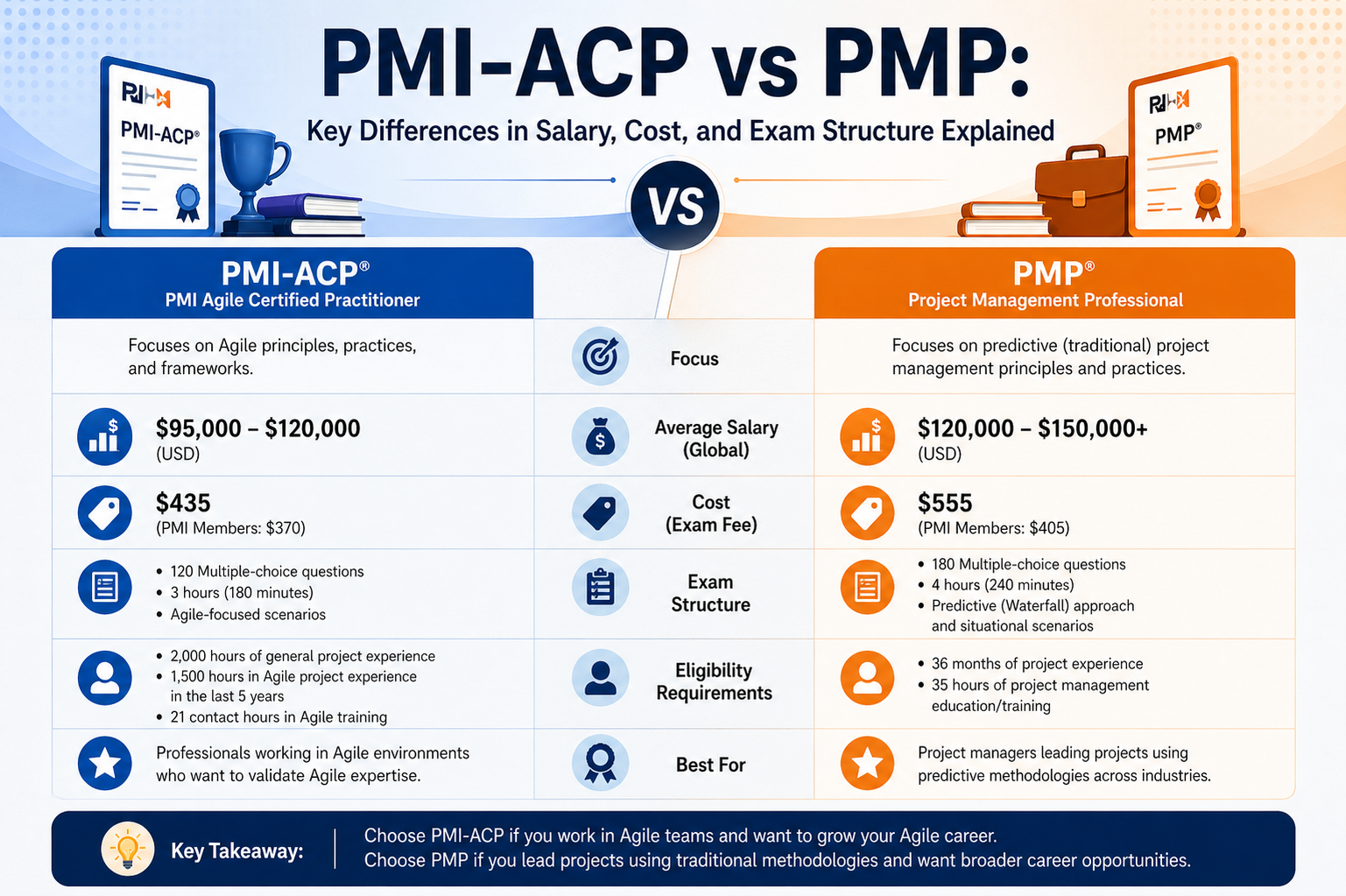
The PMP (Project Management Professional) and PMI-ACP (Agile Certified Practitioner) certifications are both offered by the Project Management Institute, yet they are built for very different professional needs. PMP is designed for individuals who manage projects in a structured, predictive environment where planning, documentation, and control play a central role. It represents a traditional approach to project management and is widely recognized across industries such as construction, manufacturing, engineering, and large-scale IT implementations.
PMI-ACP, on the other hand, focuses entirely on Agile principles and practices. It is intended for professionals working in environments where change is frequent, requirements evolve continuously, and iterative delivery is essential. This certification covers frameworks like Scrum, Kanban, Lean, Extreme Programming, and hybrid agile approaches. It is particularly popular in software development, digital product teams, and startups where adaptability is more important than rigid long-term planning.
While both certifications aim to improve project success rates, their philosophies differ significantly. PMP emphasizes control and predictability, whereas PMI-ACP emphasizes flexibility and responsiveness.
Differences in Eligibility Requirements
One of the most noticeable differences between PMP and PMI-ACP lies in eligibility criteria. PMP has stricter requirements because it targets experienced project managers. Candidates typically need several years of project leadership experience, along with formal project management education hours. This ensures that only professionals with substantial hands-on experience attempt the certification.
PMI-ACP has comparatively more accessible requirements. While it still requires experience in project environments, it places greater emphasis on agile exposure rather than traditional project management leadership. Candidates are expected to have worked in agile teams and understand agile principles in practice. This makes PMI-ACP more approachable for team members, developers, testers, and product professionals who are actively involved in agile projects but may not hold formal leadership roles.
This difference in eligibility often influences which certification professionals pursue at different stages of their careers.
Exam Structure and Format Comparison
The PMP exam is known for its complexity and depth. It includes scenario-based questions that test a candidate’s ability to apply project management principles in real-world situations. The exam covers predictive, hybrid, and agile methodologies, but the focus remains broad and strategic. Candidates must demonstrate understanding across multiple knowledge areas such as scope, schedule, cost, risk, procurement, and stakeholder management.
The PMI-ACP exam is more focused and agile-specific. It includes questions based on agile tools, techniques, and mindset. The exam evaluates understanding of iterative development, team collaboration, adaptive planning, and continuous improvement. Instead of covering a wide range of traditional project management areas, it dives deeply into agile frameworks and practices.
Another difference is the style of thinking required. PMP questions often require analytical decision-making based on structured processes, while PMI-ACP questions test adaptability, collaboration, and responsiveness to change.
Salary Differences and Career Impact
Salary potential is one of the key reasons professionals consider either PMP or PMI-ACP certification. PMP-certified professionals generally earn higher average salaries globally due to the seniority associated with the role. PMP holders often work as project managers, program managers, or portfolio managers, positions that come with higher responsibility and compensation.
The salary range for PMP professionals tends to be higher in industries such as construction, consulting, IT services, and enterprise project management. The certification is often seen as a benchmark for leadership-level project management roles, which directly influences compensation levels.
PMI-ACP professionals also enjoy strong salary prospects, especially in agile-driven industries. While average salaries may be slightly lower than PMP at senior leadership levels, PMI-ACP holders are highly valued in product development, software engineering, and digital transformation projects. Organizations adopting agile frameworks often seek certified practitioners to improve team efficiency and delivery speed.
In many cases, PMI-ACP professionals transition into roles such as Scrum Master, Agile Coach, Product Owner, or Agile Project Manager. These roles continue to grow in demand, particularly in technology sectors.
Ultimately, PMP tends to lead to higher long-term salary ceilings, while PMI-ACP offers faster entry into agile roles with strong growth potential.
Cost of Certification and Overall Investment
The cost of pursuing PMP certification is generally higher compared to PMI-ACP. This includes exam fees, study materials, training programs, and preparation time. PMP also requires more extensive preparation due to its broad syllabus, which can increase the total investment in terms of both time and money.
PMI-ACP is relatively more affordable. The exam fee is lower, and the preparation effort is more focused because the subject matter is narrower. However, candidates still need to invest in agile training and practical experience to meet eligibility requirements.
When considering overall return on investment, PMP may offer higher long-term financial benefits due to senior-level roles, while PMI-ACP provides quicker access to agile roles and can be a stepping stone for professionals transitioning into modern project environments.
Exam Difficulty and Preparation Approach
The PMP exam is widely considered more difficult due to its breadth and complexity. Candidates must understand not only processes but also how to apply them in unpredictable, real-world project scenarios. The exam often tests judgment under pressure, requiring strong conceptual clarity and experience-based thinking.
Preparation for PMP usually takes longer, often several months of structured study. Candidates must master frameworks, process groups, and knowledge areas while also practicing scenario-based questions extensively.
The PMI-ACP exam is challenging in a different way. Instead of breadth, it demands depth in agile principles. Candidates must understand team dynamics, iterative development cycles, backlog management, and agile ceremonies in detail. While the scope is narrower, the conceptual shift from traditional to agile thinking can be difficult for those unfamiliar with agile environments.
Preparation time for PMI-ACP is generally shorter, but practical experience in agile projects is essential for success.
Industry Demand and Career Opportunities
PMP certification has been established for decades and is recognized across almost all industries. It is especially valuable in organizations that rely on structured project management methodologies. Government projects, infrastructure development, and large corporations often prefer PMP-certified professionals for leadership roles.
PMI-ACP is growing rapidly in demand due to the global shift toward agile adoption. Technology companies, startups, fintech organizations, and product-based companies actively seek agile-certified professionals. As digital transformation accelerates, PMI-ACP is becoming increasingly relevant.
In many organizations today, hybrid project management approaches are used, combining both predictive and agile methods. In such environments, professionals with knowledge of both PMP and PMI-ACP principles are highly valued.
Skill Set Differences Between PMP and PMI-ACP Professionals
PMP professionals typically develop strong skills in planning, risk management, budgeting, scheduling, and stakeholder communication. Their expertise lies in managing large-scale, structured projects with defined timelines and deliverables.
PMI-ACP professionals, on the other hand, focus on collaboration, adaptability, continuous feedback, and iterative delivery. They are skilled in facilitating agile ceremonies, managing product backlogs, and improving team productivity in dynamic environments.
While PMP emphasizes control and governance, PMI-ACP emphasizes flexibility and team empowerment. Both skill sets are valuable but serve different organizational needs.
Long-Term Career Growth and Transition Opportunities
Professionals with PMP certification often move into senior leadership positions such as program manager, portfolio manager, or PMO director. Their career path is generally aligned with organizational leadership and strategic planning.
PMI-ACP professionals often grow into roles such as Agile Coach, Scrum Master, or Product Owner. These roles are more closely connected to product development and team facilitation rather than organizational governance.
Interestingly, many professionals pursue both certifications over time. PMP provides a strong foundation in traditional project management, while PMI-ACP adds agility and modern delivery skills. Together, they create a powerful combination that is highly valued in hybrid work environments.
Which Certification Should You Choose
The choice between PMP and PMI-ACP depends on career goals, industry, and working style. If the goal is to lead large-scale projects, manage budgets, and work in structured environments, PMP is the stronger choice. If the focus is on agile teams, product development, and fast-changing environments, PMI-ACP is more suitable.
Professionals in early or mid-career stages working in technology-driven fields often prefer PMI-ACP due to its relevance to modern practices. Senior professionals in traditional industries often pursue PMP to strengthen leadership credentials.
In many cases, the best long-term strategy is not choosing one over the other, but understanding how both complement each other in today’s evolving project management landscape.
How Industry Trends Are Shaping PMP and PMI-ACP Value
The value of PMP and PMI-ACP certifications continues to evolve as industries shift toward digital transformation and hybrid project delivery models. Traditionally, PMP dominated most sectors because organizations relied heavily on structured project management frameworks. However, with the rise of agile methodologies, especially in software development and product-based companies, PMI-ACP has gained significant traction.
Today, many organizations no longer rely purely on predictive or purely agile methods. Instead, they adopt hybrid approaches where planning is structured but execution remains flexible. This shift has created a demand for professionals who understand both mindsets. PMP provides the foundation for structured governance, while PMI-ACP introduces adaptability and iterative delivery techniques.
As a result, the gap between the two certifications is not just about traditional versus agile anymore; it is about how well a professional can operate in mixed environments where both approaches are required simultaneously.
Differences in Learning Curve and Study Depth
The learning journey for PMP is typically more extensive due to its wide coverage of project management concepts. Candidates must understand multiple domains, including integration, scope, cost, quality, resource, communication, risk, procurement, and stakeholder management. Each area requires not only memorization but also conceptual clarity and practical application.
PMI-ACP, in contrast, has a more focused syllabus but requires a mindset shift. Instead of structured processes, candidates must think in terms of agility, adaptability, and continuous improvement. This includes understanding agile values, principles, servant leadership, team collaboration, and incremental delivery.
While PMP demands broader knowledge, PMI-ACP demands deeper understanding of agile thinking. For many professionals transitioning from traditional environments, PMI-ACP can initially feel less structured but conceptually challenging because it requires abandoning rigid planning habits.
Real-World Application of PMP Skills
PMP-certified professionals are often responsible for managing complex, large-scale projects where timelines, budgets, and deliverables must be strictly controlled. These professionals are commonly found in industries such as construction, engineering, healthcare systems, defense projects, and enterprise-level IT implementations.
Their role involves defining project scope, creating detailed schedules, managing risks, coordinating stakeholders, and ensuring that projects are completed within defined constraints. PMP training equips professionals to handle uncertainty through structured processes and documentation.
In real-world scenarios, PMP professionals are often seen as decision-makers who ensure that projects remain aligned with organizational goals. Their focus is on predictability, accountability, and governance, which makes them essential in environments where deviations can lead to significant financial or operational risks.
Real-World Application of PMI-ACP Skills
PMI-ACP professionals typically work in environments where requirements change frequently and customer feedback plays a critical role in shaping the final product. This is especially common in software development, mobile applications, digital platforms, and startup ecosystems.
Their responsibilities include facilitating agile ceremonies such as sprint planning, daily stand-ups, sprint reviews, and retrospectives. They also work closely with product owners and development teams to prioritize backlogs and ensure continuous delivery of value.
In practice, PMI-ACP professionals act as enablers of collaboration and adaptability. They focus on removing obstacles, improving team efficiency, and ensuring that the product evolves based on user feedback. Unlike PMP roles that emphasize control, PMI-ACP roles emphasize empowerment and responsiveness.
Cost-Benefit Perspective Over Time
When evaluating both certifications from a long-term financial perspective, PMP often provides a higher return in senior management roles. This is because PMP-certified professionals are eligible for positions that involve larger responsibilities, strategic decision-making, and higher organizational impact.
However, PMI-ACP offers strong value in industries experiencing rapid growth, particularly technology-driven sectors. Professionals with agile expertise often find quicker job opportunities and faster entry into roles like Scrum Master or Agile Coach.
The cost of PMP may be higher initially, but its long-term earning potential can justify the investment. PMI-ACP, while more affordable, can be a strategic stepping stone for professionals aiming to build expertise in agile methodologies before advancing further.
Certification Overlap and Combined Advantage
One of the most important aspects to understand is that PMP and PMI-ACP are not mutually exclusive. In fact, many professionals pursue both certifications to strengthen their overall project management capabilities.
PMP provides a strong foundation in structured project delivery, while PMI-ACP adds flexibility and adaptability. Together, they create a hybrid skill set that is highly valuable in modern organizations that use a combination of waterfall and agile approaches.
Professionals who hold both certifications are often considered highly versatile because they can manage traditional projects while also leading agile teams. This dual expertise significantly enhances career opportunities and leadership potential.
Organizational Preference and Hiring Trends
Organizations choose between PMP and PMI-ACP candidates based on their project delivery models. Companies with strict regulatory requirements or long-term infrastructure projects often prefer PMP-certified professionals due to their structured approach.
On the other hand, companies in technology, innovation, and product development increasingly prefer PMI-ACP-certified professionals because of their ability to handle fast-changing requirements and iterative delivery cycles.
Many global organizations now include both certifications in job descriptions, especially for senior project management roles. This reflects the growing need for professionals who can bridge the gap between traditional and agile methodologies.
Challenges Faced by PMP Candidates
PMP candidates often face challenges due to the extensive syllabus and scenario-based questioning style. The exam requires not just knowledge but also the ability to apply concepts in complex situations. This can be difficult for individuals who have not worked in large-scale project environments.
Another challenge is the need to unlearn outdated practices and align with the latest version of the PMBOK guide and agile integration within PMP. This shift requires consistent study and practical understanding of modern project management trends.
Time management during preparation is also a key challenge, as PMP requires sustained focus over several weeks or months.
Challenges Faced by PMI-ACP Candidates
PMI-ACP candidates often struggle with the conceptual shift from traditional thinking to agile thinking. Those coming from structured project environments may find it difficult to adapt to flexible, iterative approaches.
Another challenge is understanding multiple agile frameworks simultaneously. Unlike PMP, which follows a more standardized structure, PMI-ACP covers several methodologies, each with its own principles and practices.
Additionally, practical experience in agile environments is crucial. Without real-world exposure, it can be difficult to fully grasp agile concepts during the exam.
Global Recognition and Industry Acceptance
PMP has long been considered a global standard in project management certification. It is recognized across industries and countries, making it one of the most widely accepted credentials for project leadership roles.
PMI-ACP, while newer, has rapidly gained global recognition due to the widespread adoption of agile practices. It is particularly valued in regions with strong IT and software development industries.
Both certifications are respected internationally, but PMP still holds a slight edge in terms of universal recognition, while PMI-ACP is gaining momentum in modern digital industries.
Future Outlook of PMP and PMI-ACP
The future of project management is increasingly hybrid, combining structured planning with agile execution. This means both PMP and PMI-ACP will continue to remain relevant, but their roles will evolve.
PMP is expected to remain essential for strategic project leadership and governance roles. PMI-ACP will continue to grow in importance as organizations prioritize speed, flexibility, and customer-centric delivery.
Professionals who understand both methodologies will likely have the strongest career advantage in the coming years, as organizations continue to seek adaptable and versatile project leaders.
Work Environment Suitability for PMP Professionals
PMP-certified professionals are best suited for environments where projects are highly structured and follow a defined lifecycle. These environments typically include industries such as construction, oil and gas, government contracting, manufacturing, and large-scale enterprise IT systems. In such settings, predictability and control are essential because even small deviations can lead to significant cost overruns or delays.
In these roles, PMP professionals are expected to manage detailed project plans, coordinate multiple stakeholders, and ensure that every phase of the project is completed according to predefined standards. They rely heavily on tools such as Gantt charts, work breakdown structures, risk registers, and communication plans to maintain order and clarity throughout the project lifecycle.
The work environment for PMP professionals is generally hierarchical, where roles and responsibilities are clearly defined. Decision-making often follows a structured approval process, and documentation plays a critical role in ensuring transparency and accountability.
Work Environment Suitability for PMI-ACP Professionals
PMI-ACP professionals thrive in environments that are fast-paced, collaborative, and continuously evolving. These environments are typically found in software development companies, digital product teams, startups, and organizations undergoing agile transformation.
In these settings, requirements are expected to change frequently based on customer feedback, market demands, or new business priorities. PMI-ACP professionals work closely with cross-functional teams that include developers, testers, product owners, and designers.
Instead of following rigid long-term plans, agile teams work in short iterations called sprints, where deliverables are continuously refined and improved. PMI-ACP professionals focus on enabling collaboration, removing blockers, and ensuring that teams can deliver value quickly and efficiently.
The environment is less hierarchical and more team-oriented, with decision-making distributed across the team rather than concentrated in a single authority.
Difference in Project Control Approach
One of the fundamental differences between PMP and PMI-ACP lies in how project control is managed. PMP follows a predictive approach where most aspects of the project are planned in advance. This includes scope definition, cost estimation, scheduling, and risk planning. Once the plan is approved, changes are carefully controlled through formal change management processes.
PMI-ACP, on the other hand, follows an adaptive approach where change is expected and welcomed. Instead of resisting change, agile teams incorporate feedback continuously throughout the project lifecycle. This allows for greater flexibility and faster response to evolving requirements.
In PMP, control is maintained through documentation and formal processes. In PMI-ACP, control is maintained through transparency, collaboration, and continuous feedback loops.
Communication Style Differences
Communication in PMP environments is typically formal and structured. Project updates are often documented in reports, presentations, and scheduled meetings. Communication flows through defined channels, ensuring that all stakeholders are informed in a controlled manner.
In PMI-ACP environments, communication is more informal, frequent, and direct. Agile teams rely heavily on daily stand-ups, real-time discussions, and visual tools like task boards to stay aligned. The focus is on quick information sharing rather than detailed documentation.
This difference in communication style reflects the broader philosophy of each methodology—PMP prioritizes documentation and control, while PMI-ACP prioritizes speed and collaboration.
Risk Management Approach
Risk management in PMP is proactive and structured. Risks are identified early in the project lifecycle, documented in detail, and assigned mitigation strategies. A formal risk register is maintained, and risks are reviewed periodically throughout the project.
PMI-ACP takes a more continuous approach to risk management. Instead of treating risk as a separate phase, agile teams integrate risk awareness into every sprint. Risks are addressed as they emerge, and teams adapt quickly to minimize impact.
This difference highlights the predictive nature of PMP versus the adaptive nature of PMI-ACP.
Career Transition Between PMP and PMI-ACP
Many professionals start their careers with traditional project management roles and later transition into agile environments. For such individuals, PMP provides a strong foundation in project planning, execution, and governance.
Transitioning to PMI-ACP allows these professionals to expand their skill set and adapt to modern agile practices. However, this transition requires a mindset shift from control-based thinking to adaptability-based thinking.
Similarly, professionals who begin in agile environments often pursue PMP later in their careers to move into senior leadership roles where structured project governance becomes essential.
This cross-transition between certifications is becoming increasingly common as organizations adopt hybrid project management models.
Exam Strategy Differences
Preparing for the PMP exam requires a structured and disciplined study approach. Candidates typically spend significant time understanding process groups, knowledge areas, and scenario-based decision-making. Practice exams play a crucial role in preparation, as they help develop analytical thinking under time pressure.
For PMI-ACP, preparation focuses more on understanding agile principles and frameworks rather than memorizing processes. Candidates often rely on real-world experience to connect theoretical concepts with practical application. Study materials emphasize agile values, team dynamics, and iterative delivery models.
While PMP preparation is more process-heavy, PMI-ACP preparation is more mindset-driven.
Workload and Responsibility Comparison
PMP professionals usually handle higher levels of responsibility, especially in large-scale projects. They are accountable for overall project success, including budget management, timeline adherence, and stakeholder satisfaction. Their workload often includes extensive planning, coordination, and reporting activities.
PMI-ACP professionals focus more on team-level delivery and continuous improvement. Their responsibilities revolve around ensuring that agile teams function effectively, deliver value in each iteration, and maintain a sustainable pace of work.
While PMP roles often involve higher organizational accountability, PMI-ACP roles are more focused on team performance and product outcomes.
Adaptability in Changing Business Environments
In today’s rapidly changing business landscape, adaptability has become a critical skill. PMP provides stability and structure, which is essential for industries that require strict compliance and long-term planning.
However, PMI-ACP provides agility and responsiveness, which is essential for industries driven by innovation and customer-centric development. Organizations that face frequent changes in market demand often prefer agile approaches because they allow faster decision-making and quicker product delivery.
As a result, PMI-ACP has become increasingly important in digital-first companies, while PMP continues to dominate traditional industries.
Long-Term Value of Both Certifications
Both PMP and PMI-ACP offer strong long-term value, but in different ways. PMP provides stability, credibility, and access to senior leadership roles in structured environments. It is often seen as a benchmark for experienced project managers.
PMI-ACP provides flexibility, modern relevance, and strong demand in agile-driven industries. It helps professionals stay aligned with current industry trends and enhances employability in fast-growing sectors.
Over time, professionals who combine both certifications often achieve the highest level of career versatility and opportunity.
Final Perspective on PMP vs PMI-ACP
The comparison between PMP and PMI-ACP is not about which certification is better, but rather about which is more suitable for a specific career path. PMP is ideal for professionals who want to work in structured, predictive environments and aim for senior leadership roles in traditional industries.
PMI-ACP is ideal for professionals who want to work in agile environments, contribute to product development, and adapt quickly to changing requirements.
In the modern project management landscape, both certifications are valuable and often complementary. The strongest professionals are those who understand when to apply predictive methods and when to embrace agile practices, depending on the needs of the project and organization.
How Organizations Evaluate PMP vs PMI-ACP Professionals
Organizations do not evaluate PMP and PMI-ACP professionals in the same way because their roles serve different project delivery needs. PMP-certified professionals are usually assessed based on their ability to manage complexity, maintain control over large-scale initiatives, and deliver projects within strict constraints. Their performance is often measured through adherence to timelines, budget control, stakeholder satisfaction, and risk mitigation effectiveness.
PMI-ACP professionals, however, are evaluated based on their ability to improve team performance, enhance delivery speed, and support continuous product evolution. Their success is closely tied to how effectively they enable agile teams to collaborate, adapt, and deliver incremental value.
In many modern organizations, both roles coexist. PMP professionals often handle program-level governance, while PMI-ACP professionals focus on execution at the team level. This complementary structure helps organizations balance stability with flexibility.
Salary Growth Over Time for PMP Professionals
PMP professionals generally experience steady salary growth over time, especially as they move into senior project and program management roles. Early in their careers, PMP holders may work as project coordinators or junior project managers, but with experience, they progress into roles such as senior project manager, program manager, portfolio manager, or PMO director.
As responsibility increases, so does compensation. PMP professionals managing multi-million-dollar projects or overseeing multiple teams typically earn significantly higher salaries. Their expertise in budgeting, governance, and strategic planning makes them valuable assets in large organizations.
Salary growth for PMP professionals is often tied to organizational hierarchy, meaning that advancement comes with increased leadership responsibility.
Salary Growth Over Time for PMI-ACP Professionals
PMI-ACP professionals also experience strong salary growth, but their progression follows a slightly different path. Instead of moving strictly through hierarchical management roles, they often grow into specialized agile positions such as Scrum Master, Agile Coach, Product Owner, or Agile Transformation Lead.
As organizations continue adopting agile frameworks, demand for experienced agile practitioners is increasing. This demand contributes to strong salary growth, particularly in industries such as technology, fintech, e-commerce, and digital services.
Unlike PMP roles, PMI-ACP career growth is often tied to expertise in agile maturity rather than organizational rank. Professionals who can lead agile transformations or coach multiple teams often reach high earning potential.
Cost of Career Development Beyond Certification
The cost of PMP and PMI-ACP certification is only part of the overall investment. Long-term career development also includes continuous learning, skill upgrades, and professional experience.
For PMP professionals, additional investment often involves advanced project management tools, leadership training, and sometimes additional certifications like PgMP or PfMP for program and portfolio management.
For PMI-ACP professionals, continuous development typically includes learning new agile frameworks, attending agile coaching programs, and gaining experience with scaled agile frameworks used in large enterprises.
Both paths require ongoing learning, but the focus differs—PMP leans toward structured leadership development, while PMI-ACP emphasizes agile maturity and coaching capabilities.
Impact of Certification on Job Opportunities
PMP certification significantly improves job opportunities in traditional industries and large organizations. Many job postings for project management roles explicitly require PMP certification as a preferred or mandatory qualification. It is often used as a benchmark for screening candidates for senior-level positions.
PMI-ACP certification improves job opportunities in agile-driven environments. Companies undergoing digital transformation or adopting agile methodologies actively seek PMI-ACP professionals to support their transition.
In many cases, PMI-ACP serves as a differentiator for candidates applying to agile-specific roles, especially in competitive tech markets.
Global Salary Trends for PMP vs PMI-ACP
Globally, PMP-certified professionals tend to earn higher average salaries, particularly in regions where traditional project management is still dominant. Countries with large infrastructure, engineering, and consulting sectors often place higher value on PMP certification.
PMI-ACP salaries, while slightly lower on average in traditional industries, are rapidly increasing in regions with strong digital economies. In tech hubs, PMI-ACP professionals often earn salaries comparable to PMP holders, especially when they hold additional agile experience.
The salary gap between the two certifications is narrowing as agile adoption becomes more widespread.
Exam Preparation Investment Comparison
PMP preparation often requires a longer and more structured study plan. Candidates typically invest in training courses, mock exams, study guides, and several months of preparation time. The breadth of the syllabus makes it necessary to allocate consistent study hours over an extended period.
PMI-ACP preparation, while still demanding, is usually more focused and shorter in duration. Candidates with prior agile experience often find the preparation more intuitive, though understanding multiple agile frameworks still requires dedicated study.
In terms of effort, PMP requires sustained long-term preparation, while PMI-ACP requires focused conceptual understanding and practical application.
Workplace Authority and Decision-Making Power
PMP professionals generally hold higher levels of authority in project decision-making. They are responsible for approving budgets, managing stakeholders, and making strategic decisions that impact project outcomes. Their role is closely aligned with organizational leadership.
PMI-ACP professionals have influence within teams but typically do not hold final authority over budgets or high-level project decisions. Instead, they facilitate collaboration and ensure that teams follow agile practices effectively.
This difference highlights the leadership-oriented nature of PMP versus the facilitation-oriented nature of PMI-ACP.
Hybrid Role Evolution in Modern Organizations
Modern organizations are increasingly adopting hybrid project management models. In these environments, PMP and PMI-ACP roles often overlap. Project managers are expected to understand both predictive and agile methodologies.
As a result, many PMP professionals are gaining agile knowledge, while PMI-ACP professionals are learning structured planning techniques. This convergence is creating hybrid professionals who can adapt to multiple delivery models.
These hybrid roles are becoming highly valuable because they allow organizations to remain flexible while maintaining control over critical initiatives.
Long-Term Industry Relevance
PMP continues to remain highly relevant in industries where structure, compliance, and predictability are essential. Its value is stable and long-term, especially in sectors where projects are large, expensive, and complex.
PMI-ACP is becoming increasingly relevant in industries driven by innovation, customer experience, and rapid delivery cycles. Its importance is expected to grow further as more organizations adopt agile frameworks at scale.
Both certifications are expected to remain relevant in the future, but their areas of dominance will differ based on industry needs.
Strategic Career Planning Between PMP and PMI-ACP
Choosing between PMP and PMI-ACP should be based on long-term career goals rather than short-term opportunities. Professionals aiming for executive-level roles in structured industries may benefit more from PMP.
Those aiming for roles in agile coaching, product development, or technology-driven environments may benefit more from PMI-ACP.
In many cases, professionals start with one certification and later pursue the other to expand their career flexibility.
Conclusion
PMP and PMI-ACP are both valuable project management certifications, but they are designed for different career paths and working environments. PMP focuses on structured, predictive project management where planning, control, budgeting, and governance are the core responsibilities. It is widely recognized across industries and is often associated with senior-level leadership roles, higher responsibility, and stronger long-term earning potential.
PMI-ACP, in contrast, is built around agile principles and is best suited for fast-paced, adaptive environments where change is constant and delivery happens in iterations. It is highly relevant in modern industries like software development, product management, and digital transformation, where flexibility and continuous improvement are essential for success.
From a cost and exam perspective, PMP generally requires a higher investment of time, effort, and preparation due to its broader syllabus and experience requirements. PMI-ACP is comparatively more focused and accessible, especially for professionals already working in agile environments. However, both certifications demand practical experience and a strong understanding of their respective methodologies.