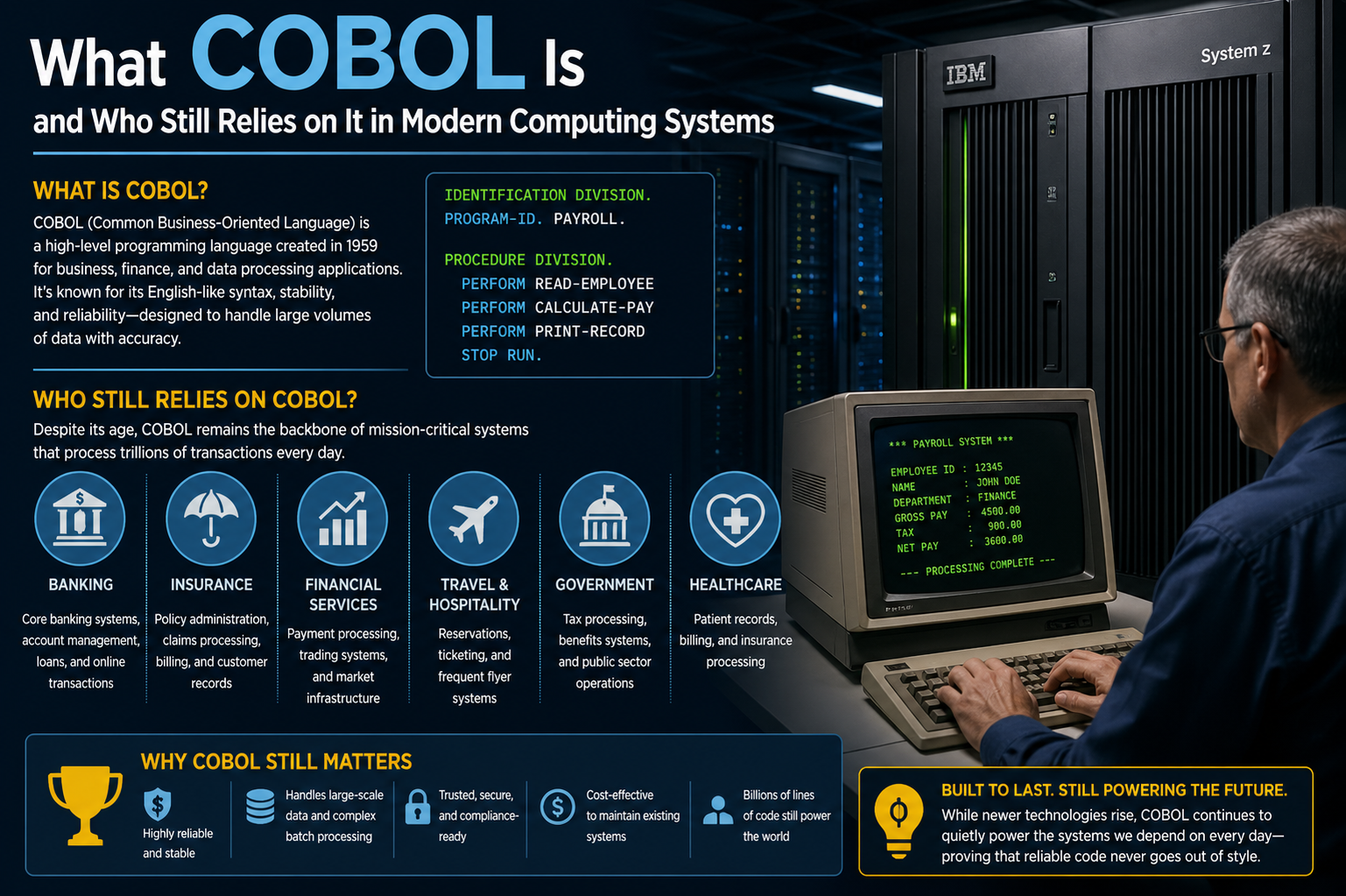
COBOL was created during a period when computing was transitioning from experimental machines to practical business tools. In the late 1950s, organizations were struggling with a lack of standardized programming methods for handling commercial data. Different computer manufacturers had their own languages, which made software portability almost impossible. COBOL emerged as a solution to this fragmentation, aiming to provide a universal language for business applications that could run across different systems with minimal modification. Its design was heavily influenced by the need for readability, ensuring that even non-technical professionals could understand the logic behind programs.
From the beginning, COBOL was not intended for scientific or engineering calculations. Instead, it focused on data processing tasks such as payroll, inventory management, and financial reporting. This clear purpose allowed it to dominate early enterprise computing environments. Governments, banks, and large corporations quickly adopted COBOL because it allowed them to process large datasets efficiently and consistently. Over time, it became deeply embedded in the technological foundations of many institutions, forming systems that are still operational today.
Design Philosophy and Language Structure
One of the most distinctive aspects of COBOL is its emphasis on readability and structured English-like syntax. Unlike many programming languages that rely heavily on symbols and abbreviations, COBOL was designed so that its code could be read almost like a natural language description of a process. This made it particularly attractive to business analysts and administrative staff who were not traditional programmers but needed to understand or verify system logic.
COBOL programs are divided into clearly defined sections, each serving a specific purpose such as data definition, environment configuration, or procedural instructions. This structured approach helped reduce complexity in large systems, making it easier to maintain and update software over long periods. The language also introduced strong data structuring capabilities, allowing developers to handle records, files, and hierarchical data efficiently, which was essential for business applications.
The focus on stability rather than innovation meant that COBOL evolved slowly compared to modern programming languages. However, this stability is one of the key reasons it has remained relevant for so long. Systems built decades ago often still function without major modifications, demonstrating the robustness of its original design principles.
COBOL in Early Enterprise Computing
During the 1960s and 1970s, COBOL became the dominant language for business computing. Large organizations invested heavily in mainframe systems that ran COBOL applications for critical operations. These systems were responsible for processing payrolls, managing customer accounts, and handling financial transactions on a massive scale.
At that time, computing resources were expensive and limited, so efficiency and reliability were more important than flexibility. COBOL’s ability to handle batch processing made it ideal for organizations that needed to process large volumes of data overnight or during off-peak hours. As a result, entire industries built their core infrastructure around COBOL systems.
Because these systems were so deeply integrated into daily operations, replacing them was not a priority. Instead, organizations continued to expand and modify existing COBOL applications, creating highly complex but stable ecosystems. This gradual evolution led to the long lifespan of COBOL-based infrastructure that still exists today.
Why COBOL Systems Persist in Modern Computing
The continued use of COBOL in modern computing is largely due to the immense cost and risk associated with replacing legacy systems. Many of these systems handle mission-critical operations where even minor errors could have serious financial or operational consequences. As a result, organizations prefer to maintain and extend existing COBOL applications rather than rebuild them from scratch using newer technologies.
Another important factor is reliability. COBOL systems have been tested and refined over decades, making them extremely stable. They are capable of processing millions of transactions daily with minimal failure rates. This level of dependability is difficult to replicate in newly developed systems without extensive testing and validation.
Additionally, many COBOL systems are deeply integrated with other legacy technologies, including mainframe hardware and specialized databases. Replacing one component often requires rewriting or redesigning multiple interconnected systems, which increases complexity significantly. This interdependence has contributed to the long-term survival of COBOL in enterprise environments.
Industries That Continue to Depend on COBOL
Even in today’s modern computing landscape, COBOL remains a foundational technology in several key industries. The financial sector is one of the largest users, with banks relying on COBOL for core banking systems that manage accounts, loans, and transactions. These systems are responsible for processing a vast number of daily operations with high accuracy and security.
Insurance companies also depend heavily on COBOL for managing policies, claims processing, and customer records. The structured nature of COBOL makes it particularly suitable for handling large amounts of structured data that require consistent processing rules.
Government agencies are another major user of COBOL systems. Many public services, including taxation systems, social security databases, and pension management systems, still rely on COBOL-based infrastructure. These systems often serve millions of citizens and require exceptional stability and reliability.
Retail and logistics sectors also use COBOL in backend systems that manage inventory, supply chains, and transaction processing. Although front-end systems have become more modern and user-friendly, the core processing logic often remains COBOL-based.
Integration with Modern Technologies
Although COBOL is considered a legacy language, it has not been completely isolated from modern computing environments. Many organizations have implemented integration layers that allow COBOL systems to communicate with newer technologies such as web applications, cloud platforms, and APIs.
This hybrid approach enables businesses to retain their reliable COBOL core systems while gradually introducing modern interfaces and functionalities. In many cases, COBOL programs run on mainframes while newer systems handle user interactions and data visualization. This separation of responsibilities allows organizations to modernize their systems without disrupting critical backend processes.
In recent years, there has also been renewed interest in updating COBOL applications using automated tools and modernization frameworks. These tools help translate or interface COBOL code with newer programming environments, reducing the need for complete system rewrites.
Challenges Associated with COBOL Systems
Despite its strengths, COBOL presents several challenges in modern computing environments. One of the most significant issues is the shortage of skilled developers familiar with the language. Since COBOL is no longer widely taught in modern computer science curricula, many experienced programmers have retired, leaving a gap in expertise.
Another challenge is the complexity of maintaining large, decades-old codebases. Over time, COBOL systems have accumulated layers of modifications and patches, making them difficult to understand and manage. Documentation may be incomplete or outdated, further complicating maintenance efforts.
Additionally, integrating COBOL systems with modern digital infrastructure requires specialized knowledge and tools. While integration is possible, it often requires careful planning and testing to ensure compatibility and stability.
Modern Relevance and Ongoing Importance
Even with these challenges, COBOL continues to play an important role in global computing infrastructure. Its presence in critical systems means that it cannot simply be replaced without significant disruption. Instead, it remains a foundational layer that supports essential services in finance, government, and industry.
The language’s endurance highlights an important aspect of technology: not all systems are replaced quickly by newer innovations. In many cases, reliability and stability are more valuable than modernization. COBOL exemplifies this principle by continuing to operate behind the scenes in systems that power everyday financial and administrative activities.
Future Outlook of COBOL in Computing Systems
The future of COBOL is likely to involve gradual modernization rather than complete replacement. Many organizations are investing in training programs to develop new COBOL programmers and maintain existing systems. At the same time, efforts are being made to integrate COBOL with cloud computing, automation tools, and modern programming environments.
It is unlikely that COBOL will disappear entirely in the near future because of its deep integration into critical infrastructure. Instead, it will continue to coexist with newer technologies, serving as a stable backbone while modern systems handle evolving user requirements and interfaces.
In this way, COBOL represents a unique case in the history of computing—a language that was designed decades ago but still plays a vital role in today’s digital world.
Modernization Efforts Around COBOL Systems
As technology continues to evolve, organizations that rely on COBOL are increasingly focused on modernization rather than replacement. The goal is not to eliminate COBOL entirely, but to extend its usefulness by connecting it with modern systems. Many enterprises have adopted strategies that allow COBOL applications to remain stable while new layers of technology are added on top.
One common approach involves wrapping COBOL programs with APIs. This allows older systems to communicate with modern web applications, mobile apps, and cloud-based services without altering the core COBOL logic. In this way, COBOL continues to handle backend processing while newer technologies manage user interfaces and external communication. This layered structure helps organizations modernize gradually while avoiding the risks associated with rewriting critical systems from scratch.
Another important modernization technique involves migrating COBOL workloads to cloud environments. Instead of running on traditional mainframe hardware, COBOL applications are being adapted to operate in virtualized cloud infrastructures. This transition helps reduce hardware costs and improves scalability, while still preserving the reliability of existing COBOL code. However, this process requires careful planning because COBOL systems often depend on specific runtime environments that must be accurately replicated in the cloud.
The Role of COBOL in Financial Infrastructure
COBOL remains deeply embedded in global financial infrastructure, particularly in core banking systems. These systems manage essential functions such as account balances, transaction processing, loan calculations, and interest computations. The accuracy and reliability required in these operations make COBOL particularly suitable, as it was originally designed for high-volume business data processing.
Even modern banking applications often rely on COBOL in the background. While customers interact with sleek mobile apps and online platforms, the actual transaction processing frequently occurs within COBOL-based mainframe systems. This separation between user experience and backend processing allows financial institutions to modernize interfaces without risking the stability of their core systems.
Payment networks and clearing systems also depend heavily on COBOL. These systems process millions of transactions daily, often in real time or near real time. The ability of COBOL systems to handle large-scale batch processing with consistency ensures that financial operations remain stable even under heavy load.
COBOL in Government and Public Services
Government systems are among the most long-standing users of COBOL. Many public sector applications were developed decades ago and continue to function as essential components of national infrastructure. These systems often manage sensitive data such as tax records, social security benefits, healthcare eligibility, and pension distributions.
The reason COBOL remains so prevalent in government systems is primarily due to risk avoidance. Replacing these systems would require rewriting complex logic that has been refined over decades, which introduces significant risk of errors or disruptions. Since these systems directly affect millions of citizens, even minor failures could have widespread consequences.
As a result, governments tend to invest in maintaining and gradually updating COBOL systems rather than replacing them entirely. This includes improving security, adding integration capabilities, and ensuring compatibility with modern reporting and analytics tools.
The Technical Strengths That Keep COBOL Relevant
One of COBOL’s strongest advantages is its ability to handle large-scale data processing with precision. The language was specifically designed for business applications that require accurate record handling and predictable outcomes. This makes it particularly well-suited for environments where data integrity is critical.
COBOL also excels in batch processing, which remains an important requirement in industries such as banking and insurance. Large volumes of transactions can be processed efficiently in scheduled cycles, ensuring that systems remain consistent and synchronized.
Another technical strength is its stability. COBOL systems are known for their extremely low failure rates when properly maintained. This reliability is a key reason why organizations continue to trust COBOL for mission-critical operations even decades after its creation.
Additionally, COBOL’s strong data structuring capabilities allow it to manage complex record-based systems effectively. This makes it ideal for applications that rely heavily on structured data rather than unstructured or dynamic content.
The Challenge of the COBOL Skills Gap
One of the most pressing issues facing COBOL systems today is the shortage of skilled programmers. As newer programming languages have become more popular, fewer developers are trained in COBOL. Many experienced COBOL programmers are reaching retirement age, creating a gap in expertise that organizations must address.
This skills shortage has led to increased efforts in training and education programs focused on COBOL. Some organizations have launched internal initiatives to teach younger developers how to maintain and update existing COBOL systems. Others have partnered with educational institutions to reintroduce COBOL into specialized curricula.
The shortage of COBOL expertise has also encouraged the development of automation tools that help analyze and maintain legacy code. These tools assist developers by identifying dependencies, documenting system logic, and even converting COBOL code into more modern languages when necessary.
COBOL and System Complexity Over Time
Over decades of continuous use, COBOL systems have become highly complex. Many applications have been modified repeatedly to accommodate new business requirements, regulatory changes, and technological updates. As a result, modern COBOL environments often consist of millions of lines of interconnected code.
This complexity can make maintenance challenging. In some cases, documentation may be incomplete or outdated, and original developers may no longer be available to explain system logic. This increases reliance on experienced COBOL programmers who understand both the language and the business processes it supports.
Despite this complexity, many COBOL systems continue to operate efficiently. Their long history of incremental updates has created highly optimized workflows tailored to specific organizational needs. This makes them difficult to replace without risking operational disruption.
Security and Stability in COBOL Systems
Security is another important factor in the continued use of COBOL. Because many COBOL systems are isolated within mainframe environments, they are often less exposed to external threats compared to modern distributed systems. This isolation can provide a level of inherent security, especially for sensitive financial and governmental data.
However, as COBOL systems become integrated with modern technologies, new security challenges emerge. APIs, cloud interfaces, and external connections can introduce vulnerabilities that did not previously exist in isolated environments. As a result, organizations must carefully implement security measures when modernizing COBOL systems.
Stability remains one of COBOL’s defining characteristics. Its predictable execution model and long-tested runtime environments ensure consistent performance, even under heavy workloads. This stability is one of the main reasons organizations continue to rely on it for critical operations.
COBOL in the Age of Digital Transformation
Digital transformation initiatives have not eliminated COBOL; instead, they have reshaped how it is used. Rather than replacing legacy systems, many organizations are adopting hybrid architectures where COBOL handles core processing while modern systems provide digital interfaces and analytics capabilities.
This approach allows businesses to innovate without disrupting essential operations. It also ensures that valuable legacy systems remain operational while gradually integrating new technologies such as artificial intelligence, machine learning, and real-time analytics.
In many cases, COBOL acts as the foundation of these hybrid systems, providing reliable data processing while newer technologies enhance functionality and user experience. This coexistence demonstrates the adaptability of COBOL even in rapidly evolving technological landscapes.
Long-Term Outlook for COBOL in Enterprise Systems
Looking ahead, COBOL is expected to remain a significant part of enterprise computing for many years. While its role may continue to shift toward backend processing and legacy system support, its importance will not disappear quickly.
Organizations that depend on COBOL are likely to continue investing in maintenance, modernization, and integration rather than full replacement. This gradual evolution ensures that COBOL remains relevant even as newer technologies dominate other areas of computing.
Ultimately, COBOL’s long lifespan reflects a broader reality in enterprise IT: critical systems are often built for endurance rather than novelty. As long as stability, accuracy, and reliability remain priorities, COBOL will continue to hold an important place in modern computing infrastructure.
COBOL Migration Strategies and Gradual Replacement Approaches
As organizations continue modernizing their infrastructure, one of the most important considerations is how to deal with existing COBOL systems without disrupting essential operations. Because these systems often support critical functions, direct replacement is rarely a practical option. Instead, companies adopt gradual migration strategies that allow COBOL applications to evolve over time.
One common strategy is called phased migration. In this approach, COBOL systems are not replaced all at once. Instead, individual components are slowly rewritten or replaced with modern programming languages while the rest of the system continues to run normally. This reduces risk because only small parts of the system are changed at a time, allowing thorough testing and validation before further updates are made.
Another approach involves replatforming, where COBOL applications are moved from traditional mainframe environments to modern infrastructure without changing the core code. This allows organizations to reduce hardware costs and improve scalability while still relying on the same proven business logic. In many cases, COBOL programs continue running almost unchanged, but the underlying execution environment is updated.
There is also the concept of code wrapping, where COBOL systems are encapsulated within modern interfaces. Instead of rewriting the original program, developers create layers that allow new applications to interact with COBOL functionality through APIs. This approach preserves the reliability of legacy systems while enabling integration with modern software ecosystems.
COBOL in Large-Scale Enterprise Architecture
In many large organizations, COBOL is not just a standalone technology but a core part of a broader enterprise architecture. These architectures often consist of multiple layers, where COBOL handles backend processing while other systems manage presentation, analytics, and user interaction.
This separation of responsibilities allows organizations to maintain stability at the core while still innovating at the edges. For example, a banking system may use COBOL to process transactions and maintain account records, while modern web and mobile applications provide customer-facing services. This design ensures that even if user interfaces change frequently, the underlying financial data remains consistent and secure.
COBOL’s role in these architectures is often invisible to end users. Most people interacting with modern digital services are unaware that COBOL is still processing their transactions in the background. This hidden presence highlights its importance as a foundational technology that continues to support global systems without drawing attention.
The Human Factor in COBOL Maintenance
One of the most significant challenges in maintaining COBOL systems is the human factor. Many of the original developers who built these systems have retired or moved on to other technologies. As a result, knowledge about system architecture, business rules, and historical design decisions is often limited to a small group of remaining experts.
This creates a situation where a relatively small number of professionals are responsible for maintaining extremely large and complex systems. These individuals often possess deep institutional knowledge that is not easily replaced. Their expertise includes not only COBOL programming but also an understanding of business processes that have evolved over decades.
To address this challenge, many organizations are implementing knowledge transfer programs. These programs aim to document existing systems and train new developers in COBOL maintenance. In some cases, experienced programmers work alongside newer developers to gradually pass on their knowledge, ensuring continuity.
Despite these efforts, the aging workforce remains a concern. As experienced COBOL developers retire, organizations must find ways to preserve system knowledge and prevent critical expertise from being lost.
COBOL and System Reliability in Critical Infrastructure
Reliability is one of the primary reasons COBOL continues to be used in critical infrastructure systems. These systems must operate continuously with minimal downtime, often processing millions of transactions without interruption. COBOL’s long history of stable performance makes it a trusted choice for such environments.
In financial systems, even a small error can have significant consequences. COBOL’s predictable behavior and strict data handling rules help minimize the risk of unexpected failures. This reliability is particularly important in systems that manage monetary transactions, where accuracy is essential.
Government systems also depend heavily on reliability. Public services such as tax processing, social benefit distribution, and national record management require consistent uptime and accuracy. COBOL’s proven track record in handling these responsibilities makes it difficult to replace in such environments.
Even in modernized systems, COBOL often remains the backbone of reliability, ensuring that core processes continue to function even when other parts of the system are updated or changed.
Comparison Between COBOL and Modern Programming Languages
When comparing COBOL to modern programming languages, several key differences become apparent. Modern languages such as Python, Java, and JavaScript are designed for flexibility, rapid development, and integration with web and mobile technologies. COBOL, on the other hand, is focused on stability, structured data processing, and long-term reliability.
Modern languages often prioritize developer productivity and ease of use in dynamic environments. They support a wide range of applications, from web development to artificial intelligence. COBOL, however, remains specialized for business data processing and large-scale transaction systems.
Another major difference is in system lifespan. Modern applications are often designed for shorter development cycles and frequent updates. COBOL systems, in contrast, are built for longevity and can remain operational for decades with minimal structural changes.
While modern languages dominate new software development, COBOL continues to outperform them in specific legacy environments where stability and predictability are more important than rapid innovation.
The Economic Reality of COBOL Systems
One of the main reasons COBOL systems continue to exist is economic practicality. Rewriting large-scale legacy systems is extremely expensive, often requiring years of development, testing, and validation. For many organizations, the cost of replacement far exceeds the cost of maintaining existing systems.
Additionally, COBOL systems often represent decades of business logic that has been refined over time. Recreating this logic in a new language is not just a technical challenge but also a business risk. Any errors in translation could lead to financial losses or operational disruptions.
Because of these factors, many organizations adopt a cost-effective approach of maintaining and gradually modernizing COBOL systems rather than replacing them entirely. This allows them to balance innovation with financial responsibility.
COBOL in the Context of Global Digital Dependence
Modern society relies heavily on digital systems, many of which still depend on COBOL in some form. From banking transactions to government services, COBOL quietly supports infrastructure that billions of people use every day.
This dependence highlights an important aspect of technology evolution: older systems do not simply disappear when new technologies emerge. Instead, they often remain embedded within larger ecosystems, continuing to provide essential services long after their creation.
In this sense, COBOL represents a foundational layer of global digital infrastructure. Even as new technologies emerge, they frequently build on top of or interact with existing COBOL systems rather than replacing them entirely.
Future Trends and Long-Term Evolution of COBOL
Looking ahead, COBOL is likely to continue evolving through integration rather than replacement. As organizations adopt cloud computing, automation, and artificial intelligence, COBOL systems will increasingly be connected to these technologies through modern interfaces.
One emerging trend is the use of automated code analysis and transformation tools. These tools help organizations understand and modernize COBOL codebases more efficiently, reducing the complexity of maintenance and migration efforts.
Another trend is the increasing use of hybrid architectures, where COBOL handles core processing while modern systems manage analytics, visualization, and user interaction. This allows organizations to leverage the strengths of both legacy and modern technologies.
In the long term, COBOL may gradually become less visible but will likely remain operational in the background of critical systems. Its role may shift from active development to stable infrastructure support, ensuring continuity in essential services.
Enduring Legacy of COBOL in Computing History
COBOL’s continued presence in modern computing is a rare example of technological longevity. Few programming languages have maintained such a long and active lifespan in real-world systems. Its success is not based on modern features or popularity but on reliability, consistency, and deep integration into essential infrastructure.
Over time, COBOL has become more than just a programming language; it has become a symbol of stable enterprise computing. Its ability to adapt through integration and modernization efforts demonstrates that older technologies can remain relevant when they are built on strong foundational principles.
Even as the computing world continues to evolve rapidly, COBOL remains a quiet but powerful force operating behind the scenes. Its legacy is not defined by innovation alone but by endurance, proving that in technology, longevity and reliability can be just as important as change and advancement.
COBOL and the Future of Enterprise Modernization
As enterprises continue to evolve in a digital-first world, COBOL is increasingly viewed through the lens of modernization rather than legacy abandonment. Organizations are no longer asking whether COBOL should exist, but how it can coexist with newer technologies in a sustainable way. This shift in perspective has led to a more practical and realistic approach to system evolution.
Modern enterprise systems are now designed with interoperability in mind. COBOL applications are being connected to microservices, cloud platforms, and distributed computing environments through middleware layers. This allows organizations to preserve the core logic of their long-standing systems while expanding functionality using modern tools. In many cases, COBOL becomes part of a larger ecosystem rather than a standalone environment.
This evolution reflects a broader trend in enterprise IT: systems are no longer replaced wholesale but are instead incrementally improved. COBOL, due to its stability and deep integration into critical operations, fits naturally into this model of gradual transformation.
The Role of Automation in COBOL Maintenance
Automation is playing an increasingly important role in managing COBOL systems. With millions of lines of legacy code in existence across global industries, manual maintenance alone is no longer sufficient. Automated tools now help organizations analyze, document, and optimize COBOL applications.
These tools can identify unused code, map system dependencies, and highlight potential risks in legacy applications. In some cases, they can even translate COBOL code into modern programming languages, allowing developers to understand and modify systems more easily. However, full automated replacement remains complex due to the deep business logic embedded in COBOL applications.
Automation also assists in testing COBOL systems. Given the critical nature of many COBOL-based applications, rigorous testing is essential whenever changes are made. Automated testing frameworks help ensure that updates do not introduce errors or disrupt existing functionality.
COBOL’s Place in Cloud and Distributed Systems
Cloud computing has transformed the way modern applications are built and deployed, but COBOL has not been left behind. Instead, it has been adapted to work within cloud-based architectures. Many organizations now run COBOL workloads in virtualized environments that mimic traditional mainframe systems.
This transition allows businesses to reduce dependency on physical hardware while maintaining the stability of their legacy applications. In some cases, COBOL programs are integrated into hybrid cloud systems where data is processed across multiple environments depending on workload and performance requirements.
Distributed systems also benefit from COBOL integration through API-based communication. COBOL applications can send and receive data from microservices, enabling seamless interaction between legacy and modern systems. This ensures that COBOL remains relevant even in highly distributed and scalable architectures.
Economic and Strategic Value of COBOL Preservation
From a strategic perspective, COBOL systems represent significant long-term investments. Many organizations have spent decades refining and expanding these systems, embedding critical business logic that is difficult to replicate. As a result, preserving COBOL is often more economically viable than replacing it.
The cost of rewriting large-scale COBOL systems includes not only development expenses but also testing, validation, training, and risk management. Any failure during migration could lead to financial losses or operational disruption. Because of this, organizations often adopt a conservative approach, prioritizing stability over rapid transformation.
In addition, COBOL systems often support revenue-critical operations. Even short periods of downtime can have serious financial consequences. This makes reliability a higher priority than modernization speed in many industries.
Education and the Revival of COBOL Knowledge
In recent years, there has been a renewed interest in COBOL education. As organizations struggle with the shortage of experienced COBOL developers, training programs and academic courses are being reintroduced to address the gap.
Some universities and technical institutions have begun offering COBOL modules as part of broader computer science or enterprise systems curricula. These programs focus on legacy system maintenance, mainframe computing, and enterprise integration strategies.
Additionally, organizations are investing in internal training programs to upskill existing developers. Younger programmers are being introduced to COBOL not as a primary language for new development, but as a critical skill for maintaining and modernizing existing systems.
This revival of interest highlights COBOL’s continued importance in enterprise computing and ensures that knowledge of the language is not lost over time.
The Psychological Barrier to Replacing COBOL
Beyond technical and economic challenges, there is also a psychological barrier to replacing COBOL systems. Many organizations have developed a strong sense of trust in their legacy infrastructure. These systems have operated reliably for decades, reinforcing confidence in their stability.
Decision-makers often prefer incremental change over complete replacement because it reduces uncertainty. Even when modern alternatives are available, the perceived risk of failure during migration can outweigh the benefits of new technology.
This conservative mindset contributes to the continued use of COBOL, especially in industries where errors can have severe consequences. As a result, COBOL remains deeply embedded not only in technical systems but also in organizational decision-making processes.
COBOL in a Multi-Generational Technology Stack
Modern enterprise environments are increasingly multi-generational, meaning they contain technologies from different eras working together. COBOL often represents the oldest active layer in this stack, yet it continues to play a foundational role.
In such environments, COBOL handles core data processing, while newer systems manage interfaces, analytics, and automation. This layered structure allows organizations to innovate without destabilizing essential operations.
This coexistence of old and new technologies demonstrates that technological progress is not always linear. Instead, it is often cumulative, with each generation building on the foundations of the previous one.
Long-Term Sustainability of COBOL Systems
The long-term sustainability of COBOL depends on continued investment in maintenance, integration, and modernization. As long as organizations prioritize stability and reliability, COBOL will remain relevant.
Sustainability efforts include improving documentation, modernizing interfaces, and enhancing security. These efforts ensure that COBOL systems can continue operating safely within modern digital ecosystems.
At the same time, organizations are increasingly designing systems with future adaptability in mind. This means ensuring that COBOL components can evolve alongside emerging technologies without requiring full replacement.
Conclusion
COBOL remains one of the most enduring technologies in the history of computing. Originally designed for business data processing more than half a century ago, it continues to support some of the world’s most critical systems today. Its longevity is not accidental but the result of careful design, deep integration, and unmatched reliability in large-scale enterprise environments.
While newer programming languages and technologies dominate modern software development, COBOL maintains a unique and irreplaceable role in legacy infrastructure. It powers financial systems, government services, insurance platforms, and many other essential operations that millions of people rely on every day.
The future of COBOL is not defined by replacement but by coexistence. Through modernization, integration, and gradual transformation, COBOL continues to adapt to the changing technological landscape. It stands as a powerful example of how foundational systems can remain relevant even in rapidly evolving digital environments.
Ultimately, COBOL’s story is not just about an old programming language. It is about resilience, stability, and the reality that in complex global systems, reliability often matters more than reinvention.