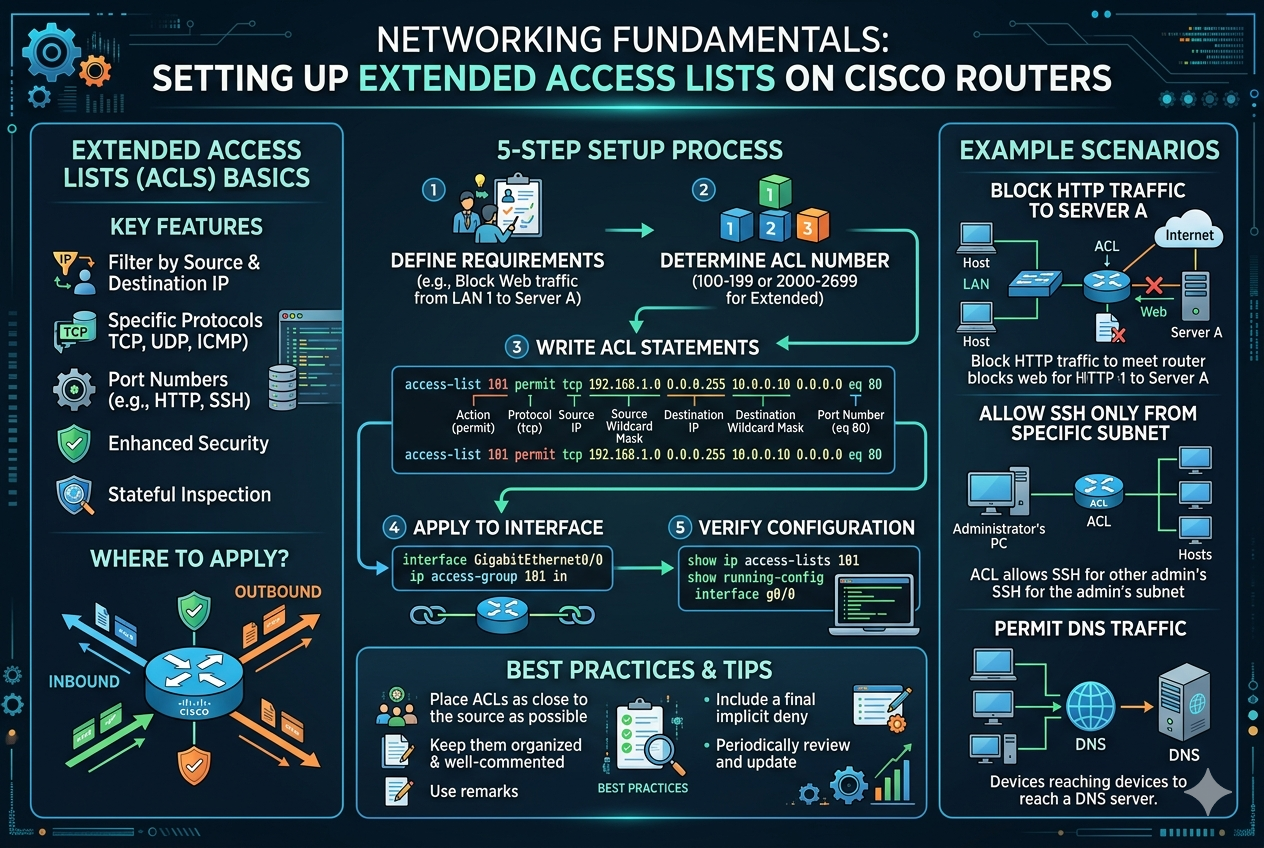
Extended Access Control Lists (ACLs) represent one of the most important security and traffic control mechanisms available in Cisco-based networking environments. They provide administrators with the ability to define highly specific rules that determine how packets are handled as they traverse routers. Unlike simpler filtering methods, extended ACLs enable control over both the origin and destination of traffic, as well as the type of communication taking place. This makes them suitable for environments where security requirements are strict and network segmentation is essential.
At their core, extended ACLs function as rule-based filters applied to router interfaces. Each packet entering or leaving an interface is evaluated against a configured set of conditions. These conditions determine whether the packet is allowed to pass through the network or is discarded. Because of this mechanism, extended ACLs are often considered a fundamental part of network defense strategies, especially in enterprise environments where multiple services and users coexist on shared infrastructure.
Core Logic Behind Packet Filtering
The operational logic of extended ACLs is based on sequential evaluation. When a packet arrives at a router interface where an ACL is applied, it is checked against the first rule in the list. If the packet matches that rule, the defined action is executed immediately, and no further rules are checked. If it does not match, the router proceeds to the next rule in the sequence. This continues until a match is found or until the end of the list is reached. If no match is found, the packet is implicitly denied.
This sequential nature makes rule order extremely important. Incorrect placement of rules can result in legitimate traffic being blocked or unwanted traffic being allowed. For this reason, network administrators must carefully design ACLs before applying them to production environments.
Components That Define Extended Access Lists
Extended ACLs are built using several key components that define how traffic is matched and controlled. These include protocol type, source address, destination address, and port numbers. Each component plays a specific role in identifying the exact nature of network traffic.
The protocol component allows administrators to specify whether the rule applies to TCP, UDP, ICMP, or other supported protocols. This ensures that filtering is not limited to just IP addresses but can also consider the nature of communication.
The source and destination address fields define where the traffic originates and where it is trying to go. These fields can be configured to represent individual hosts, entire subnets, or ranges of IP addresses depending on the wildcard mask used.
Port numbers provide even deeper control by allowing filtering based on specific services. For example, web traffic typically uses HTTP or HTTPS ports, while file transfer services use different port ranges. By controlling ports, administrators can selectively allow or block specific applications.
Wildcard Masking and Its Role in Filtering
Wildcard masks are a critical part of extended ACL configuration. They are used to specify which bits of an IP address should be matched and which should be ignored. Unlike subnet masks, wildcard masks operate in reverse logic, where a zero indicates a match requirement and a one indicates that the corresponding bit should be ignored.
This mechanism allows for flexible matching of IP address ranges. For example, a wildcard mask can be used to match a single host, a small group of devices, or an entire network segment. This flexibility is essential when designing scalable network policies that must accommodate both precision and efficiency.
Understanding Traffic Direction and ACL Placement
The placement of extended ACLs within a network topology has a direct impact on their effectiveness. In most cases, extended ACLs are placed close to the source of the traffic being controlled. This reduces unnecessary load on the network by preventing unwanted packets from traveling deeper into the infrastructure.
Applying ACLs at the correct interface and in the correct direction is essential. Traffic can be filtered as it enters an interface or as it exits. Inbound filtering is typically used to control traffic before it enters the router, while outbound filtering is used to control traffic leaving an interface. Choosing the correct direction depends on the specific security requirements and network design.
Security Advantages of Extended ACLs
Extended ACLs provide a strong layer of security by allowing detailed inspection and control of network traffic. One of their key advantages is the ability to enforce policies that go beyond simple IP filtering. By incorporating protocol and port-based rules, administrators can prevent unauthorized access to sensitive services while still allowing legitimate communication.
They also help in mitigating certain types of network attacks. For example, unwanted traffic targeting specific services can be blocked at the router level before it reaches internal systems. This reduces the risk of exploitation and helps maintain the integrity of critical infrastructure.
Another advantage is the ability to segment networks logically without requiring physical separation. Different departments or user groups can be restricted from accessing certain resources while still sharing the same physical network infrastructure.
Rule Processing Behavior and Implicit Deny Concept
Every extended ACL ends with an implicit deny rule, even if it is not explicitly configured. This means that any traffic that does not match a defined rule is automatically denied. This default behavior enhances security by ensuring that only explicitly permitted traffic is allowed through the network.
Because of this implicit deny, administrators must explicitly define rules for all required traffic. Failure to do so can result in unintended service disruptions. Understanding this behavior is critical when designing ACLs, as it directly impacts network availability.
Common Design Approaches for Extended ACLs
When designing extended ACLs, a structured approach is often followed to ensure clarity and efficiency. One common method is to start by identifying the specific services that need to be allowed or denied. This includes determining which applications, protocols, and users require access.
Once the requirements are defined, rules are created to permit necessary traffic first, followed by rules that deny unwanted traffic. This approach helps maintain clarity and reduces the likelihood of misconfiguration.
Another important design consideration is minimizing the number of rules. Overly complex ACLs can become difficult to manage and troubleshoot. Therefore, administrators often group similar rules together and use wildcard masks effectively to simplify configurations.
Impact on Network Performance
While extended ACLs provide significant security benefits, they also have an impact on router performance. Since each packet must be compared against ACL rules, large and complex lists can increase processing overhead. This is why efficient rule design is important.
Placing ACLs closer to the traffic source not only improves security but also reduces unnecessary processing on downstream devices. By filtering unwanted traffic early, network resources are conserved, and overall performance is improved.
Practical Considerations in Real Network Environments
In real-world deployments, extended ACLs are often used in combination with other security mechanisms. They form part of a layered security approach where multiple controls work together to protect the network.
Administrators must also consider future scalability when designing ACLs. As networks grow, new services and devices are added, requiring updates to existing rules. Proper documentation and structured design help ensure that changes can be made without introducing errors.
Testing is another critical step before applying ACLs in production environments. Misconfigured rules can disrupt business operations, so simulation and validation are commonly performed in controlled environments first.
Troubleshooting Extended Access Lists
Troubleshooting ACL-related issues often involves verifying rule order, checking wildcard masks, and confirming interface direction. Since ACLs process traffic sequentially, even a small mistake in rule placement can cause unexpected behavior.
Administrators typically analyze logs and use diagnostic tools to determine why specific traffic is being denied or allowed. Understanding the logic behind ACL processing is essential for efficient troubleshooting.
Role in Modern Network Security Architecture
Even with the introduction of more advanced security technologies, extended ACLs remain a fundamental part of network security architecture. Their simplicity, efficiency, and flexibility make them suitable for a wide range of use cases.
They are often used as a first line of defense, filtering traffic at the network edge before it reaches more advanced security systems. This reduces the load on deeper security layers and improves overall network resilience.
As networks continue to evolve, extended ACLs remain relevant due to their adaptability and integration with other networking technologies.
Advanced Configuration Concepts of Extended Access Lists
Extended Access Control Lists become significantly more powerful when their configuration is expanded beyond basic permit and deny rules. Advanced configuration techniques allow network administrators to build highly precise traffic control policies that align with complex organizational requirements. These techniques include the use of multiple condition matching, layered filtering logic, and refined control over application-level traffic behavior.
In more sophisticated network environments, extended ACLs are not simply used to allow or block traffic but are designed to enforce structured communication rules between different network zones. This ensures that each segment of the network communicates only with authorized services and systems. As networks grow in complexity, these advanced configurations become essential for maintaining both performance and security.
Logical Structuring of Complex ACL Rules
When dealing with large-scale networks, ACLs can quickly become lengthy and difficult to manage if not properly structured. Logical structuring involves organizing rules in a way that reflects real-world traffic patterns. This means grouping similar services together and placing high-priority rules at the top of the list to ensure they are processed first.
For example, critical services such as authentication systems or core business applications are typically prioritized above general internet traffic rules. This ensures that essential services remain accessible even during periods of high network load or security filtering.
Proper structuring also improves readability and maintainability. When ACLs are logically organized, troubleshooting becomes easier because administrators can quickly identify which section of the list is responsible for specific traffic behavior.
Protocol-Specific Filtering Strategies
One of the most important strengths of extended ACLs is their ability to filter traffic based on protocol types. This allows administrators to differentiate between various forms of communication such as connection-oriented and connectionless traffic.
For instance, TCP-based applications require session establishment and reliable delivery, while UDP-based applications prioritize speed over reliability. By using protocol-specific rules, administrators can fine-tune how different types of services are treated within the network.
ICMP traffic, often used for diagnostic purposes, can also be selectively controlled. While it is important for network troubleshooting, unrestricted ICMP traffic can sometimes be exploited for reconnaissance activities. Extended ACLs allow administrators to strike a balance between usability and security by carefully controlling such protocols.
Port-Based Traffic Control and Application Awareness
Port-based filtering is one of the most practical features of extended ACLs. Since most network applications communicate through well-known ports, controlling access at this level provides direct control over application usage.
For example, web browsing typically relies on standard web ports, while email services use different port ranges depending on the protocol involved. By defining rules based on these ports, administrators can allow or restrict access to specific applications without affecting other services using the same network infrastructure.
This level of control is especially useful in environments where certain applications are restricted for security or productivity reasons. It also helps reduce exposure to unnecessary services that may introduce vulnerabilities.
Source and Destination-Based Security Policies
Extended ACLs allow for detailed control over both source and destination addresses, making them highly effective for implementing security zones within a network. By defining which devices or subnets are allowed to communicate with each other, administrators can create segmented environments that limit lateral movement of traffic.
This segmentation is particularly important in enterprise networks where sensitive systems must be isolated from general user traffic. For example, database servers can be restricted so that only application servers are allowed to communicate with them, while direct access from user devices is blocked.
Such policies significantly reduce the attack surface and help contain potential security breaches by limiting access pathways within the network.
Sequence Numbers and Rule Management
Modern Cisco implementations support sequence numbers within ACL configurations, allowing administrators to insert, modify, or delete specific rules without rewriting the entire list. This feature greatly improves flexibility and reduces the risk of configuration errors during updates.
Sequence numbering also helps maintain order in complex ACLs. Instead of relying solely on manual positioning, administrators can assign logical numbering schemes that reflect rule priority. This makes long ACLs easier to manage and update over time.
Proper use of sequence numbers is especially important in dynamic environments where network requirements frequently change.
Implicit Deny Behavior and Security Enforcement
A critical concept in extended ACL operation is the implicit deny rule that exists at the end of every list. This means that any traffic not explicitly permitted by a rule is automatically denied by default.
This behavior reinforces a security-first approach where access is granted only when explicitly defined. It eliminates the risk of unintended traffic passing through the network due to missing rules.
However, this also requires careful planning. If administrators fail to account for all necessary traffic flows, legitimate services may be unintentionally blocked. Therefore, understanding and documenting traffic requirements is essential when designing ACLs.
Performance Considerations in Large ACL Deployments
As ACLs grow in size and complexity, they can have an impact on router performance. Each packet must be evaluated against the list of rules, and longer lists require more processing time. In high-traffic environments, this can lead to increased CPU usage on networking devices.
To mitigate this, administrators often optimize ACLs by placing the most frequently matched rules at the top of the list. This reduces the average number of comparisons required for each packet and improves overall efficiency.
Additionally, unnecessary or redundant rules should be avoided. Regular auditing of ACL configurations helps ensure that only relevant rules remain active.
Real-World Implementation Scenarios
Extended ACLs are widely used in real-world networking scenarios to enforce organizational policies. In corporate environments, they are commonly used to control employee access to external websites, restrict internal service communication, and protect sensitive data resources.
In service provider networks, extended ACLs help manage traffic between customers and shared infrastructure, ensuring isolation and preventing unauthorized access. They are also used to implement quality control measures by prioritizing certain types of traffic over others.
Educational institutions often use extended ACLs to limit access to non-academic resources during specific hours, helping maintain focus on learning activities.
Integration with Other Network Security Mechanisms
Extended ACLs are rarely used in isolation. They are typically integrated with other security technologies such as firewalls, intrusion detection systems, and authentication services. This layered approach strengthens overall network security by combining multiple defensive mechanisms.
While ACLs provide basic packet filtering, more advanced systems offer deep packet inspection and behavioral analysis. Together, these tools create a comprehensive security framework that protects against a wide range of threats.
The integration of ACLs with routing policies also enables dynamic traffic control based on network conditions. This allows administrators to adapt security policies in real time as network demands change.
Best Practices for Extended ACL Design
Effective ACL design requires careful planning and adherence to best practices. One of the most important practices is simplicity. Overly complex ACLs are difficult to manage and increase the likelihood of configuration errors.
Another important practice is documentation. Clearly documenting the purpose of each rule helps future administrators understand the logic behind the configuration and reduces troubleshooting time.
Testing changes in a controlled environment before deployment is also essential. This ensures that new rules do not disrupt existing network services.
Regular review and optimization of ACLs help maintain efficiency and security over time. As network requirements evolve, ACLs should be updated to reflect current operational needs.
Troubleshooting and Diagnostic Techniques
When issues arise, troubleshooting extended ACLs involves a systematic approach. Administrators typically begin by verifying rule order and ensuring that traffic matches the intended conditions. They also check interface direction to confirm that ACLs are applied correctly.
Logging features can be used to monitor how packets are processed by ACL rules. This helps identify which rule is affecting specific traffic flows.
In some cases, temporary rule modifications are used to isolate issues. Once the problem is identified, the ACL is restored to its original state with corrections applied.
Role in Modern Network Architectures
Even with the rise of advanced security solutions, extended ACLs remain a foundational element of modern network design. Their simplicity, efficiency, and direct control over traffic make them indispensable in many environments.
They continue to play a critical role in edge security, internal segmentation, and traffic management. As networks become more distributed and complex, the importance of well-designed ACLs continues to grow.
Their adaptability ensures that they remain relevant in both traditional and modern networking architectures, providing a reliable method of enforcing security policies across diverse environments.
Traffic Flow Control and Directional Filtering in Extended Access Lists
Extended Access Control Lists provide powerful mechanisms for controlling how traffic flows through a network by allowing administrators to define directional filtering policies. Traffic direction plays a crucial role in determining how and where ACL rules are applied, and incorrect direction configuration can significantly affect network behavior.
In Cisco routing environments, ACLs can be applied either in an inbound direction, where traffic is evaluated as it enters an interface, or in an outbound direction, where traffic is filtered as it exits an interface. Each direction serves a different purpose and must be selected based on the desired control point within the network topology.
Inbound filtering is typically used when administrators want to block or permit traffic before it is processed by the router. This approach is efficient because unwanted traffic is dropped early, conserving router resources and reducing unnecessary processing. Outbound filtering, on the other hand, is used when traffic decisions need to be made after routing decisions have been applied, often to control what leaves a network segment.
The choice between inbound and outbound placement depends on security requirements, network design, and traffic optimization goals. In many cases, inbound filtering is preferred for external-facing interfaces, while outbound filtering may be used internally for more controlled environments.
Granular Control Through Multiple Condition Matching
One of the defining features of extended ACLs is their ability to evaluate multiple conditions simultaneously. Unlike simpler filtering methods that rely on a single parameter such as source address, extended ACLs can combine protocol type, source address, destination address, and port numbers into a single rule.
This multi-condition matching allows for extremely precise traffic control. For example, it becomes possible to allow only a specific type of traffic from a particular subnet to a designated server while blocking all other communication attempts. This level of granularity is essential in environments where security policies must be strictly enforced.
By combining multiple conditions in a single rule, administrators can reduce the total number of ACL entries required, improving both efficiency and readability.
Stateful Limitations and Stateless Behavior
It is important to understand that extended ACLs operate in a stateless manner. This means that each packet is evaluated independently without awareness of previous packets or established connections. Unlike stateful firewalls, ACLs do not track session states or maintain connection histories.
Because of this stateless behavior, rules must be carefully designed to account for both directions of traffic when necessary. For example, if a service requires bidirectional communication, separate rules may be needed to allow return traffic.
This limitation makes planning essential, as failing to account for response traffic can result in communication failures even when initial traffic is permitted.
Optimizing Rule Order for Efficient Processing
Rule order is one of the most critical aspects of extended ACL configuration. Since packets are evaluated sequentially, placing frequently matched rules near the top of the list can significantly improve performance.
Efficient rule ordering reduces the number of comparisons required for each packet, which helps minimize processing overhead on routing devices. High-priority traffic, such as internal service communication or critical application access, should always be placed before more general rules.
Inefficient ordering can lead to unnecessary processing delays and may even cause unintended traffic behavior if broader rules override more specific ones.
Wildcard Mask Precision and Advanced Matching Techniques
Wildcard masks play a central role in defining the precision of extended ACL rules. By carefully structuring wildcard masks, administrators can create highly specific or broadly inclusive rules depending on network requirements.
Advanced matching techniques involve using wildcard masks to target specific IP ranges within larger networks. This allows for flexible policy enforcement without the need to define multiple individual entries.
For example, a single rule can be designed to apply to an entire department’s subnet while excluding certain devices if needed. This level of precision is essential for large organizations with complex network hierarchies.
Access Control in Multi-Tier Network Architectures
In modern multi-tier network architectures, extended ACLs are commonly used to enforce separation between different functional layers. These layers often include access, distribution, and core segments, each serving a distinct role within the network.
At the access layer, ACLs may be used to control end-user traffic and enforce basic security policies. At the distribution layer, they can be used to regulate inter-segment communication between different departments or services. At the core layer, ACL usage is typically minimized to maintain high-speed data forwarding.
This layered approach ensures that security policies are enforced at multiple points within the network, reducing the likelihood of unauthorized access or lateral movement.
Traffic Segmentation and Logical Isolation
Extended ACLs enable logical segmentation of networks without requiring physical separation. This allows organizations to isolate different groups of users, applications, or services while still operating on shared infrastructure.
Logical isolation is achieved by defining rules that restrict communication between specific network segments. For example, users in one department may be prevented from accessing resources in another department unless explicitly permitted.
This segmentation improves security by limiting exposure between systems and reducing the potential impact of compromised devices.
Logging and Monitoring of ACL Activity
Logging is an important feature that enhances visibility into how extended ACLs are affecting network traffic. By enabling logging on specific rules, administrators can track which packets are being permitted or denied.
This information is valuable for both security monitoring and troubleshooting. It allows administrators to identify unauthorized access attempts, analyze traffic patterns, and verify that ACLs are functioning as intended.
However, excessive logging can generate large amounts of data and impact device performance, so it must be used selectively and strategically.
Dynamic Network Environments and ACL Adaptation
In dynamic network environments where devices and services frequently change, extended ACLs must be regularly updated to remain effective. Static configurations may quickly become outdated if new applications or subnets are introduced.
To address this, administrators often design ACLs with flexibility in mind. This includes using broader address ranges where appropriate and minimizing overly specific entries that may require frequent updates.
Regular review cycles help ensure that ACLs continue to align with current network requirements and security policies.
Common Configuration Errors and Their Impact
Misconfiguration of extended ACLs can lead to significant network issues. One common error is incorrect rule ordering, which can cause legitimate traffic to be blocked unintentionally. Another frequent issue is improper wildcard mask usage, leading to overly broad or overly restrictive matching.
Incorrect interface direction assignment is also a common problem. If an ACL is applied in the wrong direction, it may not filter traffic as intended, resulting in security gaps or connectivity issues.
Careful validation and testing are essential to prevent these issues from affecting production environments.
Scalability Challenges in Large Networks
As networks grow, managing extended ACLs becomes increasingly complex. Large organizations may have hundreds or even thousands of rules distributed across multiple devices.
Scalability challenges arise when ACLs are not standardized or properly documented. Without consistent structure, maintaining and updating rules becomes difficult and error-prone.
To address scalability concerns, administrators often adopt naming conventions, modular rule design, and centralized management practices.
Role of Extended ACLs in Policy Enforcement
Extended ACLs play a critical role in enforcing organizational network policies. These policies may include restrictions on certain types of traffic, limitations on external access, or requirements for secure communication between systems.
By translating policy requirements into technical rules, ACLs ensure that organizational standards are consistently applied across the network.
This enforcement capability makes ACLs an essential tool for maintaining compliance with internal governance and external regulatory requirements.
Integration with Routing Decisions
Since ACLs operate on routed traffic, they are closely integrated with routing decisions made by the router. The routing process determines the path a packet will take, while ACLs determine whether the packet is allowed to traverse that path.
This interaction allows for sophisticated traffic control strategies where routing and filtering work together to optimize both security and efficiency.
In some cases, ACLs are even used to influence routing behavior indirectly by blocking or permitting specific traffic flows.
Long-Term Importance in Network Infrastructure
Despite advancements in modern security technologies, extended ACLs remain a foundational component of network infrastructure. Their simplicity, efficiency, and direct control over packet flow ensure their continued relevance.
They provide a first layer of defense that complements more advanced security systems, creating a balanced and layered security architecture.
As networks continue to evolve, extended ACLs will remain an essential tool for controlling traffic, enforcing policies, and maintaining secure communication environments.
Advanced Troubleshooting of Extended Access Lists
Troubleshooting extended Access Control Lists requires a structured and logical approach because even small configuration errors can lead to significant network disruptions. Since ACLs operate on a top-down evaluation model, the first step in troubleshooting is always to verify rule order and ensure that traffic is not being unintentionally matched by a higher-priority entry.
One of the most common diagnostic techniques involves analyzing which rule is being triggered when a packet is either permitted or denied. This helps identify whether the issue lies in an overly broad deny statement or a missing permit rule. In many cases, legitimate traffic is blocked simply because a general deny rule appears before a more specific allow rule.
Another important step is verifying wildcard masks. Incorrect wildcard masking can cause rules to match a wider or narrower range of addresses than intended. This often results in unexpected traffic filtering behavior, especially in large networks with multiple subnets.
Interface direction is another critical factor in troubleshooting. An ACL applied in the wrong direction can completely change how traffic is evaluated. Administrators must always confirm whether the ACL is configured for inbound or outbound processing on the correct interface.
Logging features also play a key role in troubleshooting. By enabling logging on specific ACL entries, administrators can observe real-time packet decisions and trace how traffic is being processed through the rule set. This visibility is essential for identifying misconfigurations and validating rule behavior.
Security Policy Enforcement Using Extended ACLs
Extended Access Control Lists are widely used as a mechanism for enforcing organizational security policies at the network level. These policies define what types of traffic are allowed, which systems can communicate, and how different services are accessed.
By translating these policies into structured ACL rules, administrators ensure that security requirements are consistently applied across all network segments. For example, policies may restrict access to sensitive databases, limit external internet usage, or control communication between departments.
This enforcement capability helps reduce reliance on manual user compliance, as the network itself enforces the rules automatically. It also reduces the risk of human error and unauthorized access attempts.
Extended ACLs are particularly effective in environments where regulatory compliance is required. They help ensure that only authorized traffic flows through critical systems, supporting audit requirements and security standards.
Performance Optimization Techniques for ACLs
As networks scale, performance optimization becomes an important consideration when deploying extended ACLs. Since each packet must be evaluated against ACL rules, inefficient configurations can increase processing overhead on routers.
One key optimization technique is placing the most frequently matched rules at the top of the ACL. This reduces the average number of comparisons required per packet and improves processing efficiency. High-volume traffic patterns should always be considered when designing rule order.
Another optimization strategy involves minimizing redundant rules. Duplicate or overlapping entries increase processing time without providing additional value. Regular auditing of ACL configurations helps identify and remove unnecessary entries.
Grouping similar rules together is also beneficial. This improves readability and reduces complexity, making it easier to manage large rule sets without affecting performance.
In high-traffic environments, careful ACL design can significantly improve router efficiency and overall network responsiveness.
Real-World Deployment Challenges
Deploying extended ACLs in real-world environments presents several challenges. One of the most common issues is managing complexity as networks grow. As more applications, users, and services are added, ACLs can become increasingly difficult to maintain.
Another challenge is ensuring consistency across multiple devices. In large networks, ACLs may be applied on several routers, and inconsistencies between configurations can lead to unpredictable behavior.
Change management is also critical. Modifying ACLs in production environments must be done carefully to avoid service disruptions. Even small changes can have widespread effects if dependencies are not properly understood.
Testing and validation are essential steps before deployment. Simulating traffic scenarios helps ensure that ACLs behave as expected under real conditions.
Role of Extended ACLs in Network Segmentation
Network segmentation is one of the most important security strategies in modern infrastructure design, and extended ACLs play a key role in implementing it. Segmentation involves dividing a network into smaller, isolated sections to reduce risk and improve control.
Extended ACLs enforce segmentation by controlling which segments can communicate with each other. This prevents unauthorized lateral movement within the network, which is a common technique used in security breaches.
For example, user networks can be isolated from server networks, while administrative systems may have restricted access to sensitive resources. This structured separation improves both security and performance.
Segmentation also simplifies policy enforcement by allowing different rules to be applied to different network zones based on their function.
Best Practices for Long-Term ACL Management
Effective long-term management of extended ACLs requires adherence to several best practices. One of the most important practices is maintaining clear documentation. Every rule should have a defined purpose, making it easier for administrators to understand and manage configurations.
Another best practice is periodic review. Networks evolve over time, and ACLs must be updated to reflect current requirements. Regular audits help identify outdated or unnecessary rules.
Standardization is also important. Using consistent naming conventions, structure, and formatting across ACLs improves readability and reduces errors during updates.
Limiting complexity is another key principle. Overly complex ACLs are difficult to troubleshoot and increase the risk of misconfiguration. Simpler, well-structured rules are easier to maintain and more reliable.
Integration with Modern Security Architectures
Extended ACLs remain relevant even in modern security architectures that include advanced firewalls, intrusion detection systems, and cloud-based security solutions. While these technologies offer deeper inspection capabilities, ACLs still provide a fast and efficient first layer of filtering.
They are often used at network edges to reduce unnecessary traffic before it reaches more advanced security systems. This improves overall efficiency by reducing the load on deeper inspection layers.
In hybrid environments, ACLs also help enforce consistent policies between on-premises and cloud-based infrastructure. This ensures uniform security behavior across distributed systems.
Conclusion
Extended Access Control Lists are a fundamental component of Cisco networking that provide detailed and flexible control over network traffic. Their ability to filter based on source and destination addresses, protocols, and port numbers makes them far more powerful than basic filtering methods.
Throughout their use, ACLs support essential functions such as security enforcement, traffic segmentation, performance optimization, and policy implementation. Their stateless nature requires careful planning, but it also allows for efficient packet processing without maintaining connection states.
When properly designed and implemented, extended ACLs significantly enhance network security by ensuring that only authorized traffic is permitted to pass through critical infrastructure. They help prevent unauthorized access, reduce attack surfaces, and enforce organizational policies consistently across the network.
Despite the emergence of advanced security technologies, extended ACLs remain a core element of modern network design. Their simplicity, reliability, and efficiency ensure that they continue to play an important role in both small and large-scale networking environments.