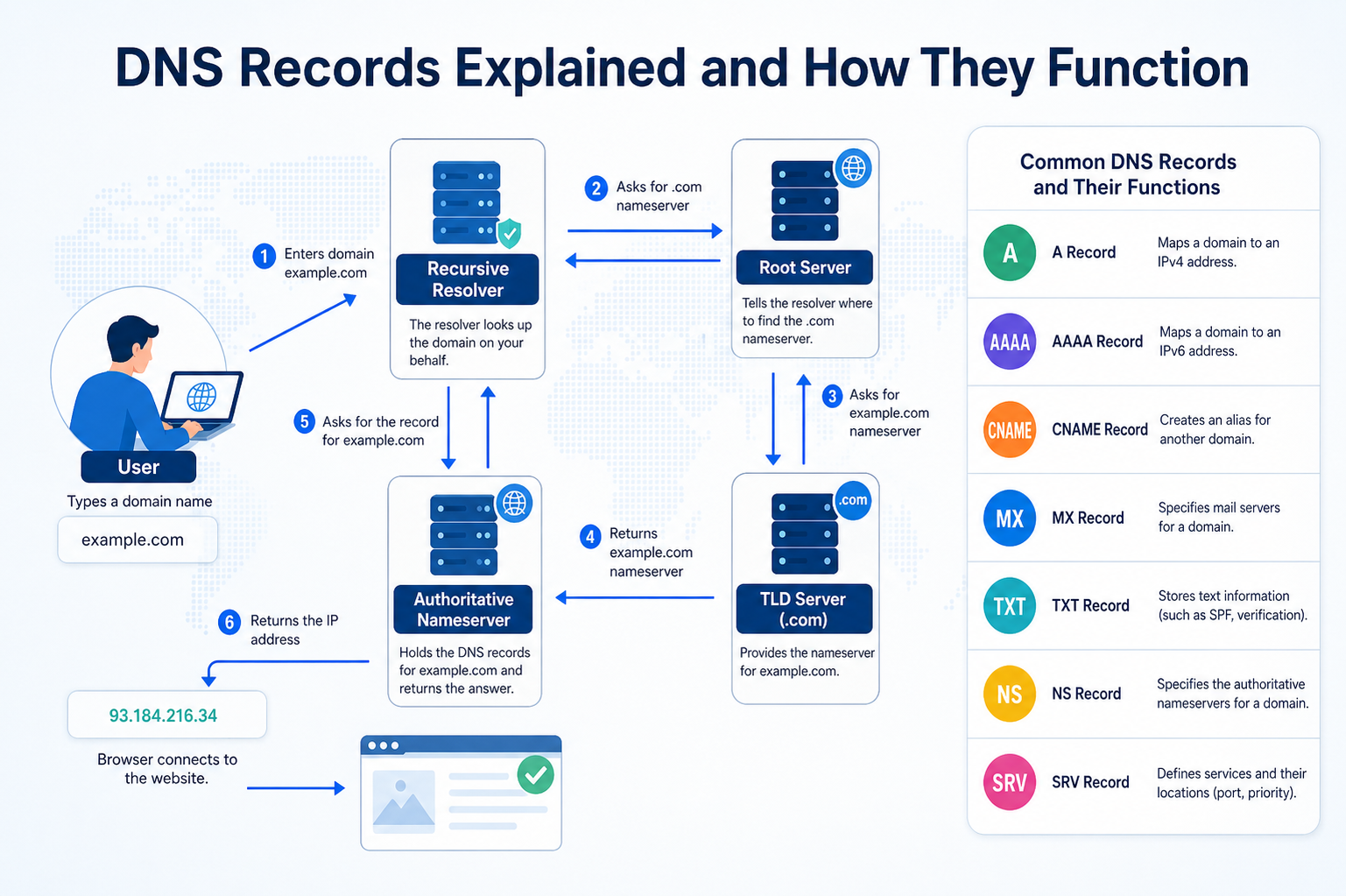
DNS operates as a distributed and hierarchical system designed to ensure fast and reliable name resolution across the internet. Instead of relying on a single centralized database, DNS is spread across millions of servers worldwide. This structure prevents overload, increases redundancy, and improves speed for users accessing online services. At its core, DNS is built in layers, where each layer has a specific responsibility in translating domain names into usable IP addresses.
The hierarchy begins with root-level systems at the top, followed by top-level domain structures, and then authoritative systems that store the final mapping information. This layered approach ensures that no single point of failure can disrupt the entire system, making DNS one of the most resilient infrastructures in modern networking.
Role of the DNS Resolver in Request Handling
When a user enters a web address into a browser, the first component that processes the request is the DNS resolver. This resolver is typically provided by an internet service provider or a third-party service. Its main job is to act as an intermediary between the user and the DNS infrastructure.
The resolver receives the query and begins the process of finding the correct IP address. If the answer is already stored in its cache, it returns the result instantly. If not, it continues the lookup process by communicating with other DNS components. This caching ability significantly reduces lookup time and improves browsing speed for frequently visited websites.
Understanding Root Name Servers
Root name servers represent the highest level in the DNS hierarchy. They do not store specific domain information but instead provide guidance on where to find more detailed records. When a resolver does not have cached information, it first contacts a root server.
The root server responds by directing the resolver to the appropriate top-level domain server. This step is crucial because it narrows down the search path and prevents unnecessary querying of unrelated servers. Although root servers are few in number, they are strategically distributed across the globe to ensure stability and performance.
Top-Level Domain Systems and Their Function
Top-level domain systems are responsible for managing domain categories such as general and country-based extensions. When a resolver receives guidance from a root server, it contacts the appropriate top-level system to continue the lookup process.
These systems do not contain full website details but instead maintain information about where authoritative servers are located. Their role is to bridge the gap between root servers and final data sources. This intermediate step ensures that DNS queries follow an organized and efficient path.
Authoritative Name Servers and Final Resolution
Authoritative name servers hold the actual DNS records for a domain. When a resolver reaches this level, it finally obtains the exact IP address or relevant data associated with the requested domain name.
These servers are considered the final source of truth in DNS resolution. They store different types of records that define how a domain behaves on the internet, including routing, email handling, and verification information. Once the authoritative server responds, the resolver sends the result back to the user’s browser, completing the lookup process.
DNS Caching and Performance Optimization
Caching plays a vital role in improving DNS performance. When a DNS resolver successfully retrieves a record, it stores that information temporarily. This stored data allows future requests for the same domain to be answered instantly without repeating the full lookup process.
The duration for which this information is stored is determined by a value known as TTL, or time-to-live. Once the TTL expires, the cached data is refreshed to ensure accuracy. This balance between speed and freshness ensures that DNS remains both efficient and reliable.
Time-to-Live and Data Refreshing Mechanism
Time-to-live controls how long a DNS record remains stored in cache before it must be refreshed. Short TTL values allow faster updates when changes are made to DNS configurations, while longer TTL values reduce the frequency of queries and improve performance.
This mechanism is especially important when websites change hosting providers or update server configurations. Without TTL control, outdated information could remain in circulation, leading to connection errors or delays in reaching updated services.
DNS Query Process Step by Step
The DNS query process follows a structured path that ensures accurate resolution. It begins when a user submits a domain request. The resolver first checks its local cache. If no matching record is found, it contacts a root server, which directs it to a top-level domain server. The next step involves querying that server for guidance toward an authoritative server.
Finally, the authoritative server provides the required IP address. The resolver then returns this information to the user’s device, allowing the browser to establish a connection. This entire process usually happens within milliseconds, making it invisible to the user.
DNS Record Propagation Across Networks
When changes are made to DNS records, those updates must spread across the global network. This process is known as propagation. It can take varying amounts of time depending on TTL settings and caching behavior across different servers.
During propagation, some users may see updated information while others still receive older data. This temporary inconsistency occurs because different DNS resolvers update their caches at different intervals. Eventually, all systems synchronize with the latest configuration.
Security Challenges in DNS Systems
Despite its reliability, DNS is vulnerable to certain security threats. One common issue is spoofing, where attackers manipulate DNS responses to redirect users to malicious websites. Another risk is cache poisoning, which involves inserting false data into a resolver’s cache.
These threats can lead to serious consequences such as data theft or service disruption. To counter these risks, additional security layers are implemented to verify the authenticity of DNS responses and ensure data integrity.
DNSSEC and Data Integrity Protection
DNS Security Extensions provide an added layer of protection by digitally signing DNS records. This ensures that the data received from a DNS response has not been altered during transmission.
When a resolver receives a signed record, it can verify its authenticity before using it. This prevents attackers from injecting false information into the resolution process. DNSSEC plays a critical role in strengthening trust within the DNS infrastructure.
Load Distribution and Traffic Management
DNS is also used to distribute traffic across multiple servers. By assigning different IP addresses to the same domain based on location or load, DNS helps balance network demand.
This improves performance by directing users to the nearest or least congested server. As a result, websites load faster and remain stable even during high traffic conditions. This dynamic routing capability is essential for large-scale online platforms.
Role of DNS in Email Communication
DNS is not limited to web browsing; it also plays a key role in email delivery. Special records determine which servers are responsible for receiving emails for a domain. When an email is sent, DNS ensures it reaches the correct destination server.
This process prevents misdelivery and ensures that messages are routed efficiently. Without DNS, email systems would not be able to locate the correct servers for message exchange.
Common Issues in DNS Resolution
Several issues can affect DNS performance and reliability. Misconfigured records, expired TTL values, or server outages can lead to failed lookups. Users may experience delays or inability to access websites when such problems occur.
Troubleshooting DNS issues often involves checking record configurations, clearing cached data, or switching to alternative resolvers. Proper management is essential to maintain smooth connectivity.
Importance of DNS in Modern Internet Infrastructure
DNS serves as a foundational element of the internet, enabling seamless communication between users and online services. Without it, accessing websites would require memorizing complex numerical addresses, making the internet far less practical.
Its hierarchical design, caching mechanisms, and distributed structure allow it to handle billions of queries daily with remarkable efficiency. DNS remains one of the most critical systems supporting global digital communication.
Evolution and Scalability of DNS Systems
Over time, DNS has evolved to support increasing internet demand. Originally designed for a much smaller network, it has been scaled to handle massive global traffic. Improvements in caching, security, and infrastructure have made it capable of supporting modern digital ecosystems.
Its decentralized nature ensures that it can grow continuously without collapsing under pressure. This scalability is one of the reasons the internet has been able to expand so rapidly.
Final Understanding of DNS Functionality
DNS functions as a highly organized system that connects human-readable names to machine-readable addresses. Through a combination of hierarchical servers, caching mechanisms, and record types, it ensures that users can access websites and services quickly and reliably.
Its role extends beyond simple translation, influencing performance, security, and communication across the entire internet ecosystem.
Advanced DNS Record Types and Their Roles
Beyond the commonly known DNS records, there are several advanced record types that support deeper control, security, and functionality of internet systems. These records are not always visible to end users, but they play a crucial role in ensuring that websites, applications, and communication systems operate smoothly and securely.
Each record type is designed for a specific technical purpose, ranging from routing services to verifying authenticity and managing advanced network behaviors. Together, they extend the capabilities of DNS far beyond simple domain-to-IP translation.
SOA Records and Zone Authority Management
The Start of Authority record defines the primary source of information for a DNS zone. It contains administrative details about the domain, including the main authoritative server, refresh intervals, and serial numbers used for version control.
This record is essential because it tells other DNS servers which source is responsible for managing updates within a specific zone. It also controls how often secondary servers should check for updates, ensuring consistency across distributed DNS systems.
NS Records and Delegation of Authority
Name Server records define which servers are responsible for handling DNS queries for a domain. These records essentially delegate authority to specific DNS servers that store and manage DNS data.
When a resolver needs information about a domain, NS records guide it to the correct authoritative servers. This delegation structure allows DNS to remain scalable and distributed, as different servers can manage different parts of the system independently.
PTR Records and Reverse DNS Lookup
Pointer records are used for reverse DNS lookup, which means finding the domain name associated with a given IP address. While most DNS queries translate domain names into IP addresses, PTR records perform the opposite function.
This process is commonly used for security checks, email validation, and network troubleshooting. Reverse lookup helps verify whether an IP address is legitimately associated with a domain, improving trust and reducing spam or malicious activity.
SRV Records and Service Location Mapping
Service records are used to define the location of specific services within a domain. Instead of pointing to a general server, SRV records specify exact services such as communication protocols, ports, and target hosts.
This is especially useful for applications that require multiple services under one domain, allowing precise routing of requests to the correct service endpoint without confusion or manual configuration.
CAA Records and Certificate Authority Control
Certification Authority Authorization records provide security control over which certificate authorities are allowed to issue digital certificates for a domain. This helps prevent unauthorized issuance of SSL certificates, reducing the risk of impersonation or fraud.
By defining trusted authorities, CAA records strengthen the security of encrypted connections and ensure that only verified entities can issue certificates for a domain.
TXT Records for Verification and Policy Enforcement
TXT records are flexible text-based entries used for a variety of purposes, including domain verification and email security policies. Many services rely on these records to confirm ownership of a domain before enabling features.
They are also used to implement security protocols such as SPF and DKIM, which help prevent email spoofing and ensure that messages are authenticated before delivery.
DNS Propagation Delays and Global Synchronization
When DNS records are updated, the changes do not appear instantly across the entire internet. Instead, they go through a propagation process where different servers gradually update their cached data.
This delay happens because each DNS resolver operates independently and follows its own caching rules. As a result, some users may see updated information earlier than others until the system fully synchronizes globally.
Factors Affecting DNS Propagation Speed
Several factors influence how quickly DNS changes spread across the network. Time-to-live settings play a major role, as shorter values lead to faster updates while longer values delay propagation.
Additionally, the behavior of internet service providers and caching policies of individual resolvers also impact speed. The combination of these factors determines how quickly changes become universally visible.
DNS Performance Optimization Techniques
To improve DNS performance, multiple optimization techniques are used. Caching is the most important method, as it reduces the need for repeated queries. Load balancing is another technique that distributes traffic across multiple servers to prevent overload.
Geolocation-based routing is also used to direct users to the nearest server, reducing latency and improving response times. These strategies ensure that DNS remains efficient even under heavy global traffic.
Anycast Routing and Traffic Efficiency
Anycast is a routing method where multiple servers share the same IP address. When a DNS query is made, it is automatically directed to the nearest or most efficient server based on network conditions.
This improves speed and reliability by reducing travel distance for data. It also enhances redundancy, as multiple servers can handle the same request without requiring a single centralized point of failure.
DNS and Content Delivery Optimization
DNS plays a key role in content delivery systems by helping route users to optimal servers. When combined with distributed networks, it ensures that users receive data from the closest available location.
This reduces loading times and improves overall user experience. It is especially important for large-scale platforms that serve global audiences with high performance requirements.
Security Enhancements in Modern DNS Systems
Modern DNS systems include multiple layers of security to protect against attacks and data manipulation. Encryption protocols are increasingly used to secure DNS queries and prevent interception by unauthorized parties.
Authentication mechanisms ensure that responses come from legitimate sources, reducing the risk of spoofing or tampering during transmission.
Role of DNS Over HTTPS and DNS Over TLS
Encrypted DNS protocols improve privacy by preventing third parties from monitoring or altering DNS queries. These technologies ensure that DNS requests are transmitted securely over encrypted channels.
This reduces exposure to surveillance and manipulation, enhancing both user privacy and data integrity. As internet security standards evolve, encrypted DNS is becoming more widely adopted.
DNS Failover and System Reliability
DNS failover mechanisms ensure continuity of service when a server becomes unavailable. If a primary server fails, DNS automatically redirects traffic to backup servers.
This improves reliability and minimizes downtime, ensuring that users can still access services even during technical failures or maintenance periods.
Scalability Challenges in Global DNS Networks
As internet usage continues to grow, DNS systems must handle increasing query volumes. Scalability is achieved through distributed infrastructure, caching optimization, and load distribution techniques.
Despite this, managing global DNS traffic requires constant monitoring and upgrades to maintain speed and reliability across all regions.
Impact of DNS on Internet Speed and User Experience
DNS resolution speed directly affects how quickly websites begin to load. Even a slight delay in DNS lookup can increase perceived loading times for users.
Optimized DNS systems reduce this delay through caching, proximity routing, and efficient query handling, significantly improving user experience across devices and networks.
Future Developments in DNS Technology
DNS continues to evolve with advancements in security, performance, and automation. Future improvements are expected to focus on stronger encryption, faster resolution methods, and deeper integration with cloud-based systems.
As internet usage becomes more complex, DNS will continue adapting to support emerging technologies and increasing global demand.
Overall Importance of DNS in Digital Infrastructure
DNS remains one of the most critical components of the internet, silently powering nearly every online interaction. From browsing websites to sending emails and accessing applications, it ensures seamless connectivity across systems.
Its layered architecture, diverse record types, and global distribution make it a highly efficient and resilient system that continues to support the growing digital world.
DNS Caching Deep Behavior and Resolution Layers
DNS caching does not operate as a single uniform layer but instead exists in multiple levels across different systems. Each layer stores previously resolved information to reduce lookup time and network load. These layers include the browser cache, operating system cache, resolver cache, and sometimes even ISP-level caching systems. Each of these contributes to faster access by avoiding repeated queries to external DNS servers.
When a domain is frequently accessed, caching ensures that the response is almost instant. However, this speed benefit must always be balanced with accuracy, since outdated cached data can lead to incorrect routing if changes occur in DNS records. That is why cache expiration rules and refresh cycles are tightly controlled through TTL settings.
Recursive vs Iterative DNS Query Processing
DNS resolution can occur through two main methods: recursive and iterative querying. In a recursive query, the DNS resolver takes full responsibility for finding the final answer. It communicates with multiple servers on behalf of the user until the correct IP address is obtained.
In contrast, iterative querying involves each DNS server providing the best possible answer it has, usually a referral to another server. The resolver then continues the process step by step until it reaches the authoritative source. This layered communication approach ensures flexibility and efficiency in large-scale distributed networks.
DNS Prefetching and Predictive Resolution
Modern systems often use DNS prefetching to improve browsing speed. This technique predicts which domains a user may access next and resolves them in advance. By doing so, the system reduces perceived loading time when the user actually clicks on a link or requests a resource.
Prefetching is commonly used in browsers and applications that rely heavily on multiple external resources. While it improves performance, it must be managed carefully to avoid unnecessary network usage and privacy concerns.
Negative Caching and Error Handling in DNS
DNS does not only cache successful responses; it can also cache negative results. This means that if a domain does not exist or a record is unavailable, the system temporarily remembers that failure. This prevents repeated unnecessary queries for non-existent records.
Negative caching improves efficiency but must be carefully timed. If a domain is newly created, overly long negative caching can delay its accessibility until the cached error expires.
DNS and Network Latency Factors
Latency in DNS resolution refers to the time taken for a query to be resolved. Several factors influence this delay, including physical distance to servers, network congestion, and the number of hops required in the resolution process.
Optimized DNS systems reduce latency through intelligent routing and caching strategies. Even small improvements in DNS response time can significantly enhance overall website performance because DNS lookup is often the first step in establishing a connection.
GeoDNS and Location-Based Routing
GeoDNS is a system that returns different DNS responses based on the geographic location of the user. This allows traffic to be directed to servers that are physically closer, reducing latency and improving performance.
This approach is widely used in global applications where users from different regions access the same service. By adapting responses based on location, DNS helps ensure a consistent and optimized experience worldwide.
DNS Load Balancing Techniques
DNS can distribute traffic across multiple servers using load balancing techniques. Instead of pointing all users to a single server, DNS can rotate between multiple IP addresses or select servers based on load conditions.
This prevents any single server from becoming overwhelmed and improves system stability. Load balancing through DNS is a foundational method for handling high-traffic websites and applications.
Round-Robin DNS Mechanism
Round-robin DNS is a simple load distribution technique where multiple IP addresses are assigned to a single domain. Each time a request is made, the DNS system rotates through the available IP addresses.
While this method does not account for server load or health status, it provides a basic level of traffic distribution that can improve performance in certain environments.
DNS Health Checks and Failover Systems
Advanced DNS systems include health monitoring features that check whether a server is functioning properly. If a server becomes unresponsive, DNS failover mechanisms automatically redirect traffic to a backup server.
This ensures continuous availability even during outages or maintenance periods. Health-based routing is especially important for critical services that require high uptime guarantees.
DNS Amplification and Abuse Risks
DNS can be exploited in certain types of cyberattacks, such as amplification attacks. In this scenario, attackers send small queries that trigger large responses, overwhelming target systems with traffic.
To reduce this risk, modern DNS systems implement rate limiting, response filtering, and security protocols that restrict misuse. These protections are essential for maintaining internet stability.
Role of DNS in Distributed Applications
Distributed applications rely heavily on DNS to connect different components across networks. Services hosted in multiple regions depend on DNS to route requests efficiently between servers, databases, and APIs.
Without DNS, managing communication between distributed systems would require manual configuration of IP addresses, making scalability nearly impossible.
Dynamic DNS and Real-Time Updates
Dynamic DNS allows IP addresses associated with a domain to be updated automatically in real time. This is particularly useful for systems where IP addresses change frequently, such as home networks or mobile services.
Instead of manually updating DNS records, dynamic DNS systems automatically synchronize changes, ensuring continuous connectivity without interruption.
DNS and Cloud Infrastructure Integration
Cloud platforms rely heavily on DNS for service discovery and routing. As services scale up or down dynamically, DNS helps maintain connectivity between users and cloud-based resources.
This integration allows cloud environments to remain flexible and responsive to changing demand while maintaining stable access points for users.
Edge Computing and DNS Optimization
In edge computing environments, DNS plays a key role in directing users to nearby processing nodes. This reduces latency by minimizing the distance data must travel between user and server.
By combining DNS with edge infrastructure, systems can deliver faster response times and improved performance for real-time applications.
DNS Security Threat Detection Systems
Modern DNS infrastructure often includes threat detection mechanisms that monitor unusual query patterns. These systems can identify potential attacks such as bot activity, data exfiltration attempts, or abnormal traffic spikes.
Early detection helps mitigate risks before they escalate into larger security incidents, strengthening overall network resilience.
Role of AI in DNS Management
Artificial intelligence is increasingly being used to optimize DNS performance. AI systems can predict traffic patterns, detect anomalies, and automatically adjust routing decisions for better efficiency.
This helps improve both speed and security while reducing the need for manual configuration and monitoring.
DNS Automation in Large-Scale Networks
Automation plays a major role in managing modern DNS systems. Automated tools handle record updates, failover switching, load balancing adjustments, and security monitoring.
This reduces human error and ensures that DNS infrastructure can respond quickly to changes in network conditions.
Evolution Toward Decentralized DNS Models
There is ongoing exploration of decentralized DNS systems that reduce reliance on traditional hierarchical structures. These models aim to distribute domain management across peer-to-peer networks.
While still developing, decentralized DNS could improve resilience and reduce dependency on centralized authorities in the future internet landscape.
Final Overview of DNS Functionality in Modern Systems
DNS has evolved far beyond simple name resolution. It now supports security enforcement, performance optimization, traffic distribution, and global scalability. Its layered architecture ensures reliability, while advanced mechanisms like caching, failover, and encryption enhance its functionality.
As internet systems continue to grow in complexity, DNS remains a foundational technology that quietly enables nearly every digital interaction across the world.
DNS in Modern Cybersecurity Ecosystems
DNS has become a critical component in modern cybersecurity frameworks because it sits at the entry point of almost all internet communication. Every connection attempt begins with a DNS query, which makes it a valuable checkpoint for detecting malicious activity. Security systems often monitor DNS traffic to identify suspicious patterns such as repeated failed lookups, unusual query volumes, or requests to known harmful domains.
Organizations also use DNS filtering to block access to dangerous or unwanted content before a connection is even established. This early interception makes DNS one of the most effective layers of defense in network security architecture.
DNS Threat Intelligence and Monitoring
Advanced DNS systems are now integrated with threat intelligence platforms that continuously analyze global data about cyber threats. These systems compare incoming DNS queries against databases of malicious domains, phishing sites, and command-and-control servers used by attackers.
When a match is found, the DNS response can be blocked, redirected, or flagged for investigation. This real-time monitoring capability helps organizations respond quickly to emerging threats and reduces exposure to cyberattacks.
DNS Tunneling and Data Exfiltration Risks
DNS can sometimes be misused for covert communication channels known as DNS tunneling. In this technique, attackers encode data inside DNS queries and responses to secretly transfer information outside a secured network.
Because DNS traffic is often trusted and allowed through firewalls, this method can be difficult to detect without specialized monitoring tools. Security systems now analyze query patterns and payload structures to identify and block such hidden data transfers.
Encrypted DNS and Privacy Protection
Modern privacy-focused DNS technologies aim to prevent third parties from observing or modifying DNS queries. Encryption ensures that DNS requests cannot be easily intercepted or manipulated during transmission.
This significantly reduces the risk of surveillance and man-in-the-middle attacks. It also strengthens user privacy by hiding browsing behavior from unauthorized observers, making internet usage more secure and confidential.
DNS in Mobile and Wireless Networks
In mobile environments, DNS plays an even more dynamic role due to frequent changes in network connections. Devices often switch between Wi-Fi, cellular networks, and hotspots, requiring constant DNS reconfiguration.
Efficient DNS systems ensure that these transitions happen seamlessly without disrupting user experience. Optimized mobile DNS resolution reduces delays and maintains stable connectivity even in changing network conditions.
DNS and Internet of Things Devices
The expansion of connected devices has increased the importance of DNS in Internet of Things environments. Smart devices rely on DNS to communicate with cloud services, update servers, and other devices within a network.
Because IoT systems often operate with limited processing power, efficient DNS resolution is essential for maintaining performance and responsiveness across large device networks.
DNS Scalability in Global Internet Growth
As internet usage continues to expand globally, DNS must handle an ever-increasing number of queries every second. This scalability is achieved through distributed infrastructure, caching layers, and optimized routing systems.
The design of DNS allows it to grow without collapsing under demand, making it one of the most scalable systems ever created. Its ability to handle billions of daily requests is a key reason the internet functions smoothly at a global level.
DNS Automation and Self-Healing Systems
Modern DNS infrastructures increasingly rely on automation to maintain stability. Self-healing systems can automatically detect failures, reroute traffic, and restore services without human intervention.
These automated responses reduce downtime and ensure continuous availability even during unexpected disruptions. This level of automation is essential for large-scale digital platforms that require constant uptime.
DNS Analytics and Performance Insights
Organizations now use DNS analytics to gain insights into network performance, user behavior, and security threats. By analyzing DNS query data, patterns can be identified that reveal traffic trends, peak usage times, and potential vulnerabilities.
These insights help improve infrastructure planning, optimize performance, and strengthen security strategies across digital systems.
DNS Integration with Artificial Intelligence Systems
Artificial intelligence is increasingly being used to enhance DNS decision-making processes. AI models can predict traffic loads, identify anomalies, and optimize routing paths in real time.
This intelligent adaptation improves both speed and reliability while reducing manual configuration efforts. As AI systems evolve, DNS management is becoming more proactive and predictive rather than reactive.
DNS Role in Global Digital Infrastructure
DNS acts as a foundational layer of the global internet ecosystem. It connects users to websites, applications, cloud services, and communication platforms across the world.
Without DNS, modern digital infrastructure would become extremely difficult to manage, as every connection would require direct numerical addressing. Its abstraction of complex network details into simple names is what makes the internet user-friendly and accessible.
Future of DNS Technology
The future of DNS is expected to focus on stronger security, faster resolution times, and deeper integration with emerging technologies. Improvements in encryption, automation, and decentralized systems will continue to shape its evolution.
As digital ecosystems become more complex, DNS will adapt to support new communication models, including edge computing, real-time applications, and advanced cloud architectures.
Conclusion
DNS is far more than a simple system for converting domain names into IP addresses. It is a highly structured, globally distributed, and continuously evolving infrastructure that supports nearly every aspect of internet communication.
From routing website traffic and delivering emails to enforcing security policies and optimizing performance, DNS operates silently but critically behind the scenes. Its layered architecture, caching mechanisms, security enhancements, and scalability make it one of the most essential technologies in the modern digital world.
As internet usage continues to grow and evolve, DNS will remain at the core of connectivity, ensuring that digital systems stay fast, reliable, and accessible across the globe.