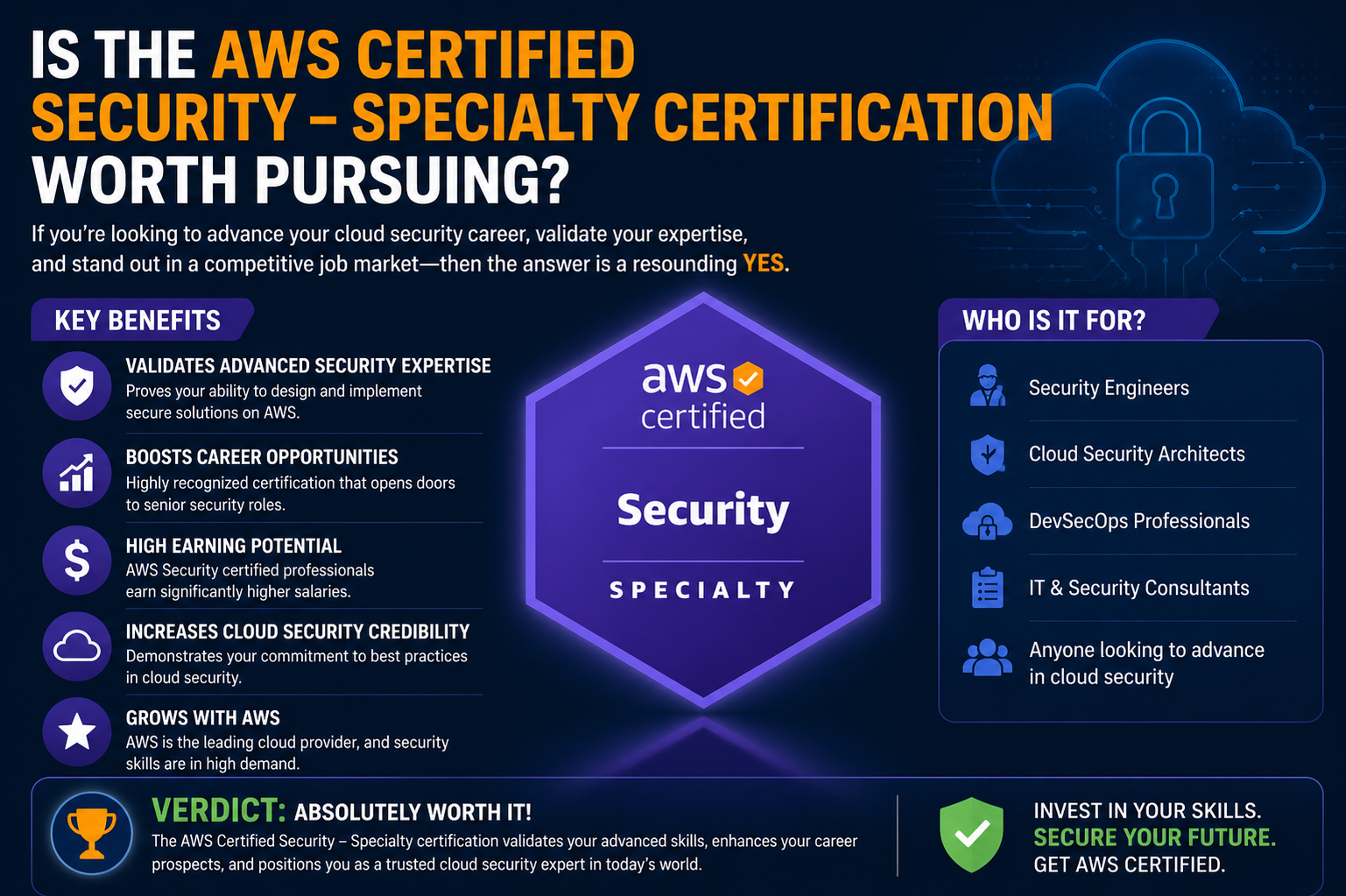
Cloud computing has become the backbone of modern digital infrastructure, and AWS remains one of the most widely used platforms across industries. As organizations move critical workloads, sensitive data, and large-scale applications to the cloud, the importance of security has increased significantly. Cyber threats are evolving rapidly, and companies are no longer only concerned with traditional network security but also with securing distributed cloud environments. This shift has created a strong demand for professionals who understand how to design, implement, and maintain secure cloud systems. Within this context, specialized certifications focused on cloud security have gained substantial value, and the AWS Certified Security – Specialty certification stands out as one of the most recognized credentials in this space.
Security in the cloud is not a single-layer responsibility. It involves identity management, data protection, threat detection, incident response, compliance, and continuous monitoring. AWS provides a wide range of services to support these areas, but effectively using them requires deep technical understanding. This is where the certification becomes relevant, as it validates the ability to apply security principles in real AWS environments rather than just theoretical knowledge.
Position of AWS Security – Specialty in the Certification Landscape
AWS certifications are structured in levels, starting from foundational knowledge and progressing through associate and professional stages. The Security – Specialty certification sits at an advanced level, meaning it is designed for individuals who already have hands-on experience with AWS. Unlike entry-level certifications that focus on general cloud concepts, this one dives deeply into specialized security domains.
What makes this certification unique is its focus on real-world security challenges rather than basic service familiarity. It is not simply about knowing what AWS services do, but understanding how to secure them in complex architectures. This includes designing secure applications, implementing encryption strategies, managing identity and access control, and responding to security incidents in a structured and efficient manner.
Because of this advanced positioning, the certification is often considered a benchmark for professionals aiming to transition into dedicated cloud security roles or strengthen their expertise in existing roles.
Core Skills and Knowledge Areas Validated
The AWS Certified Security – Specialty certification covers a broad range of technical domains that reflect real-world security responsibilities. One of the most important areas is identity and access management, which involves controlling who can access AWS resources and under what conditions. This includes managing roles, policies, and permissions in a way that minimizes risk while maintaining operational efficiency.
Another critical area is data protection, which focuses on securing data both at rest and in transit. This includes encryption mechanisms, key management systems, and secure data storage practices. Professionals are expected to understand how to implement encryption strategies using AWS-native tools and how to ensure compliance with organizational security standards.
Monitoring and logging also play a major role in the certification. Security professionals must be able to detect unusual activity, investigate potential threats, and respond quickly to incidents. AWS provides tools for logging and monitoring cloud activity, and the certification tests the ability to interpret and act on this data effectively.
In addition, the certification covers infrastructure security, which includes securing virtual networks, configuring secure communication channels, and protecting workloads from external threats. Incident response and troubleshooting are also key components, requiring professionals to understand how to respond when security breaches or vulnerabilities are detected.
Relevance in Today’s Job Market
The demand for cloud security professionals has grown significantly in recent years, largely due to increased adoption of cloud technologies across industries such as finance, healthcare, retail, and government. Organizations are increasingly concerned about data breaches, compliance violations, and cyberattacks, which has made security expertise one of the most sought-after skill sets in IT.
Professionals with AWS security expertise are often considered valuable assets because they can bridge the gap between cloud architecture and cybersecurity. The AWS Certified Security – Specialty certification serves as a formal validation of these skills, making it easier for candidates to stand out in competitive job markets.
Roles that benefit from this certification include cloud security engineer, security architect, DevSecOps engineer, cloud consultant, and systems administrator with security responsibilities. In many cases, it can also support career progression into senior or leadership positions where security strategy becomes a key responsibility.
Impact on Salary and Career Growth
While salary varies depending on region, experience, and job role, cloud security professionals generally earn higher-than-average compensation compared to general IT roles. This is primarily due to the specialized nature of the skill set and the critical importance of security in cloud environments. Organizations are willing to invest more in professionals who can prevent security incidents and ensure compliance with regulatory standards.
Holding the AWS Certified Security – Specialty certification can strengthen negotiation power during job applications and promotions. It signals to employers that the individual has verified expertise in securing AWS environments, which can reduce onboarding time and increase trust in their technical abilities. In many cases, it also opens opportunities for roles that require advanced security knowledge and are not accessible to those without specialized certifications.
However, it is important to understand that certification alone does not guarantee higher pay. Practical experience, problem-solving ability, and real-world implementation skills play an equally important role. The certification works best as a complement to hands-on experience rather than a standalone achievement.
Who Should Consider This Certification
This certification is best suited for professionals who already have experience working with AWS and a basic understanding of cloud security concepts. Individuals working in roles such as cloud engineering, system administration, cybersecurity, or DevOps will benefit the most from pursuing it.
It is particularly valuable for those who want to specialize in security rather than remain in general cloud roles. For example, a DevOps engineer who wants to move into DevSecOps or a system administrator transitioning into cloud security architecture can use this certification as a stepping stone.
The certification is also useful for professionals working in regulated industries where compliance and security are critical. In such environments, having validated security expertise can enhance both individual performance and organizational trust.
Who May Not Benefit Immediately
Despite its value, the AWS Certified Security – Specialty certification is not suitable for everyone. Beginners who are new to cloud computing or AWS may find it difficult because it assumes prior knowledge of core AWS services and security principles. Attempting this certification without foundational experience can lead to frustration and inefficient learning.
Similarly, professionals who are not directly involved in cloud or security-related roles may not gain immediate value from this certification. In such cases, starting with foundational or associate-level AWS certifications may be a more practical approach.
It is also important to consider career direction before investing time in preparation. If a professional does not plan to work in cloud security or related fields, the certification may not provide significant return on investment.
Why This Certification Stands Out
One of the key reasons this certification is highly regarded is its focus on practical, scenario-based knowledge. Rather than testing memorization of facts, it evaluates the ability to solve real-world security problems in AWS environments. This makes it more aligned with actual job responsibilities compared to many theoretical certifications.
It also reflects the increasing importance of security in cloud computing. As cyber threats become more sophisticated, organizations need professionals who can think critically about security architecture and implement proactive defense strategies. The certification encourages this mindset by focusing on applied knowledge rather than surface-level understanding.
Another important factor is its vendor-specific depth. While general security certifications exist, this one provides deep insight into AWS-specific tools and best practices. Since AWS is widely used across industries, this specialization can be particularly valuable for professionals working in AWS-heavy environments.
Setting the Stage for Deeper Evaluation
Understanding whether the AWS Certified Security – Specialty certification is worth pursuing requires more than just an overview of its benefits. It also involves analyzing preparation effort, difficulty level, real-world applicability, and long-term career impact. While this first part highlights its importance, industry relevance, and foundational value, a deeper evaluation is necessary to understand how it performs in real career scenarios and whether the investment of time and effort truly aligns with professional goals.
Depth of Difficulty and Realistic Expectations
The AWS Certified Security – Specialty certification is widely considered one of the more challenging AWS certifications, not because of trick questions or obscure theory, but because of the depth of understanding it demands. It assumes that candidates already know how AWS services work in real environments and can apply that knowledge to complex security scenarios. This makes the exam less about recalling definitions and more about making architectural decisions under realistic constraints.
One of the most common difficulties candidates face is the scenario-based format. Questions are rarely straightforward. Instead, they often describe a multi-layered business requirement involving compliance, data protection, identity management, or incident response. The candidate is expected to choose the most secure, efficient, and cost-effective solution from several plausible options. This requires not only technical knowledge but also judgment and experience.
Another challenge is the breadth of topics covered. Unlike some certifications that focus narrowly on one domain, this certification spans multiple areas of security including cryptography, network security, monitoring, logging, automation, and governance. Each of these areas can be complex on its own, and the exam expects familiarity with how they interact within AWS ecosystems.
For many candidates, the difficulty is not the individual concepts but integrating them into a cohesive understanding. AWS security is highly interconnected, meaning a change in one area, such as identity management, can directly affect network security or data access policies. The certification tests this interconnected thinking rather than isolated knowledge.
Preparation Journey and Learning Curve
Preparing for the AWS Certified Security – Specialty certification typically requires a structured and disciplined approach. Most successful candidates already have hands-on AWS experience before they begin studying seriously. Without that practical background, the learning curve can feel steep.
The preparation process usually begins with reviewing core AWS services, especially those related to security. Identity and Access Management is one of the most important areas, as it forms the foundation of security in AWS. Understanding how permissions, roles, and policies work is essential because many exam questions revolve around controlling access in different scenarios.
Encryption and key management are another major focus area. Candidates need to understand how AWS handles encryption both at rest and in transit, as well as how key management systems operate. This includes knowing when to use managed keys versus customer-managed keys and how to design secure data storage strategies.
Monitoring and logging require equally strong attention. AWS provides tools for tracking activity and detecting anomalies, and candidates must understand how to interpret logs and configure alerts. This is crucial for identifying security incidents and responding effectively.
A significant part of preparation also involves practice questions and scenario-based learning. Simply reading documentation is not enough. Candidates need to simulate decision-making under exam-like conditions to develop the ability to choose the most appropriate solutions quickly.
The learning curve can be intense for those without prior AWS exposure. However, for professionals already working in cloud environments, the certification often feels like a natural extension of their daily responsibilities rather than entirely new territory.
Practical Value in Real-World Work Environments
One of the strongest arguments in favor of the AWS Certified Security – Specialty certification is its practical relevance. The knowledge gained during preparation is directly applicable to real-world cloud security tasks. Unlike purely theoretical certifications, this one is closely aligned with actual job responsibilities in cloud security roles.
In real environments, security professionals are constantly dealing with access control issues, monitoring alerts, compliance requirements, and infrastructure protection. The certification helps structure this knowledge in a way that improves decision-making and system design. For example, understanding how to properly configure identity permissions can prevent unauthorized access incidents, while knowledge of encryption strategies can protect sensitive data from exposure.
Another important aspect is incident response. In real organizations, security breaches and misconfigurations are not hypothetical—they happen regularly. Professionals trained through this certification are better equipped to respond quickly and systematically, reducing potential damage and recovery time.
It also enhances collaboration between teams. Security professionals often work with developers, system administrators, and DevOps engineers. Having a shared understanding of AWS security principles improves communication and reduces the likelihood of misconfigurations or security gaps during deployment.
However, it is important to note that the certification does not replace real experience. While it strengthens theoretical and applied knowledge, actual security work still requires hands-on problem-solving in live environments. The certification acts as a reinforcement tool rather than a substitute for practical exposure.
Career Advancement Opportunities
For professionals already working in IT or cloud-related roles, the AWS Certified Security – Specialty certification can open doors to more specialized and higher-responsibility positions. Organizations are increasingly prioritizing security expertise, and individuals with validated AWS security knowledge are often considered for advanced roles.
Common career paths include cloud security engineer, security architect, DevSecOps engineer, and cybersecurity consultant. These roles typically involve designing secure cloud systems, implementing security policies, and ensuring compliance with industry standards. In many organizations, these positions also carry leadership responsibilities in shaping security strategy.
The certification can also serve as a stepping stone for professionals looking to transition from general IT roles into cybersecurity-focused careers. For example, a system administrator or DevOps engineer may use this certification to shift into a dedicated cloud security position.
In addition to role advancement, the certification can also improve visibility within organizations. Employees who demonstrate initiative in obtaining advanced certifications are often viewed as proactive and technically strong, which can lead to involvement in more critical projects and decision-making processes.
However, career advancement is not automatic. The certification increases opportunities, but actual growth depends on how effectively the knowledge is applied in real work scenarios. Employers value both certification and proven ability to deliver results in production environments.
Return on Investment Considerations
When evaluating whether the certification is worth pursuing, it is important to consider the investment of time, effort, and cost. Preparation typically requires several weeks or months depending on experience level. This includes studying AWS documentation, practicing hands-on labs, and reviewing scenario-based questions.
For experienced professionals, the return on investment is often high because the certification aligns closely with their job responsibilities. It can lead to better job opportunities, higher compensation potential, and increased professional credibility.
For beginners, however, the return may be lower initially because the certification is advanced in nature. Without foundational AWS knowledge or job experience, the effort required to pass the exam may not translate into immediate career benefits. In such cases, starting with associate-level certifications may provide better long-term value.
Another factor to consider is industry demand. Cloud security continues to grow as a critical field, and AWS remains a dominant platform. This ensures that the skills validated by this certification remain relevant for the foreseeable future, adding long-term value to the investment.
Common Misconceptions About the Certification
One common misconception is that passing the certification alone guarantees a high-paying job in cloud security. In reality, employers look for a combination of certification, experience, and problem-solving ability. The certification helps open doors, but it does not replace real-world expertise.
Another misconception is that it is only useful for security specialists. While it is designed for security-focused roles, it is also valuable for DevOps engineers, cloud architects, and system administrators who work with AWS infrastructure. Security is a shared responsibility in cloud environments, making this knowledge broadly useful.
Some also believe that the certification is outdated or too vendor-specific. However, AWS remains one of the most widely used cloud platforms globally, and its security practices often reflect industry standards. Understanding AWS security concepts can also provide transferable knowledge applicable to other cloud platforms.
Final Evaluation Before Decision Making
The AWS Certified Security – Specialty certification is not a casual achievement. It requires commitment, prior experience, and a willingness to engage with complex security concepts. However, for the right candidate, it offers strong professional value, practical skills, and enhanced career opportunities.
Its worth ultimately depends on individual career goals. For professionals aiming to specialize in cloud security or advance in AWS-focused roles, it can be a powerful credential. For those still building foundational knowledge, it may be better approached after gaining more experience.
The next part will focus on long-term career impact, comparison with other certifications, and whether it truly stands out as a strategic investment in the evolving cloud security landscape.
Long-Term Career Impact and Industry Relevance
Over the long term, the AWS Certified Security – Specialty certification tends to hold strong value because cloud security itself is not a temporary trend but a continuing necessity. As organizations expand their digital infrastructure, security requirements become more complex, not less. This means professionals who understand AWS security principles are likely to remain in demand for years to come.
One of the key long-term benefits is specialization. General IT roles are becoming increasingly competitive, while specialized roles in cybersecurity and cloud security are growing steadily. This certification helps professionals move away from generalist positions and into niche, high-impact areas where expertise is more valuable. Over time, this specialization can lead to more stable career growth and increased job security.
Another important factor is adaptability. AWS continuously evolves, introducing new services and updating existing ones. Professionals who understand security principles within AWS are better positioned to adapt to these changes because they are not just learning tools, but underlying concepts like access control, encryption, and monitoring. This conceptual understanding makes it easier to adjust to new technologies and architectures as they emerge.
In the long run, individuals with this certification often find themselves involved in strategic decision-making rather than just technical execution. Security architects and senior engineers are frequently consulted on system design, compliance planning, and risk mitigation strategies. This shift from implementation to strategy is one of the most significant career benefits over time.
Comparison with Other AWS Certifications
When comparing the AWS Certified Security – Specialty certification with other AWS certifications, its specialized nature becomes clear. Associate-level certifications such as Solutions Architect or SysOps Administrator focus on broader cloud understanding and foundational skills. These are often stepping stones that build general AWS knowledge.
In contrast, the Security – Specialty certification narrows its focus entirely on security. It does not cover general architecture design in depth, nor does it focus on development or operations workflows outside of security contexts. This makes it more targeted and technically demanding.
Compared to professional-level certifications like Solutions Architect Professional, the Security – Specialty certification is not necessarily broader, but it is deeper in its domain. While Solutions Architect certifications cover architecture design across multiple areas, the Security certification dives deeply into securing those architectures.
It also differs from general cybersecurity certifications outside AWS. Traditional security certifications often focus on on-premises systems, networking fundamentals, and general security frameworks. The AWS certification, however, is cloud-native, meaning it focuses specifically on securing distributed systems in AWS environments. This specialization makes it highly relevant for modern cloud-first organizations.
In terms of difficulty, it is often considered comparable to professional-level AWS certifications. However, the challenge lies more in scenario interpretation and applied security thinking rather than architectural breadth alone.
Real Value Versus Certification Hype
It is important to separate genuine value from certification hype. In the tech industry, certifications are sometimes perceived as shortcuts to career advancement, but the reality is more nuanced. The AWS Certified Security – Specialty certification does carry real value, but only when combined with practical experience.
The real strength of this certification is not the certificate itself, but the structured knowledge it provides. It forces candidates to understand how AWS security services interact in real environments. This structured understanding can significantly improve decision-making in professional roles.
However, there is a risk of overestimating its impact. Some individuals assume that obtaining the certification alone will lead to immediate job offers or salary increases. While it can improve visibility and competitiveness, employers still prioritize hands-on experience and proven ability to handle real-world security challenges.
In practice, the certification works best as part of a broader professional profile. When combined with experience in cloud environments, scripting, automation, or incident response, it becomes a strong differentiator. On its own, it is valuable but not sufficient to define a career.
Return on Effort for Different Experience Levels
The value of this certification varies significantly depending on the candidate’s background. For experienced cloud engineers or security professionals, the return on effort is typically high. They can relate exam concepts directly to their daily work, making preparation more efficient and practical.
For mid-level professionals transitioning into cloud security, the certification can be a turning point. It helps formalize existing knowledge and fill gaps in understanding AWS-specific security mechanisms. In this case, the return on effort is also strong, as it directly supports career transition goals.
For beginners, however, the return is more limited in the short term. Without prior AWS experience, the learning curve can be steep, and the benefits may not immediately translate into job opportunities. In such cases, foundational certifications or hands-on experience may provide a better starting point before attempting this specialty certification.
This difference in return on effort highlights an important reality: the certification is not universally suitable, but highly valuable for the right stage of career development.
Industry Perception and Employer Expectations
From an employer’s perspective, the AWS Certified Security – Specialty certification is generally viewed as a strong technical signal. It indicates that a candidate has invested time in understanding cloud security at a deeper level and can handle complex AWS environments.
However, employers also interpret it within context. In senior or specialized roles, it is often seen as a positive reinforcement of existing experience rather than a standalone qualification. In junior roles, it may help a candidate stand out but will not replace practical experience requirements.
Many organizations value this certification particularly for roles involving compliance, regulated data environments, or large-scale cloud infrastructure. Industries such as finance, healthcare, and government often prioritize candidates with strong security credentials due to strict regulatory requirements.
It is also worth noting that some employers use certifications as part of structured hiring filters, especially for consulting firms or cloud-focused service providers. In such environments, having this certification can directly influence shortlisting decisions.
Common Challenges After Certification
Earning the certification is only part of the journey. One challenge many professionals face afterward is applying the knowledge effectively in real environments. While the certification provides theoretical and scenario-based understanding, real-world systems often involve additional complexity, legacy systems, and organizational constraints.
Another challenge is staying current. AWS frequently updates its services, and security best practices evolve over time. Professionals must continuously update their knowledge even after certification to remain effective in their roles.
There is also the challenge of expectation management. Some professionals expect immediate career transformation after certification, but in reality, career growth tends to be gradual. The certification enhances opportunities, but consistent performance and experience are what ultimately drive advancement.
Strategic Positioning in a Cloud Career Path
When viewed strategically, the AWS Certified Security – Specialty certification fits best as a mid-to-advanced career milestone. It is not typically the first certification someone should pursue, but rather a targeted specialization after foundational knowledge has been established.
For cloud engineers, it can serve as a bridge into security-focused architecture roles. For cybersecurity professionals, it can serve as an entry point into cloud specialization. For DevOps engineers, it strengthens the security dimension of their skill set, which is increasingly important in modern CI/CD pipelines.
In a broader career path, this certification helps professionals move toward roles that combine technical depth with strategic responsibility. These include cloud security architect, principal security engineer, and cloud governance specialist positions.
Final Reflection on Overall Value
The AWS Certified Security – Specialty certification holds genuine value in today’s cloud-driven technology landscape, but its worth is highly dependent on context. It is not a universal requirement for success, nor is it a guaranteed shortcut to career advancement. Instead, it is a powerful specialization tool for professionals who already have a foundation in AWS and want to deepen their expertise in security.
Its greatest strength lies in its relevance to real-world cloud challenges and its alignment with industry demand for security-focused professionals. When combined with practical experience, it can significantly enhance career prospects, technical credibility, and long-term growth opportunities.
Ultimately, the certification is most valuable for those who see cloud security not just as a requirement, but as a career direction.
Return on Investment in Real Career Scenarios
When evaluating the AWS Certified Security – Specialty certification in real career scenarios, its value becomes clearer when connected to specific job outcomes. Professionals who already work in cloud environments often find that the certification strengthens their ability to take on more complex responsibilities. This includes designing secure architectures, reviewing system vulnerabilities, and guiding teams on best security practices within AWS.
In many organizations, security responsibilities are distributed across teams rather than handled by a single role. Developers, DevOps engineers, and system administrators are all expected to follow security best practices. This certification helps unify that understanding by providing a structured approach to AWS security principles. As a result, professionals can contribute more effectively to cross-functional teams and security discussions.
In consulting or client-facing environments, the certification can also increase trust. Clients often prefer working with professionals who have verified expertise in cloud security, especially when sensitive data or regulated workloads are involved. This can translate into more opportunities for critical projects and higher-responsibility assignments.
However, the return on investment is not purely financial or title-based. A significant benefit is improved problem-solving capability. Professionals often report that after preparing for this certification, they are better able to anticipate security risks, design more resilient systems, and respond more efficiently to incidents.
Evolving Role of Cloud Security Professionals
The role of cloud security professionals is evolving rapidly, and this certification aligns well with that evolution. Traditionally, security was often treated as a separate function handled late in the development process. In modern cloud environments, security is integrated into every stage of system design and deployment.
This shift has led to the rise of DevSecOps practices, where security is embedded into continuous integration and continuous deployment pipelines. The AWS Certified Security – Specialty certification supports this shift by emphasizing proactive security design rather than reactive problem-solving.
As automation becomes more prevalent in cloud environments, security professionals are increasingly expected to work with infrastructure-as-code, automated monitoring systems, and policy-driven governance. The certification indirectly prepares professionals for this by encouraging a structured understanding of AWS security services and how they can be automated and scaled.
In the long term, cloud security professionals are likely to move further into strategic roles. Instead of only implementing security controls, they will be responsible for defining security frameworks, ensuring regulatory compliance, and shaping organizational cloud strategies. This certification serves as a stepping stone toward that level of responsibility.
Limitations of the Certification
Despite its strengths, the AWS Certified Security – Specialty certification has limitations that should be considered before pursuing it. One of the main limitations is its vendor-specific nature. While AWS is widely used, organizations that operate in multi-cloud environments may require broader security knowledge beyond AWS-specific tools.
Another limitation is that it does not cover foundational cybersecurity principles in great depth. It assumes that candidates already understand basic security concepts. As a result, it may not be sufficient for individuals seeking a comprehensive cybersecurity education from the ground up.
Additionally, the certification focuses heavily on technical implementation rather than organizational security strategy. While it covers incident response and compliance concepts, it does not deeply explore areas such as governance frameworks, risk management at an enterprise level, or legal aspects of cybersecurity.
There is also the practical limitation of experience dependency. Without hands-on AWS exposure, the certification can feel abstract and difficult to fully understand. This makes it less effective as an entry-level credential and more suited to professionals already working in cloud environments.
Strategic Decision: Should You Pursue It?
Deciding whether to pursue the AWS Certified Security – Specialty certification depends heavily on career goals and current experience. For professionals actively working in AWS environments or planning to specialize in cloud security, the certification is highly valuable and strategically aligned.
If the goal is to transition into cloud security architecture, DevSecOps, or senior cloud engineering roles, this certification can act as a strong accelerator. It not only validates technical skills but also helps structure knowledge in a way that aligns with industry expectations.
However, if the goal is general IT advancement without a focus on cloud or security specialization, the certification may not provide immediate or significant benefits. In such cases, broader certifications or hands-on experience in different areas of IT might be more beneficial.
Timing also plays an important role. Pursuing this certification too early in a career can lead to frustration due to its complexity. On the other hand, pursuing it at the right stage—after gaining AWS and security fundamentals—can maximize its impact.
Balanced Perspective on Its Worth
A balanced view of the AWS Certified Security – Specialty certification shows that it is neither a universal requirement nor an unnecessary credential. Instead, it is a high-value specialization for a specific career path.
Its strength lies in validating advanced cloud security skills that are directly applicable in modern IT environments. It provides structured knowledge, improves decision-making, and enhances professional credibility in cloud-focused roles.
At the same time, it should not be viewed as a shortcut to success. It requires effort, experience, and continuous learning to translate certification knowledge into real-world impact. Without practical application, its value remains limited.
For those who align with its focus area, it can be a powerful asset that enhances both technical capability and career progression. For those outside its target domain, it may serve better as a future goal rather than an immediate priority.
Conclusion
The AWS Certified Security – Specialty certification holds significant value in today’s cloud-driven technology landscape, particularly for professionals focused on AWS and cybersecurity. It is designed for individuals who already understand cloud environments and want to deepen their expertise in securing them.
Its importance continues to grow as organizations prioritize cloud security, regulatory compliance, and threat prevention. The certification validates not just theoretical knowledge but the ability to apply security principles in complex, real-world AWS scenarios.
However, its worth is highly dependent on timing, experience level, and career direction. For experienced cloud professionals and aspiring security specialists, it offers strong long-term benefits including career advancement, increased credibility, and improved technical capability. For beginners, it may be more effective as a later-stage goal after building foundational skills.
Ultimately, the certification is most valuable when viewed as part of a broader learning and career strategy rather than an isolated achievement. When combined with real-world experience, it becomes a powerful tool for advancing in the growing field of cloud security.