Modern networking depends heavily on secure communication. Every day, businesses transfer sensitive information across the internet, employees access company resources remotely, and organizations connect offices located in different parts of the world. While the internet makes communication fast and convenient, it also introduces major security risks. Data moving across public networks can potentially be intercepted, monitored, or altered by attackers if proper security measures are not in place.
To protect this information, networking professionals use encryption technologies designed to secure communications between devices and networks. One of the most important and widely used technologies for this purpose is IPSec.
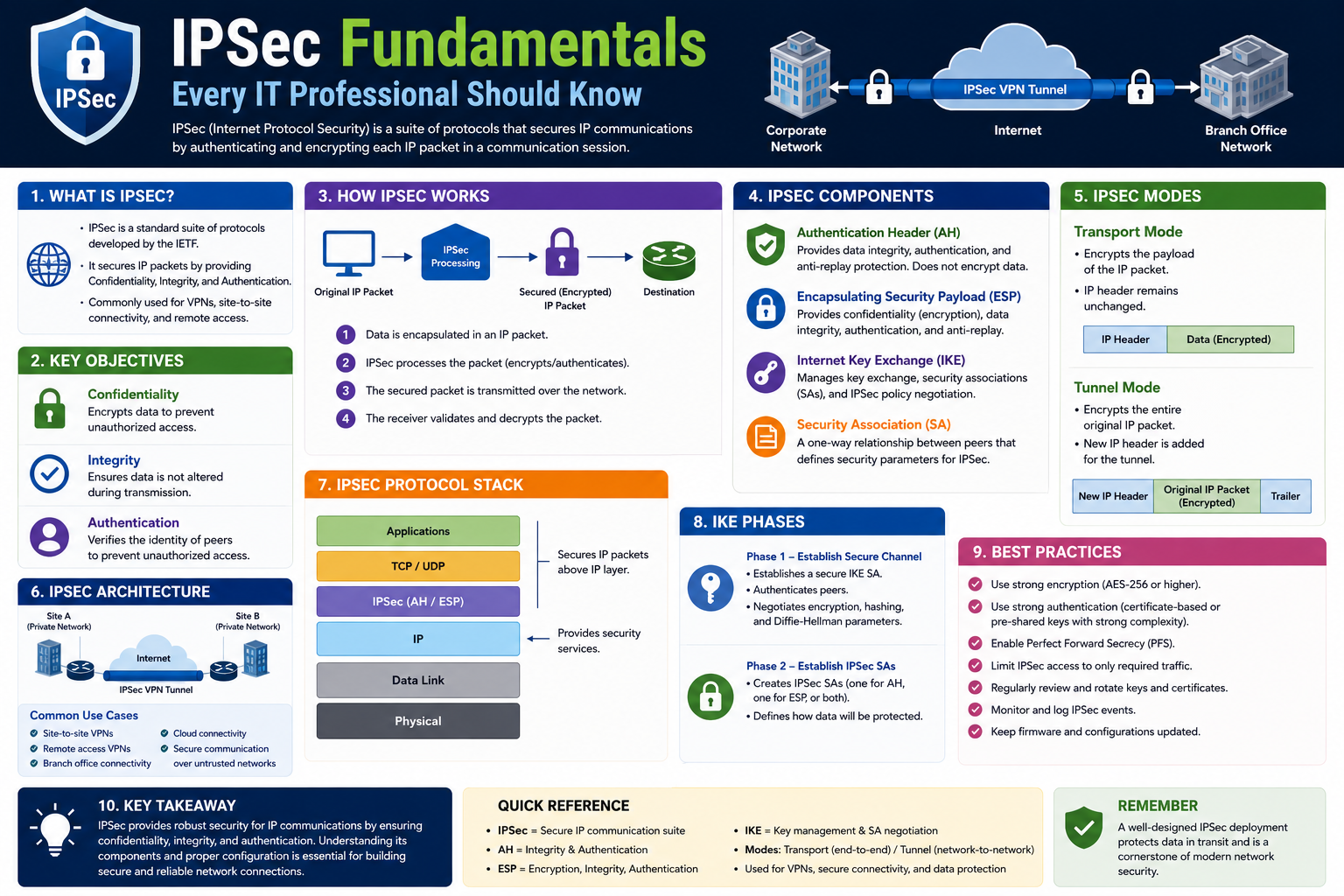
IPSec, which stands for Internet Protocol Security, is a framework used to secure network communications through encryption, authentication, and integrity verification. It creates protected communication channels across untrusted networks such as the internet. IPSec is commonly used in virtual private networks, remote access solutions, and site-to-site business connections.
Although many people have heard the term IPSec before, not everyone fully understands how it works or why it is so important. Some only associate IPSec with VPNs without realizing that it is actually a collection of protocols and technologies designed to secure IP communications at the network level.
Understanding IPSec is extremely valuable for network administrators, cybersecurity professionals, IT technicians, and anyone involved in managing secure communications. Learning how IPSec works also helps explain many of the technologies organizations rely on every day to keep their systems and information protected.
Why Network Security Matters
Before understanding IPSec itself, it is important to understand why secure communication is necessary in the first place.
Whenever data travels across a network, it moves through many devices before reaching its destination. On the internet, this may include routers, switches, service provider infrastructure, and various external networks. Because of this, data can potentially be intercepted during transmission.
Without encryption, sensitive information may be exposed to unauthorized individuals. Attackers could capture passwords, financial records, emails, customer information, or confidential business data.
Even worse, attackers may attempt to modify data while it is being transmitted. This could allow them to manipulate communications, inject malicious content, or impersonate legitimate users.
Organizations therefore need technologies that can provide several important protections.
They need confidentiality so outsiders cannot read transmitted data.
They need integrity so data cannot be altered unnoticed.
They need authentication so both sides of the communication can verify each other’s identity.
They also need secure communication methods that function reliably across public networks.
IPSec was created specifically to solve these problems.
What IPSec Really Is
One of the biggest misunderstandings about IPSec is the belief that it is a single protocol. In reality, IPSec is a complete suite of protocols and security technologies working together to secure communications.
Rather than focusing on one specific application or service, IPSec secures IP traffic itself. Since IP is the foundation of internet communication, IPSec can protect nearly all types of network traffic.
This gives IPSec a major advantage over some other security technologies that only protect specific applications or communication methods.
For example, when users visit secure websites, technologies such as SSL or TLS are often used to protect web traffic. However, IPSec works at a lower level in the networking process, allowing it to secure much broader categories of communication.
This makes IPSec highly flexible and useful in many networking environments.
The Core Goals of IPSec
IPSec was designed with several key security objectives in mind.
The first objective is confidentiality. Confidentiality means protecting data from unauthorized viewing. IPSec accomplishes this by encrypting data before transmission.
The second objective is integrity. Integrity ensures that transmitted data has not been modified during transport. If attackers attempt to alter packets, IPSec can detect those changes.
The third objective is authentication. Authentication allows communicating devices to verify each other’s identities. This prevents attackers from pretending to be legitimate users or systems.
The fourth objective is secure key management. Encryption requires cryptographic keys, and IPSec includes mechanisms for securely exchanging and managing those keys.
Together, these capabilities create a strong foundation for secure communications across insecure networks.
The History and Development of IPSec
The internet was originally designed during a time when security concerns were far less significant than they are today. Early networks focused mainly on connectivity and data sharing rather than protection against cyber threats.
As the internet expanded into commercial and public use, organizations began using online communications for highly sensitive operations. Businesses transferred financial records, governments exchanged classified information, and individuals conducted personal transactions online.
This rapid expansion created serious security challenges.
Traditional IP networking did not include built-in encryption or authentication features. Data packets could travel across networks without protection, making interception relatively easy for attackers with sufficient access or technical skill.
To address these issues, security experts developed IPSec as a method of adding strong protection directly to IP communications.
By integrating security at the network layer, IPSec provided a flexible and scalable way to secure communications without requiring every individual application to implement its own encryption system.
Over time, IPSec became a standard component of enterprise networking and cybersecurity infrastructure.
How IPSec Fits Into the OSI Model
To understand IPSec more clearly, it helps to examine its position within the OSI networking model.
The OSI model divides networking functions into seven layers. Each layer performs specific tasks related to communication.
IPSec operates primarily at Layer 3, which is the network layer.
The network layer is responsible for routing packets between devices and networks. Because IPSec functions at this level, it can secure nearly all IP-based communications regardless of the application being used.
This is different from technologies such as SSL and TLS, which operate at higher layers associated with applications and sessions.
By functioning at Layer 3, IPSec provides broad security coverage without requiring changes to individual applications.
This also allows organizations to deploy IPSec security centrally through routers, firewalls, or VPN gateways.
The Main Components of IPSec
IPSec relies on several important components that work together to secure communications.
Authentication Header is one of these components. It focuses on verifying packet integrity and authentication.
Encapsulating Security Payload is another major component. ESP provides encryption and is responsible for protecting data confidentiality.
Security Associations define the rules and parameters used during secure communications.
Internet Key Exchange handles the negotiation and management of encryption keys between devices.
Each component performs a specialized role within the IPSec framework.
Together, they create secure communication tunnels capable of protecting sensitive network traffic.
Understanding Authentication Header
Authentication Header, often abbreviated as AH, provides integrity and authentication services for network traffic.
When a packet is transmitted using AH, cryptographic information is attached to the packet. This allows the receiving system to verify that the packet has not been altered during transmission.
AH also helps confirm that the packet originated from a trusted source.
However, AH does not encrypt the actual packet contents. This means the information remains visible even though attackers cannot modify it undetected.
Because modern security environments usually require encryption as well as authentication, AH is less commonly used today than ESP.
Nevertheless, AH still plays an important role in understanding how IPSec operates.
Understanding Encapsulating Security Payload
Encapsulating Security Payload, commonly called ESP, is the most widely used IPSec component.
ESP provides confidentiality through encryption while also supporting authentication and integrity verification.
Before transmission, ESP encrypts the packet payload using cryptographic algorithms. This prevents unauthorized users from reading the transmitted data.
ESP can also verify data integrity and authenticate the sender.
Because ESP combines multiple security features into a single mechanism, it has become the preferred choice for most IPSec implementations.
Modern VPN solutions rely heavily on ESP to protect sensitive communications.
How Encryption Protects Communications
Encryption is one of the most important parts of IPSec.
When data is encrypted, it is transformed from readable information into unreadable ciphertext using mathematical algorithms and cryptographic keys.
Only authorized devices possessing the correct keys can decrypt and interpret the information.
Even if attackers intercept encrypted traffic, they cannot understand the contents without the proper decryption keys.
IPSec supports several encryption algorithms, including advanced cryptographic standards designed to resist modern attacks.
The strength of encryption plays a major role in protecting sensitive communications against cyber threats.
Why Authentication Is Important
Encryption alone is not enough to guarantee security.
Attackers may still attempt to impersonate legitimate users or systems. This is why authentication is critical.
Authentication ensures that devices participating in communication are actually who they claim to be.
IPSec uses authentication methods to verify identities before secure communication begins.
This helps prevent unauthorized systems from gaining access to protected networks.
Authentication also helps reduce the risk of man-in-the-middle attacks in which attackers attempt to intercept and manipulate communications between two parties.
The Role of Security Associations
Security Associations are another essential part of IPSec.
Before two devices can communicate securely, they must agree on several security settings.
These settings include encryption algorithms, authentication methods, cryptographic keys, and session parameters.
The agreed-upon settings form a Security Association.
Each IPSec communication session uses one or more Security Associations to define how traffic will be protected.
Without these associations, devices would not know how to encrypt, decrypt, or verify communications properly.
Security Associations therefore act as the foundation for IPSec communication sessions.
Internet Key Exchange and Secure Negotiation
Encryption depends on cryptographic keys.
However, exchanging keys securely across the internet presents its own security challenge.
Internet Key Exchange, commonly called IKE, was developed to solve this problem.
IKE allows devices to establish secure communication sessions and exchange cryptographic information safely.
Using secure negotiation methods, devices authenticate each other and agree on encryption settings without exposing sensitive key material to attackers.
Two major versions of IKE exist.
IKEv1 was the original version and introduced automated key management for IPSec.
IKEv2 is the modern version and is now widely used in enterprise networking environments.
IKEv2 provides improved security, better performance, greater reliability, and enhanced support for mobile and modern network connections.
Most current IPSec deployments rely on IKEv2.
How IPSec Creates Secure Tunnels
One of the most important concepts in IPSec networking is the secure tunnel.
An IPSec tunnel is an encrypted communication path established between two endpoints.
All traffic traveling through the tunnel becomes protected from interception or tampering.
This tunnel may connect an employee’s laptop to a corporate network, two branch offices, or even two individual systems.
Once the tunnel is established, data can travel securely across public infrastructure such as the internet.
From the perspective of users and applications, communication appears normal. However, behind the scenes, IPSec encrypts and protects the traffic automatically.
This secure tunneling capability is one of the reasons IPSec became so important in modern networking.
Remote Access and Modern Work Environments
Remote work has become increasingly common in modern organizations.
Employees often work from home, travel frequently, or access company resources from remote locations.
Without proper security, remote connections could expose organizations to major cybersecurity risks.
IPSec VPN technology helps solve this problem by allowing employees to establish secure encrypted connections to company networks over the internet.
Once connected, users can safely access internal applications, databases, printers, and other business resources.
This allows organizations to support flexible work environments while maintaining strong security protections.
Remote access IPSec VPNs remain one of the most common enterprise uses of IPSec technology.
Connecting Multiple Offices Securely
Many businesses operate across multiple locations.
Companies may have headquarters, regional branches, manufacturing facilities, and remote offices spread across large geographic areas.
These locations often need constant communication and shared access to business systems.
In the past, organizations relied on dedicated private communication lines to connect offices securely.
These dedicated connections were reliable but extremely expensive.
IPSec introduced a more affordable solution.
Using site-to-site VPNs, organizations can connect entire office networks securely over the public internet.
Routers or firewalls at each location establish IPSec tunnels between offices.
All traffic moving between the sites becomes encrypted and protected.
This approach dramatically reduces communication costs while still maintaining strong security standards.
Understanding the Operational Structure of IPSec
IPSec is widely recognized as one of the most reliable technologies for securing communications across public and private networks. While many people understand that IPSec is used in VPNs and encrypted connections, fewer people fully understand how the technology actually functions behind the scenes.
At its core, IPSec works by protecting IP packets as they travel across a network. Instead of securing only specific applications, IPSec secures communications at the network layer, which allows it to protect many different types of traffic simultaneously.
When two systems communicate using IPSec, they establish a trusted and encrypted relationship before any sensitive data is exchanged. Once this secure relationship is created, the systems encrypt traffic, verify identities, and ensure data integrity during transmission.
This process happens automatically after the connection is established, allowing users to communicate securely without constantly managing encryption settings manually.
Understanding the operational structure of IPSec helps explain why it has become such an important part of modern networking and cybersecurity.
The Importance of IP Packets in Communication
To understand IPSec properly, it is important to understand how network communication normally works.
Whenever information is sent across a network, the data is divided into smaller pieces called packets. These packets contain both the actual data and addressing information that tells the network where the packets should go.
IP packets are the foundation of internet communication. Every website request, email, file transfer, video call, or online service depends on IP packets moving between devices.
Normally, these packets travel openly across networks. Routers and switches forward the packets toward their destinations based on the information in the packet headers.
Without encryption, anyone with sufficient access to the network could potentially inspect the packet contents.
This is where IPSec becomes valuable.
Instead of allowing packets to travel unprotected, IPSec secures them through encryption and authentication before transmission occurs.
How IPSec Establishes Secure Communication
Before secure communication can begin, the devices involved must first establish trust.
This process involves several important steps.
The devices identify each other.
They agree on encryption and authentication methods.
They exchange or generate cryptographic keys.
They establish communication parameters that define how traffic will be protected.
Only after this secure negotiation process is complete does encrypted communication begin.
This initial setup process is critical because encryption is only effective if both sides communicate securely and use trusted security settings.
IPSec automates much of this process using Internet Key Exchange.
The Role of Internet Key Exchange
Internet Key Exchange, commonly called IKE, is responsible for establishing secure IPSec sessions.
IKE allows devices to negotiate security settings automatically and securely.
Without IKE, administrators would need to manually configure encryption keys on every device involved in communication. This would be extremely difficult and impractical for large organizations.
IKE simplifies this by automating secure key management.
During the negotiation process, devices authenticate each other and establish Security Associations that define the encryption rules for communication.
IKE also periodically refreshes encryption keys to maintain security over time.
Modern IPSec environments typically use IKEv2, which offers better reliability, stronger security, and improved performance compared to older implementations.
Phase One of IKE Negotiation
IKE negotiation usually occurs in multiple phases.
The first phase focuses on creating a secure management channel between devices.
During this phase, the devices authenticate each other using methods such as pre-shared keys, digital certificates, or cryptographic signatures.
They also agree on encryption algorithms, authentication protocols, and key exchange methods.
Once this secure management channel is established, the devices can safely negotiate additional communication settings.
This secure channel protects the negotiation process itself from attackers.
Phase Two of IKE Negotiation
The second phase establishes the actual IPSec communication tunnel.
During this stage, the devices create Security Associations that define how data traffic will be protected.
These settings include encryption methods, authentication parameters, session lifetimes, and traffic protection rules.
Once phase two is complete, the encrypted IPSec tunnel becomes active.
At this point, protected traffic can begin flowing securely between the devices.
Understanding Security Associations in Detail
Security Associations are essential to IPSec communication.
A Security Association is essentially an agreement between devices regarding how communication will be secured.
Each Security Association includes important information such as:
The encryption algorithm being used.
The authentication method.
The cryptographic keys.
The lifetime of the connection.
The communication mode.
The rules for packet protection.
Every IPSec session depends on Security Associations to ensure both sides use compatible security settings.
In many cases, two Security Associations are used simultaneously because communication is bidirectional. One association protects outgoing traffic while another protects incoming traffic.
This structure helps maintain organized and secure communication flows.
Encryption and Cryptographic Protection
Encryption is one of the most critical parts of IPSec.
When data is encrypted, it is transformed into unreadable ciphertext using cryptographic algorithms.
Only authorized devices possessing the correct decryption keys can convert the ciphertext back into readable information.
IPSec supports several encryption algorithms designed to provide strong security.
These algorithms use complex mathematical operations to make unauthorized decryption extremely difficult.
Even if attackers intercept encrypted traffic, they cannot understand the contents without the correct keys.
The effectiveness of encryption depends heavily on key management and algorithm strength.
Modern IPSec implementations use highly advanced encryption standards capable of resisting sophisticated attacks.
Authentication and Identity Verification
Authentication is equally important in IPSec communications.
Encryption protects data confidentiality, but authentication ensures that communication occurs between trusted devices.
Without authentication, attackers could potentially impersonate legitimate systems.
IPSec verifies identities before secure communication begins.
This authentication process may use several different methods.
Pre-shared keys are one common option. In this method, both devices already know a secret key used for authentication.
Digital certificates provide another method. Certificates are issued by trusted certificate authorities and verify device identities using public key infrastructure.
Authentication helps protect against impersonation attacks and unauthorized network access.
Data Integrity and Packet Validation
Another major function of IPSec is ensuring data integrity.
Data integrity means confirming that transmitted information has not been modified during transport.
Attackers may attempt to alter packets in transit to inject malicious content or manipulate communications.
IPSec uses cryptographic hash functions and integrity checks to detect unauthorized modifications.
When a packet arrives, the receiving device verifies its integrity information.
If the packet appears altered, corrupted, or invalid, it is rejected.
This helps maintain trustworthy communication between systems.
Authentication Header and Its Purpose
Authentication Header, often called AH, is one of the protocols used within IPSec.
AH focuses mainly on authentication and integrity verification.
When AH is applied to a packet, cryptographic validation data is added.
The receiving system uses this information to verify that the packet originated from a trusted source and was not altered during transmission.
However, AH does not encrypt the packet contents.
Because modern networks usually require encryption as well as authentication, AH is used less frequently today than ESP.
Still, AH remains an important part of IPSec architecture and helps illustrate how IPSec security mechanisms function.
Encapsulating Security Payload and Encryption
Encapsulating Security Payload, commonly called ESP, is the most widely used IPSec protocol.
ESP provides encryption, authentication, and integrity protection.
Before transmission, ESP encrypts the packet payload using cryptographic algorithms.
This prevents unauthorized users from viewing the data.
ESP can also authenticate packets and validate integrity.
Because ESP combines multiple security functions, it has become the preferred IPSec implementation for most organizations.
Modern VPN technologies rely heavily on ESP to secure communications.
Transport Mode Explained
IPSec operates in two primary modes.
The first is transport mode.
In transport mode, IPSec encrypts only the payload portion of the packet while leaving the original IP header visible.
This mode is typically used for direct communication between two devices.
Transport mode offers lower overhead because less data requires encryption.
However, since the original IP header remains exposed, some information about the communication remains visible to observers.
Transport mode is often used when end-to-end device communication is required.
Tunnel Mode Explained
The second IPSec operating mode is tunnel mode.
Tunnel mode provides greater security by encrypting the entire original IP packet, including its header.
After encryption, the original packet is placed inside a new packet with a new header.
This process is known as encapsulation.
Tunnel mode hides the original source and destination information from outside observers.
Because of its stronger protection capabilities, tunnel mode is commonly used for VPNs and site-to-site connections.
Most enterprise IPSec deployments use tunnel mode.
Why Tunnel Mode Is Important for VPNs
Tunnel mode is particularly valuable in VPN environments.
When employees connect remotely to company networks, tunnel mode protects not only the data itself but also internal network addressing information.
This helps prevent attackers from learning details about the organization’s internal infrastructure.
Tunnel mode also allows organizations to create secure virtual connections across public internet infrastructure.
Even though communication travels across untrusted networks, the encrypted tunnel protects the data from interception and monitoring.
This capability makes tunnel mode essential for secure remote access and interoffice connectivity.
How IPSec Handles Packet Encapsulation
Encapsulation is one of the key technical processes within IPSec.
When IPSec secures a packet, additional information must be added for encryption and routing purposes.
In tunnel mode, the original packet becomes fully encrypted.
A new outer header is then attached so routers can forward the packet across the network.
When the packet reaches its destination, the outer header is removed, the original packet is decrypted, and the data is delivered normally.
This process allows IPSec to maintain security while still supporting standard network routing.
How IPSec Affects Packet Size
One important effect of IPSec is increased packet size.
Encryption, authentication information, additional headers, and encapsulation data all increase the amount of information contained within each packet.
This added overhead can affect network performance if not managed properly.
Maximum Transmission Unit and Maximum Segment Size settings may need adjustment in IPSec environments.
If packets become too large, fragmentation may occur, which can reduce performance and create connectivity issues.
Network administrators must therefore carefully design IPSec configurations to ensure efficient communication.
Performance Considerations in IPSec Deployments
Encryption and authentication require computational resources.
Every packet must be encrypted before transmission and decrypted upon arrival.
Authentication checks and integrity validation also consume processing power.
Because of this, IPSec can place significant demands on networking hardware.
Modern routers, firewalls, and VPN appliances often include hardware acceleration features specifically designed to improve IPSec performance.
Organizations deploying IPSec solutions must consider factors such as bandwidth requirements, processing capacity, and scalability.
Proper planning helps ensure strong security without negatively affecting network performance.
How IPSec Supports Remote Work
Remote work has become increasingly common across many industries.
Employees frequently access company systems from home offices, hotels, airports, and mobile devices.
These remote connections create security risks because public internet connections are not inherently secure.
IPSec VPNs help solve this problem by creating encrypted tunnels between remote users and company networks.
Once connected, remote employees can securely access internal systems, databases, applications, and resources.
The encrypted tunnel protects communications from eavesdropping and cyberattacks.
This capability has made IPSec a critical component of modern remote access infrastructure.
Using IPSec for Site-to-Site Connectivity
In addition to remote access, IPSec is widely used for site-to-site VPNs.
Many businesses operate multiple offices across large geographic areas.
These offices often need constant communication and shared access to centralized systems.
Instead of relying on expensive private leased lines, organizations can use IPSec tunnels across the internet.
Routers or firewalls at each office establish secure tunnels that protect traffic moving between locations.
Employees at both sites can communicate securely as though they were connected to the same internal network.
This approach reduces costs while maintaining strong security protections.
Advantages of IPSec
IPSec offers many advantages for organizations.
It provides strong encryption and authentication.
It operates transparently at the network layer.
It supports many types of traffic and applications.
It allows secure remote access.
It enables affordable site-to-site connectivity.
It integrates well with enterprise networking infrastructure.
It supports scalable security deployments across large organizations.
Because of these strengths, IPSec remains one of the most trusted technologies in enterprise networking.
Challenges and Limitations of IPSec
Despite its advantages, IPSec also presents certain challenges.
Configuration can sometimes be complex, especially in large environments.
Improper configurations may create connectivity problems or security weaknesses.
Encryption overhead can impact network performance.
Firewall and Network Address Translation compatibility issues may require additional configuration.
Troubleshooting IPSec connections can also be difficult because encrypted traffic is harder to inspect and analyze.
Nevertheless, with proper planning and management, these challenges can usually be addressed effectively.
Understanding the Need for Multiple Security Technologies
Modern networks rely on several different security technologies to protect communication across the internet and private infrastructures. As cyber threats continue to grow in sophistication, organizations must choose security solutions that provide confidentiality, authentication, integrity, and reliable performance.
Among the most widely used communication security technologies are IPSec, SSL, and TLS. While all of them aim to protect information during transmission, they function in very different ways and serve different purposes within networking environments.
Many people mistakenly assume that IPSec and SSL or TLS are interchangeable technologies. In reality, each operates at different layers of the networking stack and is designed for different use cases.
Understanding these differences is essential for network administrators, cybersecurity professionals, and IT teams responsible for securing modern communication systems.
At the same time, networking technology continues to evolve rapidly. Cloud computing, mobile devices, hybrid work environments, and large-scale internet infrastructure have transformed how organizations approach security.
As a result, IPSec continues adapting to meet new challenges while remaining one of the foundational technologies in secure networking.
The Basic Purpose of SSL and TLS
SSL, which stands for Secure Sockets Layer, and TLS, which stands for Transport Layer Security, are technologies designed primarily to secure application-level communications.
SSL was originally developed to protect web traffic between browsers and websites. Over time, SSL evolved into TLS, which is the modern standard used today.
Whenever users visit websites using HTTPS, TLS is typically responsible for encrypting the communication.
TLS protects activities such as:
Online banking.
E-commerce transactions.
Email communications.
Video conferencing.
Cloud applications.
Secure website access.
TLS focuses mainly on securing specific application sessions rather than protecting all network traffic.
This approach differs significantly from IPSec.
How IPSec Differs from SSL and TLS
One of the biggest differences between IPSec and TLS is the layer of the OSI model where each technology operates.
IPSec functions primarily at Layer 3, which is the network layer.
TLS operates at higher layers associated with application and session communication.
Because IPSec works at the network layer, it can secure almost all IP-based traffic regardless of the application being used.
TLS, on the other hand, typically secures individual applications or services.
For example, a web browser may use TLS to secure website traffic, while other applications on the same device may not use encryption unless separately configured.
IPSec provides broader protection because it secures traffic before it reaches higher networking layers.
This architectural difference plays a major role in determining how each technology is used.
The Advantages of Network Layer Security
Operating at the network layer gives IPSec several important advantages.
First, IPSec can secure many different types of traffic simultaneously without requiring individual applications to support encryption.
Second, IPSec protection is transparent to users and applications. Most applications do not even realize IPSec is operating in the background.
Third, IPSec allows organizations to implement centralized security policies through routers, firewalls, and VPN gateways.
This simplifies security management in large enterprise environments.
Because IPSec secures all traffic between endpoints, organizations can create highly secure communication channels across public infrastructure.
This makes IPSec especially useful for remote access VPNs and site-to-site connectivity.
The Advantages of TLS and SSL
Although IPSec offers broad network-level protection, TLS also provides important benefits.
TLS is relatively easy to deploy for web-based applications.
Most modern browsers and operating systems support TLS automatically.
Application developers can integrate TLS directly into software and websites without requiring changes to network infrastructure.
TLS is also highly effective for securing internet-facing services such as websites, cloud applications, and online platforms.
Because TLS protects specific application sessions, it allows fine-grained control over communication security.
TLS has become the dominant security protocol for web communications and internet commerce.
Encryption Approaches in IPSec and TLS
Both IPSec and TLS use encryption to protect data confidentiality, but they apply encryption differently.
IPSec encrypts IP packets directly at the network layer.
This means entire communications can be protected regardless of which application generated the traffic.
TLS encrypts application sessions after the connection has already been established.
For example, when a user opens a secure website, TLS negotiates encryption settings between the browser and server.
Once negotiation is complete, the application session becomes encrypted.
In IPSec, encryption often begins before higher-level communications occur.
This difference influences how each technology handles security management and communication control.
Authentication Differences Between IPSec and TLS
Authentication also differs significantly between IPSec and TLS.
IPSec commonly authenticates devices or network endpoints.
For example, a VPN gateway may authenticate a remote user device before allowing network access.
TLS typically authenticates servers and sometimes users at the application level.
When users visit a secure website, TLS verifies the identity of the website using digital certificates.
This allows users to confirm they are communicating with the legitimate server rather than an impersonator.
Both technologies rely heavily on cryptographic certificates and secure key exchange mechanisms, but their authentication focus differs based on their operational layers.
Connection Negotiation in TLS
TLS relies on a process called the TLS handshake.
During this handshake, the client and server negotiate encryption settings, exchange certificates, authenticate identities, and establish session keys.
Only after the handshake is complete does encrypted communication begin.
This negotiation process occurs each time a secure session is created.
The TLS handshake is designed to balance security, compatibility, and performance.
Modern TLS implementations support advanced cryptographic techniques that improve both efficiency and protection against attacks.
Connection Negotiation in IPSec
IPSec uses Internet Key Exchange for negotiation and authentication.
IKE establishes secure communication channels before protected traffic is transmitted.
Unlike TLS, which focuses on application sessions, IKE negotiates security settings for network-level communication.
IPSec tunnels can remain active for extended periods and support large amounts of traffic from many applications simultaneously.
This makes IPSec highly suitable for long-term VPN connections and persistent secure communication channels between networks.
Why Businesses Use IPSec VPNs
One of the most common uses of IPSec is the creation of VPNs.
VPNs allow organizations to create secure communication tunnels across public infrastructure such as the internet.
Employees working remotely can securely access company resources from home, hotels, airports, or mobile devices.
Businesses can also connect branch offices securely without relying on expensive leased communication lines.
IPSec VPNs provide strong encryption, centralized management, and scalable security.
Because IPSec protects all traffic between endpoints, organizations gain comprehensive security coverage for remote communications.
This capability has become increasingly important as remote work and hybrid business models continue expanding globally.
Remote Work and Cybersecurity Challenges
The growth of remote work has introduced significant cybersecurity challenges.
Employees often connect from networks that organizations do not control.
Home Wi-Fi networks, public hotspots, and mobile internet connections may expose users to various cyber threats.
Attackers frequently target remote workers through phishing, malware, and network interception attacks.
IPSec VPNs help reduce these risks by encrypting communication between remote users and corporate networks.
Even if attackers intercept the traffic, the encrypted tunnel protects the information from exposure.
This security model allows organizations to support flexible work environments while maintaining strong cybersecurity protections.
Site-to-Site VPN Infrastructure
Large organizations often operate in multiple geographic locations.
Headquarters, branch offices, warehouses, manufacturing facilities, and remote sites all require secure communication.
Site-to-site IPSec VPNs allow these locations to communicate securely over the internet.
Routers or firewalls at each location establish encrypted tunnels that protect traffic moving between networks.
Employees at different offices can access shared systems, databases, applications, and communication services securely.
This approach reduces infrastructure costs while maintaining reliable connectivity and strong security.
How IPSec Protects Against Cyber Threats
IPSec helps defend against several major cybersecurity threats.
Encryption protects against eavesdropping and data theft.
Authentication helps prevent unauthorized access and impersonation attacks.
Integrity verification detects tampering or packet modification.
Secure tunnels reduce exposure to network-based attacks.
By securing communications at the network layer, IPSec minimizes the risk of attackers intercepting sensitive information during transmission.
Organizations handling financial data, intellectual property, healthcare records, or confidential communications rely heavily on IPSec protections.
The Importance of Digital Certificates
Digital certificates play a major role in both IPSec and TLS environments.
Certificates verify the identities of systems, users, and services.
Certificate authorities issue trusted certificates that allow devices to authenticate securely.
Certificates help prevent attackers from impersonating legitimate systems.
In enterprise environments, certificate management is a critical part of maintaining secure communication infrastructures.
Improper certificate management can introduce vulnerabilities and operational risks.
As a result, organizations invest heavily in public key infrastructure and certificate lifecycle management systems.
IPSec in Cloud Computing Environments
Cloud computing has transformed modern networking.
Organizations now rely on cloud providers for applications, storage, infrastructure, and business services.
Despite these changes, secure communication remains essential.
IPSec continues playing an important role in cloud connectivity.
Businesses often use IPSec VPNs to connect internal networks securely to cloud environments.
Hybrid cloud deployments frequently rely on IPSec tunnels between on-premises infrastructure and cloud providers.
This allows organizations to extend secure communication policies into cloud environments while protecting sensitive data.
IPSec and Mobile Connectivity
Mobile devices have become central to business operations.
Employees frequently use smartphones, tablets, and laptops to access company resources.
Mobile connectivity introduces additional security challenges because devices often move between networks.
IPSec supports secure mobile communication by encrypting traffic regardless of the network being used.
Modern IPSec implementations support features that maintain stable connections even when devices switch between Wi-Fi and cellular networks.
This flexibility makes IPSec suitable for highly mobile workforces.
Challenges in IPSec Deployment
Although IPSec offers strong security benefits, deploying and managing IPSec environments can sometimes be challenging.
Configuration complexity is one of the most common issues.
Administrators must properly configure encryption algorithms, authentication methods, key management, firewall rules, and routing settings.
Even small configuration mistakes can create communication failures or security weaknesses.
Troubleshooting encrypted traffic can also be difficult because administrators cannot easily inspect protected packets.
Organizations therefore require skilled networking and cybersecurity professionals to manage IPSec deployments effectively.
Performance Considerations in Modern Networks
Encryption and authentication consume processing power.
As network speeds increase, IPSec infrastructure must handle large volumes of encrypted traffic efficiently.
Modern networking hardware often includes cryptographic acceleration technologies designed specifically for IPSec processing.
Dedicated VPN appliances, enterprise firewalls, and advanced routers help maintain high performance while supporting strong encryption.
Organizations must carefully balance security requirements with bandwidth demands and application performance expectations.
Proper hardware selection and network design are essential for maintaining reliable IPSec performance.
The Future of IPSec Technology
Despite the emergence of newer networking technologies, IPSec remains highly relevant.
Cybersecurity threats continue evolving rapidly, increasing the demand for strong communication security.
Organizations continue relying on IPSec because of its flexibility, broad compatibility, and proven reliability.
New developments in cloud networking, zero-trust security models, software-defined networking, and secure remote access continue integrating IPSec capabilities.
Modern enterprise security architectures often combine IPSec with other technologies to create layered security environments.
IPSec may continue evolving, but its fundamental role in secure networking is unlikely to disappear anytime soon.
Zero Trust and IPSec
Many organizations are adopting zero-trust security models.
Zero trust assumes that no user, device, or network should automatically be trusted.
Every connection must be authenticated, authorized, and continuously verified.
IPSec supports zero-trust strategies by providing strong encryption, authentication, and secure communication channels.
Secure tunnels help organizations enforce strict access controls while protecting sensitive traffic across distributed environments.
As zero-trust adoption grows, IPSec remains an important tool for securing network communications.
Why IPSec Remains Important
Some technologies become obsolete as networking evolves, but IPSec has remained relevant for decades.
Its continued importance comes from several key strengths.
It provides strong encryption and authentication.
It secures traffic at the network layer.
It supports scalable enterprise deployments.
It works across many types of networks and applications.
It integrates with routers, firewalls, VPN gateways, and cloud platforms.
It supports remote access, branch connectivity, and hybrid environments.
Because of these capabilities, IPSec continues serving as a core technology in enterprise cybersecurity.
Conclusion
IPSec has become one of the most important security technologies in modern networking. By protecting communications at the network layer, IPSec provides strong encryption, authentication, integrity verification, and secure connectivity across public and private networks.
Although technologies such as SSL and TLS also play major roles in communication security, IPSec offers broader protection by securing entire network communications rather than individual application sessions. This makes IPSec especially valuable for VPNs, remote access, and site-to-site connectivity.
As businesses continue expanding remote work, cloud computing, and distributed networking environments, the demand for secure communication technologies will only continue growing. IPSec remains highly effective because of its flexibility, scalability, and proven reliability in protecting sensitive information.
From enterprise VPN infrastructure to secure cloud communication, IPSec continues serving as a critical foundation of modern cybersecurity and networking architecture.