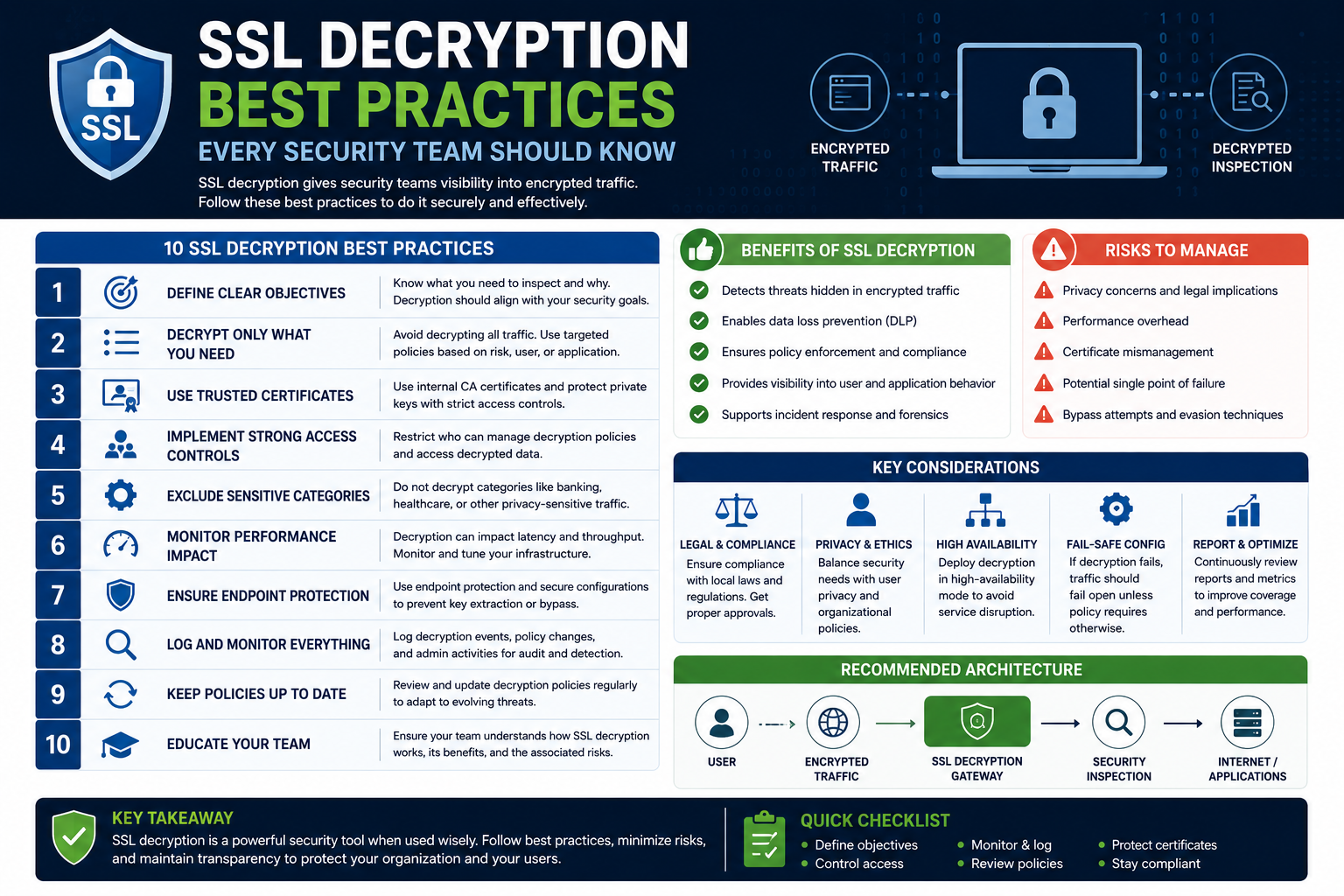
Encrypted communication has become the foundation of modern internet security. Almost every website, cloud platform, online service, and business application uses SSL or TLS encryption to protect sensitive information moving between users and servers. Encryption prevents attackers from intercepting passwords, financial records, healthcare information, emails, and confidential company data while it travels across networks.
While encryption improves privacy and security for legitimate users, it also creates challenges for cybersecurity teams. Attackers understand that encrypted traffic is harder to inspect, which makes SSL and TLS connections an attractive hiding place for malicious activities. Malware operators, ransomware groups, phishing attackers, and data thieves often conceal their operations inside encrypted traffic to bypass traditional security controls.
Security tools that cannot inspect encrypted packets are limited in what they can detect. Firewalls may see that a connection exists, but they cannot always determine whether the encrypted session contains malware downloads, suspicious file transfers, command-and-control communication, or attempts to exfiltrate sensitive company information. This creates dangerous blind spots that attackers actively exploit.
SSL decryption allows organizations to inspect encrypted traffic safely and identify threats before they cause damage. Security devices temporarily decrypt traffic, analyze its contents, apply threat detection rules, and then re-encrypt the data before forwarding it to its destination. This process gives organizations visibility into encrypted traffic without completely sacrificing the benefits of encryption.
However, SSL decryption introduces important legal, ethical, operational, and privacy concerns. Organizations that decrypt network traffic gain access to highly sensitive information. If that information is mishandled, leaked, or accessed without authorization, the consequences can include legal penalties, compliance violations, damaged reputations, and loss of user trust.
Implementing SSL decryption successfully requires more than simply enabling a feature on a firewall or security appliance. Organizations need careful planning, strong governance, user awareness, secure infrastructure, and detailed operational procedures. Security teams must understand which traffic should be inspected, which traffic should remain private, how decrypted information will be stored, and who is authorized to access it.
The first and most important best practice focuses on authorization, governance, and compliance. Before inspecting encrypted traffic, organizations must establish clear policies and ensure that SSL decryption aligns with privacy laws, regulatory requirements, and internal security objectives.
Best Practice 1: Obtain Authorization and Establish Clear Governance Policies
SSL decryption gives organizations the ability to inspect almost everything moving through encrypted connections. This includes web traffic, cloud application data, email communications, login credentials, downloaded files, uploaded documents, and sensitive corporate information. Because decrypted traffic may contain personal and confidential data, organizations must handle it responsibly and legally.
The first step in any SSL decryption strategy is obtaining formal authorization. Organizations should never deploy traffic inspection systems without executive approval, legal review, and documented governance policies. SSL decryption affects employees, customers, contractors, business partners, and potentially anyone using organizational networks or systems.
Executive leadership should clearly approve the organization’s decision to inspect encrypted traffic. Security teams should also work closely with legal departments and compliance officers to ensure the monitoring process aligns with all applicable laws and regulations.
Without proper authorization, organizations risk violating privacy protections, employment agreements, and data protection laws. Unauthorized monitoring can result in lawsuits, financial penalties, and serious reputational damage.
Formal governance establishes accountability and ensures that SSL decryption supports legitimate security objectives rather than uncontrolled surveillance practices. Governance frameworks also help security teams maintain consistent processes for handling sensitive information.
Why SSL Decryption Requires Strong Policies
Policies are essential because decrypted traffic often contains highly sensitive information. Once encryption is removed, security systems may gain access to financial records, healthcare data, personal communications, intellectual property, authentication credentials, and confidential business operations.
Organizations must define exactly how this information will be handled, who can access it, and how long it may be retained. Without clear policies, decrypted data can easily become a major security liability.
SSL decryption policies should define the purpose of traffic inspection. Most organizations use SSL inspection to identify malware, prevent ransomware attacks, detect unauthorized data transfers, stop phishing campaigns, and monitor suspicious network activity. Policies should clearly explain these objectives so employees and stakeholders understand why inspection is necessary.
Organizations should also identify which traffic categories will be decrypted. Web browsing and email traffic are common starting points because attackers frequently use these channels to distribute malicious content. Cloud applications, remote access services, and file-sharing systems may also require inspection depending on the organization’s threat exposure.
Policies should outline how decrypted data will be protected throughout its lifecycle. This includes encryption at rest, secure storage, limited access permissions, audit logging, and secure deletion procedures.
Clear documentation helps reduce confusion and ensures that all security personnel follow consistent procedures when handling decrypted information.
Defining Access Controls for Decrypted Traffic
Access control is one of the most important elements of SSL decryption governance. Not every employee or administrator should be able to view decrypted traffic. Organizations must strictly limit access to authorized personnel with legitimate operational responsibilities.
Role-based access control systems help organizations restrict who can access decrypted information. Security analysts, incident responders, and compliance investigators may require limited access to perform their duties, but broader access should be avoided whenever possible.
Each authorized individual should receive specialized training regarding privacy obligations, data handling procedures, and incident response protocols. Personnel must understand the sensitivity of decrypted traffic and the importance of protecting confidential information.
Strong authentication mechanisms should protect systems that store or process decrypted data. Multi-factor authentication, privileged access management, and session monitoring help reduce the risk of insider threats and unauthorized access.
Organizations should also implement detailed logging to track who accesses decrypted information, when the access occurred, and what actions were performed. Audit logs create accountability and support investigations if misuse or unauthorized access occurs.
Managing Data Retention and Secure Deletion
Decrypted traffic should never be stored indefinitely. The longer sensitive information remains accessible, the greater the risk of exposure during cyberattacks, insider misuse, or accidental disclosure.
Organizations should establish clear retention policies defining how long decrypted logs and inspection records may be stored. Retention periods should align with legal obligations, operational requirements, and security objectives.
Some organizations retain decrypted logs for only a few days, while others may require longer retention periods for forensic investigations or compliance reporting. Regardless of duration, retention policies must be clearly documented and consistently enforced.
Once retention periods expire, organizations must securely delete decrypted data. Secure deletion processes ensure that sensitive information cannot be recovered later by attackers or unauthorized users.
Improper disposal of decrypted data can create serious legal and operational risks. Old inspection logs containing passwords, financial information, or confidential communications may become valuable targets for cybercriminals if not removed properly.
Secure deletion procedures should apply to backup systems, archived logs, cloud storage environments, and any temporary inspection files generated during traffic analysis.
Creating Effective Incident Response Procedures
SSL decryption often reveals suspicious activity that requires immediate investigation. Organizations need detailed incident response procedures to ensure that detected threats are handled quickly and consistently.
Incident response plans should define how security teams escalate suspicious findings, preserve evidence, document investigations, and communicate with stakeholders. Clear procedures reduce confusion during active security incidents and help organizations respond more effectively to attacks.
When malware, unauthorized access attempts, or data exfiltration activities are identified through SSL inspection, incident response teams must understand exactly what steps to follow. This includes isolating affected systems, collecting forensic evidence, notifying management, and determining whether regulatory reporting requirements apply.
Evidence handling is especially important. Decrypted traffic logs may become critical evidence during internal investigations, legal proceedings, or compliance audits. Security teams must document how evidence is collected, stored, transferred, and deleted.
Well-defined incident response procedures strengthen organizational resilience and improve the effectiveness of SSL decryption programs.
User Awareness and Transparency
Organizations should be transparent about SSL inspection practices. Employees and users are more likely to support security monitoring when they understand why it exists and how their information will be protected.
Acceptable use policies should explain that encrypted traffic may be inspected for cybersecurity purposes. These policies should describe the organization’s security goals, the categories of traffic subject to inspection, and the safeguards protecting sensitive information.
Many organizations require employees to acknowledge monitoring policies during onboarding or annual compliance training. This helps establish clear expectations and reduces disputes regarding network monitoring practices.
Transparency also improves trust between employees and security teams. Users who understand that SSL decryption helps prevent ransomware, phishing attacks, and data breaches are often more willing to cooperate with security initiatives.
Organizations should avoid vague or misleading language when communicating about monitoring practices. Clear explanations help users understand that SSL inspection supports legitimate security operations rather than intrusive surveillance.
Balancing Security and Privacy
One of the biggest challenges with SSL decryption is balancing security visibility with individual privacy rights. Organizations must carefully decide which traffic should be inspected and which communications should remain private.
Certain categories of traffic may require special handling due to legal, ethical, or operational considerations. Financial transactions often contain highly sensitive banking information that organizations may choose to exclude from inspection.
Healthcare communications involving patient information may also require exemptions to comply with medical privacy regulations. Personal email accounts, private messaging services, and legal communications may receive similar protections depending on organizational policies and regional laws.
Organizations should maintain exclusion lists that identify traffic categories exempt from SSL inspection. These exclusion rules help reduce liability while respecting legitimate privacy expectations.
Security teams should review exclusion lists regularly to ensure they remain aligned with business requirements and regulatory obligations.
Understanding Compliance Requirements
Regulatory compliance plays a major role in SSL decryption governance. Different industries and geographic regions impose strict requirements regarding data collection, monitoring, retention, and disclosure.
Organizations operating internationally may need to comply with multiple regulatory frameworks simultaneously. This increases the complexity of SSL inspection programs and requires careful legal oversight.
The General Data Protection Regulation establishes strict rules for handling personal information belonging to European Union citizens. Organizations decrypting traffic containing EU personal data must ensure lawful processing, limited retention, secure storage, and appropriate user protections.
Healthcare organizations processing patient information must comply with HIPAA requirements. SSL inspection systems handling medical data need strong encryption, detailed access logging, and breach notification capabilities.
Organizations processing payment card information must follow PCI-DSS requirements designed to protect financial transactions. These rules often limit how payment-related data can be stored or inspected.
Financial institutions may also face SOX compliance obligations requiring detailed auditing and security documentation.
Failure to comply with regulatory requirements can result in severe financial penalties and reputational harm. Organizations should involve legal advisors and compliance specialists throughout the planning and implementation process.
The Risks of Poor SSL Decryption Governance
Poor governance can transform SSL decryption from a security advantage into a major liability. Mishandled decrypted data exposes organizations to insider threats, accidental disclosure, compliance violations, and cyberattacks.
Attackers actively target systems storing sensitive information. If decrypted traffic repositories are not properly secured, cybercriminals may gain access to passwords, confidential documents, authentication tokens, and intellectual property.
Insider misuse is another serious concern. Employees with unnecessary access to decrypted data may intentionally or accidentally expose sensitive information.
Organizations that fail to document monitoring practices properly may also face legal challenges regarding employee privacy or unauthorized surveillance.
Strong governance reduces these risks by establishing accountability, limiting access, enforcing security controls, and ensuring consistent operational procedures.
Building Long-Term SSL Decryption Success
SSL decryption is not a one-time deployment project. It is an ongoing security capability that requires continuous management, monitoring, auditing, and improvement.
Organizations should review decryption policies regularly to ensure they remain effective as technologies, threats, and regulations evolve. Cloud services, remote work environments, mobile devices, and encrypted applications continue to change how organizations manage network security.
Security teams should conduct periodic audits to verify that decrypted information is handled appropriately and that only authorized personnel maintain access. Audit findings should drive operational improvements and policy updates.
Training is equally important. Employees responsible for managing SSL inspection systems need ongoing education regarding compliance obligations, incident response procedures, privacy protections, and evolving cyber threats.
Organizations that combine technical controls with strong governance frameworks create more secure and sustainable SSL decryption environments. Proper authorization, transparency, compliance oversight, and privacy protection form the foundation of effective encrypted traffic inspection programs.
By establishing these controls first, organizations position themselves to use SSL decryption safely and effectively while minimizing legal, ethical, and operational risks.
Implementing SSL/TLS Interception Points for Effective Traffic Inspection
SSL decryption provides organizations with visibility into encrypted traffic, but successful implementation requires careful planning and the right infrastructure. Simply enabling decryption on a network device is not enough. Organizations must build reliable interception points capable of handling large volumes of encrypted traffic without slowing down business operations or creating new security weaknesses.
Modern enterprise networks generate enormous amounts of encrypted traffic every day. Employees access cloud applications, download files, join video conferences, use collaboration platforms, and connect remotely from different locations. Every encrypted session consumes processing power because SSL inspection requires traffic to be decrypted, analyzed, scanned for threats, and encrypted again before delivery.
Without proper hardware, network design, and traffic management, SSL decryption can introduce serious performance issues. Slow applications, delayed connections, failed sessions, and overloaded security appliances can negatively impact productivity and frustrate users. Organizations must therefore balance visibility, security, and performance carefully.
The second best practice focuses on building effective SSL/TLS interception infrastructure using next-generation security appliances, optimized traffic handling strategies, and controlled deployment methods. Organizations that implement decryption carefully gain stronger threat detection capabilities while maintaining network reliability and user experience.
Understanding SSL/TLS Interception
SSL/TLS interception works by placing security appliances between users and external destinations. These devices temporarily terminate encrypted sessions, inspect traffic contents, apply security controls, and establish new encrypted sessions toward the intended destination.
This process allows organizations to identify malicious activity hidden inside encrypted connections. Malware downloads, phishing attempts, suspicious scripts, unauthorized file uploads, and command-and-control communication become visible during inspection.
The interception device effectively acts as a trusted intermediary. It receives encrypted traffic from the user, decrypts it using trusted certificates, scans the contents using threat detection engines, and then re-encrypts the traffic before forwarding it securely.
Although this process sounds simple conceptually, it requires significant computational resources. Every encrypted session involves cryptographic operations that consume CPU power, memory, and storage bandwidth. Large organizations processing thousands or millions of encrypted sessions daily must invest in infrastructure designed specifically for SSL inspection workloads.
Choosing the Right Security Appliances
SSL decryption demands specialized hardware capable of processing encrypted traffic efficiently. Organizations typically use next-generation firewalls, intrusion detection systems, intrusion prevention systems, secure web gateways, or dedicated SSL inspection appliances for this purpose.
These devices are positioned strategically between internal users and external networks so that traffic passes through inspection points before reaching the internet or cloud services.
Security appliances performing SSL decryption should include high-performance processors optimized for cryptographic operations. Standard hardware may struggle to handle large encryption workloads, especially during traffic spikes or high-demand business hours.
Many enterprise-grade systems include dedicated cryptographic acceleration chips designed specifically for SSL and TLS processing. These accelerators reduce the performance impact associated with encryption and decryption operations.
Fast storage systems are equally important. SSL inspection platforms often generate logs, temporary session data, threat analysis results, and forensic records that require rapid storage access. NVMe-based storage solutions improve performance and reduce bottlenecks during high-volume traffic inspection.
Organizations should also prioritize reliability. SSL inspection systems become critical security infrastructure, meaning outages can affect the entire organization. Redundant power supplies, multiple network interfaces, failover clustering, and high-availability configurations help prevent single points of failure.
Scalability is another major consideration. Traffic volumes continue growing as organizations adopt cloud services, remote work environments, video conferencing platforms, and mobile devices. SSL inspection infrastructure should support future expansion without requiring complete redesigns.
How SSL Decryption Works in Real Environments
When users access secure websites or cloud services, their devices initiate encrypted sessions using SSL or TLS protocols. Under normal circumstances, traffic remains encrypted from the source device to the destination server.
With SSL interception enabled, the inspection device intercepts the connection request before it reaches the destination. The security appliance establishes one encrypted connection with the user and another separate encrypted connection with the external service.
The appliance temporarily decrypts traffic flowing between these sessions so security tools can inspect the contents. Threat detection engines analyze files, scripts, downloads, uploads, web requests, and communication patterns for malicious behavior.
If the traffic appears safe, the appliance re-encrypts the session and forwards it securely to its destination. If suspicious activity is detected, the system can block the connection, quarantine files, alert administrators, or trigger automated incident response actions.
This visibility dramatically improves security monitoring capabilities because organizations can detect threats hidden inside encrypted communications.
Threats That SSL Decryption Can Detect
Encrypted traffic often conceals dangerous cyber threats. Without SSL inspection, many attacks can bypass traditional perimeter defenses unnoticed.
Malware distributors commonly use HTTPS websites to deliver malicious payloads. SSL decryption allows security appliances to inspect downloads and identify malicious code before it reaches users.
Phishing attacks frequently use encrypted websites to appear trustworthy. Attackers create fake login portals protected by SSL certificates to steal credentials. Inspection systems can analyze these pages and detect phishing indicators.
Ransomware operators also rely heavily on encrypted communication channels. Malware often contacts remote command-and-control servers through encrypted sessions to receive instructions, encryption keys, or data exfiltration commands. SSL inspection helps identify and block these connections.
Unauthorized cloud storage uploads are another major concern. Employees or attackers may attempt to transfer sensitive company information to external storage platforms using encrypted sessions. SSL inspection enables organizations to monitor data movement and enforce security policies.
Advanced persistent threats often use encrypted channels for lateral movement, credential theft, and persistent communication with compromised systems. Decryption improves visibility into these activities and helps security teams identify attacks earlier.
Balancing Security and Performance
Although SSL decryption improves visibility, inspecting all encrypted traffic can significantly impact network performance. Every decryption and encryption operation consumes processing resources, increases latency, and places additional load on security appliances.
Organizations must therefore balance inspection coverage with operational performance requirements.
One effective strategy is selective decryption. Instead of inspecting every encrypted session, organizations can prioritize high-risk traffic categories while bypassing trusted or low-risk services.
Trusted software update services from major vendors are often excluded from inspection because they generate large traffic volumes and are generally considered safe. Cloud productivity platforms with strong security reputations may also bypass deep inspection to reduce overhead.
Critical business applications sometimes receive whitelist exemptions to preserve performance and ensure uninterrupted operations. However, these exemptions should only apply to well-secured applications that are difficult for attackers to spoof.
Selective inspection reduces processing demands while maintaining visibility into high-risk traffic categories.
Organizations should continuously evaluate which traffic requires inspection based on threat intelligence, risk assessments, and operational priorities.
Using Whitelisting and Exclusion Rules Carefully
Whitelisting allows organizations to exempt specific applications, domains, or services from SSL inspection. This reduces appliance workloads and improves user experience for trusted traffic sources.
However, excessive whitelisting creates dangerous blind spots. Attackers may attempt to mimic trusted services or exploit whitelisted applications to bypass inspection systems.
Security teams should apply exclusion rules cautiously and review them regularly. Each exemption should have a documented business justification and risk assessment.
Applications involving financial transactions, healthcare data, or highly sensitive communications may also require exclusion due to privacy or compliance considerations.
Organizations should maintain detailed records of all bypass rules and validate them periodically to ensure they remain appropriate.
Testing SSL Decryption Before Full Deployment
Rolling out SSL decryption across an entire organization without testing can cause widespread disruptions. Applications may fail unexpectedly, certificate errors may appear, and performance issues can overwhelm users.
A phased deployment approach helps organizations identify problems gradually and reduce operational risk.
Many organizations begin by decrypting a small percentage of traffic, often around ten percent. Security teams monitor system performance, user feedback, CPU utilization, latency metrics, and application compatibility during this phase.
Testing should include multiple traffic types, including web browsing, cloud applications, email platforms, remote access systems, and collaboration tools. Some applications use certificate pinning or proprietary encryption mechanisms that may not function properly with interception enabled.
Security teams should document compatibility issues carefully and develop solutions before expanding deployment.
As performance and stability improve, organizations can gradually increase inspection coverage while continuing to monitor infrastructure health and user experience.
This gradual rollout approach reduces the risk of widespread outages and helps organizations fine-tune inspection policies effectively.
Monitoring Infrastructure Performance
Continuous monitoring is essential for SSL inspection environments. Organizations must track appliance performance carefully to prevent overload conditions and maintain reliable operations.
Key performance metrics include CPU utilization, memory consumption, session counts, throughput rates, latency, packet loss, and storage utilization.
Unexpected traffic spikes can overwhelm inspection systems quickly, especially during malware outbreaks, software updates, or large-scale cloud migrations.
Automated alerting systems help administrators identify resource exhaustion before users experience disruptions. Capacity planning processes should also account for future traffic growth and evolving encryption standards.
Organizations should regularly test failover mechanisms and redundancy configurations to ensure inspection systems remain operational during hardware failures or maintenance events.
Addressing Challenges with Modern Encryption
Modern encryption standards continue evolving, creating additional challenges for SSL inspection systems. Newer TLS versions improve security and privacy but may also increase processing demands and reduce visibility into certain session characteristics.
Some applications use certificate pinning techniques that prevent interception by validating server certificates directly. Others implement end-to-end encryption models that limit inspection capabilities intentionally.
Organizations must adapt their inspection strategies continuously to address these evolving technologies.
Security vendors regularly update inspection appliances to support newer protocols, stronger ciphers, and emerging traffic patterns. Organizations should maintain current software versions and review compatibility regularly.
Threat actors also adapt quickly. Attackers increasingly use encrypted DNS, encrypted messaging platforms, and cloud-based command infrastructure to evade detection. SSL inspection strategies must evolve alongside these changes.
Integrating SSL Decryption with Broader Security Operations
SSL inspection should not operate in isolation. The most effective security programs integrate decrypted traffic analysis with broader cybersecurity operations.
Threat intelligence platforms, endpoint detection systems, security information and event management platforms, and incident response tools all benefit from visibility into decrypted traffic.
When inspection systems identify suspicious behavior, alerts should feed into centralized monitoring environments where analysts can correlate activity across endpoints, networks, cloud systems, and user accounts.
Integrated workflows improve threat detection accuracy and accelerate incident response efforts.
Organizations should also align SSL inspection strategies with zero trust security models. Zero trust architectures assume that no connection or device should be trusted automatically. SSL decryption supports this approach by enabling deeper verification of encrypted sessions.
Protecting User Experience During Inspection
Users expect secure and responsive network access. Poorly implemented SSL decryption can create slow browsing experiences, broken applications, and certificate warnings that frustrate employees and encourage risky workarounds.
Organizations should prioritize user experience during deployment planning.
Communication is important. Users should understand why SSL inspection exists and how it supports organizational security goals. Help desk teams should also receive training to troubleshoot certificate issues and application compatibility problems effectively.
Performance optimization techniques, selective inspection policies, and phased deployments all contribute to smoother user experiences.
Security controls are most effective when they protect organizations without significantly disrupting productivity.
The Importance of Strategic SSL Inspection
SSL decryption has become essential for modern cybersecurity operations because attackers increasingly hide malicious activities inside encrypted traffic. Organizations that lack encrypted traffic visibility face significant detection gaps that adversaries actively exploit.
However, successful implementation requires careful planning, powerful infrastructure, selective traffic management, and ongoing performance monitoring.
Organizations that rush into full-scale decryption without testing risk overwhelming their infrastructure and disrupting business operations. Those that avoid SSL inspection entirely may miss critical threats moving through encrypted channels.
The best approach balances security visibility, operational stability, privacy protections, and user experience. By deploying capable interception infrastructure, testing gradually, monitoring performance continuously, and integrating inspection with broader security operations, organizations can improve threat detection without sacrificing reliability.
SSL decryption is not simply a technical capability. It is a critical component of modern network defense strategies that helps organizations regain visibility into encrypted environments where attackers increasingly operate.
Protecting Decrypted Traffic and Maintaining Strong Certificate Security
SSL decryption gives organizations visibility into encrypted traffic, but the process also introduces serious security responsibilities. Once encrypted data is decrypted for inspection, it temporarily becomes readable information. During this stage, usernames, passwords, financial records, confidential emails, internal communications, customer information, and sensitive business documents may all be exposed within the inspection environment.
This creates a major security challenge. If attackers gain access to decrypted traffic, they can capture enormous amounts of valuable information. In many ways, improperly protected decrypted traffic becomes even more dangerous than encrypted traffic because the protective layer of encryption has already been removed.
Organizations that implement SSL inspection must therefore focus heavily on protecting decrypted data throughout its entire lifecycle. Strong security controls, isolated inspection environments, certificate management, continuous monitoring, and strict access policies are all necessary to maintain a safe and effective SSL decryption strategy.
The third best practice focuses on securing decrypted traffic, managing certificates properly, protecting inspection infrastructure, and integrating SSL decryption into broader zero trust security models. Organizations that neglect these protections risk creating new vulnerabilities while attempting to improve security visibility.
Why Decrypted Traffic Requires Maximum Protection
Encrypted traffic is designed to protect information from unauthorized access during transmission. SSL and TLS protocols prevent attackers from reading intercepted communications by scrambling data into unreadable formats.
When organizations decrypt traffic for inspection, they temporarily remove those protections. During this stage, inspection systems can access the actual contents of communications. Security tools analyze this information to identify malware, suspicious behavior, unauthorized data transfers, phishing attempts, and other threats.
However, if attackers compromise the inspection environment itself, they may gain access to everything flowing through the system. This could include confidential business records, authentication credentials, cloud application sessions, customer databases, intellectual property, and private employee communications.
Attackers actively target security infrastructure because these systems often contain high-value information. A compromised SSL inspection platform can become a goldmine for cybercriminals.
This is why organizations must treat decrypted traffic environments as highly sensitive security zones requiring multiple layers of protection.
Creating Isolated Inspection Environments
One of the most effective ways to secure decrypted traffic is through network isolation. SSL inspection systems should operate within dedicated security zones separated from general business networks.
Organizations commonly use VLAN segmentation, restricted routing policies, and isolated subnets to contain inspection environments. This limits the ability of attackers to move laterally if a system becomes compromised.
Inspection appliances should communicate with other security systems through encrypted management channels rather than unsecured internal connections. Administrative interfaces should never be exposed directly to public networks or standard user segments.
Organizations should also apply zero trust principles internally. Even systems inside the security environment should authenticate and verify connections continuously rather than assuming trust automatically.
Strong segmentation reduces the attack surface and limits the potential damage if attackers breach inspection infrastructure.
Implementing Strict Access Controls
Access to decrypted traffic must remain tightly controlled at all times. Only authorized personnel with legitimate operational responsibilities should be allowed to view or manage decrypted information.
Role-based access control systems help organizations restrict access according to job responsibilities. Security analysts investigating incidents may require limited visibility into decrypted sessions, while network administrators may only need infrastructure management permissions.
Multi-factor authentication should protect all administrative accounts associated with SSL inspection systems. Password-only access creates unnecessary risks, especially for systems processing highly sensitive data.
Privileged access management solutions provide additional protection by monitoring administrative sessions, limiting privilege escalation, and enforcing temporary access approvals.
Organizations should also review access permissions regularly to ensure former employees, contractors, or reassigned personnel no longer maintain unnecessary privileges.
Strict access controls reduce insider threats and make it more difficult for attackers to compromise sensitive inspection environments.
Using Comprehensive Logging and Audit Trails
Monitoring activity within SSL inspection systems is essential for maintaining accountability and detecting suspicious behavior.
Organizations should log all access attempts, configuration changes, administrative actions, policy modifications, and decrypted data access events. Detailed audit trails help security teams identify misuse, investigate incidents, and demonstrate compliance with regulatory requirements.
Logs should capture who accessed sensitive information, when the access occurred, what actions were performed, and which systems were affected.
Centralized logging platforms improve visibility by collecting records from firewalls, SSL inspection appliances, endpoint systems, identity management tools, and cloud services into a single monitoring environment.
Security teams can then correlate events across multiple systems to identify suspicious patterns more effectively.
Organizations should also protect logs carefully because attackers often attempt to modify or delete audit records after compromising systems. Immutable logging solutions and secure archival systems help preserve forensic evidence.
Regular log reviews and automated threat detection rules improve the organization’s ability to identify abnormal activity quickly.
Managing SSL Certificates Securely
Certificates form the foundation of SSL decryption operations. Inspection systems use trusted certificates to establish secure sessions with users and external services during the interception process.
Poor certificate management can disrupt business operations, weaken security, and expose organizations to serious risks.
Organizations should use strong encryption standards when generating certificates. Modern best practices generally require at least 2048-bit RSA keys or equivalent cryptographic strength.
Certificate authorities used within inspection environments must also be protected carefully. If attackers compromise certificate infrastructure, they may issue fraudulent certificates capable of intercepting or impersonating trusted communications.
Hardware security modules provide additional protection by storing private keys in tamper-resistant hardware devices. These systems reduce the risk of key theft and improve overall certificate security.
Certificate expiration management is equally important. Expired certificates can interrupt inspection operations, break secure connections, and create widespread user disruptions.
Organizations should track expiration dates continuously and renew certificates proactively before they expire. Automated certificate management tools help reduce administrative overhead and minimize the risk of outages.
Regular certificate rotation further strengthens security by limiting the lifespan of cryptographic keys.
Handling Decrypted Data Securely
Decrypted traffic should be handled as sensitive information from the moment it becomes readable until it is securely deleted.
Organizations should minimize the amount of decrypted data stored whenever possible. Retaining unnecessary information increases the impact of potential breaches.
When storage is necessary for investigations, compliance, or operational analysis, organizations should encrypt stored logs and inspection records using strong encryption standards.
Access to stored decrypted information should remain limited to authorized personnel only. Security teams should monitor all access events and investigate unusual behavior promptly.
Retention policies should clearly define how long decrypted information may be stored. Many organizations limit retention periods to thirty days or less unless extended storage is required for legal or investigative purposes.
Once retention periods expire, organizations must securely delete the data using approved destruction methods.
Improper handling of decrypted information can create severe legal and reputational consequences if sensitive records become exposed.
Monitoring for Suspicious Behavior
SSL inspection environments require continuous monitoring to identify potential attacks or misuse.
Organizations should watch for unusual activity patterns such as unauthorized access attempts, abnormal data transfers, unexpected administrative actions, or unusual communication patterns between systems.
Late-night access events, large-scale log exports, repeated failed login attempts, and unexplained configuration changes may indicate insider threats or external compromises.
Behavioral analytics and automated threat detection systems improve visibility by identifying anomalies that traditional signature-based tools may miss.
Threat intelligence integration also enhances monitoring effectiveness. Security platforms can compare decrypted traffic against known malicious domains, command-and-control infrastructure, malware signatures, and suspicious IP addresses.
Rapid detection is critical because attackers who compromise inspection environments may gain access to highly sensitive information quickly.
Continuous monitoring helps organizations identify threats earlier and reduce the potential impact of breaches.
Applying Zero Trust Principles to SSL Decryption
Zero trust security models assume that no user, device, application, or connection should be trusted automatically. Every request must be verified continuously regardless of location or network position.
SSL decryption plays a major role in supporting zero trust strategies because encrypted traffic often hides malicious behavior that traditional security tools cannot inspect.
By decrypting traffic safely, organizations gain visibility into communication patterns, user behavior, cloud application usage, and data movement across the environment.
Zero trust environments rely heavily on identity verification, device validation, least-privilege access controls, and continuous monitoring. SSL inspection enhances these controls by revealing hidden threats inside encrypted sessions.
Organizations implementing zero trust architectures often combine SSL decryption with endpoint detection systems, identity management platforms, microsegmentation technologies, and behavioral analytics tools.
This integrated approach improves the organization’s ability to detect compromised accounts, malicious applications, unauthorized data transfers, and suspicious internal communication patterns.
Protecting Remote Work Environments
Remote work has transformed enterprise security strategies significantly. Employees now access corporate resources from home networks, coffee shops, airports, hotels, and mobile devices outside traditional corporate perimeters.
These remote environments create additional risks because organizations no longer control the underlying networks directly.
Attackers frequently target remote users through phishing attacks, malicious websites, compromised Wi-Fi networks, and cloud application abuse.
SSL decryption helps organizations maintain visibility into remote traffic by inspecting encrypted sessions flowing through VPNs, secure access gateways, and cloud security platforms.
Security teams can identify malware downloads, unauthorized cloud storage usage, suspicious login behavior, and attempts to exfiltrate sensitive data through encrypted channels.
Organizations should ensure that remote inspection environments maintain the same security standards applied within corporate networks.
Remote users should also receive security awareness training explaining safe browsing practices, phishing risks, and the importance of encrypted communication.
Managing Shadow IT and Unauthorized Applications
Shadow IT refers to applications and services employees use without formal approval from the organization’s IT or security departments.
Many unauthorized applications operate entirely through encrypted web traffic, making them difficult to detect without SSL inspection.
Employees may upload sensitive company data to unapproved cloud storage platforms, communicate through unauthorized messaging services, or install unsanctioned collaboration tools.
These applications often bypass established security controls and may expose organizations to compliance violations or data breaches.
SSL decryption allows organizations to identify shadow IT activity and enforce acceptable use policies more effectively.
Security teams can monitor which cloud services employees access, evaluate application risks, and block unauthorized platforms when necessary.
Organizations should balance enforcement carefully to avoid disrupting legitimate productivity needs while maintaining security visibility.
Detecting Internal Threats and Lateral Movement
External attackers are not the only threat organizations face. Insider threats, compromised employee accounts, and malware spreading internally can also cause significant damage.
Attackers who breach one system often attempt lateral movement to reach more valuable targets. Encrypted communication between internal systems may conceal these activities.
SSL inspection improves visibility into internal traffic flows, helping organizations identify suspicious communication patterns, unusual authentication activity, and unauthorized data movement between systems.
Security teams can monitor how applications communicate, identify compromised devices, and detect abnormal behavior more quickly.
Microsegmentation and internal SSL inspection strengthen zero trust architectures by reducing the ability of attackers to move undetected within the environment.
Preparing for Future Encryption Challenges
Encryption technologies continue evolving rapidly. New protocols, privacy standards, and application architectures create ongoing challenges for SSL inspection systems.
Encrypted DNS, certificate pinning, end-to-end encrypted messaging platforms, and emerging cryptographic techniques may reduce visibility into certain traffic categories.
Organizations must adapt continuously by updating security infrastructure, reviewing inspection policies, and monitoring industry developments.
Threat actors will continue leveraging encryption to conceal malicious activities. Organizations that fail to evolve their inspection capabilities risk losing visibility into increasingly sophisticated attacks.
Continuous improvement, regular infrastructure updates, and strategic planning are essential for maintaining effective SSL decryption programs.
Conclusion
SSL decryption has become a critical component of modern cybersecurity because encrypted traffic now dominates enterprise networks. Attackers rely heavily on encryption to hide malware, phishing attacks, ransomware communication, credential theft, and unauthorized data transfers from traditional security controls.
Organizations that cannot inspect encrypted traffic operate with major visibility gaps that cybercriminals actively exploit. SSL decryption helps eliminate these blind spots by allowing security systems to inspect encrypted communications safely and identify threats before damage occurs.
However, SSL decryption must be implemented carefully. Decrypted traffic contains highly sensitive information that requires strong protection throughout its lifecycle. Poorly secured inspection environments can create serious risks, including data breaches, privacy violations, insider misuse, and compliance failures.
Organizations must combine SSL inspection with strong governance, isolated infrastructure, strict access controls, secure certificate management, continuous monitoring, and zero trust security principles. Careful planning and phased deployment strategies help organizations improve visibility while minimizing operational disruptions.
Remote work, cloud adoption, and evolving cyber threats continue increasing the importance of encrypted traffic inspection. Organizations that integrate SSL decryption into broader cybersecurity strategies gain stronger visibility, faster threat detection, and improved protection against modern attacks.
The most successful SSL decryption programs balance security, privacy, compliance, and performance effectively. By protecting decrypted traffic as carefully as the original encrypted data, organizations can strengthen their defenses without introducing unnecessary risk.
SSL decryption is no longer optional for many modern enterprises. It is an essential capability for organizations that want to detect threats hidden inside encrypted traffic while maintaining strong security across increasingly complex digital environments.