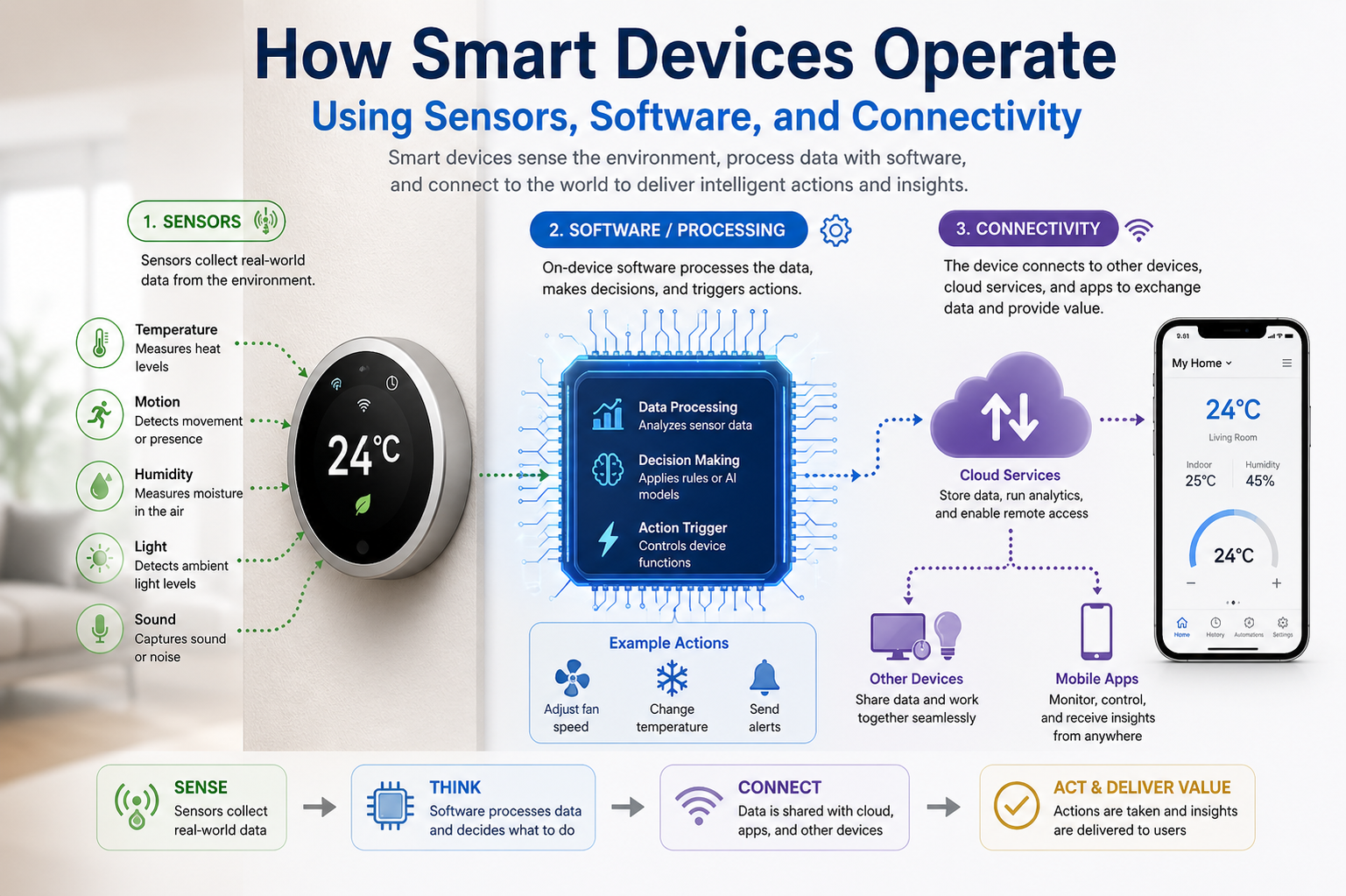
Smart devices are designed to interact with their surroundings in an intelligent and automated way by combining sensing capabilities, computational processing, and network communication. Their operation is based on a continuous loop in which data is collected from the environment, analyzed through software systems, and then used to perform actions or trigger responses. This integration allows devices to function beyond basic mechanical tools, turning them into adaptive systems capable of learning from usage patterns and environmental conditions.
Smart technology has become deeply embedded in everyday life, from wearable fitness trackers and voice-controlled assistants to smart thermostats and connected home security systems. The effectiveness of these devices depends on how efficiently they combine hardware and software components into a unified system that responds quickly and accurately to user needs.
Role of Sensors in Data Collection
Sensors form the foundation of smart device functionality by acting as the interface between the physical world and digital systems. They continuously monitor environmental variables and convert them into electrical signals that can be processed by the device. These signals represent real-world conditions such as temperature fluctuations, motion detection, pressure changes, sound levels, humidity, and proximity.
Different types of sensors are used depending on the device’s purpose. Motion sensors detect movement and orientation, making them essential for smartphones and gaming controllers. Temperature sensors help regulate climate control systems, while optical sensors enable automatic brightness adjustment in screens. Microphones capture sound input for voice recognition, and biometric sensors identify users through fingerprints or facial recognition.
The accuracy and sensitivity of these sensors determine how effectively a smart device can interpret its surroundings. High-quality sensors ensure that even minor environmental changes are detected and recorded, allowing for more precise responses from the system.
Conversion of Physical Data into Digital Signals
Once sensors capture information, the data must be converted into a digital format that software systems can understand. This conversion process is essential because raw physical signals cannot be directly used for computation. Analog signals are transformed into digital values through specialized circuits that measure and encode the information.
This step ensures that environmental data becomes structured input for processing units within the device. Without this conversion, smart systems would not be able to interpret real-world conditions or make informed decisions based on them.
Software as the Decision-Making Core
Software plays a central role in interpreting sensor data and determining how the device should respond. It acts as the brain of the system, executing instructions that define how inputs are processed and what outputs are generated. Operating systems manage the overall functioning of the device, while application software handles specific tasks such as fitness tracking, home automation, or voice assistance.
Advanced algorithms allow software to analyze patterns in data and make predictions based on historical behavior. This enables smart devices to anticipate user needs, adjust settings automatically, and improve performance over time. Machine learning techniques further enhance this capability by allowing systems to adapt without explicit reprogramming.
Software also ensures coordination between different hardware components, making sure that sensors, processors, and communication modules work together efficiently. This coordination is essential for maintaining smooth and uninterrupted device performance.
Artificial Intelligence and Machine Learning Integration
Artificial intelligence enhances smart device functionality by enabling systems to perform complex decision-making tasks. Instead of relying solely on predefined instructions, AI-powered software can learn from data and improve its responses over time.
Machine learning models analyze large volumes of sensor data to identify trends and patterns. For example, a smart assistant can learn a user’s daily routine and adjust reminders or device settings accordingly. Similarly, smart security systems can differentiate between normal activity and potential threats by analyzing movement patterns.
Natural language processing allows devices to understand and respond to human speech, making voice-controlled systems more intuitive and interactive. This combination of AI technologies transforms smart devices from reactive tools into proactive assistants.
Connectivity and Communication Systems
Connectivity is the element that enables smart devices to interact with external systems and other devices. Through wireless communication technologies such as Wi-Fi, Bluetooth, and cellular networks, devices can exchange data in real time.
This connectivity allows smart devices to function as part of a larger ecosystem rather than as isolated units. For example, a smart home system can link lighting, security cameras, and temperature controls into a single network that can be managed centrally. Data shared between devices enhances coordination and enables automation across multiple systems.
Cloud connectivity further extends device capabilities by allowing data to be stored and processed remotely. This reduces the burden on local hardware and enables access to powerful computing resources that would otherwise be unavailable on individual devices.
The Role of the Internet of Things Ecosystem
Smart devices are often part of a broader Internet of Things ecosystem where multiple connected devices communicate and collaborate. In this system, each device contributes data that can be used collectively to improve efficiency and decision-making.
For instance, in a smart city environment, traffic sensors, streetlights, and public transportation systems can work together to optimize traffic flow and reduce congestion. Similarly, in healthcare, wearable devices can transmit patient data to medical professionals for continuous monitoring and early diagnosis.
The interconnected nature of this ecosystem allows for more intelligent infrastructure and improved resource management across various sectors.
Edge Computing and Real-Time Processing
Edge computing enhances smart device performance by processing data closer to where it is generated rather than relying entirely on remote servers. This reduces latency and allows for faster decision-making.
In many applications, real-time response is critical. For example, autonomous systems and security monitoring devices require immediate analysis of sensor data to function effectively. By processing information locally, edge computing ensures that delays caused by network transmission are minimized.
This approach also improves privacy and security, as sensitive data can be processed without always being transmitted to external servers.
Cloud Computing and Data Storage
While edge computing handles immediate processing, cloud computing provides long-term storage and advanced data analysis capabilities. Smart devices regularly upload collected data to cloud systems where it can be stored, analyzed, and accessed from multiple locations.
Cloud platforms enable large-scale processing of data, allowing for deeper insights and more advanced machine learning models. They also support device synchronization, ensuring that settings and preferences are consistent across multiple devices used by the same individual.
This combination of local and cloud computing creates a balanced system where performance, storage, and intelligence are optimized.
Security and Data Protection in Smart Systems
Security is a critical aspect of smart device operation because these systems often handle sensitive personal and environmental data. Encryption techniques are used to protect data during transmission and storage, ensuring that unauthorized access is prevented.
Authentication mechanisms such as passwords, biometric verification, and multi-factor authentication help control access to devices and systems. Regular software updates are also important for fixing vulnerabilities and improving system protection.
As smart devices become more integrated into daily life, maintaining strong cybersecurity measures becomes increasingly essential to protect user privacy and system integrity.
Energy Efficiency and Resource Management
Smart devices are designed to operate efficiently while minimizing energy consumption. Sensors and processors are optimized to use power only when necessary, often entering low-power modes when idle.
Energy-efficient algorithms help reduce computational load, while adaptive systems adjust performance based on usage patterns. For example, a smart thermostat may reduce energy usage when no one is at home, contributing to overall resource conservation.
This focus on efficiency not only extends device lifespan but also supports sustainable technology development.
Applications Across Different Industries
Smart device technology is applied across numerous industries, transforming how services are delivered and managed. In healthcare, wearable devices monitor vital signs and provide real-time health insights. In transportation, smart navigation systems optimize travel routes and improve safety.
In agriculture, sensor-based systems monitor soil conditions and weather patterns to improve crop productivity. In industrial environments, smart machines enable predictive maintenance, reducing downtime and operational costs.
These applications demonstrate the versatility of smart systems and their ability to improve efficiency across multiple fields.
Challenges in Smart Device Development
Despite their advantages, smart devices face several challenges. Data privacy concerns remain a major issue due to the large amount of personal information being collected. Interoperability between different devices and platforms can also be difficult, limiting seamless integration.
Another challenge is the dependency on stable internet connectivity for full functionality. In areas with poor network infrastructure, performance may be affected. Additionally, the increasing complexity of smart systems requires continuous updates and maintenance to ensure reliability.
Future of Smart Device Technology
The future of smart devices is expected to focus on greater intelligence, autonomy, and integration. Advances in artificial intelligence will enable more natural interactions between humans and machines. Improved sensor technology will allow for even more precise environmental detection.
As connectivity expands with faster and more reliable networks, smart devices will become even more interconnected and responsive. The combination of AI, edge computing, and advanced sensors will lead to systems that are capable of making independent decisions with minimal human intervention.
Smart technology will continue to evolve toward creating fully adaptive environments where devices work seamlessly together to enhance comfort, efficiency, and productivity.
Advanced Data Processing in Smart Devices
Smart devices rely heavily on advanced data processing techniques to transform raw sensor inputs into meaningful actions. Once data is collected and digitized, it must be filtered, organized, and interpreted in a way that allows the system to make accurate decisions. This process involves multiple computational layers that work together to refine information before it is used.
At the initial stage, noise reduction techniques are applied to remove irrelevant or inaccurate signals captured by sensors. This ensures that only useful and reliable data moves forward in the processing pipeline. After cleaning, the data is structured into formats that can be easily analyzed by software algorithms.
Pattern recognition plays a major role in this stage. Smart systems continuously compare incoming data with stored patterns to identify similarities or anomalies. This allows devices to detect familiar situations, such as recognizing a user’s voice, or unusual conditions, such as sudden temperature spikes or unexpected motion.
Over time, as more data is collected, the system becomes better at recognizing patterns and improving accuracy. This continuous refinement is what makes smart devices increasingly reliable and efficient.
Decision-Making Mechanisms in Smart Systems
After data is processed and analyzed, smart devices must decide what action to take. This decision-making process is driven by embedded logic systems and artificial intelligence models that evaluate different possible outcomes.
Rule-based systems operate using predefined instructions. For example, if a motion sensor detects movement at night, the system may automatically turn on a light. These rules are simple but effective for basic automation tasks.
More advanced systems use probabilistic models and machine learning algorithms. These allow devices to evaluate multiple factors before making a decision. Instead of following a fixed rule, the system considers context, historical data, and predictive analysis to choose the most appropriate response.
This intelligent decision-making capability allows smart devices to behave more naturally and adaptively, closely resembling human reasoning in certain situations.
Automation and Self-Regulation Features
One of the key strengths of smart devices is their ability to automate tasks without continuous human control. Automation is achieved through the combination of sensors, software logic, and connectivity, which work together to perform actions based on real-time conditions.
Self-regulation takes automation a step further by enabling devices to adjust their own performance. For example, a smart air conditioning system can monitor room temperature and automatically adjust cooling levels to maintain comfort. Similarly, smart lighting systems can regulate brightness based on natural light availability.
These self-regulating mechanisms reduce the need for manual intervention and create more efficient and responsive environments. They also contribute to energy savings and improved resource management.
Role of Embedded Systems in Smart Devices
Embedded systems form the backbone of smart device architecture. These are specialized computing units integrated directly into devices to perform dedicated functions. Unlike general-purpose computers, embedded systems are designed for specific tasks with optimized performance and minimal resource usage.
They consist of microcontrollers or microprocessors, memory units, and input/output interfaces that manage sensor data and control device operations. Embedded systems ensure that smart devices respond quickly and efficiently to changing conditions.
Because they operate in real time, embedded systems are essential for applications that require immediate responses, such as security alarms, medical monitoring devices, and industrial automation systems.
Communication Between Devices
Smart devices often need to communicate with each other to perform coordinated actions. This communication happens through network protocols that define how data is transmitted and received.
Device-to-device communication allows multiple smart systems to work together. For example, a smart door lock can communicate with a home security camera to verify identity before granting access. Similarly, wearable health devices can share data with mobile applications for real-time health tracking.
This interconnected communication improves system efficiency and enables more complex automation scenarios where multiple devices collaborate to achieve a common goal.
Cloud-Based Intelligence and Remote Access
Cloud computing plays a critical role in extending the intelligence of smart devices beyond their physical limitations. By connecting to cloud servers, devices gain access to powerful computing resources and large-scale data storage.
Cloud-based intelligence allows devices to perform complex computations that would be too demanding for local hardware. It also enables remote access, allowing users to control and monitor devices from anywhere in the world through connected applications.
This remote capability enhances convenience and flexibility, especially in smart home systems and industrial monitoring setups. It ensures that users remain connected to their devices regardless of location.
Synchronization Across Multiple Devices
Modern smart environments often involve multiple devices working together in synchronization. This synchronization ensures that all connected systems share consistent data and operate in harmony.
For example, when a user adjusts settings on a smartphone, those changes can automatically reflect on other connected devices such as tablets, smart speakers, or home appliances. This unified experience is made possible through cloud synchronization and shared network protocols.
Synchronization improves usability and creates a seamless digital ecosystem where all devices function as part of a single integrated system.
User Interaction and Interface Design
Smart devices are designed to interact with users in intuitive and accessible ways. User interfaces play a crucial role in enabling this interaction, allowing individuals to control and configure devices easily.
Touchscreens, voice commands, gesture recognition, and mobile applications are common interface methods. Voice assistants, in particular, have become increasingly popular due to their natural and hands-free interaction style.
Good interface design ensures that users can fully utilize device capabilities without needing technical expertise. This enhances user experience and encourages wider adoption of smart technology.
Adaptive Learning and Behavioral Analysis
Smart devices often include adaptive learning capabilities that allow them to improve performance based on user behavior. By analyzing patterns over time, devices can predict preferences and adjust their functions accordingly.
For instance, a smart thermostat may learn a household’s daily schedule and automatically adjust temperature settings based on occupancy patterns. Similarly, recommendation systems in smart applications suggest content or actions based on previous usage.
Behavioral analysis helps create personalized experiences, making devices more efficient and user-friendly.
Integration with Artificial Intelligence Systems
Artificial intelligence integration significantly enhances the capabilities of smart devices. AI enables systems to process large datasets, recognize complex patterns, and make autonomous decisions with high accuracy.
Computer vision allows devices to interpret visual data, while natural language processing enables understanding of human speech and text. These capabilities make smart devices more interactive and intelligent.
AI integration also supports predictive maintenance in industrial systems, where devices can identify potential failures before they occur, reducing downtime and improving efficiency.
Real-Time Monitoring and Feedback Systems
Real-time monitoring is a critical feature of smart devices, especially in applications such as healthcare, security, and industrial control. Continuous data collection allows systems to provide immediate feedback based on current conditions.
Feedback mechanisms ensure that users or systems are informed about changes instantly. For example, a fitness tracker can provide real-time heart rate updates during exercise, while a security system can send alerts when unusual activity is detected.
This immediate feedback loop enhances responsiveness and improves decision-making accuracy.
Environmental Adaptation Capabilities
Smart devices are increasingly designed to adapt to their environment. This means they can adjust their behavior based on external conditions such as lighting, temperature, humidity, and user presence.
Environmental adaptation improves efficiency and user comfort. For example, smart lighting systems adjust brightness based on ambient light levels, while smart irrigation systems modify watering schedules based on soil moisture and weather conditions.
This adaptability allows devices to function effectively in dynamic and changing environments.
System Integration
The operation of smart devices is the result of a highly coordinated system where sensors, software, and connectivity work together seamlessly. Each component plays a vital role in enabling devices to sense, analyze, decide, and act in real time.
As technology continues to advance, these systems are becoming more intelligent, efficient, and autonomous. The integration of artificial intelligence, cloud computing, and advanced sensor technology is pushing smart devices toward a future where they can operate with minimal human input while delivering highly personalized and efficient experiences.
Security Architecture in Smart Devices
Security forms a critical layer in the functioning of smart devices because these systems constantly collect, transmit, and process sensitive information. To protect this data, smart devices use multiple levels of security architecture that work together to prevent unauthorized access and ensure safe operation.
At the foundational level, device authentication ensures that only verified users and systems can access the device. This may include passwords, biometric verification such as fingerprints or facial recognition, and secure device pairing methods. These authentication methods act as the first barrier against unauthorized entry.
Encryption is another essential component of smart device security. It converts data into coded formats during storage and transmission, making it unreadable to outsiders. Even if data is intercepted during communication, encryption ensures that it cannot be easily interpreted or misused.
Secure boot mechanisms are also used to verify that a device starts with trusted software only. This prevents malicious programs from being loaded during startup, maintaining system integrity from the moment the device powers on.
Data Privacy and Information Control
Smart devices continuously generate large volumes of personal and behavioral data, making privacy protection an important concern. Privacy systems are designed to control how data is collected, stored, and shared.
Access control mechanisms allow users to decide what information is shared and with whom. Many smart systems include customizable privacy settings that enable users to limit data usage or disable certain tracking features.
Data anonymization techniques are also used to remove personally identifiable information before data is processed or transmitted. This helps protect user identity while still allowing systems to analyze trends and improve performance.
Regular software updates are essential for maintaining privacy protection. These updates often include security patches that fix vulnerabilities and strengthen system defenses against emerging threats.
Communication Protocols in Smart Networks
Smart devices rely on structured communication protocols to exchange information efficiently and reliably. These protocols define the rules for data transmission, ensuring that devices can understand each other regardless of manufacturer or system type.
Wireless communication technologies such as Wi-Fi, Bluetooth, Zigbee, and cellular networks are commonly used. Each technology serves different purposes depending on range, power consumption, and data requirements.
Wi-Fi is typically used for high-speed data transfer, while Bluetooth is preferred for short-range, low-power communication between personal devices. Zigbee is often used in smart home systems because it supports multiple connected devices with low energy usage.
These communication systems ensure that smart devices remain interconnected and responsive within their environments.
Role of Firmware in Device Operation
Firmware is a specialized type of software embedded directly into hardware components. It controls how a device’s hardware operates and ensures that all internal functions are executed correctly.
Unlike regular software that can be easily updated or removed, firmware operates at a deeper level within the device system. It is responsible for managing essential functions such as sensor activation, power management, and communication control.
Firmware updates are periodically released to improve performance, fix bugs, and enhance security. These updates are crucial for maintaining long-term device stability and functionality.
Power Management and Energy Optimization
Efficient power management is essential for smart devices, especially those that operate continuously or rely on battery power. Smart systems are designed to minimize energy consumption without compromising performance.
Power-saving modes allow devices to reduce activity when not in use. For example, sensors may enter sleep mode and activate only when needed. Processors can also adjust their speed based on workload, conserving energy during low-demand periods.
Energy-efficient algorithms are used to optimize computational processes, reducing unnecessary processing steps. This ensures that devices remain functional for longer periods while using minimal energy resources.
Edge Intelligence and Local Decision Processing
Edge intelligence refers to the ability of smart devices to process data locally without relying entirely on external servers. This approach improves speed and reduces dependency on network connectivity.
Local decision processing allows devices to respond immediately to environmental changes. For example, a security camera can detect motion and trigger alerts instantly without sending all data to the cloud first.
This method enhances reliability, especially in situations where internet connectivity is weak or unavailable. It also improves privacy by keeping sensitive data within the device itself.
Sensor Fusion and Data Integration
Modern smart devices often use multiple sensors simultaneously to gather comprehensive information about their environment. Sensor fusion is the process of combining data from different sensors to create a more accurate and complete understanding.
For example, a smartphone may use accelerometers, gyroscopes, and GPS sensors together to determine movement, orientation, and location. By integrating these data sources, the system can produce more precise results than using a single sensor alone.
This integration improves decision-making accuracy and allows devices to function more effectively in complex environments.
Real-Time Analytics and Continuous Processing
Real-time analytics enables smart devices to process data instantly as it is generated. This continuous processing allows systems to react without delay, which is essential for time-sensitive applications.
In healthcare monitoring, real-time analytics can detect abnormal heart rates and trigger immediate alerts. In transportation systems, it can analyze traffic conditions and adjust navigation routes dynamically.
Continuous processing ensures that smart devices remain responsive and adaptive at all times, improving overall system efficiency.
System Interoperability and Compatibility
Interoperability refers to the ability of different smart devices and systems to work together seamlessly. Since smart ecosystems often include devices from multiple manufacturers, compatibility is essential.
Standard communication protocols and shared data formats enable devices to exchange information without conflict. This ensures that systems such as smart homes, industrial automation setups, and healthcare networks can function as unified environments.
Interoperability enhances user convenience by allowing different devices to be controlled through a single interface or platform.
Human-Device Interaction Enhancements
Smart devices are designed to improve the way humans interact with technology by making interfaces more natural and intuitive. Advances in interaction design focus on reducing complexity and increasing accessibility.
Voice recognition systems allow users to control devices using spoken commands. Gesture recognition enables touchless control, while haptic feedback provides physical responses to user actions.
These interaction methods make technology more accessible and easier to use, especially for individuals who may not be familiar with traditional digital interfaces.
Predictive Systems and Future Behavior Modeling
Predictive systems use historical data and machine learning algorithms to forecast future actions or conditions. This capability allows smart devices to prepare for events before they occur.
For example, predictive maintenance systems in industrial environments can identify equipment wear and schedule repairs before failures happen. In consumer devices, predictive systems can suggest actions based on user habits and preferences.
Behavior modeling improves system efficiency by reducing unexpected disruptions and optimizing performance.
Adaptive System Evolution
Smart devices are not static systems; they evolve over time through continuous learning and updates. Adaptive systems analyze usage patterns and adjust their behavior accordingly.
This evolution allows devices to become more efficient and personalized the longer they are used. Software updates also contribute to this evolution by introducing new features and improving existing functions.
Adaptive systems ensure that smart technology remains relevant and effective in changing environments.
System Intelligence Development
The intelligence of smart devices is built upon the integration of security systems, communication protocols, power management, and adaptive learning technologies. Each layer contributes to creating a stable, efficient, and responsive system capable of operating in real-world environments.
As these technologies continue to develop, smart devices are becoming increasingly autonomous and capable of performing complex tasks with minimal human input. This progression is shaping a future where digital systems are deeply embedded in everyday life, working continuously to enhance convenience, safety, and efficiency.
Scalability and Expansion of Smart Systems
Smart devices are designed not only for individual use but also for expansion into larger networks and systems. Scalability refers to the ability of a smart system to grow in size and complexity without losing performance or efficiency. This is achieved through modular design, cloud integration, and standardized communication protocols.
In scalable systems, new devices can be added to an existing network without requiring major changes to the infrastructure. For example, a smart home system can start with a few devices such as lights and thermostats and later expand to include security cameras, appliances, and energy management systems. The system automatically recognizes and integrates new devices into its network.
Cloud-based platforms play a major role in scalability by providing centralized control and data management. As more devices are added, cloud systems handle increased data flow and processing demands without affecting local device performance.
Interconnected Ecosystem Development
Smart devices are increasingly becoming part of interconnected ecosystems where multiple systems work together in coordination. These ecosystems extend beyond individual households or devices and include industries, cities, and global networks.
In such ecosystems, data flows continuously between devices, allowing them to operate in synchronization. For example, transportation systems can communicate with traffic management centers, weather systems, and navigation applications to optimize travel routes in real time.
This interconnected structure enhances efficiency and creates a more intelligent environment where decisions are made based on collective data rather than isolated inputs.
Role of Machine Intelligence in System Evolution
Machine intelligence continues to evolve as a key driver of smart device advancement. Through continuous learning, systems improve their ability to understand patterns, predict outcomes, and make autonomous decisions.
Deep learning models enable devices to process complex data such as images, speech, and behavioral patterns. This allows for more advanced applications such as facial recognition, automated translation, and intelligent recommendation systems.
As machine intelligence becomes more advanced, smart devices shift from being reactive systems to proactive systems that anticipate user needs and environmental changes.
Context Awareness in Smart Devices
Context awareness refers to the ability of a device to understand the situation in which it is operating. This includes recognizing user behavior, environmental conditions, time, and location.
By understanding context, smart devices can make more appropriate decisions. For example, a smartphone may automatically switch to silent mode during meetings or adjust brightness based on surrounding light conditions.
Context awareness enhances personalization and improves the overall user experience by ensuring that device behavior aligns with real-world situations.
Autonomous Operation and Self-Management
Autonomous operation is one of the most advanced features of modern smart systems. It allows devices to function independently with minimal human intervention.
Self-management includes tasks such as system optimization, error detection, and performance adjustment. For instance, a smart system can identify performance slowdowns and automatically allocate additional resources to maintain efficiency.
Autonomous systems are particularly important in applications such as autonomous vehicles, industrial robotics, and smart infrastructure where continuous human monitoring is not practical.
Latency Reduction and System Responsiveness
Latency refers to the delay between an input being received and a response being generated. In smart devices, reducing latency is essential for ensuring real-time responsiveness.
Techniques such as edge computing, optimized algorithms, and efficient communication protocols help minimize delays. By processing data closer to its source, systems can respond almost instantly to changes in their environment.
Low latency is especially important in applications such as healthcare monitoring, security systems, and autonomous navigation where immediate response is critical.
Adaptive Security Systems
Security systems in smart devices are becoming increasingly adaptive, meaning they can evolve based on new threats and usage patterns. Instead of relying solely on static protection methods, adaptive systems analyze behavior to detect unusual activity.
For example, if a device detects login attempts from unfamiliar locations or unusual usage patterns, it can trigger additional verification steps or temporarily restrict access.
This dynamic approach improves protection against cyber threats and ensures that security measures remain effective even as attack methods evolve.
Energy Harvesting and Sustainable Operation
Some advanced smart devices incorporate energy harvesting techniques to improve sustainability. Energy harvesting involves collecting energy from the environment, such as solar power, motion, heat, or vibration, to supplement or replace traditional power sources.
This approach reduces dependency on batteries and external power supplies, allowing devices to operate for longer periods with minimal maintenance. It is especially useful in remote or large-scale sensor networks.
Sustainable operation also includes optimizing energy consumption through intelligent power management systems that balance performance with efficiency.
Data Lifecycle Management in Smart Systems
Data lifecycle management refers to the process of handling data from its creation to its eventual deletion or archival. In smart systems, data is continuously generated, processed, stored, and sometimes discarded.
Efficient lifecycle management ensures that only relevant and necessary data is retained, reducing storage requirements and improving system performance. Older or unused data may be compressed or moved to long-term storage systems.
This structured approach to data handling helps maintain system efficiency and supports better decision-making based on relevant information.
Real-World Simulation and Digital Modeling
Smart systems often use digital modeling and simulation techniques to predict real-world behavior. These models replicate physical environments or systems in a virtual space, allowing devices to test different scenarios before taking action.
For example, smart city systems may simulate traffic patterns to optimize road usage, while industrial systems may model machine performance to predict maintenance needs.
These simulations improve planning accuracy and reduce the risk of errors in real-world operations.
Cognitive Computing in Smart Devices
Cognitive computing refers to systems that mimic human thought processes to solve complex problems. These systems use artificial intelligence, natural language processing, and pattern recognition to interpret unstructured data.
Cognitive systems can understand context, reason through problems, and generate solutions in a way that resembles human decision-making. This capability makes smart devices more intuitive and capable of handling complex tasks.
Applications include virtual assistants, intelligent customer service systems, and advanced analytics platforms.
Continuous Improvement Through Feedback Loops
Feedback loops are essential for the continuous improvement of smart devices. In these systems, output results are continuously monitored and fed back into the system for analysis.
This feedback helps refine algorithms, improve accuracy, and enhance performance over time. For example, if a recommendation system notices that users frequently ignore certain suggestions, it adjusts its future recommendations accordingly.
Continuous feedback ensures that smart devices remain adaptive and aligned with user expectations.
Human-Centered Design in Smart Technology
Human-centered design focuses on creating smart devices that prioritize user needs, comfort, and accessibility. This approach ensures that technology remains easy to use and relevant to everyday life.
Design principles include simplicity, intuitive navigation, and accessibility for users with different levels of technical knowledge. The goal is to make interaction with smart systems as natural and seamless as possible.
By focusing on human needs, smart technology becomes more inclusive and widely adoptable.
Integration of Robotics with Smart Systems
Robotics is increasingly being integrated with smart device technology to create autonomous physical systems. These systems combine mechanical components with sensors, software, and connectivity to perform physical tasks.
Robotic systems are used in manufacturing, healthcare, logistics, and domestic applications. When combined with smart technology, they can operate autonomously, adapt to changing environments, and perform complex tasks with precision.
This integration expands the capabilities of smart systems beyond digital environments into the physical world.
Long-Term Impact of Smart Device Evolution
The long-term evolution of smart devices is reshaping how humans interact with technology and their environment. As systems become more intelligent and interconnected, they are influencing industries, economies, and daily life.
Automation, data-driven decision-making, and intelligent systems are increasing efficiency and reducing human workload. At the same time, they are creating new opportunities for innovation and development.
The continued advancement of sensors, software, and connectivity ensures that smart devices will play an increasingly central role in shaping the future of digital and physical environments.
Conclusion
Smart devices operate through a highly coordinated system where sensors, software, and connectivity work together to create intelligent and responsive technology. Sensors continuously gather real-world data, software processes and interprets that information, and connectivity ensures seamless communication between devices, networks, and cloud systems. This integrated cycle allows devices to sense their environment, make decisions, and perform actions with minimal human intervention.
As these technologies continue to evolve, smart systems are becoming more advanced, efficient, and adaptive. Artificial intelligence, edge computing, and machine learning are further enhancing their ability to learn from behavior, predict outcomes, and respond in real time. This shift is transforming ordinary devices into intelligent assistants capable of supporting daily life, industrial operations, healthcare systems, and modern infrastructure.
Overall, smart devices represent a major step toward a connected digital ecosystem where technology operates in harmony with human needs. Their development continues to shape a future defined by automation, intelligence, and seamless interaction between the physical and digital worlds.