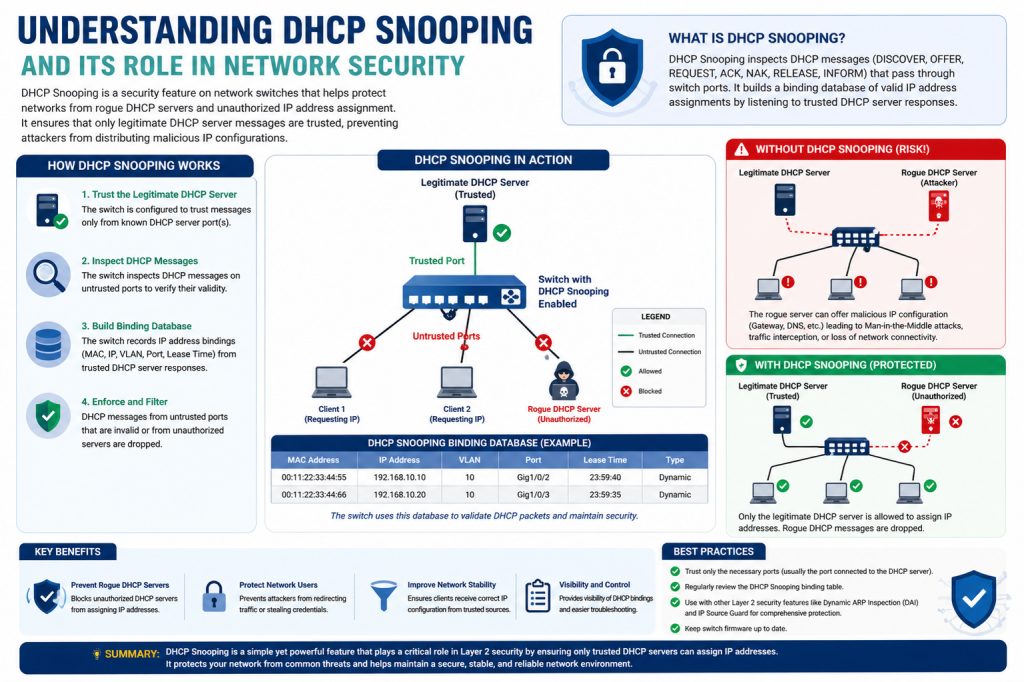
DHCP snooping is a switch security feature that inspects DHCP traffic on configured Layer 2 networks. Its key purpose is to prevent a device connected to an untrusted interface from acting as an unauthorized DHCP server. Correctly implemented, it can build a database of dynamically assigned IP-to-MAC-to-port bindings that other controls use. It is not a universal firewall, identity system, or protection against every DHCP exhaustion attack. The VLAN, trust boundary, switch model and upstream DHCP relay design determine what it can safely enforce.
Where trusted and untrusted ports belong
In traditional network environments, DHCP operates in an open and trust-based manner. Any device capable of sending DHCP responses could potentially act as a DHCP server. This creates a significant vulnerability, especially in environments where users can physically or logically connect unauthorized devices. Without protection, a malicious user can introduce a rogue DHCP server that distributes incorrect IP addresses, default gateways, or DNS settings. This can lead to traffic interception, denial of service, or redirection of users to malicious destinations. DHCP Snooping is introduced to eliminate this trust gap.
At the heart of DHCP Snooping lies the classification of switch ports into trusted and untrusted categories. Trusted ports are those that are allowed to send DHCP responses. These are typically connected to legitimate DHCP servers or upstream network infrastructure that is verified and secure. Untrusted ports, on the other hand, are those connected to end-user devices such as computers, printers, or IoT devices. When DHCP Snooping is enabled, all ports are untrusted by default. Network administrators must manually define which ports should be trusted.
When a device connected to an untrusted port sends a DHCP request, the switch allows the request to pass through to the DHCP server. However, when a DHCP response is received, the switch performs validation before forwarding it to the client. If the response originates from a trusted port, it is allowed to proceed. If it originates from an untrusted port, it is dropped immediately. This inspection process applies to all DHCP message types including discovery, offer, request, and acknowledgment packets. By controlling these exchanges, DHCP Snooping ensures that only valid configuration data reaches client devices.
A trusted DHCP-snooping port is usually on the path toward an approved DHCP server or relay, not every uplink or switch trunk by default. End-device-facing access ports normally remain untrusted. A mistaken trust decision can allow a rogue server response into the broadcast domain, while incorrectly untrusting the real server path can prevent clients from receiving leases. Draw the actual server, relay, trunks and VLANs before defining the configuration.
The DHCP exchange and binding database
One of the most powerful features of DHCP Snooping is the creation of a binding database. This database stores detailed information about IP address assignments, including the MAC address of the device, the assigned IP address, lease duration, VLAN information, and the switch port where the assignment was made. This binding information is dynamically learned as devices request and receive IP addresses. It serves as a trusted reference for other security features within the network.
When a switch with DHCP Snooping enabled starts operating, it follows a structured workflow. First, it initializes all ports as untrusted. As DHCP traffic flows through the switch, it monitors and filters messages based on port trust status. When a client sends a DHCP discovery message, it is forwarded to the DHCP server through trusted paths. The server responds with an offer, which is then inspected by the switch. If the response comes from a trusted port, it is forwarded to the client. Once the client accepts the configuration, the switch records the binding information.
As networks become more complex and distributed, DHCP Snooping evolves from a simple filtering mechanism into a more sophisticated operational control system. Its behavior extends beyond basic packet validation and begins to influence how switches manage, prioritize, and record network activity. In high-density environments, this operational intelligence becomes critical for maintaining consistency and preventing configuration drift across multiple network segments. DHCP Snooping operates continuously in the background, inspecting traffic at wire speed.
DHCP communication involves multiple packet types, each serving a specific stage in the IP assignment process. DHCP Snooping analyzes each of these packet types individually. Discovery packets initiated by clients are typically allowed to pass through without restriction, as they represent legitimate requests for network configuration. Offer packets, which originate from DHCP servers, are carefully evaluated based on the trust status of the interface. If an offer arrives from an untrusted port, it is immediately dropped. Request and acknowledgment packets are also monitored to ensure consistency between client expectations and server responses.
The switch observes legitimate lease negotiation and may record an assigned address, client MAC, VLAN, port and lease duration. The binding table is a security input, not an authoritative identity directory. Clients with static addresses require a documented exception or alternative evidence for dependent features. Confirm how binding persistence and switch restarts work for the hardware and software in use; a missing table after a reboot can disrupt otherwise valid client traffic.
Rogue DHCP service versus starvation
One of the most critical threats in network environments is the presence of rogue DHCP servers. These unauthorized servers can be introduced either intentionally by attackers or accidentally by users who connect consumer-grade routers to enterprise networks. A rogue DHCP server can disrupt network operations by assigning incorrect IP configurations. This may lead to network outages, traffic interception, or misrouting of data. DHCP Snooping prevents this by blocking DHCP server responses from untrusted ports, effectively neutralizing rogue servers before they can affect clients.
Once DHCP Snooping is active, every DHCP packet passing through a switch is subjected to validation rules. This inspection is not passive; it actively determines whether a packet should be forwarded, modified, or dropped. The switch examines both the source of the packet and the interface it arrived on, ensuring that DHCP responses only originate from approved network segments. This validation process creates a controlled environment where IP assignment cannot be manipulated externally. Even if an attacker manages to inject DHCP responses into the network, those packets are immediately discarded if they originate from an untrusted interface.
As attackers develop more sophisticated techniques, DHCP Snooping continues to provide a reliable first line of defense against several advanced network threats. One of the most concerning scenarios is DHCP starvation attacks, where an attacker floods the network with fake DHCP requests to exhaust the available IP address pool. While DHCP Snooping does not directly allocate or manage IP pools, it can limit the impact of such attacks by controlling abnormal DHCP traffic patterns and ensuring that only legitimate request flows are processed normally.
A rogue DHCP server might offer an attacker-controlled default gateway or DNS resolver, redirecting subsequent traffic. DHCP starvation instead abuses address allocation by generating many apparent clients. DHCP snooping is especially relevant to blocking unauthorized server replies; rate limits and related controls can reduce some floods, but implementation and threat model matter. DHCP starvation deserves a distinct diagnosis and should not be presented as automatically solved by one feature toggle.
Dynamic ARP inspection and IP source guard
DHCP Snooping does not operate in isolation. It is often integrated with other security mechanisms such as Dynamic ARP Inspection and IP Source Guard. These features rely on the binding database generated by DHCP Snooping to validate network traffic. Dynamic ARP Inspection uses the binding table to verify ARP packets and prevent ARP spoofing attacks. IP Source Guard uses the same information to restrict IP traffic based on validated bindings, ensuring that devices cannot impersonate other IP addresses on the network. This interconnected approach creates a layered security model that significantly enhances network resilience.
Dynamic ARP Inspection is one of the most important security features that depends heavily on DHCP Snooping. It uses the binding database created by DHCP Snooping to validate ARP packets. In normal network operation, ARP is used to map IP addresses to MAC addresses. However, attackers can exploit ARP by sending false mappings, a technique known as ARP spoofing or ARP poisoning. When DHCP Snooping is enabled, Dynamic ARP Inspection can compare ARP packets against the trusted binding table, rejecting any that do not match legitimate assignments.
Another feature that benefits from DHCP Snooping is IP Source Guard. This mechanism restricts IP traffic on a port based on the DHCP Snooping binding table. Essentially, it ensures that a device can only send traffic using the IP address that was originally assigned to it. If a device attempts to spoof another IP address, the traffic is blocked at the switch level. This prevents internal users from impersonating other systems, adding another layer of enforcement to network policies.
Dynamic ARP Inspection (DAI) can use snooping bindings to challenge forged ARP address assertions. IP Source Guard may use the same bindings to restrict source IP use on access ports. These controls can improve resistance to certain local-network impersonation attacks, but they also introduce operational dependencies. Confirm how static hosts, virtual machines, phones, and failover devices are represented before enabling enforcement. Different switch families have different command syntax and supported combinations.
VLAN scope, uplinks, and deployment planning
Beyond security, DHCP Snooping also improves network visibility. The binding database acts as a historical record of IP assignments, making it easier to trace connectivity issues. If a user reports a network problem, administrators can quickly verify which IP address was assigned, when it was assigned, and through which switch port. This level of detail reduces troubleshooting time and helps identify whether issues are caused by misconfiguration, unauthorized devices, or hardware failures.
In production environments, it is important that DHCP Snooping bindings are not lost during power failures or device reboots. Many switches support saving the binding database to external storage or synchronized systems. This persistence ensures that security mechanisms relying on the database continue functioning correctly even after interruptions. Without persistence, temporary loss of binding information could weaken enforcement until new leases are learned.
In modern networks, VLAN segmentation is widely used to isolate traffic logically. DHCP Snooping integrates directly with VLAN structures, allowing policies to be applied per VLAN rather than globally. This means that a port may be trusted in one VLAN while remaining untrusted in another, depending on network design requirements. This VLAN-aware behavior allows administrators to implement highly granular security policies. For example, a DHCP server serving a management VLAN can be trusted only within that VLAN, preventing it from influencing other segments of the network.
In large enterprise environments, multiple switches often operate together to support a single logical network. DHCP Snooping databases can be synchronized across these switches to maintain consistent IP-to-MAC mappings. This synchronization is essential in environments where devices frequently move between switch ports. Without consistent database sharing, a device could appear valid on one switch but unrecognized on another, leading to inconsistent enforcement of security policies. By maintaining synchronized binding tables, DHCP Snooping ensures uniform security enforcement across the entire network infrastructure.
On many switching platforms, enabling snooping requires both a global feature state and a per-VLAN setting. Verify relay agent behavior, Option 82 support, trunk trust, hardware capacity and any DHCP server requirements. Deploy with a known inventory of user, voice and infrastructure VLANs. Start with a pilot access switch and include a client renew test, a legitimate lease from each server path, an intentionally blocked rogue offer and a safe rollback.
Troubleshooting and monitoring without broad bypasses
In environments where networks are shared by multiple users, such as educational institutions or public access networks, DHCP Snooping becomes especially valuable. These environments are more vulnerable to rogue devices because users may have limited restrictions on what they can connect. By enforcing DHCP control at the switch level, administrators can ensure that even if a user introduces unauthorized networking equipment, it cannot disrupt the IP assignment process for others.
While DHCP Snooping is highly effective when properly configured, misconfiguration can introduce vulnerabilities. One of the most common issues is incorrectly marking a port as trusted. If an end-user port is mistakenly set as trusted, a malicious device connected to that port could operate a rogue DHCP server without restriction. Another risk arises when administrators fail to secure uplink ports correctly. If upstream connections are not properly trusted, legitimate DHCP traffic may be blocked, resulting in widespread network outages. These risks highlight the importance of careful planning and documentation when deploying DHCP Snooping in production environments.
Modern network devices equipped with DHCP Snooping provide detailed logging capabilities. These logs record events such as DHCP packet drops, binding updates, and trust violations. This information is invaluable for security auditing and incident response. By analyzing these logs, administrators can identify patterns of suspicious behavior, such as repeated attempts to introduce unauthorized DHCP servers or abnormal IP assignment requests from specific ports. This level of visibility transforms DHCP Snooping from a passive security feature into an active monitoring tool.
In high-performance environments such as data centers, DHCP Snooping must operate efficiently to avoid becoming a bottleneck. Switches are designed to process DHCP inspection at hardware level whenever possible, minimizing impact on throughput. However, as DHCP traffic scales, especially in environments with frequent device churn, administrators must ensure that switch resources such as CPU and memory are not overwhelmed by excessive logging or database updates. Proper tuning of DHCP Snooping parameters helps maintain a balance between security enforcement and operational performance.
If users suddenly lose addresses, inspect switch logs, DHCP drop counters, lease-expiry times, uplink trust designation and binding table state. Distinguish snooping drops from DHCP server exhaustion, relay failures and mismatched VLAN tags. Logging should record enough source-port and lease context to explain drops without leaking more endpoint metadata than necessary. Avoid disabling protection across an entire campus because a small population of static-address devices needs remediation.
How this control fits the wider network design
DHCP Snooping also plays an indirect role in network access control systems. By providing verified IP-to-MAC mappings, it helps access control systems determine whether a device should be allowed to connect to specific network resources. This integration ensures that only authenticated and properly configured devices can access sensitive parts of the network. It also helps enforce compliance policies by tracking device behavior over time. In environments with strict regulatory requirements, this level of integration is essential for maintaining audit readiness.
Although DHCP Snooping is traditionally associated with IPv4, similar principles apply in IPv6 networks through DHCPv6 Snooping. The same trust-based model is used to validate DHCPv6 messages and prevent unauthorized address assignment. As networks transition toward dual-stack or IPv6-only architectures, the principles of DHCP Snooping remain relevant and continue to provide essential protection against configuration abuse.
In environments such as banking systems, healthcare networks, and industrial control systems, network stability and integrity are extremely sensitive. DHCP Snooping contributes to protecting these infrastructures by ensuring that endpoint devices always receive correct and verified configuration settings. In such environments, even a minor misconfiguration can lead to service disruption or security breaches. By strictly controlling DHCP message flow, DHCP Snooping ensures that critical systems operate within predictable network parameters, reducing operational risk and improving reliability.
DHCP snooping sits at an access-layer boundary and cannot by itself stop compromised endpoints, unsafe DNS resolvers already authorized by policy, or application-layer abuse. Network segmentation, credential protection, secure configuration and patch management remain separate controls. For switch-level specifics, use Cisco’s DHCP snooping and DAI guidance, and verify the actual platform version before applying commands.
The right outcome is not merely an enabled feature flag: approved clients should obtain leases reliably, unauthorized DHCP offers should be blocked, dependent security tables should remain accurate and the operations team should be able to explain each exception.