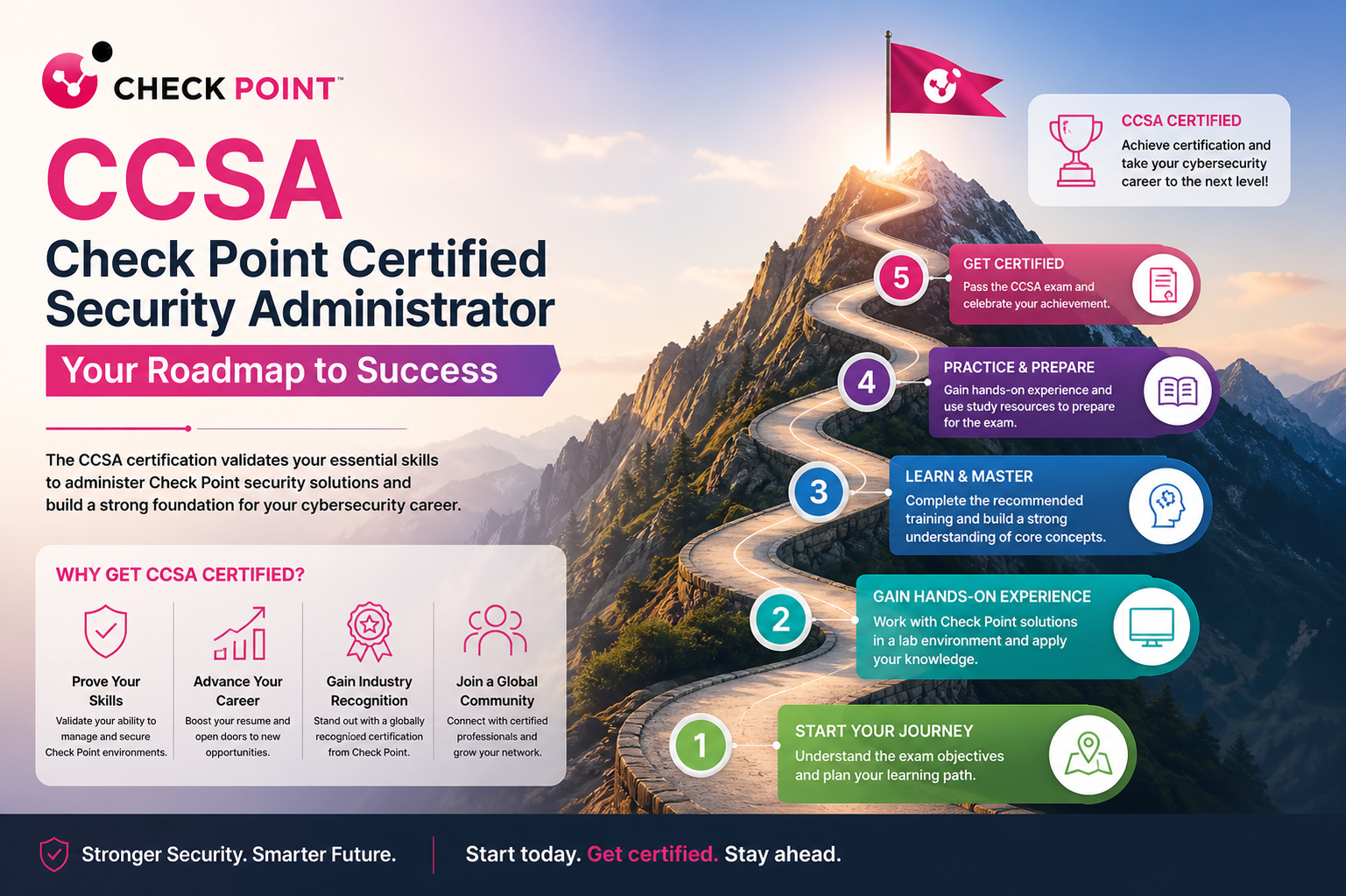
The Check Point Certified Security Administrator certification represents an essential milestone for anyone beginning a professional journey in cybersecurity and network defense. It is designed to build strong foundational knowledge of security management systems, focusing on how modern organizations protect their digital infrastructure from evolving threats. This certification is not only about memorizing technical concepts but also about developing the ability to think like a security administrator who can maintain stability, enforce policies, and respond to incidents effectively.
At its core, the CCSA journey introduces learners to the principles of centralized security management. This includes understanding how security policies are created, deployed, and monitored across different network environments. The certification helps develop a structured mindset where security is not treated as an isolated function but as an integrated layer of every digital operation within an organization.
Building Understanding of Security Architecture
A key part of mastering CCSA is developing a clear understanding of security architecture. This involves learning how different components of a security system interact with each other to create a unified defense mechanism. Security gateways, management servers, policy rules, and monitoring tools all work together to ensure that network traffic is controlled and threats are identified before they cause damage.
Understanding architecture also means recognizing how data flows through a protected environment. Every connection, request, and communication must pass through defined security checkpoints. The administrator’s role is to ensure these checkpoints are properly configured and consistently enforced. This requires both conceptual clarity and attention to operational detail.
A strong grasp of architecture allows professionals to visualize how changes in policy or configuration affect the entire network. This perspective is essential for preventing misconfigurations that could lead to vulnerabilities or system disruptions.
Core Principles of Security Policy Management
Security policy management forms the backbone of the CCSA certification. It focuses on how rules are defined to control traffic between users, systems, and external networks. These policies determine what is allowed, what is restricted, and what must be monitored for suspicious activity.
Developing expertise in this area requires understanding rule structure, order of evaluation, and the impact of each rule on network behavior. Even small changes in policy configuration can significantly affect system performance and security posture. Therefore, precision and logical thinking are essential.
Administrators must also learn how to balance security with usability. Overly strict policies may hinder business operations, while overly relaxed rules may expose the system to risks. Achieving the right balance is a critical skill developed through practice and experience.
Understanding Network Traffic Control
Network traffic control is another major component of the CCSA framework. It involves regulating how data moves within and outside an organization’s infrastructure. This includes inspecting packets, filtering traffic based on predefined rules, and ensuring that only authorized communication is allowed.
A strong understanding of traffic behavior helps in identifying abnormal patterns that may indicate security threats. Administrators must be able to distinguish between legitimate traffic and potentially harmful activity. This requires both technical knowledge and analytical thinking.
Traffic control also plays a key role in maintaining system performance. Efficient filtering and inspection processes ensure that security measures do not create unnecessary delays or bottlenecks in communication.
System Monitoring and Event Analysis
Monitoring is a continuous responsibility in security administration. It involves observing system activity, reviewing logs, and identifying events that require attention. The CCSA certification emphasizes the importance of proactive monitoring to ensure that issues are detected before they escalate.
Event analysis helps administrators understand what is happening within the network environment at any given time. Logs provide detailed information about connections, policy actions, and system behavior. Interpreting this data accurately is essential for maintaining security integrity.
Effective monitoring is not just about reacting to problems but also about recognizing patterns. Over time, administrators develop the ability to anticipate potential risks based on recurring behaviors or unusual system activity.
Hands-On Practice and Skill Development
Practical experience is one of the most important elements of preparing for CCSA certification. Theoretical knowledge alone is not sufficient to handle real-world security challenges. Hands-on practice allows learners to apply concepts in a controlled environment, reinforcing their understanding and building confidence.
Working with security tools helps develop familiarity with configuration settings, policy creation, and system management tasks. Repeated practice ensures that these actions become intuitive over time. This reduces the likelihood of errors in real operational environments.
Practical exercises also improve problem-solving skills. When faced with configuration issues or system alerts, administrators learn to analyze the situation, identify root causes, and implement appropriate solutions efficiently.
Developing a Structured Learning Approach
A structured approach to preparation is essential for success in CCSA certification. The vast amount of information involved requires careful planning and consistent effort. Breaking down topics into manageable sections helps maintain clarity and focus throughout the learning process.
Regular revision is equally important. Revisiting previously studied concepts strengthens memory retention and ensures long-term understanding. Combining revision with practical exercises creates a balanced learning cycle that reinforces both theory and application.
Consistency plays a key role in preparation. Steady progress over time is more effective than irregular bursts of study. A disciplined routine helps build momentum and improves overall performance.
Understanding Security Troubleshooting
Troubleshooting is a critical skill for any security administrator. It involves identifying and resolving issues that affect system performance or security functionality. The CCSA certification emphasizes logical thinking and systematic analysis when dealing with technical problems.
Effective troubleshooting begins with understanding the symptoms of an issue. Once the problem is identified, administrators must trace its origin by analyzing configurations, logs, and system behavior. This process requires patience and attention to detail.
The ability to troubleshoot efficiently reduces system downtime and ensures that security measures remain effective. It also enhances confidence in handling complex operational scenarios.
Real-World Application of CCSA Skills
The knowledge gained through CCSA certification is directly applicable to real-world environments. Organizations rely on security administrators to maintain system integrity, enforce policies, and respond to threats. The skills developed during preparation are used daily in managing enterprise networks.
In practical environments, administrators are responsible for ensuring that security systems align with organizational requirements. This involves continuous monitoring, policy updates, and coordination with other IT teams. The ability to apply theoretical knowledge to real situations is what makes CCSA professionals valuable in the industry.
Developing a Security Mindset
Beyond technical skills, CCSA certification helps develop a security-focused mindset. This involves thinking proactively about risks, anticipating potential threats, and designing systems that minimize vulnerabilities. A security mindset is essential for maintaining long-term protection in dynamic environments.
Administrators must always consider the impact of their decisions on the overall security posture. Every configuration change or policy update carries potential consequences. Developing awareness of these implications is a key part of professional growth.
This mindset also encourages continuous learning. Cybersecurity is an evolving field, and staying updated with new threats and technologies is essential for long-term success.
Career Growth and Professional Value
Achieving CCSA certification enhances professional credibility and opens opportunities for career advancement in the cybersecurity domain. It demonstrates a strong foundation in security principles and practical administrative skills.
Organizations value certified professionals because they bring structured knowledge and operational efficiency to security management tasks. This certification can serve as a stepping stone toward more advanced roles and specialized security domains.
It also builds confidence in handling complex security environments. With a solid foundation in place, professionals are better prepared to take on greater responsibilities in their careers.
Deep Dive into Security Management Concepts
As the learning journey progresses, a deeper understanding of security management concepts becomes essential. Security management is not limited to configuring rules or monitoring traffic; it involves building a controlled environment where all network activities are governed by structured policies. This requires a clear understanding of how centralized management systems operate and how different security components are coordinated from a single interface.
A major focus in this stage is learning how security objects are created and managed. These objects represent network elements such as users, devices, networks, and services. Proper definition and organization of these objects ensure that policies remain clean, scalable, and easy to manage. Poor object management can lead to confusion, policy errors, and security gaps.
Security management also involves maintaining consistency across the entire network environment. Any change made in the management system must be accurately reflected across all connected gateways. This synchronization ensures that security enforcement remains uniform and reliable.
Advanced Policy Structure and Optimization
At a more advanced level, policy structure becomes increasingly important. Security policies are not just a collection of rules; they are carefully designed frameworks that determine how traffic flows within a network. Understanding rule hierarchy, placement, and optimization is critical for maintaining both security and performance.
Efficient policy design reduces unnecessary processing and improves system responsiveness. Rules should be structured in a logical order, starting from specific conditions and moving toward general ones. This helps the system evaluate traffic more efficiently and reduces overhead.
Optimization also involves eliminating redundant or unused rules. Over time, security policies can become cluttered if not properly maintained. Regular review and cleanup help maintain clarity and effectiveness in policy enforcement.
Understanding Logging and Reporting Mechanisms
Logging plays a vital role in security administration. Every action taken within the system is recorded for analysis and auditing purposes. These logs provide valuable insights into system behavior, user activity, and potential security incidents.
A strong understanding of log interpretation is essential for identifying unusual patterns or suspicious events. Logs must be reviewed regularly to ensure that no critical activity goes unnoticed. Administrators must be able to differentiate between normal operational data and indicators of potential threats.
Reporting mechanisms convert raw log data into structured information that can be used for decision-making. Reports help organizations understand security trends, compliance status, and system performance over time.
Firewall Inspection and Threat Prevention
Firewall inspection is one of the most important components of network security. It involves analyzing incoming and outgoing traffic to determine whether it should be allowed or blocked. This process ensures that only legitimate communication is permitted within the network.
Threat prevention mechanisms add an additional layer of protection by identifying and blocking malicious activities. These systems are designed to detect known attack patterns, suspicious behavior, and unauthorized access attempts.
Understanding how inspection layers work together helps administrators create more effective security strategies. Each layer contributes to overall protection, ensuring that threats are identified at different stages of traffic evaluation.
User Access Control and Authentication
Managing user access is a critical responsibility in any secure environment. Access control ensures that only authorized individuals can interact with specific resources. This is achieved through authentication and authorization mechanisms.
Authentication verifies the identity of users, while authorization determines what actions they are allowed to perform. Together, these processes help maintain strict control over sensitive data and system resources.
Proper access control reduces the risk of internal and external security breaches. It also ensures accountability by tracking user activity within the system.
Gateway Management and Configuration Control
Security gateways act as checkpoints between internal networks and external environments. Managing these gateways effectively is essential for maintaining network security. This includes configuring interfaces, defining security rules, and ensuring proper communication between components.
Configuration control ensures that gateways operate according to defined policies. Any misconfiguration can lead to vulnerabilities or service disruptions. Therefore, careful attention must be given to every setting and parameter.
Regular updates and maintenance of gateway configurations help maintain system stability and security effectiveness.
Understanding VPN and Secure Communication
Virtual Private Networks (VPNs) play an important role in securing communication between remote users and organizational networks. VPNs create encrypted tunnels that protect data from interception during transmission.
Understanding how VPNs are configured and managed is essential for ensuring secure remote access. This includes defining encryption methods, authentication mechanisms, and connection policies.
Secure communication is a fundamental requirement in modern network environments, especially with the increasing use of remote work and cloud-based systems.
Monitoring System Health and Performance
System health monitoring ensures that all security components are functioning correctly. This involves tracking resource usage, system load, and operational status of security devices.
Performance monitoring helps identify potential bottlenecks or inefficiencies within the system. Early detection of performance issues allows administrators to take corrective actions before they impact operations.
Maintaining optimal system health is essential for ensuring continuous protection and reliability.
Incident Response and Problem Resolution
Incident response is a structured approach to handling security events. When a potential threat or issue is detected, administrators must follow a defined process to investigate and resolve it.
This process includes identifying the incident, analyzing its impact, containing the threat, and restoring normal operations. Effective incident response minimizes damage and ensures quick recovery.
Problem resolution also involves documenting incidents for future reference. This helps improve security strategies and prevents similar issues from occurring again.
Understanding Change Management in Security Systems
Change management is a controlled process used to implement modifications within a security environment. Since security systems are highly sensitive, any change must be carefully planned and tested before deployment.
This process ensures that updates do not introduce vulnerabilities or disrupt existing configurations. It also helps maintain system stability and consistency.
Proper documentation of changes is essential for tracking system evolution and maintaining accountability.
Building Analytical and Decision-Making Skills
As expertise grows, analytical thinking becomes increasingly important. Security administrators must evaluate complex situations, interpret data, and make informed decisions quickly.
Decision-making in security environments often involves balancing risk and operational requirements. This requires both technical knowledge and practical judgment.
Strong analytical skills improve the ability to identify root causes of issues and develop effective solutions.
Strengthening Practical Confidence Through Simulation
Simulated environments provide an excellent opportunity to practice real-world scenarios without affecting live systems. These simulations help reinforce learning and build confidence in handling complex tasks.
Repeated exposure to different scenarios improves adaptability and prepares learners for unexpected challenges. It also enhances problem-solving speed and accuracy.
Practical simulation is one of the most effective ways to bridge the gap between theory and real-world application.
Preparing for Professional Responsibilities
The knowledge gained through this stage of learning prepares individuals for professional responsibilities in security administration. These responsibilities include managing policies, monitoring systems, responding to incidents, and maintaining overall network security.
Professionals are expected to operate with precision, responsibility, and attention to detail. The ability to manage complex environments efficiently is a key requirement in real-world roles.
This preparation builds the foundation for long-term career growth in cybersecurity and network security management.
Strengthening Real-World Security Thinking
As the learning journey reaches a more mature stage, the focus shifts toward developing real-world security thinking. This involves moving beyond theoretical knowledge and understanding how security decisions impact actual business environments. In professional settings, security is not just about technical configuration; it is about protecting critical assets while ensuring smooth operational flow.
Security thinking requires the ability to anticipate risks before they become incidents. This means evaluating systems from an attacker’s perspective and identifying weak points that could be exploited. It also involves understanding organizational priorities so that security measures align with business goals rather than obstruct them.
At this level, decision-making becomes more strategic. Every configuration change, policy adjustment, or system update must be evaluated for both security impact and operational efficiency.
Understanding Enterprise Security Environments
Enterprise environments are complex structures consisting of multiple users, departments, applications, and interconnected systems. Managing security in such environments requires a broad understanding of how different components interact with each other.
A security administrator must ensure that all systems are protected consistently across the entire organization. This includes maintaining uniform policies, controlling access to resources, and ensuring secure communication between internal and external networks.
Complex environments also introduce scalability challenges. As organizations grow, security systems must adapt without compromising performance or reliability. This requires careful planning and structured implementation of security frameworks.
Policy Maintenance and Continuous Improvement
Security policies are not static; they evolve over time based on changing requirements and emerging threats. Continuous improvement is an essential part of effective security administration.
Regular policy reviews help identify outdated rules, redundant configurations, and potential vulnerabilities. Removing unnecessary rules improves system performance and reduces complexity.
Policy maintenance also involves adapting to new technologies and business processes. As organizations adopt cloud services, remote access solutions, and hybrid infrastructures, security policies must be updated accordingly.
A well-maintained policy structure ensures long-term stability and reduces the risk of misconfigurations.
Understanding Threat Landscape and Risk Awareness
The modern threat landscape is constantly evolving, with attackers using increasingly sophisticated methods. Security administrators must stay aware of these changes to effectively protect systems.
Risk awareness involves identifying potential threats, evaluating their impact, and implementing preventive measures. This requires continuous learning and staying updated with emerging security trends.
Understanding different types of attacks, such as unauthorized access attempts, malware infections, and phishing techniques, helps administrators build stronger defenses.
Risk-based thinking ensures that security efforts are focused on the most critical vulnerabilities first.
Enhancing Troubleshooting Efficiency in Complex Systems
In real-world environments, troubleshooting becomes more challenging as system complexity increases. Issues may arise from multiple sources, including misconfigurations, network failures, or policy conflicts.
Efficient troubleshooting requires a structured approach. Administrators must systematically isolate problems, analyze system behavior, and verify configurations step by step.
Experience plays a key role in improving troubleshooting speed. With time, administrators develop the ability to recognize patterns and quickly identify root causes.
Strong troubleshooting skills reduce downtime and ensure that security systems remain operational under all conditions.
Security Best Practices and Operational Discipline
Following best practices is essential for maintaining secure and stable environments. These practices include proper documentation, regular system updates, controlled access management, and consistent monitoring.
Operational discipline ensures that all security procedures are followed correctly. Even small deviations from established guidelines can create vulnerabilities.
Best practices also emphasize the importance of testing changes before implementation. This helps prevent unexpected issues and ensures system reliability.
A disciplined approach to security management builds trust and stability within the organization.
Understanding Role-Based Access and Privilege Management
Role-based access control is a critical concept in enterprise security. It ensures that users are granted permissions based on their job roles rather than individual requests.
This approach simplifies access management and reduces the risk of unauthorized actions. By limiting privileges to only what is necessary, organizations can minimize potential security exposure.
Privilege management also involves regularly reviewing user roles and adjusting permissions as responsibilities change. This ensures that access rights remain accurate and up to date.
Integration with Organizational Processes
Security systems do not operate in isolation; they are integrated into broader organizational workflows. Understanding this integration is essential for effective administration.
Security policies must align with business processes to avoid disruptions. For example, new applications or services must be evaluated for security compliance before deployment.
Collaboration between IT teams, management, and security personnel ensures that security measures support overall organizational goals.
This integration strengthens both security posture and operational efficiency.
Monitoring Advanced Security Events
Advanced security monitoring involves detecting complex or subtle threats that may not be immediately visible. This includes analyzing behavioral patterns, identifying anomalies, and correlating multiple events.
Administrators must be able to distinguish between normal variations in system activity and indicators of potential attacks.
Advanced monitoring tools help automate this process, but human analysis remains essential for accurate interpretation.
Proactive monitoring helps prevent incidents before they escalate into serious problems.
Building Confidence in Security Administration Roles
Confidence in security administration comes from a combination of knowledge, experience, and practical exposure. As learners progress through CCSA preparation, they gradually build the ability to handle real-world scenarios with assurance.
This confidence is essential in professional environments where quick and accurate decisions are required. It allows administrators to respond effectively under pressure and maintain system stability.
Confidence is also developed through repeated practice and problem-solving in simulated environments.
Preparing for Advanced Cybersecurity Learning Paths
CCSA serves as a foundation for more advanced cybersecurity certifications and roles. The knowledge gained during this stage prepares individuals for deeper exploration of security technologies and specialized domains.
Future learning paths may include advanced firewall management, threat prevention systems, and security automation. The foundational skills developed here make it easier to understand more complex concepts later.
This progression ensures continuous professional development in the cybersecurity field.
Developing Long-Term Career Perspective
A successful cybersecurity career requires long-term vision and continuous growth. The skills gained through CCSA certification form the first step in this journey.
Professionals must stay committed to learning and adapting as technology evolves. Cybersecurity is a dynamic field where new challenges emerge regularly.
Building a strong foundation early ensures better adaptability and career resilience in the future.
Learning Journey Framework
This stage of the CCSA roadmap completes the structured learning framework by focusing on real-world application, advanced security thinking, and professional readiness.
It emphasizes continuous improvement, practical experience, and strategic understanding of enterprise security environments.
With strong foundational knowledge, hands-on practice, and a disciplined approach, individuals are well-prepared to succeed in both certification and real-world cybersecurity roles.
Mastering Security Operations in Practice
At this stage of the learning journey, attention shifts from understanding concepts to mastering day-to-day security operations. Security operations form the backbone of any enterprise environment, where continuous monitoring, maintenance, and enforcement of policies ensure system integrity. In real-world scenarios, administrators are expected to manage live environments where even small mistakes can have significant consequences.
Operational mastery involves developing speed, accuracy, and consistency in handling security tasks. This includes managing gateways, updating policies, reviewing logs, and ensuring that all systems are functioning as expected. Over time, these repetitive tasks become second nature, allowing administrators to focus more on analysis and decision-making rather than execution alone.
A strong operational foundation ensures that security systems remain stable, efficient, and resilient under varying workloads and conditions.
Understanding Incident Lifecycle Management
Incident lifecycle management is a structured process that governs how security events are handled from detection to resolution. Every incident follows a defined path that includes identification, classification, investigation, containment, eradication, and recovery.
The ability to manage incidents effectively requires calm thinking and systematic execution. Administrators must quickly determine the severity of an issue and prioritize responses accordingly. High-impact incidents demand immediate attention, while low-risk events may be handled through scheduled review processes.
Documentation plays a crucial role throughout the incident lifecycle. Recording details ensures transparency, helps in post-incident analysis, and supports future prevention strategies. Over time, organizations build a knowledge base that improves response efficiency and reduces recurrence of similar issues.
Enhancing Security Visibility and Awareness
Security visibility refers to the ability to observe and understand everything happening within a network environment. Without proper visibility, even the most advanced security systems can fail to detect hidden threats.
Achieving high visibility requires proper configuration of monitoring tools, log systems, and reporting mechanisms. Administrators must ensure that all relevant data sources are connected and actively monitored.
Awareness comes from interpreting this data correctly. It is not enough to collect information; it must be analyzed to identify meaningful patterns and potential risks. Strong visibility ensures that security teams remain proactive rather than reactive.
Refining Firewall Policy Expertise
Firewall policy management becomes more refined at this stage of learning. Administrators move beyond basic rule creation and focus on optimizing policies for performance, clarity, and security effectiveness.
Well-designed policies follow logical structures that minimize redundancy and ensure efficient traffic processing. Each rule must serve a clear purpose, and unnecessary complexity should be avoided.
Refinement also includes periodic auditing of existing policies. This helps identify outdated rules that no longer serve operational needs. Removing or updating these rules improves system efficiency and reduces potential attack surfaces.
Strengthening Authentication and Identity Control Systems
Identity and authentication systems are critical components of modern security frameworks. They ensure that only verified users gain access to protected resources.
At this level, administrators must understand advanced authentication methods, including multi-factor authentication and centralized identity management. These systems enhance security by adding multiple layers of verification.
Identity control also involves managing user lifecycles, including onboarding, role changes, and offboarding. Proper management ensures that access rights remain accurate and aligned with organizational structure.
Exploring Advanced Logging Correlation Techniques
Log correlation is the process of connecting multiple log entries to identify patterns or incidents that may not be visible when viewed individually. This technique is essential for detecting complex or multi-stage attacks.
Administrators must learn how to analyze logs from different sources and correlate them to build a complete picture of system activity. This requires attention to detail and analytical thinking.
Advanced correlation techniques help in identifying hidden threats, reducing false positives, and improving incident detection accuracy.
Optimizing Security Infrastructure Performance
Performance optimization is an often-overlooked aspect of security administration. Security systems must not only be effective but also efficient.
Optimization involves balancing security enforcement with system performance. Overly complex configurations can slow down network traffic, while overly simple configurations may reduce protection levels.
Administrators must regularly assess system performance and make necessary adjustments. This includes tuning policies, managing resource usage, and ensuring that security processes do not create bottlenecks.
Strengthening Change Control Discipline
Change control is a critical discipline in security environments. Every modification to the system must follow a structured approval and implementation process.
This ensures that changes are properly evaluated before being deployed. Testing environments are often used to validate changes before they are applied to production systems.
Strict change control reduces the risk of unexpected disruptions and ensures system stability. It also provides accountability by tracking who made changes and why.
Developing Threat Detection Intelligence
Threat detection intelligence involves identifying potential security risks before they cause harm. This requires analyzing patterns, monitoring behaviors, and understanding attacker methodologies.
Administrators must learn to differentiate between normal system activity and suspicious behavior. This ability improves over time with experience and exposure to real-world scenarios.
Threat intelligence also involves staying informed about global security trends and emerging attack techniques. This knowledge helps in strengthening defensive strategies.
Improving Decision-Making Under Pressure
Security environments often require quick decisions under pressure. Incidents may occur unexpectedly, and administrators must respond immediately to minimize damage.
Effective decision-making relies on both knowledge and experience. Understanding system behavior allows administrators to choose the most appropriate response quickly.
Maintaining composure during critical situations is essential. Panic or hesitation can lead to incorrect actions and further complications.
Strengthening Collaboration in Security Teams
Security administration is rarely a solo responsibility. It involves collaboration between multiple teams, including network engineers, system administrators, and management personnel.
Effective communication ensures that security policies are understood and implemented correctly across all departments. Collaboration also improves incident response efficiency.
Team coordination plays a key role in maintaining a strong and unified security posture within an organization.
Preparing for Real-Time Security Environments
Real-time environments require constant vigilance and immediate response capabilities. Administrators must be prepared to handle live traffic, ongoing threats, and system alerts without delay.
This environment demands a high level of focus and technical readiness. Every action must be precise and well-informed.
Real-time experience is one of the most valuable aspects of security training, as it closely reflects actual job responsibilities.
Developing Professional Security Identity
At this stage, individuals begin to develop their professional identity as security administrators. This identity is shaped by knowledge, experience, and problem-solving ability.
A strong professional identity includes responsibility, attention to detail, and commitment to continuous improvement. These qualities distinguish skilled administrators from beginners.
Professional growth in cybersecurity is a gradual process built through consistent learning and practical exposure.
Operational Mastery Phase
This phase of the CCSA roadmap focuses on mastering operational tasks, enhancing analytical abilities, and strengthening real-world readiness.
It emphasizes incident management, policy refinement, system optimization, and professional collaboration.
With these skills in place, learners are well-prepared to transition into fully operational security roles and continue advancing in their cybersecurity careers.
Conclusion
The Check Point CCSA journey represents a structured and progressive path into the field of cybersecurity and network security administration. It begins with foundational concepts and gradually builds toward advanced operational understanding, real-world application, and professional readiness. Throughout this learning process, the focus remains on developing both technical expertise and a security-driven mindset that can adapt to evolving threats and complex enterprise environments.
By understanding security architecture, policy management, traffic control, and system monitoring, learners build a strong base that supports every future step in their cybersecurity career. As the journey continues, practical experience becomes equally important, helping transform theoretical knowledge into actionable skills that can be applied in real-time environments.
The certification process also encourages discipline, consistency, and analytical thinking. These qualities are essential for handling security incidents, optimizing systems, and maintaining organizational protection standards. Over time, learners develop confidence in managing security infrastructures, responding to threats, and making informed decisions under pressure.
Ultimately, the CCSA roadmap is not just about passing a certification exam; it is about building a professional foundation in cybersecurity. It prepares individuals for real-world responsibilities, opens pathways to advanced security roles, and establishes the mindset required for continuous growth in a rapidly changing digital landscape.