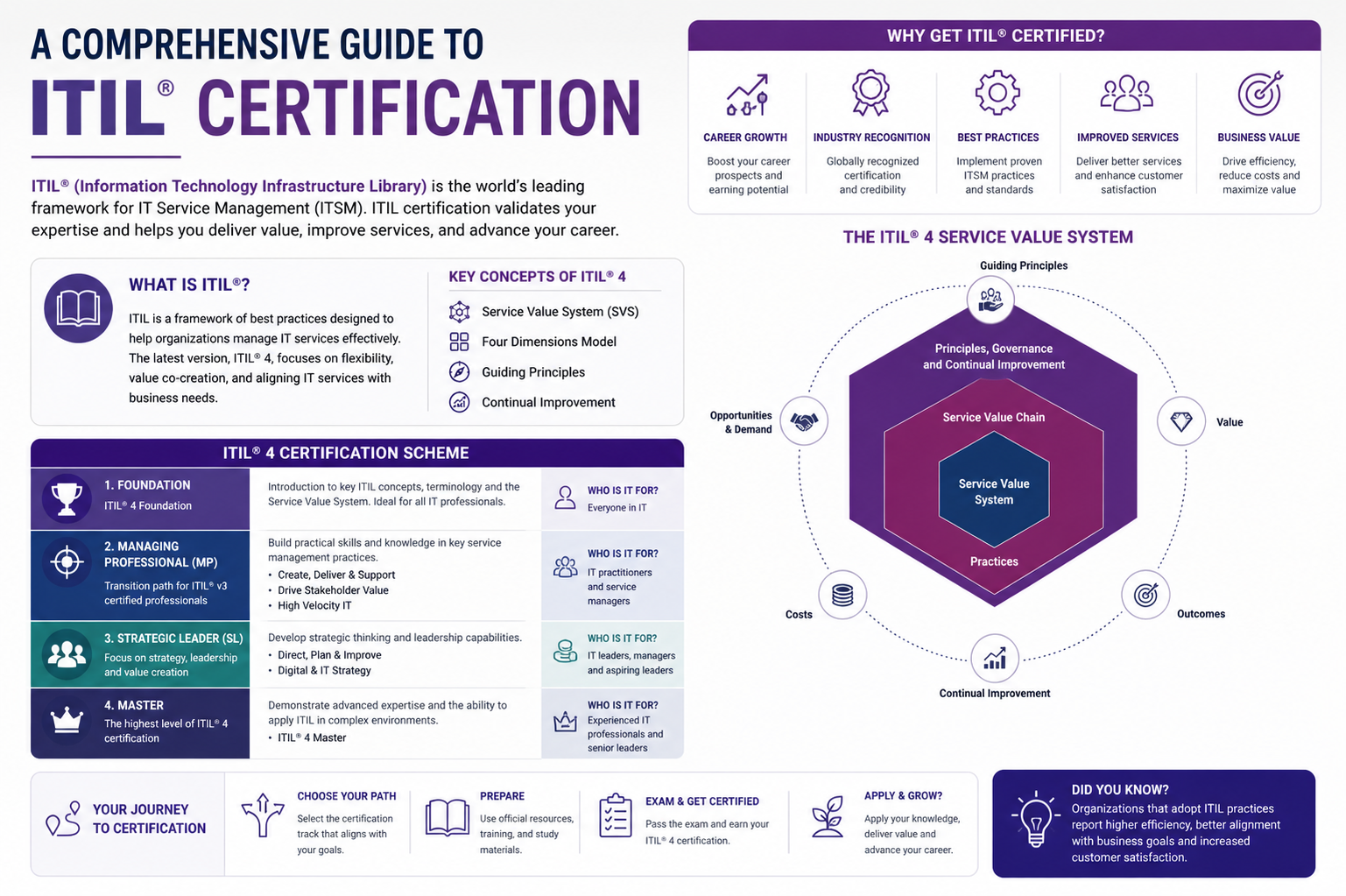
ITIL® Certification is a globally recognized credential that focuses on IT service management best practices and structured service delivery. It is designed to help professionals and organizations align IT services with business goals in a consistent and efficient manner. In today’s technology-driven environment, businesses rely heavily on IT systems, and any disruption can significantly impact productivity and customer satisfaction. This is where IT service management frameworks become essential.
The ITIL® framework provides a standardized approach for managing IT services from planning and design to operation and continuous improvement. It emphasizes delivering value to customers while maintaining cost efficiency and operational stability. Professionals who pursue ITIL® Certification develop a deeper understanding of how IT services support business processes and how to improve them systematically.
The certification is widely respected across industries because it focuses on practical, real-world applications rather than theoretical knowledge alone. It helps individuals build structured thinking when handling IT services, ensuring that organizations can respond effectively to changing business demands.
Understanding ITIL® and Its Purpose
ITIL® is built around the concept of aligning IT services with business needs. It is not just a set of rules but a collection of best practices that have evolved over time based on industry experience. The framework provides guidance on how to design, deliver, manage, and improve IT services in a controlled and efficient way.
One of the primary purposes of ITIL® is to ensure that IT services deliver maximum value to customers. This means focusing not only on technology but also on processes, people, and organizational structure. It encourages collaboration between IT teams and business stakeholders to ensure that services are reliable, scalable, and adaptable.
Another key objective of ITIL® is continuous improvement. Organizations are encouraged to regularly evaluate their services and identify areas where performance can be enhanced. This helps businesses remain competitive and responsive to market changes.
Evolution and Growth of ITIL®
The ITIL® framework has evolved over several decades to meet the changing needs of the IT industry. Initially developed as a set of guidelines for government IT departments, it gradually gained global recognition and was adopted by private organizations as well.
Over time, ITIL® has undergone multiple updates to reflect modern technologies and business practices. Earlier versions focused heavily on process management, while newer versions emphasize flexibility, collaboration, and value creation. This evolution ensures that the framework remains relevant in today’s fast-paced digital environment.
Modern ITIL® practices integrate concepts such as cloud computing, agile methodologies, and digital transformation. This makes it suitable not only for traditional IT environments but also for modern enterprises that rely on dynamic and scalable IT solutions.
Core Concepts of ITIL® Framework
The ITIL® framework is built on several key concepts that guide how IT services should be managed. One of the central ideas is the service lifecycle, which represents the stages through which a service passes from initial concept to retirement.
These stages include service strategy, service design, service transition, service operation, and continual service improvement. Each stage plays a critical role in ensuring that services are well-planned, effectively implemented, and continuously enhanced.
Another important concept is value co-creation, where IT services are designed to deliver mutual value to both providers and customers. Instead of simply delivering technical solutions, ITIL® encourages organizations to understand customer needs and create services that directly support business outcomes.
Service Strategy in ITIL®
Service strategy focuses on understanding organizational objectives and defining how IT services can support them. It involves identifying market opportunities, analyzing demand, and determining how IT resources can be used effectively.
This stage ensures that IT services are aligned with business goals before they are developed or implemented. It also involves financial management, service portfolio management, and demand management. These processes help organizations make informed decisions about which services to offer and how to allocate resources efficiently.
A strong service strategy ensures that IT investments are justified and contribute to long-term business success.
Service Design Principles
Service design focuses on creating IT services that are efficient, scalable, and reliable. It involves designing processes, technologies, and architectures that support service delivery.
This stage ensures that all aspects of a service, including infrastructure, security, and availability, are carefully planned before implementation. It also includes designing service level agreements to define performance expectations.
Good service design reduces the risk of service failures and ensures that services can meet both current and future business needs.
Service Transition and Implementation
Service transition is responsible for moving services from design into live environments. It ensures that new or changed services are properly tested, evaluated, and deployed without disrupting existing operations.
This stage includes change management, release management, and knowledge management. These processes help minimize risks associated with service changes and ensure smooth implementation.
Effective service transition ensures that services are delivered in a controlled and predictable manner, reducing downtime and operational disruptions.
Service Operation and Daily Management
Service operation focuses on the day-to-day management of IT services. It ensures that services are delivered efficiently and meet agreed performance levels.
This stage includes incident management, problem management, and request fulfillment. The goal is to restore normal service as quickly as possible when issues occur and to prevent recurring problems.
Service operation is essential for maintaining user satisfaction and ensuring that IT systems remain stable and reliable.
Continual Service Improvement
Continual service improvement is a core principle of ITIL® that emphasizes ongoing enhancement of services and processes. It involves regularly reviewing performance, identifying gaps, and implementing improvements.
This approach ensures that IT services evolve with changing business needs and technological advancements. It promotes a culture of learning and adaptation within organizations.
By continuously improving services, organizations can maintain competitiveness and deliver higher value to customers.
Benefits of ITIL® Certification for Professionals
ITIL® Certification provides several advantages for individuals working in IT service management. It enhances knowledge of structured processes and improves problem-solving abilities in complex IT environments.
Certified professionals are often better equipped to handle service disruptions, manage IT operations, and contribute to strategic decision-making. The certification also increases career opportunities by making candidates more attractive to employers.
It is widely recognized across industries, making it valuable for professionals seeking global career mobility.
Benefits of ITIL® for Organizations
Organizations that adopt ITIL® practices experience improved efficiency and better alignment between IT services and business goals. Standardized processes reduce errors and improve service quality.
It also helps organizations manage risks more effectively and improve customer satisfaction. By implementing structured service management practices, businesses can optimize resource utilization and reduce operational costs.
ITIL® also supports digital transformation by providing a flexible framework that can adapt to modern technologies.
Skills Developed Through ITIL® Certification
Professionals who pursue ITIL® Certification develop a wide range of skills, including process management, service optimization, and strategic thinking.
They learn how to analyze business requirements and translate them into effective IT solutions. The certification also improves communication skills by encouraging collaboration between IT teams and business stakeholders.
Additionally, it enhances analytical thinking and decision-making abilities, which are essential in managing complex IT environments.
Real-World Application of ITIL®
ITIL® principles are widely applied in real-world IT environments across industries such as banking, healthcare, education, and technology.
Organizations use ITIL® to manage service desks, handle incidents, implement changes, and ensure system reliability. It is particularly useful in large organizations where multiple IT systems need to be managed efficiently.
By applying ITIL® practices, businesses can ensure consistent service delivery and improve overall operational performance.
ITIL® in Real Organizational Implementation
Implementing ITIL® in an organization is not just about adopting a framework but about changing the way IT services are planned, delivered, and improved. Many organizations begin by assessing their current IT maturity level before introducing ITIL® practices. This helps identify gaps in processes, communication, and service delivery.
In real-world environments, ITIL® implementation often starts with critical areas such as incident management and service desk operations. These areas directly affect end users, making improvements visible in a short time. Once stability is achieved, organizations gradually expand ITIL® practices to include change management, problem management, and service level management.
A key success factor in implementation is leadership support. Without management commitment, ITIL® initiatives often fail to gain momentum. Leaders play an important role in defining priorities, allocating resources, and ensuring that teams adopt new processes consistently.
Employee training is also essential. ITIL® introduces structured ways of working that may differ from traditional IT practices. Training ensures that employees understand not only what to do but also why processes are important for delivering value.
Challenges in ITIL® Adoption
Although ITIL® provides a strong framework, organizations often face challenges during adoption. One of the most common issues is resistance to change. Employees who are used to informal or flexible processes may find structured workflows difficult to follow initially.
Another challenge is process complexity. If ITIL® is implemented without proper customization, it can become overly bureaucratic. This may slow down service delivery instead of improving it. Successful organizations adapt ITIL® principles to fit their size, industry, and operational needs.
Lack of proper tool integration is also a common issue. Without supporting software systems, managing ITIL® processes manually can become inefficient and error-prone. Organizations need appropriate service management tools to automate workflows and improve visibility.
In some cases, organizations also struggle with measuring success. Without clear performance indicators, it becomes difficult to evaluate whether ITIL® implementation is delivering expected benefits.
ITIL® and Service Quality Improvement
One of the primary goals of ITIL® is improving service quality. This is achieved by standardizing processes and ensuring consistent service delivery across the organization. Standardization reduces errors and helps teams follow best practices in every situation.
Service quality is also improved through better communication. ITIL® encourages structured communication between IT teams and business stakeholders. This ensures that expectations are clear and service performance is regularly reviewed.
Another important aspect is accountability. ITIL® defines clear roles and responsibilities, ensuring that every task has an owner. This reduces confusion and improves response times during incidents or service requests.
Continuous monitoring of service performance allows organizations to identify weaknesses and make improvements. Over time, this leads to more reliable systems and higher user satisfaction.
ITIL® and Risk Management
Risk management is an important part of IT service management. ITIL® helps organizations identify, assess, and control risks associated with IT services. These risks may include system failures, security breaches, or operational disruptions.
Change management plays a key role in reducing risk. Every change to IT systems is evaluated before implementation to ensure it does not negatively impact services. This controlled approach reduces unexpected failures.
Incident and problem management processes also contribute to risk reduction. By analyzing recurring issues, organizations can identify underlying problems and eliminate them before they cause major disruptions.
ITIL® also encourages proactive monitoring of systems. This helps detect potential issues early, allowing IT teams to resolve them before they affect users.
Integration of ITIL® with Modern IT Practices
Modern IT environments rely on agile development, DevOps, and cloud computing. ITIL® has evolved to integrate effectively with these approaches rather than replace them.
In agile environments, ITIL® provides structure and stability, while agile methods provide speed and flexibility. Together, they help organizations deliver services quickly without compromising quality.
In DevOps environments, ITIL® supports collaboration between development and operations teams. It ensures that changes are managed properly while maintaining continuous delivery pipelines.
Cloud computing has also influenced ITIL® practices. Service management now includes managing virtual infrastructure, scalable resources, and distributed systems. ITIL® provides guidelines for handling these modern environments efficiently.
Role of Automation in ITIL®
Automation is becoming increasingly important in IT service management. Many ITIL® processes such as incident routing, ticket categorization, and change approvals can be automated to improve efficiency.
Automation reduces manual effort and minimizes human errors. It also speeds up response times, allowing IT teams to focus on more complex tasks.
However, automation does not replace human decision-making. Instead, it supports IT teams by handling repetitive tasks and providing better visibility into system performance.
Organizations that combine ITIL® with automation tools often achieve higher efficiency and improved service quality.
ITIL® Metrics and Performance Measurement
Measuring performance is essential for evaluating the success of ITIL® implementation. Organizations use key performance indicators (KPIs) to track service quality, efficiency, and user satisfaction.
Common metrics include incident resolution time, service availability, and change success rate. These indicators help organizations understand how well IT services are performing.
Customer satisfaction is another important metric. Feedback from users provides valuable insights into service quality and areas for improvement.
Regular reporting ensures that management has clear visibility into IT operations. This supports better decision-making and strategic planning.
ITIL® and Organizational Culture
Successful ITIL® adoption requires a supportive organizational culture. Culture determines how employees respond to new processes and whether they are willing to adopt structured ways of working.
A culture of collaboration is essential because ITIL® relies on communication between different teams. When teams work together effectively, service delivery becomes smoother and more efficient.
A culture of continuous improvement is also important. Employees should be encouraged to identify problems and suggest improvements regularly.
Organizations that promote learning and adaptability are more likely to succeed in implementing ITIL® practices effectively.
Advanced Service Management Concepts
As organizations mature in ITIL® adoption, they move toward advanced service management concepts. These include service integration, portfolio management, and strategic alignment.
Service integration ensures that multiple IT services work together seamlessly. This is especially important in large organizations with complex IT environments.
Service portfolio management helps organizations manage all IT services throughout their lifecycle. It ensures that only valuable and relevant services are maintained.
Strategic alignment focuses on ensuring that IT services directly support business goals. This helps organizations maximize return on IT investments.
ITIL® in Incident and Problem Resolution
Incident management focuses on restoring services quickly when disruptions occur. The goal is to minimize downtime and ensure business continuity.
Problem management goes deeper by identifying root causes of incidents. Instead of repeatedly fixing the same issue, it aims to eliminate the source of the problem.
Together, these processes ensure both immediate recovery and long-term stability of IT services.
Efficient incident and problem resolution improves user experience and builds trust in IT systems.
Future Trends in ITIL® Practices
The future of ITIL® is closely linked to emerging technologies such as artificial intelligence, machine learning, and predictive analytics. These technologies will further enhance service management capabilities.
Predictive analytics will allow organizations to anticipate incidents before they occur. This will shift IT service management from reactive to proactive approaches.
Artificial intelligence will improve automation, decision-making, and service optimization. It will help IT teams handle complex environments more efficiently.
As technology continues to evolve, ITIL® will remain relevant by adapting its practices to new challenges and opportunities.
ITIL® Continual Improvement Model in Depth
Continual improvement is one of the most important aspects of ITIL® because it ensures that services do not remain static. Instead, they evolve based on performance data, user feedback, and changing business needs. The continual improvement model provides a structured way to identify what needs to be improved, plan improvements, and measure their effectiveness.
The process typically begins by identifying opportunities for improvement across IT services and processes. These opportunities can come from incidents, customer feedback, performance reports, or business changes. Once identified, they are analyzed to understand their impact and priority.
After analysis, improvement initiatives are planned in a structured manner. This includes defining objectives, allocating resources, and setting timelines. Implementation follows, where changes are applied to processes or systems.
Finally, results are measured to determine whether improvements have achieved the desired outcomes. If not, further adjustments are made. This cycle ensures continuous enhancement of IT services over time.
ITIL® Service Level Management
Service level management focuses on defining, agreeing, and monitoring service expectations between IT teams and business users. These expectations are usually documented in service level agreements that outline performance standards such as availability, response time, and resolution time.
The main goal of service level management is to ensure that IT services meet business requirements consistently. It acts as a bridge between technical teams and business stakeholders, ensuring mutual understanding of expectations.
Regular reviews of service performance are conducted to ensure that agreed service levels are being met. If performance falls below expectations, corrective actions are taken to improve service quality.
This practice helps organizations maintain transparency and accountability in IT service delivery.
ITIL® Knowledge Management
Knowledge management plays a crucial role in improving efficiency within IT service management. It focuses on collecting, organizing, and sharing information across the organization.
When knowledge is properly managed, IT teams can resolve incidents faster, reduce duplication of effort, and make better decisions. It also helps new employees learn processes more quickly.
A centralized knowledge base is often used to store solutions to common problems, process documentation, and best practices. This ensures that valuable information is easily accessible to everyone who needs it.
Effective knowledge management reduces dependency on individual expertise and strengthens organizational capability.
ITIL® Capacity and Availability Management
Capacity management ensures that IT systems have enough resources to meet current and future demands. It involves monitoring system performance and planning for growth so that services remain stable even during high usage.
Availability management focuses on ensuring that IT services are accessible when users need them. It aims to minimize downtime and ensure reliable service delivery.
Both practices work together to ensure that IT infrastructure supports business operations effectively. Poor capacity planning can lead to system slowdowns, while poor availability management can result in frequent outages.
By proactively managing these areas, organizations can maintain high performance and user satisfaction.
ITIL® Security Management
Security management ensures that IT services are protected against threats such as unauthorized access, data breaches, and cyberattacks. It focuses on maintaining confidentiality, integrity, and availability of information.
This practice involves implementing security policies, monitoring systems for threats, and responding to security incidents. It also includes regular risk assessments to identify vulnerabilities.
Security management is closely aligned with organizational compliance requirements and industry regulations. It ensures that IT systems meet legal and ethical standards.
In modern environments, security management is becoming increasingly important due to the rise of cyber threats and digital transformation.
ITIL® Supplier Management
Supplier management focuses on managing relationships with external vendors and service providers. Many organizations rely on third-party suppliers for hardware, software, and IT services.
This practice ensures that suppliers meet agreed service levels and deliver value to the organization. It involves selecting suppliers, negotiating contracts, and monitoring performance.
Effective supplier management helps organizations reduce risks associated with outsourcing and ensures consistent service quality.
It also ensures that external services integrate smoothly with internal IT processes.
ITIL® Change Control in Detail
Change control is one of the most critical ITIL® practices because it directly impacts system stability. Any modification to IT systems, whether small or large, must be carefully evaluated before implementation.
The process begins with a change request, which is reviewed to assess its impact, risk, and benefit. Approved changes are then scheduled and implemented in a controlled manner.
After implementation, changes are reviewed to ensure they have been successful and have not caused any unexpected issues.
This structured approach helps prevent system failures and ensures that IT environments remain stable even during updates and improvements.
ITIL® Release and Deployment Management
Release and deployment management focuses on planning, scheduling, and controlling the movement of changes into live environments. It ensures that new or updated services are delivered smoothly to users.
This practice involves testing changes before deployment, preparing release packages, and coordinating deployment activities.
A key objective is to minimize disruption during releases and ensure that users experience smooth transitions.
Proper release management reduces the risk of service downtime and improves overall service reliability.
ITIL® Service Desk Function
The service desk is the central point of contact between users and IT teams. It handles incidents, service requests, and communication between stakeholders.
A well-functioning service desk ensures that users receive timely support and that issues are resolved efficiently. It also plays a key role in maintaining user satisfaction.
Service desks often use ticketing systems to track and manage requests. This helps ensure that no issue is overlooked and that all requests are handled systematically.
The service desk also acts as a communication hub, providing updates and information to users during service disruptions.
ITIL® and Customer Experience
Customer experience is a key focus of modern IT service management. ITIL® emphasizes delivering services that meet or exceed user expectations.
Good customer experience is achieved through reliable services, fast response times, and effective communication. ITIL® practices help organizations achieve these goals by standardizing processes and improving service quality.
Feedback from users is used to identify areas for improvement and enhance service delivery.
A positive customer experience leads to higher satisfaction and stronger trust in IT services.
ITIL® Automation and Artificial Intelligence Integration
Automation and artificial intelligence are transforming how ITIL® processes are executed. Many routine tasks such as ticket assignment, monitoring, and reporting can now be automated.
Artificial intelligence can analyze large amounts of data to identify patterns, predict incidents, and suggest solutions. This helps IT teams respond faster and more accurately.
Automation reduces manual workload and improves efficiency, allowing teams to focus on strategic tasks rather than repetitive activities.
However, human oversight remains important to ensure that automated decisions align with business goals.
ITIL® in Hybrid IT Environments
Modern organizations often use a combination of on-premise systems, cloud platforms, and third-party services. This is known as a hybrid IT environment.
ITIL® provides a structured approach to managing these complex environments. It ensures that services remain consistent across different platforms and technologies.
Hybrid environments require strong coordination between different systems, and ITIL® practices help maintain this coordination effectively.
This ensures that users experience seamless service regardless of where the infrastructure is hosted.
ITIL® and Business Alignment
One of the core strengths of ITIL® is its ability to align IT services with business objectives. Instead of operating in isolation, IT teams work closely with business stakeholders.
This alignment ensures that IT investments support organizational goals and deliver measurable value.
Regular communication between IT and business teams helps ensure that services remain relevant and effective.
Business alignment is essential for maximizing the impact of IT services on organizational success.
ITIL® Problem Management in Practice
Problem management is a key ITIL® practice focused on identifying the root causes of recurring incidents and preventing them from happening again. Unlike incident management, which aims to restore services quickly, problem management looks deeper into underlying issues.
It typically begins when patterns of repeated incidents are detected. These patterns indicate that there is a deeper issue within the system that needs investigation. The goal is not only to fix the immediate symptoms but to eliminate the root cause permanently.
Once a problem is identified, it is analyzed using techniques such as root cause analysis, trend analysis, and diagnostic reviews. After the cause is understood, a known error record may be created to document the issue and possible workarounds.
A permanent fix is then planned and implemented through the change management process. This ensures that the solution is applied in a controlled and safe manner. Over time, effective problem management significantly reduces the number of incidents and improves overall system stability.
ITIL® Incident Management Lifecycle
Incident management is designed to restore normal service operation as quickly as possible when disruptions occur. It focuses on minimizing the impact of incidents on business operations and users.
The lifecycle begins when an incident is reported, either by users or monitoring systems. The incident is logged, categorized, and prioritized based on its impact and urgency. High-priority incidents are addressed first to reduce business disruption.
Next, the incident is assigned to the appropriate support team for resolution. Teams investigate the issue and apply known solutions or workarounds if available.
Once the issue is resolved, the incident is closed after confirmation from the user. Throughout the process, communication is maintained to keep stakeholders informed about progress.
Efficient incident management ensures quick recovery and helps maintain user satisfaction.
ITIL® Request Fulfillment Process
Request fulfillment handles standard service requests from users. These requests are usually routine in nature and do not involve system failures. Examples include password resets, access requests, or installation of software.
The process begins when a user submits a request through the service desk. The request is logged and categorized according to its type.
If the request is approved, it is fulfilled by the relevant IT team. Some requests may be automated, allowing faster processing without manual intervention.
Once completed, the user is notified, and the request is closed. This process improves efficiency by separating routine requests from complex incidents.
ITIL® Configuration Management System
The configuration management system is responsible for maintaining accurate information about IT assets and their relationships. It provides a structured view of all configuration items within the IT environment.
This includes hardware, software, network components, and documentation. The system tracks how these components interact with each other and how they support business services.
Having accurate configuration data is essential for effective incident resolution, change management, and problem analysis. It helps IT teams understand the impact of changes and identify dependencies quickly.
Without proper configuration management, organizations may struggle with inconsistent data and inefficient decision-making.
ITIL® Event Management
Event management focuses on monitoring IT systems and identifying significant occurrences that may require attention. Events can be informational, warning-based, or indicative of a problem.
The main goal is to detect and respond to events before they escalate into incidents. Automated monitoring tools often play a key role in this process.
When an event is detected, it is analyzed to determine whether action is required. If necessary, it is escalated into an incident or problem record.
Effective event management improves system reliability by enabling proactive responses to potential issues.
ITIL® Financial Management for IT Services
Financial management ensures that IT services are delivered in a cost-effective manner. It involves budgeting, accounting, and charging for IT services.
Organizations use this practice to plan IT expenditures and ensure that resources are used efficiently. It also helps in understanding the cost of delivering specific services.
In some cases, internal charging models are used where departments are billed for IT services they consume. This promotes accountability and efficient usage of resources.
Financial management ensures that IT investments are aligned with business priorities and deliver measurable value.
ITIL® Demand Management
Demand management focuses on understanding and influencing customer demand for IT services. It ensures that IT resources are available to meet fluctuating business needs.
By analyzing usage patterns, organizations can predict peak demand periods and allocate resources accordingly. This helps prevent system overloads and performance issues.
Demand management also works to balance supply and demand effectively, ensuring optimal use of IT infrastructure.
This practice is essential for maintaining service stability in dynamic business environments.
ITIL® Service Catalog Management
Service catalog management involves maintaining a structured list of all available IT services. This catalog provides users with clear information about services they can request.
Each service in the catalog includes details such as description, availability, and support options. It helps users understand what services are offered and how to access them.
A well-maintained service catalog improves transparency and reduces confusion. It also streamlines request fulfillment by providing standardized service definitions.
This practice ensures that users have a clear and consistent view of IT services.
ITIL® Measurement and Reporting
Measurement and reporting are essential for evaluating the performance of IT services. Organizations collect data on various metrics to assess efficiency, reliability, and user satisfaction.
Reports are generated to provide insights into service performance and identify areas for improvement. These reports are often shared with management and stakeholders.
Key metrics may include response times, resolution rates, system uptime, and customer feedback scores.
Accurate reporting helps organizations make informed decisions and improve service quality over time.
ITIL® and Organizational Efficiency
ITIL® significantly improves organizational efficiency by standardizing processes and reducing unnecessary complexity. It ensures that tasks are performed in a consistent and controlled manner.
By clearly defining roles and responsibilities, ITIL® eliminates confusion and improves accountability. Teams know exactly what is expected of them in different situations.
Automation and structured workflows further enhance efficiency by reducing manual effort and speeding up service delivery.
Overall, ITIL® helps organizations achieve more with fewer resources while maintaining high-quality service standards.
ITIL® and Strategic Decision Making
ITIL® supports strategic decision-making by providing accurate and timely information about IT services. Managers can use this data to make informed choices about investments and improvements.
Service performance reports, incident trends, and financial data all contribute to better decision-making.
This ensures that IT strategies are aligned with business objectives and long-term goals.
By using ITIL® practices, organizations can move from reactive management to proactive planning.
ITIL® in Cloud and Virtual Environments
Cloud computing has transformed the way IT services are delivered. ITIL® provides a structured approach to managing cloud-based and virtual environments.
It helps organizations manage scalability, resource allocation, and service availability in cloud systems.
Virtual environments require careful monitoring and configuration management, which ITIL® supports through its practices.
This ensures that cloud services remain reliable, secure, and cost-effective.
ITIL® and Service Resilience
Service resilience refers to the ability of IT systems to recover quickly from disruptions. ITIL® contributes to resilience through practices such as incident management, problem management, and availability management.
Resilient systems are designed to minimize downtime and ensure continuous service delivery.
By identifying risks and implementing preventive measures, organizations can improve system reliability.
This is especially important in industries where downtime can have significant financial or operational impact.
ITIL® Value Creation in IT Services
The ultimate goal of ITIL® is to create value for both organizations and customers. Value is achieved when IT services support business objectives and improve efficiency.
ITIL® ensures that services are not just technically sound but also aligned with user needs and expectations.
Value creation involves balancing cost, quality, and performance to deliver optimal results.
By focusing on value, organizations can ensure that their IT investments produce meaningful outcomes.
Final Conclusion
ITIL® provides a complete and structured framework for managing IT services across all stages of the service lifecycle. From incident management to strategic planning, it ensures consistency, efficiency, and continuous improvement.
Its practices help organizations reduce risks, improve service quality, and align IT operations with business goals. For professionals, ITIL® offers deep knowledge, practical skills, and strong career opportunities in IT service management.
As technology continues to evolve, ITIL® remains a reliable foundation for building efficient, scalable, and value-driven IT services in modern organizations.