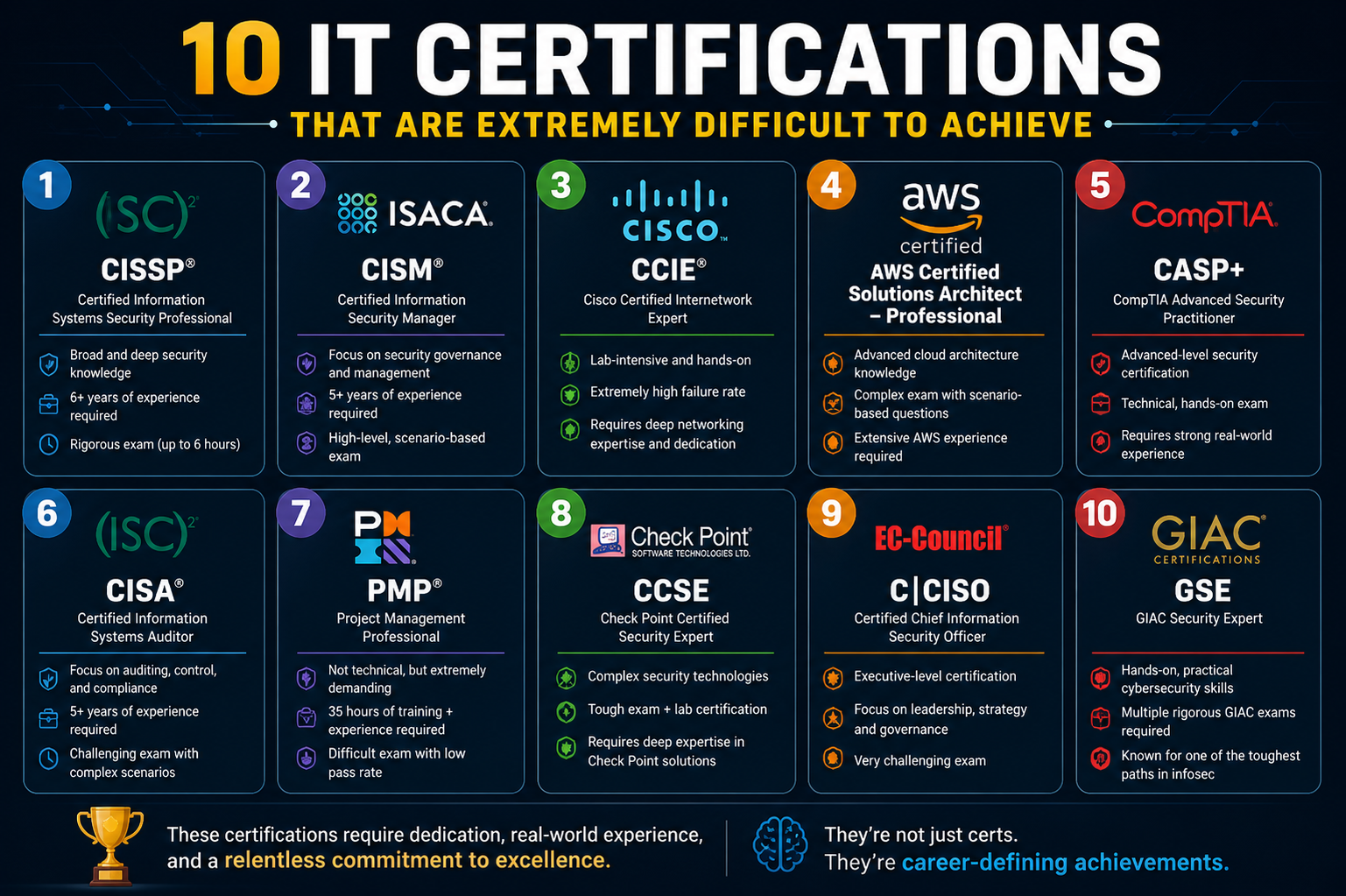
The Cisco Certified Internetwork Expert is considered one of the most prestigious and demanding networking certifications in the world. It is designed for professionals who already possess advanced-level networking knowledge and want to validate their ability to design, implement, and troubleshoot complex enterprise and service provider infrastructures. What makes CCIE exceptionally difficult is not just the depth of knowledge required, but also the ability to apply that knowledge under extreme pressure in real-world scenarios.
The certification process includes two major stages: a written qualification exam and a rigorous hands-on lab exam. The written exam tests theoretical understanding of networking concepts such as routing protocols, network security, automation, and infrastructure design. However, the true challenge lies in the lab exam, which can last for eight hours or more. During this time, candidates must configure and troubleshoot a fully simulated network environment while meeting strict performance requirements.
Many candidates struggle because the exam does not simply test memorization. Instead, it evaluates critical thinking, time management, and real-world problem-solving abilities. Even highly experienced network engineers often require multiple attempts before passing. CCIE is also constantly updated to reflect modern networking trends, including software-defined networking and cloud integration, making continuous learning essential for success.
Professionals who achieve CCIE status are often regarded as elite networking experts and typically work in high-level roles such as network architects, senior engineers, or consultants. The certification not only validates technical excellence but also demonstrates persistence, discipline, and deep practical expertise in networking technologies.
Certified Information Systems Security Professional (CISSP)
The Certified Information Systems Security Professional certification is one of the most respected credentials in the field of cybersecurity. It is intended for experienced security practitioners, managers, and executives who are responsible for designing and managing an organization’s security posture. Unlike highly technical certifications that focus on tools or hands-on tasks, CISSP emphasizes a broad understanding of security principles and strategic decision-making.
The exam covers eight major domains, including security and risk management, asset security, security architecture, communication and network security, identity and access management, and software development security. The breadth of these topics makes CISSP particularly challenging because candidates must understand a wide range of concepts at both technical and managerial levels.
One of the most difficult aspects of CISSP is its scenario-based questioning style. Instead of asking straightforward factual questions, the exam presents complex situations that require candidates to choose the “best” security practice or solution. This often involves thinking like a security leader rather than a technician, which can be difficult for those who lack management experience.
Another major requirement is professional experience. Candidates typically need several years of full-time security work experience before they can even qualify for certification. This ensures that only individuals with real-world exposure attempt the exam, but it also increases the difficulty level significantly.
Those who earn CISSP certification are often trusted with senior roles such as security analysts, consultants, and chief information security officers. The certification is widely recognized across industries and is often a requirement for advanced cybersecurity positions.
Offensive Security Certified Professional (OSCP)
The Offensive Security Certified Professional certification is one of the most respected ethical hacking credentials in cybersecurity. It is known for its extremely practical and hands-on nature, which sets it apart from many other certifications that rely heavily on theoretical knowledge. OSCP focuses on real penetration testing skills, requiring candidates to actively exploit vulnerabilities in a controlled environment.
The exam is conducted in a virtual lab where candidates are given access to multiple machines with different security weaknesses. Their task is to identify vulnerabilities, exploit them, gain unauthorized access, and document the entire process. The challenge is not only technical but also strategic, as candidates must decide how to approach each system efficiently within a limited timeframe.
One of the most difficult aspects of OSCP is its requirement for persistence and creativity. There are no multiple-choice questions or guided instructions. Instead, candidates must independently figure out how to break into systems using a combination of tools, scripting, and manual techniques. This often involves deep knowledge of Linux, networking, and common exploitation methods.
Time management also plays a critical role in the exam. Candidates typically have 24 hours to complete the lab portion, followed by a detailed report submission. The pressure of working continuously under time constraints adds to the difficulty.
OSCP is highly respected in the cybersecurity industry because it proves that a professional can perform real-world penetration testing tasks. Those who earn this certification are often employed as penetration testers, security researchers, and ethical hacking consultants.
AWS Certified Solutions Architect – Professional
The AWS Certified Solutions Architect – Professional certification is one of the most advanced cloud computing credentials available. It is designed for individuals who already have significant experience working with Amazon Web Services and want to demonstrate their ability to design highly scalable, secure, and cost-efficient cloud architectures.
The exam is known for its complexity and scenario-based questions. Instead of testing simple definitions or commands, it presents real-world business problems that require candidates to design optimal cloud solutions. These scenarios often involve trade-offs between performance, cost, security, and reliability.
To succeed, candidates must have deep knowledge of a wide range of AWS services, including compute, storage, networking, databases, and security tools. They must also understand architectural best practices such as high availability, fault tolerance, and disaster recovery strategies.
One of the most challenging aspects of this certification is the need for strategic thinking. Candidates are often required to evaluate multiple possible solutions and choose the one that best meets specific business requirements. This goes beyond technical skills and requires strong analytical and decision-making abilities.
Practical experience is essential for success. Those without hands-on experience in designing and deploying AWS architectures often struggle significantly. The exam is intentionally designed to test real-world expertise rather than theoretical knowledge.
Professionals who achieve this certification are typically cloud architects, senior engineers, or consultants responsible for designing enterprise-level cloud systems. It is highly valued in the industry and often leads to advanced career opportunities in cloud computing.
Google Professional Cloud Architect
The Google Professional Cloud Architect certification is one of the most challenging cloud certifications offered by Google Cloud. It validates the ability to design, develop, and manage secure, scalable, and highly available solutions using Google Cloud Platform services.
The certification goes beyond technical configuration and focuses heavily on system design and business alignment. Candidates are expected to translate business requirements into technical cloud solutions, which requires both engineering knowledge and strategic thinking.
The exam includes detailed case studies that simulate real-world business environments. Candidates must analyze these scenarios and determine the most effective architectural approach. This often involves balancing performance, cost optimization, security, and operational efficiency.
A major challenge of this certification is the breadth of services covered. Google Cloud offers a wide range of tools, and candidates must understand how they interact within complex systems. This includes computing services, storage solutions, machine learning tools, and networking configurations.
Unlike simpler exams, this certification tests judgment and architectural decision-making rather than memorization. Candidates must demonstrate the ability to design solutions that are not only technically sound but also aligned with business goals.
Professionals who earn this certification are typically cloud architects, solution designers, or senior engineers working on large-scale cloud projects. It is highly respected in the industry and indicates strong expertise in modern cloud architecture principles.
Microsoft Certified: Azure Solutions Architect Expert
The Microsoft Certified: Azure Solutions Architect Expert certification is one of the most advanced credentials in the Microsoft Azure ecosystem. It is designed for professionals who are responsible for translating business requirements into secure, scalable, and reliable cloud solutions using Microsoft Azure services. This certification is not focused on basic cloud usage but instead targets complex architectural design and implementation decisions across enterprise-level systems.
The difficulty of this certification lies in its wide technical scope and scenario-based exam format. Candidates are expected to understand networking, identity management, storage systems, security controls, and governance models within Azure. However, the exam does not test these topics in isolation. Instead, it presents real-world business scenarios where multiple Azure services must be combined to create an optimal solution.
One of the most challenging aspects is the requirement to balance competing priorities such as cost efficiency, performance, scalability, and security. Candidates must decide how to architect systems that meet strict business requirements while also following Microsoft’s best practices. This requires not only technical knowledge but also strong analytical and decision-making skills.
Hands-on experience is essential for success in this certification. Professionals who have not worked extensively with Azure services often struggle because the exam assumes familiarity with real-world deployments. Tasks may involve designing hybrid cloud environments, implementing disaster recovery strategies, or optimizing large-scale distributed applications.
Those who achieve this certification are often employed as cloud architects, senior consultants, or enterprise solution designers. It is widely respected in the IT industry because it demonstrates the ability to design and manage complex cloud infrastructures at an enterprise level.
Red Hat Certified Engineer (RHCE)
The Red Hat Certified Engineer certification is one of the most respected credentials for Linux system administrators. It focuses on advanced system administration skills using Red Hat Enterprise Linux environments. Unlike many theory-based certifications, RHCE is entirely performance-based, meaning candidates must demonstrate their skills in a live system environment.
The exam requires candidates to complete a series of real-world tasks such as configuring system services, managing storage, securing systems, and automating administrative tasks using scripting tools like Ansible. There are no multiple-choice questions, which significantly increases the difficulty level because every task must be performed accurately under time pressure.
One of the most challenging aspects of RHCE is its emphasis on automation and efficiency. Modern system administration requires not only manual configuration skills but also the ability to automate repetitive tasks. Candidates must demonstrate proficiency in writing automation scripts and managing multiple systems simultaneously.
Another difficulty factor is the strict exam environment. Candidates are given a limited amount of time to complete all tasks, and even small mistakes can result in failure. There is no partial credit, so precision and deep understanding of Linux systems are critical.
RHCE is highly valued in industries that rely heavily on Linux infrastructure, such as cloud computing, data centers, and enterprise IT environments. Professionals who earn this certification are often considered expert-level Linux engineers capable of managing large-scale systems efficiently and securely.
GIAC Security Expert (GSE)
The GIAC Security Expert certification is one of the most advanced and prestigious certifications in cybersecurity. It is offered by the Global Information Assurance Certification organization and is designed for elite security professionals who have mastered multiple areas of information security.
What makes GSE extremely difficult is its multi-layered structure. Before even qualifying for the final exam, candidates must pass several prerequisite GIAC certifications covering different domains such as penetration testing, incident response, network defense, and digital forensics. This ensures that only highly experienced professionals can attempt the final certification.
The final exam itself is known for its intensity and breadth. It tests deep technical knowledge across a wide range of cybersecurity disciplines. Candidates are expected to understand advanced attack techniques, defensive strategies, and security architecture design at a highly detailed level.
Another major challenge is the practical nature of the exam. It often requires candidates to solve complex security problems under time constraints, simulating real-world cyberattack and defense scenarios. This demands not only theoretical knowledge but also strong hands-on experience in cybersecurity operations.
The GSE certification is highly respected in government agencies, military organizations, and enterprise security teams. Professionals who achieve this certification are considered top-tier cybersecurity experts capable of handling the most complex security challenges.
Certified Information Security Manager (CISM)
The Certified Information Security Manager certification focuses on the management and governance aspects of information security. Unlike highly technical certifications, CISM is designed for professionals who are responsible for overseeing and managing enterprise-level security programs.
The exam covers four major domains: information security governance, risk management, security program development, and incident management. While these topics may seem straightforward, the difficulty lies in the managerial and strategic perspective required to answer the questions correctly.
One of the most challenging aspects of CISM is its focus on decision-making from a leadership standpoint. Candidates are often presented with complex organizational scenarios and must choose the most appropriate management action. This requires understanding not just technical security concepts but also business priorities and risk considerations.
Experience plays a critical role in this certification. Candidates are expected to have several years of professional experience in information security management before attempting the exam. This ensures that they can apply real-world knowledge to the scenarios presented in the test.
CISM is highly valued in leadership roles such as information security managers, risk officers, and compliance directors. It demonstrates the ability to design, implement, and manage enterprise security programs effectively.
CompTIA SecurityX (formerly CASP+)
CompTIA SecurityX is an advanced-level cybersecurity certification designed for experienced IT security professionals. It focuses on enterprise security architecture, risk management, integration of secure solutions, and advanced cybersecurity concepts. Unlike entry-level certifications, SecurityX is designed for professionals who already have strong technical backgrounds in IT and cybersecurity.
The exam is performance-based and scenario-driven, requiring candidates to apply their knowledge to real-world enterprise environments. Instead of simple theoretical questions, candidates must analyze complex situations and determine the best security solutions based on organizational needs.
One of the most difficult aspects of this certification is its emphasis on advanced security integration. Candidates must understand how different security technologies work together within large-scale systems. This includes network security, endpoint protection, identity management, and cloud security integration.
Another challenge is the depth of technical knowledge required. The exam covers a wide range of topics including cryptography, risk analysis, secure architecture design, and incident response strategies. Candidates must not only understand these concepts but also know how to apply them in practical scenarios.
SecurityX is widely recognized in enterprise IT environments where advanced cybersecurity expertise is required. Professionals who earn this certification often work as senior security engineers, cybersecurity architects, or technical security consultants. It demonstrates a high level of practical expertise and strategic thinking in cybersecurity operations.
Certified Ethical Hacker (CEH)
The Certified Ethical Hacker certification is one of the most well-known cybersecurity credentials focused on offensive security skills. It is designed to teach professionals how to think and act like hackers in order to identify and fix vulnerabilities in systems before malicious attackers can exploit them. While the certification is often considered entry-to-mid level in cybersecurity, its difficulty should not be underestimated due to the breadth of topics covered.
The exam includes a wide range of domains such as footprinting and reconnaissance, network scanning, system hacking, malware threats, social engineering, and web application attacks. Candidates must understand both theoretical concepts and practical attack techniques. The challenge lies in memorizing a large number of tools, commands, and methodologies used in ethical hacking.
Another difficult aspect of CEH is its fast-paced exam structure. Candidates are required to answer a large number of questions within a limited time, which tests both accuracy and speed. Many questions are scenario-based, requiring the candidate to choose the most appropriate hacking or defense technique in a given situation.
Although CEH is less hands-on compared to certifications like OSCP, it still requires strong foundational knowledge of networking, operating systems, and cybersecurity principles. Without practical exposure to real-world systems, many candidates struggle to fully understand how attacks and defenses work in practice.
Professionals who earn CEH certification are often employed as security analysts, penetration testers, or cybersecurity consultants. It serves as a strong entry point into offensive security roles and is widely recognized across industries.
Cisco Certified Network Professional (CCNP)
The Cisco Certified Network Professional certification is an advanced-level networking credential that validates the ability to plan, implement, verify, and troubleshoot enterprise networks. It is considered a significant step up from entry-level certifications because it focuses on complex networking environments and real-world infrastructure challenges.
The certification covers multiple areas such as advanced routing, switching, network security, automation, and network services. Candidates are expected to have a deep understanding of how large-scale networks operate and how different protocols interact within enterprise systems.
One of the most challenging aspects of CCNP is the level of detail required in troubleshooting network issues. Candidates must be able to diagnose and resolve complex connectivity problems that may involve multiple layers of the network stack. This requires strong analytical skills and hands-on experience with networking equipment.
The exam also includes scenario-based questions that test decision-making in real-world environments. Candidates may be asked to design or optimize network architectures based on specific business requirements, which adds another layer of difficulty.
CCNP is highly valued in networking careers and often leads to roles such as network engineer, infrastructure specialist, or systems administrator. It is considered a stepping stone toward the more advanced CCIE certification.
Project Management Professional (PMP)
The Project Management Professional certification is one of the most recognized credentials in the field of project management. Although it is not a technical IT certification, it is widely used in IT project environments and is known for its difficulty due to its conceptual and scenario-based nature.
The PMP exam is based on project management principles such as planning, execution, monitoring, controlling, and closing projects. It also includes agile and hybrid methodologies, making it relevant to modern IT environments. Candidates must understand how to manage scope, time, cost, quality, risk, and stakeholder expectations effectively.
One of the most difficult aspects of PMP is its emphasis on situational judgment. The exam presents complex project scenarios and asks candidates to choose the best course of action. There is often more than one seemingly correct answer, but only one aligns with best practices according to the Project Management Institute standards.
Another challenge is the requirement for formal project management experience before even qualifying for the exam. Candidates must have documented hours of leading and directing projects, which ensures that only experienced professionals attempt the certification.
PMP-certified professionals are highly valued in IT organizations because they are capable of managing large-scale projects, coordinating teams, and ensuring successful project delivery.
Oracle Certified Master (OCM)
The Oracle Certified Master certification is one of the highest-level credentials offered by Oracle and is considered extremely difficult due to its hands-on and practical exam format. It focuses on advanced database administration skills and is designed for experienced Oracle professionals.
Unlike many certifications that rely on written exams, OCM requires candidates to complete complex tasks in a live database environment. These tasks may include database installation, configuration, performance tuning, backup and recovery, and troubleshooting critical system issues.
The difficulty of OCM lies in its requirement for deep technical expertise and real-world experience. Candidates must be able to manage large and complex database systems under strict time constraints. Even small configuration errors can lead to system failures, which increases the pressure during the exam.
Another challenge is the extensive preparation required before attempting the certification. Candidates must complete prerequisite Oracle certifications and gain significant hands-on experience with Oracle databases.
OCM-certified professionals are often employed as senior database administrators, enterprise architects, or database consultants. The certification is highly respected because it demonstrates elite-level expertise in Oracle technologies.
Google Cloud Professional Data Engineer
The Google Cloud Professional Data Engineer certification is designed for professionals who specialize in designing and managing data processing systems on Google Cloud Platform. It is considered one of the more challenging cloud certifications due to its focus on both data engineering and cloud architecture.
The certification covers topics such as data ingestion, storage systems, data processing, machine learning integration, and system optimization. Candidates must understand how to design scalable data pipelines and ensure data reliability, security, and efficiency.
One of the most difficult aspects of this certification is the complexity of data architecture scenarios. Candidates are required to analyze large-scale data problems and select the most appropriate Google Cloud services to solve them. This requires strong analytical thinking and deep familiarity with cloud-based data tools.
Another challenge is the integration of multiple services within a single solution. Candidates must understand how different components such as BigQuery, Dataflow, and Pub/Sub work together in real-world architectures.
Professionals who achieve this certification are often data engineers, analytics specialists, or cloud architects working on large-scale data platforms. It demonstrates advanced expertise in designing and managing data-driven systems in cloud environments.
AWS Certified Security – Specialty
The AWS Certified Security – Specialty certification is one of the most advanced credentials in Amazon Web Services, focusing specifically on securing cloud environments. It is designed for professionals who already have strong experience working with AWS and want to demonstrate deep expertise in cloud security architecture, data protection, and incident response within distributed systems.
The exam covers a wide range of complex security topics, including identity and access management, encryption methods, monitoring and logging, infrastructure security, and incident investigation. Candidates are expected to understand how to secure both data at rest and data in transit across multiple AWS services.
One of the most difficult aspects of this certification is the depth of knowledge required for AWS security tools and configurations. Candidates must know how to implement advanced security controls using services such as AWS IAM, KMS, CloudTrail, and GuardDuty. The exam often presents real-world scenarios where multiple security layers must be combined to protect a system effectively.
Another challenge is the scenario-based nature of the questions. Instead of asking simple definitions, the exam tests decision-making skills in complex cloud environments. Candidates must choose the most secure and cost-effective solution while following AWS best practices, which requires strong analytical thinking.
Professionals who earn this certification are typically cloud security engineers, security architects, or DevSecOps specialists. It is highly respected because it proves advanced capability in securing enterprise-level cloud systems.
Microsoft Certified: DevOps Engineer Expert
The Microsoft Certified: DevOps Engineer Expert certification validates the ability to design and implement DevOps practices using Microsoft Azure technologies. It focuses on combining development and operations processes to improve software delivery speed, reliability, and efficiency.
The certification covers areas such as continuous integration, continuous delivery, infrastructure as code, monitoring, security, and automation. Candidates must understand how to integrate development pipelines with cloud infrastructure to create seamless deployment workflows.
One of the most challenging aspects of this certification is the requirement to understand both development and operations perspectives. Candidates must be comfortable with coding concepts as well as system administration and cloud infrastructure management.
The exam includes scenario-based questions that test the ability to design DevOps strategies for real-world enterprise environments. These scenarios often involve trade-offs between speed, reliability, and security, requiring strong decision-making skills.
Hands-on experience is extremely important for this certification. Professionals must be familiar with Azure DevOps tools, Git workflows, containerization technologies, and cloud deployment strategies to succeed.
DevOps Engineer Experts are highly valued in modern IT organizations because they improve software development cycles and operational efficiency. They often work in roles such as DevOps engineers, release managers, or cloud automation specialists.
Certified Information Systems Auditor (CISA)
The Certified Information Systems Auditor certification is a globally recognized credential focused on auditing, control, and assurance of information systems. It is ideal for professionals involved in IT auditing, compliance, and governance roles.
The certification covers domains such as information system auditing processes, governance and management of IT, information system acquisition and development, and protection of information assets. Candidates must understand both technical systems and business control frameworks.
One of the most difficult aspects of CISA is its emphasis on auditing principles rather than technical execution. Candidates must evaluate systems from a risk and compliance perspective, which requires a different mindset compared to technical IT roles.
The exam includes scenario-based questions where candidates must identify risks, evaluate controls, and recommend audit procedures. This requires strong analytical and critical thinking skills, as well as knowledge of industry standards and regulations.
CISA also requires professional experience in IT auditing or control-related roles, ensuring that candidates have real-world exposure to enterprise systems before attempting the exam.
Professionals who earn this certification often work as IT auditors, compliance officers, or risk management specialists. It is highly valued in industries where regulatory compliance and security governance are critical.
CompTIA Advanced Security Practitioner (CASP+)
The CompTIA Advanced Security Practitioner certification is an advanced-level cybersecurity credential designed for experienced IT security professionals. It focuses on enterprise security architecture, risk management, integration of advanced security solutions, and cryptographic systems.
The certification is known for its practical and scenario-based exam format. Candidates are required to analyze complex enterprise security problems and design appropriate solutions that align with organizational requirements.
One of the most difficult aspects of CASP+ is its broad coverage of advanced cybersecurity topics. Candidates must understand not only technical security controls but also how to integrate them into large-scale enterprise environments.
The exam includes performance-based questions that test real-world problem-solving abilities. These questions often require candidates to evaluate multiple security options and choose the most effective solution based on risk, cost, and efficiency.
CASP+ is particularly challenging because it is designed for experienced professionals rather than beginners. It assumes a strong foundation in networking, security, and system administration.
Professionals who achieve CASP+ certification are often senior security engineers, cybersecurity architects, or technical consultants. It demonstrates advanced expertise in designing and implementing secure enterprise systems.
Certified Cloud Security Professional (CCSP)
The Certified Cloud Security Professional certification is an advanced credential focused on securing cloud environments across different platforms and architectures. It is designed for professionals who already have experience in cybersecurity and want to specialize in cloud security principles, governance, and risk management.
The exam covers domains such as cloud data security, cloud platform architecture, legal and compliance issues, and cloud application security. Candidates must understand how security controls are applied in shared responsibility models across different cloud service providers.
One of the most challenging aspects of CCSP is its conceptual depth combined with broad coverage. Unlike certifications that focus on a single platform, CCSP requires knowledge of general cloud security principles that apply across multiple environments. This makes it both wide-ranging and strategically demanding.
Scenario-based questions are a major difficulty factor. Candidates must evaluate cloud architectures and determine the most secure design while considering compliance requirements and operational constraints. This requires both technical knowledge and strong decision-making skills.
Professionals who earn CCSP are often cloud security architects, consultants, or enterprise security specialists working in organizations with complex cloud infrastructures.
VMware Certified Design Expert (VCDX)
The VMware Certified Design Expert is one of the most elite and difficult certifications in virtualization and cloud infrastructure design. It is considered the highest level of VMware certification and is aimed at experienced architects responsible for designing enterprise-scale virtualization solutions.
Unlike traditional exams, VCDX requires candidates to submit a complete design documentation portfolio and defend it in front of a panel of experts. This oral defense process makes it extremely challenging because candidates must justify every architectural decision in real time.
The certification focuses on deep understanding of VMware technologies, including virtualization, networking, storage design, and cloud infrastructure architecture. Candidates must demonstrate not only technical expertise but also the ability to design scalable and resilient systems.
One of the hardest aspects is the defense interview, where experts challenge the design choices under intense questioning. Many candidates fail not due to lack of knowledge, but due to inability to defend architectural decisions clearly and confidently.
VCDX-certified professionals are considered elite VMware architects and often lead large-scale virtualization and cloud transformation projects.
Cisco Certified Design Expert (CCDE)
The Cisco Certified Design Expert certification is one of the highest-level networking design certifications available. It focuses on the ability to design complex, scalable, and secure network infrastructures for large enterprises and service providers.
The exam does not test configuration skills but instead focuses entirely on network design theory and architecture. Candidates must analyze business requirements and translate them into efficient network designs.
One of the most difficult aspects of CCDE is the abstract nature of the exam. Instead of hands-on tasks, candidates must evaluate complex design scenarios and choose the best architectural solution. This requires deep conceptual understanding of networking principles.
The exam is also known for its long and complex scenario-based questions, which test critical thinking, business understanding, and technical expertise simultaneously.
CCDE-certified professionals are often senior network architects responsible for designing large-scale global networks.
GIAC Security Leadership Certification (GSLC)
The GIAC Security Leadership Certification is focused on cybersecurity management and leadership. It is designed for professionals who manage security teams and develop organizational security strategies.
The certification covers topics such as security governance, policy development, risk management, and strategic planning. It bridges the gap between technical cybersecurity knowledge and executive-level decision-making.
The difficulty of GSLC lies in its leadership-focused approach. Candidates must understand how to align security strategies with business goals while managing risks and compliance requirements.
The exam includes scenario-based questions that require candidates to act as security leaders making decisions that affect entire organizations. This requires both experience and strategic thinking.
GSLC-certified professionals often work as security managers, directors, or consultants responsible for shaping enterprise security programs.
Conclusion
Advanced IT certifications represent some of the highest levels of achievement in the technology industry. They are designed to test not only theoretical knowledge but also real-world problem-solving abilities, hands-on experience, and strategic thinking. Across all certifications, a common theme emerges: success requires deep expertise, continuous learning, and significant practical exposure.
Certifications such as CCIE, CISSP, OSCP, and cloud architecture credentials are widely respected because they validate skills that directly apply to complex enterprise environments. These certifications are not easy to obtain, and they often require months or even years of preparation, along with professional experience in the relevant field.
The difficulty of these certifications also reflects the rapidly evolving nature of the IT industry. As technology becomes more complex, professionals are expected to master multiple domains, including networking, security, cloud computing, automation, and data management. This makes advanced certifications a valuable benchmark for assessing true expertise.
Ultimately, earning any of these certifications is a significant professional milestone. They not only enhance career opportunities but also demonstrate dedication, discipline, and a strong commitment to mastering advanced technical skills in the ever-changing world of information technology.