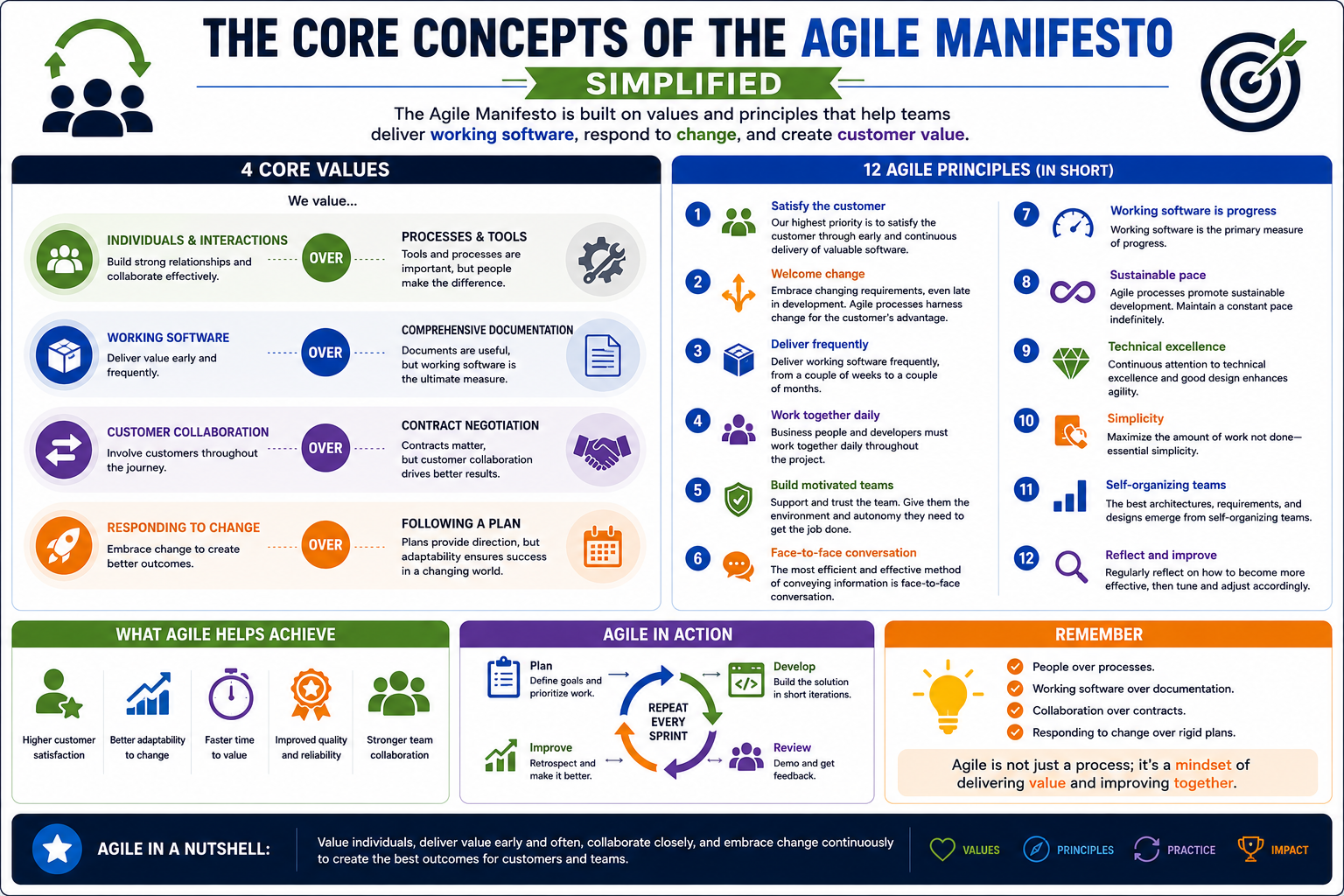
The Agile Manifesto transformed the world of software development by introducing a new way of thinking about projects, teamwork, and customer satisfaction. Before Agile became widely accepted, many organizations relied on rigid development structures that emphasized long-term planning, extensive documentation, and strict approval processes. These traditional methods often caused delays, reduced flexibility, and made it difficult for businesses to respond to rapid market changes. Agile introduced a different philosophy that focused on adaptability, collaboration, continuous improvement, and delivering value quickly.
When the Agile Manifesto was created in 2001 by a group of software professionals in Snowbird, Utah, the goal was not to eliminate structure or discipline. Instead, the creators wanted to address the growing frustrations within software development teams. Projects were taking too long, customers were becoming dissatisfied, and organizations struggled to adapt to changing business requirements. Developers realized that traditional methodologies were no longer sufficient in fast-moving industries where customer expectations and technology changed constantly.
The Agile Manifesto presented a framework that valued people, communication, flexibility, and practical results. Rather than viewing change as a threat, Agile encouraged teams to embrace change and use feedback to improve products continuously. This shift in thinking had a massive impact not only on software development but also on project management, business operations, product design, and organizational culture.
Today, Agile is used across industries worldwide. Technology companies, financial institutions, healthcare providers, educational organizations, and even government agencies have adopted Agile principles in some form. Its widespread popularity comes from its ability to help teams deliver value faster while maintaining close collaboration with customers and stakeholders.
To understand why Agile became so influential, it is important to explore the environment that existed before Agile methods emerged.
The Problems With Traditional Development Methods
Before Agile, the Waterfall methodology dominated software development. Waterfall followed a linear process where each stage of development had to be completed before the next phase could begin. Teams first gathered requirements, then moved into planning, design, development, testing, and finally deployment. Once a phase was completed, returning to it later became expensive and time-consuming.
At first glance, Waterfall appeared logical and organized. Managers appreciated the clear structure because it allowed them to create timelines, budgets, and documentation before development started. However, software development is rarely predictable. Customer needs evolve, markets shift, and technologies change rapidly. Waterfall struggled to adapt to these realities.
One of the biggest issues with traditional methods was delayed feedback. Customers often waited months or years before seeing a functional version of the product. During that time, business priorities could change dramatically. When customers finally reviewed the finished software, they sometimes realized it no longer met their needs. Making changes at that stage required revisiting earlier phases, rewriting documentation, redesigning systems, and retesting features. This process increased costs and delayed releases even further.
Traditional methodologies also created communication barriers between teams and stakeholders. Developers focused heavily on following predefined plans, while customers had limited involvement after the initial planning stage. Misunderstandings often remained hidden until late in development, when fixing them became difficult.
Another challenge was the heavy emphasis on documentation. Teams spent enormous amounts of time creating requirement documents, design specifications, and approval records. While documentation has value, excessive paperwork slowed progress and frequently became outdated before projects were completed.
Large projects under traditional methodologies also carried significant risk. Because testing occurred near the end of development, teams sometimes discovered major problems very late in the process. These issues could require extensive rework, causing delays and budget overruns.
As industries became more competitive and technology evolved faster, businesses needed a more flexible approach. Organizations wanted shorter development cycles, faster delivery, and better collaboration with customers. Agile emerged as a response to these growing challenges.
The Birth of the Agile Manifesto
In February 2001, seventeen software developers gathered in Snowbird, Utah, to discuss better ways of developing software. These individuals came from different technical backgrounds and methodologies, including Scrum, Extreme Programming, Crystal, Adaptive Software Development, and Feature-Driven Development.
Although they used different approaches, they shared common frustrations with traditional software development methods. They believed projects were becoming too bureaucratic, too slow, and too disconnected from customer needs.
During their discussions, the group created what became known as the Agile Manifesto. The document was concise yet powerful. Instead of introducing technical frameworks or coding standards, it focused on values and principles that emphasized flexibility, collaboration, and delivering customer value.
The Agile Manifesto introduced four core values and twelve supporting principles. These ideas encouraged organizations to rethink how teams communicate, plan, and deliver software.
One important aspect of the manifesto is that it does not reject structure entirely. Each Agile value compares two concepts using the phrase “over,” not “instead of.” This distinction matters because Agile does not claim that processes, documentation, contracts, or planning are useless. Instead, Agile argues that the items on the left side of the values should receive greater emphasis.
This balanced perspective helped Agile gain widespread acceptance. Organizations could still maintain documentation and planning while becoming more adaptable and customer-focused.
Individuals and Interactions Over Processes and Tools
The first core value of Agile emphasizes the importance of people and communication. While processes and tools remain valuable, Agile recognizes that successful projects depend primarily on effective collaboration between individuals.
Traditional organizations often rely heavily on procedures, reporting structures, and management systems. Employees may spend large amounts of time following processes rather than solving actual problems. Agile challenges this mindset by prioritizing teamwork and direct communication.
Software development involves constant problem-solving. Developers, testers, designers, analysts, and stakeholders must collaborate closely to build successful products. Miscommunication between team members can lead to delays, technical issues, and misunderstandings about customer expectations.
Agile encourages teams to communicate openly and frequently. Rather than relying entirely on formal reports or lengthy email chains, Agile teams often hold short daily meetings where members discuss progress, challenges, and priorities. These conversations help identify problems early and improve team alignment.
Face-to-face communication is especially valued because it reduces confusion and accelerates decision-making. When people speak directly, they can clarify misunderstandings immediately and collaborate more effectively.
This value also recognizes that tools should support people rather than control them. Modern organizations use many tools for project management, communication, testing, and documentation. While these tools are useful, they cannot replace human creativity, critical thinking, and collaboration.
Agile environments often encourage cross-functional teamwork. Instead of separating departments into isolated groups, Agile teams work closely together throughout development. Developers may collaborate directly with testers, designers, and product owners to solve problems quickly and improve product quality.
Leadership also changes under Agile principles. Traditional management approaches often rely on strict supervision and command-and-control structures. Agile leaders focus more on supporting teams, removing obstacles, and encouraging collaboration.
Trust becomes an important part of Agile culture. Team members are encouraged to share ideas openly, provide honest feedback, and take ownership of their work. This environment promotes innovation and continuous improvement.
Another important concept within this value is adaptability. Agile teams regularly evaluate their processes and make adjustments when necessary. Instead of following rigid systems indefinitely, teams improve workflows based on experience and feedback.
Organizations that prioritize individuals and interactions often experience faster problem resolution, better morale, and stronger customer relationships. Agile recognizes that technology projects succeed because of effective people working together, not because of perfect procedures alone.
Working Software Over Comprehensive Documentation
The second core value of Agile emphasizes delivering functional software rather than focusing excessively on documentation. Traditional development methods often required extensive planning documents before development could even begin. Teams spent months writing specifications, requirement documents, technical diagrams, and approval reports.
While documentation remains important, Agile believes the primary measure of progress should be working software that provides value to users.
One reason for this shift is the rapidly changing nature of technology and business environments. Documents created early in a project can quickly become outdated as customer needs evolve and markets change. Spending excessive time maintaining documentation can slow development without improving customer outcomes.
Agile encourages teams to focus on creating usable products that customers can test and evaluate. Early delivery allows organizations to gather feedback quickly and make improvements before investing too heavily in the wrong direction.
Working software provides tangible evidence of progress. Customers and stakeholders can interact with actual features instead of reviewing theoretical plans. This improves communication and helps teams identify misunderstandings earlier.
Another advantage of frequent software delivery is risk reduction. Large projects often contain unknown challenges that may not become visible until development begins. By delivering smaller updates regularly, Agile teams can identify problems sooner and adjust more easily.
The concept of a Minimal Viable Product, often called an MVP, plays a major role in Agile development. An MVP includes only the essential features needed to provide immediate value. Instead of building a massive system all at once, teams release a simpler version and improve it continuously based on feedback.
This approach allows organizations to test ideas in real-world environments. Customer behavior often reveals insights that planning documents cannot predict. Agile teams use this information to guide future development decisions.
Continuous delivery also improves responsiveness to market changes. Businesses can release new features, updates, and improvements faster than competitors using slower development cycles.
Testing becomes more integrated within Agile workflows as well. Instead of waiting until the end of a project, Agile teams test continuously throughout development. This helps maintain quality and reduces the likelihood of major failures during deployment.
Agile does not eliminate documentation entirely. Teams still create user guides, technical references, compliance materials, and architecture documentation when necessary. The difference is that Agile prioritizes documentation that provides clear practical value.
This value reflects Agile’s broader philosophy of focusing on outcomes rather than appearances. A perfectly documented project has little value if the software itself does not meet customer needs. Agile encourages teams to concentrate their energy on building functional, high-quality products that users can benefit from immediately.
Customer Collaboration Over Contract Negotiation
The third core value of Agile focuses on maintaining close collaboration with customers throughout the development process. Traditional project management approaches often relied heavily on fixed contracts and predefined requirements established at the beginning of a project.
Under traditional methods, customers typically participated heavily during initial planning but had limited involvement afterward. Once requirements were finalized, development teams focused on executing the plan exactly as documented. Any requested changes later in development could become expensive and time-consuming.
Agile introduced a more flexible and collaborative approach. Instead of treating customer requirements as permanently fixed, Agile recognizes that needs evolve over time. Customers may gain new insights, market conditions may shift, and new technologies may emerge during development.
By involving customers continuously, Agile teams can respond to these changes more effectively. Regular collaboration allows stakeholders to provide feedback, clarify priorities, and suggest improvements throughout the project lifecycle.
This ongoing communication improves alignment between development teams and business goals. Developers gain a deeper understanding of customer needs, while stakeholders gain visibility into project progress.
Agile teams often use product owners or customer representatives who work closely with developers on a daily basis. These individuals help prioritize features, answer questions, and ensure the product continues delivering value.
Frequent software demonstrations are another important Agile practice. Teams present completed work regularly so customers can review progress and provide immediate feedback. This transparency reduces misunderstandings and strengthens trust.
Customer collaboration also improves product quality because feedback arrives earlier. Instead of discovering issues after a major release, teams can identify problems during development and correct them quickly.
This approach encourages shared responsibility for success. Customers and developers work together as partners rather than operating under rigid contractual boundaries. Both sides focus on creating the best possible product instead of simply enforcing original agreements.
Agile recognizes that long-term success depends on adaptability and communication. Markets change quickly, and organizations that resist change often struggle to remain competitive. Continuous collaboration allows businesses to stay responsive and innovative.
This value also reduces waste. By maintaining close communication with customers, teams avoid spending time developing features that provide little practical value. Resources can instead focus on improvements that genuinely matter to users.
Strong customer collaboration creates better relationships between businesses and their clients. Customers feel more involved in the development process, while teams gain clearer direction and feedback. This partnership-oriented mindset remains one of Agile’s defining characteristics and a major reason for its continued popularity across industries.
Responding to Change Over Following a Plan
The fourth core value of the Agile Manifesto focuses on adaptability and flexibility. Traditional development approaches often emphasized detailed long-term planning. Teams created extensive schedules, timelines, budgets, and requirements before development even began. Once these plans were approved, organizations expected teams to follow them as closely as possible.
While planning is still important in Agile environments, Agile recognizes that change is unavoidable. Customer expectations shift, technologies evolve, competitors introduce new products, and market conditions change rapidly. A plan that seemed perfect at the beginning of a project may become outdated halfway through development.
Agile encourages teams to embrace change instead of resisting it. Rather than viewing modifications as disruptions, Agile teams treat changes as opportunities to improve products and deliver greater value to customers.
One major advantage of this mindset is responsiveness. Businesses that adapt quickly can remain competitive in fast-moving industries. Companies that rigidly follow outdated plans often struggle to keep up with changing customer demands.
Agile teams work in shorter development cycles, allowing them to evaluate progress frequently and make adjustments when necessary. This iterative approach creates flexibility because teams are not locked into long-term commitments without feedback.
For example, imagine a software company developing an application over several years. During development, new technologies such as artificial intelligence or cloud computing may become essential market expectations. Traditional methods would require revisiting earlier planning stages and seeking multiple approvals before incorporating these changes. Agile, however, allows teams to adapt continuously without disrupting the entire project structure.
This value also encourages continuous learning. Teams regularly analyze customer feedback, market trends, and performance data to guide decisions. Instead of assuming all answers are known upfront, Agile promotes experimentation and improvement.
Adaptability improves risk management as well. Projects often encounter unexpected technical challenges or changing business priorities. Agile teams can respond faster because they are accustomed to reviewing and adjusting their plans regularly.
Another important aspect of responding to change is prioritization. Agile teams focus on delivering the most valuable features first. If priorities shift later, organizations have already delivered meaningful functionality instead of waiting until the very end of development.
Agile planning still exists, but it becomes more flexible and dynamic. Teams create short-term goals while remaining open to revisions based on feedback and new information. This balance allows organizations to maintain direction without becoming overly rigid.
The ability to respond to change has become increasingly important in modern industries. Technology evolves faster than ever before, and customer expectations continue to rise. Agile provides organizations with a framework for adapting effectively while maintaining productivity and quality.
Understanding the Twelve Principles of Agile
The four core values form the philosophical foundation of Agile, but the Agile Manifesto also includes twelve supporting principles. These principles provide more detailed guidance on how Agile teams should operate.
The principles emphasize customer satisfaction, collaboration, continuous delivery, simplicity, technical excellence, and sustainable development. Together, they create a practical framework for building adaptable and efficient teams.
Although organizations may interpret these principles differently, the underlying goal remains consistent: delivering value while remaining flexible and customer-focused.
The principles are not strict rules. Agile was intentionally designed to avoid rigid frameworks that limit creativity or adaptability. Instead, the principles serve as guidelines that teams can apply based on their specific needs and environments.
Understanding these principles helps organizations move beyond simply adopting Agile terminology. True Agile transformation requires embracing the mindset behind the principles rather than mechanically following processes.
Customer Satisfaction Through Early and Continuous Delivery
The first Agile principle states that the highest priority is satisfying customers through early and continuous delivery of valuable software. This principle captures one of the most important differences between Agile and traditional development methods.
In traditional approaches, customers often waited until the end of development to see the finished product. This created significant risk because feedback arrived very late. If customers disliked features or discovered missing functionality, making changes became difficult and expensive.
Agile addresses this problem by encouraging teams to deliver software incrementally. Instead of waiting months or years for a final release, teams provide smaller updates regularly. Customers can then review these updates, test features, and provide feedback continuously.
Early delivery creates several advantages. First, it allows organizations to generate value faster. Even a limited product version can begin solving customer problems or generating revenue.
Second, continuous delivery improves communication between teams and stakeholders. Customers gain visibility into progress, while developers gain clearer insight into customer expectations.
Third, regular delivery reduces uncertainty. Teams can test assumptions quickly and make improvements before investing too heavily in the wrong direction.
This principle also supports innovation. Because Agile teams release updates frequently, they can experiment with new ideas and evaluate real-world results faster than traditional organizations.
Customer satisfaction remains central to Agile thinking. Successful Agile teams focus not only on completing tasks but also on understanding how their work benefits users.
Welcoming Changing Requirements
Another important Agile principle encourages teams to welcome changing requirements, even late in development. Traditional methodologies often viewed changing requirements as failures in planning. Agile, however, recognizes that change is a natural part of product development.
Businesses operate in dynamic environments where priorities evolve constantly. Customer preferences shift, regulations change, competitors introduce innovations, and technological capabilities expand rapidly.
Agile teams understand that refusing to adapt can create products that no longer meet market needs. By remaining flexible, teams can keep products relevant and competitive throughout development.
This principle became especially important in modern technology industries where innovation cycles move quickly. A product designed several years earlier may require significant updates before launch to remain useful.
Welcoming change also improves customer relationships. Stakeholders feel more confident when teams remain open to feedback and evolving priorities.
Agile frameworks support this adaptability through shorter development cycles and continuous communication. Teams review priorities regularly and adjust plans based on current information.
This principle does not imply chaos or lack of direction. Agile teams still maintain goals and priorities. The difference is that they remain willing to revise plans when necessary instead of blindly following outdated assumptions.
Organizations that embrace change often respond faster to opportunities and challenges. They can introduce improvements more quickly and remain aligned with customer expectations.
Frequent Delivery of Working Software
Agile principles emphasize delivering working software frequently, often within weeks rather than months. This frequent delivery model creates momentum and encourages continuous improvement.
Smaller releases are easier to test, evaluate, and improve than large, infrequent releases. Teams can identify issues earlier and correct them before they become major problems.
Frequent delivery also improves transparency. Stakeholders can see visible progress regularly instead of relying solely on status reports or planning documents.
Another benefit is reduced deployment risk. Large software releases often contain many interconnected changes, making failures more difficult to diagnose and resolve. Smaller releases isolate changes more effectively and simplify troubleshooting.
Frequent delivery encourages better prioritization as well. Teams focus on completing high-value features first instead of attempting to build everything simultaneously.
This principle supports customer engagement because users can provide feedback continuously. Real-world testing often reveals insights that internal planning cannot predict.
Agile teams use automation, continuous integration, and regular testing to support frequent releases efficiently. These technical practices help maintain quality while increasing delivery speed.
Organizations that deliver software regularly often build stronger trust with customers because progress remains visible and measurable.
Business and Development Teams Working Together
Agile strongly encourages collaboration between business stakeholders and development teams. Traditional organizations often separated technical teams from business decision-makers, creating communication gaps and misunderstandings.
Agile removes many of these barriers by promoting continuous interaction between all participants involved in a project.
Business stakeholders provide valuable context about customer needs, market conditions, and organizational priorities. Developers contribute technical expertise and implementation knowledge. Combining these perspectives leads to better decision-making.
Frequent communication reduces delays because questions can be answered quickly instead of waiting through long approval chains.
This collaboration also improves alignment between technical work and business objectives. Teams understand not only what they are building but also why it matters.
Agile environments often encourage shared ownership of outcomes. Instead of dividing responsibilities into isolated departments, teams work collectively toward common goals.
Cross-functional collaboration improves adaptability because teams can respond to changing priorities more efficiently.
Organizations that encourage close cooperation between business and technical teams often experience fewer misunderstandings and stronger customer satisfaction.
Building Projects Around Motivated Individuals
Agile recognizes that successful projects depend heavily on motivated and empowered people. Processes and tools matter, but talented individuals ultimately drive innovation and productivity.
This principle encourages organizations to create environments where employees can succeed. Teams need support, trust, resources, and opportunities for growth.
Micromanagement often reduces creativity and slows decision-making. Agile instead promotes autonomy and accountability. Teams are trusted to organize their work and solve problems collaboratively.
Motivated individuals tend to communicate more effectively, take ownership of challenges, and pursue continuous improvement.
Agile leaders focus on enabling teams rather than controlling every detail. They remove obstacles, provide guidance, and encourage collaboration.
Positive team culture also matters significantly. Employees who feel respected and valued are more likely to contribute ideas and remain engaged.
Continuous learning plays an important role in maintaining motivation. Agile environments encourage experimentation, skill development, and knowledge sharing.
Organizations that invest in people often achieve better long-term results because motivated teams adapt more effectively to challenges and opportunities.
Face-to-Face Communication as the Most Effective Method
Agile principles emphasize direct communication as the most effective way to share information. Although digital communication tools are valuable, face-to-face conversations often improve clarity and reduce misunderstandings.
Complex discussions can become confusing when handled entirely through emails or documentation. Direct conversations allow participants to ask questions immediately, clarify details, and interpret tone and intent more accurately.
Daily stand-up meetings are one example of this principle in practice. Team members briefly discuss progress, obstacles, and priorities each day. These conversations help maintain alignment and identify issues quickly.
Face-to-face communication also strengthens relationships within teams. Trust and collaboration often improve when people interact regularly.
Modern Agile teams may use video conferencing and collaborative tools when working remotely. The underlying principle remains the same: communication should be direct, efficient, and interactive whenever possible.
Effective communication reduces delays because problems can be resolved immediately instead of waiting through lengthy approval processes.
Organizations that prioritize open communication often experience stronger teamwork and faster decision-making.
Working Software as the Primary Measure of Progress
Traditional projects often measured progress using completed documentation, approved plans, or reported milestones. Agile shifts the focus toward working software.
A project cannot truly deliver value until users can interact with functional products. Documentation and planning are important, but they do not replace actual results.
This principle encourages teams to prioritize practical outcomes over appearances. Progress becomes visible through completed functionality rather than theoretical completion percentages.
Working software also provides more accurate feedback about project status. Stakeholders can evaluate real performance instead of relying solely on reports.
Measuring progress through functional products improves accountability because teams must demonstrate tangible results regularly.
This principle supports continuous delivery and iterative development. Small improvements accumulate over time, creating steady progress and reducing uncertainty.
Organizations that focus on functional outcomes often maintain stronger customer trust because value remains visible throughout development.
Sustainable Development Practices
Agile promotes sustainable work environments where teams can maintain consistent productivity over time. Traditional projects sometimes relied on excessive overtime and burnout to meet deadlines.
While short-term intensity may occasionally be necessary, constant overwork reduces quality, creativity, and employee well-being.
Agile encourages realistic planning and balanced workloads. Teams should work at a pace that remains sustainable throughout the project lifecycle.
Sustainable development improves long-term productivity because employees remain healthier, more focused, and more engaged.
This principle also reduces turnover. Burnout often leads talented employees to leave organizations, creating additional costs and disruptions.
Consistent pacing improves software quality because exhausted teams are more likely to make mistakes.
Agile recognizes that long-term success depends on maintaining healthy and motivated teams rather than maximizing short-term output at any cost.
Advanced Agile Principles, Frameworks, and Final Thoughts
Agile development continues to evolve as organizations discover new ways to improve teamwork, customer satisfaction, and product delivery. While the four core values and twelve principles provide the philosophical foundation of Agile, successful implementation requires practical techniques, consistent communication, and a commitment to continuous improvement.
Many organizations adopt Agile because they want faster delivery times, improved collaboration, and greater flexibility. However, Agile is not simply a checklist of meetings or project management tools. It is a mindset that influences how teams think, communicate, prioritize work, and respond to challenges.
Companies that successfully implement Agile usually focus on building strong team cultures, encouraging experimentation, and maintaining close relationships with customers. They recognize that no project unfolds exactly as planned and that adaptability is essential for long-term success.
As Agile practices spread across industries, several frameworks and methodologies emerged to help organizations apply Agile principles more effectively. Among the most widely used approaches are Scrum and Kanban. These frameworks provide structures that support Agile thinking while allowing teams to remain flexible and collaborative.
Understanding these frameworks is important because they translate Agile philosophy into daily workflows and practical team activities.
The Importance of Continuous Improvement
One of the defining characteristics of Agile is its commitment to continuous improvement. Agile teams constantly evaluate their processes, communication, workflows, and products to identify opportunities for enhancement.
Traditional project management approaches often focused primarily on completing tasks according to plan. Agile goes further by encouraging teams to analyze how they work and how they can become more efficient over time.
Continuous improvement begins with feedback. Agile teams seek input from customers, stakeholders, and team members regularly. This feedback helps identify strengths, weaknesses, bottlenecks, and areas where adjustments are needed.
The concept of “failing fast” plays an important role in Agile improvement cycles. Instead of avoiding mistakes at all costs, Agile teams try to identify problems early when they are easier and less expensive to fix. Quick feedback loops allow teams to experiment, learn, and improve continuously.
Retrospective meetings are one of the most common Agile practices supporting continuous improvement. At the end of each development cycle, teams discuss what worked well, what challenges occurred, and what changes could improve future performance.
These conversations encourage honesty, accountability, and collaboration. Team members share insights openly and work together to solve recurring issues.
Continuous improvement also applies to technical practices. Agile teams regularly refine coding standards, testing processes, deployment methods, and automation strategies to improve quality and efficiency.
Organizations that embrace continuous learning tend to adapt more successfully to changing markets and technologies. They remain competitive because they consistently evaluate and improve their operations rather than relying on outdated methods.
Agile recognizes that improvement is never fully complete. Teams should always remain curious, open-minded, and willing to evolve.
Starting Small With Agile Adoption
Many organizations make the mistake of attempting massive Agile transformations too quickly. Agile works best when teams start small, learn gradually, and improve over time.
Beginning with manageable projects allows organizations to understand Agile practices without overwhelming employees or disrupting operations completely.
One common Agile strategy involves creating a Minimum Viable Product, or MVP. An MVP contains only the essential features needed to provide immediate value to users. Instead of building every possible feature upfront, teams release a simpler version and improve it based on customer feedback.
This approach offers several advantages. First, it allows businesses to begin generating value quickly rather than waiting for a fully polished product.
Second, it reduces development risk because organizations can validate assumptions before investing heavily in additional features.
Third, customer feedback arrives earlier, helping teams prioritize future improvements more effectively.
Starting small also helps teams build confidence in Agile practices. Employees learn how iterative development, collaboration, and continuous delivery function in real-world environments.
Organizations often discover that Agile adoption involves cultural change as much as procedural change. Teams must learn to communicate differently, share responsibility, and embrace adaptability.
Small successes help build organizational support for broader Agile adoption. When employees and leadership see positive results, they become more willing to expand Agile practices across additional teams and departments.
Agile transformation should be viewed as an ongoing journey rather than a single event. Teams improve gradually through experience, experimentation, and learning.
Scrum as an Agile Framework
Scrum is one of the most widely used Agile frameworks in the world. It provides a structured yet flexible approach for managing complex projects and delivering products incrementally.
Scrum organizes work into short development cycles called sprints. These sprints typically last between two and four weeks. During each sprint, teams focus on completing specific tasks and delivering a functional product increment.
At the beginning of a sprint, the team holds a Sprint Planning meeting. During this meeting, developers, product owners, and other stakeholders discuss priorities and define goals for the upcoming sprint.
The Product Owner plays an important role in Scrum by representing customer interests and prioritizing work based on business value. This person ensures the team focuses on the most important features and improvements.
During the sprint, Scrum teams hold Daily Stand-Up meetings. These are short discussions where team members share progress updates, identify obstacles, and coordinate activities.
Daily communication improves transparency and helps teams identify issues quickly before they become major problems.
At the end of each sprint, the team conducts a Sprint Review. During this meeting, stakeholders review completed work and provide feedback. This continuous feedback loop helps ensure the product remains aligned with customer expectations.
Another important Scrum practice is the Sprint Retrospective. In this meeting, the team reflects on the sprint itself and discusses ways to improve processes, communication, and collaboration.
Scrum encourages accountability, transparency, and continuous improvement. Because work is divided into smaller increments, teams can adapt quickly to changing priorities and customer needs.
One reason Scrum became so popular is its simplicity. The framework provides enough structure to organize work effectively while remaining flexible enough for different types of projects and organizations.
Scrum also improves visibility into project progress. Stakeholders can evaluate working software regularly instead of waiting months for large releases.
Organizations using Scrum often experience faster delivery cycles, stronger collaboration, and improved responsiveness to change.
Kanban and Visual Workflow Management
Kanban is another popular Agile methodology that focuses on visualizing work and improving workflow efficiency.
Unlike Scrum, Kanban does not rely on fixed sprint cycles. Instead, work flows continuously through different stages represented visually on a Kanban board.
A typical Kanban board includes columns such as “To Do,” “In Progress,” “Testing,” and “Completed.” Tasks move across these columns as work progresses.
This visual representation helps teams understand project status immediately. Team members can quickly identify bottlenecks, overloaded stages, or delayed tasks.
One of Kanban’s most important concepts is limiting Work In Progress, often called WIP limits. WIP limits restrict how many tasks can exist in a particular stage simultaneously.
These limits prevent teams from starting too many tasks at once without completing them. By focusing on finishing work before beginning new tasks, teams improve efficiency and reduce delays.
Kanban promotes continuous delivery because work moves steadily through the system rather than being grouped into scheduled releases.
Another advantage of Kanban is flexibility. Teams can add or reprioritize tasks easily as business needs change.
Kanban works especially well in environments where priorities shift frequently or where work arrives unpredictably. Support teams, maintenance departments, and operational groups often benefit from Kanban workflows.
The simplicity of Kanban makes it accessible for many organizations. Teams can adopt visual workflow management gradually without requiring major structural changes.
Kanban also supports continuous improvement by helping teams analyze workflow patterns and identify inefficiencies.
Organizations using Kanban often improve productivity, transparency, and task management while maintaining flexibility.
The Role of Agile Tools and Technology
Although Agile emphasizes individuals and interactions over tools, technology still plays an important supporting role in Agile environments.
Modern Agile teams use software platforms to manage tasks, track progress, organize workflows, and improve collaboration.
One of the most widely used Agile tools is JIRA. JIRA helps teams manage Scrum and Kanban workflows by providing visual boards, task tracking, reporting features, and backlog management.
In Agile environments, tasks are often organized into “stories.” A story represents a specific feature, improvement, or user requirement.
Teams estimate the complexity of stories using story points. Story points help teams evaluate workload and plan development cycles more effectively.
Agile tools improve visibility because stakeholders can monitor project progress in real time. Teams can view completed tasks, pending work, and sprint goals through centralized dashboards.
Collaboration platforms also support communication between distributed teams. As remote work becomes more common, digital collaboration tools help Agile teams maintain alignment and productivity.
Automation tools play an increasingly important role as well. Continuous Integration and Continuous Deployment systems allow teams to test and release software more efficiently.
Automated testing improves quality by identifying defects earlier in development. This supports Agile goals of frequent delivery and rapid feedback.
While tools provide valuable support, Agile reminds organizations not to become overly dependent on technology alone. Effective communication, collaboration, and adaptability remain the true foundations of successful Agile teams.
Agile Beyond Software Development
Although Agile originated within software development, its principles now influence many other industries and professions.
Marketing teams use Agile methods to manage campaigns, respond to market trends, and improve collaboration.
Healthcare organizations apply Agile principles to improve operational efficiency and patient services.
Educational institutions use Agile-inspired approaches for curriculum development and project-based learning.
Manufacturing companies apply Agile concepts to product design, supply chain management, and operational improvement.
Even government agencies increasingly explore Agile frameworks to improve responsiveness and service delivery.
The reason Agile adapts so well across industries is because its core principles are universally valuable. Communication, adaptability, collaboration, customer focus, and continuous improvement benefit nearly every type of organization.
Agile encourages organizations to become more responsive to change and more focused on delivering value consistently.
As industries continue evolving rapidly, the demand for flexibility and innovation will likely make Agile thinking even more important in the future.
Challenges Organizations Face With Agile
Despite its advantages, Agile implementation is not always easy. Many organizations encounter challenges during Agile adoption.
One common problem is misunderstanding Agile as merely a set of meetings or tools rather than a cultural mindset.
Some organizations attempt to follow Agile ceremonies mechanically while maintaining rigid hierarchical structures and outdated communication patterns.
Resistance to change can also create difficulties. Employees and managers accustomed to traditional methods may struggle with increased transparency, collaboration, and adaptability.
Poor communication can undermine Agile effectiveness as well. Agile relies heavily on teamwork and feedback, so communication breakdowns can reduce efficiency.
Another challenge involves balancing flexibility with long-term planning. Agile encourages adaptability, but organizations still need strategic direction and coordination.
Scaling Agile across large organizations can become complex too. Multiple teams must coordinate effectively while maintaining consistent goals and standards.
Leadership support is critical for overcoming these challenges. Successful Agile transformations require commitment from both management and team members.
Training and continuous learning also play important roles. Employees need opportunities to understand Agile principles, frameworks, and best practices.
Organizations that treat Agile as an ongoing learning process rather than a quick solution often achieve better results over time.
The Future of Agile Methodologies
Agile continues evolving as technology, workplaces, and industries change.
Artificial intelligence, automation, cloud computing, and remote collaboration are influencing how Agile teams operate.
Distributed teams now rely heavily on digital communication tools and virtual collaboration platforms.
Organizations increasingly combine Agile with other methodologies such as DevOps, Lean, and Design Thinking to improve efficiency and innovation.
Agile is also expanding into strategic planning and organizational leadership. Businesses use Agile principles to improve decision-making, adaptability, and customer engagement at broader organizational levels.
As industries become more competitive and technology-driven, the need for rapid learning and adaptability will continue increasing.
Agile’s emphasis on flexibility and collaboration positions it well for future challenges and opportunities.
Conclusion
The Agile Manifesto introduced a revolutionary way of thinking about software development, teamwork, and customer value. Instead of relying on rigid planning, excessive documentation, and inflexible processes, Agile promotes adaptability, communication, collaboration, and continuous improvement.
Its four core values emphasize the importance of people, working solutions, customer involvement, and responsiveness to change. The twelve supporting principles provide practical guidance for creating flexible and customer-focused development environments.
Frameworks such as Scrum and Kanban help organizations apply Agile principles in structured yet adaptable ways. These methodologies improve transparency, collaboration, workflow management, and delivery speed.
Agile’s influence now extends far beyond software development. Businesses across industries use Agile principles to improve operations, innovation, and customer satisfaction.
The true strength of Agile lies in its mindset. Agile encourages teams to learn continuously, communicate openly, and adapt confidently in changing environments.
Rather than treating projects as rigid sequences of tasks, Agile views development as an ongoing process of collaboration, experimentation, and improvement.
Organizations that embrace Agile successfully often become more responsive, innovative, and customer-focused. They deliver value faster, reduce risks, and build stronger relationships with both customers and employees.
As technology and industries continue evolving rapidly, Agile remains one of the most important approaches for navigating uncertainty and delivering meaningful results in modern organizations.