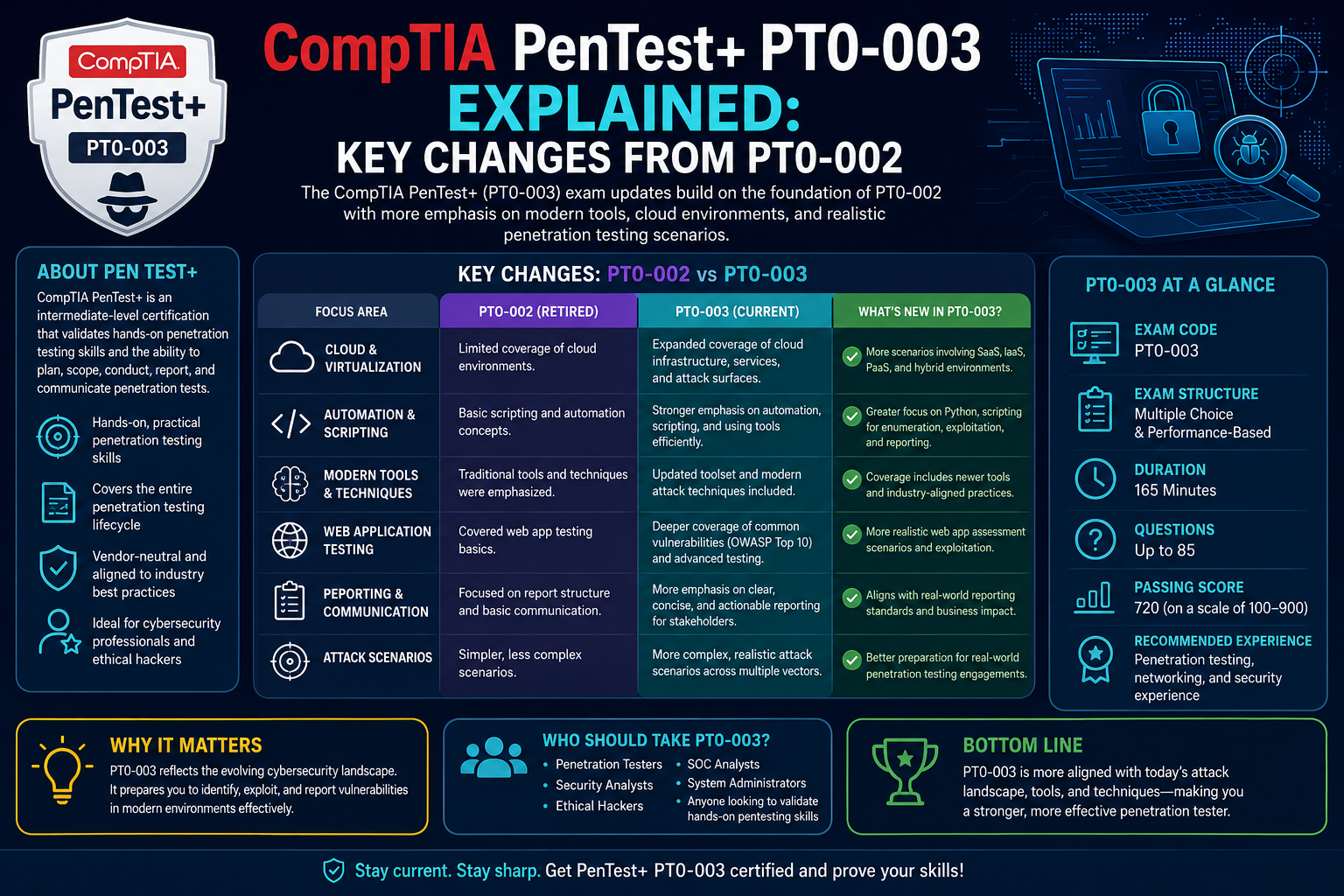
The cybersecurity industry changes constantly, and certifications must evolve to stay relevant. Attack methods that worked several years ago may no longer be effective today, while new technologies introduce completely different security challenges. This is exactly why CompTIA updated the PenTest+ certification from PT0-002 to PT0-003. The newer version reflects the current realities of penetration testing and offensive security work in modern environments.
CompTIA PenTest+ has always stood out because of its practical approach to cybersecurity. Instead of focusing entirely on theory or memorization, the certification emphasizes real-world skills. Candidates are expected to understand how attackers think, how vulnerabilities are discovered, how systems are exploited, and how findings are reported professionally. The exam measures the ability to apply offensive security techniques in realistic scenarios rather than simply recalling definitions from a textbook.
The transition from PT0-002 to PT0-003 is not a small adjustment. It represents a significant modernization of the certification objectives. Cloud environments, API security, automation, scripting, and Zero Trust architecture now play a major role in cybersecurity operations, and the updated exam reflects these priorities. Modern penetration testers must assess hybrid infrastructures, test web applications, analyze identity systems, and understand attacker behavior across increasingly complex networks.
As organizations continue moving toward cloud-first infrastructure and remote work models, the demand for skilled penetration testers continues to rise. Businesses need professionals who can identify weaknesses before malicious attackers exploit them. This makes certifications like PenTest+ increasingly valuable for aspiring offensive security specialists.
Understanding the differences between PT0-002 and PT0-003 is important for anyone considering the certification. Candidates who already started preparing for PT0-002 may wonder whether they should continue or transition to PT0-003. New learners also need to understand which skills matter most in the latest version of the exam.
The updated PenTest+ exam demonstrates how penetration testing itself has evolved. Modern offensive security work is no longer limited to scanning local networks or exploiting outdated servers. Today’s professionals deal with cloud workloads, APIs, modern authentication systems, automation pipelines, and advanced attacker methodologies. PT0-003 was created to validate these updated responsibilities.
This article explores the major changes introduced in PT0-003, explains why the certification update matters, and examines how the offensive security industry has changed in recent years.
What Is CompTIA PenTest+?
CompTIA PenTest+ is a penetration testing certification designed for cybersecurity professionals who want to validate offensive security skills. The certification focuses on hands-on penetration testing techniques, vulnerability management, exploitation methods, reporting, and assessment procedures used in real-world environments.
Unlike some certifications that focus primarily on theoretical concepts, PenTest+ emphasizes practical cybersecurity operations. Candidates are expected to understand the complete penetration testing lifecycle, including planning, reconnaissance, scanning, exploitation, post-exploitation activities, and reporting findings to organizations.
The certification is often viewed as an intermediate-level credential. It bridges the gap between foundational cybersecurity certifications and more advanced offensive security specializations. Professionals pursuing PenTest+ typically already possess a basic understanding of networking, Linux systems, cybersecurity concepts, and security operations.
PenTest+ is particularly valuable because it aligns closely with actual penetration testing workflows used by security professionals. Organizations increasingly seek candidates who can perform practical security assessments rather than simply discuss cybersecurity theory.
The exam includes both multiple-choice and performance-based questions. Performance-based questions are designed to test practical thinking and analytical abilities in simulated environments. Candidates may need to interpret command outputs, identify vulnerabilities, analyze attack paths, or recommend mitigation strategies.
Because of this practical focus, PenTest+ has gained respect among many employers. It demonstrates that a candidate understands offensive security techniques in realistic environments rather than relying solely on memorized information.
Why PenTest+ Continues to Grow in Popularity
The demand for penetration testing skills has increased dramatically over the last several years. Organizations face constant threats from cybercriminals, ransomware groups, insider attacks, and advanced persistent threats. Businesses now understand that waiting for a real attack before improving security can be extremely costly.
Penetration testers help organizations identify weaknesses before malicious actors can exploit them. This proactive security approach has made offensive security specialists essential members of modern cybersecurity teams.
CompTIA PenTest+ has become popular because it reflects practical industry needs. Many employers appreciate certifications that focus on applied knowledge rather than purely academic concepts. PenTest+ demonstrates that a professional understands how offensive security operations function in real environments.
The certification also aligns with government workforce standards and cybersecurity frameworks. This makes it attractive for professionals pursuing roles in both public-sector and private-sector organizations.
Another reason for the certification’s popularity is its balance between accessibility and technical depth. While PenTest+ is challenging, it remains achievable for motivated learners who build practical experience through labs and study environments.
The certification is often considered a strong option for professionals transitioning into offensive security roles from areas such as system administration, networking, help desk operations, or defensive security positions.
Because the certification focuses heavily on realistic attack scenarios, many candidates find the learning process itself highly valuable. Preparing for PenTest+ exposes learners to penetration testing methodologies, attack techniques, vulnerability analysis, and professional assessment workflows.
The Cybersecurity Landscape Has Changed Dramatically
One of the biggest reasons CompTIA updated PenTest+ is that the cybersecurity industry itself has changed significantly.
Several years ago, many penetration tests focused mainly on internal networks and on-premise infrastructure. Organizations relied heavily on perimeter security models, local servers, and centralized corporate networks. Traditional penetration testing techniques reflected this environment.
Today, enterprise infrastructure looks very different.
Organizations increasingly rely on cloud computing, hybrid infrastructure, remote access systems, software-as-a-service platforms, and distributed environments. Employees often work remotely, applications run in multiple cloud regions, and identity systems connect numerous services together.
These changes created entirely new attack surfaces.
Cloud storage misconfigurations, exposed APIs, weak identity permissions, insecure containers, and improperly configured access controls have become major security concerns. Attackers increasingly target these weaknesses because they often provide direct access to sensitive data or critical infrastructure.
Traditional penetration testing methods are no longer enough. Modern offensive security professionals must understand how cloud environments function, how APIs communicate, how authentication systems operate, and how attackers exploit distributed infrastructure.
PT0-003 reflects these changes by introducing stronger emphasis on cloud penetration testing, automation, scripting, modern attack techniques, and API security.
The updated exam demonstrates that penetration testing has evolved alongside enterprise technology.
PT0-002 vs PT0-003: Understanding the Core Shift
Although PT0-002 and PT0-003 share the same general goal of validating penetration testing skills, the focus areas have shifted significantly.
PT0-002 concentrated more heavily on traditional penetration testing workflows. Candidates primarily dealt with network scanning, vulnerability analysis, exploitation fundamentals, reporting processes, and standard assessment procedures used in legacy environments.
While PT0-002 introduced some modern concepts, much of the content remained centered on conventional infrastructure and traditional security models.
PT0-003 expands beyond these boundaries.
The updated exam recognizes that modern penetration testers work across cloud environments, hybrid infrastructures, APIs, distributed applications, and identity systems. Offensive security professionals must understand far more than local networks and operating system vulnerabilities.
Cloud security now receives substantial attention. Candidates are expected to understand cloud misconfigurations, identity weaknesses, storage vulnerabilities, and access management problems within cloud providers.
Scripting and automation also play a much larger role in PT0-003. Modern penetration testers automate repetitive tasks extensively, and the updated certification reflects this industry expectation.
Web application testing has expanded as well. APIs are now essential components of modern software architecture, making API security testing a critical offensive security skill.
The exam also aligns more closely with modern attacker behavior through updated MITRE ATT&CK mappings and adversary techniques.
These changes make PT0-003 far more representative of real-world penetration testing responsibilities in modern enterprise environments.
Cloud Security Becomes a Major Focus
One of the most important additions in PT0-003 is expanded cloud security coverage.
Cloud adoption has transformed how organizations operate. Businesses increasingly host applications, databases, storage systems, authentication services, and development pipelines within cloud platforms such as Amazon Web Services, Microsoft Azure, and Google Cloud Platform.
These platforms provide flexibility and scalability, but they also introduce new security risks.
Many cloud breaches occur because of misconfigurations rather than software vulnerabilities. Publicly exposed storage buckets, excessive permissions, weak identity policies, and improperly configured services can all create severe security weaknesses.
Modern penetration testers must understand how attackers abuse these weaknesses.
PT0-003 introduces stronger emphasis on cloud penetration testing methodologies. Candidates are expected to recognize insecure storage configurations, overly permissive identity roles, weak access controls, and exposed cloud services.
Identity and access management systems receive particular attention because attackers frequently target cloud permissions to escalate privileges or move laterally across environments.
Understanding cloud architecture is now essential for offensive security professionals. Attackers increasingly focus on cloud services because organizations continue migrating sensitive systems and data into these environments.
The updated exam reflects this reality by ensuring candidates develop practical awareness of cloud attack surfaces and common cloud security mistakes.
Identity Security and Access Control Weaknesses
Identity systems have become central to modern cybersecurity operations.
In many environments, compromising an identity account can provide attackers with extensive access to systems, services, and sensitive information. As a result, attackers increasingly focus on authentication systems rather than relying solely on software vulnerabilities.
PT0-003 places greater emphasis on identity-related attack techniques.
Candidates are expected to understand how attackers exploit weak passwords, excessive permissions, token theft, credential reuse, and poorly configured authentication systems.
Cloud environments especially rely heavily on identity and access management controls. Weak role configurations or improperly assigned permissions can allow attackers to escalate privileges rapidly.
Understanding how attackers abuse identity systems is critical for modern penetration testers. Offensive security professionals must identify these weaknesses during assessments and explain the associated risks clearly to organizations.
The increased focus on identity security reflects how enterprise security priorities have evolved over recent years.
The Expanding Role of Web Application Security
Modern businesses rely heavily on web applications and APIs to deliver services, process transactions, and manage operations.
As applications become more complex, the number of potential attack vectors increases. Web vulnerabilities remain among the most common causes of data breaches and security incidents.
PT0-003 expands web application security coverage significantly.
Candidates are expected to understand updated web vulnerabilities, API security risks, authentication flaws, and authorization weaknesses. The exam introduces deeper focus on modern web technologies and application architectures.
REST APIs and GraphQL services now play major roles in enterprise environments. Attackers frequently target insecure APIs because they often expose sensitive functionality or data.
The updated certification ensures candidates understand how to identify weaknesses in authentication flows, session management systems, input validation mechanisms, and API interactions.
OWASP concepts remain important, but PT0-003 expands beyond basic vulnerability recognition. Candidates must understand how vulnerabilities are exploited in realistic scenarios and how modern applications differ from traditional web environments.
This shift reflects the growing importance of web application testing in professional penetration testing engagements.
Modern Penetration Testers Must Think Like Real Attackers
Perhaps the most important theme in PT0-003 is realism.
The updated certification emphasizes how real attackers behave in modern environments. Instead of focusing only on isolated vulnerabilities, the exam encourages candidates to think about complete attack chains and realistic adversary tactics.
Attackers today often combine credential abuse, automation, social engineering, cloud exploitation, and stealth techniques to compromise organizations.
Penetration testers must understand these behaviors to simulate realistic threats effectively.
PT0-003 aligns more closely with current attacker methodologies through expanded ATT&CK framework coverage, defense evasion concepts, lateral movement techniques, and living-off-the-land tactics.
This approach helps ensure certified professionals can operate effectively within modern cybersecurity teams and contribute meaningful security insights to organizations.
The Growing Importance of Automation in Penetration Testing
One of the biggest differences between PT0-002 and PT0-003 is the increased emphasis on automation and scripting. Modern penetration testers are expected to automate repetitive tasks whenever possible. Security assessments often involve large environments, extensive data collection, multiple scanning phases, and rapid analysis requirements. Performing every task manually is no longer practical in most real-world engagements.
Automation improves speed, consistency, and efficiency during penetration testing operations. Offensive security professionals commonly rely on scripts to perform reconnaissance, process outputs, chain together commands, automate exploitation steps, and organize findings during assessments.
PT0-003 reflects this industry reality by introducing stronger scripting expectations than the previous version of the exam.
Candidates are now expected to understand scripting concepts in practical offensive security scenarios. The certification focuses primarily on Python, PowerShell, and Bash because these languages are heavily used in penetration testing workflows.
Python has become one of the most widely used languages in cybersecurity. Penetration testers often use Python for exploit development, automation, API interaction, data parsing, and tool customization. Many offensive security tools are either built with Python or allow Python integration.
Candidates preparing for PT0-003 should understand how Python scripts are structured, how variables and functions work, and how scripts can automate offensive security tasks. The goal is not to become a professional software engineer but rather to understand how scripts support penetration testing operations.
PowerShell remains essential in Windows environments. Many organizations continue relying heavily on Windows infrastructure, making PowerShell knowledge extremely valuable for both attackers and defenders. Offensive security professionals use PowerShell for system enumeration, credential operations, privilege escalation activities, and remote management tasks.
Attackers frequently abuse PowerShell because it is trusted by operating systems and administrators. PT0-003 recognizes this by increasing focus on PowerShell usage during offensive security operations.
Bash scripting also receives greater attention in the updated exam. Linux systems remain deeply connected to cybersecurity work, especially within penetration testing distributions such as Kali Linux. Bash scripts allow testers to automate command execution, process files, manage workflows, and connect multiple tools together efficiently.
The updated certification reflects how scripting has become a foundational skill for modern penetration testers.
Understanding Real-World Offensive Security Workflows
PT0-003 places stronger emphasis on how penetration testing engagements operate in professional environments.
Real penetration testing is not simply about launching attacks or running scanners. Professional engagements involve planning, scoping, communication, evidence collection, reporting, and careful coordination with organizations.
Modern penetration testers must balance technical skill with professionalism and operational awareness.
Candidates preparing for PT0-003 should understand how assessments are structured from beginning to end. This includes defining rules of engagement, understanding legal authorization, identifying testing boundaries, documenting activities, and communicating findings responsibly.
Professional penetration testing also requires organization and methodology. Security professionals often follow established frameworks during engagements to ensure consistency and reduce the chance of overlooking critical vulnerabilities.
The updated certification aligns more closely with these professional expectations. Candidates are expected to think beyond isolated technical attacks and understand the complete assessment lifecycle.
This includes pre-engagement activities, active testing phases, post-exploitation analysis, and final reporting procedures.
Real-world penetration testers must also manage time effectively during assessments. Organizations may provide narrow testing windows, production limitations, or operational restrictions that influence how tests are performed.
PT0-003 reflects the growing maturity of offensive security as a professional discipline rather than simply a collection of technical attack techniques.
Expanded Coverage of Modern Attack Techniques
Cybercriminals continuously adapt their tactics to bypass modern security defenses. Because of this, penetration testing certifications must evolve to reflect current attacker behavior.
PT0-003 introduces broader coverage of modern attack techniques used by real adversaries.
One major focus area involves living-off-the-land tactics. These techniques involve abusing legitimate operating system tools rather than deploying traditional malware. Attackers prefer these methods because trusted system utilities often generate less suspicion from security tools.
Examples may include using native Windows commands, administrative tools, scripting engines, or built-in management utilities to move through environments while avoiding detection.
Modern penetration testers must understand these techniques because organizations increasingly rely on endpoint detection systems capable of identifying traditional malware activity.
PT0-003 also emphasizes credential-based attacks more heavily than PT0-002.
Many modern breaches occur because attackers successfully compromise user credentials rather than exploiting software vulnerabilities directly. Weak passwords, password reuse, phishing attacks, token theft, and poor access management all create opportunities for attackers.
Candidates are expected to understand how attackers abuse credentials for privilege escalation and lateral movement activities.
The updated exam also introduces greater attention to defense evasion strategies. Attackers constantly develop methods to avoid antivirus software, logging systems, behavioral analysis tools, and endpoint monitoring solutions.
Penetration testers must understand these evasion concepts to simulate realistic adversary behavior during engagements.
Rather than focusing solely on technical exploitation, PT0-003 encourages candidates to think like modern attackers who prioritize stealth, persistence, and operational efficiency.
MITRE ATT&CK Alignment in PT0-003
The MITRE ATT&CK framework has become one of the most widely used cybersecurity knowledge bases for understanding adversary behavior.
Security teams use ATT&CK to categorize attack tactics, identify detection gaps, improve defensive monitoring, and analyze threat activity. Because the framework reflects real-world attacker methodologies, offensive security certifications increasingly incorporate ATT&CK concepts into their objectives.
PT0-003 aligns more closely with modern ATT&CK techniques than PT0-002.
Candidates are expected to understand how attackers achieve persistence, escalate privileges, evade detection, move laterally across networks, and collect sensitive information during intrusions.
The updated exam encourages a more strategic understanding of offensive security operations. Rather than simply identifying vulnerabilities, candidates should understand how attackers chain together multiple techniques during realistic campaigns.
For example, attackers may begin with phishing, move into credential theft, escalate privileges through misconfigured permissions, and laterally move across systems using legitimate administrative tools.
Understanding these attack sequences helps penetration testers conduct more realistic assessments and provide more valuable insights to organizations.
ATT&CK alignment also improves communication between offensive and defensive security teams. Many organizations structure their detection and monitoring programs around ATT&CK techniques, making this knowledge increasingly valuable for cybersecurity professionals.
PT0-003 reflects the growing importance of threat-informed security operations across the industry.
Why API Security Became a Major Focus
Application programming interfaces, commonly called APIs, now power much of the modern internet.
APIs allow applications, cloud services, mobile platforms, and backend systems to exchange information and functionality. Businesses rely heavily on APIs to connect services, automate workflows, and support distributed architectures.
Unfortunately, APIs have also become attractive targets for attackers.
Weak authentication, poor authorization controls, insecure endpoints, and excessive data exposure can create serious vulnerabilities. Because APIs often connect directly to sensitive systems or databases, exploitation can lead to severe security incidents.
PT0-003 expands API security coverage to reflect these modern risks.
Candidates are expected to understand common API vulnerabilities and testing methodologies. This includes authentication flaws, authorization weaknesses, insecure object references, input validation problems, and improper data handling practices.
REST APIs receive particular attention because they are widely used in modern applications.
GraphQL APIs also appear more frequently in current software architectures, making them relevant to offensive security professionals.
Testing APIs requires different approaches compared to traditional web applications. Penetration testers must understand how API requests are structured, how tokens and authentication systems function, and how attackers manipulate requests to access unauthorized resources.
The inclusion of API security in PT0-003 demonstrates how modern penetration testing has expanded far beyond traditional network assessments.
Web Application Security Has Evolved
Web applications remain one of the most common attack surfaces in cybersecurity.
Businesses increasingly rely on web-based systems for customer services, internal operations, financial transactions, and cloud management. As web technologies evolve, vulnerabilities become more complex and difficult to identify.
PT0-003 expands web application testing coverage significantly compared to PT0-002.
The updated exam includes deeper focus on modern authentication systems, session management, access control mechanisms, and application logic vulnerabilities.
Candidates are expected to understand updated web attack techniques and modern application architectures.
OWASP concepts continue to play an important role, but PT0-003 moves beyond basic vulnerability awareness. Instead of simply recognizing common vulnerabilities, candidates should understand how attackers exploit them in realistic scenarios.
Modern applications often involve multiple services, APIs, identity systems, and third-party integrations. This complexity creates new opportunities for attackers to abuse authentication flows, bypass authorization controls, or manipulate backend processes.
The updated exam reflects these modern realities by emphasizing practical understanding rather than theoretical memorization.
Penetration testers must now think about applications holistically rather than focusing only on isolated vulnerabilities.
Zero Trust Security Changes the Offensive Security Perspective
Zero Trust architecture has become one of the most important concepts in modern cybersecurity.
Traditional security models often relied heavily on perimeter defenses. Once users gained access to internal networks, they were frequently trusted automatically.
Zero Trust environments operate differently.
The core idea behind Zero Trust is that no user, system, or device should be trusted by default. Verification should occur continuously regardless of whether access requests originate internally or externally.
This shift significantly affects penetration testing operations.
PT0-003 introduces Zero Trust concepts from an attacker’s perspective. Candidates are expected to understand how attackers adapt to environments where access controls, segmentation, identity verification, and monitoring systems are more restrictive.
Modern attackers often focus heavily on identity abuse because Zero Trust environments rely extensively on authentication systems.
Privilege escalation, token theft, session hijacking, and access misconfigurations become especially valuable in these architectures.
Penetration testers must understand how attackers navigate segmented environments and identify weaknesses in identity-based security models.
The inclusion of Zero Trust concepts demonstrates how offensive security certifications continue evolving alongside modern enterprise security strategies.
Physical Security and Social Engineering Coverage Expanded
Penetration testing is not limited to software vulnerabilities and network attacks.
Real attackers frequently exploit human behavior and physical access opportunities during intrusions. Because of this, PT0-003 introduces expanded coverage of physical security assessments and social engineering concepts.
Physical security testing may involve evaluating badge systems, access controls, surveillance procedures, workstation security, or environmental protections.
Attackers often target physical weaknesses because bypassing digital security controls can sometimes be easier through direct access or social manipulation.
Social engineering also remains one of the most effective attack methods in cybersecurity.
Phishing emails, impersonation attempts, pretexting, and manipulation techniques continue causing major security incidents across industries.
PT0-003 reflects the importance of understanding human-focused attack strategies.
Candidates should understand how social engineering engagements operate, how attackers manipulate trust, and how organizations can reduce human-related security risks.
The updated certification recognizes that offensive security extends beyond technical exploitation. Successful attackers often combine technical knowledge with psychological manipulation and operational planning.
This broader perspective helps prepare penetration testers for realistic security assessment scenarios.
The Role of Kali Linux in Modern Penetration Testing
Kali Linux remains one of the most important platforms in offensive security work.
The operating system includes numerous penetration testing tools used for reconnaissance, scanning, exploitation, wireless testing, password analysis, web application testing, and post-exploitation activities.
PT0-003 preparation often involves extensive hands-on practice within Kali Linux environments.
Candidates are expected to understand how penetration testing tools function, how command-line workflows operate, and how offensive security professionals structure assessments using Linux-based environments.
Kali Linux also supports scripting, automation, and tool integration, making it highly relevant to the updated certification objectives.
Hands-on experience becomes especially important because PT0-003 focuses heavily on practical understanding rather than memorization alone.
Candidates who actively practice in lab environments often perform significantly better than those who rely only on reading materials or video courses.
Modern penetration testing requires familiarity with tools, workflows, scripting, documentation, and analytical thinking.
PT0-003 reflects this practical industry expectation by emphasizing real-world offensive security concepts throughout the certification objectives.
Should You Take PT0-002 or PT0-003?
One of the most common questions cybersecurity learners ask after hearing about the PenTest+ update is whether they should continue studying for PT0-002 or switch to PT0-003. The answer depends largely on where someone currently stands in their preparation journey.
Candidates who already invested substantial time studying PT0-002 objectives may still decide to complete the older version if the retirement timeline allows enough time for scheduling and preparation. If someone is consistently scoring well on practice exams and feels ready for the certification, taking PT0-002 before retirement could still make sense.
However, candidates who are early in their studies generally benefit more from switching to PT0-003. The updated exam better reflects the skills employers currently expect from penetration testers and offensive security professionals. Cloud security, automation, API testing, and modern attacker methodologies are becoming essential competencies across cybersecurity roles.
Employers rarely focus on the specific exam code attached to a certification. Most organizations care more about the practical skills the certification represents. Because PT0-003 aligns more closely with modern penetration testing workflows, many candidates will benefit more from learning the updated material.
The cybersecurity field changes rapidly, and certifications that reflect current technologies often provide stronger long-term value. Candidates entering offensive security today will likely encounter cloud infrastructure, hybrid environments, APIs, Zero Trust systems, and automation-heavy workflows almost immediately in professional settings.
Preparing for PT0-003 can therefore help candidates build skills that are more applicable to current enterprise environments rather than legacy systems alone.
Another consideration involves study resources. As newer certifications gain adoption, training providers gradually shift attention toward updated objectives. This means PT0-003 study content, labs, and practice environments will continue expanding while PT0-002 resources slowly become less relevant over time.
For candidates starting fresh, PT0-003 is generally the stronger option because it prepares learners for the direction offensive security continues moving toward.
Understanding the PT0-003 Exam Structure
Preparing effectively for PenTest+ begins with understanding how the exam itself works.
PT0-003 continues the practical tradition established by previous PenTest+ versions. The exam is designed to test both technical understanding and analytical decision-making under realistic conditions.
Candidates can expect a combination of multiple-choice questions and performance-based questions. Performance-based questions are especially important because they evaluate how well candidates apply cybersecurity knowledge in practical scenarios rather than simply recalling memorized information.
The exam may include tasks involving vulnerability analysis, attack path identification, command interpretation, tool usage, scripting concepts, web application testing, or security assessment planning.
The time limit remains demanding. Candidates must manage time carefully while analyzing complex technical information under pressure.
Performance-based questions often require slower, more methodical thinking than traditional multiple-choice questions. Candidates who lack hands-on experience may struggle with these sections because practical understanding becomes extremely important.
The exam also tests the ability to interpret outputs from offensive security tools. Candidates should feel comfortable reading command-line results, vulnerability scan outputs, scripting snippets, network information, and authentication data.
Success in PT0-003 depends heavily on practical familiarity with penetration testing workflows rather than theoretical memorization alone.
Candidates who spend significant time practicing in labs usually develop stronger analytical skills and greater confidence during the exam.
Why Hands-On Experience Matters More Than Ever
One of the most important realities about modern cybersecurity certifications is that memorization alone rarely leads to real understanding.
PT0-003 especially rewards practical experience.
Many offensive security concepts become difficult to understand without seeing them in action. Reading about reconnaissance, privilege escalation, lateral movement, or API vulnerabilities is very different from performing these activities in controlled environments.
Hands-on labs allow candidates to observe how attacks behave, how systems respond, and how vulnerabilities are exploited in realistic scenarios.
This practical exposure helps candidates develop problem-solving skills that become extremely valuable during performance-based exam questions.
Modern penetration testing requires adaptability and critical thinking. Offensive security professionals often encounter unfamiliar systems, unexpected configurations, incomplete information, and changing circumstances during assessments.
Hands-on practice builds the confidence needed to analyze situations methodically rather than panic when challenges appear.
Lab environments also help candidates become comfortable with command-line interfaces, scripting syntax, penetration testing tools, and Linux workflows.
The more familiar candidates become with practical environments, the easier it becomes to recognize attack patterns and understand offensive security processes conceptually.
Many candidates discover that topics initially confusing in textbooks become much clearer after hands-on experimentation.
Practical learning remains one of the most effective ways to prepare for PT0-003 because the exam itself reflects real-world offensive security thinking.
Building an Effective Study Strategy
Preparing for PenTest+ requires organization and consistency. Because PT0-003 covers multiple technical domains, candidates benefit from structured study plans rather than random topic review.
The first step is understanding the official exam objectives thoroughly.
The objectives outline the topics candidates are expected to understand and help organize study priorities. Reviewing the objectives carefully also helps identify weaker areas that may require additional attention.
Candidates should divide study sessions into manageable sections focusing on topics such as reconnaissance, vulnerability management, exploitation, cloud security, scripting, web applications, APIs, authentication systems, reporting, and post-exploitation activities.
Consistency matters more than cramming.
Studying regularly over several months usually produces stronger retention and deeper understanding than attempting to memorize large amounts of information quickly.
Practical lab time should remain a major component of preparation. Reading concepts without applying them often leads to shallow understanding that becomes difficult to use during realistic scenarios.
Candidates should also combine multiple learning formats whenever possible. Video courses, written materials, practice labs, flashcards, walkthroughs, and practice exams all contribute differently to learning.
Practice exams become especially useful closer to the actual test date. They help identify weak areas, improve time management, and familiarize candidates with exam-style thinking.
Candidates should avoid relying solely on memorization-focused practice tests. Understanding why answers are correct matters much more than recognizing patterns.
The strongest preparation strategies balance theory, hands-on practice, repetition, and analytical thinking.
Common Challenges Candidates Face During Preparation
Many learners underestimate how broad penetration testing can be.
PT0-003 introduces topics spanning networking, operating systems, scripting, web applications, cloud security, authentication systems, APIs, and offensive security methodologies. Candidates without strong foundational knowledge may initially feel overwhelmed.
One common challenge involves Linux familiarity.
Many penetration testing tools and workflows rely heavily on Linux environments. Candidates unfamiliar with Linux command-line usage may struggle initially with navigation, file management, scripting, and tool execution.
Another challenge involves scripting.
Some candidates become nervous when they see Python, Bash, or PowerShell objectives because they assume advanced programming expertise is required. In reality, PT0-003 focuses more on practical scripting understanding rather than professional software development.
Candidates should focus on understanding script logic, recognizing functions, modifying existing scripts, and automating simple tasks rather than mastering advanced programming concepts.
Cloud security can also feel intimidating for candidates coming from traditional IT backgrounds.
Cloud environments introduce unfamiliar terminology, permission models, storage concepts, identity systems, and architecture designs. However, understanding common cloud security principles often matters more than mastering every cloud service individually.
API testing represents another newer challenge area for many learners.
Modern applications rely heavily on APIs, but candidates without development exposure may initially struggle to understand request structures, authentication tokens, or API interaction methods.
Fortunately, repeated hands-on practice usually improves confidence significantly across all these domains.
The key is maintaining consistency rather than becoming discouraged by unfamiliar topics.
The Importance of Reporting and Communication Skills
Many aspiring penetration testers focus heavily on exploitation techniques while overlooking communication skills.
However, reporting remains one of the most important parts of professional penetration testing.
Organizations hire penetration testers not only to discover vulnerabilities but also to explain risks clearly and provide actionable remediation guidance.
PT0-003 continues emphasizing reporting and communication because technical findings become useless if organizations cannot understand or address them effectively.
Professional reports should communicate vulnerabilities clearly without unnecessary complexity.
Penetration testers must explain attack paths, business impact, affected systems, risk severity, and remediation recommendations in ways both technical and non-technical audiences can understand.
Strong reporting also demonstrates professionalism and attention to detail.
Many organizations evaluate penetration testing providers heavily based on report quality because reports often become long-term security reference documents.
Candidates preparing for PT0-003 should therefore treat communication skills as seriously as technical skills.
Understanding how to organize findings, summarize risks, prioritize vulnerabilities, and explain technical concepts clearly remains extremely valuable within cybersecurity careers.
Modern offensive security professionals frequently interact with executives, administrators, developers, compliance teams, and security engineers. Effective communication helps bridge the gap between technical analysis and business decision-making.
PT0-003 reflects this professional reality by including reporting concepts throughout the exam objectives.
Career Opportunities After Earning PenTest+
PenTest+ can support several cybersecurity career paths.
Many candidates pursue the certification while transitioning into penetration testing roles directly. Others use it to strengthen existing careers in defensive security, system administration, vulnerability management, or consulting.
Potential roles include penetration tester, ethical hacker, vulnerability analyst, red team operator, security consultant, application security analyst, and cybersecurity specialist.
The certification may also help candidates stand out during hiring processes because it demonstrates practical offensive security understanding.
While certifications alone do not guarantee employment, they often help validate technical commitment and foundational competency.
Practical experience remains extremely important in offensive security hiring decisions. Employers typically value candidates who combine certifications with lab work, home projects, capture-the-flag participation, or real-world technical experience.
PenTest+ preparation itself can become valuable because candidates gain exposure to offensive security methodologies, tools, scripting, reconnaissance, and assessment workflows.
These skills often transfer well into broader cybersecurity responsibilities beyond dedicated penetration testing roles.
As organizations continue investing in proactive security programs, offensive security expertise will likely remain highly valuable across industries.
How PT0-003 Reflects the Future of Offensive Security
Perhaps the most important aspect of PT0-003 is what it reveals about the future direction of penetration testing itself.
Offensive security is becoming increasingly integrated with cloud infrastructure, identity management, automation, and modern application architecture.
Traditional network-focused penetration testing still matters, but organizations now expect security professionals to assess far more complex environments.
Future penetration testers will likely spend significant time analyzing cloud permissions, API interactions, authentication systems, distributed services, and automated workflows.
Attackers continue evolving rapidly, forcing offensive security professionals to adapt continuously.
PT0-003 reflects this shift toward broader, more realistic security assessment methodologies.
The updated exam demonstrates that penetration testing is no longer simply about exploiting technical vulnerabilities. Modern offensive security professionals must understand attacker behavior, infrastructure design, business risk, operational constraints, and evolving technologies simultaneously.
This broader skillset makes penetration testing both more challenging and more valuable than ever before.
The Value of Continuous Learning in Cybersecurity
Cybersecurity remains one of the fastest-changing industries in the world.
Tools evolve constantly. Attack methods change rapidly. New technologies introduce entirely different attack surfaces. Security professionals who stop learning quickly fall behind.
PT0-003 reflects the importance of continuous adaptation.
Candidates preparing for the certification should view it not as a final destination but as part of an ongoing learning process.
The most successful penetration testers continue experimenting, practicing, researching vulnerabilities, learning new technologies, and refining methodologies long after passing certifications.
Hands-on curiosity often becomes one of the most valuable qualities in offensive security careers.
Cybersecurity rewards professionals who actively explore systems, analyze behaviors, solve problems, and remain adaptable during uncertainty.
PenTest+ can provide an excellent foundation, but long-term success depends on continuous growth and practical experience.
Conclusion
CompTIA PenTest+ PT0-003 represents a major evolution in offensive security certification objectives. The updated exam reflects the realities of modern penetration testing far more accurately than previous versions by emphasizing cloud security, scripting, automation, API testing, Zero Trust concepts, identity systems, and realistic attacker methodologies.
The transition from PT0-002 to PT0-003 highlights how dramatically cybersecurity environments have changed in recent years. Organizations increasingly rely on cloud infrastructure, distributed applications, APIs, and identity-driven security models. Modern penetration testers must therefore understand far more than traditional network exploitation techniques alone.
PT0-003 prepares candidates for these evolving responsibilities by encouraging practical thinking, hands-on experience, and realistic offensive security analysis. The certification rewards candidates who understand how attacks function in modern environments rather than those who rely solely on memorization.
For new learners entering offensive security today, PT0-003 offers stronger alignment with current enterprise technologies and industry expectations. Candidates who combine structured study plans with extensive hands-on practice will likely gain the most value from the certification process.
Ultimately, PenTest+ is not just about passing an exam. It is about developing the mindset, technical understanding, and practical skills required to think like a penetration tester in today’s rapidly evolving cybersecurity landscape.