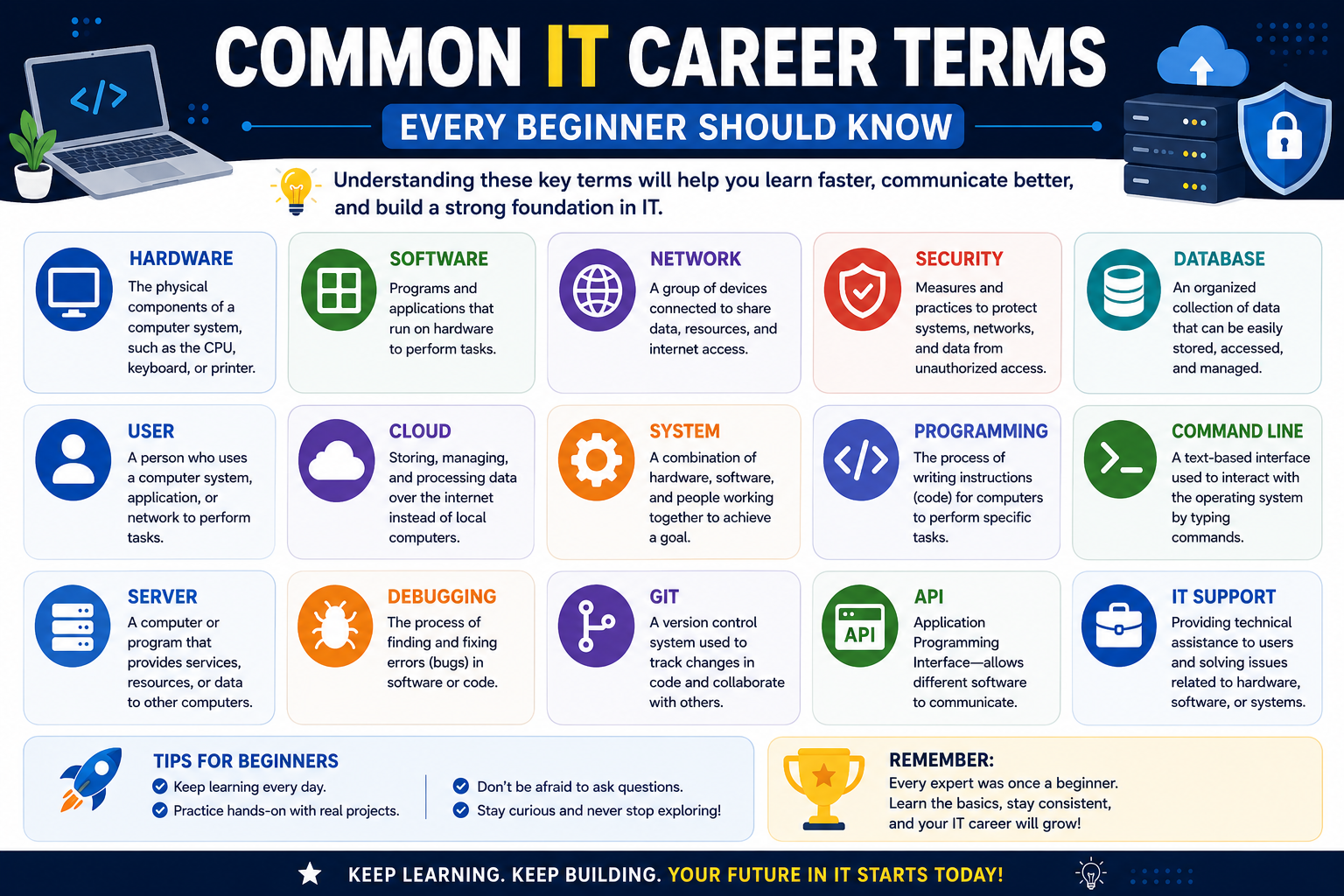
Technology has become one of the most important parts of modern life. Nearly every business, school, hospital, bank, and government organization relies on technology systems to communicate, store information, provide services, and operate efficiently. Behind those systems are information technology professionals who design, manage, secure, and improve the digital tools people use every day.
For people outside the technology field, understanding IT careers can feel confusing. Job titles often sound similar, yet the responsibilities can be completely different. One person may focus on maintaining servers, another may secure networks against cyberattacks, while another writes software applications or analyzes data. Every IT role serves a unique purpose within an organization, and together these professionals keep businesses functioning in a fast-moving digital world.
The technology industry also changes constantly. Cloud computing, cybersecurity, artificial intelligence, automation, and remote work technologies continue reshaping how businesses operate. Because of this, IT careers remain in high demand and offer opportunities for long-term growth, specialization, and advancement. Many people are drawn to IT because it provides strong career stability, competitive salaries, and the chance to work in nearly any industry imaginable.
Understanding the basics of different IT careers is valuable for students exploring future jobs, professionals considering career changes, managers leading technical teams, and organizations hiring technology employees. Knowing what each role does helps businesses build stronger teams and helps individuals choose career paths that match their interests and strengths.
Some IT professionals enjoy solving infrastructure problems and working with hardware systems. Others prefer coding applications, managing projects, analyzing data, or protecting networks from cyber threats. There is no single path into technology because the field includes both technical and strategic roles with many opportunities for specialization.
This guide explores several major IT careers, including network administration, network engineering, systems administration, and systems engineering. Each role plays an important part in maintaining reliable technology environments and supporting the systems organizations depend on every day.
Network Administrator
Network administrators are responsible for maintaining the communication systems that allow devices and users to connect with one another. In modern organizations, almost every business activity depends on networking in some way. Employees access cloud applications, communicate through email and messaging platforms, transfer files, attend video meetings, and connect to shared resources using network infrastructure.
A network administrator ensures those systems remain operational, reliable, and secure. Their responsibilities often include configuring routers and switches, maintaining wireless access points, monitoring network performance, troubleshooting connectivity issues, and managing network-related hardware and software.
Without stable networks, businesses can experience major disruptions. Employees may lose access to critical applications, communication systems may fail, and productivity can drop quickly. Network administrators help prevent these issues by maintaining strong and efficient network environments.
One of the core responsibilities of a network administrator is monitoring network health. They use monitoring tools to track bandwidth usage, identify performance bottlenecks, and detect outages before they become serious problems. In many organizations, administrators respond quickly to incidents such as slow internet speeds, disconnected users, or failed network devices.
Security also plays a major role in network administration. Although cybersecurity teams may handle advanced threat protection, network administrators help build the foundation for secure systems. They often configure firewalls, apply firmware updates, manage access permissions, and implement secure networking practices that reduce vulnerabilities.
Network administrators need a strong understanding of networking fundamentals. This includes concepts such as IP addressing, subnetting, DNS, routing, switching, wireless networking, and network protocols like TCP/IP. Understanding how devices exchange information across networks is essential for troubleshooting and system management.
Many professionals begin learning networking through certifications and hands-on labs. Entry-level certifications introduce networking basics, while advanced certifications focus on enterprise infrastructure and troubleshooting. Practical experience is especially important because networking problems often require real-world diagnostic skills.
The daily work of a network administrator can vary depending on the organization. In small businesses, one administrator may manage the entire network infrastructure independently. In larger enterprises, network administrators may specialize in specific areas such as wireless systems, remote connectivity, or network security.
Strong problem-solving skills are essential in this career. Network administrators often investigate complex technical issues where multiple systems interact with one another. Diagnosing failures requires patience, logical thinking, and attention to detail.
Communication skills are equally important. Administrators regularly assist employees who may not understand technical terminology. Explaining problems and solutions clearly helps reduce confusion and improves collaboration between technical and nontechnical teams.
As businesses continue adopting cloud services and remote work technologies, networking environments are becoming more complex. Modern administrators often work with hybrid systems that combine physical infrastructure with cloud-based networking services. This shift requires continuous learning and adaptation.
Automation is also transforming networking careers. Many organizations now use automation tools and scripts to simplify configuration management and reduce repetitive tasks. Network administrators who understand automation technologies can improve efficiency and reduce human error.
Career growth opportunities in networking are extensive. After gaining experience, network administrators often advance into positions such as network engineer, systems engineer, cloud engineer, or cybersecurity specialist. Some eventually move into infrastructure management or enterprise architecture roles.
Networking remains one of the most important areas of information technology because every organization depends on connectivity. As digital systems continue expanding, skilled network administrators will remain essential to maintaining communication and operational stability.
Network Engineer
Network engineers focus on designing, building, and optimizing the systems that allow organizations to communicate efficiently and securely. While network administrators maintain and troubleshoot existing infrastructure, network engineers are often responsible for creating the architecture behind those systems.
Their work involves planning how networks should function, selecting appropriate technologies, implementing scalable infrastructure, and ensuring networks can support future business growth. Network engineers help organizations develop systems that remain reliable even as demands increase.
Modern businesses rely heavily on stable connectivity. Employees work remotely, customers access online services, and applications depend on cloud platforms and data centers. Network engineers design systems capable of handling these requirements while maintaining performance and security.
A network engineer may design enterprise-wide network topologies, configure advanced routing protocols, implement virtual private networks, optimize wireless coverage, or create redundant systems that minimize downtime during failures.
Scalability is one of the most important aspects of network engineering. As businesses grow, their technology infrastructure must support additional users, devices, applications, and locations. Network engineers create systems that can expand without major disruptions or performance problems.
Performance optimization is another major responsibility. Engineers monitor traffic patterns, analyze bottlenecks, and improve data flow across networks. Efficient network design helps applications run smoothly and reduces delays that impact productivity.
Security is deeply integrated into network engineering. Engineers work closely with cybersecurity teams to implement secure architectures, segmentation strategies, encryption technologies, and access controls that protect organizational data and systems.
The profession requires strong technical knowledge in areas such as routing, switching, network protocols, wireless technologies, cloud networking, and infrastructure design. Engineers must understand how complex systems interact across large environments.
Many network engineers begin their careers in technical support or network administration roles before moving into engineering positions. Real-world troubleshooting experience provides valuable practical knowledge that supports advanced design responsibilities later in their careers.
Large organizations often divide network engineering into specialized fields. Some engineers focus on data center networking, while others specialize in cloud connectivity, wireless infrastructure, telecommunications, or network automation.
Automation has become increasingly important in networking careers. Engineers frequently use scripting languages and automation platforms to manage configurations, monitor infrastructure, and deploy updates efficiently. Automation reduces manual work and improves consistency across large environments.
Cloud computing has also transformed networking responsibilities. Many organizations now operate hybrid environments that combine on-premises infrastructure with cloud-based services. Network engineers help design secure and efficient connections between these systems.
Collaboration is essential for success in this role. Engineers often work alongside systems administrators, cloud teams, cybersecurity professionals, and software developers when implementing infrastructure projects. Communication and teamwork help ensure successful deployments.
Because networks support nearly every business function, network engineers often contribute to strategic planning discussions. Their expertise helps organizations make decisions about scalability, remote work infrastructure, cloud adoption, and long-term technology investments.
The career path offers many advancement opportunities. Experienced engineers may move into senior engineering positions, network architecture roles, infrastructure leadership, or enterprise technology management.
The demand for skilled network engineers continues growing as businesses expand their digital operations. Organizations need professionals who can design secure, scalable, and high-performance systems capable of supporting modern technology requirements.
Systems Administrator
Systems administrators manage and maintain the servers, operating systems, applications, and infrastructure that organizations rely on daily. They help ensure that employees can access the tools and systems they need to perform their jobs efficiently.
A systems administrator may oversee physical servers, virtual machines, storage systems, user accounts, enterprise applications, and operating system environments. Their work keeps business technology stable, updated, and operational.
When employees log into workstations, access shared files, connect to email platforms, or use internal applications, systems administrators help ensure those systems function properly behind the scenes. Their role is essential to maintaining productivity across the organization.
One major responsibility of systems administrators is managing servers. Servers host applications, databases, files, and services that employees and customers depend on every day. Administrators monitor server health, install updates, manage performance, and troubleshoot failures.
Backup management is another critical task. Businesses rely heavily on digital information, and data loss can cause serious operational and financial damage. Systems administrators configure backup systems and recovery procedures to protect important information.
Cybersecurity responsibilities are also closely tied to systems administration. Administrators apply security patches, enforce password policies, manage permissions, and monitor systems for vulnerabilities. Keeping systems updated helps reduce exposure to cyber threats.
Virtualization has become a central part of modern systems administration. Rather than maintaining separate physical servers for every workload, organizations often use virtualization platforms to host multiple systems on shared hardware. Administrators manage these environments to improve efficiency and reduce costs.
Cloud services are increasingly integrated into systems administration as well. Many organizations use cloud-based storage, virtual servers, and software platforms alongside traditional infrastructure. Administrators often manage hybrid environments that combine cloud and on-premises technologies.
Troubleshooting skills are essential in this career. Systems administrators investigate issues such as server crashes, application failures, storage problems, authentication errors, and performance slowdowns. Diagnosing problems requires logical thinking and careful analysis.
Time management is equally important because administrators frequently handle multiple tasks simultaneously. They may monitor system alerts, respond to incidents, assist users, apply updates, and manage infrastructure projects within the same day.
Documentation is another valuable skill. Administrators maintain records of configurations, recovery procedures, software changes, and infrastructure setups. Clear documentation improves consistency and helps teams respond effectively during emergencies.
Many systems administrators start their careers in help desk or desktop support positions before advancing into infrastructure roles. Supporting end users provides valuable experience with troubleshooting and technology operations.
The role varies depending on company size and structure. In smaller organizations, one administrator may handle nearly all infrastructure responsibilities. In larger enterprises, administrators often specialize in areas such as virtualization, cloud systems, storage management, or identity services.
Automation is becoming increasingly important in systems administration. Administrators use scripting tools to automate repetitive tasks such as account creation, software deployment, monitoring, and reporting. Automation improves efficiency and reduces the likelihood of human error.
Continuous learning is important because infrastructure technologies evolve rapidly. Administrators regularly adapt to new operating systems, cloud platforms, security practices, and management tools.
Systems administration provides strong opportunities for career growth. Professionals may advance into systems engineering, cloud administration, infrastructure architecture, or IT management positions as they gain experience and technical expertise.
Organizations across every industry rely on systems administrators to maintain operational stability. Without effective systems management, businesses would struggle to maintain productivity, protect data, and support daily operations.
Systems Engineer
Systems engineers focus on designing and integrating the technology environments organizations depend on. Their role centers on creating reliable systems that combine hardware, software, networking, and cloud technologies into unified infrastructure solutions.
Unlike systems administrators, who primarily maintain existing systems, systems engineers often work on larger design and implementation projects. They evaluate business requirements, identify technical solutions, and develop infrastructures capable of supporting organizational growth and operational goals.
Systems engineers help businesses modernize technology environments, improve efficiency, and build scalable infrastructure that can adapt to changing needs. Their work often involves integrating multiple technologies into cohesive systems that function smoothly together.
A systems engineer may design virtualization environments, implement cloud migrations, deploy enterprise applications, create disaster recovery solutions, or optimize infrastructure performance. Their projects often support long-term technology strategies rather than daily maintenance tasks.
Scalability is one of the most important aspects of systems engineering. Organizations constantly evolve, and their infrastructure must support increasing workloads, users, and applications. Systems engineers design environments capable of handling growth without major disruptions.
Reliability is another critical focus. Businesses depend heavily on continuous system availability, and downtime can create serious operational problems. Systems engineers develop redundancy, failover, and recovery solutions that improve resilience and minimize service interruptions.
Cloud computing plays a major role in modern systems engineering. Many engineers work extensively with public cloud platforms, hybrid environments, and virtualization technologies. They help organizations migrate workloads, optimize cloud performance, and manage infrastructure costs effectively.
Automation is also becoming increasingly important. Systems engineers frequently implement automation tools that streamline deployments, simplify management tasks, and improve consistency across infrastructure environments.
Strong analytical skills are essential in this profession. Engineers evaluate existing systems, identify inefficiencies, and recommend improvements that enhance performance, scalability, and security.
Collaboration is a major part of systems engineering work. Engineers often coordinate with network teams, cybersecurity professionals, developers, project managers, and business leaders to ensure successful implementations.
Communication skills are important because engineers frequently explain technical recommendations to stakeholders who may not have deep technical knowledge. Translating complex infrastructure concepts into business-focused discussions helps organizations make informed decisions.
Most systems engineers build their expertise after working in systems administration, networking, or infrastructure support roles. Practical experience with enterprise systems provides the foundation necessary for designing advanced environments.
The career path offers many opportunities for specialization. Some engineers focus on cloud architecture, virtualization, automation, infrastructure security, or enterprise systems design. Others move into leadership positions overseeing infrastructure strategy and digital transformation projects.
As organizations continue investing in modernization, cloud adoption, and scalable infrastructure, systems engineers remain highly valuable technology professionals. Their ability to design reliable and adaptable systems plays a major role in helping businesses operate successfully in an increasingly digital environment.
DevOps Engineer
Modern businesses depend on software and digital services to operate efficiently, communicate with customers, and stay competitive. However, building software is only one part of the process. Applications must also be tested, deployed, monitored, updated, and maintained reliably. DevOps engineers help organizations improve this entire lifecycle by combining development and operations practices into a more collaborative and automated process.
The term “DevOps” comes from combining development and operations. Traditionally, software developers and IT operations teams worked separately. Developers focused on creating applications, while operations teams managed servers, deployments, and infrastructure. This separation often created delays, communication problems, and deployment failures.
DevOps engineers help eliminate those barriers. Their role centers on improving collaboration between teams while automating processes that make software delivery faster, safer, and more efficient. Instead of relying heavily on manual deployments and repetitive tasks, DevOps practices encourage automation, consistency, and continuous improvement.
One of the most important responsibilities of a DevOps engineer is creating and maintaining deployment pipelines. These pipelines automate the process of testing and releasing software updates. Rather than manually moving code between environments, automated systems can verify functionality, detect errors, and deploy updates more reliably.
Automation reduces the risk of human mistakes and helps organizations release software more frequently. Faster deployment cycles allow businesses to respond quickly to customer needs, security vulnerabilities, and changing market conditions.
DevOps engineers also manage infrastructure environments. Many organizations now use infrastructure as code, which allows servers and systems to be configured automatically through scripts and templates instead of manual setup processes. This approach improves consistency and simplifies scaling.
Cloud computing plays a major role in DevOps careers. DevOps engineers frequently work with cloud platforms that support scalable infrastructure, containerized applications, and automated deployment systems. Understanding cloud architecture and services is often essential for success in the role.
Containerization technologies have become especially important in DevOps environments. Containers package applications and their dependencies together so they can run consistently across different systems. This reduces compatibility problems and improves deployment reliability.
Monitoring and performance management are also key responsibilities. DevOps engineers track application performance, system health, and infrastructure stability using monitoring tools and analytics platforms. Quick identification of issues helps reduce downtime and improve user experiences.
Security has become increasingly integrated into DevOps practices as well. Many organizations now follow DevSecOps principles, where security testing and compliance checks are included throughout the development and deployment process rather than added later.
Problem-solving abilities are critical for DevOps engineers because they often work with complex systems involving applications, servers, cloud platforms, automation tools, and networking infrastructure. Diagnosing failures may require understanding multiple technologies at once.
Collaboration is one of the defining features of DevOps work. Engineers frequently coordinate with developers, system administrators, quality assurance teams, security professionals, and project managers. Strong communication skills help teams work together more effectively.
Many DevOps professionals begin their careers in systems administration, software development, or cloud engineering before moving into DevOps-focused positions. The role combines infrastructure knowledge with software development concepts, making broad technical experience especially valuable.
Continuous learning is extremely important because DevOps tools and practices evolve rapidly. Automation frameworks, cloud technologies, and deployment platforms frequently change, requiring professionals to stay updated with industry trends.
The career path offers significant advancement opportunities. Experienced DevOps engineers may move into cloud architecture, platform engineering, site reliability engineering, or IT leadership positions. Organizations increasingly depend on automation and scalable deployment systems, making DevOps expertise highly valuable across industries.
Cloud Administrator
Cloud computing has transformed how organizations manage technology infrastructure. Instead of relying entirely on physical servers located in office buildings or data centers, businesses can now use cloud platforms to host applications, store data, and deliver services over the internet. Cloud administrators help manage these environments and ensure they remain reliable, secure, and efficient.
A cloud administrator is responsible for maintaining cloud-based systems such as virtual servers, storage resources, databases, and user access controls. Their work helps organizations operate flexible and scalable infrastructure without managing all hardware directly.
Many businesses use hybrid environments that combine traditional on-premises systems with cloud services. Cloud administrators often manage both environments simultaneously, ensuring systems work together smoothly and securely.
One of the major advantages of cloud computing is scalability. Organizations can increase or decrease resources depending on demand without purchasing additional physical hardware. Cloud administrators help configure these resources efficiently while controlling costs and maintaining performance.
Cloud administrators frequently manage virtual machines, storage systems, backups, user permissions, networking configurations, and monitoring services within cloud platforms. They also help ensure applications remain available and responsive for employees and customers.
Security is a critical part of cloud administration. Administrators configure identity management systems, implement access controls, monitor suspicious activity, and help maintain compliance with security standards. Because cloud environments often store sensitive business information, strong security practices are essential.
Backup and disaster recovery planning are also important responsibilities. Cloud platforms offer powerful recovery capabilities, but administrators must configure those systems correctly to ensure data protection during outages or cyber incidents.
Automation has become increasingly important in cloud administration. Many cloud platforms allow infrastructure to be deployed and managed using scripts and templates rather than manual configuration. Automation improves consistency and reduces repetitive work.
Monitoring and optimization are central to the role as well. Cloud administrators track resource usage, performance metrics, and infrastructure costs to ensure systems operate efficiently. Poorly optimized cloud environments can become expensive quickly if resources are not managed properly.
Strong troubleshooting skills are essential because cloud environments can involve many interconnected services. Administrators may need to investigate networking issues, storage failures, application outages, or authentication problems across distributed systems.
The role often requires familiarity with multiple cloud service categories, including computing resources, storage systems, networking, security tools, and monitoring platforms. Understanding how these services interact is important for effective management.
Cloud administrators also support business continuity by maintaining high availability and minimizing downtime. Organizations depend heavily on cloud-hosted applications, and service interruptions can affect employees, customers, and operations significantly.
Many professionals enter cloud administration after gaining experience in systems administration, networking, or infrastructure support roles. Foundational knowledge of operating systems, virtualization, and networking helps prepare individuals for cloud-focused responsibilities.
Continuous learning is especially important in cloud careers because platforms regularly introduce new features, services, and security practices. Professionals must stay current with evolving technologies and operational models.
The demand for cloud administrators continues growing as organizations migrate applications and infrastructure to cloud environments. Businesses across industries need professionals who can manage scalable systems, maintain security, and optimize cloud operations effectively.
Career advancement opportunities include cloud engineer, cloud architect, infrastructure engineer, or cloud operations management roles. Professionals with strong expertise in automation, security, and infrastructure design are especially valuable in modern IT environments.
Solutions Architect
Solutions architects help organizations design technology systems that solve specific business problems. Their role combines technical expertise with strategic planning to ensure companies choose and implement the right technologies for their needs.
Rather than focusing only on maintaining systems, solutions architects evaluate business goals, operational challenges, and technical requirements before designing solutions that align with organizational objectives.
A solutions architect may help a company migrate to cloud infrastructure, integrate new software platforms, modernize outdated systems, improve scalability, or enhance operational efficiency through technology improvements.
One of the most important parts of the role is understanding both business and technical perspectives. Solutions architects communicate with executives, managers, technical teams, and stakeholders to identify problems and recommend practical solutions.
Technology environments in large organizations are often complex. Businesses may use multiple cloud platforms, legacy systems, databases, applications, and networking technologies simultaneously. Solutions architects design systems that allow these technologies to work together effectively.
Scalability is a major focus for solutions architects. Businesses need systems capable of supporting growth, increasing workloads, and changing operational requirements. Architects help organizations avoid infrastructure limitations that could slow future expansion.
Cost management is another important consideration. Solutions architects evaluate the financial impact of technology decisions and recommend solutions that balance performance, reliability, and budget requirements.
Security is deeply connected to architecture design as well. Architects help ensure systems include appropriate protections for sensitive data, access management, compliance requirements, and disaster recovery capabilities.
Cloud computing plays a major role in modern solution architecture. Many architects design hybrid or fully cloud-based systems that support remote work, application hosting, storage, and scalable infrastructure services.
Documentation and planning are essential parts of the profession. Architects create diagrams, technical plans, implementation strategies, and system designs that guide project teams during deployments and upgrades.
Strong communication skills are critical because solutions architects frequently explain technical concepts to nontechnical decision-makers. They must translate complex technology discussions into business-focused recommendations that leadership teams can understand.
Problem-solving abilities are equally important. Organizations often seek architects when facing complicated operational or infrastructure challenges. Architects analyze current systems, identify weaknesses, and design solutions that improve efficiency and reliability.
Most solutions architects develop their expertise after years of experience in infrastructure, engineering, networking, cloud computing, or software development roles. Broad technical knowledge helps them understand how different systems interact within enterprise environments.
Collaboration is a central part of the role. Architects work closely with engineers, developers, cybersecurity teams, project managers, and executives throughout planning and implementation processes.
The profession offers strong advancement opportunities. Experienced architects may move into enterprise architecture, infrastructure leadership, technology consulting, or executive technology management positions.
As businesses continue investing in digital transformation and modernization, solutions architects remain highly valuable professionals capable of aligning technology strategies with long-term organizational goals.
Security Administrator
Cybersecurity has become one of the most important areas of information technology. Businesses face constant threats from cybercriminals, ransomware attacks, phishing campaigns, data breaches, and unauthorized access attempts. Security administrators help protect organizations from these threats by managing and maintaining security systems and policies.
A security administrator is responsible for monitoring systems, identifying vulnerabilities, implementing protections, and responding to security-related incidents. Their work helps organizations reduce risk and protect sensitive information.
One of the primary responsibilities of a security administrator is managing access controls. They help determine who can access systems, applications, and data while enforcing policies that limit unauthorized activity.
Monitoring security alerts is another major part of the role. Security administrators use monitoring tools to detect suspicious behavior, unusual login attempts, malware infections, or other indicators of potential attacks.
When vulnerabilities are discovered, administrators help implement fixes and security updates quickly. Unpatched systems are common targets for attackers, making proactive maintenance extremely important.
Firewall management is also a common responsibility. Firewalls help control incoming and outgoing network traffic based on security rules. Administrators configure these systems to block unauthorized access while allowing legitimate communication.
Endpoint security plays a growing role in cybersecurity as well. Organizations use antivirus software, detection tools, and device management systems to protect laptops, servers, and mobile devices from threats.
Security administrators often participate in incident response efforts. If an attack or breach occurs, they help investigate the problem, contain the damage, and restore affected systems. Quick response times can significantly reduce the impact of cyber incidents.
Compliance and policy management are important aspects of the role too. Many industries must follow security regulations and standards related to data protection and privacy. Administrators help organizations maintain compliance through audits, policies, and security controls.
Strong analytical thinking is essential because cybersecurity involves identifying patterns, investigating anomalies, and understanding how attackers exploit weaknesses.
The field also requires continuous learning. Cyber threats evolve constantly, and security professionals must stay updated on new attack methods, vulnerabilities, and defense strategies.
Communication skills are valuable because security administrators often educate employees about safe technology practices. Human error remains one of the biggest cybersecurity risks, so awareness training is important for reducing threats.
Many professionals begin cybersecurity careers in technical support, networking, or systems administration roles before specializing in security. Broad infrastructure knowledge helps security administrators understand how systems interact and where vulnerabilities may exist.
The demand for cybersecurity professionals continues growing rapidly because organizations of every size face increasing digital threats. Businesses, governments, healthcare providers, financial institutions, and educational organizations all require strong security practices.
Career advancement opportunities include cybersecurity engineer, penetration tester, security analyst, incident responder, or chief information security officer positions. Experienced professionals with strong technical and leadership skills are especially valuable in modern organizations.
Cybersecurity remains one of the fastest-growing and most critical areas within information technology. As technology continues expanding into every part of business and society, protecting digital systems and sensitive information will remain an essential responsibility for organizations worldwide.
Database Administrator
Data is one of the most valuable assets modern organizations possess. Businesses store customer information, financial records, inventory details, operational metrics, and countless other forms of data that support daily decision-making and operations. Database administrators help ensure that information remains organized, secure, and accessible.
A database administrator, often called a DBA, manages database systems that store and organize information. Their responsibilities include maintaining performance, securing sensitive data, backing up information, and troubleshooting database issues.
Databases support many critical business functions. E-commerce systems process transactions using databases, healthcare organizations store patient records, financial institutions manage banking information, and businesses analyze operational data through database platforms.
One of the most important responsibilities of a DBA is performance optimization. Large databases can become slow or inefficient if not managed properly. Administrators analyze queries, improve indexing strategies, and optimize configurations to ensure applications respond quickly.
Security is another critical aspect of database administration. Sensitive information must be protected from unauthorized access, accidental exposure, and cyber threats. DBAs configure permissions, encryption systems, and access controls that help safeguard data.
Backup and recovery planning are essential responsibilities as well. Data loss can create serious financial and operational consequences for organizations. Database administrators maintain backup systems and recovery procedures that help restore information during failures or disasters.
Monitoring database health is a routine part of the role. Administrators track performance metrics, storage usage, system availability, and error logs to identify issues before they impact operations.
Troubleshooting skills are highly important because database problems can affect entire applications and business services. DBAs investigate issues such as slow queries, corrupted data, replication failures, and connection problems.
Cloud technology has transformed database management in recent years. Many organizations now use cloud-hosted database platforms that provide scalability and managed infrastructure services. Database administrators increasingly work with both traditional and cloud-based environments.
Automation is becoming more common in database administration as well. Automated monitoring, backups, scaling, and maintenance tasks help improve efficiency and reduce manual workload.
Strong attention to detail is essential because even small configuration errors can affect performance, security, or data integrity. DBAs must carefully manage changes and updates within production environments.
Collaboration is also important. Database administrators frequently work with developers, analysts, infrastructure teams, and business stakeholders to support applications and reporting systems.
Many professionals enter database administration after gaining experience with SQL, data analysis, software development, or infrastructure support. Understanding how applications interact with databases helps administrators manage systems more effectively.
The demand for database expertise continues growing as organizations collect and analyze larger amounts of information. Businesses depend on reliable data systems for operations, customer service, reporting, and strategic decision-making.
Career advancement opportunities include database architect, data engineer, analytics engineer, infrastructure manager, or data platform leadership roles. Professionals with expertise in cloud databases, automation, and performance optimization are especially valuable in modern IT environments.
Programmer and Developer
Software developers and programmers are responsible for creating the applications, systems, and digital tools people use every day. From mobile apps and websites to banking systems and enterprise software, developers build the technology that powers modern businesses and digital experiences.
At the core of programming is writing code. Developers use programming languages to create instructions that computers can understand and execute. These instructions allow applications to process information, perform tasks, communicate with databases, and interact with users.
Developers work on many different types of software. Some create web applications used through internet browsers, while others build mobile applications, desktop programs, cloud-based platforms, video games, or embedded systems used in hardware devices. The type of development work depends heavily on the organization and industry.
A programmer’s responsibilities often include writing code, testing applications, debugging errors, improving performance, and updating existing systems. In many organizations, developers also participate in planning meetings, design discussions, and project collaboration.
Problem-solving is one of the most important skills in programming. Developers constantly analyze technical challenges and design logical solutions. Whether fixing a software bug or building an entirely new feature, programming requires careful thinking and attention to detail.
Programming languages vary depending on the type of work being performed. Some developers specialize in languages commonly used for web development, while others focus on application development, automation, data analysis, or enterprise systems. Learning multiple languages over time is common in software careers.
Version control systems are another important part of software development. These systems help developers manage changes to code, collaborate with team members, and track project history. In modern development environments, collaboration tools are essential because software projects often involve multiple developers working together.
Testing is also a major responsibility. Developers must ensure applications function correctly, handle errors properly, and remain secure and stable under different conditions. Many organizations use automated testing systems to improve reliability and reduce deployment issues.
Software development methodologies influence how teams operate as well. Agile development practices, for example, focus on collaboration, iterative progress, and continuous improvement. Developers often work in short development cycles that allow teams to release updates more frequently.
Cloud computing has changed the software industry significantly. Many applications now operate entirely in cloud environments, requiring developers to understand scalable systems, APIs, cloud services, and distributed architectures.
Cybersecurity awareness is becoming increasingly important for developers too. Secure coding practices help reduce vulnerabilities that attackers could exploit. Developers often work closely with security teams to ensure applications protect sensitive data properly.
Communication skills matter more in development careers than many people expect. Developers frequently collaborate with designers, project managers, analysts, testers, and business stakeholders. Being able to explain technical concepts clearly improves teamwork and project success.
Continuous learning is a major part of software development because technologies evolve rapidly. New programming frameworks, tools, languages, and best practices emerge constantly. Successful developers regularly update their skills and adapt to industry changes.
Some developers specialize in front-end development, focusing on user interfaces and visual experiences. Others work in back-end development, managing databases, servers, and application logic. Full-stack developers handle both front-end and back-end responsibilities.
The profession offers extensive career flexibility. Developers can work in industries such as healthcare, finance, education, entertainment, cybersecurity, manufacturing, and e-commerce. Nearly every modern business depends on software in some form.
Career advancement opportunities include software engineering, technical leadership, development management, solutions architecture, or specialized engineering positions. Experienced developers may also transition into cybersecurity, cloud engineering, artificial intelligence, or data science roles.
Software development remains one of the most influential and rapidly growing areas of information technology. As businesses continue digitizing operations and expanding online services, skilled developers will remain essential to innovation and technological progress.
Project Manager
Technology projects often involve many moving parts, including developers, engineers, business stakeholders, vendors, budgets, and deadlines. Project managers help coordinate all of these elements to ensure projects are completed successfully and efficiently.
An IT project manager oversees technology initiatives from planning to completion. Their responsibilities include organizing tasks, managing timelines, coordinating teams, tracking budgets, and ensuring projects align with business goals.
Technology projects can range from software development and cloud migrations to infrastructure upgrades and cybersecurity implementations. Without strong project management, even technically skilled teams can struggle with delays, miscommunication, or budget problems.
One of the most important responsibilities of a project manager is planning. Before work begins, project managers help define objectives, timelines, deliverables, risks, and resource requirements. Careful planning improves organization and reduces confusion during execution.
Communication is at the center of project management. Managers act as a bridge between technical teams and business stakeholders. They help ensure everyone understands project goals, expectations, and progress updates.
Scheduling is another major responsibility. Technology projects often involve multiple teams working on interconnected tasks. Project managers coordinate timelines and dependencies to keep work moving forward efficiently.
Risk management is a critical part of the role as well. Technology projects frequently encounter unexpected challenges such as technical issues, staffing shortages, security concerns, or changing business priorities. Project managers identify potential risks early and develop strategies to minimize disruptions.
Budget oversight is also important. Organizations invest significant resources into technology projects, and managers help ensure spending remains under control while meeting project objectives.
Strong leadership skills are essential because project managers coordinate diverse teams with different responsibilities and perspectives. Successful managers motivate teams, resolve conflicts, and maintain focus during challenging projects.
Organization and attention to detail are equally important. Managing large technology initiatives often involves tracking deadlines, documentation, meeting schedules, approvals, and progress reports simultaneously.
Project managers commonly use collaboration and tracking tools to organize work and monitor progress. These platforms help teams communicate efficiently and maintain visibility into project status.
Understanding technology concepts is valuable even though project managers may not perform technical tasks themselves. Familiarity with software development, infrastructure, cybersecurity, or cloud computing helps managers communicate more effectively with technical teams.
Agile project management practices have become increasingly common in IT environments. Agile approaches emphasize flexibility, collaboration, and iterative progress rather than rigid long-term planning. Many project managers now oversee fast-moving development cycles with continuous updates and feedback.
Problem-solving skills are also important because projects rarely proceed exactly as planned. Managers must adapt quickly to changing circumstances while keeping projects aligned with organizational goals.
Many IT project managers begin their careers in technical roles before transitioning into leadership and coordination responsibilities. Experience working within technology teams provides valuable insight into project challenges and workflows.
Career advancement opportunities include program management, portfolio management, operations leadership, or executive management positions. Experienced project managers often oversee multiple teams or large enterprise initiatives.
The demand for skilled project managers continues growing as organizations invest heavily in digital transformation, infrastructure modernization, and software development. Effective leadership and coordination remain essential for successful technology implementation.
Data Analyst
Modern organizations generate enormous amounts of information every day. Customer interactions, financial transactions, operational metrics, website activity, and business performance data all create valuable insights that can help companies make better decisions. Data analysts help organizations interpret that information and turn raw data into actionable knowledge.
A data analyst collects, organizes, processes, and analyzes data to identify trends, patterns, and opportunities. Their work supports decision-making across departments such as marketing, finance, operations, healthcare, and technology.
Businesses rely on data analysis to improve efficiency, understand customer behavior, reduce costs, forecast trends, and measure performance. Without skilled analysts, valuable information may remain hidden within large datasets.
One of the most important responsibilities of a data analyst is cleaning and organizing data. Raw information often contains duplicates, inconsistencies, missing values, or formatting issues. Analysts prepare datasets so they can be analyzed accurately and effectively.
Data visualization is another major part of the role. Analysts create charts, dashboards, reports, and visual summaries that help organizations understand complex information quickly. Clear visualizations make it easier for decision-makers to identify trends and insights.
Analytical thinking is central to the profession. Data analysts examine information carefully, ask meaningful questions, and identify relationships within datasets. Their findings often influence important business strategies and operational improvements.
Many analysts work with databases and query languages to retrieve information from large systems. Understanding how to organize and manipulate data efficiently is essential for success in the role.
Programming and automation skills are becoming increasingly valuable in data analysis careers. Analysts often use scripting tools to automate repetitive tasks, process large datasets, and improve reporting efficiency.
Business knowledge is equally important. Effective analysts understand organizational goals and focus their analysis on solving real business problems rather than simply producing reports.
Communication skills play a major role in data analysis as well. Analysts must explain findings clearly to managers, executives, and stakeholders who may not have technical backgrounds. Translating complex information into understandable insights helps organizations make informed decisions.
The growth of artificial intelligence and machine learning has increased demand for strong data skills across industries. Businesses increasingly rely on data-driven strategies to remain competitive and adapt to changing markets.
Data analysts often collaborate with developers, engineers, project managers, marketing teams, and executives. Their insights support strategic planning, product development, operational improvements, and customer engagement efforts.
Many professionals enter data analysis careers from backgrounds in business, technology, mathematics, finance, or statistics. Curiosity, attention to detail, and analytical thinking are valuable traits in the field.
Cloud platforms and business intelligence tools have transformed data analysis significantly. Modern analysts frequently work with cloud-based datasets, interactive dashboards, and large-scale analytics systems.
Continuous learning is important because data technologies evolve rapidly. Analysts often expand their skills into areas such as machine learning, predictive analytics, automation, and advanced visualization techniques.
Career advancement opportunities include data science, business intelligence, analytics management, machine learning engineering, or strategic consulting positions. Experienced analysts with strong technical and communication skills are highly valuable in modern organizations.
As businesses continue collecting larger volumes of information, data analysis remains one of the fastest-growing and most influential areas within information technology and business operations.
How IT Careers Continue to Evolve
The technology industry changes faster than almost any other professional field. New tools, platforms, security threats, and business requirements constantly reshape how IT professionals work. Because of this, adaptability has become one of the most important qualities for long-term success in technology careers.
Cloud computing has dramatically changed infrastructure management. Organizations increasingly move systems and applications to cloud environments because they offer flexibility, scalability, and cost efficiency. As a result, many traditional IT roles now include cloud-focused responsibilities.
Cybersecurity concerns continue growing as well. Businesses face increasingly sophisticated attacks targeting networks, applications, databases, and employees. Security awareness has become important across nearly every IT role, not just dedicated cybersecurity positions.
Automation is another major trend transforming technology careers. Tasks that once required extensive manual effort can now be handled through scripts, orchestration platforms, and intelligent systems. IT professionals who understand automation technologies often improve efficiency and reduce operational complexity.
Artificial intelligence and machine learning are influencing many areas of IT too. From automated monitoring systems to predictive analytics and intelligent security tools, organizations are integrating AI-driven technologies into business operations at a rapid pace.
Remote work technologies have also changed how businesses operate. Organizations now rely heavily on secure connectivity, cloud collaboration tools, and scalable infrastructure that supports distributed teams. IT professionals play a major role in maintaining these environments.
Despite rapid technological change, foundational skills remain extremely valuable. Networking, operating systems, troubleshooting, communication, and problem-solving continue forming the basis of many successful IT careers.
Soft skills are becoming increasingly important across technology roles. Businesses need professionals who can collaborate effectively, explain technical concepts clearly, manage projects, and align technology decisions with organizational goals.
Continuous learning has become a permanent part of IT careers. Technology professionals regularly update their skills through certifications, hands-on practice, training programs, and real-world experience. Lifelong learning is often necessary to remain competitive in the industry.
The flexibility of IT careers is one of the field’s greatest strengths. Professionals can specialize in infrastructure, software development, cybersecurity, cloud computing, data analysis, automation, project management, artificial intelligence, or countless other areas.
Technology careers also exist in nearly every industry imaginable. Healthcare organizations need secure systems and databases. Financial institutions require cybersecurity and infrastructure professionals. Manufacturers rely on automation and networking. Educational institutions depend on cloud platforms and digital learning systems.
The diversity of opportunities means individuals can often combine technology skills with personal interests. Someone interested in healthcare, gaming, finance, education, or media can often find technology roles within those industries.
Career progression in IT is also highly flexible. Many professionals begin in support or entry-level infrastructure positions before advancing into engineering, architecture, management, or specialized technical roles.
Experience often matters as much as formal education in technology careers. Hands-on practice, problem-solving ability, and real-world technical skills are highly valued by employers across the industry.
Technology will continue evolving rapidly in the coming years, creating new career paths and transforming existing roles. Professionals who remain adaptable, curious, and committed to learning will continue finding strong opportunities throughout the IT industry.
Choosing the Right IT Career Path
Choosing a technology career can feel overwhelming because the field includes so many different specializations. However, understanding personal interests and strengths can help narrow the options.
People who enjoy troubleshooting hardware, systems, and infrastructure may thrive in networking or systems administration roles. Those who enjoy coding and building applications may prefer software development careers.
Individuals interested in protecting systems and investigating threats may find cybersecurity rewarding, while analytical thinkers who enjoy working with information may excel in data analysis careers.
Leadership-oriented professionals may pursue project management or solutions architecture positions that combine technical understanding with strategic planning and communication responsibilities.
Exploring different areas of IT through courses, labs, certifications, internships, or personal projects can help individuals discover which roles best match their goals and interests.
Technology careers rarely follow a single fixed path. Many professionals transition between specialties over time as they gain experience and discover new interests. A systems administrator may become a cloud engineer, while a developer may move into cybersecurity or architecture.
The wide range of opportunities within IT makes it one of the most flexible and dynamic industries in the modern workforce.
Conclusion
Information technology careers play a critical role in keeping modern businesses, organizations, and daily life functioning smoothly. Networks, servers, applications, databases, cloud systems, cybersecurity tools, and data platforms all depend on skilled professionals who design, manage, secure, and improve them.
From network administrators and systems engineers to developers, project managers, security professionals, and data analysts, every IT role contributes to the larger technology ecosystem in a unique way. Some professionals focus on infrastructure and reliability, while others create software, analyze information, manage projects, or defend systems against cyber threats.
The technology industry continues evolving rapidly as businesses adopt cloud computing, automation, artificial intelligence, and advanced security practices. Because of this constant change, IT professionals must continue learning and adapting throughout their careers.
At the same time, the growing importance of technology across every industry creates strong demand for skilled professionals. Organizations rely on IT teams not only to maintain operations but also to support innovation, growth, and long-term competitiveness.
Whether someone is beginning their first technology job, considering a career change, or exploring new specializations, the IT field offers diverse opportunities for growth and advancement. Understanding the purpose and responsibilities of different IT careers is an important first step toward building a successful future in technology.