The modern world depends heavily on digital technology. Businesses use online platforms to manage operations, governments store citizen records in digital systems, hospitals maintain electronic medical histories, and individuals rely on smartphones and cloud services for daily communication. Every interaction online generates data, and much of that data contains sensitive personal or financial information. Because of this rapid digital expansion, organizations now face enormous pressure to protect the information they collect and store.
Cyberattacks have become increasingly common across every industry. Criminal groups, independent hackers, and even state-sponsored actors constantly search for vulnerabilities they can exploit. A successful attack can expose customer records, shut down critical services, and damage public trust. The financial consequences alone can be devastating, but the long-term reputational harm may be even worse. Customers often lose confidence in organizations that fail to protect their information.
At the same time, people have become more aware of how their personal data is used. Consumers now expect companies to be transparent about what information they collect and why they collect it. Governments around the world have introduced regulations designed to ensure organizations handle personal data responsibly. These regulations place strict obligations on businesses regarding consent, storage, sharing, and protection of sensitive information.
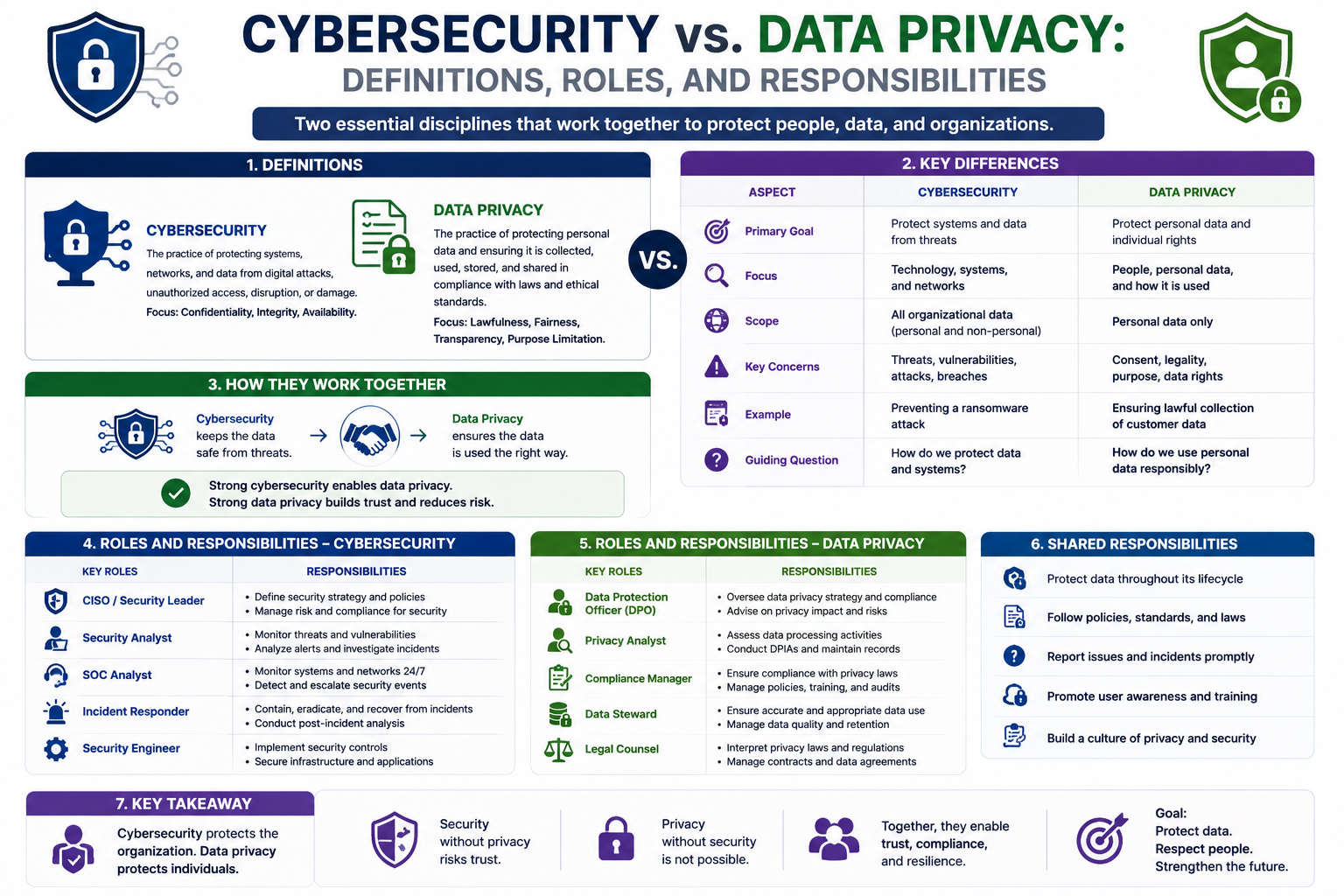
Two important concepts dominate these discussions: cybersecurity and data privacy. Although many people use these terms interchangeably, they represent different areas of responsibility. Cybersecurity focuses on protecting systems and networks from unauthorized access and malicious attacks. Data privacy focuses on the proper handling, collection, storage, and sharing of personal information.
Understanding the distinction between these concepts is essential for any organization operating in the digital age. Strong cybersecurity helps prevent attacks and breaches, while strong data privacy practices ensure information is handled ethically and legally. Both are necessary for building trust and maintaining secure operations.
What Is Cybersecurity?
Cybersecurity refers to the technologies, strategies, policies, and practices used to protect digital systems from cyber threats. It involves defending computers, servers, networks, applications, databases, and electronic devices from unauthorized access, damage, or disruption.
Cybersecurity exists because digital systems are constantly under attack. Criminals attempt to steal information, install malicious software, disrupt services, or gain financial benefits through cybercrime. Organizations must therefore implement protective measures that reduce vulnerabilities and strengthen defenses.
Cybersecurity is not limited to a single tool or department. It includes a wide range of activities and responsibilities across an organization. Technical teams configure secure infrastructure, developers build safer applications, and employees follow security guidelines designed to reduce risks.
The primary objective of cybersecurity is to preserve three essential principles: confidentiality, integrity, and availability.
Confidentiality ensures that sensitive information remains accessible only to authorized users. Integrity ensures that data cannot be altered improperly or maliciously. Availability ensures systems and information remain accessible when needed.
Together, these principles form the foundation of modern cybersecurity strategies.
Why Cybersecurity Matters More Than Ever
Technology has transformed the way organizations operate. Businesses now use cloud computing, mobile devices, remote work platforms, and interconnected systems to improve productivity and efficiency. While these innovations provide many benefits, they also increase exposure to cyber threats.
In the past, organizations stored most information in physical locations with limited digital access. Today, sensitive data travels across networks and is stored in multiple locations around the world. This creates many opportunities for attackers to exploit weaknesses.
Cybercriminals target organizations for several reasons. Financial gain remains one of the biggest motivations. Attackers may steal banking information, demand ransom payments, or sell stolen data on illegal marketplaces.
Some attackers seek intellectual property or confidential business information. Others aim to damage infrastructure or disrupt operations for political or ideological reasons.
Even small organizations are vulnerable. Many attackers specifically target smaller businesses because they often lack advanced security protections.
A successful cyberattack can have severe consequences. Businesses may lose customer trust, face legal penalties, and suffer operational downtime. Recovery costs can be extremely high, especially if sensitive customer information becomes exposed.
For this reason, cybersecurity is now considered a critical business priority rather than simply a technical concern.
The Expanding Threat Landscape
Cyber threats continue to evolve rapidly. Attackers constantly develop new methods to bypass security defenses and exploit weaknesses.
One common threat is malware. Malware refers to malicious software designed to damage systems, steal information, or gain unauthorized access. Malware includes viruses, spyware, trojans, and ransomware.
Ransomware attacks have become especially dangerous in recent years. In these attacks, cybercriminals encrypt an organization’s files and demand payment in exchange for restoring access. Hospitals, schools, and businesses around the world have experienced major disruptions because of ransomware incidents.
Phishing attacks are another widespread threat. Phishing occurs when attackers trick individuals into revealing sensitive information through deceptive emails, messages, or websites. These attacks often impersonate trusted organizations or coworkers.
Social engineering attacks manipulate human behavior rather than exploiting technical vulnerabilities. Attackers may pretend to be technical support personnel, executives, or customers to convince employees to share information.
Distributed Denial-of-Service attacks overwhelm systems with excessive traffic, causing websites or services to become unavailable.
Insider threats also create serious cybersecurity risks. Employees or contractors with legitimate access may intentionally or accidentally expose sensitive information.
Organizations must continuously monitor these evolving threats and adapt their defenses accordingly.
Cybersecurity as a Shared Responsibility
Many organizations have dedicated cybersecurity teams responsible for protecting systems and responding to threats. These teams may include security analysts, network engineers, incident responders, compliance specialists, and ethical hackers.
Their responsibilities include monitoring suspicious activity, securing infrastructure, testing applications, and investigating incidents.
However, cybersecurity is not solely the responsibility of technical experts. Every employee within an organization contributes to overall security.
Human error is one of the leading causes of cybersecurity incidents. Employees may click malicious links, use weak passwords, or accidentally expose confidential information.
Because of this, organizations must educate employees about common threats and safe security practices.
For example, employees should know how to recognize phishing emails. Suspicious messages often contain unusual requests, urgent language, spelling errors, or unexpected attachments.
Workers should also understand the importance of secure passwords, device protection, and reporting suspicious activity promptly.
When employees remain vigilant, organizations become significantly more resistant to attacks.
The Importance of Security Awareness Training
Security awareness training helps employees recognize and respond to potential threats. Effective training programs teach workers how cyberattacks occur and how they can reduce risks.
Training topics often include phishing prevention, password management, secure browsing habits, and safe handling of sensitive information.
Organizations may conduct simulated phishing exercises to test employee awareness. These exercises help identify weaknesses and reinforce good security behavior.
Regular training is essential because cyber threats evolve constantly. Attackers continuously refine their tactics to bypass defenses and exploit human behavior.
Employees who understand security risks are less likely to make mistakes that could lead to breaches.
Security awareness also encourages employees to report suspicious activity immediately. Early reporting can help organizations stop attacks before they spread.
Security by Design
One of the most important modern cybersecurity principles is Security by Design. This approach emphasizes integrating security protections into systems and applications from the beginning of development rather than adding them later.
Historically, many organizations prioritized functionality and speed during software development. Security was often treated as a secondary concern addressed only after applications were completed.
This reactive approach created vulnerabilities because systems were not originally designed with security in mind.
Security by Design changes this mindset by making security a core part of the development process.
For example, imagine an insurance company creating an online application where customers submit personal information to receive policy quotes.
Under a Security by Design approach, developers would build security features directly into the application architecture. Sensitive data would be encrypted, access controls would restrict unauthorized viewing, and security testing would occur throughout development.
Developers would also validate user inputs to prevent attackers from injecting malicious code into the system.
By addressing security early, organizations reduce vulnerabilities and create more resilient applications.
The Role of Software Developers in Cybersecurity
Software developers play a major role in maintaining cybersecurity. Applications often become targets for attackers because they interact directly with users and sensitive data.
Poorly written code can create vulnerabilities that attackers exploit. Common vulnerabilities include SQL injection, cross-site scripting, insecure authentication, and improper access controls.
Developers must therefore follow secure coding practices throughout the software development process.
Secure coding involves validating user input, encrypting sensitive data, managing sessions safely, and implementing proper authentication controls.
Developers must also stay informed about emerging threats and regularly update applications to fix vulnerabilities.
Code reviews and security testing help identify weaknesses before attackers can exploit them.
By prioritizing secure development practices, organizations significantly reduce cybersecurity risks.
Logging and Monitoring
Effective cybersecurity requires continuous monitoring of systems and network activity. Logging allows organizations to record events occurring within their digital environments.
Logs may include login attempts, file transfers, configuration changes, and application errors.
Security teams analyze logs to detect suspicious behavior and investigate incidents. For example, repeated failed login attempts may indicate a brute-force attack.
Monitoring tools can automatically alert security personnel when unusual activity occurs.
However, organizations must handle logs carefully because they may contain sensitive information.
Sensitive data such as passwords, medical information, or financial details should never appear in plain text within logs. Instead, organizations should mask or encrypt this information.
This balance between visibility and privacy protection demonstrates how cybersecurity and data privacy often intersect.
Failing Securely
No system operates perfectly all the time. Applications occasionally experience errors, outages, or unexpected failures.
When failures occur, organizations must ensure systems remain secure and do not expose sensitive information.
Error messages provide a good example of this principle. Detailed technical errors may help developers troubleshoot issues, but they can also reveal valuable information to attackers.
An error message that exposes database names, server details, or software versions may help hackers identify vulnerabilities.
Secure systems intentionally limit the information displayed to users during failures.
Instead of exposing technical details, applications should provide generic messages indicating that an issue occurred.
Internal technical information should remain accessible only to authorized personnel through secure logging systems.
This practice helps reduce the risk of attackers gaining useful information from system failures.
Access Control and the Principle of Least Privilege
Access control is a fundamental component of cybersecurity. Not every employee should have unrestricted access to all systems and information.
Organizations use access controls to limit what users can view or modify based on their roles and responsibilities.
This concept is known as the Principle of Least Privilege.
Under this principle, users receive only the minimum level of access necessary to perform their jobs.
For example, a receptionist may need access to appointment schedules but not financial records. A software developer may need access to application code but not customer payment information.
Limiting access reduces the likelihood of unauthorized activity and minimizes damage if accounts become compromised.
Access controls often include role-based permissions, authentication requirements, and activity monitoring.
Organizations should regularly review user permissions to ensure access remains appropriate.
Authentication and Password Security
Authentication verifies the identity of users attempting to access systems or information.
Passwords remain one of the most common authentication methods, but weak passwords create major security risks.
Many people reuse passwords across multiple accounts or choose simple passwords that attackers can easily guess.
Organizations therefore enforce password policies requiring strong and unique credentials.
Strong passwords typically include a combination of letters, numbers, and special characters.
However, passwords alone are no longer sufficient protection against modern cyber threats.
Attackers may steal passwords through phishing attacks, malware, or data breaches.
For this reason, organizations increasingly use Multi-Factor Authentication to strengthen security.
Multi-Factor Authentication
Multi-Factor Authentication requires users to provide multiple forms of verification before gaining access to systems or accounts.
These verification methods typically involve something the user knows, something the user has, or something the user is.
For example, a user may enter a password and then confirm their identity using a mobile authentication code.
Biometric methods such as fingerprints or facial recognition may also serve as authentication factors.
Multi-Factor Authentication significantly reduces the risk of unauthorized access because attackers must compromise multiple verification methods rather than just a password.
Even if a password becomes stolen, additional authentication layers help prevent account compromise.
Organizations now consider Multi-Factor Authentication an essential cybersecurity defense.
Network Security
Networks connect devices, applications, and users across organizations. Because networks transmit sensitive information, they are major targets for cyberattacks.
Network security focuses on protecting these communication systems from unauthorized access and malicious activity.
Firewalls are one of the most common network security tools. Firewalls monitor incoming and outgoing traffic and block unauthorized connections.
Intrusion detection systems monitor networks for suspicious behavior and alert security teams when threats appear.
Encryption protects data traveling across networks by converting information into unreadable formats accessible only to authorized users.
Virtual Private Networks create secure communication channels for remote employees accessing company systems.
Organizations must carefully configure and monitor their networks to prevent attackers from gaining access.
Endpoint Security
Endpoint security focuses on protecting devices such as laptops, smartphones, tablets, and desktop computers.
Every connected device represents a potential entry point for attackers.
Endpoint security solutions include antivirus software, device encryption, patch management, and remote monitoring tools.
Organizations must ensure devices remain updated with the latest security patches because outdated software often contains exploitable vulnerabilities.
Remote work has increased the importance of endpoint security because employees frequently access corporate systems from outside traditional office environments.
Protecting endpoints helps prevent attackers from compromising organizational networks through vulnerable devices.
Understanding Data Privacy
While cybersecurity focuses on defending systems, networks, and applications against threats, data privacy concentrates on how information is collected, stored, shared, and used. Data privacy is centered on protecting an individual’s personal information and ensuring organizations handle that information responsibly.
In today’s digital world, companies gather enormous amounts of data from customers, employees, patients, and users. This information may include names, addresses, phone numbers, financial records, medical histories, browsing behavior, purchasing habits, and even biometric data. Because so much information is being collected, organizations must establish clear rules governing how that data is managed.
Data privacy ensures that people maintain a level of control over their personal information. It determines what data can be collected, why it is collected, how long it should be stored, who can access it, and whether it can be shared with third parties.
Unlike cybersecurity, which mainly focuses on preventing unauthorized access and attacks, data privacy emphasizes ethical and lawful data management.
Organizations may have strong cybersecurity protections while still violating privacy rules if they collect unnecessary information or misuse customer data. Similarly, organizations may follow privacy regulations but remain vulnerable to cyberattacks if their systems are insecure.
This distinction highlights why cybersecurity and data privacy must work together rather than function independently.
The Growing Importance of Data Privacy
Public concern about data privacy has increased dramatically in recent years. Consumers are more aware than ever that organizations collect and analyze large amounts of personal information.
People now expect transparency regarding how their data is handled. They want to know what information companies collect, why they collect it, and how it will be used.
High-profile data scandals have increased public skepticism about corporate data practices. Incidents involving unauthorized sharing of user information, targeted advertising abuses, and massive data leaks have made privacy a global concern.
Governments around the world have responded by introducing regulations that require organizations to protect personal data and respect user rights.
Failure to comply with privacy laws can lead to severe penalties, lawsuits, and reputational damage.
Because of this, organizations increasingly view data privacy as both a legal obligation and a business necessity.
Personal Data and Sensitive Information
Data privacy begins with understanding the types of information organizations collect.
Personal data refers to any information that can identify an individual directly or indirectly. This may include names, addresses, phone numbers, email addresses, identification numbers, and online account details.
Sensitive personal information includes data that requires even stronger protection because misuse could cause serious harm. Examples include medical records, financial information, biometric data, social security numbers, and religious or political affiliations.
Organizations must treat sensitive information with greater care because exposure can lead to identity theft, discrimination, financial fraud, or personal harm.
The level of protection required often depends on the type of information being stored and the risks associated with its exposure.
The Core Principles of Data Privacy
Data privacy is guided by several important principles that help organizations handle information responsibly.
One of the most important principles is transparency. Organizations should clearly explain what data they collect and how it will be used.
Another principle is consent. Users should have the ability to agree to or decline certain forms of data collection and sharing.
Purpose limitation is also essential. Organizations should collect data only for specific and legitimate reasons rather than gathering excessive information unnecessarily.
Data minimization requires companies to collect only the information they truly need. Collecting unnecessary data increases privacy risks and potential liabilities.
Accuracy is another important principle. Organizations should ensure stored information remains correct and updated.
Storage limitation emphasizes that data should not be retained indefinitely without a valid reason.
Finally, accountability requires organizations to demonstrate compliance with privacy standards and regulations.
These principles help organizations create ethical and responsible data management practices.
How Organizations Collect Data
Modern organizations collect information through many different methods.
Websites often gather user data through registration forms, cookies, tracking technologies, and online purchases.
Mobile applications may collect location data, contact lists, browsing habits, and device information.
Healthcare providers gather medical histories, treatment records, and insurance details.
Financial institutions store account information, transaction histories, and identification documents.
Employers collect employee records, payroll details, and performance information.
While data collection helps organizations improve services and operations, excessive or unnecessary collection increases privacy risks.
Organizations must therefore carefully evaluate what information they truly need and avoid gathering data without a clear purpose.
Data Privacy Regulations
Governments worldwide have introduced privacy regulations to protect individuals from misuse of their personal information.
One of the most well-known privacy laws is the General Data Protection Regulation in Europe. This regulation establishes strict requirements regarding consent, transparency, and data protection.
Another major law is the California Consumer Privacy Act, which gives consumers greater control over their personal information.
Healthcare organizations in the United States must follow the Health Insurance Portability and Accountability Act, which governs medical information privacy.
These regulations often require organizations to inform users about data collection practices, provide access to personal information, and allow individuals to request deletion of their data.
Organizations that fail to comply may face heavy fines and legal consequences.
Privacy regulations continue to evolve as governments respond to new technologies and changing public expectations.
The Relationship Between Cybersecurity and Data Privacy
Cybersecurity and data privacy are closely connected, but they focus on different objectives.
Cybersecurity protects systems and information from unauthorized access and attacks.
Data privacy ensures personal information is collected, used, and shared appropriately.
Cybersecurity provides the technical protections that help support privacy goals. Without strong cybersecurity, private information becomes vulnerable to theft or exposure.
At the same time, privacy policies guide organizations regarding what information should be protected and how it should be handled.
For example, encryption is both a cybersecurity and data privacy measure. It protects information from attackers while also ensuring sensitive data remains confidential.
Similarly, access controls help prevent unauthorized viewing of private information.
Although these areas overlap frequently, they remain distinct disciplines with different priorities.
Multi-Factor Authentication and Privacy Protection
Multi-Factor Authentication is an important tool that supports both cybersecurity and data privacy.
This authentication method requires users to provide multiple forms of verification before accessing systems or accounts.
Traditional passwords alone are often vulnerable to theft or guessing. Multi-Factor Authentication adds additional security layers that reduce unauthorized access risks.
For example, a user may enter a password and then confirm identity through a mobile authentication code or biometric scan.
This additional protection helps prevent attackers from accessing sensitive personal information.
Even if credentials become compromised, Multi-Factor Authentication makes it significantly harder for attackers to gain access.
Organizations increasingly require Multi-Factor Authentication because it strengthens security and protects private information simultaneously.
Data Masking
Data masking is another critical privacy protection technique.
Data masking involves hiding or obscuring sensitive information so unauthorized users cannot view the original values.
Organizations often use data masking in databases, applications, and testing environments.
For example, developers working on software applications may require access to database structures but should not view real customer information.
Instead of displaying actual social security numbers or medical records, systems replace sensitive information with random or encrypted characters.
This allows employees to work with data structures safely without exposing confidential information.
Data masking reduces the risk of accidental exposure and insider threats.
Healthcare organizations frequently use data masking to limit access to patient information based on employee roles.
A doctor may see complete patient records, while administrative staff only view limited information necessary for scheduling or billing.
This approach helps maintain privacy while still supporting operational needs.
Encryption and Data Protection
Encryption plays a major role in protecting sensitive information.
Encryption converts readable information into unreadable code accessible only to authorized users with the correct decryption keys.
Organizations use encryption to protect data both at rest and in transit.
Data at rest refers to information stored in databases, devices, or servers.
Data in transit refers to information moving across networks or communication channels.
Without encryption, attackers intercepting data transmissions may be able to read sensitive information directly.
Encrypted data remains unusable without the appropriate keys.
Encryption is widely used in banking systems, healthcare applications, online shopping platforms, and cloud storage services.
Strong encryption significantly reduces the impact of data breaches because stolen encrypted information is difficult to exploit.
Consent and User Control
Consent is a central concept in data privacy.
Organizations should obtain clear permission before collecting or using personal information for certain purposes.
Users should understand what information is being collected and how it will be used.
Privacy notices and consent forms help organizations communicate these details.
Consent should not be hidden within confusing legal language. Clear communication helps users make informed decisions about their information.
Many privacy regulations also give users the ability to withdraw consent or request deletion of their data.
Providing users with greater control over their information builds trust and demonstrates responsible data practices.
Third-Party Data Sharing
Many organizations share information with external vendors, partners, or service providers.
For example, businesses may use third-party payment processors, marketing companies, or cloud service providers.
While third-party services often improve efficiency, they also create privacy risks.
Organizations remain responsible for protecting personal information even when it is shared externally.
Before sharing data, companies should evaluate whether third parties follow appropriate security and privacy standards.
Contracts and compliance agreements often establish expectations regarding data handling and protection.
Organizations should avoid sharing unnecessary information and ensure data transfers remain secure.
Improper third-party data sharing can lead to major privacy violations and legal consequences.
Data Retention Policies
Organizations must determine how long personal information should be stored.
Keeping data indefinitely increases privacy risks because larger data stores become attractive targets for attackers.
Data retention policies establish guidelines for storing and deleting information responsibly.
Organizations should retain information only as long as necessary for business, legal, or regulatory purposes.
When data is no longer required, it should be securely deleted or anonymized.
Secure deletion prevents unauthorized recovery of sensitive information.
Responsible retention practices reduce risks while helping organizations comply with privacy regulations.
Privacy by Design
Just as cybersecurity promotes Security by Design, data privacy emphasizes Privacy by Design.
Privacy by Design encourages organizations to incorporate privacy protections into systems and processes from the beginning rather than adding them later.
Developers and business leaders should consider privacy implications during planning and development stages.
For example, applications should collect only necessary information and provide users with privacy settings and consent options.
Privacy by Design also encourages secure default configurations that minimize unnecessary data exposure.
By integrating privacy protections early, organizations reduce compliance risks and build greater trust with users.
Insider Risks and Data Privacy
Not all privacy risks come from external attackers. Employees and insiders may also expose sensitive information intentionally or accidentally.
An employee might send confidential information to the wrong recipient, misuse customer records, or access information without authorization.
Organizations reduce insider risks through access controls, monitoring, employee training, and clear privacy policies.
Role-based access restrictions ensure employees view only the information necessary for their responsibilities.
Audit logs help organizations monitor who accesses sensitive information and detect suspicious behavior.
Training programs educate employees about proper data handling and privacy responsibilities.
Strong internal controls are essential for protecting sensitive information.
The Role of Transparency
Transparency is one of the most important aspects of data privacy.
Organizations should communicate clearly about their data practices rather than hiding important details.
Privacy policies should explain what information is collected, why it is needed, how long it will be stored, and whether it will be shared with others.
Users should also understand their rights regarding access, correction, and deletion of personal information.
Transparent practices build trust and demonstrate accountability.
When organizations are open about their data handling practices, customers are more likely to feel confident sharing information.
Balancing Business Needs and Privacy
Organizations often rely on data to improve products, personalize services, analyze trends, and increase efficiency.
However, businesses must balance these goals with privacy responsibilities.
Collecting excessive information or using data in unexpected ways can damage trust and create legal risks.
Responsible organizations carefully evaluate how data collection impacts users and ensure privacy considerations remain part of decision-making processes.
Balancing innovation with privacy protection is one of the biggest challenges organizations face in the digital era.
Privacy Challenges in the Modern World
Emerging technologies continue to create new privacy concerns.
Artificial intelligence systems analyze enormous amounts of data to make predictions and automate decisions.
Internet-connected devices collect detailed information about user behavior and environments.
Social media platforms gather vast amounts of personal information for advertising and engagement purposes.
Cloud computing increases accessibility but also creates concerns regarding data storage locations and third-party access.
As technology evolves, organizations must adapt their privacy strategies to address new risks and expectations.
Privacy protection requires continuous evaluation and improvement rather than a one-time effort.
Building a Privacy-Focused Culture
Strong privacy protection requires more than policies and regulations. Organizations must create cultures that prioritize responsible data handling.
Leadership should emphasize the importance of protecting personal information and ensuring ethical data practices.
Employees should receive training regarding privacy responsibilities and proper information handling procedures.
Organizations that prioritize privacy demonstrate respect for customers and employees alike.
Building a privacy-focused culture strengthens trust, improves compliance, and reduces long-term risks.
Cybersecurity Incidents Versus Data Privacy Violations
One of the most effective ways to understand the difference between cybersecurity and data privacy is by examining real-world scenarios. Although these concepts overlap frequently, certain incidents primarily involve cybersecurity, while others mainly concern data privacy. In many situations, both areas are affected simultaneously.
Cybersecurity incidents generally involve unauthorized access, attacks against systems, malicious software, service disruptions, or attempts to exploit vulnerabilities. These events focus on protecting systems and infrastructure from external or internal threats.
Data privacy violations, on the other hand, involve improper handling, exposure, misuse, or sharing of personal information. Even if no hacking occurs, an organization can still violate privacy principles by exposing sensitive information carelessly or collecting data without appropriate consent.
Understanding this distinction helps organizations identify weaknesses more accurately and respond appropriately to different types of risks.
A Data Privacy Failure Scenario
Imagine a patient logging into a hospital’s online medical portal to submit personal health information. The patient enters highly sensitive details, including medical history, social security numbers, and contact information.
After clicking the submit button, the system experiences a database failure. Instead of displaying a simple and secure error message, the application reveals detailed information directly on the screen. The error message accidentally displays portions of the patient’s social security number and date of birth.
Additionally, the application logs this information in plain text within system records accessible to technical staff.
In this situation, the primary issue involves data privacy. Sensitive information was exposed unnecessarily to individuals who may not be authorized to see it.
Even though no attacker successfully breached the system, the organization failed to protect confidential information appropriately.
This scenario highlights the importance of secure error handling, data masking, and privacy-focused design practices.
Organizations must ensure that applications never expose sensitive information through logs, debugging messages, or visible error screens.
A Cybersecurity Failure Scenario
Now consider another example involving a healthcare website. A patient successfully submits personal information through an online form connected to a database.
A technically skilled user observes the network activity generated during the submission process. By analyzing the request structure, the individual identifies the application programming interface endpoint responsible for handling data submissions.
Using external software tools, the user begins sending unauthorized requests directly to the endpoint. The attacker inserts junk data into the database and manipulates records without authorization.
In this case, the problem primarily involves cybersecurity rather than data privacy.
The attacker exploited weaknesses in authentication and access controls to interact with the system improperly.
The issue demonstrates a failure to enforce the Principle of Least Privilege and proper authorization mechanisms.
Only approved users and validated application workflows should have been allowed to communicate with the database endpoint.
Although sensitive information may not have been exposed directly, the integrity of the system became compromised.
This example illustrates how cybersecurity focuses heavily on securing infrastructure, systems, and technical access controls.
A Combined Cybersecurity and Data Privacy Incident
Many real-world incidents affect both cybersecurity and data privacy simultaneously.
Imagine a nurse receiving an urgent email appearing to come from a patient’s family member. The message explains that a relative experienced a medical emergency while traveling abroad and urgently requires medical records and identification details for treatment.
The email appears convincing and includes realistic personal details. Believing the request to be legitimate, the nurse sends confidential patient information to the sender.
Later, it becomes clear that the message was actually part of a phishing attack conducted by cybercriminals.
This incident represents both a cybersecurity breach and a data privacy violation.
From a cybersecurity perspective, the organization failed to prevent a successful phishing attack.
From a data privacy perspective, confidential medical information was disclosed improperly to unauthorized individuals.
This example demonstrates why cybersecurity and data privacy cannot operate independently. Effective protection requires strong technical defenses as well as careful handling of personal information.
Human Error and Organizational Risk
Human error remains one of the biggest contributors to both cybersecurity incidents and privacy violations.
Employees may accidentally click malicious links, send confidential information to incorrect recipients, or mishandle sensitive records.
Attackers often target employees directly because manipulating human behavior is easier than bypassing advanced technical defenses.
Social engineering attacks exploit trust, urgency, fear, or curiosity to convince individuals to take harmful actions.
For example, attackers may impersonate executives requesting urgent wire transfers or technical support personnel asking for passwords.
Organizations must therefore invest heavily in employee education and awareness training.
Employees should understand how to recognize suspicious emails, verify unusual requests, and follow secure communication procedures.
Regular training reduces the likelihood of mistakes that could lead to major incidents.
Creating a culture where employees feel comfortable reporting suspicious activity is equally important.
Early reporting can prevent minor incidents from escalating into serious breaches.
The Financial Impact of Cybersecurity Failures
Cybersecurity incidents can create enormous financial consequences for organizations.
Direct costs may include incident response expenses, legal fees, system recovery costs, regulatory fines, and compensation payments.
Operational disruptions may also reduce productivity and revenue generation.
For example, ransomware attacks can temporarily shut down hospitals, manufacturing facilities, or financial institutions.
Organizations often spend millions restoring systems, recovering data, and rebuilding infrastructure after significant attacks.
Insurance costs may also rise following major incidents.
In addition to direct financial damage, organizations frequently experience reputational harm that affects long-term profitability.
Customers may lose trust and choose competitors if they believe their information is unsafe.
Investors and business partners may also become hesitant to engage with organizations that demonstrate weak security practices.
Cybersecurity failures therefore impact both immediate operations and long-term business stability.
The Legal Consequences of Privacy Violations
Data privacy violations often lead to legal and regulatory consequences.
Governments worldwide enforce privacy laws designed to protect personal information and ensure responsible data handling.
Organizations that fail to comply with these regulations may face investigations, penalties, and lawsuits.
Privacy laws frequently require organizations to notify affected individuals when breaches occur.
Failure to report incidents promptly can increase penalties significantly.
Regulators may also impose restrictions on how organizations collect or process data in the future.
Beyond legal penalties, privacy violations damage customer trust and public perception.
Consumers increasingly choose organizations that demonstrate transparency and strong privacy protections.
Businesses that mishandle personal information risk losing loyal customers and damaging their brand reputation permanently.
The Importance of Incident Response Planning
No organization can completely eliminate cybersecurity or privacy risks. Because threats constantly evolve, organizations must prepare to respond quickly when incidents occur.
Incident response planning helps organizations detect, contain, investigate, and recover from security events effectively.
A strong incident response plan outlines responsibilities, communication procedures, technical recovery steps, and escalation processes.
Organizations should establish dedicated response teams trained to manage different types of incidents.
For example, technical specialists may investigate malware infections, while legal and compliance teams manage regulatory reporting obligations.
Communication plans are especially important during incidents involving customer information.
Organizations must communicate honestly and transparently with affected individuals while avoiding unnecessary panic or confusion.
Testing incident response procedures regularly helps organizations improve readiness and identify weaknesses before real incidents occur.
Preparation significantly reduces recovery time and minimizes long-term damage.
Business Continuity and Disaster Recovery
Cybersecurity incidents can disrupt essential operations for extended periods. Organizations must therefore develop business continuity and disaster recovery strategies.
Business continuity planning focuses on maintaining essential services during disruptions.
Disaster recovery focuses on restoring systems, data, and infrastructure after incidents occur.
For example, organizations should maintain secure backups of important information.
Backups help organizations recover from ransomware attacks, hardware failures, or accidental data loss.
Disaster recovery plans should define recovery priorities, backup schedules, and restoration procedures.
Organizations that prepare effectively recover more quickly and minimize operational disruptions.
Strong continuity planning is critical for industries where downtime can threaten safety or public services, such as healthcare and finance.
Cloud Computing and Shared Responsibility
Cloud computing has transformed modern business operations. Organizations increasingly rely on cloud providers for storage, applications, and infrastructure.
While cloud services improve scalability and accessibility, they also introduce new cybersecurity and privacy challenges.
Many organizations mistakenly assume cloud providers handle all security responsibilities automatically.
In reality, cloud security often follows a shared responsibility model.
Cloud providers typically secure the underlying infrastructure, while customers remain responsible for protecting their applications, configurations, and data.
Improper cloud configurations can expose sensitive information publicly.
Organizations must therefore understand their responsibilities clearly and implement appropriate protections.
Cloud environments should include encryption, access controls, monitoring tools, and secure authentication practices.
Privacy considerations are also important because cloud providers may store information across multiple geographic locations.
Organizations must ensure data storage practices comply with applicable privacy regulations.
Remote Work and Security Challenges
Remote work has become increasingly common across industries. Employees now frequently access corporate systems from homes, hotels, airports, and public networks.
While remote work offers flexibility and productivity benefits, it also creates new cybersecurity risks.
Employees working remotely may use unsecured Wi-Fi networks, personal devices, or outdated software.
Attackers often target remote workers through phishing campaigns and credential theft attempts.
Organizations must therefore strengthen remote access protections.
Virtual Private Networks help encrypt communication between remote employees and corporate systems.
Multi-Factor Authentication reduces the risk of unauthorized access to remote accounts.
Organizations should also establish clear policies regarding device usage, software updates, and secure communication practices.
Remote work security requires balancing flexibility with strong protective measures.
Artificial Intelligence and Emerging Risks
Artificial intelligence is rapidly transforming cybersecurity and data privacy practices.
Security teams use artificial intelligence tools to detect suspicious activity, identify anomalies, and automate threat analysis.
Machine learning systems can analyze large amounts of data quickly and recognize attack patterns more effectively than traditional methods.
However, artificial intelligence also creates new risks.
Cybercriminals increasingly use artificial intelligence to automate attacks, generate convincing phishing messages, and bypass traditional defenses.
Privacy concerns also arise because artificial intelligence systems often rely on enormous datasets containing personal information.
Organizations must carefully evaluate how artificial intelligence tools collect, process, and store sensitive data.
Responsible artificial intelligence governance is becoming an essential component of modern cybersecurity and privacy strategies.
Internet of Things and Connected Devices
The Internet of Things refers to networks of connected devices capable of collecting and exchanging data.
Examples include smart home systems, wearable health devices, industrial sensors, and connected vehicles.
These devices improve convenience and efficiency but also expand the number of potential attack surfaces.
Many connected devices have limited security protections and infrequent software updates.
Attackers may exploit vulnerable devices to gain access to larger networks or collect personal information.
Organizations deploying connected technologies must ensure devices follow strong security standards.
Privacy concerns are equally significant because connected devices often gather detailed behavioral and environmental data.
Organizations should minimize unnecessary data collection and provide clear explanations regarding device functionality and information usage.
Ethical Responsibility in Data Handling
Protecting information is not only a technical or legal responsibility but also an ethical obligation.
Customers trust organizations with highly personal information, expecting that it will be handled carefully and respectfully.
Organizations should therefore evaluate not only what is legally permissible but also what is ethically appropriate.
For example, collecting excessive information simply because technology allows it may undermine customer trust even if no laws are violated.
Ethical organizations prioritize transparency, fairness, and respect for individual privacy.
Strong ethics contribute to long-term customer relationships and positive organizational reputations.
The Future of Cybersecurity and Data Privacy
Cybersecurity and data privacy will continue evolving as technology changes.
Emerging technologies such as quantum computing, biometric systems, autonomous devices, and advanced analytics will create new opportunities as well as new risks.
Regulations will likely become stricter as governments respond to increasing public concerns regarding personal information protection.
Organizations must remain adaptable and proactive rather than relying on outdated security models.
Continuous improvement, employee education, technological investment, and ethical leadership will remain essential.
Cybersecurity and data privacy should not be viewed as obstacles to innovation. Instead, they are foundational elements that support sustainable digital growth and public trust.
Organizations that prioritize both areas effectively will be better positioned to succeed in an increasingly connected world.
Conclusion
Cybersecurity and data privacy are closely connected but fundamentally different concepts. Cybersecurity focuses on protecting systems, networks, applications, and infrastructure from unauthorized access, attacks, and operational disruption. Data privacy focuses on ensuring personal information is collected, stored, shared, and used responsibly and ethically.
Strong cybersecurity measures help defend sensitive information against threats such as malware, phishing, ransomware, and unauthorized access. At the same time, effective data privacy practices ensure organizations respect user rights, comply with regulations, and handle personal information transparently.
Neither area can function effectively without the other. An organization with excellent privacy policies but weak cybersecurity protections remains vulnerable to attacks and data breaches. Similarly, strong cybersecurity defenses alone are not enough if personal information is collected excessively or shared improperly.
Modern organizations must therefore treat cybersecurity and data privacy as shared responsibilities involving leadership, technical teams, employees, and business stakeholders alike.
As technology continues evolving, the importance of protecting systems and personal information will only increase. Organizations that invest in strong security practices, responsible data handling, employee awareness, and ethical decision-making will be better equipped to navigate future challenges successfully.
Ultimately, cybersecurity and data privacy are both essential for building trust, protecting individuals, and ensuring the safe and responsible use of digital technology in an interconnected world.