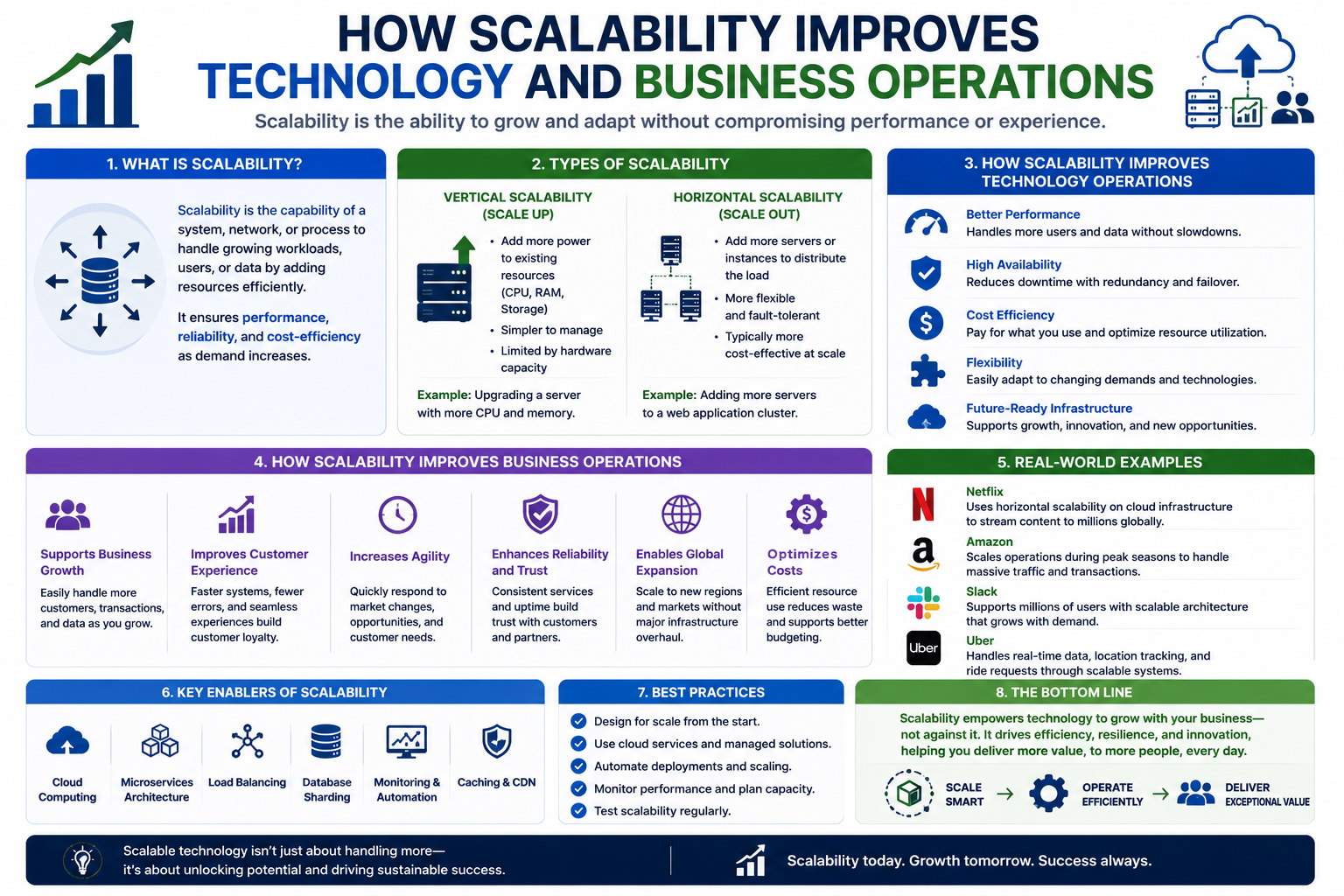
Scalability is one of the defining characteristics of modern computing environments. It represents the ability of an IT system, application, or infrastructure to grow and adapt as demand changes over time. In a world where businesses increasingly depend on digital services, online applications, remote collaboration, and cloud-based operations, scalability has become essential for maintaining performance, reliability, and operational efficiency.
Before the rise of cloud computing, scaling infrastructure was a difficult and expensive process. Organizations had to purchase physical hardware, estimate future growth, wait for equipment deliveries, configure systems manually, and integrate everything into their existing environment. These tasks required large budgets, specialized staff, and significant amounts of time. If businesses underestimated demand, systems became overloaded and unstable. If they overestimated demand, expensive hardware sat unused in data centers.
Cloud computing changed this process dramatically. Instead of relying entirely on physical infrastructure, businesses can now increase computing power, storage, and memory resources within minutes. The ability to allocate resources quickly and efficiently is what makes scalability one of the most powerful advantages of the cloud.
Scalability is no longer limited to large enterprises with massive IT budgets. Small businesses, startups, educational institutions, healthcare providers, and government organizations all benefit from scalable systems. Whether supporting a website with a few hundred users or an enterprise platform with millions of daily transactions, scalability ensures systems continue functioning effectively under changing workloads.
Understanding scalability is important not only for cloud engineers and IT administrators but also for business leaders and developers. It affects system design, cost management, user experience, application performance, and long-term business growth. Modern digital services depend heavily on scalable infrastructure to remain competitive and reliable in rapidly changing environments.
The Core Meaning of Scalability
At its core, scalability refers to how effectively a system can handle growth. This growth may involve more users, more data, more applications, or increased processing demands. A scalable system can expand its capacity while continuing to perform efficiently and reliably.
Every IT system has some level of scalability. The real question is how quickly, easily, and cost-effectively additional capacity can be added. In traditional environments, scalability was often limited by physical hardware availability and infrastructure design. Cloud platforms removed many of these barriers by providing virtually unlimited resources on demand.
A useful way to understand scalability is to compare it to transportation infrastructure. Imagine a small town with a two-lane road that handles traffic comfortably for years. As the town grows into a large city, the road becomes congested with vehicles during peak hours. To improve traffic flow, city planners widen the road to four or six lanes.
This expansion requires time, planning, labor, and financial investment. Once complete, traffic moves more efficiently during busy periods. However, during quieter hours, many lanes remain underutilized. The city accepts this inefficiency because the extra capacity is necessary during periods of high demand.
IT systems behave similarly. As businesses grow, user demand increases. Applications receive more requests, databases store more information, and servers process larger workloads. Without scalability, systems become overwhelmed, resulting in slow performance, crashes, or service outages.
Scalability allows organizations to increase system capacity so that performance remains stable even when workloads grow significantly. In cloud environments, this process can often happen within minutes rather than weeks or months.
Traditional Infrastructure and Scalability Challenges
In the past, organizations relied heavily on physical servers and on-premises infrastructure. Scaling these environments required purchasing new hardware such as servers, storage devices, networking equipment, and backup systems.
The process was complicated and time-consuming. IT teams first had to estimate future demand based on expected business growth. Procurement departments then gathered quotes from vendors, approved budgets, and ordered hardware. Once the equipment arrived, engineers installed and configured the systems manually.
This approach created several major challenges.
First, predicting future demand accurately was difficult. Businesses often purchased extra hardware to prepare for growth, but unused equipment represented wasted money and energy. On the other hand, insufficient planning resulted in overloaded systems and poor performance.
Second, scaling physical infrastructure required significant capital investment. Companies needed large budgets upfront, even if resources would not be fully utilized immediately.
Third, infrastructure expansion took time. Businesses could not react quickly to unexpected demand increases because deploying new hardware often required weeks or months.
Finally, managing physical infrastructure demanded specialized expertise. IT staff needed to monitor hardware health, install updates, replace failing components, and maintain data center environments.
Cloud computing addressed many of these limitations by introducing flexible, on-demand resource allocation.
How Cloud Computing Changed Scalability
Cloud computing transformed scalability by making infrastructure resources instantly accessible. Instead of purchasing physical hardware, organizations can rent computing resources from cloud providers.
These providers operate massive global data centers containing thousands of servers, storage systems, and networking devices. Customers access these resources through online management platforms, paying only for what they use.
This model fundamentally changed how organizations approach scalability.
If a business needs additional servers, it can launch them in minutes rather than waiting months for hardware procurement. If an application requires more memory or storage, administrators can allocate additional resources immediately.
This flexibility enables businesses to respond quickly to changing conditions. A sudden increase in website traffic, seasonal shopping demand, or rapid business expansion no longer requires extensive infrastructure planning months in advance.
Cloud scalability also supports experimentation and innovation. Development teams can test new applications without investing heavily in physical infrastructure. If a project succeeds, resources can scale rapidly. If it fails, unnecessary resources can be removed without major financial losses.
The cloud also simplifies infrastructure management. Providers handle many operational responsibilities such as hardware maintenance, cooling systems, power management, and physical security. This allows organizations to focus more on applications and business operations rather than infrastructure maintenance.
Why Scalability Matters in Modern Business
Modern organizations depend heavily on digital systems for daily operations. Websites, mobile applications, cloud platforms, collaboration tools, and online services must remain available and responsive at all times.
When systems cannot scale effectively, businesses face serious problems. Slow applications frustrate users, outages damage customer trust, and poor performance impacts productivity and revenue.
Scalability helps businesses maintain service quality even during periods of rapid growth or unexpected demand spikes. For example, an online retailer may experience massive traffic increases during holiday sales. Without scalable infrastructure, the website could crash under heavy demand.
Similarly, streaming services, banking platforms, educational portals, and healthcare systems all require scalable architectures to support large numbers of simultaneous users.
Scalability also supports long-term business growth. Organizations do not need to redesign their infrastructure every time workloads increase. Instead, scalable systems grow gradually alongside business operations.
Another important benefit is agility. Businesses can adapt quickly to market changes, launch new services faster, and respond more effectively to customer needs.
Scalability is particularly important in industries where demand fluctuates frequently. Seasonal businesses, online entertainment platforms, and global services often experience unpredictable workload patterns. Scalable infrastructure allows these organizations to maintain consistent performance without excessive resource waste.
Key Characteristics of Scalable Systems
A scalable system typically demonstrates several important characteristics.
Flexibility is one of the most important. The system must support resource expansion without major architectural changes or service interruptions.
Reliability is another essential characteristic. Even as workloads increase, the system should continue operating consistently and efficiently.
Efficiency is equally important. Scalable systems should use resources intelligently rather than wasting computing power or storage capacity.
Automation also plays a critical role. Modern scalable environments often rely on automated monitoring and resource allocation to respond quickly to changing conditions.
Modularity supports scalability as well. Systems designed with independent components or services can scale individual functions separately rather than expanding the entire environment unnecessarily.
Finally, scalability requires visibility and monitoring. Organizations need accurate performance metrics to understand workload trends, identify bottlenecks, and make informed scaling decisions.
Different Approaches to Scalability
There are multiple approaches to scaling infrastructure and applications. The two most common methods are horizontal scaling and vertical scaling.
Horizontal scaling involves adding more systems or instances to distribute workloads across multiple resources. Instead of relying on a single powerful server, workloads are shared among several servers working together.
This approach improves both performance and reliability. If one server fails, the remaining systems continue handling requests.
Horizontal scaling is commonly used in web applications, cloud platforms, and containerized environments. Load balancers distribute incoming traffic across multiple servers to ensure no single system becomes overwhelmed.
Vertical scaling focuses on increasing the capacity of an individual system. This may involve adding more memory, processing power, or storage to a server.
Vertical scaling is often simpler because applications continue running on a single system. However, physical hardware limitations eventually restrict how much capacity can be added.
Many organizations combine horizontal and vertical scaling to achieve optimal flexibility and performance.
The Relationship Between Scalability and Performance
Performance and scalability are closely connected but not identical concepts.
Performance refers to how efficiently a system handles workloads at a specific point in time. Scalability refers to how effectively the system continues performing as workloads increase.
A high-performance system may still fail if it cannot scale properly under growing demand. Similarly, a scalable system must maintain acceptable performance levels during expansion.
Organizations often use performance monitoring tools to analyze CPU usage, memory consumption, network traffic, and application response times. These metrics help determine when additional resources are necessary.
Scalability planning requires understanding workload patterns, identifying bottlenecks, and designing systems capable of adapting efficiently to future growth.
The Importance of Planning for Scalability
Scalability should be considered during the earliest stages of application and infrastructure design. Systems built without scalability in mind often become difficult and expensive to expand later.
Modern development practices encourage organizations to adopt cloud-native design principles. These approaches focus on modular architectures, containerization, automation, and distributed services.
Separating applications into different layers also improves scalability. For example, frontend services, backend logic, and databases can each scale independently based on workload demands.
APIs play a major role in scalable architectures as well. Standardized communication between services improves flexibility and allows components to evolve independently.
Planning for scalability also involves anticipating operational challenges. Monitoring tools, automation systems, security controls, and cost management strategies must all support scalable growth.
Organizations that ignore scalability during planning often encounter performance issues, rising operational complexity, and expensive redesign efforts later.
The Growing Importance of Cloud-Native Infrastructure
Cloud-native infrastructure has become increasingly popular because it is designed specifically for scalable environments.
Cloud-native applications are built to operate efficiently within distributed cloud platforms. They typically rely on containers, orchestration tools, automated deployment pipelines, and microservices architectures.
Containers package applications and their dependencies into portable units that can run consistently across environments. Orchestration platforms manage these containers automatically, ensuring workloads remain balanced and available.
Microservices divide applications into smaller independent components. Each service can scale individually based on demand, improving resource efficiency and operational flexibility.
These technologies allow organizations to deploy scalable applications more quickly while improving resilience and simplifying updates.
Cloud-native infrastructure also supports continuous integration and continuous delivery practices, enabling faster software development and deployment cycles.
Scalability as a Competitive Advantage
In modern business environments, scalability is not just a technical feature. It is a strategic advantage.
Organizations with scalable systems can respond faster to opportunities, support larger customer bases, and adapt more effectively to changing market conditions.
Scalable infrastructure also improves customer satisfaction. Users expect fast, reliable digital experiences regardless of traffic levels or workload conditions.
Businesses that fail to scale effectively risk losing customers, damaging their reputation, and limiting growth potential.
As technology continues evolving, scalability will become even more critical. Artificial intelligence, data analytics, Internet of Things devices, and real-time applications all generate massive workloads requiring flexible infrastructure.
Organizations that invest in scalable architectures position themselves for long-term success in increasingly digital and data-driven industries.
Understanding the Different Forms of Scalability
Scalability is not a single process or technology. Modern IT environments use multiple scaling approaches depending on the type of workload, application architecture, business goals, and infrastructure requirements. Different systems require different methods of expansion, and understanding these methods helps organizations design more efficient and reliable environments.
As businesses grow, workloads become increasingly complex. Some applications require more computing power, while others need additional storage or better traffic distribution. Cloud computing supports these varying demands by offering multiple scalability models that can be adapted to different scenarios.
The most common forms of scalability include horizontal scalability and vertical scalability. In modern cloud-native environments, containerized scalability and microservices scalability also play major roles. Each approach has its own strengths, limitations, and ideal use cases.
Choosing the correct scaling strategy is important because it affects application performance, operational costs, reliability, and long-term flexibility. Many organizations use a combination of scaling methods to achieve the best results.
Scalability is not simply about adding more resources. Effective scalability ensures resources are allocated intelligently, workloads remain balanced, and applications continue delivering reliable performance as demand changes over time.
Horizontal Scalability
Horizontal scalability involves adding more systems or instances to distribute workloads across multiple resources. Instead of increasing the capacity of one server, organizations add additional servers or application instances to share the workload.
This method is commonly referred to as scaling out. It is one of the most widely used scalability models in cloud computing because of its flexibility and reliability.
A typical example is a web application operating behind a load balancer. Instead of routing all traffic to a single server, incoming requests are distributed across several servers. As traffic increases, additional servers can be added to the environment.
This approach offers several advantages.
One major benefit is improved fault tolerance. If one server fails, other servers continue handling requests. This reduces the risk of complete service outages and improves overall system availability.
Horizontal scaling also allows organizations to increase capacity gradually. Instead of purchasing extremely powerful hardware upfront, businesses can add more instances as demand grows.
Cloud platforms make horizontal scaling particularly efficient. Virtual machines or containers can often be deployed automatically within minutes, allowing organizations to respond quickly to changing workloads.
Another advantage is flexibility. Workloads can be distributed across different geographic regions, improving performance for global users and supporting disaster recovery strategies.
However, horizontal scaling also introduces complexity. Applications must be designed to operate across multiple systems. Load balancing, session management, data synchronization, and network communication all become important considerations.
Not every application scales horizontally easily. Legacy systems designed for single-server operation may require significant architectural changes before they can support distributed workloads effectively.
Despite these challenges, horizontal scalability remains one of the most important principles in modern cloud infrastructure design.
Load Balancing and Distributed Traffic Management
Load balancing is a critical component of horizontally scalable environments. A load balancer distributes incoming traffic across multiple servers or application instances to prevent any single resource from becoming overloaded.
Without load balancing, some servers might receive excessive traffic while others remain underutilized. Proper distribution improves performance, reliability, and resource efficiency.
Load balancers can operate using different methods. Some distribute requests evenly across all available servers, while others use algorithms based on server performance, response time, or geographic location.
Cloud providers often include managed load balancing services that automatically monitor server health and redirect traffic when failures occur.
Load balancing also improves availability during maintenance or upgrades. Servers can be temporarily removed from the traffic pool without interrupting services for users.
As applications scale horizontally, effective traffic management becomes increasingly important. Organizations must ensure requests are routed efficiently and consistently to maintain stable performance.
Containerized Scalability
Container technology has transformed the way organizations approach scalability. Containers package applications and their dependencies into lightweight, portable units that can run consistently across different environments.
Unlike traditional virtual machines, containers share the host operating system kernel, making them more resource efficient and faster to deploy.
Container orchestration platforms such as Kubernetes enable organizations to manage large numbers of containers automatically. These platforms monitor workloads, distribute resources, and scale applications dynamically based on demand.
For example, if a particular application service experiences increased traffic, the orchestration platform can automatically launch additional container instances to handle the extra load.
This type of scalability is highly efficient because containers start quickly and consume fewer resources compared to full virtual machines.
Containerized scalability also supports microservices architectures. Instead of building one large monolithic application, developers divide functionality into smaller independent services. Each service can scale separately depending on workload requirements.
For instance, an e-commerce platform may scale its search functionality independently from its payment processing system. This targeted scaling improves efficiency and reduces unnecessary resource usage.
Containerized environments also simplify deployment consistency. Since containers include all required dependencies, applications behave predictably across development, testing, and production environments.
This consistency improves operational reliability and reduces configuration-related issues during scaling operations.
Vertical Scalability
Vertical scalability involves increasing the capacity of a single system rather than adding additional systems. This method is often referred to as scaling up.
Examples of vertical scaling include increasing server memory, upgrading processors, adding storage capacity, or improving network bandwidth.
In cloud environments, vertical scaling is relatively straightforward. Administrators can often change virtual machine instance types or allocate additional storage through management consoles with minimal downtime.
Vertical scaling is commonly used for databases, legacy applications, and workloads that rely heavily on single-system performance.
One advantage of vertical scaling is simplicity. Applications continue operating on the same system, avoiding many of the complexities associated with distributed environments.
Vertical scaling also benefits workloads that require high processing power or memory capacity but do not distribute easily across multiple systems.
However, vertical scaling has limitations. Physical hardware can only support a certain amount of memory, processing power, or storage. Eventually, further upgrades become impossible or prohibitively expensive.
Another limitation is fault tolerance. Since workloads remain concentrated on a single system, hardware failures can create service disruptions unless redundancy measures are implemented separately.
For this reason, many organizations combine vertical scaling with horizontal scaling to achieve both performance and resilience.
Combining Horizontal and Vertical Scalability
Modern infrastructures often use hybrid scalability strategies that combine horizontal and vertical scaling techniques.
For example, a database server may scale vertically by increasing memory and processor capacity, while application servers scale horizontally by adding more instances behind a load balancer.
This approach allows organizations to optimize different parts of their infrastructure according to workload characteristics.
Applications that distribute easily across multiple servers benefit from horizontal scaling, while resource-intensive workloads requiring centralized processing may benefit more from vertical scaling.
Combining scaling methods provides greater flexibility and helps organizations achieve better performance, reliability, and cost efficiency.
Hybrid scalability strategies are especially common in enterprise environments where multiple application types operate simultaneously.
Benefits of Scalable Infrastructure
Scalable infrastructure provides numerous advantages for businesses and IT operations. One of the most important benefits is the ability to respond quickly to changing workloads.
In traditional environments, infrastructure expansion often required lengthy procurement and deployment processes. Cloud scalability eliminates many of these delays by making resources instantly available.
Organizations can launch additional servers, increase storage capacity, or deploy new application instances within minutes. This agility allows businesses to respond rapidly to customer demand, seasonal traffic increases, or unexpected growth opportunities.
Scalability also improves operational efficiency. Resources can be allocated dynamically based on actual workload requirements instead of maintaining excessive unused capacity.
This flexibility reduces waste and improves infrastructure utilization.
Another important benefit is improved user experience. Applications remain responsive and reliable even during periods of heavy demand. Faster response times and reduced downtime increase customer satisfaction and trust.
Scalability also supports innovation. Development teams can experiment with new applications or features without major infrastructure investments. If projects succeed, resources can expand quickly. If projects fail, unused resources can be removed easily.
Modern businesses depend heavily on digital services. Scalable infrastructure ensures organizations can continue delivering consistent service quality as workloads evolve over time.
On-Demand Resource Provisioning
One of the most transformative aspects of cloud scalability is on-demand provisioning.
In traditional infrastructure environments, acquiring additional capacity involved purchasing physical hardware, waiting for deliveries, installing equipment, and configuring systems manually.
Cloud platforms remove these barriers by providing instant access to computing resources.
Organizations can deploy virtual machines, databases, storage volumes, and networking components through web interfaces or automation tools within minutes.
This capability dramatically improves operational agility.
For example, if an online retailer experiences a sudden traffic spike during a promotional event, additional application servers can be deployed immediately to maintain performance.
Similarly, software development teams can create temporary testing environments without investing in permanent infrastructure.
On-demand provisioning also simplifies experimentation and scaling strategies. Businesses can test different configurations, monitor performance, and adjust resources dynamically without major financial risk.
This flexibility is one of the primary reasons cloud computing has become so widely adopted across industries.
Cost Efficiency and Financial Flexibility
Scalability contributes significantly to cost efficiency in modern IT environments.
Traditional infrastructure often required businesses to purchase hardware based on projected future demand. This resulted in large upfront investments and underutilized resources.
Cloud scalability introduces a more flexible financial model. Organizations pay only for the resources they actually use.
Instead of purchasing expensive servers that may remain idle during low-demand periods, businesses can allocate resources dynamically according to current workloads.
This pay-as-you-go approach reduces financial waste and improves budget management.
Scalability also allows organizations to start small and grow gradually. Startups and smaller businesses benefit particularly from this flexibility because they can avoid massive infrastructure investments during early growth stages.
Operational efficiency improves as well. Automation reduces manual management tasks, lowering administrative overhead and improving resource optimization.
However, organizations must monitor scalable environments carefully. Uncontrolled resource expansion can lead to unexpectedly high cloud costs if governance policies and monitoring tools are not implemented effectively.
Improved Reliability and Availability
Scalable infrastructures often improve system reliability and availability.
Distributed workloads reduce dependence on individual systems. If one server fails, other systems continue operating, minimizing disruptions.
This redundancy is especially important for mission-critical applications such as banking platforms, healthcare systems, online retail services, and communication platforms.
Cloud providers also support geographic redundancy by allowing workloads to operate across multiple regions and data centers.
If one location experiences issues, traffic can be redirected to alternative regions automatically.
Scalable architectures also support maintenance operations more effectively. Servers can be updated or replaced without shutting down entire applications.
Containerized and microservices environments improve resilience further by isolating application components. Problems affecting one service do not necessarily impact the entire application.
These capabilities help organizations maintain continuous service availability even during failures, maintenance periods, or traffic spikes.
Scalability and Business Growth
Scalability directly supports business growth by enabling organizations to expand services without major infrastructure limitations.
As customer bases grow, applications and systems must handle increased workloads efficiently. Scalable infrastructure ensures businesses can continue operating smoothly during expansion.
For startups, scalability is especially valuable because growth can be unpredictable. A successful product launch or viral marketing campaign may generate sudden traffic increases that overwhelm traditional systems.
Cloud scalability allows startups to respond quickly without large upfront investments.
Enterprise organizations also benefit from scalability during mergers, acquisitions, or international expansion efforts. Infrastructure can adapt rapidly to support new users, locations, and services.
Scalability also improves competitiveness. Businesses capable of responding quickly to market opportunities gain significant advantages over organizations constrained by rigid infrastructure limitations.
Modern consumers expect fast, reliable digital experiences. Scalable systems help businesses meet these expectations consistently.
Automation and Intelligent Scaling
Automation has become essential for managing scalable environments effectively.
Manual resource management becomes increasingly difficult as infrastructures grow more complex. Automation tools simplify provisioning, monitoring, deployment, and scaling operations.
Auto-scaling technologies monitor system performance metrics such as CPU utilization, memory consumption, network traffic, or application response times.
When workloads exceed predefined thresholds, additional resources are allocated automatically.
Similarly, resources can be reduced during periods of low demand to improve efficiency and reduce costs.
Automation improves consistency as well. Infrastructure as code tools allow organizations to define environments through configuration files rather than manual processes.
This ensures systems remain standardized across deployments and reduces configuration-related errors.
Automated scaling also improves response times during sudden workload increases. Instead of waiting for administrators to intervene manually, systems adjust dynamically in real time.
As cloud environments continue evolving, automation and intelligent scaling will become even more important for maintaining operational efficiency.
Scalability and Modern Application Development
Modern application development practices increasingly focus on scalability from the beginning.
Cloud-native applications are designed specifically for distributed, scalable environments. These applications typically rely on microservices architectures, APIs, containers, and orchestration platforms.
This design approach improves flexibility and allows individual application components to scale independently.
For example, a video streaming platform may scale video delivery services separately from user authentication systems or recommendation engines.
APIs also play an important role in scalable development. Standardized communication between services simplifies integration and improves operational flexibility.
Continuous integration and continuous delivery pipelines further support scalable development by automating testing, deployment, and updates.
Organizations that prioritize scalability during development create applications that adapt more effectively to future growth and changing business requirements.
Introduction to Scalability Challenges
Scalability offers enormous advantages for organizations using modern cloud infrastructure, but implementing scalable systems is not always simple. While cloud platforms make it easier to increase resources quickly, organizations still face technical, operational, financial, and security-related challenges when building scalable environments.
Many businesses assume scalability simply means adding more servers or increasing hardware capacity whenever performance slows down. In reality, successful scalability requires careful planning, intelligent architecture, proper monitoring, and long-term operational management. Without these elements, scaling efforts can create new problems instead of solving existing ones.
Applications must be designed to support scalable operations. Infrastructure must be monitored continuously. Costs must be controlled carefully. Security practices must remain consistent as environments expand. Every additional server, container, service, or workload introduces more complexity into the infrastructure.
As organizations continue adopting cloud-native technologies, the importance of understanding scalability challenges becomes even greater. Businesses increasingly depend on distributed applications, microservices architectures, remote collaboration systems, artificial intelligence platforms, and global digital services. These technologies generate massive workloads that require scalable environments capable of adapting quickly and reliably.
The key to successful scalability is balance. Organizations must increase capacity efficiently without creating excessive operational complexity, financial waste, or security risks. Achieving this balance requires strong planning, modern development practices, automation, and effective governance.
Architectural Challenges in Scalable Systems
One of the biggest obstacles in scalability is application architecture. Not all applications are designed to scale efficiently. Older legacy systems often depend heavily on single-server configurations, making distributed scaling difficult.
Traditional monolithic applications combine multiple functions into one large system. As workloads increase, the entire application must scale together even if only one component experiences high demand. This creates inefficiency because additional resources are allocated to areas that may not actually need them.
Modern scalable architectures solve this problem by separating applications into independent services or components. However, transitioning from legacy designs to scalable architectures can be complicated and time-consuming.
Distributed systems also introduce communication challenges. When multiple servers or services operate together, they must exchange data continuously. Network delays, synchronization issues, and communication failures can affect application performance and reliability.
Databases are especially challenging in scalable environments. While frontend applications often scale horizontally relatively easily, databases require careful synchronization to maintain data consistency across multiple systems.
For example, if several database servers process updates simultaneously, ensuring all copies remain accurate becomes difficult. Organizations often need advanced database technologies such as replication, sharding, or distributed storage systems to support scalability effectively.
Session management creates additional complexity. In distributed environments, users may interact with multiple servers during a single session. Systems must ensure session data remains consistent regardless of which server handles the request.
These architectural challenges require careful planning during the application development process. Scalability cannot simply be added as an afterthought. Applications must be designed with scalability principles from the beginning.
Performance Bottlenecks and Resource Limitations
As workloads grow, performance bottlenecks often emerge in unexpected areas. A scalable environment is only as strong as its weakest component.
For example, increasing the number of application servers may improve frontend performance temporarily, but if the database cannot handle the additional traffic, the overall system still experiences slowdowns.
Network bandwidth limitations can also create bottlenecks. Distributed systems rely heavily on network communication between servers, containers, databases, and cloud services. Insufficient bandwidth or high network latency can reduce application responsiveness significantly.
Storage performance presents another challenge. Large-scale applications generate enormous amounts of data, and storage systems must support rapid data access while maintaining reliability and consistency.
Processor and memory limitations are also common issues. Some workloads require intensive computational resources that cannot easily distribute across multiple systems. In these cases, vertical scaling may eventually reach hardware limitations.
Monitoring and identifying bottlenecks becomes increasingly difficult as infrastructures grow more complex. Organizations must use advanced monitoring tools to track system performance, analyze workload patterns, and identify areas requiring optimization.
Without accurate monitoring, businesses may allocate additional resources inefficiently or fail to recognize underlying architectural problems.
The Importance of Metrics and Monitoring
Scalability decisions should always be data-driven. Monitoring and metrics are essential for understanding system behavior and determining when scaling actions are necessary.
Organizations need visibility into CPU usage, memory consumption, network traffic, storage performance, application response times, error rates, and user activity patterns.
These metrics help administrators identify trends, anticipate demand increases, and detect performance issues before they impact users.
For example, consistently high CPU utilization may indicate that additional computing resources are required. Increasing response times may reveal application bottlenecks or database performance problems.
Cloud providers offer numerous monitoring services that collect and analyze infrastructure data automatically. These tools generate dashboards, alerts, and performance reports that help administrators manage scalable environments more effectively.
Monitoring also supports capacity planning. By analyzing historical workload patterns, organizations can predict future resource requirements more accurately.
However, monitoring large-scale environments can become complicated. Distributed systems generate massive amounts of performance data, and interpreting this information requires specialized expertise.
Organizations must also avoid relying solely on raw metrics. Performance problems often result from combinations of factors rather than single issues. Effective monitoring strategies involve comprehensive analysis across the entire infrastructure.
Financial Challenges and Cost Management
Cloud scalability provides financial flexibility, but it can also create significant cost management challenges.
One of the major advantages of cloud computing is the ability to allocate resources dynamically. Organizations pay only for what they use instead of investing heavily in physical infrastructure upfront.
However, this convenience can lead to uncontrolled spending if resources are not monitored carefully.
It is extremely easy to launch additional servers, increase storage capacity, or deploy large numbers of containers in cloud environments. Without proper governance, costs can rise rapidly.
Organizations sometimes assume scaling automatically solves performance issues. Instead of optimizing applications or identifying bottlenecks, teams may continue adding resources unnecessarily.
This approach creates financial inefficiency and operational waste.
Idle resources are another common issue. Temporary testing environments, unused storage volumes, or forgotten virtual machines can continue generating charges long after they are needed.
Auto-scaling systems also require careful configuration. Aggressive scaling policies may allocate excessive resources during short traffic spikes, increasing operational costs unnecessarily.
Cost visibility becomes increasingly important in large organizations where multiple departments share cloud infrastructure. Businesses must track resource usage accurately to manage budgets effectively.
Cloud financial management practices, often referred to as FinOps, help organizations optimize cloud spending through monitoring, governance, automation, and resource optimization strategies.
Successful scalability requires balancing performance improvements with financial sustainability.
Scalability and Elasticity
Scalability and elasticity are closely related concepts, but they are not identical.
Scalability refers to the ability of a system to grow and support increasing workloads over time. Elasticity focuses on dynamic resource adjustment in response to changing workloads automatically.
Scalability is often associated with planned or long-term growth. Organizations scale systems to support larger user bases, increased data volumes, or expanding business operations.
Elasticity responds to short-term workload fluctuations automatically. Resources increase during high-demand periods and decrease when demand returns to normal.
For example, an online ticketing platform may experience heavy traffic during concert ticket releases. Elastic cloud systems automatically allocate additional resources during the surge and reduce capacity afterward.
Elasticity relies heavily on automation and monitoring technologies. Cloud platforms continuously analyze performance metrics and adjust infrastructure dynamically.
Scalability and elasticity work together in modern cloud environments. Scalable architectures provide the foundation for growth, while elasticity improves efficiency by responding to workload changes in real time.
Organizations that combine both capabilities achieve greater operational flexibility and resource optimization.
Security Considerations in Scalable Environments
Security remains one of the most important considerations in scalable infrastructure design.
As environments expand, the number of systems, services, containers, APIs, and network connections increases significantly. Each component introduces potential security risks if not managed properly.
One advantage of scalable cloud environments is consistency. When new systems are deployed using automated templates or configuration management tools, they inherit predefined security settings.
For example, if servers are created from secure machine images with updated software, firewall configurations, and monitoring agents already installed, the risk of configuration-related vulnerabilities decreases.
Automation plays a critical role in maintaining security consistency. Manual server deployments often lead to configuration errors, forgotten updates, or inconsistent security controls.
Infrastructure as code technologies improve security by ensuring systems are deployed using standardized configurations repeatedly.
Identity and access management is another major concern in scalable environments. As infrastructures grow, controlling user permissions and service access becomes increasingly complex.
Organizations must implement strong authentication mechanisms, role-based access controls, and least-privilege principles to reduce unauthorized access risks.
Network segmentation is equally important. Scalable systems should isolate sensitive workloads and restrict unnecessary communication between services.
Encryption also plays a vital role in protecting scalable environments. Data should be encrypted both during transmission and while stored within cloud systems.
Monitoring and threat detection capabilities must scale alongside infrastructure growth. Security teams need visibility into logs, user activity, network traffic, and application behavior across distributed environments.
Containerized applications introduce additional security considerations. Containers share operating system resources, so vulnerabilities within the host environment can affect multiple containers simultaneously.
Organizations must also manage software dependencies carefully. Open-source libraries and third-party components require continuous vulnerability monitoring and updates.
Security in scalable environments is not a one-time activity. It requires ongoing monitoring, automation, governance, and continuous improvement.
Automation and Infrastructure as Code
Automation is one of the most important best practices for scalable infrastructure management.
As environments grow larger and more complex, manual operations become increasingly inefficient and error-prone.
Automation simplifies provisioning, deployment, scaling, monitoring, and maintenance processes.
Infrastructure as code allows organizations to define infrastructure configurations using code files rather than manual setup procedures.
This approach improves consistency, repeatability, and operational efficiency.
For example, instead of configuring servers individually, administrators can use templates to deploy identical environments automatically.
Automation also supports rapid recovery during failures. If a server crashes, replacement systems can be deployed automatically with predefined configurations.
Continuous integration and continuous delivery pipelines further improve scalability by automating software testing, deployment, and updates.
Automation reduces human error, accelerates operations, and improves overall infrastructure reliability.
However, automated systems must be monitored carefully. Incorrect automation policies can create unintended consequences such as excessive resource allocation or accidental service disruptions.
Successful automation requires strong governance, testing procedures, and operational oversight.
Cloud-Native Design Principles
Modern scalable systems increasingly follow cloud-native design principles.
Cloud-native applications are built specifically for distributed cloud environments. These applications typically use containers, microservices architectures, APIs, and orchestration platforms.
Microservices divide applications into smaller independent services that can scale separately based on workload requirements.
This modular approach improves flexibility and simplifies scalability.
Containers provide lightweight, portable application environments that support rapid deployment and efficient resource utilization.
Orchestration platforms such as Kubernetes automate container deployment, scaling, networking, and monitoring.
Cloud-native architectures also improve resilience. Failures affecting one service do not necessarily impact the entire application.
APIs support standardized communication between services, improving integration flexibility and scalability.
Organizations adopting cloud-native practices often achieve faster deployment cycles, improved reliability, and more efficient scalability.
However, cloud-native systems also introduce operational complexity. Managing large numbers of services, containers, and distributed workloads requires specialized expertise and advanced management tools.
Planning for Long-Term Scalability
Scalability should always be viewed as a long-term strategy rather than a short-term solution.
Organizations must plan for future growth, evolving workloads, and changing technology requirements.
Effective scalability planning includes architectural design, capacity forecasting, cost management, security governance, and operational automation.
Businesses should regularly review performance metrics, analyze workload trends, and update scaling strategies accordingly.
Documentation is also important. Teams need clear procedures for deployment, monitoring, incident response, and resource management.
Training and skill development are equally critical. Cloud-native technologies, automation platforms, and scalable architectures require specialized knowledge.
Organizations that invest in long-term scalability planning position themselves for greater operational stability and business growth.
The Future of Scalability
Scalability will continue evolving alongside advances in cloud computing, artificial intelligence, edge computing, and distributed systems.
Artificial intelligence workloads require enormous computational resources that demand highly scalable infrastructure.
Edge computing introduces new scalability models by distributing workloads closer to users and connected devices.
Serverless computing is also changing scalability strategies. In serverless environments, cloud providers automatically manage infrastructure scaling behind the scenes.
Organizations increasingly prioritize sustainability as well. Efficient scalability reduces energy consumption and infrastructure waste, supporting environmentally responsible operations.
Future scalable systems will likely become even more automated, intelligent, and adaptive.
Machine learning technologies may eventually optimize resource allocation dynamically based on predictive workload analysis.
As digital transformation continues across industries, scalability will remain one of the most important foundations of modern technology infrastructure.
Conclusion
Scalability is far more than simply adding servers or increasing computing resources. It is a comprehensive strategy involving architecture, automation, monitoring, security, cost management, and operational planning.
While cloud computing has made scalability significantly easier and more accessible, organizations still face many challenges when building scalable environments. Performance bottlenecks, database limitations, financial risks, security concerns, and operational complexity all require careful management.
Modern best practices such as cloud-native architectures, infrastructure as code, containerization, automation, and continuous monitoring help organizations overcome these challenges effectively.
Scalable systems provide businesses with the flexibility to grow, adapt, and innovate in rapidly changing digital environments. They improve reliability, enhance user experiences, support operational efficiency, and enable organizations to respond quickly to evolving demands.
As technology continues advancing, scalability will remain one of the defining characteristics of successful IT infrastructure. Organizations that invest in scalable design principles today will be better prepared to handle the opportunities and challenges of tomorrow’s digital world.