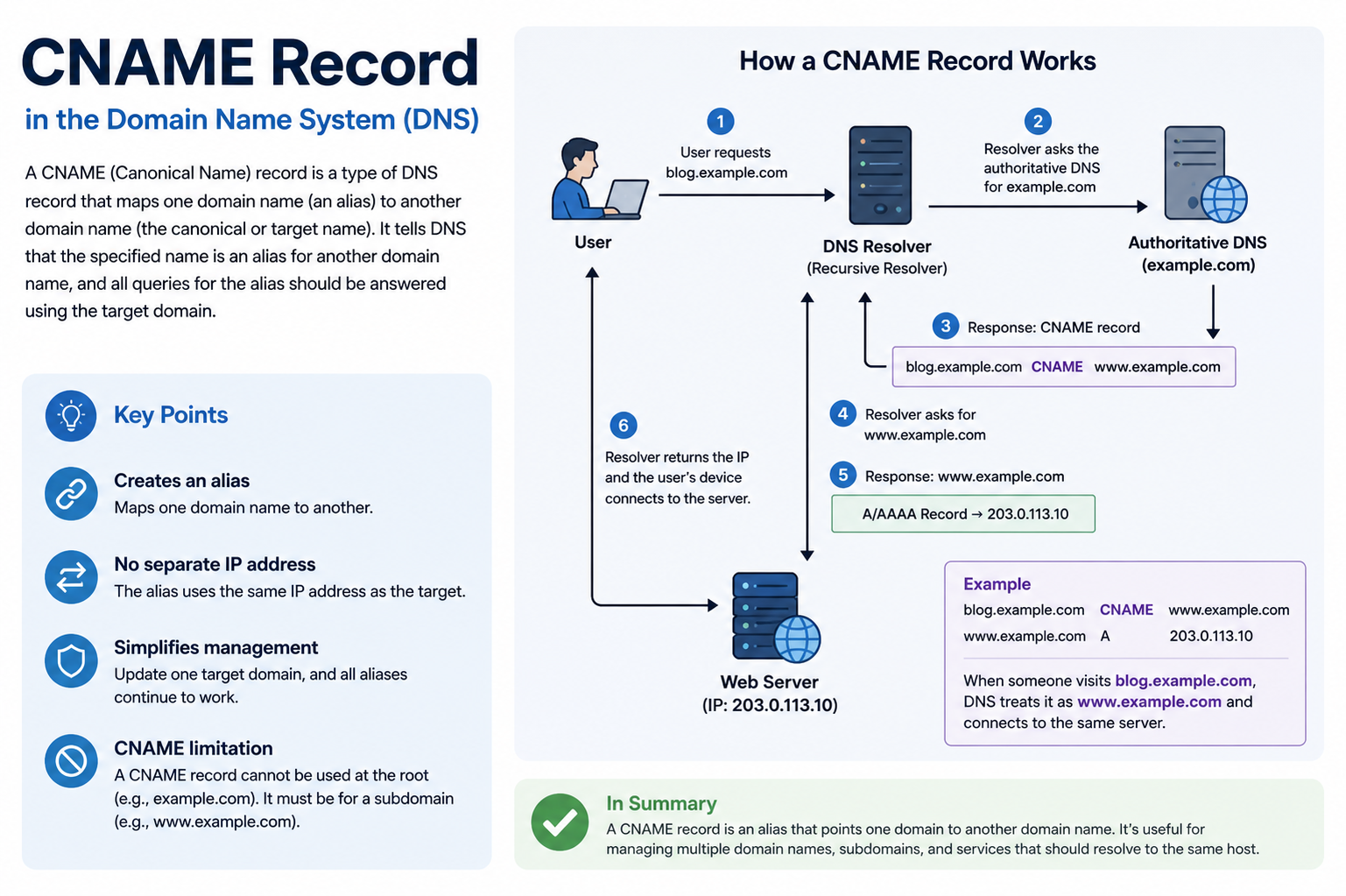
A CNAME record plays an important role in how name resolution works across the internet. When a request is made to access a specific hostname, the system begins a lookup process to find the correct destination. If that hostname has a CNAME record, the resolution does not stop there. Instead, it is redirected to another hostname, which then undergoes its own resolution process to eventually reach an IP address. This layered approach allows a flexible structure where names can be decoupled from fixed numerical addresses. It also enables smoother transitions when underlying services change locations or infrastructure, since only the final target needs to be adjusted while all alias names remain untouched.
In modern system design, CNAME records remain an essential tool for building adaptable, scalable, and well-structured environments. They continue to support cloud-based systems, distributed architectures, hybrid deployments, and automated infrastructure management by offering a reliable abstraction layer between services and their underlying resources. As digital systems grow in complexity and demand higher levels of flexibility and resilience, the importance of CNAME-based design patterns continues to increase, making them a long-standing and valuable component of network architecture.
Difference Between CNAME and Other DNS Records
CNAME records differ significantly from other common record types because they do not directly map a name to an IP address. Instead, they map one name to another name. In contrast, other records typically provide a direct connection to a numeric address. This distinction makes CNAME unique because it introduces an additional step in the lookup process. While this may seem less direct, it actually provides greater flexibility in managing systems. By pointing multiple names to a single canonical reference, it becomes easier to maintain consistency across different services without duplicating configuration efforts.
Role of CNAME in Simplifying Management
One of the key advantages of using CNAME records is the simplification of administrative tasks. In systems where multiple names are associated with a single service, managing individual records for each name can become complicated and error-prone. A CNAME record solves this by allowing all alternative names to reference a single canonical name. When changes are required, such as updating infrastructure or moving services, only the canonical record needs modification. This reduces the risk of missing updates and ensures that all associated names continue to function correctly without manual intervention.
CNAME and Service Flexibility
CNAME records provide a high level of flexibility when dealing with changing environments. Services can be relocated, scaled, or restructured without requiring changes to every individual name that points to them. Instead, updating the canonical destination automatically applies the change to all associated aliases. This makes system design more adaptable, especially in environments where services frequently evolve. It also reduces downtime and configuration overhead, since changes are centralized rather than distributed across multiple records.
Impact on Performance and Resolution Flow
While CNAME records introduce an additional lookup step, the impact on performance is generally minimal in modern systems. The resolution process is designed to handle such indirections efficiently. However, because a CNAME requires an extra query before reaching the final destination, it is still considered slightly less direct than a standard mapping. Despite this, the trade-off is usually worth it due to the administrative simplicity and flexibility it provides. The slight overhead in resolution is often negligible compared to the benefits of centralized management.
CNAME in Alias Management
CNAME records are commonly used to create aliases, which are alternative names that point to a single canonical name. This allows multiple entry points to lead to the same underlying service. For example, different naming variations can be unified under one target without creating separate configurations for each. This is especially useful in large systems where consistency and ease of maintenance are important. Aliases ensure that users can access services using different names while the system maintains a single source of truth.
Restrictions and Limitations of CNAME Records
Although CNAME records are highly useful, they come with certain limitations. One of the most important restrictions is that a CNAME cannot coexist with other record types for the same name. This means that if a name is defined as a CNAME, it cannot also have direct mappings or other types of records. This restriction is necessary to prevent conflicts in the resolution process. Another limitation is that CNAME records are only suitable for name-to-name mapping and cannot be used for direct numerical addressing. These constraints require careful planning when designing a system that uses them.
CNAME and System Scalability
CNAME records contribute significantly to scalability in large systems. As services grow and expand, managing individual name mappings can become increasingly complex. By using a layered approach where multiple names point to a single canonical source, scaling becomes more manageable. New aliases can be added without modifying the underlying structure, and changes to the main service automatically propagate to all connected names. This reduces operational overhead and supports smoother expansion of systems over time.
Maintenance Advantages of Using CNAME
Maintenance becomes much more efficient when CNAME records are used correctly. Instead of updating multiple individual entries whenever a change occurs, administrators only need to modify the canonical target. This reduces the likelihood of errors and ensures consistency across all references. It also simplifies troubleshooting, as issues can often be traced back to a single source rather than multiple independent configurations. This centralized approach makes ongoing system management significantly easier.
CNAME in Modern Infrastructure Design
In modern system architecture, CNAME records are often used as part of a broader strategy for managing services. They help abstract the underlying infrastructure, allowing systems to evolve without affecting how users access them. This abstraction layer is especially important in dynamic environments where services may be frequently updated or relocated. By decoupling names from fixed destinations, CNAME records contribute to more resilient and adaptable infrastructure designs.
Why CNAME Remains Important Today
Even with advancements in system design and automation, CNAME records remain a fundamental component of name resolution systems. Their ability to simplify management, support flexibility, and reduce redundancy makes them valuable in a wide range of applications. They provide a clean and efficient way to handle multiple references to a single destination, ensuring that systems remain organized and maintainable. As digital environments continue to grow in complexity, the role of CNAME records continues to be relevant and essential.
CNAME in Load Distribution and Traffic Handling
CNAME records are often used as part of broader traffic handling strategies where requests need to be directed efficiently to underlying services. Instead of assigning multiple direct mappings, a CNAME allows all incoming requests to point toward a single canonical target, which may then be managed by a system that distributes traffic internally. This indirect structure makes it easier to adjust how traffic is handled without changing the visible names used by users or applications. It also allows backend systems to evolve independently while keeping the external naming structure stable and consistent.
CNAME and Cloud-Based Architecture
In modern cloud-based environments, CNAME records play an important role in abstracting services from their physical or virtual locations. Since cloud services often change endpoints dynamically, using a fixed direct mapping would be inefficient and difficult to maintain. A CNAME allows a stable name to remain constant while the actual underlying destination can change as needed. This separation between identity and location is a key principle in cloud design, making systems more resilient and easier to manage at scale.
Role in Multi-Environment Systems
Many organizations operate multiple environments such as development, testing, staging, and production. CNAME records help maintain consistency across these environments by allowing uniform naming patterns that point to different underlying targets. This ensures that applications can reference services in a predictable way, even if the actual destinations differ depending on the environment. It reduces confusion and helps maintain a structured approach to environment management.
CNAME and Redirection Behavior
When a CNAME record is used, it does not directly provide the final destination but instead acts as a pointer to another name. This means that resolution continues until a final address is reached. This layered redirection process allows flexibility but also introduces dependency on the target name. If the final target is misconfigured or unavailable, the CNAME chain will not resolve properly. Understanding this behavior is important when designing reliable systems that depend on consistent name resolution.
Propagation and Change Handling
One of the advantages of using CNAME records is how changes propagate across the system. When the canonical target is updated, all names pointing to it automatically reflect the change without requiring individual updates. However, changes may take time to propagate across distributed systems due to caching mechanisms. This means that while updates are centralized, their visibility may vary depending on how quickly cached information is refreshed across networks.
CNAME and Dependency Structure
CNAME records introduce a dependency relationship between the alias and the canonical target. This means that the alias cannot function independently without the target being correctly configured. This dependency structure simplifies management but also requires careful planning to avoid broken references. If the canonical target is removed or misconfigured, all associated aliases will also fail to resolve correctly, highlighting the importance of maintaining stable core records.
Best Practices in Using CNAME Records
Effective use of CNAME records involves careful planning of naming structures and dependencies. It is generally recommended to use them for aliasing purposes rather than critical direct mappings. Keeping the canonical structure stable ensures that aliases remain reliable over time. It is also important to avoid unnecessary chaining of multiple CNAME records, as this can increase resolution complexity and potential failure points. A clean and minimal structure is typically more efficient and easier to maintain.
CNAME and System Reliability
CNAME records can improve reliability when used properly because they centralize control over name resolution. Instead of managing multiple independent records, administrators can rely on a single source of truth. However, this also means that the canonical target becomes a critical dependency. If it fails, all linked names are affected. Therefore, system reliability depends not only on the use of CNAME records but also on the stability of the underlying target infrastructure.
Security Considerations with CNAME
While CNAME records themselves are not inherently insecure, they can introduce indirect risks if not managed carefully. Since they rely on external or internal targets, ensuring that those targets are trustworthy is essential. Misconfiguration or unintended redirection could potentially lead to incorrect routing of requests. Maintaining strict control over canonical destinations helps reduce these risks and ensures that resolution behaves as expected across all environments.
Performance Implications in Large Systems
In large-scale systems, the use of CNAME records can slightly increase lookup time due to the additional resolution step. However, this impact is generally offset by caching mechanisms and optimized resolution systems. In practice, the performance difference is minimal compared to the operational benefits gained from simplified management. The trade-off between a small performance overhead and significant administrative efficiency is often considered acceptable in most architectures.
CNAME in Hybrid Infrastructure Models
In hybrid environments that combine multiple types of infrastructure, CNAME records serve as a bridging mechanism that connects different systems under a unified naming structure. This allows services hosted in different locations or platforms to appear as part of a single coherent system. By abstracting the underlying complexity, CNAME records help maintain a consistent user-facing structure even when backend systems are distributed across diverse environments.
Long-Term Value of CNAME Usage
Over time, the value of CNAME records becomes more apparent as systems grow in complexity. They reduce duplication, simplify updates, and provide a structured way to manage multiple references to the same service. Their ability to decouple names from physical or logical destinations ensures that systems remain adaptable to change. This long-term flexibility makes them a foundational component in scalable and maintainable network design.
CNAME in Service Migration Scenarios
CNAME records are particularly useful during service migration or transition periods. When a system moves from one infrastructure to another, maintaining uninterrupted access is critical. By pointing an existing name to a new canonical target, the transition can happen without forcing users or applications to change how they access the service. This reduces disruption and allows backend systems to evolve gradually. Once migration is complete, only the canonical reference needs to be finalized, while all associated aliases continue functioning without modification.
Role in Content Delivery and Edge Systems
In distributed delivery systems, CNAME records are commonly used to route requests toward optimized edge locations. Instead of directing traffic directly to a fixed endpoint, a CNAME allows requests to be dynamically resolved to the most appropriate service location. This helps improve efficiency by ensuring that users are connected to nearby or best-performing nodes. The abstraction provided by CNAME records makes it easier to manage complex delivery networks without exposing their internal structure.
CNAME and Domain Abstraction Strategy
A major strength of CNAME records is their ability to support abstraction layers in system design. By separating the visible name from the actual destination, systems can evolve internally without affecting external access patterns. This abstraction allows developers and administrators to restructure backend services while preserving a consistent naming interface. It also reduces the dependency of applications on fixed infrastructure details, making systems more resilient to change.
Behavior in Nested Resolution Chains
In some cases, a CNAME may point to another name that also resolves through additional records. This creates a chain of resolution steps that must be followed until a final destination is reached. While this is technically possible, long chains are generally avoided because they introduce complexity and potential delays. Each additional step increases dependency on intermediate records, which can make troubleshooting more difficult if something goes wrong in the chain.
Caching Influence on CNAME Performance
Caching plays an important role in how efficiently CNAME records are resolved. Once a resolution is performed, the result is often stored temporarily to reduce repeated lookups. This means that even though a CNAME introduces an extra step in theory, in practice the performance impact is often minimized. However, caching can also delay the visibility of changes, meaning updates to canonical targets may not be immediately reflected everywhere until cached data expires.
Operational Risks of Misconfiguration
Improper configuration of CNAME records can lead to resolution failures or unexpected routing behavior. Since they depend entirely on the validity of the target name, any error in the canonical reference can cascade across all linked aliases. This makes careful configuration and validation essential. Ensuring that target names remain stable and correctly maintained helps prevent disruptions in services that depend on them.
CNAME in Multi-Region Deployments
In systems deployed across multiple geographic regions, CNAME records help unify access under a single logical structure. Instead of exposing region-specific endpoints, a single name can be used to represent the service globally. Behind the scenes, the CNAME can resolve to region-appropriate destinations based on routing logic. This simplifies user experience while allowing complex regional distribution strategies to operate transparently.
Flexibility in Scaling Services
As systems scale, the ability to redirect traffic without changing user-facing names becomes increasingly important. CNAME records support this by allowing the underlying destination to change independently of the alias. Whether scaling vertically, horizontally, or across different platforms, the external name remains stable. This makes scaling operations smoother and reduces the need for widespread configuration updates during growth phases.
CNAME and System Decoupling Principles
Modern system design often emphasizes decoupling components to improve flexibility and maintainability. CNAME records support this principle by separating identity from location. Instead of binding a name directly to a fixed endpoint, they introduce an intermediate reference layer. This allows backend systems to change independently without affecting how they are accessed externally, improving overall system adaptability.
Limitations in Complex Architectures
While CNAME records provide flexibility, they are not always suitable for highly complex routing scenarios. In systems requiring advanced logic such as conditional routing or weighted distribution, additional mechanisms are often needed alongside CNAME records. They are best suited for straightforward aliasing rather than dynamic decision-making. Understanding this limitation helps ensure they are applied in appropriate contexts.
Maintenance Efficiency in Large Networks
In large-scale networks with many interconnected services, maintaining individual mappings can become a significant operational burden. CNAME records reduce this burden by centralizing control over destination management. Instead of updating numerous entries, administrators can modify a single canonical reference. This improves efficiency and reduces the likelihood of inconsistencies across distributed configurations.
CNAME and Evolution of Infrastructure Design
As infrastructure design continues to evolve, the role of CNAME records remains relevant due to their simplicity and effectiveness. They provide a stable mechanism for managing name relationships in environments that are constantly changing. Even as more advanced routing and abstraction technologies emerge, the fundamental concept of aliasing through a canonical reference continues to be widely used because of its reliability and ease of implementation.
CNAME in High Availability Systems
In high availability systems, maintaining continuous access to services is a critical requirement. CNAME records support this goal by allowing a stable name to remain unchanged even when the underlying infrastructure shifts between multiple servers or locations. If a backend service is replaced or moved, only the canonical reference needs to be updated, while all alias names continue to function normally. This reduces downtime and helps ensure that services remain accessible during maintenance or failover events.
CNAME and Failover Strategies
CNAME records are often used alongside failover strategies where services need to switch between primary and backup systems. Instead of updating every individual reference during a failure, the canonical target can be redirected to a backup destination. This allows systems to recover more quickly and reduces manual intervention during critical events. The alias structure ensures that users continue to access the service without needing to be aware of backend changes.
Use in Microservices Architecture
In microservices-based systems, CNAME records help manage communication between multiple small, independent services. Each service may have its own identity, but CNAMEs allow flexible referencing between them. This makes it easier to reorganize or replace services without breaking dependent systems. As services evolve independently, the alias mechanism helps maintain stability in how they are accessed across the architecture.
CNAME and Version Management
When systems undergo updates or version changes, CNAME records can simplify the transition process. A new version of a service can be deployed under a different canonical target, while existing aliases continue to point to it. This allows controlled rollouts and easier rollback if needed. Instead of changing multiple references, administrators can switch the canonical pointer between versions, ensuring smooth transitions.
Dependency Management in Large Systems
Large systems often contain many interdependent components, and managing these relationships can become complex. CNAME records introduce a clear dependency structure where multiple aliases depend on a single canonical source. This simplifies tracking relationships between services and reduces the number of direct dependencies. However, it also means that careful monitoring of the canonical target is essential to avoid widespread impact if it fails.
CNAME and System Transparency
One of the advantages of using CNAME records is improved transparency in system design. External users interact with consistent names, while internal changes remain hidden. This separation allows infrastructure teams to modify backend systems without affecting user experience. It creates a stable interface layer that shields users from complexity while enabling continuous internal improvements.
Behavior During Service Changes
When a service behind a CNAME record changes, the update process is typically seamless from the perspective of the alias. Once the canonical target is updated, all associated names automatically reflect the change. However, depending on caching behavior and propagation delays, there may be a short period where old information is still used. Understanding this timing aspect is important when planning critical updates.
CNAME and Automation in Infrastructure
Modern infrastructure often relies heavily on automation, and CNAME records fit naturally into automated workflows. Systems can dynamically update canonical targets based on conditions such as load, availability, or performance. This allows automated systems to manage routing decisions without requiring manual updates to each alias. The abstraction provided by CNAME makes it easier to integrate with automated infrastructure management tools.
Error Propagation Risks
Although CNAME records simplify management, they can also amplify errors if not handled carefully. Since multiple aliases depend on a single canonical target, any misconfiguration at the target level can affect all linked names simultaneously. This makes it important to validate changes before applying them and to ensure that fallback mechanisms are in place when necessary.
CNAME in Hybrid Cloud Environments
In hybrid cloud setups where services are distributed across multiple platforms, CNAME records help unify access under a single naming structure. This allows services hosted in different environments to appear consistent to users and applications. Behind the scenes, the canonical target can be adjusted to point to different cloud providers or environments without changing the external interface.
Lifecycle Management of CNAME Records
Over time, CNAME records may need to be updated, replaced, or removed as systems evolve. Proper lifecycle management ensures that outdated references do not remain in the system. Regular audits help identify unused or redundant aliases, reducing complexity and improving clarity. Maintaining a clean structure ensures that resolution paths remain efficient and predictable.
CNAME and System Evolution
As systems grow and change, CNAME records continue to provide a stable mechanism for managing name relationships. They allow infrastructure to evolve without disrupting how services are accessed. This adaptability makes them a long-standing and reliable component of network and system design, even as newer technologies and patterns emerge around them.
CNAME in Disaster Recovery Planning
In disaster recovery scenarios, CNAME records provide a practical way to restore service access quickly without requiring widespread configuration changes. When a primary system becomes unavailable, the canonical target can be redirected to a recovery environment. Since all alias names already point to that canonical reference, the switch automatically applies across all connected services. This reduces recovery time and simplifies the process of restoring operations after a failure event.
Role in Traffic Rebalancing
CNAME records can support traffic rebalancing strategies where workloads need to be shifted between different backend systems. Instead of modifying multiple endpoints individually, administrators can adjust the canonical destination to redistribute traffic. This centralized control helps maintain balanced resource usage and avoids manual reconfiguration across multiple services. It is especially useful in environments where demand fluctuates frequently.
CNAME and Configuration Centralization
One of the most valuable aspects of CNAME usage is centralization. By consolidating multiple references into a single canonical point, system configuration becomes easier to manage and audit. Changes only need to be applied in one place, reducing the chance of inconsistency. This centralized approach also improves visibility, making it easier to understand how different parts of a system are connected.
Impact on System Debugging
When troubleshooting issues in systems that use CNAME records, the resolution path must be followed step by step. Since the alias does not directly resolve to a final address, debugging requires tracing the canonical chain. While this adds an extra layer of investigation, it also helps isolate issues more effectively by narrowing down the source of failure to either the alias or the canonical target.
CNAME in Automated Scaling Environments
In environments where scaling is automated, CNAME records allow dynamic adjustment of service endpoints without disrupting access. As systems scale up or down based on demand, the canonical target can be updated automatically to reflect new resource allocations. This ensures that service names remain stable while backend resources change in real time.
Consistency Across Distributed Systems
Distributed systems often rely on consistent naming structures to maintain coordination between components. CNAME records help enforce this consistency by ensuring that multiple references point to a unified canonical identity. This reduces fragmentation in system design and ensures that all components reference services in a predictable manner, regardless of their physical location.
CNAME and Dependency Chains in Modern Infrastructure
Modern infrastructure often consists of layered services that depend on one another. CNAME records can form part of these dependency chains by linking higher-level service names to underlying components. While this improves modularity, it also means that changes at lower levels can have cascading effects. Proper dependency management is essential to avoid unintended disruptions.
Role in Blue-Green Deployments
In deployment strategies where two identical environments are maintained for smooth transitions, CNAME records provide a simple switching mechanism. The canonical target can be updated from one environment to another without changing the external alias. This enables seamless switching between active and standby systems, reducing downtime during deployment cycles.
CNAME and Operational Simplicity
Operational simplicity is one of the key reasons CNAME records remain widely used. Instead of managing multiple independent mappings, administrators can rely on a single reference point. This reduces complexity in both configuration and maintenance, making it easier to operate large-scale systems with fewer errors and less manual effort.
Long-Term Stability Considerations
Over time, systems that rely on CNAME records benefit from improved stability due to reduced duplication and centralized control. However, this stability depends on the reliability of the canonical target. Ensuring that this central reference remains stable is critical to maintaining consistent service behavior across all dependent names.
CNAME in Modern Network Design Philosophy
Modern network design emphasizes abstraction, flexibility, and modularity. CNAME records align well with these principles by decoupling identity from location. This allows systems to evolve without breaking existing access patterns. As infrastructure becomes more dynamic and distributed, the role of such abstraction mechanisms becomes increasingly important.
Final Perspective on CNAME Usage
CNAME records remain a foundational mechanism in name resolution systems due to their simplicity and adaptability. They provide a structured way to manage multiple references to a single destination while supporting flexibility, scalability, and maintainability. Even as system architectures continue to evolve, the core value of alias-based resolution ensures that CNAME records continue to play an important role in modern infrastructure design.
NAME in Integration with External Services
CNAME records are frequently used when integrating external services into a system. Instead of directly exposing third-party endpoints, a CNAME allows organizations to create a consistent internal reference that points to the external service. This approach keeps integration flexible, since the underlying provider or endpoint can be changed without affecting how internal systems access it. It also improves maintainability by ensuring that external dependencies are managed through a controlled and centralized reference.
CNAME and DNS Architecture Simplicity
One of the long-term benefits of using CNAME records is the simplification they bring to overall DNS architecture. By reducing the number of direct mappings required, system structures become cleaner and easier to understand. Instead of maintaining multiple independent entries, administrators can rely on a hierarchical structure where aliases point to a single canonical source. This reduces clutter and improves clarity in large-scale environments.
Role in Continuous Deployment Systems
In continuous deployment workflows, CNAME records support rapid and safe updates. As new versions of services are deployed frequently, the canonical target can be switched to point to the latest stable version. This enables smooth transitions between releases without requiring changes to all dependent references. It also supports rollback scenarios, where the canonical pointer can be reverted to a previous version if issues are detected.
CNAME and System Observability
From an observability perspective, CNAME records help create clearer mapping between service names and their actual destinations. This makes it easier to trace request flows across systems. When monitoring tools analyze traffic, they can follow the canonical chain to understand where requests are ultimately resolved. This improves visibility into system behavior and helps identify performance bottlenecks or misconfigurations more efficiently.
Importance of Proper Planning
Although CNAME records offer flexibility, they must be planned carefully to avoid complexity. Poorly designed alias structures can lead to unnecessary dependency chains or confusion during troubleshooting. A well-structured approach ensures that each CNAME serves a clear purpose and points to a stable canonical target. Proper planning reduces operational risks and improves long-term maintainability.
CNAME in Future-Ready Infrastructure
As infrastructure continues to evolve toward more dynamic and automated systems, the role of CNAME records remains relevant. They provide a simple yet powerful abstraction layer that fits well with modern design principles. Whether used in cloud systems, distributed environments, or hybrid architectures, CNAME records help maintain consistency while allowing backend flexibility.
Conclusion
CNAME records are a fundamental part of name resolution systems that provide flexibility, abstraction, and centralized management of service references. Instead of mapping directly to fixed destinations, they create a relationship between one name and another, enabling easier updates and smoother system evolution. Across various use cases such as scaling, migration, deployment, disaster recovery, load balancing, and external service integration, they help reduce complexity and improve maintainability in both small and large-scale infrastructures.
They also play a key role in supporting modern architectural principles such as decoupling and modular design. By separating the visible identifier from the actual destination, systems gain the ability to evolve internally without disrupting external access patterns. This becomes especially important in environments where services are frequently updated, relocated, or replaced. Rather than modifying multiple individual configurations, administrators can simply adjust the canonical reference, and all connected aliases automatically follow the updated path.
While they introduce an additional resolution step and require careful dependency management, their advantages in simplifying infrastructure far outweigh these limitations. Proper use of CNAME records reduces duplication, minimizes configuration errors, and improves operational efficiency by centralizing control over name resolution. However, they must be designed thoughtfully to avoid unnecessary chaining or overly complex dependency structures, which can make troubleshooting more difficult and increase reliance on a single canonical target.
In modern system design, CNAME records remain an essential tool for building adaptable, scalable, and well-structured environments. They continue to support cloud-based systems, distributed architectures, hybrid deployments, and automated infrastructure management by offering a reliable abstraction layer between services and their underlying resources. As digital systems grow in complexity and demand higher levels of flexibility and resilience, the importance of CNAME-based design patterns continues to increase, making them a long-standing and valuable component of network architecture.