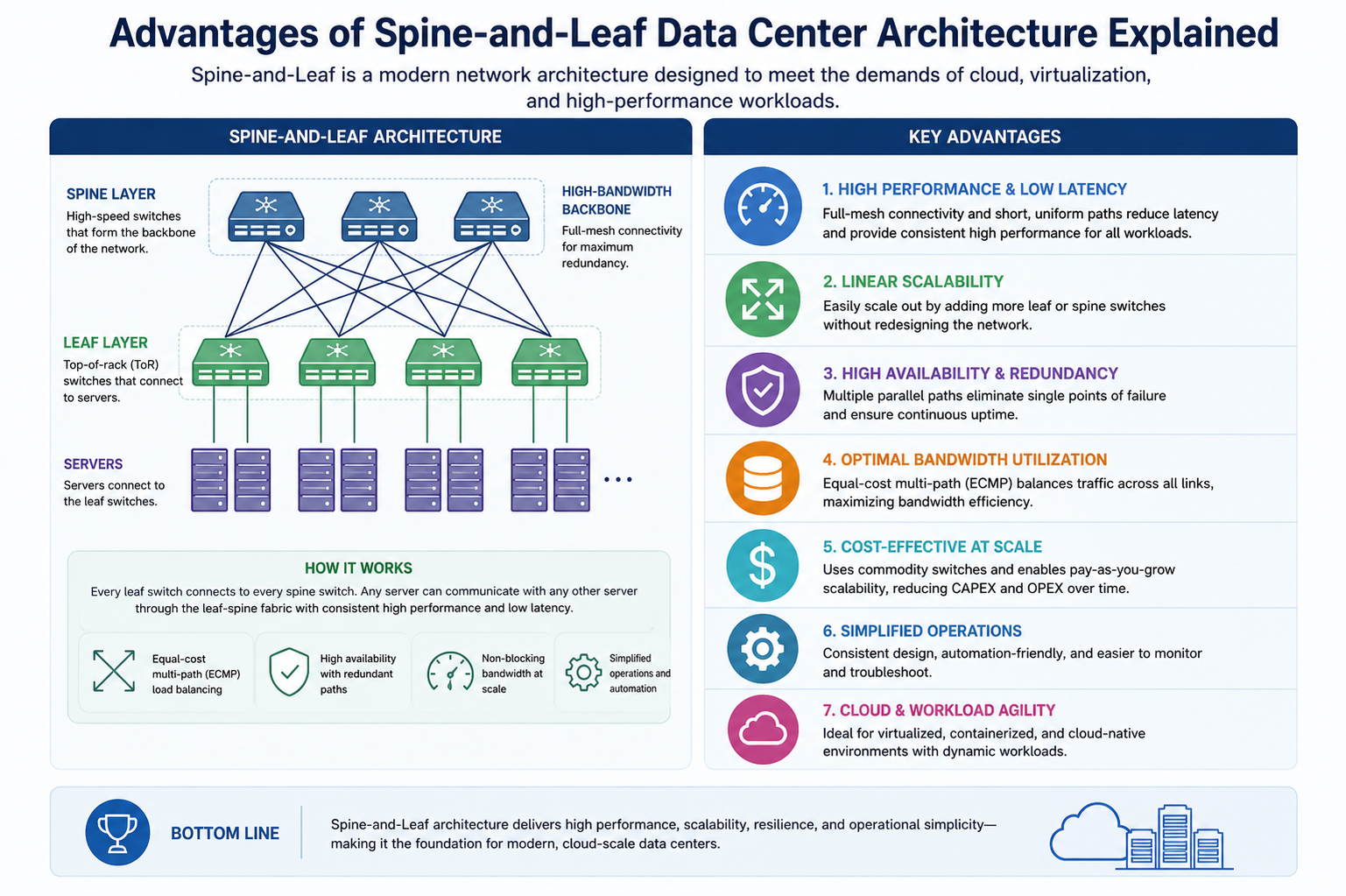
Spine-and-leaf architecture has become a foundational design in modern data centers due to its ability to handle large-scale, high-speed, and highly distributed computing environments. It replaces older hierarchical three-tier designs with a flatter, more efficient structure that improves communication between servers and reduces bottlenecks. In this model, leaf switches act as the access layer connecting directly to servers, while spine switches form the core backbone that interconnects all leaf switches. Every leaf switch is connected to every spine switch, ensuring that traffic between any two endpoints follows a predictable and optimized path.
This design is particularly important in environments where applications generate heavy east-west traffic, such as cloud platforms, virtualization clusters, and container-based systems. Instead of funneling traffic through multiple aggregation points, spine-and-leaf architecture distributes traffic evenly across the network, improving both speed and reliability.
Core Structural Efficiency of Spine-and-Leaf Design
The efficiency of spine-and-leaf architecture lies in its simplicity and uniformity. Unlike traditional multi-layer networks that rely on core, aggregation, and access layers with complex dependencies, spine-and-leaf uses only two logical layers. This reduction in hierarchy simplifies network design and eliminates unnecessary complexity in traffic routing.
Each leaf switch connects to every spine switch, creating a full-mesh between the two layers. This ensures that any server connected to a leaf switch can communicate with another server through a consistent number of hops. The result is predictable performance, which is critical for latency-sensitive applications.
The design also avoids traffic concentration at any single point. Because multiple spine switches share the forwarding load, the network can handle high volumes of traffic without degradation in performance.
Scalability Advantages in Large Environments
One of the most significant strengths of spine-and-leaf architecture is its horizontal scalability. In traditional networks, scaling often requires redesigning core components or introducing more complex aggregation layers. In contrast, spine-and-leaf allows administrators to expand capacity simply by adding more leaf switches to accommodate additional servers or adding spine switches to increase overall bandwidth.
This modular growth model is particularly beneficial for cloud providers and enterprises experiencing rapid expansion. It allows infrastructure to grow incrementally without disrupting existing services. As long as design principles such as consistent uplink ratios are maintained, the network can scale to thousands or even tens of thousands of servers.
The scalability also extends to bandwidth. By increasing the number of spine switches, overall interconnection capacity increases proportionally, ensuring that performance remains stable even under heavy load conditions.
Predictable Latency and Performance Optimization
Spine-and-leaf architecture is designed to ensure that data packets take a consistent and predictable path through the network. Typically, traffic moves from a source server to its leaf switch, then to a spine switch, and finally to the destination leaf switch and server. This fixed-hop pattern ensures that latency remains stable regardless of server location within the data center.
This predictability is especially valuable for applications such as distributed databases, financial trading systems, real-time analytics, and machine learning workloads. These systems require consistent response times, and unpredictable routing delays can negatively impact performance.
Additionally, because all spine switches perform similar roles and share load evenly, no single point becomes a performance bottleneck. This balanced traffic distribution helps maintain high throughput even during peak usage periods.
Equal-Cost Multi-Path (ECMP) Utilization
A key technical advantage of spine-and-leaf architecture is its reliance on Equal-Cost Multi-Path (ECMP) routing. ECMP allows multiple active paths between source and destination devices, enabling traffic to be distributed evenly across all available links.
Instead of relying on a single path, the network dynamically selects from multiple equal-cost routes, improving both performance and resilience. This ensures that no single link becomes overloaded while others remain underutilized.
ECMP also enhances fault tolerance. If one path fails, traffic is automatically rerouted through alternative paths without manual intervention, minimizing disruption and maintaining service continuity.
High Availability and Fault Tolerance
Reliability is a critical requirement in data center environments, and spine-and-leaf architecture provides strong fault tolerance through its redundant design. Each leaf switch is connected to multiple spine switches, meaning that the failure of a single spine switch does not isolate any portion of the network.
Similarly, if a link between a leaf and spine fails, traffic can be rerouted through other spine connections. This redundancy ensures that there is no single point of failure within the architecture.
The design also simplifies maintenance operations. Network administrators can take individual switches offline for upgrades or repairs without causing widespread service disruption. This contributes to higher uptime and improved service reliability.
Traffic Optimization for East-West Communication
Modern applications generate significant east-west traffic, which refers to communication between servers within the same data center rather than traffic entering or leaving the network. Traditional network designs were optimized for north-south traffic patterns, which are less relevant in distributed computing environments.
Spine-and-leaf architecture is specifically designed to optimize east-west traffic. By providing direct and multiple paths between leaf switches, it reduces the distance data must travel and eliminates unnecessary intermediate hops.
This optimization leads to lower latency, higher throughput, and improved application performance, particularly in microservices-based architectures where frequent inter-service communication is required.
Operational Simplicity and Manageability
Despite its advanced capabilities, spine-and-leaf architecture is operationally simpler than traditional hierarchical designs. The uniformity of switches at each layer reduces configuration complexity and makes network management more consistent.
Each leaf switch typically performs similar functions, and spine switches are primarily focused on forwarding traffic at high speed. This separation of roles allows network administrators to apply standardized configurations and policies across the entire infrastructure.
Troubleshooting is also more straightforward. Because traffic paths are predictable and evenly distributed, identifying and isolating network issues becomes easier compared to complex multi-tier architectures.
Support for Virtualization and Cloud Workloads
Spine-and-leaf architecture is particularly well-suited for virtualized environments and cloud computing platforms. Virtual machines and containers frequently migrate between physical servers, requiring fast and reliable network connectivity across different parts of the data center.
The architecture supports this mobility by providing consistent performance between any two points in the network. It ensures that workload migration does not result in performance degradation or increased latency.
Additionally, software-defined networking technologies often integrate seamlessly with spine-and-leaf designs, enabling dynamic control over traffic flows and network policies.
Efficient Use of Network Resources
Another advantage of spine-and-leaf architecture is efficient utilization of available bandwidth. Because all spine switches are actively used in forwarding traffic, network resources are balanced rather than underutilized or overburdened.
Traditional designs often suffer from oversubscription at aggregation layers, where too many devices compete for limited uplink capacity. Spine-and-leaf mitigates this issue by providing multiple equal-capacity paths, reducing congestion and improving overall efficiency.
This balanced usage also contributes to better return on investment for network infrastructure, as hardware resources are fully leveraged.
Reduced Network Bottlenecks
Bottlenecks are a common issue in traditional hierarchical networks where traffic converges at aggregation or core layers. Spine-and-leaf architecture eliminates this problem by distributing traffic across multiple spine switches.
Because each leaf switch connects to every spine switch, there is no single aggregation point where traffic can become congested. This distributed model ensures smoother traffic flow even during peak demand periods.
As a result, applications experience fewer slowdowns, and overall network performance remains stable under varying workloads.
Flexibility for Future Technologies
Spine-and-leaf architecture is highly adaptable to emerging networking technologies. It supports advanced overlays such as VXLAN and EVPN, which enable large-scale virtual networks across distributed environments.
This flexibility allows organizations to adopt new technologies without redesigning their underlying physical network infrastructure. It also supports hybrid and multi-cloud strategies, where workloads span across different environments.
The architecture’s modular nature ensures that new technologies can be integrated incrementally without disrupting existing services.
Improved Cabling and Physical Layout Efficiency
From a physical infrastructure perspective, spine-and-leaf architecture offers a more organized cabling structure. Although it requires more connections between leaf and spine switches, the layout is predictable and standardized.
This predictability simplifies data center planning and reduces complexity in large installations. It also makes scaling more systematic, as additional racks and switches follow the same design pattern.
While initial cabling requirements may be higher, long-term management becomes easier due to the structured nature of the design.
Cost Efficiency Over Time
Although spine-and-leaf architecture may require more initial investment in switching hardware compared to traditional designs, it often proves cost-effective over time. Its scalability reduces the need for major redesigns as the network grows, and its efficient resource utilization minimizes waste.
Additionally, reduced downtime, simplified maintenance, and improved performance contribute to lower operational costs. Organizations benefit from a more stable and predictable infrastructure that supports long-term growth.
Operational Reliability in Large-Scale Environments
In large data center environments, reliability is not just about avoiding downtime but ensuring continuous, uninterrupted performance under varying workloads. Spine-and-leaf architecture contributes significantly to operational reliability by distributing traffic across multiple redundant paths and eliminating dependency on any single switch or link.
Because every leaf switch connects to every spine switch, the failure of one or more components does not disrupt overall network communication. Traffic automatically reroutes through alternative spine switches using dynamic routing protocols and ECMP mechanisms. This resilience is especially important in mission-critical environments such as financial systems, healthcare platforms, and global cloud services where even brief outages can have significant consequences.
Another important aspect of reliability is maintenance flexibility. Network administrators can upgrade or replace switches without shutting down large portions of the network. This capability, often referred to as non-disruptive maintenance, allows organizations to perform hardware upgrades, firmware updates, and configuration changes while keeping services online.
Load Balancing and Traffic Distribution Efficiency
One of the defining strengths of spine-and-leaf architecture is its ability to balance network load efficiently. In traditional network models, traffic often converges at aggregation or core layers, creating congestion points. In contrast, spine-and-leaf distributes traffic evenly across multiple spine switches, ensuring that no single device becomes a bottleneck.
Load balancing is achieved through equal-cost multi-path routing, which allows the network to use multiple available paths simultaneously. This ensures that bandwidth is utilized efficiently and that no link is underused while others are overloaded.
This balanced distribution is particularly important in modern computing environments where applications generate unpredictable traffic patterns. For example, microservices-based applications may create sudden spikes in internal communication between services. Spine-and-leaf architecture handles these fluctuations gracefully by dynamically spreading traffic across all available paths.
Support for High-Bandwidth Applications
Modern applications such as artificial intelligence, big data analytics, and high-performance computing require extremely high bandwidth between servers. Spine-and-leaf architecture is well-suited for these workloads due to its high-speed interconnectivity and parallel path structure.
Since every leaf switch has multiple uplinks to spine switches, the available bandwidth scales with the number of spine devices. This means that as demand increases, the network can accommodate higher throughput without redesigning the infrastructure.
Additionally, the architecture reduces packet congestion by avoiding oversubscription at key network points. This ensures that bandwidth-intensive applications can operate efficiently even during peak usage periods.
Enhanced Support for Cloud-Native Architectures
Cloud-native environments rely heavily on distributed systems, container orchestration, and dynamic workload placement. Spine-and-leaf architecture aligns naturally with these requirements by providing a flexible and scalable networking foundation.
Containers and virtual machines often move between physical hosts as workloads shift dynamically. Spine-and-leaf ensures that connectivity remains consistent regardless of where workloads are placed within the data center.
This consistency is critical for orchestration platforms, which require reliable network performance for service discovery, load balancing, and inter-service communication. The architecture’s predictable latency and uniform connectivity simplify the deployment and scaling of cloud-native applications.
Reduced Complexity in Traffic Engineering
Traffic engineering in traditional hierarchical networks often involves complex configurations to manage congestion and optimize routing paths. Spine-and-leaf architecture simplifies this process by using a uniform topology and predictable routing behavior.
Because all leaf switches have identical connections to spine switches, traffic paths are inherently balanced. This reduces the need for manual intervention in optimizing network performance.
Network engineers can rely on automated routing protocols to distribute traffic efficiently, minimizing the need for complex policy-based routing or manual tuning. This simplification reduces operational overhead and improves overall network stability.
Improved Security Segmentation and Policy Enforcement
Security is a critical concern in modern data centers, and spine-and-leaf architecture supports effective segmentation and policy enforcement. Since the architecture is highly structured, it is easier to implement consistent security policies across the entire network.
Micro-segmentation techniques can be applied at the leaf level to isolate workloads and control communication between different services. This reduces the attack surface and limits lateral movement in case of a security breach.
Additionally, the predictable nature of traffic flow allows for better monitoring and inspection of network traffic. Security tools can be integrated more effectively to detect anomalies and enforce compliance policies.
Integration with Software-Defined Networking (SDN)
Spine-and-leaf architecture is highly compatible with software-defined networking technologies. SDN separates the control plane from the data plane, allowing centralized management of network behavior.
In a spine-and-leaf environment, SDN controllers can dynamically manage traffic flows, optimize routing paths, and enforce policies across the entire infrastructure. This enhances automation and reduces manual configuration efforts.
The combination of SDN and spine-and-leaf architecture enables highly programmable networks that can adapt in real time to changing workload demands. This is particularly useful in environments where rapid provisioning and scaling are required.
Efficient Fault Isolation and Troubleshooting
When network issues occur, quickly identifying and isolating the problem is essential. Spine-and-leaf architecture simplifies troubleshooting due to its predictable and uniform design.
Because every device operates within a clearly defined role, network administrators can quickly narrow down potential points of failure. If an issue arises, it is often easier to determine whether it is located at the leaf layer, spine layer, or an individual link.
The consistent structure also allows for standardized monitoring and logging practices, making it easier to detect anomalies and performance degradation across the network.
Flexibility in Network Expansion Strategies
As organizations grow, their networking needs evolve. Spine-and-leaf architecture provides significant flexibility in expansion strategies, allowing data centers to grow in a controlled and predictable manner.
New racks of servers can be added by simply connecting them to existing leaf switches or introducing additional leaf switches when capacity is reached. Similarly, additional spine switches can be introduced to increase overall fabric bandwidth.
This flexibility ensures that infrastructure investments are incremental rather than large-scale overhauls, allowing organizations to align growth with demand.
Optimized Data Center Fabric Design
Spine-and-leaf architecture is often referred to as a fabric due to its interconnected structure. This design creates a highly meshed network where every leaf switch has equal access to all spine switches.
This fabric-like structure eliminates hierarchical bottlenecks and ensures consistent communication between all endpoints. It also supports advanced routing and overlay technologies that enhance network flexibility and scalability.
The result is a unified and efficient network fabric capable of supporting modern distributed computing environments at scale.
Support for Multi-Tenant Environments
In environments such as cloud service providers and large enterprises, multiple tenants often share the same physical infrastructure. Spine-and-leaf architecture supports multi-tenancy through segmentation and virtual networking overlays.
Each tenant can be logically isolated while still sharing the same physical network infrastructure. This allows service providers to maximize resource utilization while maintaining strict separation between different customer environments.
The architecture’s predictable performance ensures that one tenant’s workload does not negatively impact others, maintaining fairness and consistency across the network.
Future-Ready Network Architecture
One of the most important advantages of spine-and-leaf architecture is its ability to support future technological advancements. As networking demands continue to evolve, this architecture provides a stable foundation that can adapt to new requirements.
Emerging technologies such as edge computing, artificial intelligence workloads, and distributed cloud systems all benefit from the architecture’s scalability and performance characteristics.
Because it is built on standardized principles and modular components, spine-and-leaf can evolve alongside technological innovation without requiring fundamental redesigns.
Performance Consistency Under Variable Workloads
One of the most important challenges in modern data centers is maintaining consistent performance when workloads fluctuate unpredictably. Applications today are rarely static; they scale up and down dynamically depending on user demand, time of day, or processing requirements. Spine-and-leaf architecture addresses this challenge by ensuring that performance remains stable regardless of traffic variation.
Because every leaf switch has equal connectivity to all spine switches, traffic is distributed evenly across multiple paths. This prevents localized congestion from affecting overall network performance. Even when certain applications generate sudden spikes in traffic, the architecture absorbs the load by leveraging available spine paths.
This consistency is especially valuable for distributed systems where multiple services interact continuously. Whether workloads increase or decrease, the network maintains predictable latency and throughput, which helps applications function reliably without degradation.
Reduced Oversubscription Challenges
Oversubscription occurs when network demand exceeds available bandwidth at a particular point in the infrastructure. In traditional hierarchical networks, oversubscription is common at aggregation layers, where multiple access switches funnel traffic through limited uplinks.
Spine-and-leaf architecture significantly reduces this problem by ensuring multiple equal-capacity paths between all endpoints. Since leaf switches connect to multiple spine switches, bandwidth is distributed across a wider fabric rather than concentrated in a single layer.
This design minimizes congestion and ensures that applications receive consistent access to network resources. While oversubscription can still exist depending on design choices, it is much easier to control and optimize in spine-and-leaf environments.
Improved Deterministic Traffic Flow
Deterministic traffic flow means that data packets follow predictable and consistent paths through the network. Spine-and-leaf architecture naturally supports this behavior because every communication between endpoints follows a similar path structure: leaf to spine to leaf.
This predictability simplifies network design and performance analysis. It allows engineers to estimate latency more accurately and design applications that rely on consistent communication patterns.
Deterministic flow also improves troubleshooting, as network behavior is easier to understand and replicate. When issues occur, administrators can quickly identify where deviations from expected traffic patterns are happening.
Efficient Use of Layer 3 Routing
Spine-and-leaf architecture typically relies heavily on Layer 3 routing rather than Layer 2 switching. This shift provides several advantages, including better scalability, reduced broadcast traffic, and improved stability.
Layer 3 routing eliminates the need for large spanning tree domains, which can become complex and inefficient in traditional designs. Instead, routing protocols such as BGP or OSPF are used to manage traffic between leaf and spine switches.
This approach ensures that the network remains stable even as it scales to large sizes. It also reduces the risk of loops and broadcast storms, which are common issues in Layer 2-heavy architectures.
Minimized Broadcast Domains
In traditional networks, large broadcast domains can lead to performance issues due to excessive broadcast traffic. Spine-and-leaf architecture reduces this problem by segmenting the network into smaller, more manageable broadcast domains.
Each leaf switch typically represents a localized broadcast domain, while spine switches handle routed traffic between these domains. This segmentation significantly reduces unnecessary network overhead.
As a result, overall network efficiency improves, and bandwidth is preserved for actual application traffic rather than control or broadcast messages.
Optimized Convergence Time
Network convergence refers to the time it takes for a network to re-establish stable routing paths after a change, such as a link or device failure. Spine-and-leaf architecture offers fast convergence times due to its simplified routing structure and redundant paths.
When a failure occurs, routing protocols quickly recalculate available paths and redirect traffic through alternate spine connections. Because multiple equal-cost paths already exist, convergence is typically fast and efficient.
This rapid recovery ensures minimal disruption to applications and improves overall network resilience.
Support for High-Density Compute Environments
Modern data centers often rely on high-density compute environments, where large numbers of servers are packed into compact physical spaces. Spine-and-leaf architecture is well-suited for these environments due to its scalable and structured design.
Leaf switches can be deployed at the rack level, connecting directly to servers within that rack. Spine switches then provide high-speed interconnectivity across all racks.
This design supports dense compute clusters used in artificial intelligence training, scientific simulations, and large-scale data processing workloads. It ensures that even highly dense environments maintain strong network performance.
Simplified Capacity Planning
Capacity planning is a critical part of data center design, and spine-and-leaf architecture makes this process more predictable. Because the architecture follows a consistent structure, network engineers can estimate bandwidth requirements and scaling needs more accurately.
Adding new compute resources typically involves adding more leaf switches or upgrading spine capacity. This modular approach simplifies forecasting and reduces the complexity of long-term planning.
It also allows organizations to align infrastructure investments more closely with actual usage patterns, improving cost efficiency over time.
Better Utilization of Modern Hardware
Spine-and-leaf architecture is designed to take advantage of modern high-speed networking hardware. With the availability of 10G, 25G, 40G, 100G, and even higher-speed interfaces, the architecture can scale bandwidth efficiently.
Leaf and spine switches can be upgraded independently, allowing gradual hardware improvements without redesigning the entire network. This flexibility ensures that organizations can adopt newer technologies as they become available.
The architecture’s parallel nature also ensures that high-speed links are fully utilized, maximizing the return on investment in networking hardware.
Enhanced Support for Data Center Interconnects
In large enterprises and cloud environments, multiple data centers often need to be interconnected. Spine-and-leaf architecture supports this requirement by providing a scalable foundation for data center interconnect (DCI) solutions.
Because traffic within each data center is already efficiently managed, inter-data center communication can be layered on top using specialized routing and tunneling technologies.
This enables seamless workload mobility, disaster recovery, and geographic redundancy across multiple locations.
Lower Operational Risk in Network Changes
Network changes such as upgrades, expansions, or configuration modifications always carry some level of risk. Spine-and-leaf architecture reduces this risk by isolating changes to specific components without affecting the entire network.
Since each leaf switch operates independently in terms of connectivity, modifications can be made incrementally. This reduces the likelihood of widespread outages caused by configuration errors or hardware issues.
The modular nature of the architecture also allows for staged rollouts, where changes are tested and deployed gradually.
Better Alignment with Automation and DevOps Practices
Modern IT environments increasingly rely on automation and DevOps methodologies. Spine-and-leaf architecture aligns well with these practices due to its structured and predictable design.
Network configurations can be standardized and automated using infrastructure-as-code tools. This reduces manual intervention and increases consistency across deployments.
Automation also enables faster provisioning of network resources, allowing development teams to deploy applications more rapidly and efficiently.
Improved Energy and Resource Efficiency
While spine-and-leaf architecture may initially appear to require more hardware, it can lead to better long-term energy efficiency. Because traffic is distributed evenly, no single device is overburdened, which helps maintain optimal operating conditions.
Modern switches are also designed for energy efficiency, and balanced workloads ensure that hardware operates within ideal performance ranges.
Additionally, efficient traffic flow reduces unnecessary processing overhead, contributing to lower overall energy consumption per unit of data transferred.
Advanced Automation and Programmability in Spine-and-Leaf Networks
Modern data centers increasingly rely on automation to manage scale, reduce human error, and accelerate deployment cycles. Spine-and-leaf architecture supports this shift effectively because of its structured and predictable design. Each leaf and spine device follows consistent configuration patterns, which makes it easier to automate provisioning, monitoring, and troubleshooting tasks.
Network automation tools can deploy configurations across multiple switches simultaneously, ensuring consistency throughout the entire fabric. This reduces manual configuration efforts and minimizes the risk of inconsistencies that could lead to network issues. In addition, APIs and software-defined networking controllers can interact directly with the underlying infrastructure, enabling dynamic adjustments based on workload demands.
Programmability also allows networks to become more responsive. Instead of static configurations, policies can be updated in real time to reflect changing application requirements. This flexibility is essential in environments where workloads are constantly shifting, such as cloud platforms and containerized ecosystems.
Seamless Integration with Hybrid and Multi-Cloud Environments
Organizations today often operate across multiple environments, including on-premises data centers, private clouds, and public cloud platforms. Spine-and-leaf architecture provides a strong foundation for this hybrid and multi-cloud approach due to its scalability and consistent performance characteristics.
Because the architecture is based on Layer 3 routing and standardized connectivity patterns, it integrates smoothly with external networks and cloud providers. This makes it easier to extend workloads across different environments without major architectural changes.
The predictable nature of spine-and-leaf also ensures that applications experience consistent performance regardless of where they are deployed. This is critical for maintaining service quality in distributed systems that span multiple geographic locations or cloud platforms.
High Resilience in Disaster Recovery Scenarios
Disaster recovery is a critical component of modern IT infrastructure, and spine-and-leaf architecture plays an important role in ensuring business continuity. Its redundant design allows traffic to reroute automatically in the event of hardware failure, network disruption, or even partial data center outages.
In multi-data-center setups, spine-and-leaf structures enable efficient replication and synchronization of data across sites. This ensures that backup systems remain up to date and can take over quickly in case of failure.
Because of its deterministic routing and multiple equal-cost paths, recovery processes are faster and more reliable. This reduces downtime and ensures that critical services remain available even under adverse conditions.
Consistent Performance Across Geographic Distribution
As organizations expand globally, maintaining consistent network performance across different locations becomes increasingly important. Spine-and-leaf architecture supports this requirement by providing a uniform networking model that can be replicated across multiple data centers.
Each location can implement the same leaf-and-spine structure, ensuring consistent behavior and performance characteristics. This standardization simplifies global network management and reduces complexity when connecting distributed infrastructure.
When combined with inter-data center connectivity solutions, this architecture helps maintain predictable latency and bandwidth across regions, which is essential for global applications and services.
Optimized Support for Artificial Intelligence and Machine Learning Workloads
Artificial intelligence and machine learning workloads require extremely high levels of data exchange between compute nodes, often involving large-scale parallel processing. Spine-and-leaf architecture is particularly well-suited for these environments due to its high-bandwidth, low-latency, and non-blocking design.
Training large models involves continuous communication between GPUs or distributed compute nodes. Any network bottleneck can significantly slow down processing. Spine-and-leaf minimizes these bottlenecks by providing multiple high-speed paths between all devices.
Additionally, the architecture supports rapid scaling of compute clusters, allowing organizations to add more processing power without redesigning the underlying network. This makes it an ideal choice for AI research, deep learning training, and data-intensive analytics.
Reduced Complexity in Network Upgrades
Upgrading network infrastructure in traditional hierarchical designs can be complex and disruptive. Spine-and-leaf architecture simplifies this process by enabling incremental upgrades without affecting the entire system.
New spine or leaf switches can be added alongside existing hardware, and traffic can gradually be migrated without downtime. This allows organizations to adopt newer technologies, such as higher-speed interfaces or advanced switching platforms, in a controlled manner.
This incremental upgrade capability reduces operational risk and ensures that networks remain up to date with evolving performance requirements.
Improved Application Performance Consistency
Application performance in modern environments depends heavily on network stability and predictability. Spine-and-leaf architecture ensures that applications receive consistent network performance by eliminating unpredictable routing paths and minimizing congestion points.
Because every communication between servers follows a similar hop structure, applications experience stable latency and throughput. This consistency is particularly important for distributed applications that rely on frequent inter-service communication.
Even during peak usage periods, the architecture maintains stable performance levels by distributing traffic evenly across all available paths.
Simplified Monitoring and Observability
Monitoring large-scale networks can be challenging, but spine-and-leaf architecture simplifies observability due to its structured design. Since all switches operate within a predictable topology, it becomes easier to collect, analyze, and interpret network performance data.
Monitoring tools can track traffic flows across leaf and spine switches consistently, enabling faster detection of anomalies or performance issues. This structured visibility helps network teams respond more quickly to potential problems.
Additionally, standardized configurations make it easier to implement centralized monitoring systems that provide a unified view of the entire network fabric.
Better Support for Edge Computing Expansion
Edge computing extends processing closer to data sources, reducing latency and improving responsiveness for end users. Spine-and-leaf architecture supports this trend by providing a scalable and flexible networking foundation that can extend to edge locations.
Leaf switches can be deployed in edge environments to connect local devices, while spine-like structures can interconnect multiple edge sites or link them back to central data centers.
This ensures consistent performance and connectivity across distributed edge infrastructures, enabling real-time processing for applications such as IoT, autonomous systems, and content delivery networks.
Efficient Resource Allocation in Virtualized Environments
Virtualization allows multiple virtual machines to run on shared physical hardware, increasing resource efficiency. Spine-and-leaf architecture enhances virtualization performance by providing reliable and high-speed communication between virtualized workloads.
Virtual machines often need to communicate across different physical hosts, and spine-and-leaf ensures that this communication remains fast and consistent. This reduces delays in workload migration and improves overall system responsiveness.
It also supports dynamic resource allocation, where virtual machines can be moved or scaled based on demand without affecting network performance.
Reduced Risk of Network Fragmentation
Network fragmentation occurs when complex hierarchical designs create isolated segments that are difficult to manage or integrate. Spine-and-leaf architecture avoids this issue by maintaining a uniform and interconnected structure.
Because all leaf switches connect to all spine switches, the network remains fully integrated at all times. This prevents isolation issues and ensures seamless communication across the entire infrastructure.
This unified structure also simplifies policy enforcement and ensures consistent behavior across all network segments.
Long-Term Strategic Infrastructure Benefits
From a long-term perspective, spine-and-leaf architecture provides strategic advantages for organizations planning sustained growth. Its modular design ensures that infrastructure can evolve alongside business needs without requiring complete redesigns.
It supports gradual expansion, technology upgrades, and integration of new computing paradigms without disrupting existing operations. This makes it a future-proof choice for enterprises building long-term digital infrastructure strategies.
The combination of scalability, reliability, and flexibility ensures that organizations can adapt to changing technological landscapes while maintaining operational stability.
Conclusion
Spine-and-leaf architecture represents a highly efficient and scalable approach to modern data center networking. Its ability to support automation, hybrid cloud environments, AI workloads, and global distributed systems makes it a cornerstone of contemporary infrastructure design.
By providing consistent performance, simplifying operations, and enabling seamless scalability, it addresses the challenges of increasingly complex digital environments. As technology continues to evolve toward greater distribution, higher performance demands, and increased automation, spine-and-leaf architecture remains a reliable and future-ready foundation for data center networks.