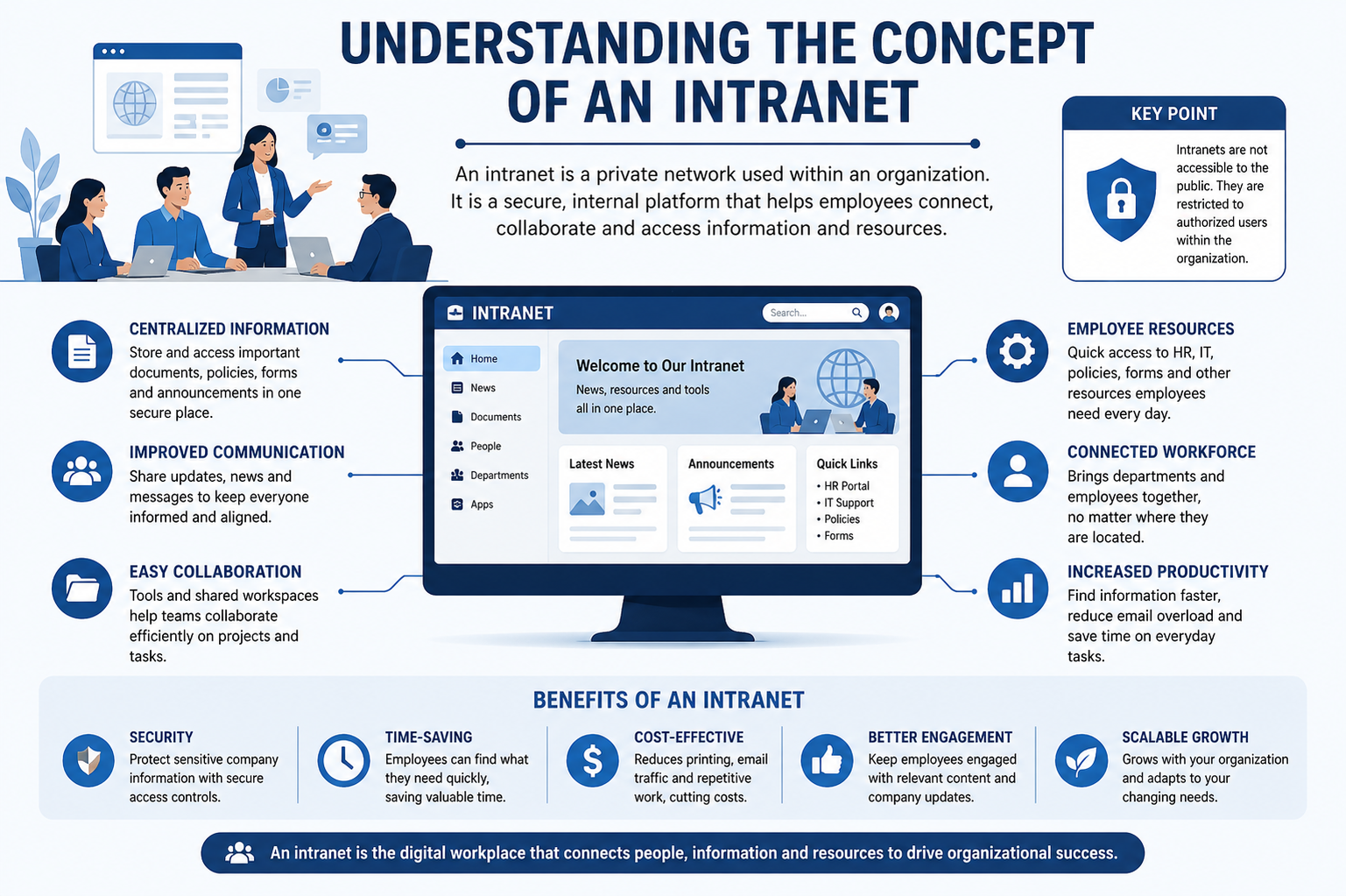
An intranet is a private digital network established within an organization to support internal communication, information sharing, and collaboration among employees. It functions as a controlled environment where access is restricted to authorized users only, making it significantly more secure than public communication platforms. The core idea behind an intranet is to create a unified digital workspace where employees can easily access essential resources, communicate efficiently, and perform tasks without relying on external systems.
An intranet is not just a technological tool but an integrated system that supports the overall functioning of an organization. It brings together people, processes, and information into a single structured environment. By doing so, it reduces communication gaps and ensures that all employees have access to the same accurate and updated information. This consistency plays an important role in maintaining productivity and coordination across different departments.
Structure and Architecture of an Intranet
The structure of an intranet is typically built on a client-server model where users access information through internal servers. These servers store organizational data, applications, and communication tools. Employees connect to the intranet using secure authentication methods, ensuring that only authorized individuals can access the system.
The architecture is designed to support scalability, meaning it can grow with the organization. As companies expand, additional users, departments, and resources can be integrated into the existing system without disrupting operations. This flexibility makes intranets suitable for both small organizations and large enterprises.
In many cases, intranets are also connected to other internal systems such as human resource platforms, customer management tools, and project management applications. This integration allows employees to switch between tasks smoothly without needing separate platforms for each function.
Core Components of an Intranet System
An intranet consists of several essential components that work together to ensure smooth operation. One of the most important components is the communication system, which includes messaging tools, announcements, and discussion spaces. These tools help employees stay informed and connected.
Another key component is document management. This allows organizations to store, organize, and share files securely within the system. Employees can access important documents such as policies, reports, and training materials without needing physical copies.
The intranet also includes user management systems that control access levels. Different employees may have different permissions depending on their roles. For example, managers may have access to more sensitive data compared to general staff members. This ensures data security and prevents unauthorized access.
Additionally, intranets often include search functionality that helps users quickly find the information they need. Instead of manually browsing through multiple folders, employees can locate documents or resources within seconds.
Communication Role of Intranets in Organizations
One of the primary functions of an intranet is to improve internal communication. In large organizations, communication can often become fragmented due to multiple departments and hierarchical structures. An intranet solves this problem by providing a centralized communication platform.
Employees can receive company-wide announcements instantly, reducing delays in information sharing. It also allows departments to communicate more effectively with each other, improving coordination and teamwork. Internal messaging systems enable quick discussions without relying on external communication tools, keeping all interactions within a secure environment.
This improved communication also contributes to better decision-making. When employees have access to accurate and timely information, they can respond more effectively to challenges and opportunities.
Role of Intranets in Collaboration and Teamwork
In addition to communication, intranets play a significant role in enhancing collaboration among employees. Teams working on projects can share files, assign tasks, and track progress within the system. This eliminates the need for multiple disconnected tools and ensures that everyone is working with the same information.
Collaboration tools within an intranet often include shared workspaces where employees can jointly edit documents or contribute ideas. This real-time interaction improves efficiency and reduces delays in project completion.
In remote or hybrid work environments, intranets become even more important. They allow employees to collaborate effectively regardless of their physical location. This ensures continuity in operations even when teams are distributed across different regions.
Security Aspects of Intranets
Security is one of the most important features of an intranet system. Since it deals with internal organizational data, protecting that information from unauthorized access is essential. Intranets use various security measures such as authentication, encryption, and access control to ensure data safety.
Authentication ensures that only verified users can log into the system. Encryption protects data during transmission, making it difficult for unauthorized parties to intercept or read sensitive information. Access control mechanisms define what each user is allowed to view or modify within the system.
Regular monitoring and updates are also part of intranet security practices. Organizations continuously improve their systems to protect against potential threats and vulnerabilities. This makes intranets a reliable solution for handling confidential business information.
Benefits of Implementing an Intranet
An intranet offers numerous benefits to organizations of all sizes. One of the most significant advantages is improved efficiency. Employees can quickly access the information they need without wasting time searching through multiple sources. This leads to faster task completion and better productivity.
Another major benefit is enhanced communication. By centralizing communication channels, intranets reduce misunderstandings and ensure that important messages reach everyone. This is especially useful in large organizations where information can easily be lost or delayed.
Cost savings is another advantage. By reducing the need for physical documents and external communication tools, organizations can lower operational expenses. Digital storage and communication also reduce paper usage, contributing to environmentally friendly practices.
Intranets also support knowledge sharing within organizations. Employees can learn from shared resources, training materials, and internal discussions. This helps improve overall skill development and organizational growth.
Challenges Associated with Intranets
Despite their benefits, intranets also come with certain challenges. One common issue is user adoption. Employees may initially resist using the system if they are not properly trained or if the interface is not user-friendly. This can limit the effectiveness of the intranet.
Another challenge is maintenance. Intranets require regular updates and management to ensure smooth operation. Without proper maintenance, the system may become outdated or inefficient over time.
Information overload can also be a problem. If too much data is stored without proper organization, users may find it difficult to locate relevant information. This reduces the overall efficiency of the system.
Security risks, although minimized, can still exist if proper protocols are not followed. Organizations must remain vigilant and continuously update their security measures to protect sensitive data.
Evolution of Intranet Systems
Over time, intranets have evolved significantly. Earlier versions were simple systems used mainly for document sharing and basic communication. However, modern intranets have become highly advanced platforms that integrate multiple tools and technologies.
Today’s intranets often include features such as artificial intelligence, automation, and personalized user experiences. These enhancements make it easier for employees to find relevant information and complete tasks more efficiently.
The evolution of cloud technology has also influenced intranet development. Many organizations now use cloud-based intranets, allowing employees to access the system from anywhere while maintaining security and performance.
Importance of Intranets in Modern Workplaces
In modern workplaces, intranets have become essential tools for managing information and communication. As organizations grow more complex, the need for efficient internal systems increases. Intranets provide a structured solution to manage this complexity.
They support remote work environments, improve employee engagement, and enhance overall organizational efficiency. By providing a centralized digital space, intranets ensure that employees remain connected and informed at all times.
They also contribute to building a strong organizational culture. When employees have access to shared information and communication platforms, they feel more connected to the organization’s goals and values.
Future of Intranet Technology
The future of intranet systems is expected to focus on greater personalization and automation. Artificial intelligence will play a key role in delivering customized content to users based on their roles and preferences. This will improve efficiency and reduce the time spent searching for information.
Integration with advanced collaboration tools will also continue to grow. Future intranets will likely provide more seamless communication experiences, combining messaging, video conferencing, and project management into a single platform.
Increased focus on mobile accessibility will also shape the future of intranets. As more employees use mobile devices for work, intranet systems will be optimized for on-the-go access.
Overall, intranets will continue to evolve as essential tools for modern organizations, supporting communication, collaboration, and productivity in increasingly dynamic work environments.
Advanced Features of Modern Intranets
Modern intranets have evolved far beyond simple information-sharing platforms and now include advanced features designed to improve user experience and organizational efficiency. One of the most important advancements is personalization, where the intranet interface adapts to each user based on their role, department, and preferences. This ensures that employees see the most relevant information first, reducing time spent searching for resources.
Another advanced feature is automation. Many intranets now include automated workflows that help streamline routine tasks such as leave requests, approvals, and document submissions. These automated processes reduce manual effort and minimize delays in internal operations, making the overall system more efficient.
Artificial intelligence is also becoming an integral part of intranet systems. AI-powered search functions allow users to find information more quickly by understanding natural language queries. Instead of relying on exact keywords, employees can type questions in a conversational manner and still receive accurate results.
In addition, modern intranets often include analytics tools that help organizations understand how employees are using the system. These insights can reveal which resources are most accessed, which departments are most active, and where improvements may be needed. This data-driven approach helps organizations continuously improve their internal systems.
Role of Intranets in Knowledge Management
Intranets play a critical role in knowledge management within organizations. Knowledge management refers to the process of capturing, organizing, and sharing information so that it can be easily accessed and used by employees. An intranet acts as a central repository for this knowledge, ensuring that valuable information is not lost or scattered across different platforms.
Employees can contribute to this knowledge base by sharing their experiences, creating guides, and uploading important documents. Over time, this builds a rich internal library of organizational knowledge that benefits both new and existing employees.
This system is particularly useful for onboarding new staff. Instead of relying solely on training sessions, new employees can use the intranet to access training materials, company policies, and workflow instructions at their own pace. This helps them adapt more quickly to their roles and responsibilities.
Intranet and Employee Engagement
Employee engagement is another important area where intranets have a significant impact. Engaged employees are more productive, motivated, and committed to their work. Intranets contribute to this by creating a sense of connection and involvement within the organization.
Features such as internal news updates, recognition boards, and employee feedback systems help employees feel valued and informed. When employees are aware of company achievements, goals, and changes, they feel more connected to the organization’s mission.
Intranets also provide platforms for employees to express their opinions and share feedback. This two-way communication helps management understand employee concerns and make necessary improvements. As a result, employees feel that their voices are heard, which increases satisfaction and loyalty.
Intranet in Remote and Hybrid Work Environments
The rise of remote and hybrid work models has made intranets more important than ever. When employees are working from different locations, maintaining communication and collaboration can become challenging. An intranet solves this problem by providing a unified digital workspace accessible from anywhere.
Employees can log into the system from home, office, or while traveling, ensuring continuous access to important resources. This flexibility supports productivity regardless of physical location.
Virtual collaboration tools within intranets allow teams to continue working together effectively. File sharing, project tracking, and real-time communication ensure that distance does not become a barrier to teamwork.
In addition, intranets help maintain organizational culture in remote environments. By providing spaces for announcements, social interaction, and employee engagement activities, they help employees stay connected to the organization despite physical separation.
Customization and Scalability of Intranet Systems
One of the strengths of intranet systems is their ability to be customized according to organizational needs. Every organization has different requirements, and intranets can be tailored to match specific workflows, communication styles, and departmental structures.
Customization can include changing the layout, adding specific tools, or integrating external applications. This ensures that the intranet aligns perfectly with the way an organization operates.
Scalability is another important feature. As organizations grow, their intranet systems can expand to accommodate more users, data, and functionalities. This makes intranets a long-term solution that can evolve alongside the organization without requiring complete replacement.
Intranet Integration with Other Systems
Modern intranets are often integrated with other business systems to create a seamless digital environment. These integrations may include human resource systems, finance tools, customer relationship management platforms, and project management software.
By connecting these systems, intranets eliminate the need for employees to switch between multiple platforms. Instead, they can access everything from a single interface, improving efficiency and reducing complexity.
For example, an employee may be able to request leave, check project status, and access company updates all from the same intranet dashboard. This level of integration simplifies workflows and enhances productivity.
Challenges in Maintaining Modern Intranets
Although intranets offer many benefits, maintaining them effectively can be challenging. One major challenge is keeping the content updated. If information becomes outdated, employees may rely on incorrect data, leading to confusion and inefficiency.
Another challenge is ensuring consistent user engagement. If employees do not actively use the intranet, its value decreases over time. Organizations must continuously encourage usage through training, updates, and engaging content.
Technical issues can also arise, especially in large systems with multiple integrations. Regular maintenance and technical support are necessary to ensure smooth performance.
Additionally, balancing security with accessibility can be difficult. While strong security measures are essential, they must not make the system too complicated for users. Finding the right balance is crucial for effective intranet management.
Impact of Intranets on Organizational Efficiency
Intranets significantly improve organizational efficiency by streamlining communication and centralizing information. When employees can quickly access what they need, they spend less time searching and more time focusing on productive tasks.
They also reduce dependency on email for internal communication, which helps minimize clutter and improves response times. Instead of long email chains, employees can use intranet-based messaging and collaboration tools for faster interaction.
By standardizing processes and providing clear workflows, intranets reduce errors and inconsistencies in daily operations. This leads to smoother functioning across departments and better overall performance.
Cultural Influence of Intranets in Organizations
Beyond operational benefits, intranets also influence organizational culture. They help create a more transparent and inclusive environment by making information accessible to all employees.
When communication flows freely across all levels of the organization, it reduces hierarchy barriers and encourages openness. Employees feel more connected to leadership and better informed about organizational direction.
Intranets also promote collaboration and teamwork, which strengthens relationships among employees. Over time, this contributes to a more positive and unified workplace culture.
Future Developments in Intranet Technology
The future of intranets is expected to be shaped by emerging technologies such as artificial intelligence, machine learning, and advanced automation. These technologies will make intranets smarter and more intuitive, allowing them to anticipate user needs and provide proactive support.
Voice-activated search and chatbot assistance are likely to become more common, enabling employees to interact with intranet systems more naturally. This will further simplify access to information and improve usability.
Virtual reality and immersive collaboration tools may also be integrated into future intranets, creating more interactive and engaging work environments.
As organizations continue to evolve, intranets will remain a key component of digital transformation strategies, helping businesses stay efficient, connected, and competitive in an increasingly digital world.
Security and Data Protection in Intranets
Security remains one of the most critical aspects of any intranet system, as it handles sensitive organizational information. To ensure protection, intranets are designed with multiple layers of security that work together to prevent unauthorized access and data breaches. These layers typically include secure login systems, encrypted communication channels, and strict user authentication processes.
Access control is a fundamental part of intranet security. It ensures that employees can only access information relevant to their roles. This minimizes the risk of internal data misuse and protects confidential information from being exposed to unauthorized personnel. Role-based permissions are commonly used, where different employees are assigned different levels of access depending on their job responsibilities.
Encryption also plays an essential role in safeguarding data. When information is transmitted across the intranet, it is converted into a secure format that cannot be easily intercepted or read by outsiders. This ensures that even if data is captured during transmission, it remains protected.
Regular system updates and security audits are equally important. Organizations frequently review their intranet systems to identify vulnerabilities and apply necessary security patches. This proactive approach helps prevent potential cyber threats and ensures that the system remains reliable and secure over time.
User Experience and Interface Design in Intranets
The effectiveness of an intranet largely depends on how easy it is to use. A well-designed user interface improves accessibility and encourages employees to engage with the system regularly. Simplicity is a key principle in intranet design, ensuring that users can navigate the system without confusion or difficulty.
Clear menus, organized layouts, and intuitive navigation structures help employees find information quickly. A clutter-free interface reduces cognitive load and allows users to focus on their tasks rather than struggling with system complexity.
Search functionality is another important aspect of user experience. A strong search system enables employees to locate documents, contacts, or tools within seconds. Advanced intranets often include smart search features that suggest results based on user behavior and past searches.
Mobile-friendly design is also becoming increasingly important. As more employees use smartphones and tablets for work, intranets must be optimized for different screen sizes. This ensures that users can access the system conveniently from any device, improving flexibility and productivity.
Intranet Governance and Management
Effective governance is essential for maintaining an intranet system. Governance refers to the rules, policies, and procedures that control how the intranet is used and managed within an organization. Without proper governance, intranets can become disorganized and inefficient over time.
Content management is a key part of governance. Organizations must ensure that all information on the intranet is accurate, relevant, and regularly updated. Outdated content can lead to confusion and reduce trust in the system.
Responsibility for managing the intranet is often assigned to specific teams or administrators. These individuals oversee system performance, user access, and content updates. They also ensure that the intranet aligns with organizational goals and policies.
Clear usage guidelines are also important. Employees must understand how to use the intranet properly, including how to share information, access resources, and follow security protocols. Training sessions and support materials are often provided to help users become familiar with the system.
Intranet as a Tool for Organizational Communication Strategy
An intranet plays a central role in shaping an organization’s communication strategy. It serves as the primary channel for sharing internal information, ensuring that communication is consistent, timely, and well-structured.
Leadership teams use intranets to communicate important announcements, policy changes, and strategic updates. This ensures that all employees receive the same information at the same time, reducing miscommunication and confusion.
Department-level communication is also enhanced through intranets. Teams can share updates, coordinate tasks, and collaborate more effectively without relying on external tools. This improves alignment and ensures that everyone is working toward the same objectives.
Feedback systems integrated into intranets allow employees to share their thoughts and suggestions. This creates a two-way communication flow, where employees are not just recipients of information but active participants in organizational dialogue.
Role of Intranets in Training and Development
Intranets are widely used for employee training and professional development. They provide a centralized platform where training materials, instructional videos, and learning resources can be stored and accessed easily.
This allows employees to learn at their own pace and revisit materials whenever needed. Self-paced learning is especially beneficial in large organizations where employees have different schedules and responsibilities.
In addition, intranets often support e-learning systems that track employee progress. This helps organizations monitor training completion and identify areas where additional support may be required.
Continuous learning becomes easier when employees have constant access to updated resources. This contributes to skill development and helps organizations maintain a knowledgeable and capable workforce.
Intranet and Digital Transformation
Intranets play a significant role in the digital transformation of organizations. Digital transformation involves integrating technology into all areas of business operations to improve efficiency and performance.
By replacing traditional communication methods such as paper documents and manual processes, intranets help organizations move toward a fully digital environment. This reduces operational costs and increases speed and accuracy.
They also support the adoption of new technologies by providing a platform where different systems can be integrated. This creates a connected digital ecosystem that enhances overall productivity.
As organizations continue to embrace digital transformation, intranets serve as a foundation for innovation and modernization.
Challenges in User Adoption and Engagement
One of the most common challenges in intranet implementation is user adoption. Employees may be reluctant to use the system if they are unfamiliar with it or if it does not appear user-friendly.
Lack of engagement can reduce the effectiveness of the intranet. If employees do not regularly use the system, important information may be missed, and communication may become fragmented.
To overcome this challenge, organizations often provide training sessions and user support. Encouraging feedback also helps improve the system based on employee needs and preferences.
Making the intranet more engaging through interactive features, updates, and personalized content can also increase user participation.
Performance Optimization of Intranet Systems
Maintaining high performance is essential for intranet systems, especially in large organizations with many users. Slow performance can reduce productivity and discourage usage.
Optimization involves ensuring that the system runs efficiently by managing server load, improving database performance, and reducing unnecessary data storage.
Regular monitoring helps identify performance issues early. Technical teams can then take corrective actions to maintain system speed and reliability.
Efficient design and clean coding practices also contribute to better performance. A well-optimized intranet ensures smooth operation even during peak usage times.
Intranet and Organizational Transparency
Intranets promote transparency within organizations by making information easily accessible to employees. When employees are informed about company decisions, goals, and performance, trust in leadership increases.
Transparency also helps reduce rumors and misinformation. Since official updates are shared directly through the intranet, employees can rely on accurate and verified information.
This open flow of information creates a more honest and trustworthy work environment, which positively impacts employee morale and engagement.
Long-Term Value of Intranet Systems
Over time, intranets provide long-term value to organizations by improving efficiency, communication, and knowledge management. They become an essential part of daily operations, supporting both strategic and operational activities.
As organizations grow, intranets adapt to new requirements and continue to support evolving business needs. Their flexibility and scalability make them a sustainable solution for internal communication and collaboration.
By continuously improving and updating intranet systems, organizations can ensure that they remain effective tools for productivity and innovation in the long run.
Integration of Intranets with Modern Workplace Technologies
Modern intranets are no longer isolated systems; they are deeply integrated with a wide range of workplace technologies to create a unified digital ecosystem. This integration allows employees to access multiple tools and services from a single platform, reducing complexity and improving efficiency. For example, intranets often connect with email systems, cloud storage services, project tracking tools, and communication applications.
This level of integration eliminates the need for employees to switch between multiple systems repeatedly. Instead, they can perform most of their daily tasks within the intranet environment. This not only saves time but also reduces the chances of errors caused by managing information across disconnected platforms.
Another important aspect of integration is synchronization. When different systems are connected to the intranet, data updates automatically across platforms. This ensures that employees always work with the most current information, improving accuracy and decision-making.
Intranet Accessibility and Inclusivity
Accessibility is an essential feature of modern intranets, ensuring that all employees can use the system effectively regardless of their abilities or technical skills. A well-designed intranet takes into account users with different levels of experience and provides simple navigation, clear instructions, and intuitive layouts.
Inclusivity is also important in intranet design. Organizations often have employees from diverse backgrounds, roles, and technical expertise levels. A good intranet accommodates this diversity by offering multilingual support, adjustable interfaces, and user-friendly features that make it easy for everyone to engage with the system.
Accessibility also extends to device compatibility. Employees should be able to access the intranet from desktops, laptops, tablets, and mobile devices without losing functionality. This ensures that the system remains useful in all working conditions, including remote and field-based environments.
Intranet as a Support System for Decision Making
Intranets play a supportive role in organizational decision-making by providing quick access to relevant data and information. Managers and executives can use the system to review reports, analyze performance metrics, and access historical records before making decisions.
Having centralized information reduces the time required to gather data from multiple sources. It also improves the accuracy of decisions because the information is consistent and up to date. This leads to more informed and strategic decision-making processes.
In addition, intranets often include dashboards that present key performance indicators in a visual format. These dashboards help decision-makers quickly understand organizational performance and identify areas that require attention or improvement.
Intranet and Employee Productivity Enhancement
One of the most significant benefits of intranets is their impact on employee productivity. By providing quick access to tools, information, and communication channels, intranets reduce the time spent on searching and switching between tasks.
Employees can complete their work more efficiently because everything they need is available in one place. This reduces interruptions and allows them to focus on meaningful tasks rather than administrative work.
Task automation within intranets also contributes to productivity. Routine processes such as approvals, reporting, and scheduling can be automated, freeing employees from repetitive tasks and allowing them to focus on higher-value work.
Content Management in Intranet Systems
Content management is a crucial function of any intranet system. It involves organizing, updating, and maintaining all information stored within the platform. Proper content management ensures that employees always have access to accurate and relevant data.
Content is usually categorized into different sections such as policies, announcements, training materials, and departmental resources. This structured approach makes it easier for users to locate specific information.
Version control is also an important part of content management. It ensures that employees are always viewing the latest version of documents, while older versions are stored for reference if needed. This prevents confusion caused by outdated information.
Role of Intranets in Crisis Communication
In times of crisis, intranets become essential communication tools. Whether dealing with organizational changes, emergencies, or unexpected disruptions, intranets allow management to quickly share important updates with all employees.
Fast and reliable communication is critical during such situations. Intranets ensure that messages reach everyone simultaneously, reducing delays and misunderstandings. This helps maintain order and clarity during uncertain times.
They also provide a centralized platform for instructions, updates, and recovery plans, ensuring that employees know exactly what steps to follow. This structured communication helps organizations respond more effectively to challenges.
Intranet Personalization and User Experience Enhancement
Personalization is one of the most advanced features of modern intranets. It allows the system to adapt to individual users based on their roles, preferences, and behavior patterns.
For example, employees may see personalized dashboards displaying relevant tasks, notifications, and frequently used tools. This reduces unnecessary clutter and improves efficiency.
Personalized content recommendations also help employees discover useful resources they might not actively search for. This enhances engagement and ensures that important information is not overlooked.
By tailoring the experience to individual users, intranets create a more efficient and enjoyable digital workspace.
Intranet as a Knowledge Retention System
Organizations often face challenges when experienced employees leave, taking valuable knowledge with them. Intranets help address this issue by acting as knowledge retention systems.
Employees can document processes, share insights, and store important information within the intranet. This ensures that knowledge remains within the organization even when individuals move on.
Over time, this creates a comprehensive knowledge base that supports continuity and reduces dependency on specific individuals. New employees can also benefit from this stored knowledge, making onboarding smoother and faster.
Monitoring and Analytics in Intranet Usage
Monitoring tools within intranets help organizations understand how the system is being used. These tools track user activity, content engagement, and system performance.
Analytics provide valuable insights into which areas of the intranet are most useful and which areas may need improvement. For example, if certain documents are rarely accessed, it may indicate that they are not relevant or difficult to find.
This data-driven approach allows organizations to continuously improve the intranet experience. By understanding user behavior, they can make informed decisions about updates and enhancements.
Intranet Support for Organizational Growth
As organizations grow, intranets help manage increasing complexity. They provide structure and organization to internal processes, ensuring that communication and collaboration remain efficient even at large scales.
New departments, teams, and workflows can be easily added to the system without disrupting existing operations. This adaptability makes intranets suitable for growing organizations.
They also support expansion by enabling consistent communication across different locations. Whether an organization operates locally or globally, intranets ensure that all employees remain connected and aligned.
Employee Autonomy Through Intranets
Intranets empower employees by giving them direct access to the tools and information they need. This reduces dependency on others and allows individuals to complete tasks independently.
Self-service features such as document access, request forms, and knowledge bases enable employees to solve problems on their own. This increases efficiency and reduces workload on administrative teams.
By promoting autonomy, intranets help create a more empowered and confident workforce.
Future Outlook of Intranet Systems
The future of intranets will continue to focus on greater intelligence, automation, and user-centric design. Systems will become more adaptive, learning from user behavior to provide more relevant content and suggestions.
Integration with emerging technologies such as artificial intelligence, machine learning, and advanced analytics will further enhance functionality. These improvements will make intranets more predictive and responsive to user needs.
Voice interaction, intelligent assistants, and immersive digital environments are also expected to become part of future intranet systems. These advancements will transform intranets into highly interactive and dynamic platforms.
As workplaces continue to evolve, intranets will remain a foundational element of organizational infrastructure, supporting communication, collaboration, and productivity in increasingly sophisticated ways.
Conclusion
An intranet serves as a vital internal network that strengthens communication, collaboration, and information sharing within an organization. By providing a secure and centralized digital environment, it ensures that employees can access important resources efficiently while maintaining data safety and organizational control. Its structured design supports smooth workflows and reduces communication gaps that often occur in large or distributed workplaces.
Beyond communication, an intranet plays an important role in improving productivity and decision-making. It brings together tools, documents, and systems into one unified platform, allowing employees to work more effectively and complete tasks with greater speed and accuracy. This integration reduces dependency on multiple disconnected systems and creates a more organized working environment.
Intranets also contribute significantly to knowledge management, employee engagement, and organizational transparency. They help preserve valuable information, support continuous learning, and create a more connected workplace culture. By ensuring that employees remain informed and involved, intranets strengthen trust and alignment across all levels of the organization.
As technology continues to evolve, intranets are becoming more advanced, intelligent, and user-friendly. Their ability to adapt to modern work environments, including remote and hybrid models, makes them an essential component of today’s digital workplaces. Overall, an intranet is not just a communication tool but a foundational system that supports efficiency, growth, and long-term organizational success.