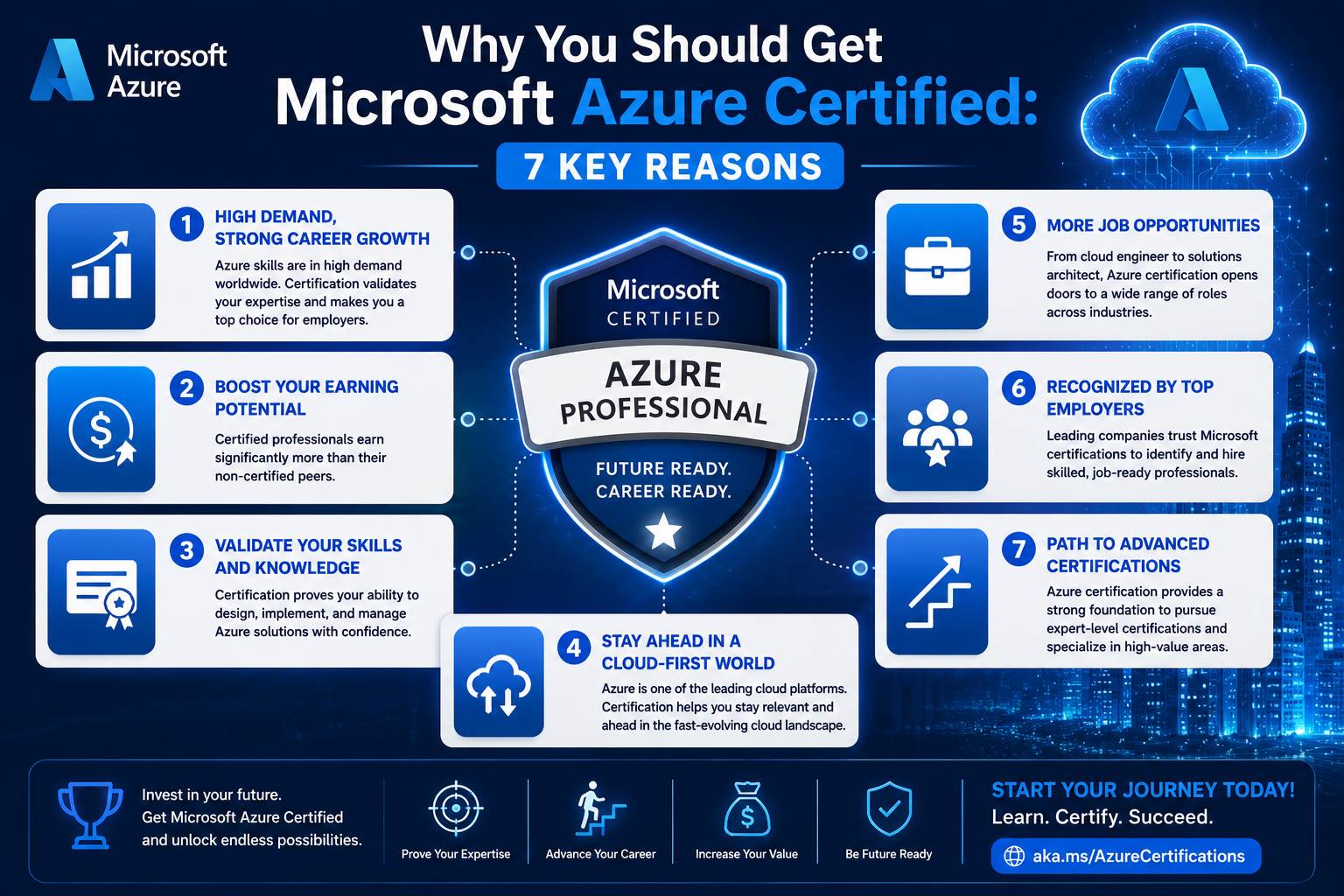
Cloud computing has transformed the way organizations operate in the modern digital world. Businesses are no longer relying entirely on traditional on-premise infrastructure because cloud platforms provide flexibility, scalability, security, and cost efficiency. Among the leading cloud providers, Microsoft Azure continues to hold a dominant position due to its powerful services and deep integration with enterprise technologies. As more companies move their operations to the cloud, professionals with Azure knowledge are becoming increasingly valuable.
Organizations across industries now depend on cloud services to support remote work, application hosting, cybersecurity, collaboration, data analytics, artificial intelligence, and disaster recovery. This widespread adoption has created enormous demand for individuals who understand how cloud environments function. Azure certifications provide structured validation of those skills and help professionals prove they are capable of managing modern cloud infrastructure.
Cloud computing is no longer a specialized field limited to a small number of technology experts. It has become a foundational part of modern IT operations. Businesses need employees who can deploy virtual machines, secure cloud resources, manage identities, automate workflows, and optimize performance. Azure-certified professionals are trained to handle these responsibilities efficiently.
One key factor behind Azure’s continued growth is its strong connection with the Microsoft technologies that many organizations already use, including Windows Server, Active Directory, SQL Server, and Microsoft 365. This compatibility makes Azure a natural choice for enterprises looking to expand their cloud capabilities while leveraging existing systems and skills. As cloud adoption continues to increase, professionals with Azure expertise are becoming increasingly valuable across organizations of all sizes, particularly those pursuing specialized certifications such as DP-700 to strengthen their data and analytics skills.
Azure certifications also help simplify the learning process. Cloud technology can feel overwhelming because it involves many different concepts, including networking, storage, virtualization, databases, security, and automation. Certification paths guide learners step by step, helping them build confidence while gaining practical knowledge.
Many employers view certifications as evidence of commitment and discipline. While hands-on experience remains important, certifications demonstrate that an individual understands industry best practices and has invested time in professional development. This makes Azure certification an excellent way to stand out in competitive job markets.
The growth of cloud computing shows no signs of slowing down. Businesses continue migrating applications and infrastructure to the cloud to improve efficiency and reduce operational complexity. As a result, Azure-certified professionals are expected to remain highly valuable for many years to come.
Why Azure Certifications Matter in Modern IT Careers
Technology careers have changed significantly over the past decade. Employers now expect IT professionals to possess cloud computing knowledge regardless of their specialization. Whether someone works in networking, cybersecurity, software development, systems administration, or database management, cloud skills have become essential.
Azure certifications matter because they provide measurable proof of technical knowledge. Employers often receive large numbers of job applications, and certifications help hiring managers quickly identify qualified candidates. When a resume includes recognized Azure certifications, it signals that the individual understands important cloud concepts and best practices.
Another reason certifications matter is that cloud environments are complex. Mistakes in cloud configuration can lead to downtime, security breaches, compliance violations, and financial losses. Organizations therefore prefer professionals who have demonstrated their understanding through certification exams and structured learning.
Azure certifications are available at different levels, allowing professionals to choose paths aligned with their goals. Beginners can start with foundational certifications that introduce basic cloud concepts. Intermediate professionals can pursue associate-level certifications focused on administration, development, or security. Advanced professionals may target expert-level certifications involving architecture and enterprise solutions.
This progression helps learners develop skills gradually instead of attempting to master everything at once. Structured certification tracks provide direction and reduce confusion, especially for people who are new to cloud computing.
Certifications also encourage continuous learning. Technology evolves rapidly, and professionals must stay updated on emerging trends and tools. Azure certifications often require learners to study new services, security practices, and deployment models. This ongoing education helps individuals remain competitive in changing job markets.
Another advantage is increased professional confidence. Many individuals hesitate to pursue cloud-related roles because they feel intimidated by the complexity of the technology. Preparing for certifications helps break difficult concepts into manageable sections, making learning more approachable.
Azure certifications are not limited to technical specialists. Project managers, business analysts, consultants, and decision-makers can also benefit from understanding cloud technologies. Cloud adoption affects nearly every aspect of business operations, making Azure knowledge valuable across many career paths.
Professionals who invest in Azure certification often discover new opportunities they had not previously considered. Cloud expertise can lead to roles in automation, cybersecurity, AI integration, infrastructure design, DevOps, and digital transformation initiatives. Certifications therefore act as gateways to broader career possibilities.
Increasing Salary Potential Through Azure Certification
One of the strongest motivations for earning Azure certifications is the potential for higher income. Cloud computing skills are among the most sought-after competencies in the technology industry, and organizations are willing to pay premium salaries to professionals who possess those abilities.
Azure-certified professionals frequently qualify for positions such as cloud engineer, systems administrator, cloud consultant, solutions architect, DevOps engineer, security engineer, and infrastructure specialist. Many of these roles offer salaries significantly higher than traditional IT positions.
The reason cloud professionals command strong salaries is simple: managing cloud environments requires specialized expertise. Organizations depend on cloud infrastructure to run mission-critical operations, host customer-facing applications, and protect sensitive information. Errors in configuration or security can result in major business disruptions and financial damage.
Because of these risks, companies value professionals who understand how to design and maintain reliable cloud environments. Azure certifications help demonstrate that an individual has learned industry-standard practices for cloud management and security.
Certifications can also improve salary negotiations for existing employees. During performance reviews and promotion discussions, certified professionals have tangible evidence of professional growth. Managers often recognize certifications as proof that employees are investing in their skills and increasing their value to the organization.
In highly competitive job markets, certifications can provide an important advantage. Employers frequently use certifications as screening criteria when reviewing resumes. Candidates with Azure credentials may therefore receive more interview opportunities than those without certifications.
Another factor contributing to higher salaries is the shortage of skilled cloud professionals. Demand for cloud expertise continues to grow faster than the supply of qualified workers. This imbalance creates strong earning potential for individuals who develop Azure skills.
Remote work opportunities have also expanded the job market for Azure-certified professionals. Many organizations now hire cloud engineers and administrators remotely, allowing certified individuals to work for companies located in different regions or countries. This flexibility can increase access to higher-paying opportunities.
Azure certifications may also accelerate career advancement. Professionals who demonstrate cloud expertise often gain access to leadership opportunities involving cloud strategy, migration planning, infrastructure modernization, and digital transformation initiatives.
Investing time in Azure certification preparation can therefore produce long-term financial benefits. While earning certifications requires effort and dedication, the potential rewards in salary growth and career opportunities make the investment worthwhile.
Aligning With Organizational Cloud Strategies
Many organizations commit to specific cloud platforms as part of their long-term technology strategies. Once a business adopts Azure infrastructure, it typically invests heavily in migration projects, cloud applications, identity systems, and security tools. As a result, organizations value employees who understand Azure technologies and can contribute to those initiatives.
Earning Azure certifications demonstrates alignment with organizational goals. It shows employers that an individual is committed to supporting the company’s chosen technology direction. This often leads to increased trust from management and expanded responsibilities within teams.
Certified professionals are more likely to participate in important projects involving cloud deployment, automation, cybersecurity, networking, and infrastructure optimization. Managers often rely on certified employees when assigning critical tasks because certifications provide reassurance regarding technical competence.
For example, software developers with Azure certifications may become responsible for designing scalable cloud-native applications. Systems administrators may oversee hybrid cloud environments and migration efforts. Security specialists may manage identity protection and compliance configurations.
Organizations also appreciate employees who proactively improve their skills. Technology changes rapidly, and businesses need adaptable workers who can learn new tools and methodologies. Pursuing Azure certification demonstrates initiative and commitment to continuous improvement.
Another benefit of aligning with organizational cloud strategies is increased visibility within the company. Employees who develop Azure expertise may become go-to resources for cloud-related questions and projects. This visibility can improve promotion prospects and strengthen professional reputation.
Cloud adoption often involves collaboration between multiple departments, including networking, cybersecurity, software development, compliance, and operations teams. Azure-certified professionals are better equipped to communicate across these departments because they understand how cloud technologies impact different business functions.
Certifications also help organizations reduce training costs. Hiring or promoting certified professionals allows companies to leverage existing expertise instead of relying entirely on external consultants. This makes certified employees even more valuable to employers.
As businesses continue modernizing their infrastructure, Azure knowledge becomes increasingly relevant. Professionals who align themselves with organizational cloud strategies position themselves for long-term career growth and expanded leadership opportunities.
Structured Learning Makes Cloud Technology Easier to Understand
One of the biggest challenges in learning technology is knowing where to begin. Cloud computing includes many different subjects, such as networking, virtualization, storage, automation, security, containers, databases, and identity management. Without guidance, beginners often feel overwhelmed by the sheer amount of information available.
Azure certification paths solve this problem by providing structured learning frameworks. Instead of randomly exploring tutorials and documentation, learners follow carefully designed objectives that build knowledge progressively.
Foundational certifications introduce essential concepts such as cloud computing models, Azure services, pricing structures, and basic security principles. Once learners understand these fundamentals, they can move toward more specialized certifications involving administration, development, architecture, or security.
This structured approach improves learning efficiency because concepts are introduced in logical order. Learners develop foundational knowledge before tackling advanced topics, reducing confusion and frustration.
Certification preparation also encourages consistency. Many people begin studying technology enthusiastically but struggle to maintain momentum over time. Having a certification goal creates accountability and motivation, helping learners stay focused.
Hands-on practice is another major advantage of Azure certification training. Learners often work with virtual labs and practice environments where they can deploy resources, configure services, and troubleshoot problems safely. This practical experience strengthens understanding and improves confidence.
Structured learning also helps individuals identify knowledge gaps. Practice exams and assessments reveal areas requiring additional study, allowing learners to improve weaknesses before taking certification exams.
Another important benefit is reduced intimidation. Cloud technology may initially appear extremely complicated, especially for individuals transitioning from non-technical backgrounds. Certification paths break complex subjects into manageable sections, making learning more approachable.
The confidence gained through structured learning often extends beyond certifications themselves. Professionals who complete Azure training typically feel more comfortable exploring additional technologies, experimenting with advanced services, and taking on new responsibilities at work.
Learning cloud technology independently without structure can sometimes lead to incomplete understanding or bad habits. Certification training emphasizes industry best practices, helping learners develop reliable and secure approaches from the beginning.
Ultimately, structured learning transforms cloud computing from an overwhelming subject into an achievable career skill. Azure certifications provide direction, clarity, and measurable progress, making them valuable for both beginners and experienced professionals.
Staying Current in a Rapidly Changing Technology Industry
Technology evolves at an extraordinary pace. New tools, platforms, services, and security threats appear constantly, forcing businesses and IT professionals to adapt quickly. Skills that were considered cutting-edge only a few years ago may already be outdated today. In this environment, continuous learning has become essential for anyone who wants long-term success in the technology field.
Microsoft Azure certifications help professionals stay aligned with modern industry standards and emerging cloud technologies. Instead of relying solely on older knowledge or workplace habits, certification preparation encourages individuals to study the latest cloud services, deployment methods, and best practices.
Cloud platforms such as Azure receive regular updates and feature expansions. Microsoft continuously introduces improvements involving automation, artificial intelligence, analytics, cybersecurity, networking, and application hosting. Professionals who pursue Azure certifications are more likely to remain informed about these developments.
One of the greatest risks in technology careers is becoming stagnant. Employees who stop learning eventually struggle to keep up with organizational needs and industry expectations. Businesses increasingly seek professionals who can adapt to change and understand evolving technologies. Azure certifications demonstrate a commitment to growth and ongoing education.
Many professionals learn skills primarily through daily work responsibilities. While practical experience is valuable, it sometimes creates narrow expertise limited to a specific environment or workflow. Certification training broadens understanding by exposing learners to industry-wide concepts and alternative approaches.
For example, an administrator managing a traditional on-premise environment may not naturally gain exposure to cloud automation, infrastructure scaling, or hybrid networking. Azure certification paths introduce these subjects systematically, helping professionals expand beyond their existing experience.
Continuous learning also improves problem-solving abilities. Professionals who study modern cloud technologies develop stronger analytical thinking because they learn how different systems interact across complex environments. This broader perspective helps them identify efficient solutions to technical challenges.
The cloud industry also places strong emphasis on automation and efficiency. Organizations want to reduce manual tasks, improve reliability, and accelerate deployments. Azure certifications often introduce automation concepts using scripting, templates, and orchestration tools. These skills are becoming increasingly valuable in modern IT operations.
Another reason staying current matters is cybersecurity. Threats evolve constantly, and outdated security practices can expose organizations to major risks. Azure certification training introduces modern security principles involving identity management, conditional access, encryption, monitoring, and threat detection.
Technology professionals who continue learning often experience greater career flexibility. Instead of being tied to one outdated specialization, they can adapt to new opportunities and industry demands. Azure certifications support this adaptability by helping individuals remain relevant in fast-changing markets.
Remaining current with technology trends also improves confidence. Professionals who understand modern cloud tools and services feel more prepared to participate in discussions, lead projects, and contribute ideas within their organizations. This confidence often translates into stronger professional performance and leadership potential.
Businesses value employees who embrace learning because innovation drives competitiveness. Organizations need workers capable of adopting new technologies and improving operational efficiency. Azure-certified professionals demonstrate that they are willing to evolve alongside the industry rather than resist change.
Cloud computing will likely continue expanding for many years. Artificial intelligence, edge computing, automation, analytics, and hybrid infrastructure are all becoming more important in enterprise environments. Azure certifications help professionals prepare for this future by keeping their knowledge aligned with current and emerging technologies.
Understanding the Growing Role of Artificial Intelligence
Artificial intelligence has become one of the most transformative technologies in the modern business world. Companies across nearly every industry are exploring AI solutions to improve customer experiences, automate repetitive tasks, analyze data, strengthen decision-making, and increase operational efficiency.
Microsoft Azure plays a major role in supporting artificial intelligence initiatives. Azure provides powerful AI services that allow businesses to build intelligent applications without needing massive infrastructure investments. As organizations adopt these technologies, professionals with AI-related Azure skills are becoming increasingly valuable.
Azure certifications introduce learners to the fundamentals of artificial intelligence and cloud-based AI services. These certifications help individuals understand concepts such as machine learning, computer vision, natural language processing, and conversational AI.
Many people assume artificial intelligence is too advanced or difficult to learn. However, Azure certification paths simplify the learning process by introducing AI concepts gradually and practically. This makes artificial intelligence more accessible to professionals from different technical backgrounds.
AI technologies are already influencing daily business operations. Companies use chatbots to improve customer support, recommendation systems to personalize user experiences, and predictive analytics to identify business trends. AI also supports fraud detection, translation services, healthcare diagnostics, manufacturing automation, and cybersecurity analysis.
Organizations need professionals who understand how to implement and manage these solutions responsibly and efficiently. Azure-certified individuals with AI knowledge can help businesses integrate intelligent technologies into their operations while maintaining security and scalability.
One major advantage of Azure AI services is accessibility. Businesses no longer need enormous research teams or specialized hardware to begin experimenting with artificial intelligence. Azure provides cloud-based tools that simplify deployment and reduce infrastructure complexity.
Professionals who study Azure AI services gain insight into how businesses can leverage data effectively. Modern organizations collect vast amounts of information, but raw data alone has little value without analysis and interpretation. AI helps transform data into actionable insights that support better business decisions.
Artificial intelligence also creates exciting career opportunities. Roles involving machine learning, AI engineering, automation, analytics, and intelligent application development continue growing rapidly. Professionals who combine cloud expertise with AI knowledge often stand out in competitive job markets.
Another reason AI knowledge matters is automation. Businesses increasingly seek ways to reduce repetitive manual tasks and improve operational efficiency. Azure AI services can automate workflows involving customer communication, document processing, image recognition, and predictive maintenance.
AI adoption is not limited to technology companies. Industries such as healthcare, finance, education, transportation, retail, logistics, and manufacturing are all investing heavily in intelligent systems. This broad adoption means AI-related cloud skills are becoming valuable across many career paths.
Ethics and responsible AI usage are also becoming important discussions within organizations. Azure certification training often emphasizes responsible implementation, security considerations, privacy protection, and compliance requirements. Understanding these principles helps professionals contribute to ethical technology practices.
Artificial intelligence will likely become even more integrated into business operations in the future. Professionals who develop Azure AI skills today position themselves for emerging opportunities and technological advancements that will shape the next generation of cloud computing.
Why Azure Skills Improve Career Flexibility
One of the greatest advantages of Azure certification is career flexibility. Technology professionals with cloud expertise are not limited to a single job role or industry. Cloud computing skills apply across many business functions, allowing certified individuals to explore diverse career opportunities.
Traditional IT careers often involved highly specialized responsibilities tied to specific hardware or local infrastructure. Cloud computing has changed this dynamic by creating interconnected environments where professionals collaborate across multiple disciplines.
Azure-certified individuals may work in infrastructure management, software development, cybersecurity, networking, automation, data analytics, artificial intelligence, compliance, consulting, or cloud architecture. This flexibility allows professionals to adapt their careers as interests and industry demands evolve.
Career flexibility is especially important in uncertain economic conditions. Industries change rapidly, and some job roles become obsolete over time. Professionals with cloud expertise are often better positioned to transition into new opportunities because cloud computing remains central to digital transformation efforts.
Azure certifications also help professionals move between industries more easily. Healthcare organizations, banks, retailers, manufacturers, educational institutions, and government agencies all rely on cloud infrastructure. This widespread adoption creates opportunities in many sectors.
Remote work has further increased flexibility for cloud professionals. Because cloud infrastructure can be managed remotely, many organizations now hire Azure professionals regardless of geographic location. This expands access to employment opportunities and allows individuals greater control over their work environments.
Another aspect of career flexibility involves advancement into leadership roles. Professionals who understand cloud technologies often participate in strategic planning and digital transformation initiatives. This exposure can lead to positions involving project management, technical leadership, or executive decision-making.
Azure certifications also support freelance and consulting opportunities. Businesses undergoing cloud migrations or modernization projects frequently seek consultants with verified cloud expertise. Certified professionals may therefore pursue independent consulting work alongside traditional employment.
Cloud knowledge also improves adaptability to technological change. Professionals who understand Azure concepts often find it easier to learn related technologies involving containers, automation, cybersecurity, analytics, and AI platforms. This adaptability strengthens long-term career resilience.
Career flexibility contributes significantly to job satisfaction. Professionals who possess versatile skills can pursue roles aligned with their interests, strengths, and lifestyle preferences. Azure certification opens doors to a wider variety of professional paths than many traditional IT specializations.
Employers also appreciate versatile professionals capable of working across multiple domains. Teams increasingly require collaboration between infrastructure, development, security, and operations personnel. Azure-certified professionals often understand how these areas connect within cloud environments.
Technology careers rarely remain static for long periods. Professionals frequently encounter new tools, methodologies, and organizational priorities. Azure certification helps individuals remain adaptable and prepared for evolving opportunities throughout their careers.
Reducing Business Costs Through Efficient Cloud Management
One of the primary reasons organizations adopt Azure is cost efficiency. Traditional on-premise infrastructure often requires major investments in hardware, maintenance, electricity, cooling systems, and physical data center space. Cloud computing reduces many of these expenses by providing scalable, usage-based resources.
Azure allows businesses to pay for services based on actual demand rather than maintaining expensive infrastructure for peak workloads. This flexibility improves resource utilization and reduces unnecessary spending.
However, achieving maximum cost savings requires skilled cloud management. Poorly configured cloud environments can quickly become inefficient and expensive. Unused virtual machines, excessive storage allocations, and unmonitored services may lead to unnecessary operational costs.
Azure-certified professionals learn how to optimize cloud environments effectively. Certification training introduces concepts involving resource scaling, workload management, monitoring, automation, and cost analysis. These skills help organizations maximize efficiency while controlling expenses.
Businesses appreciate professionals who understand financial optimization because cloud costs directly impact profitability. Certified individuals capable of balancing performance and budget considerations become valuable contributors to organizational success.
Cost management also involves selecting appropriate services for specific workloads. Azure offers numerous storage, computing, networking, and database options. Choosing the wrong configuration can increase expenses unnecessarily or reduce performance. Certification training helps professionals make informed decisions regarding resource allocation.
Automation further improves efficiency. Azure-certified professionals often learn how to automate routine tasks such as scaling, backups, monitoring, and deployments. Automation reduces administrative overhead while improving reliability and consistency.
Cloud optimization also benefits sustainability efforts. Efficient resource usage reduces energy consumption and minimizes environmental impact. Many organizations now prioritize sustainability initiatives alongside financial efficiency, making optimized cloud management even more important.
Another major advantage of Azure is scalability. Businesses can increase or decrease resources dynamically based on demand. During busy periods, applications can scale upward to maintain performance. During quieter periods, resources can scale downward to reduce costs.
Azure-certified professionals understand how to implement these scaling strategies effectively. This ensures businesses maintain performance without overspending on unnecessary infrastructure.
Disaster recovery and business continuity planning also contribute to cost efficiency. Traditional disaster recovery environments often require duplicate hardware and facilities. Azure provides cloud-based recovery solutions that reduce infrastructure requirements while improving resilience.
Organizations increasingly seek professionals capable of improving efficiency across operations. Azure-certified individuals who understand cost optimization, automation, and scalability provide direct financial value to employers.
Cloud computing is not simply about moving infrastructure online. It involves strategic resource management, operational efficiency, and continuous optimization. Azure certification helps professionals develop the skills necessary to support these goals effectively.
Strengthening Security Skills With Azure Certification
Cybersecurity has become one of the biggest concerns for organizations around the world. Businesses now store enormous amounts of sensitive information online, including customer records, financial data, employee information, and proprietary business assets. As cloud adoption continues to grow, protecting this data has become a critical responsibility for technology professionals.
Microsoft Azure certifications help individuals develop the knowledge needed to secure cloud environments properly. Security is not treated as a secondary concept within Azure training. Instead, it is integrated throughout nearly every certification path because modern cloud systems require security at every level.
Organizations face constant threats from ransomware attacks, phishing campaigns, insider threats, malware infections, and unauthorized access attempts. A single security breach can result in financial losses, operational disruption, legal penalties, and severe reputational damage. Because of these risks, companies place enormous value on professionals who understand cloud security principles.
Azure certification training introduces important topics such as identity management, access control, encryption, compliance, monitoring, and threat detection. These concepts help professionals understand how to protect cloud resources from both internal and external threats.
Identity and access management are especially important in cloud environments. Businesses must ensure that only authorized individuals can access sensitive systems and information. Azure certifications teach professionals how to implement secure authentication methods, role-based access control, multi-factor authentication, and conditional access policies.
Cloud environments also require strong monitoring and visibility. Azure provides tools that help organizations analyze activity logs, detect suspicious behavior, and respond quickly to potential threats. Certified professionals learn how to configure these monitoring systems effectively.
Another important area covered in Azure security training is data protection. Organizations often manage highly confidential information that must remain secure both during storage and transmission. Azure certifications introduce encryption technologies and secure data management practices that help protect business-critical information.
Compliance has also become a major concern for businesses operating in regulated industries. Healthcare providers, financial institutions, government agencies, and educational organizations must follow strict rules regarding data privacy and security. Azure-certified professionals learn how to configure cloud environments that support compliance requirements and regulatory standards.
Security training also encourages proactive thinking. Many individuals who learn technology only through workplace experience focus primarily on making systems function correctly. Certification training emphasizes building systems securely from the beginning instead of treating security as an afterthought.
Organizations increasingly prioritize security-focused hiring because cyber threats continue growing more sophisticated. Professionals with Azure security knowledge therefore gain access to valuable career opportunities in cybersecurity, governance, compliance, and cloud operations.
Security expertise also improves professional confidence. Individuals who understand how to secure cloud infrastructure feel more prepared to manage critical systems and respond effectively during incidents. This confidence can strengthen leadership potential and improve decision-making abilities.
Another major advantage of Azure security training is adaptability. Security concepts learned through certification apply across many cloud environments and technology platforms. Even as tools evolve, the foundational principles involving identity protection, risk management, monitoring, and secure architecture remain valuable.
Businesses today cannot afford weak security practices. Cloud systems must remain resilient, compliant, and protected against constantly evolving threats. Azure certifications help professionals develop the skills necessary to support these goals while contributing to safer and more reliable business operations.
The Importance of Cloud Infrastructure Knowledge
Cloud infrastructure forms the foundation of modern digital operations. Applications, databases, communication systems, analytics platforms, and business services all depend on reliable infrastructure to function effectively. Azure certification helps professionals understand how cloud infrastructure works and how to manage it efficiently.
Infrastructure knowledge is important because organizations increasingly rely on distributed systems rather than traditional local servers. Cloud infrastructure involves networking, storage, computing resources, virtualization, backup systems, and disaster recovery strategies. Professionals responsible for these environments must understand how different components interact.
Azure certifications introduce learners to virtual machines, storage accounts, virtual networks, containers, load balancing, and resource management. These technologies support modern business operations and enable organizations to scale rapidly while maintaining performance and reliability.
Understanding infrastructure also improves troubleshooting skills. Cloud environments are often complex and interconnected, making problem diagnosis challenging. Certification training helps professionals develop systematic approaches for identifying and resolving issues efficiently.
Reliability is another critical factor. Businesses expect applications and services to remain available around the clock. Downtime can lead to lost revenue, damaged customer trust, and operational disruption. Azure-certified professionals learn how to design resilient infrastructure that minimizes outages and supports business continuity.
Scalability is another critical consideration for modern businesses, particularly those dealing with rapid growth or unpredictable traffic. Cloud infrastructure enables organizations to scale computing resources up or down based on changing demand, helping maintain reliable performance without unnecessary costs. Azure certifications can equip professionals with the skills needed to design and manage scalable cloud solutions, while complementary credentials such as PL-300 exam can strengthen their ability to analyze data and turn business information into actionable insights.
Infrastructure knowledge also supports digital transformation initiatives. Many organizations are modernizing legacy systems and migrating workloads to the cloud. Certified professionals play important roles in planning and executing these transitions successfully.
Another advantage of infrastructure expertise is improved collaboration between teams. Cloud environments involve networking, security, development, operations, and compliance functions working together. Professionals who understand infrastructure can communicate more effectively across departments and contribute to integrated solutions.
Hybrid cloud environments are becoming increasingly common as businesses combine on-premise infrastructure with cloud services. Azure certifications introduce hybrid networking, synchronization, and integration concepts that help professionals manage these mixed environments effectively.
Automation is another essential aspect of cloud infrastructure management. Organizations seek ways to reduce manual configuration and improve consistency. Azure training often includes automation concepts involving templates, scripting, and orchestration tools that simplify infrastructure deployment and maintenance.
Infrastructure expertise also creates long-term career stability. As businesses continue migrating systems to the cloud, professionals capable of managing cloud infrastructure remain highly valuable across industries.
Technology trends may evolve, but reliable infrastructure will always remain necessary for digital operations. Azure certifications provide foundational knowledge that supports many different career paths while helping professionals understand the systems powering modern business environments.
How Azure Certifications Improve Professional Credibility
Professional credibility plays a major role in career advancement. Employers, clients, and colleagues are more likely to trust individuals who demonstrate proven expertise and commitment to learning. Azure certifications help strengthen professional credibility by validating technical knowledge through recognized industry standards.
Many organizations use certifications as benchmarks during hiring and promotion decisions. Certifications provide evidence that an individual has studied important concepts, understands best practices, and possesses practical cloud knowledge. This validation can help professionals stand out in competitive environments.
Credibility is especially important in cloud computing because organizations depend heavily on technology infrastructure. Businesses need confidence that employees responsible for cloud environments can make informed decisions regarding security, performance, scalability, and reliability.
Azure certifications also demonstrate dedication and discipline. Preparing for certification exams requires consistent study, hands-on practice, and commitment to improvement. Employers often value these qualities because they reflect strong work ethic and motivation.
Professional credibility extends beyond hiring decisions. Certified professionals may gain greater influence within their organizations because colleagues recognize their expertise. Managers may involve certified individuals in strategic discussions, infrastructure planning, or important technical projects.
Consultants and freelancers also benefit significantly from certifications. Clients often prefer working with professionals who possess recognized credentials because certifications reduce uncertainty regarding technical capability.
Another important aspect of credibility involves communication. Azure-certified professionals frequently develop stronger understanding of technical terminology, architecture concepts, and cloud strategies. This allows them to communicate more confidently with stakeholders, executives, and technical teams.
Certifications can also improve self-confidence. Many professionals doubt their abilities despite possessing strong potential. Successfully completing certification paths often helps individuals recognize their knowledge and feel more prepared to take on advanced responsibilities.
The technology industry values continuous learning highly. Professionals who pursue certifications show they are willing to adapt and stay current with industry developments. This mindset strengthens professional reputation and long-term career growth.
Another benefit of credibility is trust during decision-making processes. Organizations implementing cloud migrations or infrastructure changes often rely heavily on recommendations from knowledgeable professionals. Azure-certified individuals may therefore gain opportunities to shape important technical decisions.
Professional networking opportunities can also improve through certification communities and industry recognition. Certified individuals may connect with other cloud professionals, participate in technical discussions, and expand career opportunities through shared expertise.
Credibility becomes increasingly important as professionals move into leadership positions. Managers and executives responsible for technology strategy must understand cloud concepts and inspire confidence within teams. Azure certifications help support this transition by strengthening technical foundation and professional reputation.
Ultimately, certifications are not simply pieces of paper. They represent effort, knowledge, and commitment to excellence. Azure certifications help professionals build credibility that supports career advancement, leadership opportunities, and long-term success.
Preparing for the Future of Technology Careers
Technology careers are constantly evolving. New platforms, services, and methodologies continue reshaping how businesses operate and deliver digital experiences. Professionals who prepare for these changes position themselves for greater long-term success and stability.
Azure certifications help individuals prepare for the future by developing skills aligned with modern industry demands. Cloud computing has become central to digital transformation initiatives across nearly every industry. Organizations increasingly depend on cloud infrastructure for agility, scalability, security, and innovation.
Future technology environments will likely rely even more heavily on automation, artificial intelligence, analytics, hybrid infrastructure, and remote collaboration tools. Azure certifications introduce many of these concepts, helping professionals build future-ready skill sets.
One important trend shaping the future is automation. Businesses seek ways to reduce repetitive tasks and improve operational efficiency. Azure training often emphasizes automation tools and infrastructure management techniques that support modern operations.
Artificial intelligence is another transformative force. AI technologies are influencing customer service, cybersecurity, analytics, healthcare, manufacturing, education, and many other industries. Azure certifications provide pathways for learning how AI integrates with cloud computing and business systems.
Cybersecurity will also remain critically important in the future. As digital systems become more interconnected, organizations must protect increasingly complex environments from evolving threats. Azure certifications help professionals develop security awareness and cloud protection skills that remain highly relevant.
Remote and hybrid work models are likely to continue expanding as well. Cloud platforms enable employees to collaborate and access systems from virtually anywhere. Professionals who understand cloud technologies therefore play essential roles in supporting modern workplaces.
Another future trend involves data-driven decision-making. Businesses increasingly rely on analytics and cloud-based platforms to interpret information and guide strategy. Azure services support large-scale data processing, storage, and reporting capabilities that help organizations remain competitive.
Sustainability and efficiency are also becoming more important. Cloud computing allows businesses to optimize resource usage and reduce infrastructure waste. Azure-certified professionals who understand optimization strategies can contribute to environmentally responsible technology practices.
Preparing for the future also means developing adaptability. Technology professionals rarely spend entire careers working with identical systems or tools. Azure certification encourages continuous learning and flexible thinking, qualities that support long-term resilience.
Career opportunities related to cloud computing are expected to continue growing across industries. Healthcare organizations, financial institutions, educational providers, retailers, manufacturers, and government agencies all depend increasingly on cloud infrastructure and services.
Azure certifications therefore provide more than immediate career benefits. They help professionals build foundations for ongoing growth and adaptability in changing technological environments.
Future success in technology will depend heavily on learning ability, cloud expertise, and willingness to embrace innovation. Azure certifications support all of these qualities while helping individuals remain competitive in evolving job markets.
Conclusion
Microsoft Azure certifications have become increasingly valuable as cloud computing continues transforming the technology industry. Organizations across the world now depend on cloud platforms to support operations, improve efficiency, strengthen security, and enable innovation. This growing reliance on cloud technology has created strong demand for professionals with Azure expertise.
Earning Azure certification provides many important benefits. Certified professionals often gain access to better career opportunities, higher salaries, increased responsibilities, and stronger professional credibility. Certifications also provide structured learning paths that simplify complex cloud concepts and help individuals build confidence gradually.
Azure certifications support continuous learning, which is essential in a rapidly changing technology environment. Professionals who stay updated on cloud services, automation, artificial intelligence, cybersecurity, and infrastructure management remain better prepared for future industry demands.
Security knowledge gained through Azure training helps organizations protect sensitive data and maintain reliable operations. Infrastructure expertise supports scalability, performance, and business continuity. Cost optimization skills help businesses maximize efficiency while reducing unnecessary expenses.
Azure certifications can also enhance career flexibility by creating opportunities across a wide range of industries and technical specializations. Professionals can pursue careers in areas such as cybersecurity, cloud administration, software development, artificial intelligence, networking, and solution architecture. Foundational certifications such as AB-900 dumps can also complement broader Azure skills, helping professionals build a stronger understanding of Microsoft technologies while creating a foundation for continued career growth.
Most importantly, Azure certification demonstrates commitment to professional development and adaptability. In an industry driven by innovation and constant change, these qualities are essential for long-term success.
As businesses continue investing in cloud technologies, professionals with Azure expertise will remain highly valuable. Earning an Azure certification is not simply about passing an exam. It is an investment in future career growth, technical knowledge, and professional opportunity.