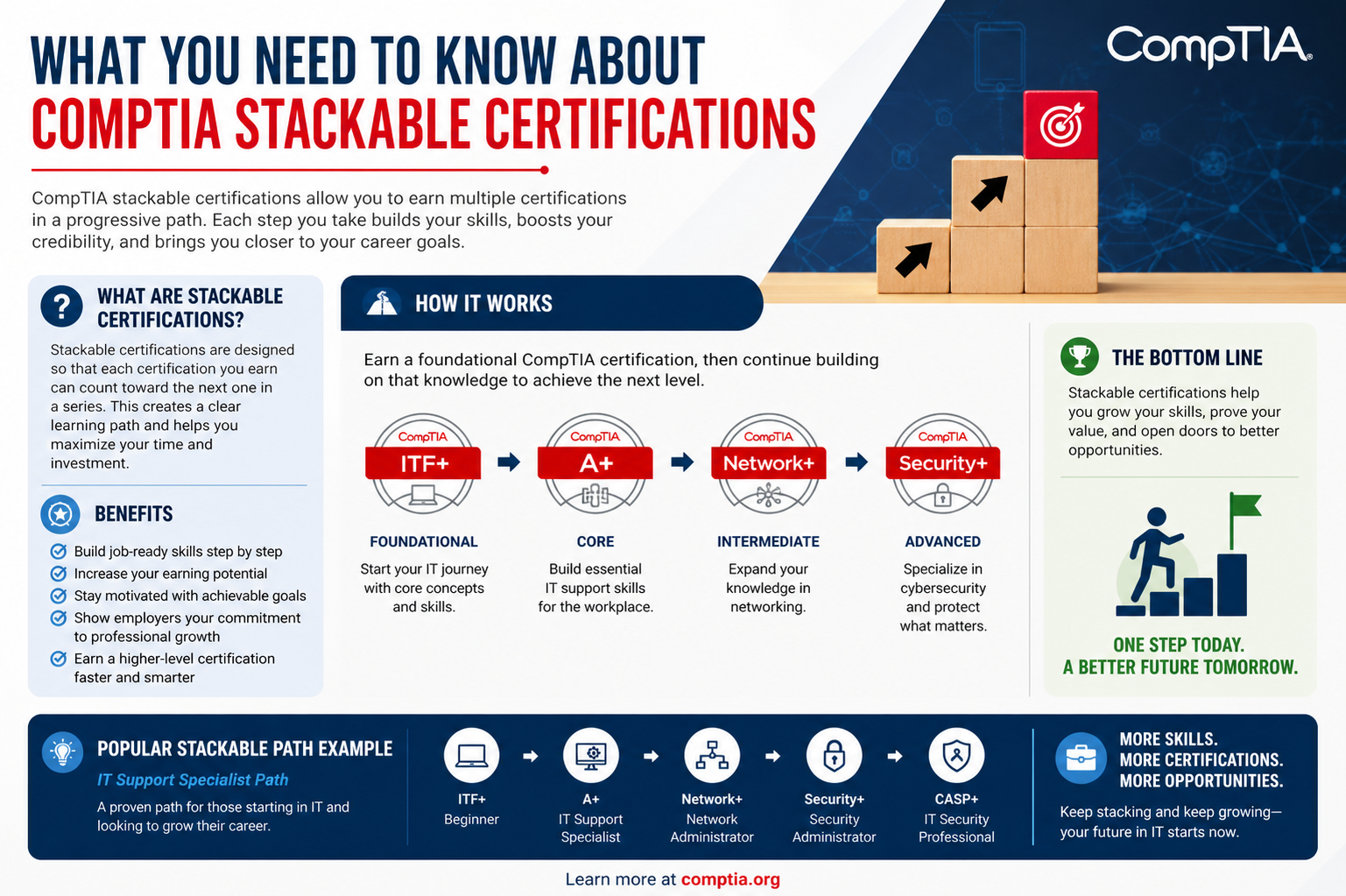
CompTIA stackable certifications are an approach designed to help IT professionals build structured and meaningful career progressions. Instead of viewing each certification in isolation, this system allows multiple certifications to combine into broader credentials that reflect real job roles and skill development. It is especially useful in the information technology industry, where skills often overlap and evolve rapidly over time.
Understanding the Concept of Stackable Certifications
The idea behind stackable certifications is simple but powerful. Rather than earning one certification and stopping there, learners are encouraged to continue developing complementary skills. When certain certifications are completed together, they can “stack” into a higher-level recognition that represents a more complete skill set.
This approach helps create a clear pathway for career growth. For example, someone starting with basic IT support knowledge can gradually move into networking, cybersecurity, or infrastructure roles by building on each certification they earn. Over time, these individual achievements come together to form a stronger professional profile.
Stackable certifications are not separate exams themselves but rather combinations of existing certifications. They are designed to align with job roles so that employers can easily understand what a candidate is qualified to do in real-world environments.
Why Stackable Certifications Matter in IT Careers
The IT industry is constantly changing, and employers often look for candidates who have both depth and breadth of knowledge. Stackable certifications help bridge this gap by showing progression and specialization at the same time.
One of the most important benefits is clarity. Instead of listing multiple unrelated certifications, professionals can present a structured set of skills that clearly matches industry roles. This makes it easier for hiring managers to evaluate technical capability without needing to interpret each certification separately.
Another important factor is motivation. Many learners find it easier to continue studying when they can see a long-term pathway. Stackable certifications provide that direction by showing how early learning contributes to advanced career outcomes.
They also encourage continuous development. Since technology evolves quickly, professionals who stop learning may fall behind. Stackable certifications promote ongoing education, helping individuals stay relevant in the job market.
How CompTIA Stackable Certifications Work
CompTIA organizes its certifications into different domains such as IT fundamentals, infrastructure, cybersecurity, and cloud computing. Each certification focuses on a specific area of knowledge, but when combined with others, they create a broader skill identity.
For example, foundational certifications may cover basic IT support and hardware understanding. When combined with networking or security certifications, they can contribute to more advanced career-level recognition. This structure allows learners to build step by step without needing to commit to a single rigid path from the beginning.
The system is designed to reflect how real IT roles function. Most technical jobs require knowledge across multiple areas rather than just one specialization. Stackable certifications mirror this reality by connecting different skills into unified professional categories.
Benefits for Beginners in Information Technology
For beginners, stackable certifications offer a clear entry point into the IT field. Starting a technology career can feel overwhelming due to the wide range of topics involved, but structured certification pathways help simplify the process.
New learners can begin with foundational knowledge that introduces basic concepts like operating systems, hardware components, and simple troubleshooting. Once this base is established, they can move into more specialized areas without feeling lost.
Another advantage is confidence building. As beginners complete each certification, they gain measurable proof of progress. This helps reinforce learning and encourages continued effort toward more advanced goals.
Additionally, stackable certifications reduce uncertainty. Instead of guessing which certifications might be useful in the future, learners can follow a structured progression that aligns with real job requirements.
Benefits for Experienced Professionals
Stackable certifications are not only useful for beginners but also highly valuable for experienced IT professionals. Many individuals in the industry already have several certifications, but they may not always be connected in a meaningful way.
By combining certifications into stackable credentials, professionals can better demonstrate their expertise in specific areas such as cybersecurity operations, network infrastructure, or cloud systems. This makes their skills easier to understand for employers and clients.
It can also support career advancement. In competitive job markets, having clearly defined and structured qualifications can make a significant difference when applying for senior roles or specialized positions.
Experienced professionals may also use stackable certifications to transition into new areas of IT. For example, someone with networking experience may expand into cybersecurity by adding relevant certifications, creating a new combined credential that reflects both skill sets.
Career Alignment and Job Roles
One of the strongest features of stackable certifications is their alignment with real-world job roles. Rather than focusing only on theoretical knowledge, they are designed to reflect actual responsibilities in the workplace.
This means that each combination of certifications can correspond to a specific type of IT role. For example, some combinations may align with support technician roles, while others may match network administration or security analyst positions.
This alignment helps employers quickly match candidates to job requirements. It also helps learners understand what kind of roles they are preparing for as they progress through their studies.
The result is a more practical learning experience that connects education directly to employment opportunities.
Skill Development Through Progressive Learning
Stackable certifications encourage a step-by-step approach to learning. Instead of trying to master everything at once, learners focus on building skills gradually.
This progressive structure improves knowledge retention. When learners apply earlier concepts in later certifications, they reinforce what they have already learned. This creates a stronger overall understanding of IT systems.
It also reduces burnout. IT education can be intensive, and breaking it into manageable stages helps learners stay engaged over time.
Each stage builds on the previous one, creating a natural learning flow that mirrors real-world experience development.
Industry Recognition and Value
In the IT industry, certifications are widely recognized as proof of knowledge and skill. Stackable certifications enhance this recognition by adding context and structure to individual achievements.
Employers often prefer candidates who demonstrate clear progression rather than isolated certifications. Stackable credentials provide that narrative by showing how skills have developed over time.
This structured recognition can also improve job mobility. Professionals with well-defined skill sets are often better positioned to move between companies or advance within their current organization.
Flexibility in Career Paths
One of the most important advantages of stackable certifications is flexibility. There is no single fixed path that all learners must follow. Instead, individuals can choose directions based on their interests and goals.
Someone interested in technical support may focus on foundational and systems-related certifications. Another person interested in security may take a different route that emphasizes threat management and defense strategies.
Despite these differences, both learners can still benefit from stackable certification structures. This flexibility ensures that the system remains useful across different IT career paths.
It also allows for career changes. If someone decides to shift focus later in their career, they can build on existing certifications rather than starting from zero.
Continuous Learning and Long-Term Growth
Technology does not remain static, and IT professionals must constantly update their skills. Stackable certifications support this need by encouraging ongoing learning.
As new technologies emerge, updated certifications can be added to existing stacks, keeping professional profiles current. This helps ensure long-term career stability in a fast-changing industry.
Continuous learning also improves adaptability. Professionals who regularly update their skills are better prepared to handle new tools, systems, and challenges.
Over time, this creates a stronger and more resilient career foundation.
Real-World Application of Skills
Another important aspect of stackable certifications is their focus on real-world application. The goal is not just to pass exams but to develop practical skills that can be used in workplace environments.
This includes troubleshooting technical issues, managing networks, securing systems, and supporting users. By combining certifications, learners gain exposure to multiple areas of IT operations.
This practical focus ensures that individuals are not only knowledgeable but also capable of performing tasks in real job scenarios.
Building a Professional Identity
Stackable certifications also contribute to building a professional identity in the IT field. Instead of presenting a long list of unrelated certifications, individuals can show a structured progression of skills.
This helps create a clear narrative of growth and specialization. Employers can quickly understand what areas a professional is strongest in and how their skills have developed over time.
A well-structured certification profile can also improve confidence, as individuals can clearly see how far they have progressed in their career journey.
Expanding Career Opportunities with CompTIA Stackable Certifications
Stackable certifications play a significant role in expanding career opportunities within the IT industry. As professionals combine different certifications, they are not only gaining technical knowledge but also positioning themselves for a wider range of job roles. This structured approach helps individuals move beyond entry-level positions and progress toward more specialized and higher-responsibility careers.
Progression from Entry-Level to Advanced Roles
One of the most important aspects of stackable certifications is the ability to move gradually from basic to advanced roles. Many individuals begin their IT journey in support or help desk positions, where foundational knowledge is essential. As they earn additional certifications, they can transition into roles that require deeper technical expertise.
For example, a professional may start with general IT support skills and later expand into networking or system administration. Over time, further specialization can lead to cybersecurity, cloud infrastructure, or advanced engineering roles. Each step builds on the previous one, creating a natural and logical career progression.
This gradual advancement is especially important in IT, where jumping directly into advanced roles without experience can be challenging. Stackable certifications ensure that each stage of learning prepares individuals for the next level of responsibility.
How Employers View Stackable Certifications
Employers value clarity and relevance when evaluating candidates. Stackable certifications provide both by grouping skills into recognizable career pathways. Instead of interpreting multiple unrelated qualifications, hiring managers can quickly understand what a candidate is capable of based on their combined certifications.
This makes recruitment more efficient. Employers can match candidates to job descriptions more accurately, reducing the time spent assessing whether an individual meets technical requirements.
Stackable certifications also demonstrate commitment. Candidates who continue to build upon their certifications show that they are actively investing in their professional development. This is often seen as a strong indicator of long-term potential within an organization.
In competitive job markets, this structured presentation of skills can provide an advantage over candidates who have similar but unorganized qualifications.
Specialization in Key IT Domains
The IT industry is made up of several major domains, including networking, cybersecurity, cloud computing, and technical support. Stackable certifications allow professionals to specialize in one or more of these areas while still maintaining a broad understanding of IT systems.
Specialization is important because many organizations require experts who can handle specific technical challenges. At the same time, a broad understanding ensures that professionals can collaborate across different teams and systems.
For example, someone specializing in cybersecurity may still need knowledge of networking and systems to effectively protect infrastructure. Stackable certifications support this balanced development by combining related skill areas into unified credentials.
This combination of depth and breadth is one of the key strengths of the stackable certification model.
Flexibility for Career Transitions
Not all IT professionals follow a straight career path. Many individuals change directions as they gain experience or discover new interests. Stackable certifications make these transitions easier by allowing existing skills to carry forward into new areas.
For instance, someone working in technical support may decide to move into cybersecurity. Instead of starting from the beginning, they can build on their existing certifications and add new ones that align with their new focus.
This flexibility reduces the need for complete retraining. It also helps professionals remain competitive in a rapidly changing industry where new technologies and roles frequently emerge.
Career transitions supported by stackable certifications are often smoother and more efficient because they recognize both previous experience and new learning.
Building Confidence Through Structured Learning
Confidence plays a key role in career development. Many learners feel uncertain when entering the IT field due to its complexity and wide range of topics. Stackable certifications help address this challenge by providing a clear and structured learning path.
As individuals complete each certification, they gain measurable proof of their progress. This sense of achievement builds confidence and encourages continued learning.
Structured learning also reduces confusion. Instead of trying to decide what to study next without guidance, learners can follow a defined pathway that leads toward specific career outcomes.
Over time, this structured approach helps individuals feel more secure in their abilities and more prepared for real-world job responsibilities.
Industry Relevance and Skill Alignment
One of the strongest advantages of stackable certifications is their alignment with industry needs. The IT field evolves rapidly, and employers are constantly looking for professionals who understand current technologies and practices.
Stackable certifications are designed to reflect these demands. Each combination of certifications corresponds to real-world job functions and responsibilities. This ensures that learners are not only gaining theoretical knowledge but also practical skills that are directly applicable in the workplace.
This alignment between education and industry needs helps reduce the gap between learning and employment. It ensures that certified professionals are job-ready and capable of handling modern IT environments.
Long-Term Career Stability
In a fast-changing industry like IT, long-term career stability depends on continuous skill development. Stackable certifications support this by encouraging ongoing learning and adaptation.
As technologies evolve, professionals can update their skill sets by adding new certifications to their existing stack. This keeps their qualifications relevant and aligned with current industry standards.
Long-term stability also comes from versatility. Professionals with stackable certifications often have skills across multiple areas, making them more adaptable to changing job roles and market demands.
This adaptability is a key factor in maintaining a stable and successful IT career over time.
Learning Efficiency and Structured Growth
Another important benefit of stackable certifications is learning efficiency. Instead of studying unrelated topics, learners follow a structured progression that builds logically from one stage to the next.
This reduces wasted effort and improves understanding. Each new certification reinforces previous knowledge while introducing new concepts.
Structured growth also helps with retention. When learning is connected and progressive, it is easier to remember and apply in real situations.
This efficient learning model is particularly valuable for individuals balancing education with work or other responsibilities.
Practical Application in Workplace Environments
Stackable certifications are designed with practical application in mind. The skills gained through these certifications are directly relevant to tasks performed in IT environments.
This includes troubleshooting systems, managing networks, securing data, and supporting users. By combining certifications, professionals develop a well-rounded skill set that prepares them for multiple aspects of IT operations.
Practical application is essential because employers value candidates who can apply knowledge effectively rather than just understand theory.
Stackable certifications ensure that learners are equipped with both conceptual understanding and hands-on capability.
Adaptability in a Changing Technology Landscape
Technology continues to evolve at a rapid pace, introducing new tools, systems, and challenges. Professionals who are unable to adapt risk becoming outdated in their skills.
Stackable certifications promote adaptability by encouraging continuous learning. As new certifications are introduced, they can be added to existing stacks, ensuring that professionals remain up to date.
This adaptability is crucial in areas such as cybersecurity and cloud computing, where changes occur frequently and impact how systems are managed and protected.
By maintaining an evolving skill set, professionals can remain relevant and valuable in their careers.
Professional Recognition and Career Identity
A well-structured certification path helps professionals establish a clear identity in the IT field. Instead of having disconnected qualifications, they can present a cohesive set of skills that reflects their expertise and career focus.
This recognition is important for career development. It helps employers understand not only what a professional knows but also how their skills fit into specific job roles.
A strong professional identity can also lead to better networking opportunities and career advancement.
Stackable certifications contribute to this identity by organizing skills into meaningful and recognized pathways.
Motivation and Continuous Improvement
Motivation is a key factor in long-term learning success. Stackable certifications help maintain motivation by providing clear milestones and achievable goals.
Each certification completed represents progress toward a larger career objective. This sense of direction encourages learners to continue improving their skills over time.
Continuous improvement is essential in IT, where new technologies require ongoing adaptation. Stackable certifications support this mindset by making learning a continuous process rather than a one-time achievement.
Advanced Skill Integration in CompTIA Stackable Certifications
As IT professionals continue progressing through CompTIA stackable certifications, one of the most important developments is the integration of advanced skills across multiple domains. At this stage, learning is no longer focused on isolated topics. Instead, it emphasizes how different systems, technologies, and security practices work together in real-world environments.
This integration is essential because modern IT infrastructure is highly interconnected. Networks, cloud systems, security frameworks, and support services all operate as part of a unified ecosystem. Stackable certifications help learners understand these relationships by combining knowledge from different areas into a cohesive skill set.
Professionals at this level are expected to think beyond individual tools or technologies. They must understand how decisions in one area can affect performance, security, and efficiency across the entire system. This broader perspective is what makes advanced stackable certifications especially valuable.
Developing Problem-Solving and Analytical Thinking
A major focus at advanced stages of stackable certification pathways is the development of problem-solving skills. IT professionals frequently face complex issues that cannot be solved using a single solution or fixed procedure. Instead, they must analyze multiple factors and determine the best approach based on the situation.
Stackable certifications encourage this type of thinking by exposing learners to diverse scenarios across different IT domains. For example, a network issue may involve security restrictions, hardware limitations, or configuration errors. Understanding how these elements interact requires strong analytical ability.
Over time, professionals learn to identify root causes rather than just surface-level symptoms. This deeper understanding leads to more efficient troubleshooting and better long-term solutions.
Analytical thinking also improves decision-making. IT professionals must often choose between different technologies, strategies, or system designs. Stackable certifications help build the confidence needed to evaluate these options effectively.
Strengthening Cybersecurity Awareness Across Roles
Cybersecurity is a critical component of modern IT systems, and stackable certifications place strong emphasis on integrating security principles across all areas of learning. Rather than treating security as a separate specialization only for experts, it is embedded into multiple certification pathways.
This approach ensures that professionals in networking, cloud computing, and support roles all understand basic and advanced security practices. It reflects real-world expectations, where every IT professional plays a role in maintaining system security.
As learners progress, they gain a deeper understanding of threat detection, risk management, and incident response. These skills become increasingly important as cyber threats continue to evolve in complexity and frequency.
By combining certifications, professionals develop a layered understanding of security, starting from foundational principles and advancing toward more specialized defense strategies. This creates a more resilient and security-conscious workforce overall.
Expanding Knowledge in Cloud and Virtual Environments
Cloud computing has become a central part of modern IT infrastructure, and stackable certifications increasingly reflect this shift. Professionals are expected to understand how cloud systems operate and how they integrate with traditional on-premises environments.
At advanced levels, learners explore topics such as cloud architecture, virtualization, resource management, and service deployment. These concepts are often combined with networking and security knowledge to create a complete understanding of distributed systems.
Stackable certifications help professionals see how cloud technologies interact with other IT components. For example, network configuration affects cloud performance, while security policies determine data access across virtual environments.
This interconnected learning approach ensures that professionals are prepared to manage complex hybrid systems that are common in modern organizations.
Enhancing Technical Leadership Capabilities
As professionals advance through stackable certification pathways, they begin to develop leadership-oriented skills in addition to technical expertise. While early stages focus on hands-on tasks and operational knowledge, advanced stages emphasize planning, coordination, and decision-making.
Technical leadership involves guiding teams, managing projects, and making strategic decisions about technology implementation. Stackable certifications support this transition by encouraging a broader understanding of IT systems and organizational needs.
Professionals learn how to evaluate technical requirements in relation to business goals. This includes balancing performance, cost, security, and scalability when designing or managing systems.
These skills are essential for roles that involve supervising teams or leading IT initiatives within organizations.
Improving Communication and Collaboration Skills
In addition to technical knowledge, stackable certifications indirectly support the development of communication and collaboration skills. IT professionals rarely work in isolation. They often interact with other technical teams, management, and end users.
As professionals advance, they must be able to explain complex technical concepts in clear and understandable terms. This is important when reporting issues, proposing solutions, or documenting system changes.
Stackable certifications help reinforce this skill by exposing learners to real-world scenarios that require explanation and documentation of technical processes.
Collaboration is also essential in modern IT environments, where multiple teams work together to maintain systems and resolve issues. Understanding how different roles contribute to overall infrastructure helps improve teamwork and efficiency.
Preparing for Specialized IT Career Paths
Advanced stackable certifications provide a foundation for highly specialized IT career paths. At this stage, professionals often choose to focus on specific areas such as cybersecurity analysis, cloud architecture, network engineering, or systems administration.
Each specialization requires a combination of skills from multiple domains. Stackable certifications make it easier to develop these combined skill sets by linking relevant certifications together.
For example, a cybersecurity-focused professional may need knowledge of networking, systems management, and threat analysis. A cloud specialist may require understanding of virtualization, infrastructure, and security controls.
By combining certifications strategically, professionals can build a profile that aligns closely with their chosen specialization.
This targeted development increases job readiness and helps individuals stand out in competitive technical fields.
Real-World Simulation and Applied Learning
At advanced levels, stackable certifications place greater emphasis on applied learning and real-world scenarios. Instead of focusing only on theoretical concepts, learners are encouraged to apply their knowledge in practical situations.
This may include troubleshooting complex system issues, designing secure network architectures, or managing multi-layered IT environments. These scenarios reflect the challenges faced by professionals in actual workplace settings.
Applied learning helps bridge the gap between knowledge and execution. It ensures that professionals are not only aware of concepts but also capable of implementing them effectively under real conditions.
This practical experience is essential for building confidence and competence in high-responsibility roles.
Adaptation to Emerging Technologies
Technology continues to evolve rapidly, introducing new tools such as automation systems, artificial intelligence, and advanced cloud services. Stackable certifications support adaptation to these changes by encouraging continuous skill development.
Professionals are exposed to evolving industry standards and emerging practices throughout their learning journey. This prepares them to adapt quickly when new technologies are introduced in the workplace.
Adaptability is a key factor in long-term IT success. Professionals who can learn and adjust quickly are more likely to remain valuable in dynamic environments.
Stackable certifications reinforce this adaptability by creating a mindset of continuous improvement and learning.
Building a Strong Professional Reputation
As professionals accumulate stackable certifications, they gradually build a stronger reputation within the IT industry. A well-structured certification profile reflects dedication, consistency, and expertise across multiple domains.
This reputation can influence career opportunities, including promotions, job offers, and leadership roles. Employers often view structured certification progress as evidence of commitment to professional growth.
A strong reputation is not built overnight. It develops over time as individuals continue to expand and refine their skills through structured learning pathways.
Stackable certifications contribute significantly to this process by providing clear evidence of advancement and specialization.
Long-Term Strategic Career Planning
At advanced stages, stackable certifications also support long-term career planning. Professionals begin to think more strategically about where they want their careers to go and what skills they need to reach those goals.
Instead of focusing only on immediate job requirements, they consider future opportunities and industry trends. This may include planning transitions into leadership roles, specialized technical fields, or emerging technology areas.
Stackable certifications provide a flexible framework for this planning. Because they are built on combinations of certifications, professionals can adjust their learning path as their goals evolve.
This flexibility ensures that career development remains aligned with both personal interests and industry demand.
Mastering Professional Growth with CompTIA Stackable Certifications
At the most advanced stage of CompTIA stackable certifications, the focus shifts from learning individual technical skills to mastering overall professional growth. This stage represents the point where knowledge, experience, and strategic thinking merge into a complete IT professional identity. Individuals are no longer just building technical ability but shaping long-term careers with direction, purpose, and adaptability.
This level of development is important because IT professionals are often required to operate in dynamic environments where responsibilities extend beyond technical execution. They may need to guide teams, make architectural decisions, evaluate risks, and align technology with business objectives. Stackable certifications help prepare individuals for these expectations by reinforcing both technical depth and professional maturity.
Transition from Technical Expertise to Strategic Thinking
One of the defining aspects of advanced certification progression is the shift from purely technical work to strategic thinking. While earlier stages focus on how systems work and how to fix them, this stage focuses on why systems are designed in a certain way and how they support organizational goals.
Strategic thinking involves evaluating long-term consequences of technical decisions. For example, choosing a cloud architecture is not just about performance but also scalability, security, cost efficiency, and future expansion. Stackable certifications help professionals develop this broader perspective by exposing them to interconnected IT domains.
At this level, professionals begin to understand that technology is not just a tool but a business enabler. Every technical decision has an impact on productivity, security, and organizational success. This awareness is critical for senior-level IT roles.
Integration of Multi-Domain Expertise
Advanced stackable certifications emphasize the integration of multiple IT domains into a unified skill set. Instead of working within a single specialization, professionals are expected to understand how networking, security, cloud systems, and infrastructure all interact.
This integration is essential in modern IT environments, where systems are highly interconnected. A change in one area can affect multiple layers of an organization’s technology stack. Professionals must therefore be able to anticipate these interactions and manage them effectively.
By combining certifications across different domains, learners build a holistic understanding of IT ecosystems. This allows them to troubleshoot complex issues that span multiple systems and design solutions that consider the entire infrastructure rather than isolated components.
Leadership in Technical Environments
At the highest levels of stackable certification pathways, leadership becomes a central focus. IT professionals are often required to lead teams, manage projects, and coordinate with stakeholders from different departments.
Technical leadership is different from traditional management because it requires both technical expertise and the ability to guide others in complex environments. Professionals must be able to make informed decisions, delegate responsibilities, and ensure that technical solutions align with organizational objectives.
Stackable certifications support this transition by building confidence in handling advanced systems and understanding multiple IT disciplines. This broad knowledge base enables professionals to communicate effectively with both technical teams and non-technical stakeholders.
Leadership also involves accountability. Professionals at this level are expected to take responsibility for system performance, security, and reliability.
Decision-Making in Complex IT Systems
Advanced IT roles require strong decision-making skills, especially when dealing with complex systems. These decisions often involve balancing multiple factors such as performance, cost, scalability, and security.
Stackable certifications help develop this ability by exposing learners to scenarios that require critical evaluation of different solutions. Instead of following fixed procedures, professionals learn to analyze situations and choose the most appropriate response based on context.
For example, selecting between different network configurations or cloud deployment models requires understanding trade-offs. There is rarely a single correct answer, and decisions must be made based on organizational needs and constraints.
This level of thinking is essential for senior IT professionals who are responsible for designing and maintaining large-scale systems.
Advanced Security Strategy and Risk Management
At this stage, cybersecurity knowledge becomes more strategic and comprehensive. Professionals are expected not only to understand threats but also to design systems that minimize risk and ensure long-term protection.
Risk management involves identifying vulnerabilities, assessing potential impact, and implementing preventive measures. Stackable certifications reinforce this by combining security knowledge with networking, infrastructure, and cloud concepts.
This integrated approach ensures that security is not treated as a separate function but as a core component of all IT systems. Professionals learn to design secure architectures from the ground up rather than applying security measures after systems are built.
They also gain the ability to respond to incidents effectively, minimizing damage and restoring operations quickly. This is a critical skill in environments where downtime or breaches can have significant consequences.
Enterprise-Level System Understanding
Advanced stackable certifications prepare professionals for enterprise-level environments where systems are large, complex, and distributed. These environments require careful coordination between multiple technologies and teams.
Professionals at this level must understand how different systems interact at scale. This includes managing large networks, cloud infrastructures, data centers, and security frameworks simultaneously.
Enterprise environments also require a strong focus on reliability and performance. Systems must remain operational under high demand while maintaining security and efficiency.
Stackable certifications help build this understanding by combining knowledge from multiple IT areas into a unified perspective of enterprise operations.
Innovation and Technology Adaptation
Innovation plays a key role in advanced IT careers. Professionals are often expected to evaluate new technologies and determine how they can be applied within their organizations.
Stackable certifications encourage this mindset by exposing learners to evolving technologies and industry trends. This helps professionals stay ahead of changes and contribute to innovation within their workplaces.
Adaptation is closely linked to innovation. As new tools and systems emerge, professionals must be able to quickly understand and integrate them into existing environments.
This requires not only technical knowledge but also flexibility and open-minded thinking. Stackable certifications support this by encouraging continuous learning and exploration of new concepts.
Professional Identity at Expert Level
At the highest stage of stackable certification progression, professionals develop a strong and clearly defined identity within the IT industry. This identity reflects both their technical expertise and their ability to operate at a strategic level.
A well-developed professional identity helps individuals stand out in competitive job markets. It communicates not only what they know but also how they think and solve problems.
This identity is built over time through consistent learning, experience, and certification stacking. It represents a combination of knowledge, skill, and professional growth.
Employers often value this clarity because it provides insight into a candidate’s long-term potential and ability to contribute at higher organizational levels.
Long-Term Career Sustainability
Sustainability in IT careers depends on continuous growth and adaptation. Technology evolves quickly, and professionals must remain relevant by updating their skills regularly.
Stackable certifications support long-term sustainability by providing a structured framework for ongoing development. Professionals can continue adding certifications as new technologies emerge, ensuring that their skills remain current.
This approach prevents skill stagnation and promotes lifelong learning. It also allows professionals to remain competitive in changing job markets.
Long-term sustainability is not just about technical ability but also about adaptability, leadership, and strategic thinking.
Mentorship and Knowledge Sharing
At advanced levels, professionals often transition into mentorship roles where they guide and support less experienced colleagues. This is an important part of career development and organizational growth.
Mentorship involves sharing knowledge, providing guidance, and helping others develop their skills. Stackable certifications prepare professionals for this role by giving them a broad understanding of IT systems and practices.
By understanding multiple domains, mentors can provide more comprehensive support to learners. This helps strengthen teams and improve overall organizational capability.
Knowledge sharing also reinforces the mentor’s own understanding, as teaching others often deepens mastery of a subject.
Final Integration of Skills and Experience
At the highest level of stackable certification progression, all previously learned skills come together into a unified professional capability. Technical expertise, strategic thinking, leadership ability, and adaptability all work together to form a complete IT professional profile.
This integration is what makes stackable certifications particularly powerful. They are not just a collection of individual achievements but a structured system that builds toward comprehensive professional development.
Professionals at this stage are capable of handling complex systems, leading teams, making strategic decisions, and adapting to technological change.
Conclusion
CompTIA stackable certifications provide a structured and progressive approach to building a successful career in the IT industry. Instead of viewing certifications as separate achievements, they combine them into meaningful pathways that reflect real-world job roles and professional skill development. This system helps learners move from foundational knowledge to advanced technical expertise in a clear and organized way.
One of the most important strengths of stackable certifications is their ability to align learning with industry needs. As technology continues to evolve, employers look for professionals who not only understand individual systems but can also work across multiple domains such as networking, cybersecurity, cloud computing, and infrastructure. Stackable certifications ensure that these skills are developed in a connected and practical manner.
They also support long-term career growth by encouraging continuous learning. Professionals are able to build on their existing knowledge, adapt to new technologies, and transition into specialized or leadership roles when needed. This flexibility makes them valuable for both beginners entering the IT field and experienced professionals seeking advancement or career change.
Ultimately, CompTIA stackable certifications help transform individual qualifications into a complete professional identity. They provide clarity, direction, and purpose to career development, ensuring that every step contributes to a larger goal. In a fast-changing and highly competitive industry, this structured approach offers a reliable pathway to growth, stability, and long-term success.