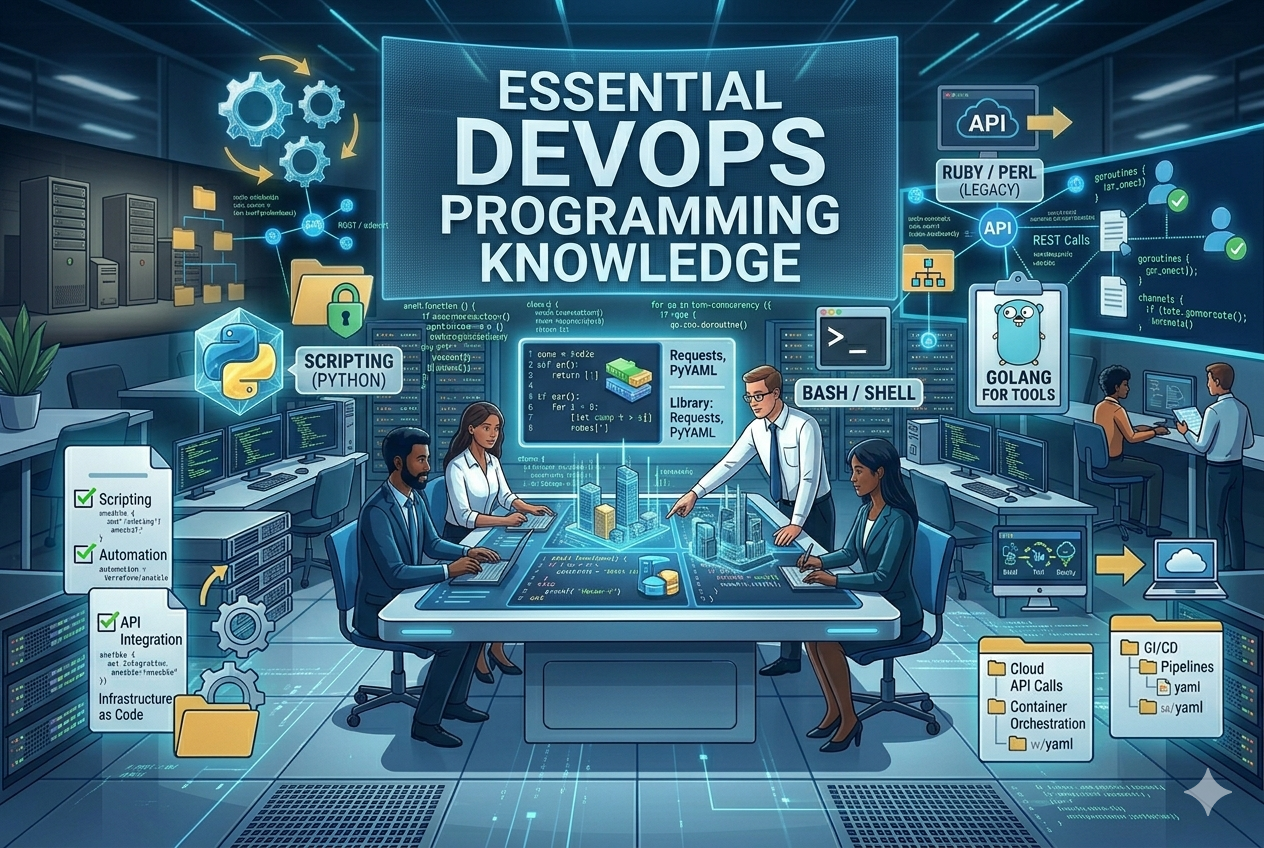
A DevOps engineer typically works with a few key programming and scripting languages that form the backbone of automation and system management. Python is one of the most widely used due to its readability, extensive libraries, and strong support for automation tasks. It is often used for writing deployment scripts, interacting with APIs, automating infrastructure tasks, and processing data from logs or monitoring systems. Bash scripting is equally important, especially in Linux-based environments, as it allows engineers to automate system-level tasks, manage files, and execute commands efficiently across servers.
Go is also becoming increasingly popular in DevOps environments because of its performance, simplicity, and strong concurrency support. Many modern infrastructure tools and cloud-native applications are built using Go, so understanding it helps engineers extend or troubleshoot these tools. JavaScript and Node.js are sometimes used for automation in environments that heavily rely on web-based systems or serverless architectures. The key is not mastering every language deeply but understanding how to use them effectively for automation and system integration.
Scripting for System Automation
Scripting is at the heart of DevOps engineering because it eliminates repetitive manual processes. Engineers write scripts to automate deployments, configure servers, manage containers, and handle backups. These scripts must be reliable, reusable, and easy to maintain. A strong understanding of conditional statements, loops, functions, and error handling is essential when writing automation scripts.
In real-world environments, scripts often interact with multiple systems at once. For example, a deployment script may pull code from a repository, build the application, run tests, and deploy it to a production server. Each step requires careful handling of failures and dependencies. Without strong scripting skills, managing such workflows becomes error-prone and inefficient.
Understanding APIs and Service Integration
Modern DevOps workflows rely heavily on APIs to connect different tools and services. A DevOps engineer must understand how REST APIs work, including methods such as GET, POST, PUT, and DELETE. This knowledge is crucial when integrating cloud services, deployment tools, monitoring systems, and CI/CD pipelines.
Programming knowledge allows engineers to interact with APIs programmatically rather than manually. For example, they might write scripts that automatically trigger deployments, fetch system metrics, or update infrastructure configurations. Understanding authentication mechanisms such as tokens, OAuth, and API keys is also important because most systems require secure access control.
Infrastructure as Code and Configuration Management
One of the most important DevOps practices is Infrastructure as Code, where infrastructure is defined and managed using code instead of manual configuration. This requires strong programming thinking because infrastructure components like servers, networks, and storage are described in structured formats that behave like software.
DevOps engineers must understand how to write and maintain these configurations in a way that is scalable and version-controlled. This includes defining environments, managing dependencies, and ensuring consistency across development, testing, and production systems. Configuration management tools rely heavily on declarative or procedural logic, so programming concepts such as idempotency, modularity, and state management are very important.
CI/CD Pipeline Development and Automation Logic
Continuous Integration and Continuous Deployment pipelines are central to DevOps practices. Programming knowledge is required to design, build, and maintain these pipelines effectively. Engineers often write pipeline scripts that define steps such as code checkout, build processes, testing, and deployment.
These pipelines are not just simple sequences; they often include conditional logic, parallel execution, and rollback mechanisms. Understanding how to structure logic efficiently ensures that pipelines are fast, reliable, and scalable. Debugging failed pipeline runs also requires the ability to interpret logs and modify scripts accordingly.
Cloud Platform Programming and SDK Usage
Most modern DevOps environments are built on cloud platforms, and each platform provides software development kits for automation. DevOps engineers use these SDKs to programmatically manage resources such as virtual machines, storage systems, networking components, and databases.
Programming knowledge allows engineers to create dynamic infrastructure that can scale automatically based on demand. Instead of manually configuring resources, they write code that defines how infrastructure should behave under different conditions. This requires understanding of object-oriented or functional programming principles depending on the SDK being used.
Containerization and Orchestration Logic
Containers are widely used in DevOps for packaging and deploying applications consistently across environments. While engineers do not always build container runtimes, they must understand how container configuration works and how to automate container deployment.
Programming knowledge is important when writing container definitions, managing environment variables, and automating container scaling. In orchestration systems, logic is used to define how containers interact, how they restart after failure, and how they scale under load. Understanding these behaviors requires a strong grasp of system design and programming logic.
Error Handling and Fault Tolerance Design
A critical part of DevOps programming knowledge is the ability to handle errors gracefully. Systems in production environments must be resilient, meaning they should continue functioning even when parts of the system fail. Engineers must design scripts and automation workflows that detect failures, log meaningful information, and recover automatically when possible.
This requires understanding of exception handling, retry mechanisms, timeout configurations, and fallback strategies. Without proper error handling, small issues can escalate into major system outages. Good programming practices ensure systems remain stable and self-healing wherever possible.
Logging, Monitoring, and Data Processing
DevOps engineers work extensively with logs and monitoring data. Programming knowledge helps them process large volumes of structured and unstructured data efficiently. They often write scripts to filter logs, extract meaningful patterns, and generate reports that help in diagnosing system behavior.
Understanding data formats such as JSON, XML, and YAML is essential. Engineers must also be able to transform data between formats and integrate it with monitoring systems. In advanced scenarios, they may write programs that analyze real-time system metrics to detect anomalies or predict failures before they occur.
Concurrency and Parallel Execution Concepts
Modern systems often require tasks to run simultaneously for efficiency. DevOps engineers benefit from understanding concurrency and parallel execution concepts. This includes knowing how multiple processes or threads can run at the same time without interfering with each other.
Programming knowledge in this area helps optimize deployment pipelines, reduce execution time, and improve system performance. It also helps in designing scalable systems that can handle multiple requests or operations concurrently without bottlenecks.
Security-Oriented Programming Awareness
Security is a major concern in DevOps environments, and programming knowledge plays an important role in implementing secure systems. Engineers must understand how to handle sensitive data, manage credentials securely, and prevent vulnerabilities in scripts and automation workflows.
This includes avoiding hard-coded secrets, implementing secure authentication methods, and ensuring proper access control in automated systems. Secure coding practices also involve validating inputs, preventing injection attacks, and maintaining audit logs for traceability.
Version Control Workflow Logic
Beyond simply using version control systems, DevOps engineers must understand the underlying workflows that support collaboration. This includes branching strategies, merge conflicts, and release management processes. Programming knowledge helps in resolving complex conflicts and automating version control operations through scripts.
Automated workflows often depend on triggers that respond to code changes. Engineers must understand how to structure repositories and design workflows that ensure smooth integration between development and operations teams.
Testing Automation and Validation Logic
Testing is not limited to developers; DevOps engineers also play a role in automating testing processes. Programming knowledge allows them to write scripts that validate system behavior after deployment. This includes functional testing, integration testing, and performance testing.
Automated testing ensures that new changes do not break existing systems. Engineers design test cases that simulate real-world scenarios and verify system stability under different conditions. Strong programming skills help in creating robust and reusable testing frameworks.
Performance Optimization Through Code Understanding
DevOps engineers often need to optimize system performance, and programming knowledge helps them identify inefficiencies in code or infrastructure. By understanding how applications execute, they can suggest improvements in resource usage, reduce latency, and improve scalability.
This may involve analyzing bottlenecks in scripts, optimizing database queries, or improving deployment strategies. Performance optimization is closely tied to understanding how software behaves under load and how different components interact.
Event-Driven Automation and Trigger-Based Systems
Many modern systems operate on event-driven architectures, where actions are triggered by specific events such as code commits, system alerts, or user activity. DevOps engineers must understand how to program and configure these event-based workflows.
This requires knowledge of how events are generated, processed, and responded to automatically. Engineers design systems that react in real time, enabling faster deployments, automatic scaling, and immediate incident response.
Programming knowledge in DevOps is not about building complex applications from scratch but about enabling automation, integration, and reliability across systems. It combines scripting, system understanding, API interaction, infrastructure logic, and automation design. A strong foundation in these areas allows DevOps engineers to build efficient workflows, maintain stable systems, and respond quickly to operational challenges.
Advanced Automation Thinking in DevOps
As DevOps responsibilities grow, programming knowledge moves beyond writing simple scripts and starts focusing on designing intelligent automation systems. This means understanding how different automation components interact with each other and how workflows can be structured to reduce human intervention as much as possible. Instead of just automating single tasks, DevOps engineers begin to design full automation pipelines that connect development, testing, deployment, monitoring, and recovery processes into a single continuous flow.
At this stage, programming becomes less about individual commands and more about system design thinking. Engineers must be able to visualize how a change in one part of the system affects other parts. This requires logical structuring, modular design, and the ability to break complex processes into smaller, manageable automated components. Good automation design ensures that systems are predictable, repeatable, and easy to maintain even as they scale.
Advanced API Orchestration and Integration Logic
In modern infrastructure environments, almost everything is connected through APIs. Advanced DevOps work requires the ability to orchestrate multiple APIs together in a meaningful way. This means not only sending requests but also managing sequences of interactions between different services.
For example, a single automated workflow might involve provisioning a server, configuring networking rules, deploying an application, and registering it with a monitoring system. Each of these steps involves a different API, and programming logic is required to ensure they execute in the correct order with proper error handling.
Engineers must also manage API rate limits, authentication refresh cycles, and response validation. Without strong programming knowledge, these integrations become fragile and difficult to maintain.
Event-Driven Architecture Understanding
A major part of advanced DevOps programming knowledge involves working with event-driven systems. Instead of executing tasks manually or on fixed schedules, systems respond to events in real time. These events might include code commits, system alerts, user requests, or infrastructure changes.
Understanding how to design logic around events allows DevOps engineers to build highly responsive systems. For example, a code push might automatically trigger testing, building, security scanning, and deployment without any manual intervention.
Programming in this context involves defining event triggers, handlers, and workflows that respond dynamically. Engineers must ensure that events are processed correctly, queued efficiently, and executed without conflicts or duplication.
Infrastructure Scaling Logic and Dynamic Resource Management
Modern systems must adapt to changing demand, and this is where programming knowledge plays a key role in scaling infrastructure dynamically. DevOps engineers write logic that determines when to increase or decrease resources based on system load.
This involves understanding metrics such as CPU usage, memory consumption, request latency, and traffic patterns. Based on these metrics, automation scripts or policies decide when to spin up new servers or shut down unused ones.
The programming challenge here is ensuring that scaling decisions are both fast and accurate. Poorly written logic can lead to over-provisioning, wasting resources, or under-provisioning, causing system failures.
Advanced Error Recovery and Self-Healing Systems
At a higher level, DevOps programming focuses on building systems that can recover automatically from failures. This concept is known as self-healing infrastructure. Instead of waiting for human intervention, systems detect issues and attempt to fix them on their own.
For example, if a service crashes, automation logic can restart it, reroute traffic, or replace the faulty instance. If a deployment fails, the system can roll back to a previous stable version automatically.
Writing this type of logic requires deep understanding of failure scenarios, retry mechanisms, fallback strategies, and system dependencies. Engineers must anticipate possible points of failure and encode recovery actions into automation scripts.
Complex Pipeline Logic and Conditional Workflows
As systems become more advanced, CI/CD pipelines also become more complex. Instead of linear execution, pipelines often include conditional logic that determines which steps should run based on specific conditions.
For instance, a pipeline might run full testing only if major code changes are detected, or skip certain steps for minor updates. It might also deploy to different environments depending on branch type or approval status.
Programming knowledge is essential for designing these conditional workflows. Engineers must understand how to structure logic that is both flexible and reliable, ensuring that pipelines remain efficient without sacrificing quality or safety.
Multi-Environment Configuration Management
DevOps engineers often manage multiple environments such as development, testing, staging, and production. Each environment may have different configurations, dependencies, and scaling requirements.
Programming knowledge helps in designing configuration systems that can adapt across environments without duplication. Instead of manually changing settings for each environment, engineers write reusable configuration logic that adjusts dynamically.
This includes parameterization, environment variables, and templating systems. Properly designed configuration logic ensures consistency while still allowing flexibility where needed.
Advanced Logging Architecture and Data Correlation
Logging in DevOps is not just about collecting system messages but about building structured observability systems. Engineers use programming knowledge to design logging formats that are consistent across services, making it easier to trace issues across distributed systems.
Advanced logging involves correlating logs from multiple services to understand the full lifecycle of a request or event. This requires programming logic that can link related logs using identifiers such as request IDs or session tokens.
Engineers also build systems that automatically filter, aggregate, and analyze logs to detect patterns or anomalies. This helps in identifying problems before they escalate into serious incidents.
Monitoring Automation and Intelligent Alert Systems
Monitoring systems generate large volumes of data, and DevOps engineers use programming to convert this data into meaningful alerts. Instead of manually checking dashboards, automated systems notify engineers only when specific conditions are met.
This requires defining thresholds, anomaly detection rules, and escalation logic. For example, an alert might trigger only if CPU usage stays high for a sustained period rather than a brief spike.
Programming knowledge ensures that alerts are accurate and actionable, reducing noise and preventing alert fatigue. Engineers must carefully design logic to balance sensitivity and stability in monitoring systems.
Pipeline Security and Secret Management Logic
Security becomes more complex in automated environments, especially when dealing with secrets such as API keys, passwords, and certificates. DevOps engineers must use programming practices that ensure sensitive data is never exposed in code or logs.
This includes integrating secret management systems, encrypting data in transit and at rest, and dynamically injecting secrets into runtime environments. Engineers must also rotate credentials automatically to reduce security risks.
Understanding how to program secure workflows is essential for maintaining compliance and protecting infrastructure from unauthorized access.
Parallel Processing and Distributed System Design
Modern DevOps environments often rely on distributed systems where tasks are executed across multiple machines simultaneously. Programming knowledge helps engineers design workflows that take advantage of parallel execution.
This improves performance and reduces execution time for tasks such as building applications, running tests, or processing data. However, it also introduces complexity, such as synchronization issues and race conditions.
Engineers must carefully design logic to ensure tasks execute in the correct order when necessary while still maximizing parallel efficiency.
Automation Testing of Infrastructure and Systems
Beyond application testing, DevOps engineers also automate testing of infrastructure itself. This includes verifying that servers are configured correctly, networks are secure, and deployments behave as expected.
Programming knowledge allows engineers to create validation scripts that check system integrity after changes. These tests ensure that infrastructure remains stable and compliant with requirements.
Automated infrastructure testing is essential for maintaining reliability in large-scale systems where manual verification is not practical.
Optimization of Resource Utilization Through Code Logic
Efficient use of computing resources is a key goal in DevOps. Engineers use programming logic to optimize how resources are allocated and consumed. This includes reducing waste, improving performance, and balancing workloads across systems.
Optimization strategies might involve caching frequently used data, reducing unnecessary computations, or scheduling tasks during low-usage periods. These improvements require careful analysis of system behavior and thoughtful application of programming principles.
Machine-Assisted Automation and Intelligent Systems
As DevOps evolves, programming knowledge also extends into intelligent automation systems that use data-driven decision-making. Engineers design workflows that adapt based on system behavior and historical patterns.
This does not necessarily require deep machine learning expertise, but it does involve understanding how to integrate predictive logic into automation systems. These systems can improve efficiency by anticipating demand, detecting anomalies, and adjusting infrastructure proactively.
Advanced programming knowledge in DevOps focuses on building intelligent, scalable, and self-sustaining systems. It goes beyond simple scripting and moves into architecture design, automation orchestration, distributed systems, and adaptive infrastructure management. Engineers who master these concepts are able to create highly efficient environments where systems operate smoothly with minimal manual intervention while remaining flexible, secure, and reliable.
High-Level System Design Thinking in DevOps Programming
At an advanced stage of DevOps work, programming knowledge shifts toward system design thinking rather than isolated automation tasks. Engineers are expected to understand how large-scale systems are structured, how services communicate, and how different components interact under real-world load. This involves designing workflows that are not only functional but also scalable, resilient, and maintainable over time.
System design thinking requires the ability to break down complex infrastructures into logical building blocks. Each block must serve a specific purpose, interact cleanly with other components, and remain independent enough to be modified without breaking the entire system. Programming knowledge helps DevOps engineers express these designs through automation code, configuration templates, and orchestration logic.
Distributed Systems Programming Awareness
Modern DevOps environments are built on distributed systems where services run across multiple servers, regions, or cloud environments. Programming knowledge is essential for understanding how these systems behave when components are spread across different locations.
In distributed systems, engineers must account for issues such as network delays, partial failures, data consistency, and synchronization challenges. This requires logical thinking to ensure that systems continue functioning even when individual components fail.
DevOps engineers use programming concepts to design retry mechanisms, load balancing strategies, and data replication rules that keep systems stable and responsive under unpredictable conditions.
Fault Tolerance and Resilience Engineering
Resilience is one of the most important goals in DevOps. Systems must continue operating even when unexpected failures occur. Programming knowledge helps engineers design fault-tolerant workflows that anticipate problems and recover automatically.
This includes creating redundancy in systems, implementing failover strategies, and designing recovery workflows that activate when failures are detected. Engineers must think in terms of what happens when services go down, networks become unstable, or deployments fail unexpectedly.
Strong programming logic ensures that systems degrade gracefully instead of collapsing entirely, maintaining partial functionality even during incidents.
Advanced CI/CD Pipeline Architecture Design
At a deeper level, CI/CD pipelines become complex architectures rather than simple sequences of tasks. DevOps engineers design pipelines that span multiple environments, integrate multiple tools, and handle different deployment strategies.
Programming knowledge allows engineers to define modular pipeline components that can be reused across different projects. These components may include build stages, testing frameworks, security scans, approval gates, and deployment strategies.
Advanced pipelines also include branching logic, parallel execution, and conditional triggers that determine how code moves from development to production. Designing such systems requires strong logical thinking and structured programming skills.
Scalability Engineering and Performance Logic
Scalability is a core principle in DevOps, and programming knowledge plays a key role in achieving it. Engineers design systems that can handle increasing workloads without performance degradation.
This involves writing logic that distributes workloads efficiently, balances traffic across multiple servers, and adjusts resource allocation dynamically. Understanding how systems behave under load allows engineers to optimize performance at both application and infrastructure levels.
Performance optimization also includes reducing latency, minimizing resource consumption, and improving throughput. Programming skills help in identifying bottlenecks and implementing solutions that enhance system efficiency.
Cloud-Native Programming Concepts
Cloud environments require a different approach to programming compared to traditional infrastructure. DevOps engineers must understand how cloud-native systems are designed and operated.
This includes working with stateless applications, microservices architecture, and containerized workloads. Programming knowledge allows engineers to define scalable cloud resources that can be created, modified, and destroyed automatically.
Cloud-native programming also involves understanding elasticity, where systems expand or contract based on demand. Engineers write automation logic that ensures optimal resource usage while maintaining performance and reliability.
Advanced Security Automation and Compliance Logic
Security becomes increasingly important as systems scale, and DevOps engineers must embed security into every layer of automation. Programming knowledge is used to enforce security policies, manage identity access, and ensure compliance with organizational standards.
This includes automating vulnerability scans, enforcing encryption standards, and validating infrastructure configurations against security benchmarks. Engineers design workflows that continuously monitor systems for security risks and respond automatically when issues are detected.
Compliance automation ensures that systems meet regulatory requirements without requiring manual audits, reducing risk and improving operational efficiency.
Observability Engineering and Data Correlation Systems
Observability goes beyond basic monitoring by providing deep insight into system behavior. DevOps engineers use programming to build systems that collect, process, and correlate data from multiple sources.
This includes logs, metrics, and traces that together provide a complete picture of system activity. Programming logic is used to link these data sources and create meaningful insights that help diagnose issues quickly.
Engineers design observability systems that allow them to trace a request from start to finish across multiple services, making debugging faster and more accurate.
Infrastructure Lifecycle Management Logic
Infrastructure is not static in DevOps environments. It evolves continuously, and programming knowledge is required to manage its lifecycle effectively.
This includes creating infrastructure, updating configurations, scaling resources, and decommissioning unused components. Engineers write automation that ensures infrastructure remains aligned with application requirements at all times.
Lifecycle management also involves versioning infrastructure changes, rolling out updates safely, and rolling back when necessary. Strong programming practices ensure that these transitions are smooth and risk-free.
Multi-Cloud and Hybrid System Programming
Many organizations use multiple cloud providers or hybrid environments combining cloud and on-premise systems. DevOps engineers must understand how to program across these environments seamlessly.
This requires writing automation that works consistently across different platforms, each with its own APIs, limitations, and configurations. Engineers design abstraction layers that unify operations across diverse systems.
Multi-cloud programming also involves handling data synchronization, workload distribution, and failover strategies between environments to ensure continuous availability.
Real-Time Automation and Streaming Data Processing
Modern systems often generate real-time data streams that must be processed instantly. DevOps engineers use programming knowledge to build systems that respond to streaming data without delay.
This includes processing logs in real time, reacting to system events immediately, and triggering automated workflows based on live data. Engineers design pipelines that can handle high-speed data flows efficiently.
Real-time automation improves responsiveness and allows systems to adapt instantly to changing conditions, improving reliability and user experience.
Advanced Debugging in Distributed Environments
Debugging in distributed systems is significantly more complex than in single applications. DevOps engineers must use programming knowledge to trace issues across multiple services and environments.
This involves analyzing logs, identifying patterns, and correlating events across different systems. Engineers often write custom scripts to extract relevant data and reconstruct the sequence of events leading to a failure.
Advanced debugging requires patience, analytical thinking, and a deep understanding of how systems interact at every level.
Automation Governance and Workflow Control Logic
As automation becomes more powerful, it must also be controlled carefully. DevOps engineers design governance systems that regulate how automation is executed.
This includes defining approval workflows, restricting access to sensitive operations, and ensuring that automation follows organizational policies. Programming logic is used to enforce these rules consistently across all systems.
Governance ensures that automation remains safe, predictable, and aligned with business requirements, preventing unintended changes or system disruptions.
Continuous Optimization and Feedback Loop Engineering
DevOps systems are never static; they continuously evolve based on feedback. Programming knowledge allows engineers to build feedback loops that improve system performance over time.
These loops collect data from system behavior, analyze it, and adjust configurations or workflows automatically. This creates a self-improving environment where systems become more efficient and reliable with usage.
Engineers use programming logic to define how feedback is collected, processed, and applied to system improvements.
At this level, programming knowledge in DevOps becomes deeply integrated with system architecture, automation intelligence, and large-scale infrastructure management. It is no longer just about writing scripts but about designing entire ecosystems that are self-operating, scalable, and resilient.
DevOps engineers who master these advanced concepts are able to build highly efficient systems that require minimal manual intervention while maintaining maximum reliability, performance, and security across complex environments.
Reliability Engineering and Production Stability Logic
At an advanced DevOps level, programming knowledge is closely tied to ensuring long-term system reliability. Engineers must design systems that remain stable under heavy usage, unexpected failures, and continuous updates. This involves writing logic that continuously checks system health and reacts before small issues turn into major outages.
Reliability engineering requires thinking in terms of probabilities, failure patterns, and recovery mechanisms. Instead of assuming systems will always function correctly, DevOps engineers design automation that expects failure and handles it gracefully. This includes retry logic, circuit breakers, graceful degradation, and automated recovery workflows.
Programming plays a key role in defining how systems behave during stress, ensuring that even in worst-case scenarios, essential services remain available.
Automation at Scale and System Standardization
As infrastructure grows, consistency becomes more important than ever. DevOps engineers use programming knowledge to standardize processes across large environments. This ensures that every deployment, configuration, and update follows the same predictable structure.
At scale, manual operations are no longer practical, so engineers rely heavily on reusable automation modules. These modules are written using clean, structured logic that can be applied across multiple systems without modification.
Standardization reduces complexity, improves reliability, and makes systems easier to maintain. Programming skills help engineers design templates and workflows that enforce consistency across all environments.
Advanced Data Flow Management in DevOps Systems
Modern infrastructure produces continuous streams of data from applications, servers, networks, and security systems. DevOps engineers use programming knowledge to manage how this data flows through monitoring and automation pipelines.
This includes filtering unnecessary data, transforming raw logs into meaningful information, and routing important events to appropriate systems. Engineers design pipelines that ensure critical data is never lost and always reaches the correct destination for processing or alerting.
Efficient data flow management improves system visibility and helps teams respond faster to operational issues.
Intelligent Incident Response Automation
Incident management is a core responsibility in DevOps environments, and programming plays a major role in improving response speed and accuracy. Engineers design automation systems that detect incidents and respond immediately without waiting for human intervention.
These systems can automatically isolate failing services, reroute traffic, restart components, or trigger rollback procedures. Programming logic ensures that each response is appropriate for the type and severity of the incident.
Over time, these systems can also learn from past incidents and improve their response strategies, making the infrastructure more resilient and self-sufficient.
Capacity Planning and Predictive Resource Logic
DevOps engineers are responsible for ensuring that systems have enough capacity to handle future demand. Programming knowledge helps in designing predictive logic that estimates resource requirements based on historical usage patterns.
This includes analyzing trends in CPU usage, memory consumption, network traffic, and storage growth. Engineers use this information to automate scaling decisions and avoid performance bottlenecks.
Predictive capacity planning reduces downtime risks and ensures that infrastructure can handle sudden spikes in demand without manual intervention.
Advanced Workflow Orchestration Across Multiple Systems
In large environments, workflows often span multiple systems, tools, and platforms. DevOps engineers use programming to orchestrate these workflows in a coordinated and reliable way.
Each step in a workflow may depend on the successful completion of previous steps, and programming logic ensures that dependencies are handled correctly. If one system fails, the workflow can pause, retry, or switch to alternative paths.
This level of orchestration requires strong logical thinking and careful design to ensure that complex processes remain manageable and predictable.
Change Management Automation and Safe Deployment Practices
Managing change safely is one of the most critical aspects of DevOps. Programming knowledge allows engineers to automate safe deployment strategies that reduce the risk of system failure during updates.
This includes techniques like gradual rollouts, canary deployments, and blue-green deployments. Engineers write logic that controls how new versions of applications are introduced into production environments.
Automated change management ensures that if a problem is detected, systems can quickly revert to a stable state without affecting users.
Deep Integration Between Development and Operations
DevOps is built on the principle of collaboration between development and operations teams, and programming acts as the bridge between them. Engineers design systems that integrate development workflows directly into operational environments.
This includes automating code testing, validating deployments, and synchronizing configuration changes across teams. Programming knowledge ensures that both development and operations follow the same structured processes.
This deep integration reduces friction, improves efficiency, and ensures faster delivery of software updates.
Adaptive Infrastructure Behavior and Self-Optimizing Systems
Modern DevOps environments are increasingly adaptive, meaning they can adjust their behavior automatically based on changing conditions. Programming knowledge is essential for designing such self-optimizing systems.
These systems analyze performance data and automatically adjust configurations to improve efficiency. For example, they may scale resources during peak hours and reduce them during low usage periods.
Adaptive infrastructure reduces costs, improves performance, and minimizes the need for manual intervention.
Long-Term Maintenance and Technical Debt Management
Over time, systems accumulate complexity and technical debt. DevOps engineers use programming knowledge to manage and reduce this complexity through refactoring automation workflows and simplifying infrastructure logic.
Maintaining clean, modular, and well-structured code ensures that systems remain maintainable as they evolve. Engineers regularly update automation scripts, remove redundant processes, and improve system efficiency.
Proper technical debt management prevents long-term instability and ensures sustainable system growth.
Continuous Improvement Through Automation Feedback Systems
DevOps environments rely heavily on continuous improvement, and programming enables the creation of feedback-driven systems. These systems collect performance data, analyze system behavior, and apply improvements automatically.
Engineers design workflows that learn from past deployments, incidents, and performance trends. This creates a cycle where systems become smarter and more efficient over time.
Feedback loops ensure that infrastructure continuously evolves without requiring constant manual tuning.
Conclusion
Programming knowledge in DevOps is not limited to writing scripts or automating simple tasks. It evolves into a powerful skill set that enables engineers to design, build, and manage large-scale, intelligent, and highly reliable systems.
From automation and API integration to distributed systems, security, scalability, and self-healing infrastructure, programming is the foundation that connects every aspect of DevOps engineering. As systems grow more complex, the ability to think in terms of logic, workflows, and architecture becomes essential.
Ultimately, DevOps engineers use programming not just to execute tasks, but to create environments where systems operate efficiently, adapt dynamically, and recover automatically. This transforms infrastructure into a living system that continuously improves, scales, and supports modern software delivery at every level.