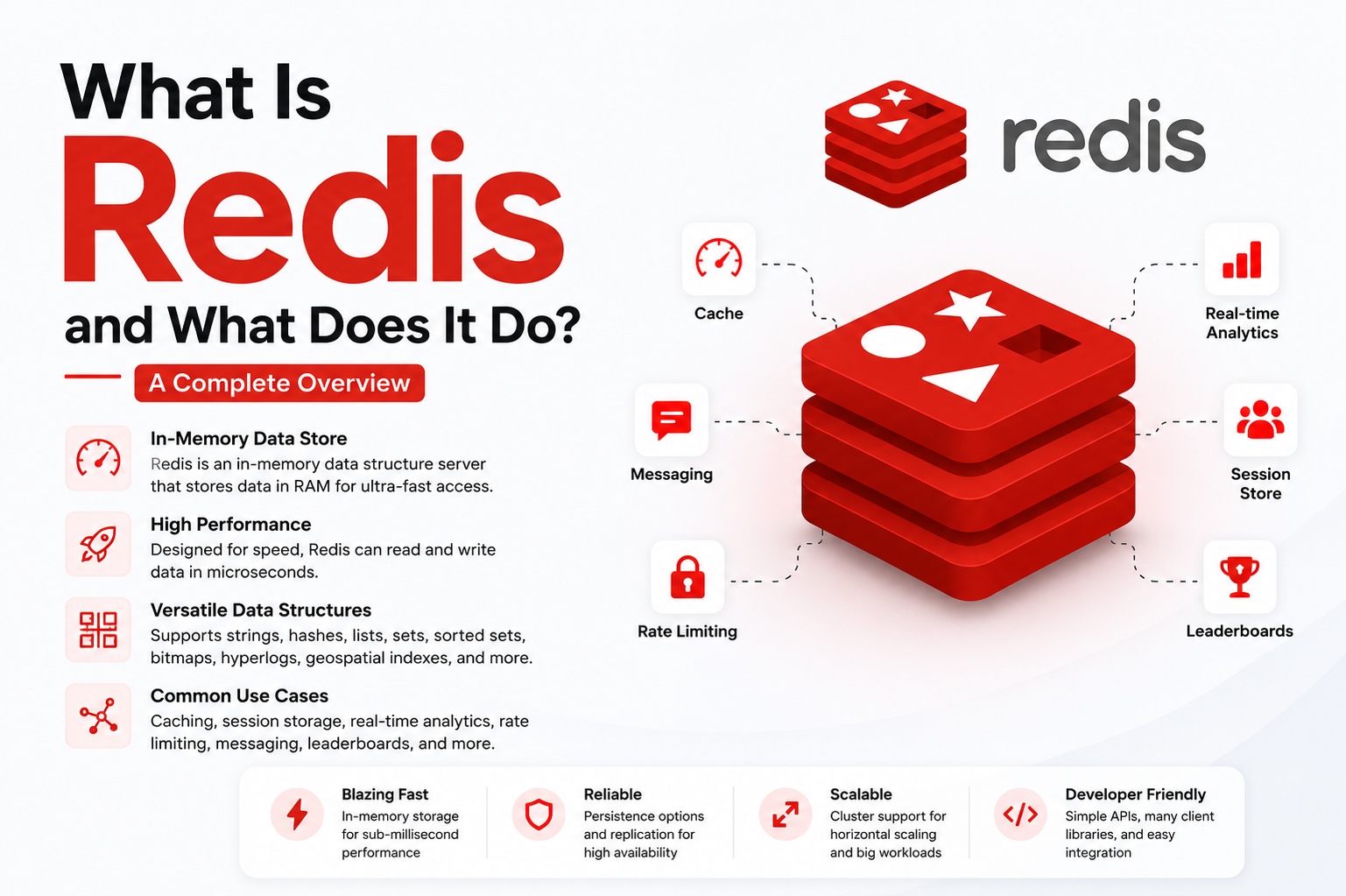
Redis is a powerful in-memory data structure store that is widely used as a database, cache, message broker, and streaming system. It is designed for extremely fast performance by keeping most of its data in system memory instead of relying on disk-based storage. This approach allows Redis to respond to requests in microseconds, making it one of the fastest data storage systems available today.
Unlike traditional databases that focus heavily on structured storage and complex querying, Redis focuses on speed, simplicity, and flexibility. It supports multiple types of data structures, which allows developers to use it in a variety of real-time applications such as caching, analytics, session storage, messaging systems, and leaderboard management.
Redis is open-source and lightweight, which makes it easy to deploy and integrate into modern application architectures. It is commonly used in systems where performance is critical and where data needs to be accessed or updated frequently with minimal delay.
Understanding the Core Concept of Redis
At its core, Redis is a key-value store. However, unlike simple key-value databases, Redis allows values to be more complex data structures instead of just strings. This means a single key can store lists, sets, hashes, or even streams of data.
When a client application sends a request to Redis, the system processes it directly in memory. This eliminates the need for slow disk access and significantly improves response times. Redis also uses a single-threaded event loop model, which avoids the overhead of managing multiple threads while still achieving high throughput.
Even though Redis is primarily memory-based, it includes persistence mechanisms that allow data to be saved to disk periodically or through continuous logging. This ensures that data can be recovered in case of system failure.
Why Redis Is Built for Speed
The main reason Redis is extremely fast is because it stores data in RAM. RAM access is thousands of times faster than disk access, which allows Redis to perform operations almost instantly.
Additionally, Redis uses highly optimized internal data structures and algorithms. Its single-threaded design removes the complexity of locking and thread synchronization, which are common performance bottlenecks in other systems.
Redis also minimizes network overhead by using a lightweight protocol for communication between clients and servers. This further improves response times, especially in high-load environments.
Data Structures Supported by Redis
One of the most powerful features of Redis is its support for multiple data structures. Each structure is designed for specific use cases, which gives developers a high degree of flexibility.
Strings are the simplest data type and are often used for caching and counters. Lists are ordered collections that are ideal for queues, stacks, and task management systems. Sets store unique values and are commonly used for tracking unique items such as tags or user IDs.
Sorted sets are similar to sets but include a score for each element, making them perfect for ranking systems such as leaderboards. Hashes allow storage of field-value pairs and are often used to represent objects like user profiles.
More advanced structures like bitmaps, hyperloglogs, and streams enable Redis to handle specialized tasks such as real-time analytics, event tracking, and large-scale data processing.
Redis as a High-Speed Caching System
One of the most common uses of Redis is caching. In modern applications, retrieving data from a database repeatedly can slow down performance. Redis solves this problem by storing frequently accessed data in memory.
When an application requests data, Redis first checks whether it exists in the cache. If it does, the data is returned immediately. If not, the system retrieves it from the primary database and stores it in Redis for future use.
This caching mechanism significantly reduces database load and improves application speed. It is widely used in web applications, APIs, and mobile backends where fast response times are critical.
Session Management Using Redis
Redis is often used for managing user sessions in web applications. Instead of storing session data on the server’s disk or in a database, Redis stores it in memory.
This allows multiple servers to access the same session data, making it ideal for distributed systems. When a user logs in, their session information is stored in Redis, and any server in the system can retrieve it instantly.
This improves scalability and ensures consistent user experience even in load-balanced environments.
Redis for Real-Time Applications
Redis is widely used in real-time systems where data changes rapidly and needs to be processed instantly. Examples include chat applications, live notifications, gaming systems, and financial trading platforms.
In these scenarios, Redis ensures that data is updated and delivered in real time without delays. Its Pub/Sub system allows different parts of an application to communicate instantly through message channels.
This makes Redis an essential component for building interactive and dynamic applications.
Persistence and Data Durability in Redis
Although Redis is primarily memory-based, it provides options for data persistence. It can periodically save snapshots of data to disk or record every write operation in a log file.
Snapshots capture the entire dataset at specific intervals, while append-only logs record every change in real time. These methods ensure that data can be recovered after a crash or restart.
While Redis is not designed to replace traditional databases for long-term storage, these persistence options make it reliable enough for many production use cases.
Redis Replication for Reliability
Redis supports replication, which allows data to be copied from a primary server to one or more secondary servers. These replicas maintain a synchronized copy of the dataset.
If the primary server fails, a replica can take over, ensuring that the system continues to function without interruption. This improves fault tolerance and system reliability.
Replication also helps distribute read requests across multiple servers, improving performance in high-traffic environments.
Scaling Redis with Clustering
As applications grow, data volume and traffic increase. Redis handles this through clustering, which distributes data across multiple nodes.
Each node is responsible for a portion of the dataset, allowing Redis to scale horizontally. The system automatically manages data distribution and request routing.
This makes Redis capable of handling very large workloads while maintaining high performance and availability.
Redis Pub/Sub Messaging System
Redis includes a publish-subscribe system that enables real-time messaging between different components of an application.
In this system, publishers send messages to channels, and subscribers receive those messages instantly. This is useful for notifications, live updates, and event-driven architectures.
The Pub/Sub system is lightweight and does not require complex configuration, making it easy to implement real-time communication features.
Redis Streams for Event Processing
Redis Streams are designed for handling continuous data flows. They allow applications to process sequences of events in real time.
Streams are useful for tracking user activity, logging events, and building analytics pipelines. They support multiple consumers, message acknowledgment, and replay capabilities.
This makes Redis suitable for modern event-driven architectures where data is continuously generated and processed.
Performance Advantages of Redis
Redis is known for its exceptional performance. It can handle millions of requests per second depending on hardware and configuration.
Its in-memory design eliminates disk latency, while its efficient internal structures reduce processing overhead. The simplicity of its architecture also contributes to its speed.
Redis is often used in systems where performance is more important than complex querying or relational data structures.
Limitations of Redis
Despite its strengths, Redis has limitations. Since it stores data in memory, it requires sufficient RAM, which can become expensive for large datasets.
It is not suitable for complex relational queries or long-term archival storage. While persistence options exist, Redis is not designed to replace traditional databases.
It is best used as a complementary system alongside other databases.
Redis in Modern System Design
In modern software architecture, Redis is often used as a supporting layer. It sits between applications and primary databases to improve performance and scalability.
It is commonly combined with relational databases, NoSQL systems, and message queues to build robust and high-performance systems.
Its flexibility allows it to fit into monolithic systems as well as microservices architectures.
Security in Redis
Redis provides basic security features such as password authentication and access control. These features help restrict unauthorized access.
In production environments, Redis is usually deployed within secure networks or behind firewalls to enhance protection.
Proper configuration is important to ensure system safety.
Why Redis Is Widely Used
Redis is popular because it solves a critical problem in modern computing: speed. Applications today require real-time responses, and traditional databases are often too slow for certain tasks.
Redis fills this gap by providing extremely fast data access with flexible data structures and simple integration. Its open-source nature and strong community support further increase its adoption.
Conclusion
Redis is a highly efficient in-memory data structure store that plays a crucial role in modern application development. It provides exceptional speed, flexible data handling, and a wide range of features that support caching, messaging, real-time processing, and scalable system design.
While it has limitations related to memory usage and long-term storage, its advantages make it an essential tool in high-performance environments. Redis continues to be a core technology in distributed systems, enabling developers to build faster, more responsive, and scalable applications.