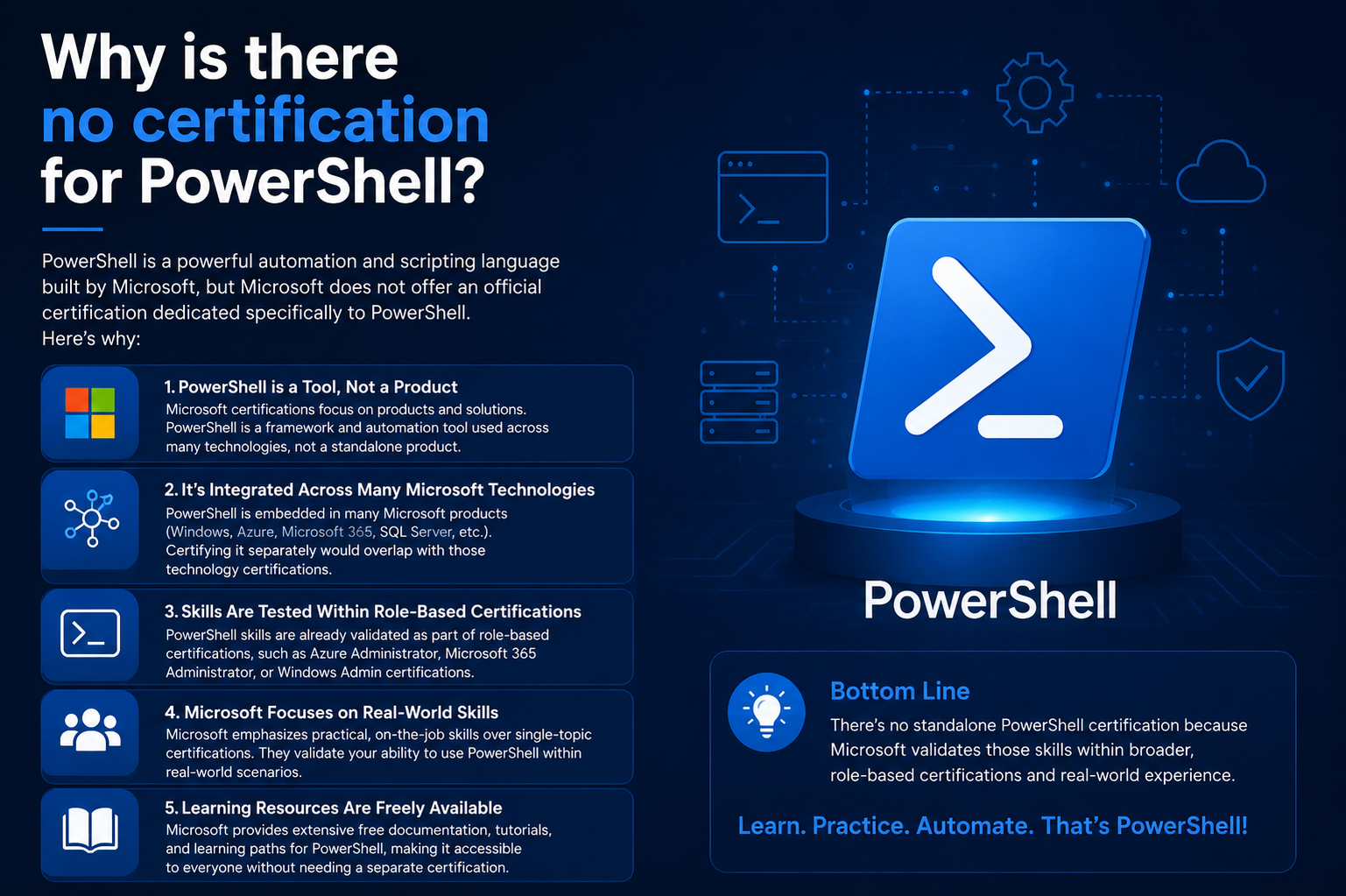
A common misunderstanding in IT education is the belief that every important tool should have its own certification. This expectation comes from earlier eras of computing when technologies were more siloed and vendor-specific certifications dominated the industry. In those times, professionals often pursued certifications tied to specific products such as operating systems, databases, or networking equipment. However, the modern IT landscape is fundamentally different, and this shift plays a major role in why PowerShell does not have its own certification.
PowerShell is widely recognized as an essential administrative and automation tool, but its role is supportive rather than defining. It enhances productivity and enables automation across many systems, but it is not the system itself. This distinction is critical. Certifications are typically designed to validate mastery of a platform or job role, not individual utilities that operate within those environments. Expecting a dedicated PowerShell certification is similar to expecting certifications for keyboard shortcuts or command-line utilities. They are important, but they function as enablers rather than standalone domains.
How Modern IT Roles Shape Certification Design
The structure of IT certifications today is heavily influenced by job roles rather than individual technologies. Employers are not simply looking for professionals who know a specific tool; they want individuals who can perform a set of responsibilities across complex systems. This role-based approach naturally absorbs tools like PowerShell into broader certification frameworks.
For example, a system administrator is expected to manage users, configure servers, and maintain system health. PowerShell is used to automate many of these tasks, but the certification focuses on the ability to administer systems effectively rather than the scripting language used to achieve that outcome. Similarly, cloud engineers are evaluated on their ability to design scalable cloud architectures, not on their knowledge of specific automation scripts.
This approach ensures that certifications remain relevant even as tools evolve. If a certification were tied too closely to PowerShell alone, it would quickly become outdated or too narrow to reflect real-world responsibilities. Instead, certifications emphasize adaptability, problem-solving, and system-level understanding.
The Fluid Nature of Automation Tools
Another important reason for the absence of a PowerShell certification is the fluid and rapidly evolving nature of automation tools. The IT industry does not rely on a single scripting or automation language. Instead, it uses a combination of tools depending on the environment and requirements.
PowerShell is dominant in Windows-based environments, but it coexists with other automation tools that serve different purposes. Python is widely used for general-purpose automation and data processing. Bash remains essential in Linux environments. Infrastructure-as-code tools and cloud-native scripting solutions are also increasingly popular. Because organizations often use multiple tools together, it becomes impractical to certify expertise in only one of them.
If a certification were created solely for PowerShell, it would fail to reflect this diversity. Professionals are expected to understand when and how to use different tools depending on the scenario. Certification bodies therefore focus on broader automation concepts rather than individual languages.
Practical Experience Over Formal Testing
PowerShell is a tool that is best learned through hands-on experience. Its value lies in solving real operational problems, automating repetitive tasks, and improving system efficiency. While theoretical knowledge is helpful, true expertise is demonstrated through practical application.
This creates a challenge for certification design. Exams are inherently limited in their ability to measure real-world problem-solving. They can test syntax, command knowledge, and basic scripting ability, but they cannot fully evaluate how effectively someone can design automation solutions in a live environment.
Because of this limitation, employers often prioritize practical experience over formal certification when evaluating PowerShell skills. A candidate who can demonstrate working scripts, automation projects, or real-world problem-solving abilities is often more valuable than someone with theoretical exam knowledge.
This emphasis on practical ability reduces the need for a formal certification path specifically for PowerShell.
The Role of PowerShell in DevOps and Automation Culture
PowerShell plays a significant role in modern DevOps practices, where automation and infrastructure as code are essential. In these environments, PowerShell is used to automate deployment pipelines, manage cloud resources, and enforce configuration consistency.
However, DevOps itself is a methodology rather than a single technology. It combines development, operations, monitoring, and continuous integration practices. Certifications in this space focus on the methodology and the ability to implement automation workflows rather than the individual scripting languages used.
PowerShell is simply one of many tools used within this ecosystem. Its inclusion in DevOps practices reinforces its importance but also highlights why it does not require a separate certification. It is part of a larger operational philosophy rather than a standalone discipline.
Microsoft’s Certification Strategy and Ecosystem Design
Microsoft’s approach to certifications provides additional insight into why PowerShell is not isolated into its own credential. Over time, Microsoft has shifted from product-based certifications to role-based certifications. This means that instead of certifying knowledge of specific tools or software versions, the focus is on job roles such as administrator, developer, security engineer, or solution architect.
Within this framework, PowerShell is integrated as a supporting skill across multiple certifications. It is not treated as a separate subject because doing so would fragment the learning experience and reduce alignment with real-world job requirements.
Microsoft’s ecosystem is highly interconnected, with PowerShell acting as a bridge between different services such as cloud platforms, identity management systems, and server infrastructure. Certifying it separately would isolate it from the context in which it is actually used.
Community Knowledge and Informal Validation
The PowerShell community plays a major role in skill development and validation. Many professionals learn through documentation, online forums, scripting challenges, and real-world experimentation. This community-driven learning model reduces reliance on formal certification.
In many cases, expertise is demonstrated through contributions to scripts, automation frameworks, or shared solutions rather than exam performance. Employers often recognize this form of validation as equally or more valuable than certification.
This informal ecosystem makes a dedicated certification less necessary. The community itself acts as a validation mechanism where skills are proven through practical contribution rather than formal testing.
The Challenge of Defining a Standardized Skill Level
Another difficulty in creating a PowerShell certification is the challenge of defining a universal skill level. PowerShell usage varies widely depending on context. A beginner might use it for simple administrative tasks, while an advanced user might build complex automation frameworks spanning multiple systems and services.
Because of this variation, it is difficult to establish a single standardized benchmark that accurately represents “PowerShell expertise.” Any certification would either be too basic to reflect real-world complexity or too advanced to be accessible to most learners.
This imbalance makes it more practical to include PowerShell knowledge within broader certifications that allow flexibility in skill assessment.
Why Employers Rarely Require It as a Standalone Skill
In real-world job postings, PowerShell is rarely listed as a standalone certification requirement. Instead, it appears as a preferred or required skill within broader roles such as system administrator, cloud engineer, or DevOps engineer.
Employers are more interested in how PowerShell is applied rather than whether a candidate holds a certification in it. They expect candidates to already possess foundational knowledge and focus more on problem-solving ability, system management experience, and automation capabilities.
This reinforces the idea that PowerShell is a means to an end rather than an end in itself. It supports job functions but does not define them.
The Future Possibility of PowerShell Certification
While there is currently no dedicated certification for PowerShell, it is worth considering whether such a certification could exist in the future. As automation becomes increasingly central to IT operations, there may be growing interest in validating scripting and automation skills more formally.
However, even if a certification were introduced, it would likely remain part of a broader framework rather than a standalone credential. It might focus on automation principles, scripting best practices, and integration with cloud services rather than PowerShell syntax alone.
The trend in IT education continues to move toward integrated skill validation rather than isolated tool certification. This makes it unlikely that PowerShell will ever become the sole focus of a major certification path.
The Balance Between Depth and Breadth in IT Learning
One of the underlying reasons for the absence of a PowerShell certification is the need to balance depth and breadth in IT education. Certifications must strike a balance between teaching enough detail to be useful and covering enough ground to remain relevant.
A certification focused exclusively on PowerShell would offer depth but lack breadth. It would teach scripting in detail but fail to connect those skills to real-world systems and workflows. On the other hand, broader certifications that include PowerShell provide context, ensuring that professionals understand how to apply the tool effectively within larger systems.
This balance is essential in modern IT education, where adaptability and system-level thinking are more valuable than narrow specialization in a single tool.
Conclusion
The absence of a dedicated PowerShell certification is not a gap in the certification ecosystem but a reflection of how modern IT skills are structured and evaluated. PowerShell is deeply embedded in system administration, cloud computing, DevOps, and security operations, but it functions as a supporting tool rather than a standalone discipline.
Certification programs today prioritize job roles, real-world outcomes, and system-level understanding over individual tool mastery. PowerShell fits naturally into this model as a foundational skill that enhances broader competencies rather than defining them.
Its versatility, integration across platforms, overlap with other automation tools, and reliance on practical experience all contribute to why it remains outside the scope of standalone certification. Instead, its value is measured through application, problem-solving ability, and contribution to real-world systems.
In the evolving landscape of IT, where automation and adaptability are key, PowerShell continues to play a crucial role—but its strength lies in its integration, not isolation.