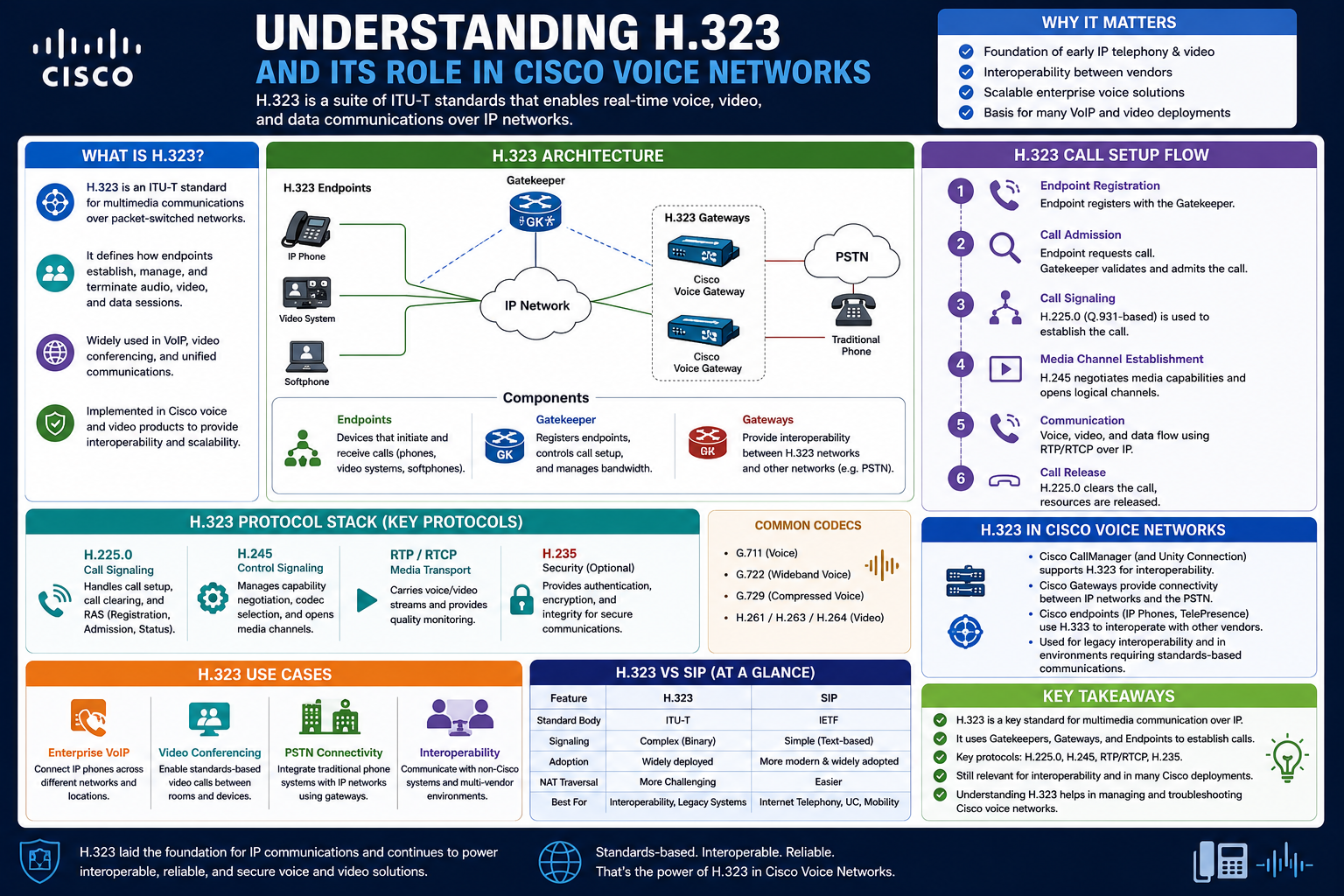
Modern businesses depend heavily on communication technologies to maintain daily operations, connect employees, support customers, and enable collaboration between offices around the world. Voice calls, video conferencing, instant messaging, and multimedia meetings are now standard features within enterprise environments. These services rely on networking protocols that make communication possible across IP-based infrastructures.
Before cloud collaboration and unified communication platforms became common, organizations used traditional telephone systems that operated through circuit-switched technologies. These older systems depended on dedicated telephone lines and hardware-based switching systems to create voice connections. While effective for voice communication, traditional telephony lacked the flexibility and scalability needed for modern digital communication.
As computer networking expanded during the 1990s, businesses began searching for methods to send voice and video traffic across data networks. This shift introduced the concept of packet-switched multimedia communication. Instead of using dedicated phone circuits, voice and video data could now travel as packets across local area networks and wide area networks.
This technological evolution required new communication standards capable of handling multimedia traffic over IP networks. One of the most important standards developed during this transition was H.323. The H.323 protocol suite became one of the earliest and most influential technologies used for Voice over IP and video conferencing systems.
Understanding H.323 is important because it helped establish many of the communication principles still used in enterprise collaboration environments today. Although newer technologies such as SIP now dominate the industry, H.323 remains an important protocol in many legacy and hybrid communication systems.
What Is the H.323 Protocol?
H.323 is a multimedia communication protocol suite developed by the International Telecommunication Union. The protocol was designed to support voice, video, and data communication over packet-switched networks such as Ethernet-based LANs and IP networks.
Rather than functioning as a single protocol, H.323 acts as a collection of related protocols that work together to provide complete multimedia communication services. The suite defines standards for signaling, call setup, media negotiation, bandwidth management, registration, authentication, and media transport.
The primary purpose of H.323 is to allow communication devices to establish and manage multimedia sessions over IP networks. These communication sessions may include audio calls, video conferencing, file sharing, whiteboarding, or other real-time collaboration services.
H.323 became one of the earliest widely adopted VoIP standards because it provided a comprehensive framework for enterprise communication systems. It introduced interoperability between devices from different vendors and allowed businesses to build scalable multimedia communication infrastructures.
The protocol was originally introduced in 1996. At that time, the internet and IP networking technologies were rapidly expanding, but real-time multimedia communication over packet-switched networks was still relatively new. Traditional telephone systems remained dominant, and businesses needed reliable standards that could support voice and video communication across data networks.
The original title of H.323 focused mainly on video conferencing over local area networks. However, as the protocol evolved and gained broader multimedia capabilities, its scope expanded significantly. Later versions emphasized support for packet-based multimedia communication systems rather than only video conferencing.
Over time, H.323 became widely used in enterprise telephony systems, video conferencing platforms, collaboration applications, and communication gateways. Many networking vendors, including Cisco, adopted H.323 in their collaboration product lines.
Why H.323 Became Important
During the early development of IP telephony, communication technologies lacked standardization. Different vendors implemented proprietary solutions that often struggled to interoperate with equipment from other manufacturers. Businesses needed a universal communication framework that could connect various devices and platforms.
H.323 addressed this challenge by providing a standardized architecture for multimedia communication. The protocol suite defined how endpoints establish connections, negotiate capabilities, exchange media streams, and terminate sessions.
One reason H.323 became popular was its extensive feature set. The protocol supported audio calls, video conferencing, multipoint communication, supplementary telephony services, and bandwidth control. These capabilities made it suitable for enterprise communication environments where reliability and scalability were essential.
Another advantage was interoperability. H.323 allowed devices from different vendors to communicate using standardized signaling and media transport methods. This reduced compatibility issues and enabled businesses to integrate equipment from multiple manufacturers.
H.323 also helped organizations transition from traditional telephony systems to packet-based communication infrastructures. Gateways connected IP networks to the Public Switched Telephone Network, allowing businesses to combine VoIP systems with existing telephone infrastructure.
The protocol gained strong adoption in enterprise environments because it provided centralized management features through components such as gatekeepers and multipoint control units. These elements improved scalability and simplified communication management for large organizations.
The Architecture of H.323
The H.323 framework includes several key components that work together to establish multimedia communication sessions. Each component performs specific functions within the communication process.
The main components include endpoints, gateways, gatekeepers, and multipoint control units.
Endpoints are devices that initiate or receive communication sessions. Examples include IP phones, video conferencing systems, softphones, and multimedia applications. Endpoints provide the user interface for voice and video communication.
Gateways connect H.323 networks to other communication systems such as PSTN networks, ISDN networks, or SIP-based environments. Gateways perform protocol conversion and media translation between different communication technologies.
Gatekeepers act as centralized control entities within H.323 environments. They manage address translation, bandwidth allocation, admission control, and call routing. Gatekeepers improve scalability and simplify administration in enterprise deployments.
Multipoint Control Units support conferences involving multiple participants. They coordinate media streams and manage conference sessions for video and audio meetings.
This modular architecture allowed H.323 systems to scale from small office deployments to large enterprise communication networks.
Understanding H.225
One of the most important protocols within the H.323 suite is H.225. This protocol handles call signaling and session establishment between endpoints.
When a user places a call in an H.323 environment, H.225 signaling messages establish the communication session. These messages contain information about the source device, destination device, session parameters, and connection details.
H.225 is responsible for call setup, call maintenance, and call termination. Without H.225, endpoints would not be able to establish communication sessions across the network.
The protocol commonly uses TCP port 1720 for signaling communication. During the call setup process, H.225 exchanges signaling messages that initiate and confirm the connection between devices.
The signaling process typically includes call requests, call proceeding messages, alerting notifications, and connection confirmations. These messages ensure both endpoints are prepared to establish the communication session successfully.
H.225 is based partly on Q.931 signaling concepts used in ISDN networks. This connection to traditional telephony standards helped H.323 integrate more easily with existing communication systems during the early years of VoIP adoption.
Because H.225 manages the signaling phase of communication, it plays a critical role in the overall H.323 call process.
The Role of H.245
While H.225 handles call signaling, H.245 manages media negotiation and logical channel control.
H.245 performs capability exchange between communication devices. This process determines which codecs and media formats both endpoints support. Since different devices may support different audio and video capabilities, negotiation is necessary to ensure compatibility.
For example, one endpoint may support G.711, G.729, and H.264 codecs, while another endpoint supports only G.711 and H.264. H.245 identifies the common capabilities shared by both devices and selects appropriate media settings for the communication session.
This capability negotiation process is essential because it ensures successful media transmission between devices with different hardware and software configurations.
H.245 also controls logical channels used for media transport. Once capabilities are negotiated, the protocol opens logical channels that allow voice and video streams to flow between endpoints.
Logical channel signaling includes opening channels, acknowledging requests, and closing channels when communication ends. This management process ensures media streams are properly established and terminated during calls.
In addition to capability exchange and channel control, H.245 supports flow control and conference control functions. These features help maintain efficient media transmission and improve overall communication quality.
Codec Negotiation in H.323
Codec negotiation is one of the most important aspects of multimedia communication. A codec determines how audio or video data is compressed, transmitted, and decompressed during communication sessions.
Different codecs provide different levels of quality, bandwidth consumption, and compression efficiency. Some codecs prioritize audio clarity, while others focus on minimizing bandwidth usage.
H.245 handles codec negotiation by allowing endpoints to exchange capability information. During this process, devices identify compatible codecs supported by both sides of the communication session.
For voice communication, common codecs may include G.711, G.729, or G.723. For video communication, codecs such as H.261, H.263, or H.264 may be used.
Once a compatible codec is selected, media transmission begins using the agreed-upon encoding format.
Codec negotiation is especially important in enterprise networks because bandwidth availability and network quality may vary across locations. Efficient codec selection helps optimize communication performance while maintaining acceptable audio and video quality.
Media Transport with RTP and RTCP
After signaling and capability negotiation are complete, media streams must be transported across the network. H.323 uses RTP and RTCP to support real-time media delivery.
RTP stands for Real-Time Transport Protocol. It carries voice and video packets between endpoints during communication sessions.
Unlike traditional data protocols that prioritize perfect delivery accuracy, RTP prioritizes speed and low latency. Real-time communication systems cannot tolerate excessive delays because delayed audio or video becomes unusable during live conversations.
RTP provides sequence numbering and timestamping mechanisms that help endpoints reconstruct media streams correctly. These features improve synchronization and playback quality during voice and video communication.
RTCP, or Real-Time Control Protocol, works alongside RTP to monitor transmission quality. RTCP collects information about packet loss, jitter, latency, and synchronization performance.
Endpoints exchange RTCP reports during communication sessions to evaluate network conditions and maintain acceptable call quality. This monitoring process helps administrators troubleshoot communication problems and optimize network performance.
Together, RTP and RTCP provide the foundation for real-time media transport within H.323 environments.
The Evolution of Enterprise VoIP
H.323 played a major role in the evolution of enterprise VoIP technologies. Before packet-switched communication became mainstream, businesses relied primarily on dedicated telephone infrastructure for voice communication.
Traditional PBX systems required expensive hardware, dedicated circuits, and specialized maintenance. Expanding communication systems often involved significant infrastructure costs and lengthy deployment timelines.
VoIP technologies changed this model by allowing voice communication to travel across existing IP networks. Businesses could consolidate voice and data traffic onto the same infrastructure, reducing costs and improving flexibility.
H.323 became one of the first standards to make enterprise VoIP practical and scalable. The protocol introduced standardized communication methods that supported interoperability between vendors and devices.
As VoIP adoption increased, H.323 deployments expanded rapidly across enterprise environments. Organizations used the protocol for voice gateways, IP telephony systems, video conferencing platforms, and multimedia collaboration services.
The protocol’s comprehensive architecture helped establish the foundation for modern unified communications technologies that continue to evolve today.
H.323 Components and Communication Processes
H.323 became one of the most widely recognized multimedia communication standards because of its structured design and comprehensive architecture. Unlike simple signaling protocols that focus only on call setup, H.323 introduced an entire framework for managing real-time communication across packet-switched networks. The protocol suite defines how devices discover one another, negotiate capabilities, establish calls, exchange media, monitor quality, and terminate communication sessions.
Understanding the individual components of H.323 is essential for understanding how enterprise voice and video systems operate. Each part of the H.323 architecture performs a specific role within the communication process. Together, these components create a reliable and scalable collaboration environment capable of supporting large enterprise deployments.
The architecture was carefully designed to handle multimedia communication challenges during a time when IP networking was still evolving. Voice and video traffic require consistent delivery, low latency, and synchronized playback. H.323 introduced mechanisms to manage these requirements across networks originally designed primarily for data communication.
The H.323 environment includes endpoints, gateways, gatekeepers, multipoint control units, signaling protocols, capability negotiation mechanisms, and media transport protocols. Each component contributes to the overall communication workflow.
Understanding H.323 Endpoints
Endpoints are the devices or applications used by people to participate in multimedia communication sessions. These devices act as the source and destination of voice, video, and data traffic within the H.323 environment.
An endpoint may be a hardware IP phone, a video conferencing unit, a softphone application installed on a computer, or a multimedia collaboration platform. Regardless of the specific device type, all endpoints must support the H.323 standard in order to communicate successfully within the H.323 infrastructure.
Endpoints perform several critical functions during communication sessions. They initiate calls, receive incoming calls, negotiate media capabilities, encode and decode media streams, and manage user interaction.
When a user places a call using an H.323 endpoint, the device begins the signaling process by sending call setup requests through the network. The endpoint identifies the destination device and exchanges signaling information necessary to establish the communication session.
Once the session begins, the endpoint processes audio and video streams using supported codecs. The endpoint also manages packet transmission and playback, ensuring users can communicate in real time.
Endpoints may support multiple communication capabilities depending on their hardware and software design. Some devices support only voice communication, while others support high-definition video conferencing, content sharing, and collaboration features.
In enterprise environments, endpoints are often integrated into larger collaboration ecosystems that include call processing systems, conferencing servers, gateways, and centralized management platforms.
Gateways in H.323 Networks
Gateways play a major role in connecting H.323 networks to other communication systems. During the early adoption of Voice over IP technologies, businesses still depended heavily on traditional telephone infrastructure. Gateways allowed organizations to integrate packet-based communication systems with legacy telephony networks.
A gateway acts as a translation device between different communication protocols and media formats. It enables interoperability between H.323 networks and systems such as PSTN, ISDN, SIP, or analog telephony environments.
For example, if a user on an H.323 network places a call to a standard telephone number, the gateway converts the packet-based voice traffic into a format compatible with the public telephone network. Similarly, incoming calls from traditional phone systems can be translated into H.323 communication sessions.
Gateways perform protocol conversion, signaling translation, codec adaptation, and media processing. These tasks ensure communication can occur between systems that use different communication standards.
In many enterprise environments, gateways also provide connectivity between branch offices, remote sites, or service provider networks. They help organizations transition gradually from traditional telephony systems to IP-based collaboration infrastructures.
Cisco collaboration deployments frequently use gateways to connect IP telephony systems with existing PSTN circuits. This integration allows businesses to preserve investments in older communication infrastructure while adopting modern VoIP technologies.
Gateways may support digital circuits such as T1, E1, PRI, or analog interfaces depending on the communication requirements of the organization.
Because gateways connect different communication environments, they often become critical points within the collaboration infrastructure. Proper configuration and maintenance are essential to ensure reliable voice and video communication across networks.
The Purpose of Gatekeepers
One of the defining features of H.323 is the use of gatekeepers. A gatekeeper acts as a centralized control component within the H.323 environment. Although optional, gatekeepers provide several important management and scalability functions.
The gatekeeper manages communication between endpoints and controls how calls are established within the network. It performs tasks such as address translation, call admission control, bandwidth management, endpoint registration, and call routing.
When an endpoint starts up within an H.323 network, it may register with the gatekeeper. During registration, the endpoint provides identifying information such as aliases, network addresses, and supported capabilities.
The gatekeeper stores this information in a database that allows endpoints to locate one another using logical aliases instead of IP addresses. For example, users may dial extensions or usernames rather than entering full network addresses.
Address translation simplifies communication and improves usability within enterprise environments.
Another important gatekeeper function is admission control. Before establishing a call, endpoints may request permission from the gatekeeper. The gatekeeper evaluates the request and determines whether sufficient bandwidth and network resources are available.
If resources are available, the gatekeeper allows the call to proceed. If bandwidth limitations or policy restrictions exist, the gatekeeper may reject the request or reroute the communication.
Bandwidth management is particularly important in enterprise networks because voice and video traffic require predictable performance. Without proper control mechanisms, excessive multimedia traffic could negatively impact network quality.
Gatekeepers also help organizations enforce communication policies. Administrators can configure routing rules, bandwidth limitations, access restrictions, and security policies within the gatekeeper environment.
Because gatekeepers centralize control functions, they improve scalability in large H.323 deployments. Enterprises with hundreds or thousands of endpoints benefit from centralized management and simplified configuration processes.
Multipoint Control Units and Video Conferencing
Multipoint communication became increasingly important as businesses adopted video conferencing technologies. H.323 introduced support for multipoint conferencing through components called Multipoint Control Units, commonly known as MCUs.
An MCU coordinates communication sessions involving multiple participants. Instead of creating separate point-to-point connections between every participant, the MCU manages media distribution and conference control centrally.
The MCU performs several important tasks during conferencing sessions. It mixes audio streams, processes video feeds, manages conference participants, synchronizes media, and controls conference resources.
In voice conferences, the MCU combines audio from multiple participants into a single stream distributed to all conference members. In video conferences, the MCU may switch active video feeds, combine layouts, or manage presentation sharing.
MCUs became essential components in enterprise collaboration systems before cloud-based conferencing platforms became widely available. Organizations used dedicated hardware MCUs to support internal and external conferencing services.
Video conferencing systems based on H.323 often relied heavily on MCUs for managing conference quality and scalability. Businesses deployed these systems in conference rooms, executive offices, training centers, and remote collaboration environments.
The MCU architecture allowed organizations to host large meetings involving participants from multiple geographic locations while maintaining synchronized communication.
As collaboration technologies evolved, software-based conferencing solutions gradually replaced many hardware MCU deployments. However, the fundamental concepts introduced by MCUs continue to influence modern conferencing platforms today.
Call Setup in H.323
The H.323 call setup process involves multiple stages that establish communication between endpoints. The process includes signaling, capability negotiation, channel establishment, media transmission, and call termination.
When a user initiates a call, the originating endpoint begins by locating the destination device. If a gatekeeper is present, the endpoint may contact the gatekeeper for address resolution and admission control.
The gatekeeper identifies the destination endpoint and determines whether the call is permitted based on configured policies and available resources.
Once permission is granted, the signaling process begins using H.225 messages. The originating endpoint sends a setup message to the destination device. This message contains information about the caller, destination, supported capabilities, and session parameters.
The receiving endpoint responds with signaling messages indicating call progress. These messages may include call proceeding notifications, alerting signals, and connection confirmations.
During this phase, the endpoints establish the communication session and prepare for media negotiation.
After signaling is complete, H.245 performs capability negotiation. The endpoints exchange information regarding supported codecs, media formats, encryption capabilities, and transport parameters.
The devices determine compatible settings and agree on media transmission methods. Once negotiation is successful, logical channels are opened for voice and video traffic.
Media streams then begin flowing between the endpoints using RTP transport mechanisms.
At the conclusion of the communication session, signaling messages terminate the call and close the logical channels.
This structured process ensures reliable communication establishment and proper resource management throughout the call lifecycle.
Fast Start and Slow Start
H.323 supports two methods for establishing communication sessions: fast start and slow start. These methods determine how signaling and capability negotiation occur during call setup.
Fast start combines capability negotiation with the initial signaling process. Endpoints exchange media information during the first call setup messages, allowing logical channels to open quickly.
This method reduces call setup delays and improves the user experience. Fast start became the preferred and default method in most H.323 deployments because of its efficiency.
By minimizing the number of signaling exchanges required before media transmission begins, fast start accelerates communication establishment.
Slow start separates signaling from capability negotiation. In this method, the call is first established using H.225 signaling, and then H.245 performs capability negotiation afterward.
Although slow start introduces additional signaling exchanges and longer setup times, it may still be used in environments where compatibility issues or specialized communication requirements exist.
Some older devices and legacy systems depend on slow start behavior to function properly.
The choice between fast start and slow start often depends on network design, endpoint compatibility, and communication requirements.
Most modern enterprise deployments prefer fast start because users expect immediate call connectivity and minimal delays during communication sessions.
Codec Selection and Media Quality
Media quality is one of the most important aspects of real-time communication systems. H.323 uses codec negotiation mechanisms to optimize communication quality while balancing bandwidth consumption and network performance.
A codec determines how voice or video data is compressed and transmitted across the network. Different codecs offer different trade-offs between quality and bandwidth efficiency.
For example, G.711 provides high-quality audio but consumes more bandwidth. G.729 uses compression to reduce bandwidth usage but introduces lower audio fidelity.
During capability negotiation, endpoints exchange codec information and identify compatible options. The devices then select codecs appropriate for the communication environment.
Video codecs operate similarly. H.323 systems may support codecs such as H.261, H.263, or H.264 depending on the capabilities of the endpoints.
Codec selection significantly affects call quality, bandwidth utilization, and network scalability.
In enterprise environments, administrators often configure preferred codecs based on available bandwidth and communication priorities.
High-bandwidth internal networks may prioritize higher-quality codecs, while remote branch offices with limited connectivity may use compressed codecs to conserve bandwidth.
Proper codec management helps organizations maintain reliable communication performance across diverse network environments.
Bandwidth Management in H.323
Bandwidth management is essential in multimedia communication systems because voice and video traffic require consistent network performance.
H.323 includes bandwidth control mechanisms that help organizations prevent network congestion and maintain call quality.
Gatekeepers often manage bandwidth allocation within enterprise environments. Before approving a call request, the gatekeeper evaluates available network resources and determines whether sufficient bandwidth exists.
If resources are limited, the gatekeeper may deny additional calls or apply policy restrictions.
Bandwidth control becomes particularly important during video conferencing sessions because video traffic consumes significantly more bandwidth than voice communication.
Administrators may configure bandwidth thresholds, traffic priorities, and quality policies to ensure critical communication services receive appropriate resources.
These controls help maintain acceptable communication quality even during periods of high network utilization.
Effective bandwidth management remains a critical aspect of collaboration infrastructure design, especially in organizations with multiple locations and shared WAN connectivity.
H.323 in Cisco Collaboration Environments
H.323 played a major role in the growth of Cisco collaboration technologies and enterprise Voice over IP infrastructures. During the early adoption of IP telephony, businesses needed reliable communication standards that could support voice, video, and multimedia communication over packet-switched networks. Cisco incorporated H.323 into many of its collaboration products because the protocol offered scalability, interoperability, and comprehensive multimedia capabilities.
As organizations transitioned away from traditional PBX systems, Cisco voice gateways and communication platforms frequently relied on H.323 to connect remote offices, branch locations, video conferencing systems, and PSTN networks. The protocol became a core part of enterprise communication architectures for many years.
Although SIP later became the dominant communication protocol in modern unified communications deployments, H.323 continued to remain important in legacy systems and hybrid collaboration environments. Many businesses invested heavily in H.323-based infrastructure, making the protocol relevant long after newer standards emerged.
Understanding how Cisco implemented H.323 helps network engineers better understand the evolution of enterprise communication technologies and the operational principles behind modern collaboration systems.
Cisco Voice Gateways and H.323
Cisco voice gateways commonly used H.323 to establish communication between IP telephony systems and traditional telephone networks. These gateways acted as bridges between packet-switched VoIP environments and circuit-switched PSTN infrastructures.
A Cisco voice gateway configured for H.323 could convert voice traffic from IP packets into formats compatible with analog or digital telephone circuits. Likewise, incoming PSTN calls could be converted into H.323 communication sessions for delivery to IP phones or collaboration systems.
This interoperability was extremely important during the migration from traditional telephony systems to VoIP networks. Many businesses could not completely replace their existing telephone infrastructure immediately. Instead, they deployed Cisco gateways that allowed both systems to coexist.
Voice gateways also enabled organizations to reduce long-distance communication costs by routing calls across IP networks rather than relying entirely on public telephone services.
In Cisco environments, H.323 gateways could operate independently without relying entirely on centralized call processing systems. This peer-to-peer communication model provided flexibility and resiliency for distributed enterprise networks.
The gateways supported features such as call routing, digit manipulation, codec conversion, and supplementary telephony services. Administrators configured dial peers and routing logic to determine how calls should travel across the network.
Because H.323 gateways could function autonomously, they became valuable components in environments requiring local survivability during WAN outages or communication disruptions.
Peer-to-Peer Communication Model
One of the defining characteristics of H.323 is its peer-to-peer communication architecture. Unlike some other protocols that rely heavily on centralized controllers, H.323 endpoints and gateways can establish direct communication sessions between devices.
In Cisco deployments, this peer-to-peer model allowed gateways and endpoints to communicate independently while still supporting centralized management features when necessary.
When an H.323 call is initiated, the originating device communicates directly with the destination endpoint or gateway after completing signaling and capability negotiation. Media traffic flows directly between the communicating devices rather than passing through a central call processor.
This design reduces dependency on centralized infrastructure and improves resiliency. Even if certain management components become unavailable, communication sessions may still function normally if endpoints can reach one another directly.
The peer-to-peer architecture also supports scalability because media streams are distributed across the network instead of concentrated through a single central device.
Cisco engineers often appreciated H.323’s distributed design because it provided flexibility in complex enterprise environments with multiple locations and varying communication requirements.
However, peer-to-peer communication also introduced administrative complexity. Configuring dial plans, routing logic, and device settings across distributed systems required careful planning and management.
As communication networks grew larger, organizations increasingly adopted centralized call management solutions to simplify administration and policy enforcement.
H.323 and Cisco Unified Communications Manager
Cisco Unified Communications Manager, often referred to as CUCM, became one of the most widely used enterprise call processing platforms. CUCM supported multiple communication protocols, including H.323, SIP, SCCP, and MGCP.
In H.323 environments, CUCM could integrate with H.323 gateways to manage call routing and communication services. However, unlike MGCP gateways, H.323 gateways did not depend entirely on CUCM for operational control.
MGCP gateways function as controlled devices that rely heavily on CUCM for call processing intelligence. In contrast, H.323 gateways maintain their own dial plans and call routing capabilities.
This difference provides H.323 gateways with greater autonomy and local decision-making capabilities.
For example, if connectivity to CUCM is lost, an H.323 gateway may still continue processing certain calls locally using preconfigured routing logic. This survivability feature became valuable in distributed enterprise networks where WAN connectivity might occasionally fail.
Administrators configured dial peers and routing rules directly on Cisco H.323 gateways. These configurations determined how calls should be handled, routed, and translated.
Although this approach provided flexibility, it also required greater configuration expertise. Managing distributed dial plans across multiple gateways could become complex in large environments.
CUCM integration allowed organizations to combine centralized call management with the resiliency and flexibility of H.323 gateways.
Dial Plans in H.323 Environments
Dial plans are one of the most important aspects of enterprise communication systems. A dial plan defines how telephone numbers, extensions, and routing patterns are interpreted and processed within the network.
In H.323 deployments, dial plans are often configured directly on gateways or gatekeepers. These dial plans determine how calls are routed between locations, communication systems, and external networks.
Cisco H.323 gateways use dial peers to define call routing behavior. Dial peers specify destination patterns, codecs, transport methods, and session targets for voice communication.
When a user places a call, the gateway evaluates the dialed number against configured dial peers and selects the appropriate route.
Dial plans may include local extensions, long-distance patterns, international dialing rules, emergency numbers, and PSTN routing logic.
Administrators must carefully design dial plans to ensure efficient call routing and prevent conflicts or routing loops.
In large organizations, dial plans often become highly complex because of multiple branch offices, overlapping numbering schemes, and integration with external service providers.
H.323 environments require detailed configuration management because routing intelligence is distributed across gateways rather than entirely centralized.
Despite this complexity, many engineers valued the flexibility and control provided by H.323 dial plans.
H.323 Versus SIP
As VoIP technologies evolved, Session Initiation Protocol gradually became the dominant signaling standard for multimedia communication systems.
SIP introduced a simpler and more flexible approach to communication signaling compared to H.323.
One of the major differences between the two protocols is signaling format. H.323 uses binary encoding methods, while SIP uses text-based signaling similar to HTTP and SMTP.
This text-based design made SIP easier to understand, troubleshoot, and integrate with internet technologies.
For example, SIP messages can often be read directly by engineers during packet captures, making troubleshooting more straightforward.
H.323 signaling, on the other hand, may require specialized decoding tools because of its binary structure.
SIP also gained popularity because of its flexibility and compatibility with internet-based applications. Developers found SIP easier to integrate into web services, mobile applications, and cloud communication platforms.
Despite SIP’s advantages, H.323 retained several strengths. The protocol offered mature multimedia capabilities, robust video conferencing support, and proven enterprise reliability.
In many early video conferencing systems, H.323 implementations were more stable and feature-rich than SIP alternatives.
Cisco environments often supported both protocols simultaneously. Organizations used H.323 for legacy systems while adopting SIP for newer collaboration services.
Hybrid deployments became common during transition periods as businesses gradually migrated toward SIP-based architectures.
Even today, some enterprise environments continue using H.323 alongside SIP because of existing infrastructure investments and interoperability requirements.
Security Considerations in H.323 Networks
Security is a critical concern in multimedia communication systems because voice and video traffic may contain sensitive business information.
H.323 environments require proper security controls to protect signaling traffic, media streams, and communication infrastructure.
Potential threats include unauthorized access, call interception, denial-of-service attacks, toll fraud, and endpoint impersonation.
Cisco collaboration deployments often implement access controls, authentication mechanisms, and network segmentation to improve security.
Gatekeepers and gateways may enforce admission control policies that restrict unauthorized devices from participating in the communication environment.
Encryption can also help protect signaling and media traffic from interception.
Firewalls and session border controllers play important roles in securing communication traffic between internal networks and external environments.
Because H.323 uses multiple protocols and dynamic port assignments, firewall configuration may become more complicated compared to some newer communication protocols.
Network administrators must carefully configure access rules to allow legitimate communication traffic while blocking unauthorized access.
Security monitoring tools and logging systems help organizations detect suspicious activity within collaboration environments.
As cyber threats continue evolving, communication infrastructure security remains a major priority for enterprise networks.
Quality of Service in H.323 Deployments
Voice and video communication require low latency, minimal jitter, and consistent packet delivery. Without proper network optimization, communication quality may degrade significantly.
Quality of Service mechanisms help prioritize real-time traffic within enterprise networks.
Cisco networks commonly use QoS policies to classify and prioritize voice and video packets generated by H.323 systems.
These policies ensure multimedia traffic receives preferential treatment during periods of network congestion.
QoS implementations may include traffic classification, packet marking, queue management, bandwidth reservation, and congestion avoidance techniques.
For example, voice traffic may receive higher priority than standard data traffic because communication quality is highly sensitive to delays.
Without QoS, large file transfers or data-intensive applications could negatively impact call quality.
Video conferencing systems require even more bandwidth and stricter performance guarantees than voice communication.
Proper QoS design becomes especially important across WAN links connecting branch offices and remote locations.
Cisco collaboration engineers often spend significant time designing and optimizing QoS policies to maintain acceptable communication quality across enterprise networks.
Effective QoS implementation remains one of the most important factors in successful VoIP and video conferencing deployments.
Troubleshooting H.323 Communication Problems
Troubleshooting H.323 environments can be challenging because the protocol suite includes multiple signaling and media components.
Communication problems may involve signaling failures, codec mismatches, routing issues, firewall restrictions, bandwidth limitations, or media transport problems.
Engineers often use debugging tools, packet captures, call logs, and gateway diagnostics to identify communication failures.
One common issue involves codec incompatibility between endpoints. If devices cannot negotiate compatible media settings, calls may fail or experience one-way audio problems.
Routing problems may also occur if dial peers or gatekeeper configurations are incorrect.
Firewall restrictions frequently cause media failures because RTP traffic uses dynamically assigned ports.
Bandwidth congestion can introduce latency, jitter, and packet loss that degrade communication quality.
Cisco troubleshooting tools provide detailed visibility into H.323 signaling messages, codec negotiations, and call establishment processes.
Engineers must understand the interaction between H.225, H.245, RTP, RTCP, gateways, and gatekeepers to troubleshoot problems effectively.
Although troubleshooting H.323 can be complex, understanding the protocol architecture helps engineers isolate failures systematically.
The Decline of H.323 Dominance
Despite its historical importance, H.323 gradually lost dominance as communication technologies evolved.
Several factors contributed to the rise of SIP over H.323.
SIP’s text-based design simplified development and troubleshooting. Its flexibility also aligned well with internet-based applications and cloud communication platforms.
As unified communications expanded into mobile devices, web applications, and cloud services, SIP became more attractive for modern deployments.
Cloud collaboration providers and unified communications vendors increasingly standardized around SIP-based architectures.
However, H.323 did not disappear entirely. Many organizations continued operating H.323 infrastructure because of stability, existing investments, and interoperability requirements.
Some video conferencing environments maintained H.323 support because of legacy endpoint compatibility.
Cisco systems often supported both H.323 and SIP simultaneously, allowing organizations to transition gradually between technologies.
Even though SIP dominates modern communication environments, H.323 remains an important part of networking history and enterprise collaboration evolution.
Learning H.323 Today
Many aspiring collaboration engineers focus primarily on SIP because it dominates current deployments. However, learning H.323 still provides significant value.
Understanding H.323 helps engineers develop deeper knowledge of multimedia communication concepts such as signaling, codec negotiation, media transport, and bandwidth management.
Many enterprise environments still include H.323 gateways, video conferencing systems, or hybrid communication infrastructures.
Engineers responsible for maintaining legacy collaboration environments may encounter H.323 regularly during troubleshooting and migration projects.
Studying H.323 also improves understanding of how modern communication systems evolved over time.
The protocol introduced many foundational concepts that continue influencing current collaboration technologies.
Knowledge of H.323 can strengthen troubleshooting skills because engineers gain insight into low-level communication processes and protocol interactions.
For Cisco collaboration professionals, understanding H.323 remains beneficial when working with gateways, dial plans, legacy systems, and enterprise voice architectures.
Conclusion
H.323 played a foundational role in the development of enterprise Voice over IP and multimedia communication systems. At a time when packet-switched voice and video communication were still emerging technologies, H.323 provided a structured and reliable framework capable of supporting large-scale collaboration environments.
The protocol suite introduced comprehensive capabilities for signaling, media negotiation, bandwidth management, conferencing, and interoperability. Cisco adopted H.323 extensively within its collaboration product lines, making the protocol a major part of enterprise communication infrastructures for many years.
Although SIP eventually became the dominant communication standard because of its simplicity and flexibility, H.323 continued serving important roles in legacy and hybrid deployments. Many organizations relied on H.323 gateways, video conferencing systems, and distributed communication architectures long after newer technologies emerged.
Understanding H.323 remains valuable for network engineers and collaboration professionals because the protocol represents an important chapter in the evolution of unified communications. Its architecture introduced many of the communication principles still used in modern voice and video systems today.
Learning H.323 provides insight into real-time communication design, enterprise VoIP deployment strategies, multimedia transport mechanisms, and collaboration infrastructure management. Even in modern environments dominated by cloud communications and SIP-based platforms, the influence of H.323 continues to shape the way organizations communicate across digital networks.