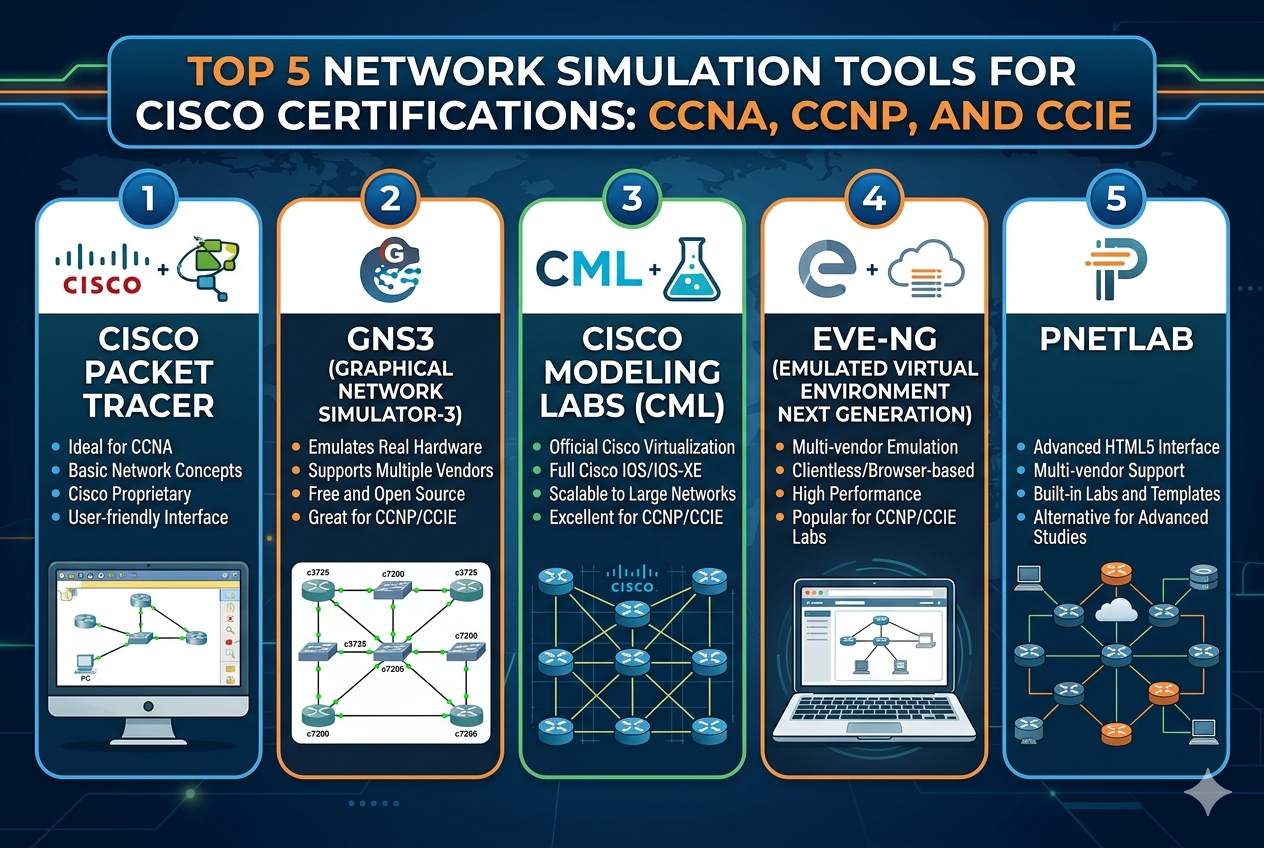
Cisco Packet Tracer remains one of the most important starting points for anyone beginning their journey into networking certifications such as CCNA. It is designed to simplify complex networking concepts by providing a visual, drag-and-drop environment where users can build and test network topologies without needing physical hardware. This makes it especially useful for students who are still developing their understanding of networking fundamentals.
One of the strongest advantages of Packet Tracer is its accessibility. It runs smoothly on most computers and does not require high system resources, which allows learners to practice anytime without needing expensive equipment. Users can simulate routers, switches, PCs, servers, and even wireless devices, making it possible to understand how data flows across different network layers.
For CCNA candidates, Packet Tracer helps reinforce key concepts such as IP addressing, subnetting, VLAN configuration, static and dynamic routing protocols, and basic troubleshooting. The built-in simulation mode allows learners to visually track packets as they move through the network, which significantly improves conceptual clarity.
Although it is not a fully realistic emulator of Cisco IOS, its educational design makes it ideal for beginners. It gradually introduces learners to command-line configuration while still providing visual feedback. This balance between simplicity and functionality is what makes Packet Tracer a foundational tool for entry-level certification preparation.
GNS3 (Graphical Network Simulator-3)
GNS3 is a more advanced and powerful network simulation tool widely used by CCNP and CCIE candidates who require deeper, real-world network behavior. Unlike basic simulators, GNS3 allows the integration of actual Cisco IOS images, which provides a highly accurate representation of real networking environments.
One of the key strengths of GNS3 is its flexibility. Users can design highly complex topologies that include multiple routers, switches, firewalls, and even external systems such as virtual machines. This makes it possible to simulate enterprise-level network infrastructures and test advanced configurations.
For CCNP-level studies, GNS3 is particularly useful for practicing advanced routing protocols like OSPF, EIGRP, and BGP. It also supports switching concepts such as STP variations, EtherChannel, and inter-VLAN routing. For CCIE candidates, the ability to build large-scale lab environments is critical, and GNS3 provides that capability effectively.
Another major advantage is its integration with virtualization platforms. This allows learners to combine networking devices with operating systems, security appliances, and application servers. As a result, users can simulate real production environments and troubleshoot multi-layered network issues.
However, GNS3 does require more technical setup compared to simpler tools. It also demands higher system resources, especially when running multiple virtual devices. Despite this, its realism and flexibility make it one of the most valuable tools for serious networking professionals.
EVE-NG (Emulated Virtual Environment – Next Generation)
EVE-NG is widely considered one of the most powerful and professional network emulation platforms available today. It is especially popular among CCNP and CCIE candidates because of its ability to replicate real-world network environments at a very large scale.
One of the defining features of EVE-NG is its web-based interface, which allows users to access and manage labs through a browser. This makes it highly convenient, especially for learners who want to access their labs from different devices without complex local setups.
EVE-NG supports a wide range of vendor images, not just Cisco. This includes routers, switches, firewalls, and security appliances from multiple manufacturers. This multi-vendor capability is extremely useful for understanding how real enterprise networks operate, where multiple technologies often coexist.
For advanced certification preparation, EVE-NG allows learners to build extremely complex topologies involving multiple routing domains, MPLS networks, VPN configurations, and advanced security scenarios. It is particularly effective for CCIE lab preparation, where large-scale troubleshooting and design skills are required.
Another strength of EVE-NG is its performance optimization. It is designed to efficiently handle large virtual environments, making it more stable for bigger labs compared to many other tools. It also supports team collaboration, allowing multiple users to work on shared lab environments.
Although it has a steeper learning curve, especially for beginners, its professional-grade capabilities make it one of the most powerful tools for serious certification candidates aiming for expert-level Cisco certifications.
Cisco Modeling Labs (CML)
Cisco Modeling Labs is an official network simulation and emulation platform developed by Cisco, making it one of the most accurate tools for certification preparation. Since it uses genuine Cisco virtual images, the behavior of devices closely matches real hardware, which is extremely beneficial for CCNP and CCIE candidates.
One of the most important advantages of CML is its reliability. Because it is officially supported, learners can trust that the configurations, command outputs, and network behaviors align with real Cisco systems. This reduces the gap between lab practice and real-world deployment.
CML allows users to design scalable and complex network topologies, ranging from small lab environments to large enterprise simulations. It supports both routing and switching technologies, along with advanced features such as policy-based routing, network automation, and virtualization integration.
For certification candidates, CML provides a highly structured environment for practicing exam objectives. It is particularly useful for learners who want to ensure that their lab practice is as close as possible to real exam scenarios. The consistency of device behavior helps reduce confusion and improves learning efficiency.
Another advantage is its integration with modern networking concepts such as programmability and automation. This makes it relevant not only for traditional CCNA, CCNP, and CCIE tracks but also for newer Cisco technologies.
While CML is more resource-intensive and may require a learning curve, its official status and accuracy make it one of the most trusted platforms for serious Cisco certification preparation.
Boson NetSim
Boson NetSim is a highly focused simulation tool designed specifically for Cisco certification exam preparation. Unlike general-purpose emulators, NetSim is built around structured learning and guided labs that align directly with exam objectives.
One of the most useful features of NetSim is its step-by-step lab guidance. This makes it ideal for learners who may struggle with understanding where to begin in a complex network configuration. It provides structured instructions while still allowing hands-on practice, helping users gradually build confidence.
NetSim is particularly effective for CCNA and CCNP candidates who want to reinforce theoretical knowledge with practical application. It covers essential topics such as routing protocols, switching configurations, network security basics, and troubleshooting techniques.
Another advantage is its focus on exam relevance. The labs are designed to match typical certification exam scenarios, which helps learners become familiar with the types of tasks they may encounter during the actual test. This targeted approach improves both efficiency and retention.
Unlike more complex emulators, NetSim is easier to install and use. It does not require advanced system configuration or virtual machine setup, making it accessible to a wider range of learners. This simplicity allows users to focus more on learning rather than system configuration.
Although it does not provide the same level of realism or scalability as GNS3 or EVE-NG, its structured learning approach makes it a strong companion tool for exam preparation. It is especially useful for reinforcing concepts after initial learning and before taking certification exams.
Overall Importance of Simulation Tools in Cisco Certification Preparation
Network simulation tools play a critical role in the journey toward Cisco certifications at all levels. They bridge the gap between theoretical knowledge and practical application, allowing learners to experience real-world networking scenarios in a safe and controlled environment.
For CCNA candidates, tools like Packet Tracer and NetSim provide a strong foundation in networking basics, helping them understand how devices communicate and how networks are built and configured. These tools emphasize simplicity and guided learning, which is essential at the beginner stage.
For CCNP candidates, more advanced tools such as GNS3 and EVE-NG become essential. At this level, learners are expected to design, configure, and troubleshoot complex network systems. These tools provide the realism and flexibility needed to simulate enterprise environments and advanced protocols.
For CCIE candidates, simulation tools are not just helpful but necessary. Platforms like EVE-NG and Cisco Modeling Labs allow for large-scale lab creation, advanced troubleshooting, and in-depth understanding of network behavior under real-world conditions.
Ultimately, the choice of tool depends on the certification level, learning style, and technical goals of the learner. However, mastering at least one or more of these platforms significantly increases the chances of success in Cisco certification exams and builds strong practical networking skills for real-world careers.
Why Simulation Tools Are Essential for Modern Networking Careers
Network simulation tools are no longer optional in today’s IT and networking landscape. They have become a core requirement for anyone pursuing certifications like CCNA, CCNP, or CCIE. The reason is simple: real networking hardware is expensive, difficult to access, and not always practical for continuous learning. Simulation and emulation tools bridge this gap by allowing learners to practice complex configurations without physical limitations.
Another important factor is the increasing complexity of modern networks. Enterprises today use hybrid environments involving cloud systems, virtualization, automation, and multi-vendor technologies. Traditional textbook learning is not enough to understand these systems. Simulation tools help recreate these environments, giving learners hands-on exposure to real-world scenarios.
These tools also help in building troubleshooting skills, which are critical for Cisco certifications. Instead of memorizing commands, learners can actively experiment, break configurations, and fix errors in a safe environment. This trial-and-error learning method significantly improves long-term retention and problem-solving ability.
For CCIE-level candidates especially, simulation platforms become a training ground for exam-style thinking. The CCIE lab is not just about configuration but also about diagnosing complex network issues under time pressure. Advanced tools allow repeated practice of these scenarios until the learner gains confidence and speed.
Comparing Simulation vs Emulation in Networking Practice
Understanding the difference between simulation and emulation is important for choosing the right tool. Simulation tools like Cisco Packet Tracer focus on replicating network behavior in a simplified way. They are designed for learning concepts and understanding workflows rather than executing real operating system commands.
On the other hand, emulation tools such as GNS3, EVE-NG, and Cisco Modeling Labs run actual Cisco IOS images. This means the behavior is almost identical to real hardware. Every command, process, and output matches production devices, making them much more suitable for advanced certifications.
Simulation tools are ideal for beginners because they remove complexity and focus on learning. Emulation tools are essential for intermediate and advanced learners because they provide realism and scalability. Both types serve different stages of the learning journey, and using them together creates a complete learning path.
A common mistake among learners is relying only on one type of tool. Beginners sometimes jump directly into advanced emulators and struggle with setup complexity. Similarly, advanced learners who stay only on simulation tools may lack real-world experience. A balanced approach is always more effective.
Role of Packet Tracer in Building Foundational Skills
Even though more advanced tools exist, Cisco Packet Tracer continues to play a major role in foundational learning. It is especially valuable for understanding basic networking concepts such as IP addressing, subnetting, and device communication.
One of its strengths is its ability to visually demonstrate packet flow. Learners can see how data travels from one device to another, which helps in understanding OSI layers and network communication principles. This visual approach makes abstract concepts easier to grasp.
Packet Tracer also supports simple configuration practice using Cisco-style commands. This allows learners to become comfortable with command-line interfaces before moving to real IOS environments. It helps reduce the learning curve when transitioning to more advanced tools.
For CCNA preparation, Packet Tracer is often enough to cover most exam topics. However, it is important to understand its limitations. It does not fully support advanced protocols or real IOS behavior, which is why learners eventually need to move to more powerful platforms.
Despite its simplicity, Packet Tracer remains one of the most effective learning tools for beginners and continues to be widely used in academic environments and certification training programs.
GNS3 for Realistic Enterprise Network Simulation
GNS3 is often considered a bridge between learning and real-world networking. It allows learners to use actual Cisco IOS images, which makes configurations behave exactly like physical devices. This realism is one of the main reasons it is widely used by CCNP and CCIE candidates.
One of the most powerful features of GNS3 is its ability to integrate with virtualization technologies. This means learners can connect virtual routers and switches with operating systems, servers, and security devices. This creates a complete enterprise simulation environment.
GNS3 is particularly useful for studying advanced routing protocols. Complex scenarios involving OSPF areas, BGP peering, route redistribution, and policy-based routing can all be tested in detail. It also allows deep exploration of switching technologies such as spanning-tree optimization and VLAN design.
However, GNS3 requires careful setup and configuration. Users must often import IOS images and configure virtual network adapters. This can be challenging for beginners, but it is a valuable learning experience in itself because it introduces real-world virtualization concepts.
Despite its complexity, GNS3 remains one of the most trusted tools for professional-level network training and certification preparation.
EVE-NG as a Professional Training Environment
EVE-NG has gained popularity as one of the most complete network emulation platforms available today. It is widely used in professional training labs, certification bootcamps, and enterprise-level practice environments.
One of its key strengths is scalability. EVE-NG can support very large network topologies without significant performance issues when properly configured. This makes it ideal for CCIE-level preparation where complex multi-domain networks are required.
Another advantage is its multi-vendor support. Unlike some tools that focus only on Cisco, EVE-NG allows integration of devices from different manufacturers. This helps learners understand how real-world networks are built using diverse technologies.
The platform also supports collaborative learning environments. Multiple users can access and work on shared labs, which is useful for group training sessions and professional development programs.
EVE-NG is often chosen by advanced learners who need a highly realistic and flexible environment for deep technical practice. While it requires technical knowledge to set up, its capabilities make it one of the most powerful tools in networking education.
Cisco Modeling Labs for Authentic Cisco Experience
Cisco Modeling Labs stands out because it is developed and maintained by Cisco itself. This means it provides the most authentic simulation of Cisco networking behavior available outside of physical hardware.
One of the biggest advantages of this platform is accuracy. Every command, configuration, and protocol behaves exactly as it would on real Cisco devices. This eliminates inconsistencies that sometimes appear in third-party tools.
CML is designed for both learning and professional use. It supports complex topologies and advanced networking scenarios, making it suitable for CCNP and CCIE preparation. It also integrates modern networking concepts such as automation and programmability.
Another important aspect of CML is stability. Because it is officially supported, users experience fewer compatibility issues and more predictable performance. This makes it a reliable choice for serious learners and enterprise training environments.
Although it requires a subscription and higher system resources, its authenticity and reliability make it one of the best options for Cisco certification preparation.
Boson NetSim for Structured Exam Preparation
Boson NetSim is designed with a very specific purpose: helping learners pass Cisco certification exams efficiently. Unlike general-purpose simulators, it focuses on guided learning and structured lab exercises.
One of its strongest features is its step-by-step instruction system. This allows learners to follow guided scenarios while still performing actual configurations. It is particularly useful for those who struggle with independent lab setup.
NetSim aligns closely with Cisco exam objectives. This means learners are practicing exactly what they are likely to encounter in real certification exams. This targeted approach improves exam readiness and reduces unnecessary learning time.
It is especially useful for reinforcing knowledge after theory study. Many learners use it alongside other tools to strengthen their understanding of key concepts before attempting the actual exam.
While it does not offer the same level of realism as GNS3 or EVE-NG, its simplicity and focus on exam success make it a valuable tool in any certification preparation plan.
Building a Complete Cisco Learning Strategy with Simulation Tools
A successful Cisco certification journey often involves using multiple simulation tools at different stages of learning. Beginners usually start with Packet Tracer to build foundational knowledge. As they progress, they move to NetSim for structured practice and then to GNS3 or EVE-NG for advanced lab environments.
At the expert level, Cisco Modeling Labs becomes the most accurate platform for real-world preparation. Each tool plays a specific role in the learning journey, and together they create a complete training ecosystem.
The key to success is not just using these tools but using them strategically. Understanding when to transition from one tool to another is just as important as the practice itself. This progression ensures that learners build both theoretical knowledge and practical expertise in a balanced way.
Ultimately, mastering these simulation platforms significantly increases the chances of success in CCNA, CCNP, and CCIE certifications while also building strong real-world networking skills that are highly valued in the IT industry.
Choosing the Right Simulation Tool Based on Certification Level
Selecting the right network simulation tool depends heavily on the certification level you are targeting and the depth of knowledge you want to achieve. Each stage of Cisco certification demands a different level of technical understanding, and using the appropriate tool at the right time can significantly improve learning efficiency.
For CCNA-level learners, simplicity and clarity are the most important factors. At this stage, the focus is on understanding basic networking concepts such as IP addressing, subnetting, routing fundamentals, and switching basics. Tools like Packet Tracer are ideal because they provide a controlled environment where learners can visualize network behavior without dealing with unnecessary complexity. The goal here is not realism but comprehension.
As learners move into CCNP-level studies, the requirement changes from basic understanding to advanced configuration and troubleshooting. At this stage, tools like GNS3 and EVE-NG become much more relevant. They allow users to work with real Cisco IOS images and simulate enterprise-grade network environments. This helps learners understand how protocols behave in real deployments rather than simplified models.
For CCIE-level preparation, realism and scale become the most critical factors. Candidates must be able to design, configure, and troubleshoot large, complex networks under time constraints. Cisco Modeling Labs and EVE-NG are especially valuable at this stage because they can simulate large-scale infrastructures with high accuracy. These tools allow repeated practice of difficult scenarios until the learner achieves expert-level confidence.
Using the wrong tool at the wrong stage can slow down progress. For example, relying only on Packet Tracer at an advanced level can limit exposure to real-world behaviors, while jumping directly into complex emulators without foundational knowledge can lead to confusion and frustration. A structured progression ensures steady skill development.
Performance Considerations and System Requirements
Another important factor when choosing a network simulation tool is system performance. Different tools have different hardware requirements, and understanding these requirements helps ensure a smooth learning experience without technical interruptions.
Lightweight tools like Packet Tracer run efficiently on most standard laptops and do not require high CPU or memory resources. This makes them accessible to students and beginners who may not have advanced hardware. It also allows uninterrupted practice without worrying about system limitations.
On the other hand, tools like GNS3 and EVE-NG require significantly more system resources. Since they run real operating systems and virtual devices, they depend heavily on CPU power, RAM, and storage performance. Running multiple routers, switches, and virtual machines simultaneously can quickly consume system resources.
Cisco Modeling Labs also requires a stable and relatively powerful system, especially when working with large topologies. While it is optimized for performance, users still need sufficient hardware to avoid lag or simulation delays during complex labs.
Understanding these requirements is important because poor system performance can negatively impact learning. Slow simulations, device crashes, or lagging interfaces can disrupt focus and reduce the effectiveness of lab practice. Proper hardware planning ensures a smoother and more productive learning experience.
Importance of Real-World Practice in Certification Success
While simulation tools are extremely useful, they are only part of the overall learning process. Real success in Cisco certifications comes from combining theoretical knowledge with consistent hands-on practice and problem-solving skills.
One of the most important aspects of real-world networking is troubleshooting. In actual network environments, problems rarely appear in isolation. Multiple issues can occur simultaneously, and engineers must be able to identify and resolve them efficiently. Simulation tools help replicate these scenarios in a safe environment.
Another key aspect is configuration accuracy. In real networks, even a small mistake can lead to connectivity failures or performance issues. Practicing configurations repeatedly in simulation environments helps develop precision and attention to detail, which is essential for certification exams and professional roles.
Time management is also a critical factor, especially for CCIE-level exams. Simulation tools allow learners to practice under timed conditions, improving both speed and accuracy. This kind of practice builds confidence and reduces stress during actual exams.
Ultimately, simulation tools are not just about learning commands but about developing a mindset for solving real networking problems. This shift from memorization to practical thinking is what separates successful candidates from others.
Integration of Networking Tools with Modern Technologies
Modern networking is no longer limited to traditional routing and switching. Technologies such as cloud computing, automation, virtualization, and network security are now integral parts of enterprise environments. Simulation tools are evolving to reflect these changes.
Platforms like EVE-NG and Cisco Modeling Labs support integration with virtual machines and external systems, allowing learners to simulate cloud-based architectures. This helps bridge the gap between traditional networking and modern infrastructure.
Automation is another important area. Many advanced tools now support scripting and programmability, allowing learners to practice configuration automation using tools like Python and network APIs. This is especially important for modern Cisco certifications that include automation topics.
Security integration is also becoming more prominent. Simulation environments allow learners to deploy firewalls, intrusion detection systems, and secure routing configurations. This helps build a strong understanding of network security principles in practical scenarios.
By combining traditional networking with modern technologies, simulation tools prepare learners not just for exams but for real-world IT environments where multiple technologies coexist.
Common Mistakes When Using Network Simulation Tools
Many learners make mistakes when using network simulation tools, which can slow down their progress or create gaps in understanding. One common mistake is relying too heavily on visual interfaces without understanding the underlying commands. While visual tools are helpful, real certification exams require command-line proficiency.
Another mistake is skipping foundational practice and jumping directly into advanced tools. This often leads to confusion because advanced emulators require strong basic knowledge of networking concepts. Without this foundation, learners may struggle to understand complex scenarios.
Some learners also focus only on configuration and ignore troubleshooting. However, troubleshooting is a major part of Cisco certifications. Practicing only successful configurations does not prepare learners for real exam or job scenarios where errors must be identified and resolved.
Another issue is inconsistent practice. Networking skills require regular hands-on repetition. Long gaps between practice sessions can lead to forgetting commands and concepts. Consistency is more important than intensity in the learning process.
Avoiding these mistakes ensures more effective use of simulation tools and faster progress toward certification goals.
Building Long-Term Networking Skills Beyond Certification
While Cisco certifications are an important milestone, the real value of network simulation tools extends beyond passing exams. These tools help build long-term professional skills that are essential in IT and networking careers.
One of the most important skills developed is logical thinking. Networking problems require structured analysis and step-by-step troubleshooting. Simulation environments help strengthen this ability by encouraging experimentation and analysis.
Another long-term benefit is confidence in handling real systems. Practicing in virtual environments reduces fear of making mistakes in real networks. This confidence is critical when working in production environments where downtime must be minimized.
Simulation tools also encourage continuous learning. Networking is a constantly evolving field, and professionals must keep updating their skills. These tools provide a safe environment for exploring new technologies and testing new configurations without risk.
Over time, consistent practice leads to strong technical intuition. Experienced learners can quickly identify issues, predict network behavior, and design efficient solutions. This level of understanding is what defines a skilled network engineer.
Final Perspective on Cisco Simulation Tools
Network simulation tools are essential for anyone pursuing Cisco certifications or a career in networking. They provide a bridge between theory and real-world practice, allowing learners to develop both conceptual understanding and technical expertise.
Each tool has its own strengths and purpose. Packet Tracer is ideal for beginners, NetSim provides structured learning, GNS3 and EVE-NG offer advanced realism, and Cisco Modeling Labs delivers official accuracy. Together, they form a complete learning ecosystem.
The key to success is not just using these tools but using them in a structured and progressive way. Starting simple, building complexity gradually, and consistently practicing real-world scenarios ensures strong preparation for CCNA, CCNP, and CCIE certifications.
With the right approach, these tools not only help in passing exams but also in building a strong and successful career in networking.
Building Structured Lab Environments
One of the most effective ways to use network simulation tools is to build structured lab environments instead of random configurations. A structured lab follows a clear learning path, where each scenario is designed to reinforce a specific concept. This approach is especially important for CCNP and CCIE candidates who need deep understanding rather than surface-level familiarity.
In a structured lab, learners typically start with basic connectivity and gradually move toward advanced configurations. For example, a lab may begin with simple IP addressing and ping tests, then progress to routing protocols like OSPF, and later expand into redistribution, filtering, and policy control. This step-by-step approach helps build logical understanding of how networks evolve.
Tools like GNS3, EVE-NG, and Cisco Modeling Labs are particularly effective for structured labs because they allow full control over network design. Learners can build topologies that simulate real enterprise networks, including multiple routing domains, redundancy protocols, and layered architectures.
By following structured lab design, learners avoid confusion and ensure that each concept is properly understood before moving to the next level. This method also improves retention and reduces the need for repeated revision.
Scenario-Based Learning for Real-World Skills
Scenario-based learning is another powerful technique used in advanced Cisco certification preparation. Instead of configuring devices in isolation, learners work on real-world inspired problems that require analysis, planning, and troubleshooting.
For example, a scenario may involve a network where users in different VLANs cannot communicate, or where routing paths are not optimized. The learner must identify the issue, analyze the configuration, and apply a solution. This approach closely mirrors real job roles in network engineering.
Simulation tools play a critical role in this process by allowing learners to recreate these scenarios safely. Mistakes can be made, tested, and corrected without affecting real systems. This builds confidence and improves problem-solving speed.
Scenario-based practice is especially important for CCIE preparation, where the exam is heavily focused on troubleshooting and complex problem resolution under time constraints. Repeated exposure to such scenarios builds strong analytical thinking.
Importance of Repetition and Practice Cycles
Networking skills cannot be developed through theory alone. Repetition is essential for mastering commands, configurations, and troubleshooting techniques. Each repetition strengthens memory and improves speed of execution.
Simulation tools allow learners to repeat lab exercises as many times as needed without limitations. This is one of their greatest advantages over physical hardware. Learners can rebuild networks, reset configurations, and test different approaches repeatedly.
A common strategy is the “practice cycle method,” where learners build a lab, complete a task, break the configuration intentionally, and then repair it. This cycle helps reinforce both configuration and troubleshooting skills simultaneously.
Over time, repetition leads to automatic recall of commands and procedures. This is particularly important in timed certification exams where quick thinking is required.
Troubleshooting Methodology Development
One of the most valuable skills developed through simulation tools is troubleshooting methodology. Instead of guessing solutions, learners are trained to follow a logical process to identify and fix issues.
A typical troubleshooting approach involves checking physical connectivity first, followed by IP configuration, routing tables, protocol status, and access control rules. This systematic approach ensures that problems are identified efficiently.
Advanced simulation platforms allow learners to introduce intentional faults into networks. For example, disabling interfaces, misconfiguring routing protocols, or blocking traffic with ACLs. These controlled failures are extremely useful for building diagnostic skills.
As learners progress, they become faster at identifying patterns and recognizing common issues. This skill is critical not only for exams but also for real-world network administration roles.
Integration of Automation in Simulation Practice
Modern networking increasingly relies on automation and programmability. Simulation tools are now evolving to include support for scripting and automated configuration deployment.
Learners can practice using tools like Python scripts, Ansible playbooks, and API-based configuration within virtual environments. This helps them understand how large-scale networks are managed efficiently in real enterprises.
Automation also reduces manual errors and speeds up configuration processes. By practicing automation in simulation tools, learners gain exposure to modern DevNet-related skills that are increasingly required in networking careers.
Platforms like EVE-NG and Cisco Modeling Labs are particularly useful for this purpose because they support integration with external tools and virtual systems.
Transition from Certification Learning to Professional Work
One of the biggest advantages of using simulation tools is that they prepare learners for real professional environments. The transition from certification study to actual job roles becomes much smoother when learners have extensive hands-on experience.
In professional environments, network engineers are expected to design, implement, and maintain complex systems. They must also respond quickly to outages and performance issues. Simulation tools help replicate these responsibilities in a controlled setting.
Learners who consistently use simulation platforms develop confidence in handling real equipment and live networks. They are less likely to make mistakes and more likely to troubleshoot effectively under pressure.
This practical experience is often what distinguishes certified professionals who are job-ready from those who only have theoretical knowledge.
Conclusion
Network simulation tools play a fundamental role in the journey toward Cisco certifications such as CCNA, CCNP, and CCIE. They transform abstract networking concepts into practical, hands-on experiences that are essential for true understanding.
Each tool serves a specific purpose in the learning process. Cisco Packet Tracer is ideal for beginners building foundational knowledge, while Boson NetSim provides structured, exam-focused practice. GNS3 and EVE-NG offer advanced realism for enterprise-level simulations, and Cisco Modeling Labs delivers the most authentic Cisco experience available.
The key to success lies not in choosing a single tool, but in using a combination of tools strategically throughout the learning journey. Starting with simple simulations and gradually moving toward complex emulation ensures steady skill development and deeper understanding.
Beyond certification success, these tools help develop critical real-world skills such as troubleshooting, network design, automation, and problem-solving. These abilities are highly valued in the IT industry and form the foundation of a successful networking career.
Ultimately, consistent practice, structured learning, and hands-on experimentation are what turn theoretical knowledge into professional expertise. With the right approach and the right tools, achieving Cisco certification goals becomes not only possible but highly achievable.