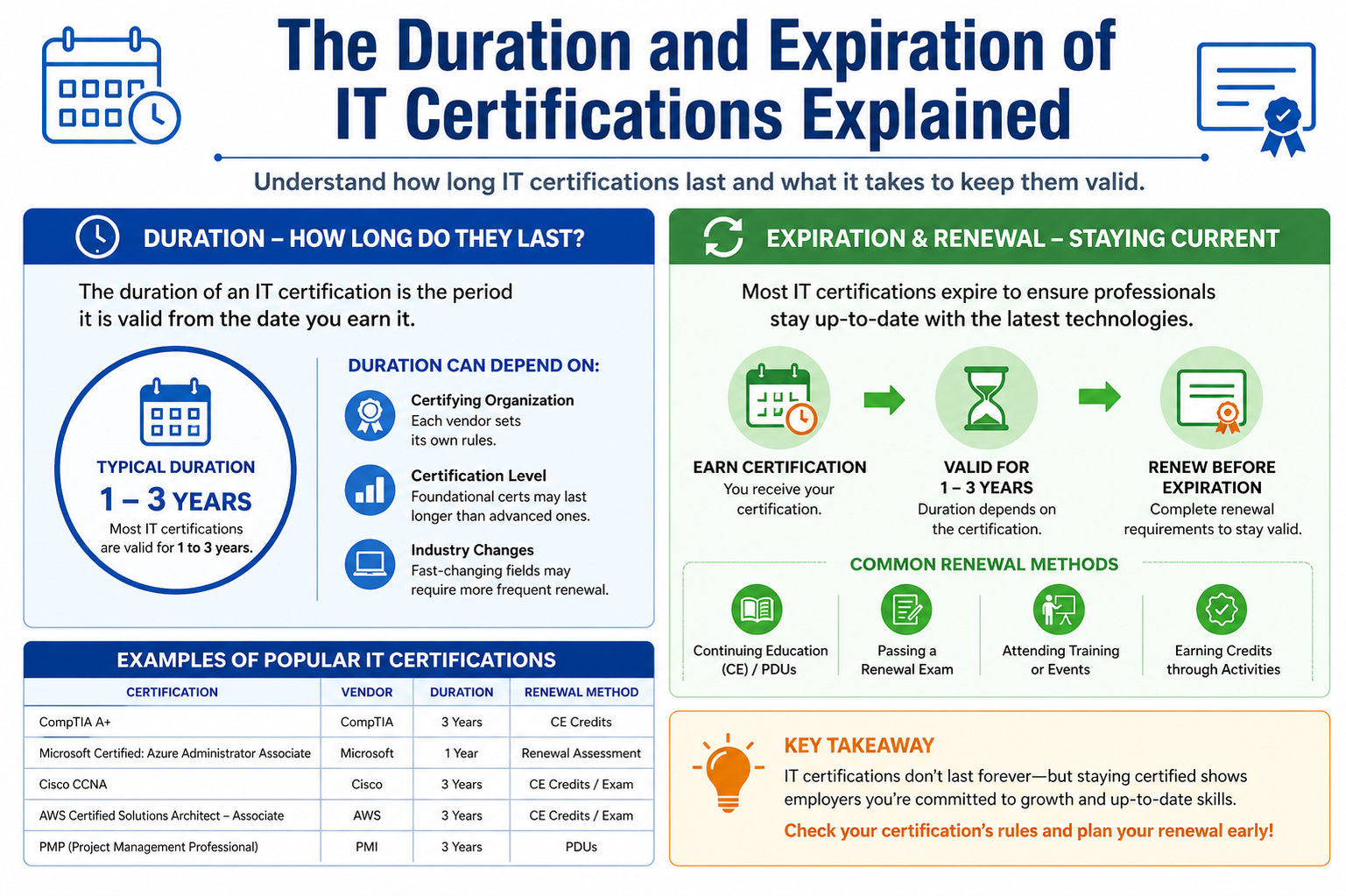
The validity period of IT certifications is not uniform across all programs, and several factors determine how long a certification remains active. One of the primary influences is the pace of technological change within a specific field. Areas such as cloud computing, cybersecurity, and data science evolve very quickly, which leads certification bodies to set shorter renewal cycles to keep professionals aligned with current industry standards.
Another factor is the complexity and depth of the certification itself. Entry-level certifications often have shorter validity periods because they cover foundational knowledge that can change as technologies advance. In contrast, advanced certifications may last longer since they focus on broader concepts and deeper expertise that do not change as rapidly.
Industry demand also plays a role in determining certification duration. Certifications that are highly sought after by employers are often updated more frequently to ensure they remain relevant to real-world job requirements. This helps maintain the credibility of the certification and ensures it reflects current professional expectations.
How Different Certification Bodies Handle Expiration
Different organizations manage certification validity in unique ways. Some certification providers use a fixed expiration model, where the certification automatically expires after a set number of years unless renewed. This approach is common in fast-changing IT domains where continuous learning is essential.
Other organizations use a continuing education model instead of strict expiration. In this system, professionals are required to earn continuing education credits or complete periodic training to keep their certification active. This method allows individuals to maintain their certification status while gradually updating their knowledge over time.
There are also certifications that combine both approaches, requiring renewal exams along with ongoing education. This hybrid system ensures both theoretical understanding and practical skill development are maintained throughout the certification cycle.
The Role of Recertification Exams
Recertification exams are one of the most common methods used to renew expired or expiring IT certifications. These exams are designed to test updated knowledge and ensure that professionals are still competent in the latest technologies and best practices.
Unlike the initial certification exam, recertification tests are often more focused on recent updates rather than foundational concepts. This allows professionals who already have experience in the field to demonstrate their continued expertise without repeating the entire certification process from the beginning.
While some professionals find recertification exams challenging due to new content, they also serve as a valuable opportunity to refresh skills and stay competitive in the job market.
Continuing Education as a Renewal Method
Continuing education is another widely accepted method for maintaining certification validity. This approach involves completing training courses, attending workshops, participating in webinars, or engaging in other structured learning activities.
The goal of continuing education is to encourage ongoing professional development rather than relying solely on exam-based evaluation. By consistently learning and applying new concepts, professionals can maintain their certification status while also improving their practical skills.
This method is particularly beneficial for individuals who prefer a steady learning pace instead of preparing for high-pressure exams every few years.
The Cost and Time Investment of Maintaining Certifications
Maintaining IT certifications often requires both financial and time investments. Renewal exams typically come with fees, and continuing education courses may also involve additional costs. These expenses vary depending on the certification provider and the complexity of the certification.
In addition to financial costs, professionals must also dedicate time to studying, attending training sessions, or completing required learning modules. This can be challenging for individuals who are already working full-time in demanding IT roles.
Despite these requirements, many professionals consider the investment worthwhile because active certifications often lead to better job opportunities, higher salaries, and improved career growth.
Common Misunderstandings About Certification Expiration
There are several misconceptions regarding IT certification expiration. One common misunderstanding is that once a certification expires, it becomes completely useless. In reality, even expired certifications can still demonstrate that an individual has previously acquired certain skills and knowledge.
Another misconception is that all certifications expire in the same way. In fact, expiration policies vary widely between different certification providers and technology domains. Some certifications require strict renewal, while others remain valid indefinitely but lose relevance over time if not updated.
It is also often believed that recertification is simply a repetitive process of retaking the same exam. However, many modern certification programs update their content significantly, meaning that professionals must learn new material rather than relying on previous knowledge alone.
Employer Expectations Regarding Active Certifications
Employers generally prefer candidates who hold active and up-to-date certifications. This is because active certifications indicate that the individual is familiar with current tools, systems, and industry standards.
In fast-moving IT environments, outdated knowledge can lead to inefficiencies or security risks. As a result, companies often prioritize candidates who demonstrate ongoing professional development through valid certifications.
However, experience and practical skills also play an important role. In some cases, employers may still value expired certifications if the candidate has strong hands-on expertise and relevant work experience.
The Impact of Technology Evolution on Certification Lifespan
The rapid evolution of technology has a direct impact on how long certifications remain valid. As new tools, platforms, and methodologies are introduced, older systems become less relevant, requiring certification programs to adapt accordingly.
For example, advancements in cloud computing have significantly changed how IT infrastructure is managed. As a result, certifications in this field are frequently updated to include new services, security practices, and deployment models.
Similarly, cybersecurity certifications must evolve quickly to address emerging threats and vulnerabilities. This constant change ensures that professionals are prepared to handle modern challenges effectively.
Strategies for Managing Certification Renewal Effectively
Professionals can take several steps to manage certification renewal more efficiently. One effective strategy is to track certification expiration dates well in advance. This allows sufficient time to prepare for renewal exams or complete required continuing education activities.
Another helpful approach is to integrate learning into daily work routines. By applying new technologies and staying engaged with industry developments, professionals can reduce the burden of last-minute exam preparation.
Joining professional communities or groups can also be beneficial. These communities often share updates about certification changes, study resources, and renewal tips, making it easier to stay informed.
Long-Term Benefits of Maintaining Active Certifications
Keeping certifications active provides several long-term career advantages. One of the most significant benefits is improved job stability, as employers are more likely to retain employees who consistently update their skills.
Active certifications also enhance professional credibility. They signal to employers, clients, and colleagues that the individual is committed to maintaining high standards of knowledge and performance.
In addition, maintaining certifications can open doors to advanced roles and specialized positions. Many senior IT roles require current certifications as part of their qualification criteria.
The Future of IT Certification Validity
As the IT industry continues to evolve, certification models are also expected to change. Some organizations are moving toward more flexible, skill-based validation systems rather than strict expiration timelines.
In the future, certifications may rely more on continuous skill assessments and real-time performance tracking instead of fixed renewal cycles. This could make the certification process more dynamic and aligned with actual job performance.
There is also a growing trend toward modular certifications, where professionals can update specific skill areas without retaking an entire exam. This approach may reduce the burden of renewal while still ensuring knowledge remains current.
Importance of Understanding Certification Duration
Understanding the duration and expiration of IT certifications is essential for anyone working in the technology field. It helps professionals plan their learning path, manage renewal requirements, and stay competitive in a rapidly changing industry.
Certifications are not just one-time achievements; they represent an ongoing commitment to professional growth. By staying aware of expiration policies and actively engaging in continuous learning, IT professionals can ensure long-term career success and maintain their relevance in an evolving technological landscape.
Career Planning Around Certification Lifecycles
Managing IT certifications effectively is closely tied to long-term career planning. Instead of treating certifications as isolated achievements, professionals benefit from viewing them as part of a continuous skill-building journey. Each certification typically builds upon previous knowledge, and understanding when each one expires helps in structuring a logical learning path over time.
For example, foundational certifications are often followed by intermediate and advanced credentials within the same specialization. By tracking expiration dates and renewal requirements early, professionals can avoid gaps in their qualifications and ensure steady career progression. This approach also helps in balancing learning efforts with job responsibilities, making development more structured and less stressful.
How Certification Renewal Supports Skill Relevance
Renewing certifications is not just a formality; it plays an important role in maintaining skill relevance in a fast-changing industry. IT systems, software platforms, and security practices evolve continuously, and outdated knowledge can quickly become a limitation in real-world scenarios.
When professionals go through renewal processes, they are often exposed to updated tools, modern frameworks, and revised best practices. This ensures that their skills remain aligned with current industry standards. As a result, certification renewal acts as a structured way of refreshing knowledge that might otherwise become outdated over time.
The Psychological Impact of Certification Expiration
Certification expiration can also have a psychological impact on professionals. Some individuals may feel pressure or anxiety as renewal deadlines approach, especially if they have not kept up with recent updates in their field. This is particularly common in high-demand areas where technologies evolve rapidly.
On the other hand, structured renewal systems can also create motivation. Knowing that certifications must be maintained encourages professionals to engage in continuous learning rather than postponing skill development. Over time, this creates a habit of staying updated, which is beneficial for long-term career growth.
Differences Between Vendor-Specific and Vendor-Neutral Certifications
IT certifications can generally be categorized into vendor-specific and vendor-neutral types, and their expiration policies often differ. Vendor-specific certifications are issued by companies that develop particular technologies or platforms. These certifications usually have stricter renewal cycles because the associated products are frequently updated.
Vendor-neutral certifications, on the other hand, focus on general concepts and skills that apply across multiple systems and technologies. While they may still have expiration dates, their renewal requirements are sometimes less frequent or less rigid. This is because the core knowledge remains relevant even as specific tools change.
Understanding this difference helps professionals choose certifications that align with both their career goals and their preferred learning pace.
The Importance of Staying Ahead of Expiration Dates
One of the most effective strategies in managing IT certifications is proactively staying ahead of expiration dates. Waiting until the last moment to renew can lead to unnecessary stress and potential lapses in certification status.
Professionals who actively monitor their certification timelines are better prepared to schedule exams, complete training, or fulfill continuing education requirements. This proactive approach also reduces the risk of certification gaps, which could negatively affect job opportunities or promotions.
Many experienced professionals maintain a personal learning calendar to track multiple certifications simultaneously, ensuring that none are overlooked.
How Employers View Certification Gaps
In some cases, professionals may experience gaps between certification expiration and renewal. Employers typically view these gaps differently depending on the role and industry. In highly technical or security-sensitive positions, even short lapses may be considered a disadvantage.
However, in many other situations, employers focus more on overall experience and current skills rather than strict certification status. If a candidate demonstrates strong practical knowledge and up-to-date expertise, a temporary certification gap may not significantly impact hiring decisions.
Still, maintaining active certifications is generally preferred, as it provides clear evidence of continuous professional development.
The Role of Online Learning Platforms in Renewal
Online learning platforms have become increasingly important in helping professionals maintain their certifications. These platforms offer flexible access to updated training materials, practice exams, and structured learning paths aligned with certification requirements.
This flexibility allows individuals to learn at their own pace, making it easier to balance work and study. Many certification bodies also recognize online learning activities as valid contributions toward continuing education credits, further simplifying the renewal process.
As a result, digital learning has made it significantly easier for professionals to keep certifications current without disrupting their work schedules.
Industry Trends Affecting Certification Expiration Models
The IT industry is gradually shifting toward more flexible certification models. Traditional fixed-expiration systems are being complemented or replaced in some cases by continuous assessment models. These new systems evaluate skills on an ongoing basis rather than requiring renewal at fixed intervals.
This trend is driven by the increasing need for real-time skill validation in dynamic work environments. As technologies evolve faster than ever, organizations are prioritizing adaptability and practical ability over static credentials.
In the future, certification systems may become more personalized, adapting renewal requirements based on an individual’s job role, experience level, and learning activity.
Global Recognition and Certification Validity Differences
Certification validity can also vary depending on geographic regions and industry standards. Some certifications are globally recognized, while others are more region-specific. This can influence how expiration and renewal policies are implemented.
In global IT environments, professionals often need to maintain multiple certifications to meet different regional requirements. This adds complexity to certification management but also increases career mobility across international markets.
Understanding these differences is important for professionals working in multinational organizations or planning to work abroad.
How Experience Can Complement Expired Certifications
Even when certifications expire, the experience gained from obtaining them does not lose its value. Practical knowledge, hands-on skills, and problem-solving abilities often remain relevant regardless of certification status.
In many cases, experienced professionals rely on their accumulated expertise rather than certification validity alone. Employers also recognize that real-world experience can sometimes be more valuable than formal credentials.
However, combining experience with active certifications creates the strongest professional profile, as it demonstrates both knowledge and up-to-date competency.
The Relationship Between Certification and Career Advancement
Certifications often play a key role in career advancement within the IT industry. They are frequently used as benchmarks for promotions, salary increases, and job eligibility.
Maintaining active certifications ensures that professionals remain eligible for advanced roles that require verified expertise. In competitive job markets, having current certifications can significantly improve visibility among employers.
Additionally, certifications can help individuals transition into new specializations by validating their skills in unfamiliar areas, supporting career flexibility and growth.
The Future Importance of Continuous Learning Mindset
As technology continues to evolve, the importance of a continuous learning mindset will only increase. Certifications are becoming less about one-time achievements and more about ongoing skill validation.
Professionals who embrace lifelong learning are better positioned to adapt to industry changes, adopt new technologies, and remain competitive. This mindset ensures that certification expiration is not seen as a barrier but rather as an opportunity for growth and renewal.
Ultimately, the ability to continuously learn and adapt will define long-term success in the IT industry more than any single certification alone.
Advanced Certification Renewal Strategies
At higher stages of an IT career, managing certifications becomes more strategic than routine. Professionals who hold multiple advanced certifications often need a structured approach to renewal so that learning efforts remain efficient and aligned with career goals. Instead of renewing each certification separately without planning, many experienced individuals group certifications by domain, such as networking, security, or cloud computing, and renew them in coordinated cycles.
This method helps reduce workload and avoids repetitive learning of overlapping topics. It also ensures that updates in one certification area naturally support knowledge in related areas. As a result, professionals can maintain a strong and consistent skill profile without unnecessary duplication of effort.
Balancing Work Responsibilities With Certification Maintenance
One of the biggest challenges in maintaining IT certifications is balancing them with full-time job responsibilities. Many professionals work in demanding environments where time for study and renewal preparation is limited. Because of this, effective time management becomes essential.
Some professionals dedicate small, consistent time blocks each week for learning rather than relying on long study sessions before exam deadlines. This steady approach helps reduce stress and improves retention of new information. Others integrate learning directly into their work by applying updated tools and techniques on the job, which reinforces certification content in practical scenarios.
Over time, this balance between work and learning becomes a sustainable habit that supports both career performance and certification maintenance.
The Evolution of Renewal Requirements Over Time
Certification renewal requirements have evolved significantly over the years. In earlier systems, professionals were often required to retake full certification exams regardless of their experience level. This approach was rigid and time-consuming but ensured uniform knowledge validation.
Modern certification systems are more flexible. Many now allow professionals to renew through shorter exams, modular assessments, or continuous education credits. This shift reflects a better understanding of how professionals learn and work in real-world environments.
As the IT industry continues to mature, renewal processes are expected to become even more adaptive, focusing on practical skill validation rather than purely theoretical testing.
The Importance of Specialization in Certification Lifespan
Specialization plays an important role in how certifications are maintained over time. Highly specialized certifications, especially in fields like cybersecurity, cloud architecture, or artificial intelligence, tend to have shorter validity periods because the underlying technologies evolve rapidly.
General certifications, on the other hand, may have longer validity periods since they focus on broader principles that remain stable over time. However, even general certifications may require periodic updates to ensure alignment with new industry practices.
Choosing between specialized and general certifications often depends on career goals. Professionals aiming for niche roles may need to commit to more frequent renewal cycles, while those in broader roles may experience less frequent updates.
The Role of Practical Experience in Certification Renewal
Practical experience plays a major role in reducing the difficulty of certification renewal. Professionals who actively use their skills in real-world environments often find it easier to stay updated with changes in their field.
Hands-on experience helps reinforce theoretical knowledge and provides exposure to real challenges that may not be covered in certification materials. This makes renewal less about relearning and more about updating existing knowledge.
In many cases, experienced professionals are able to pass renewal assessments with minimal additional preparation because their daily work already aligns with updated certification requirements.
Certification Expiration in Emerging Technologies
Emerging technologies such as artificial intelligence, machine learning, blockchain, and edge computing have introduced new challenges for certification validity. Since these fields evolve extremely quickly, certification programs in these areas often have shorter renewal cycles.
Frequent updates are necessary to reflect new tools, frameworks, and industry applications. This ensures that certified professionals remain capable of working with the latest innovations rather than relying on outdated methods.
As these technologies mature, certification structures may stabilize, but at present, they require more frequent attention and renewal compared to traditional IT domains.
The Financial Value of Maintaining Active Certifications
Active certifications can significantly impact earning potential in the IT industry. Employers often associate current certifications with updated skills, which can justify higher salaries or promotions.
From a financial perspective, maintaining certifications is often viewed as an investment rather than an expense. While renewal fees and training costs can add up, the long-term career benefits typically outweigh these short-term costs.
Professionals with multiple active certifications are often considered for higher-level positions, consulting roles, or specialized projects, all of which can lead to increased income opportunities.
The Risk of Certification Obsolescence
Certification obsolescence occurs when a certification becomes outdated due to changes in technology or industry standards. Even if a certification has not officially expired, it may lose relevance if the associated skills are no longer widely used.
This is particularly common in fast-changing IT fields where older technologies are quickly replaced by newer solutions. Professionals must be aware of this risk and actively transition toward updated certifications to remain competitive.
Ignoring obsolescence can lead to skill gaps, reduced employability, and difficulty adapting to new job requirements.
How Organizations Encourage Certification Renewal
Many organizations actively encourage employees to maintain their certifications by offering incentives such as training support, exam reimbursements, or paid study time. This benefits both employees and employers by ensuring that the workforce remains skilled and up to date.
Some companies also require employees to hold active certifications as part of their job role, especially in areas like cybersecurity, cloud management, and system administration. This ensures compliance with industry standards and reduces operational risks.
By supporting certification renewal, organizations invest in long-term workforce development and technical excellence.
The Psychological Benefits of Continuous Certification Maintenance
Beyond career and financial advantages, maintaining certifications also provides psychological benefits. It creates a sense of progress, achievement, and professional identity. Each renewal cycle reinforces confidence in one’s abilities and knowledge.
Continuous learning also helps reduce career stagnation. Professionals who regularly update their certifications often feel more engaged and motivated in their roles. This contributes to higher job satisfaction and long-term commitment to their field.
In contrast, neglecting certification maintenance can sometimes lead to decreased confidence or uncertainty about skill relevance.
Integration of Automation in Certification Tracking
With advancements in digital tools, many professionals now use automated systems to track certification expiration dates and renewal requirements. These tools send reminders, suggest training courses, and help manage multiple certifications simultaneously.
Automation reduces the risk of missing important deadlines and simplifies the overall management process. It also allows professionals to focus more on learning rather than administrative tracking.
As technology continues to advance, certification management systems are expected to become even more intelligent and personalized.
Long-Term Career Stability Through Certification Maintenance
Maintaining certifications over the long term contributes to greater career stability. Professionals who consistently update their skills are more resilient to industry changes and technological disruptions.
This stability is especially important in IT, where job roles and required skills can shift rapidly. Continuous certification renewal ensures that professionals remain relevant regardless of changes in tools or platforms.
Over time, this creates a strong professional foundation that supports career growth, adaptability, and long-term success in the technology sector.
Certification Renewal in Highly Competitive IT Fields
In highly competitive IT fields, certification renewal becomes more than just a requirement; it turns into a key differentiator between professionals. When many candidates possess similar educational backgrounds and experience levels, active and updated certifications can significantly influence hiring decisions. Employers often view current certifications as proof that a candidate is continuously improving and staying aligned with modern industry standards.
This is especially true in areas like cybersecurity, cloud engineering, data analytics, and DevOps, where tools and frameworks change rapidly. In such environments, even a small delay in renewal can make a difference in perceived expertise. Professionals who consistently maintain their certifications tend to have a stronger presence in recruitment pipelines and are often shortlisted more frequently.
The Relationship Between Certifications and Technological Shifts
Technological shifts directly influence how certification programs are designed and maintained. As industries adopt new technologies, certification bodies must revise exam content, update learning materials, and adjust renewal requirements accordingly. This ensures that certified professionals remain capable of handling modern systems and challenges.
For example, when organizations move from traditional infrastructure to cloud-based systems, certifications must reflect changes in architecture, security models, and deployment strategies. Similarly, the rise of automation and artificial intelligence has led to new certification tracks that did not exist a few years ago.
Because of these continuous shifts, certification validity is closely tied to how fast a technology evolves. Faster evolution typically results in shorter certification cycles and more frequent updates.
Adapting to Multi-Certification Management
Many IT professionals hold multiple certifications across different domains. While this strengthens their career profile, it also introduces complexity in managing expiration dates and renewal requirements. Without proper organization, it is easy to lose track of deadlines or miss important updates.
To handle this, professionals often create structured learning systems that prioritize certifications based on relevance to their current job role or career goals. Some certifications may be renewed immediately, while others are scheduled for later renewal depending on priority.
This approach helps avoid unnecessary workload and ensures that effort is focused on certifications that deliver the most professional value at a given time.
The Influence of Experience on Renewal Difficulty
Experience plays a significant role in determining how difficult certification renewal feels. Professionals with extensive hands-on experience often find renewal processes easier because they already apply many of the required concepts in their daily work.
In contrast, individuals who have not actively used certain skills may find it more challenging to prepare for updated exams or continuing education requirements. This highlights the importance of maintaining practical engagement with technologies rather than relying solely on theoretical knowledge.
Over time, experience becomes a natural advantage that reduces the effort required for maintaining certifications.
Shifting Focus From Exams to Skill Validation
The IT certification landscape is gradually shifting from exam-heavy validation toward practical skill assessment. Many modern certification programs now emphasize real-world problem solving, scenario-based testing, and hands-on evaluations.
This shift reflects industry demand for professionals who can apply knowledge effectively rather than simply memorize theoretical concepts. As a result, certification renewal is becoming more aligned with actual job performance.
In the future, it is likely that certifications will focus even more on continuous skill validation, where professionals demonstrate competence through ongoing assessments rather than periodic exams alone.
How Continuous Learning Reduces Renewal Pressure
Continuous learning significantly reduces the pressure associated with certification renewal. When professionals consistently update their knowledge throughout the certification lifecycle, they avoid the need for intensive preparation at the time of renewal.
This approach transforms certification maintenance from a stressful event into a natural part of professional development. Learning becomes integrated into daily routines, making updates easier to absorb and apply.
Over time, this reduces burnout and improves overall confidence in handling certification requirements.
The Role of Professional Communities in Certification Maintenance
Professional communities play an important role in helping individuals maintain their certifications. These communities often share updates about exam changes, new technologies, study resources, and renewal strategies.
Engaging with peers also provides motivation and accountability. When professionals see others actively preparing for renewals or discussing new developments, they are more likely to stay committed to their own learning goals.
This collaborative environment helps simplify the renewal process and keeps individuals connected to industry trends.
Long-Term Career Identity Built Through Certifications
Over time, certifications contribute to shaping a professional’s career identity. They represent not only technical skills but also dedication to continuous improvement and professional discipline.
Maintaining certifications across multiple cycles reinforces this identity and builds a reputation for reliability and expertise. Employers and colleagues often associate active certifications with consistency, adaptability, and commitment to growth.
This long-term identity can have a lasting impact on career opportunities and professional credibility.
The Future of Certification Lifecycles in IT
The future of IT certification lifecycles is expected to become more flexible, personalized, and skill-driven. Traditional fixed expiration models may gradually be replaced with adaptive systems that adjust renewal requirements based on job role, experience level, and ongoing learning activity.
Artificial intelligence and digital tracking systems may also play a larger role in monitoring skill development in real time. This could reduce the need for formal recertification exams and instead rely on continuous performance validation.
As the industry continues to evolve, certifications will likely become more dynamic, reflecting real-world expertise rather than static time-based credentials.
Conclusion
The duration and expiration of IT certifications are essential aspects of professional development in the technology industry. These timelines are designed to ensure that individuals remain updated with rapidly changing technologies and industry practices. While expiration may seem like an additional requirement, it ultimately supports skill relevance and professional growth.
Certification renewal encourages continuous learning, helping professionals stay competitive in a fast-moving job market. It also ensures that employers can trust the validity of technical expertise when hiring or promoting candidates.
Although managing expiration dates and renewal requirements can sometimes feel challenging, it becomes easier with proper planning, consistent learning, and practical experience. Over time, professionals who embrace continuous development find that certification maintenance becomes a natural part of their career journey.
In the long run, IT certifications are not just about passing exams or meeting deadlines. They represent an ongoing commitment to growth, adaptability, and excellence in an industry that never stops evolving.