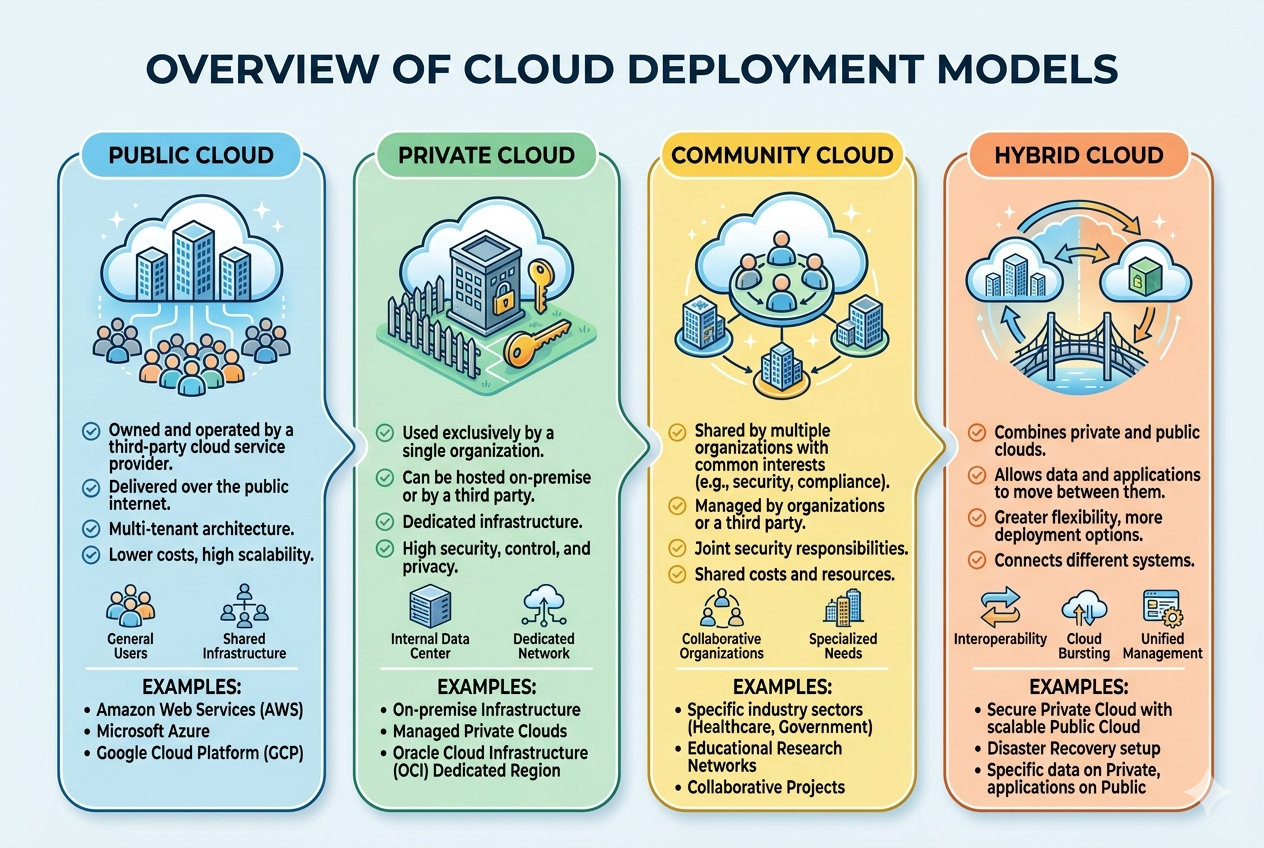
Cloud deployment models define how computing resources are made available, managed, and accessed in cloud computing environments. They determine the level of control, security, scalability, and cost structure an organization experiences when using cloud services. The four primary models—public, private, community, and hybrid—offer different approaches to infrastructure management based on business needs, regulatory requirements, and operational goals. Each model plays a significant role in modern digital transformation, enabling organizations to shift from traditional on-premises systems to flexible and scalable cloud-based environments.
Cloud computing itself has become a backbone of modern IT infrastructure because it reduces dependency on physical hardware, improves accessibility, and allows businesses to innovate faster. However, choosing the right deployment model is critical because it directly impacts performance, security posture, and long-term operational efficiency. Understanding each model in depth helps organizations align their technological strategy with business objectives.
Public Cloud Deployment Model Explained in Depth
The public cloud model operates on a shared infrastructure owned and managed by third-party service providers. These providers deliver computing resources over the internet to multiple users simultaneously. The underlying architecture is based on a multi-tenant environment, meaning that different organizations share the same physical resources while maintaining logical separation to ensure privacy and security.
One of the key strengths of the public cloud is its scalability. Organizations can increase or decrease resource usage almost instantly based on demand. This elasticity is particularly beneficial for businesses with fluctuating workloads, such as e-commerce platforms during seasonal sales or media services during high-traffic events. Instead of investing in expensive hardware, companies only pay for what they use, making it highly cost-efficient.
Another important aspect is accessibility. Public cloud services can be accessed from anywhere with an internet connection, enabling remote work, global collaboration, and continuous deployment of applications. This model also supports rapid innovation because developers can quickly deploy, test, and scale applications without waiting for physical infrastructure setup.
However, despite its advantages, the public cloud has certain limitations. Since resources are shared, organizations have less control over the infrastructure. Security concerns may arise for industries handling highly sensitive data, although providers implement strong encryption and compliance measures. Additionally, performance may sometimes vary due to shared usage, although modern load balancing techniques help mitigate this issue.
Typical use cases include web applications, software development environments, big data analytics, content delivery systems, and backup storage solutions. Its flexibility makes it suitable for startups as well as large enterprises looking to reduce capital expenditure.
Private Cloud Deployment Model Explained in Depth
The private cloud model is designed for exclusive use by a single organization. Unlike the public cloud, it is not shared with other users, which provides a higher level of control over infrastructure, security, and customization. This model can be hosted either within an organization’s own data center or managed by a dedicated third-party provider while remaining isolated from other clients.
One of the most significant advantages of private cloud is enhanced security. Since resources are not shared, organizations can implement strict security policies tailored to their specific needs. This makes it ideal for industries that handle sensitive or regulated data, such as banking, healthcare, and government institutions. It also supports compliance with strict legal and regulatory frameworks.
Customization is another major benefit. Organizations can configure hardware, storage, and network resources according to their internal requirements. This level of flexibility allows businesses to optimize performance for specialized workloads that may not function efficiently in a shared environment.
Performance consistency is also stronger in private cloud systems because resources are dedicated. There is no competition from external users, which reduces latency and improves reliability for mission-critical applications.
However, private cloud environments come with higher costs. Organizations are responsible for infrastructure setup, maintenance, and upgrades. This requires skilled IT teams and ongoing investment. Scalability is also more limited compared to public cloud, as expanding infrastructure requires physical or virtual resource provisioning within controlled environments.
Despite these challenges, private cloud remains essential for enterprises that prioritize data security, operational control, and predictable performance.
Community Cloud Deployment Model Explained in Depth
Community cloud is a collaborative cloud model where infrastructure is shared among several organizations that have common objectives, regulatory concerns, or operational requirements. These organizations jointly use and manage the cloud environment, either internally or through a third-party provider.
This model is particularly useful when multiple entities need to work together while maintaining a controlled and secure environment. Since the infrastructure is shared among a specific group rather than the general public, it offers a balance between cost efficiency and specialized control.
One of the key advantages of community cloud is cost sharing. Since infrastructure expenses are distributed among participating organizations, it becomes more affordable compared to a fully private setup. At the same time, it provides more security and customization than a public cloud.
Community cloud also supports regulatory compliance. Organizations within sectors such as healthcare, education, or public administration often have similar data governance requirements. A shared cloud environment allows them to comply with regulations while still benefiting from modern cloud technologies.
Collaboration is another strong feature of this model. Since organizations operate within the same cloud ecosystem, data sharing and joint projects become more efficient. This is particularly useful for research institutions or government departments working on shared initiatives.
However, community cloud also has limitations. Governance can be complex because multiple organizations are involved in decision-making. Standardizing policies across different entities may also be challenging. Additionally, scalability depends on the collective capacity of the shared infrastructure.
Despite these challenges, community cloud remains a practical solution for organizations that require a balance between privacy, collaboration, and cost efficiency.
Hybrid Cloud Deployment Model Explained in Depth
Hybrid cloud is a flexible deployment model that combines two or more types of cloud environments, typically integrating private and public clouds. This integration allows data and applications to move seamlessly between different environments based on workload requirements, security needs, and performance considerations.
One of the primary advantages of hybrid cloud is flexibility. Organizations can store sensitive data in a private cloud while leveraging the public cloud for less critical operations or high-demand workloads. This dynamic distribution of resources helps optimize performance and cost simultaneously.
Hybrid cloud also enhances scalability. During peak usage periods, businesses can extend their capacity into the public cloud without over-investing in permanent infrastructure. Once demand decreases, they can scale back to private environments, ensuring efficient resource utilization.
Another major benefit is improved business continuity. In case of system failures or disruptions in one environment, workloads can be shifted to another, reducing downtime and improving disaster recovery capabilities. This makes hybrid cloud an important strategy for organizations that require high availability.
Integration is a key characteristic of hybrid systems. Advanced networking and orchestration tools ensure that data flows smoothly between different environments. This allows organizations to create unified workflows despite underlying infrastructure differences.
However, hybrid cloud also introduces complexity. Managing multiple environments requires strong coordination, monitoring tools, and skilled IT teams. Security management can also become more challenging due to distributed data locations. Ensuring consistent policies across environments is essential to avoid vulnerabilities.
Despite these challenges, hybrid cloud is widely adopted because it offers the best balance between control, scalability, and cost efficiency.
Comparison of Cloud Deployment Models in Practical Perspective
Each cloud deployment model serves a different purpose depending on organizational needs. Public cloud emphasizes affordability and scalability, making it ideal for dynamic workloads and startups. Private cloud focuses on security and control, making it suitable for sensitive or regulated industries. Community cloud supports collaboration among similar organizations, while hybrid cloud combines the strengths of multiple models for maximum flexibility.
The choice between these models depends on factors such as budget, compliance requirements, workload type, and long-term IT strategy. Many modern organizations do not rely on a single model but instead adopt hybrid strategies to balance multiple requirements effectively.
Importance of Choosing the Right Deployment Model
Selecting the appropriate cloud deployment model is a strategic decision that influences operational efficiency, security posture, and business scalability. A mismatch between workload requirements and deployment model can lead to increased costs, performance issues, or security risks.
Organizations must evaluate their data sensitivity, regulatory obligations, expected growth, and technical capabilities before adopting a model. In many cases, cloud strategies evolve over time, starting with one model and gradually transitioning to more complex hybrid environments as business needs expand.
Cloud computing continues to evolve, and deployment models are becoming more interconnected. The future of cloud infrastructure is likely to focus on seamless integration, intelligent workload distribution, and enhanced automation across all environments.
Security Considerations Across Cloud Deployment Models
Security plays a central role in deciding which cloud deployment model an organization should adopt. Each model offers a different level of control over data protection, access management, and infrastructure security. In public cloud environments, security is largely managed by the service provider, which includes encryption, identity management, and compliance certifications. However, since resources are shared, organizations must carefully configure access controls and monitor data usage to avoid misconfigurations that could expose sensitive information.
In private cloud environments, security is significantly stronger because the infrastructure is dedicated to a single organization. This allows businesses to implement highly customized security policies, including strict firewall configurations, internal monitoring systems, and advanced encryption techniques. Organizations also have full visibility into their infrastructure, which helps in identifying threats and responding quickly to incidents.
Community cloud security is a shared responsibility among participating organizations. Since multiple entities operate within the same environment, standardized security policies must be agreed upon and enforced. This model works well when organizations have similar compliance requirements, but it requires strong coordination to maintain consistent protection across all users.
Hybrid cloud introduces a more complex security landscape because data and applications are distributed across multiple environments. Organizations must ensure secure data transfer between private and public systems, often using encryption, secure APIs, and identity federation. A well-designed hybrid security strategy ensures that sensitive data remains protected while still benefiting from the flexibility of public resources.
Scalability and Performance Considerations
Scalability is one of the most important advantages of cloud computing, but its implementation varies across deployment models. Public cloud offers the highest level of scalability, allowing organizations to instantly expand or reduce resources based on demand. This elasticity is particularly useful for businesses with unpredictable workloads, such as streaming services or online retail platforms.
Private cloud scalability is more limited because it depends on dedicated infrastructure. While resources can still be expanded, it usually requires additional hardware or system upgrades. However, performance is more consistent since resources are not shared with external users.
Community cloud scalability depends on the combined infrastructure capacity of all participating organizations. While it offers more flexibility than private cloud, it may face limitations if multiple users experience high demand simultaneously.
Hybrid cloud provides a balanced approach to scalability. Organizations can scale critical workloads within private environments while using public cloud resources to handle peak demand. This combination ensures both performance stability and cost efficiency.
Cost Structure and Economic Impact
Cost is a major factor influencing cloud adoption decisions. Public cloud is typically the most cost-effective option because it operates on a pay-as-you-go model. Organizations do not need to invest in physical infrastructure, making it ideal for startups and small businesses. Costs are directly linked to usage, which helps in avoiding unnecessary expenditure.
Private cloud involves significantly higher costs due to infrastructure ownership, maintenance, and staffing requirements. However, it can be more economical in the long term for organizations that require high levels of security and predictable workloads. The investment is justified by improved control and performance consistency.
Community cloud reduces individual costs by sharing infrastructure expenses among multiple organizations. This makes it a middle-ground option for institutions that need specialized environments but want to avoid the full cost of private infrastructure.
Hybrid cloud cost structures vary depending on workload distribution. While it can reduce expenses by leveraging public cloud resources for non-sensitive tasks, managing multiple environments may introduce additional operational costs. However, when properly optimized, hybrid models often deliver the best balance between cost and performance.
Flexibility and Business Agility
Flexibility is a key benefit of cloud computing, and each deployment model offers a different level of agility. Public cloud provides the highest flexibility, allowing organizations to deploy applications quickly and scale without infrastructure constraints. This supports rapid innovation and faster time-to-market for new products and services.
Private cloud offers moderate flexibility. While organizations have full control over configuration, changes to infrastructure may require more time and resources. However, this model allows deep customization tailored to specific business needs.
Community cloud provides flexibility within a shared environment. Organizations can collaborate effectively, but changes must align with agreed-upon policies and standards. This can sometimes slow down decision-making processes.
Hybrid cloud offers exceptional flexibility by combining multiple environments. Businesses can choose where to run workloads based on performance, cost, and security requirements. This adaptability makes hybrid cloud one of the most widely adopted models in modern enterprises.
Data Management and Control
Data management is another critical factor in cloud deployment. In public cloud systems, data is stored in shared infrastructure, although logically separated. Organizations rely on providers for data management tools, backup solutions, and recovery services. While this reduces operational burden, it also limits direct control over data storage locations.
Private cloud offers complete control over data management. Organizations can decide how data is stored, processed, and protected. This level of control is essential for industries dealing with confidential information or strict regulatory requirements.
Community cloud data management is shared among participating organizations. While this allows for collaboration, it also requires strict governance to ensure that data is accessed and used appropriately.
Hybrid cloud allows organizations to segment data based on sensitivity. Sensitive data can be stored in private environments, while less critical information can be processed in public systems. This layered approach improves both security and efficiency.
Compliance and Regulatory Requirements
Compliance is a major consideration, especially for industries such as healthcare, finance, and government services. Public cloud providers typically comply with international standards and regulations, but organizations are still responsible for ensuring that their usage meets specific legal requirements.
Private cloud environments make compliance easier to manage because organizations have full control over infrastructure and data handling processes. This allows them to design systems specifically aligned with regulatory frameworks.
Community cloud is often built around shared compliance needs. Organizations within the same industry can collaborate while ensuring adherence to common regulations, reducing the complexity of individual compliance management.
Hybrid cloud compliance management is more complex due to distributed environments. Organizations must ensure that data movement between clouds does not violate regulations and that consistent policies are applied across all systems.
Use Case Scenarios in Real-World Environments
Public cloud is widely used for web applications, mobile applications, content delivery, and data analytics platforms. It is particularly effective for businesses that require fast deployment and global accessibility without heavy infrastructure investment.
Private cloud is commonly used in sectors like banking, defense, and healthcare, where data privacy and security are critical. It is also used by large enterprises with predictable workloads that require dedicated infrastructure.
Community cloud is often seen in academic research, healthcare networks, and government collaborations where multiple organizations share data and resources for a common purpose.
Hybrid cloud is increasingly used by modern enterprises that require both security and scalability. For example, businesses may run core operations on private infrastructure while using public cloud for analytics, testing, or seasonal workloads.
Challenges in Cloud Deployment Models
Despite their advantages, each deployment model has challenges. Public cloud may face concerns around data privacy, vendor dependency, and limited control. Private cloud requires significant investment and ongoing maintenance. Community cloud faces governance and coordination challenges among multiple organizations. Hybrid cloud introduces complexity in integration, security management, and system orchestration.
Organizations must carefully evaluate these challenges before adopting a model to ensure long-term sustainability and efficiency.
Future Trends in Cloud Deployment Models
Cloud deployment models continue to evolve as technology advances. The future is moving toward greater integration, automation, and intelligence across all cloud environments. Artificial intelligence and machine learning are increasingly being used to optimize resource allocation and improve security.
Hybrid cloud adoption is expected to grow significantly as organizations seek more flexibility. Edge computing is also influencing deployment strategies by bringing computation closer to data sources. Additionally, serverless computing is reducing infrastructure management responsibilities, further transforming how cloud models are used.
As digital transformation continues, cloud deployment models will become more interconnected, allowing organizations to seamlessly shift workloads across environments based on real-time requirements.
Cloud Deployment Understanding
Cloud deployment models form the foundation of modern cloud computing strategies. Each model—public, private, community, and hybrid—offers unique advantages and limitations depending on organizational needs. Understanding these differences helps businesses make informed decisions that align with their goals, whether it is cost efficiency, security, scalability, or collaboration.
The right deployment model is not a one-size-fits-all solution. Instead, it is a strategic choice that evolves with business growth, technological advancement, and changing operational demands.
Cloud Deployment Model Selection Strategy
Selecting the right cloud deployment model requires a structured evaluation of organizational priorities, technical requirements, and long-term business goals. Companies cannot rely on a single factor such as cost or scalability; instead, they must consider a combination of security needs, compliance obligations, workload patterns, and operational complexity. A well-planned strategy ensures that the chosen model supports both current operations and future expansion.
For organizations prioritizing speed and innovation, public cloud often becomes the natural choice due to its rapid provisioning capabilities. Businesses that require strict control over data and infrastructure tend to lean toward private cloud solutions. When collaboration between multiple organizations is essential, community cloud becomes more relevant. Meanwhile, hybrid cloud is typically selected by enterprises that need a balanced approach, combining flexibility with control.
The decision-making process often begins with workload classification. Organizations analyze which applications require high security, which need high performance, and which can be scaled dynamically. This classification helps determine how workloads should be distributed across different cloud environments. Strategic planning at this stage prevents inefficiencies and reduces long-term operational risks.
Workload Distribution in Cloud Environments
Workload distribution plays a critical role in optimizing cloud performance. In a public cloud environment, workloads are dynamically allocated across shared infrastructure based on demand. This ensures efficient resource utilization but requires careful monitoring to maintain consistent performance.
In private cloud environments, workloads are typically stable and predictable. Organizations allocate resources based on internal requirements, ensuring consistent performance for critical applications. This stability makes private cloud ideal for mission-critical systems such as internal databases, enterprise applications, and sensitive transaction processing systems.
Community cloud environments distribute workloads among participating organizations. Since the infrastructure is shared, workload management must be carefully coordinated to prevent resource contention. Proper governance policies are essential to ensure fair usage and performance balance across all users.
Hybrid cloud offers the most advanced workload distribution capabilities. Organizations can move workloads between private and public environments depending on demand, cost considerations, or security requirements. This dynamic allocation improves efficiency and ensures that resources are used optimally at all times.
Cloud Architecture and Infrastructure Design
Cloud deployment models are deeply influenced by underlying architecture and infrastructure design. Public cloud architecture is built on large-scale data centers managed by service providers. These data centers are highly optimized for redundancy, scalability, and fault tolerance. Virtualization technologies allow multiple users to share physical hardware without interfering with each other.
Private cloud architecture is designed specifically for a single organization. It may use similar virtualization technologies, but the infrastructure is isolated and customized. This allows organizations to design systems that align precisely with internal workflows, security policies, and performance requirements.
Community cloud architecture is a hybrid design that combines shared infrastructure principles with restricted access controls. The infrastructure is tailored to meet the collective needs of participating organizations while maintaining logical separation between their environments.
Hybrid cloud architecture integrates multiple cloud environments through secure connectivity and orchestration tools. This requires advanced networking solutions such as VPNs, dedicated connections, and cloud management platforms that enable seamless data flow between environments. The complexity of hybrid architecture is higher, but it provides unmatched flexibility and scalability.
Data Security and Privacy Challenges
Data security remains one of the most critical challenges across all cloud deployment models. In public cloud environments, data is stored in shared infrastructure, which increases the importance of encryption, access control, and continuous monitoring. While providers implement strong security measures, organizations must ensure proper configuration to avoid vulnerabilities.
Private cloud environments offer stronger data privacy because access is restricted to a single organization. However, internal threats and mismanagement can still pose risks. Therefore, organizations must implement strict internal security policies and regular audits.
Community cloud security challenges arise from shared responsibility. Since multiple organizations access the same infrastructure, ensuring consistent security standards becomes essential. Misalignment in security practices among participants can lead to vulnerabilities.
Hybrid cloud environments face the most complex security challenges due to data movement between multiple systems. Secure integration, identity management, and consistent policy enforcement are necessary to maintain data integrity and prevent unauthorized access.
Operational Management and Maintenance
Operational management differs significantly across cloud deployment models. In public cloud systems, most infrastructure management responsibilities are handled by the service provider. This reduces the burden on internal IT teams, allowing them to focus on application development and business operations.
Private cloud requires extensive internal management. Organizations are responsible for maintaining hardware, updating systems, and ensuring continuous availability. This increases operational complexity but provides full control over the environment.
Community cloud management is shared among participating organizations. This requires coordination and clearly defined responsibilities to ensure smooth operations. Without proper governance, management conflicts can arise.
Hybrid cloud management is the most complex due to the integration of multiple environments. Organizations must use centralized management tools to monitor performance, manage workloads, and ensure security across all systems. Automation plays a key role in reducing operational overhead in hybrid environments.
Performance Optimization Techniques in Cloud Models
Performance optimization varies depending on the cloud model in use. In public cloud environments, optimization is achieved through auto-scaling, load balancing, and distributed computing. These techniques ensure that applications can handle varying levels of traffic efficiently.
Private cloud performance optimization focuses on resource allocation and system tuning. Since resources are dedicated, organizations can fine-tune infrastructure to meet specific application requirements, resulting in predictable performance.
Community cloud optimization depends on resource sharing agreements and collaborative planning. Efficient usage policies ensure that all participants receive fair access to resources.
Hybrid cloud performance optimization involves intelligent workload distribution. Advanced monitoring tools analyze system performance and dynamically allocate resources across environments to maintain efficiency and reduce latency.
Disaster Recovery and Business Continuity
Disaster recovery is a critical component of cloud deployment strategies. Public cloud systems often include built-in disaster recovery features such as automated backups, geographic redundancy, and failover systems. These features ensure high availability even during system failures.
Private cloud disaster recovery is managed internally or through dedicated backup systems. Organizations must design and implement their own recovery strategies, which may include off-site backups and redundant infrastructure.
Community cloud disaster recovery is coordinated among participating organizations. Shared recovery plans ensure that all members can restore operations in case of failures.
Hybrid cloud offers strong disaster recovery capabilities by enabling workload migration between environments. If one system fails, operations can be shifted to another cloud environment, minimizing downtime and data loss.
Industry Applications and Practical Implementation
Different industries adopt cloud deployment models based on their specific needs. Technology companies often rely heavily on public cloud for development, testing, and deployment of applications. Financial institutions prefer private cloud due to strict regulatory requirements and security concerns.
Healthcare organizations may use community cloud to share patient data securely among hospitals and research institutions. Educational institutions also use community cloud for collaborative learning environments and shared resources.
Large enterprises commonly adopt hybrid cloud to balance operational efficiency with security. They may store sensitive customer data in private environments while using public cloud for analytics, customer engagement, and scalability.
Evolution of Cloud Deployment Models in Modern IT
Cloud deployment models have evolved significantly over the years. Initially, organizations relied heavily on private infrastructure. With the rise of internet-based computing, public cloud became widely adopted due to its cost efficiency and scalability. Over time, the need for collaboration and specialized environments led to the development of community cloud.
Today, hybrid cloud represents the most advanced and widely adopted model because it combines the strengths of all other models. It reflects the shift toward flexible, distributed, and intelligent computing environments.
Future developments are expected to further integrate cloud environments, making deployment models more fluid and adaptive. Technologies such as artificial intelligence, automation, and edge computing will continue to reshape how cloud systems are designed and managed.
Final Perspective on Cloud Deployment Models
Cloud deployment models are essential frameworks that define how modern computing infrastructure operates. Each model offers unique benefits and challenges, and no single model is universally best for all scenarios. The effectiveness of a deployment strategy depends on how well it aligns with organizational needs, technical capabilities, and business objectives.
As digital transformation continues to accelerate, understanding these models becomes increasingly important for building efficient, secure, and scalable IT systems.
Cost Optimization Strategies in Cloud Deployment Models
Cost optimization is one of the most important objectives for organizations adopting cloud computing. Each deployment model provides different opportunities for managing and reducing expenses. In public cloud environments, cost optimization is primarily achieved through pay-as-you-go pricing, resource scaling, and usage-based billing. Organizations can reduce costs by shutting down unused resources, optimizing storage tiers, and selecting appropriate service levels based on workload demands.
Private cloud cost optimization focuses on maximizing the efficiency of dedicated infrastructure. Since organizations invest heavily in hardware and maintenance, they must ensure optimal utilization of resources. Techniques such as workload consolidation, virtualization efficiency improvements, and capacity planning are commonly used to reduce operational waste.
Community cloud cost optimization is achieved through shared investment. Since multiple organizations contribute to infrastructure costs, the financial burden is distributed. However, efficient governance is required to ensure that all participants benefit fairly from shared resources without overconsumption.
Hybrid cloud cost optimization involves balancing workloads between private and public environments. Organizations often run stable, sensitive workloads in private infrastructure while shifting variable or high-demand workloads to public cloud systems. This strategy helps reduce capital expenditure while maintaining operational flexibility.
Automation and Orchestration in Cloud Environments
Automation plays a vital role in modern cloud deployment models by reducing manual intervention and improving system efficiency. In public cloud environments, automation is widely used for auto-scaling, deployment pipelines, and infrastructure provisioning. This allows applications to respond dynamically to changing demand without human involvement.
Private cloud automation focuses on internal efficiency. Organizations implement orchestration tools to manage virtual machines, storage systems, and network configurations. This reduces operational overhead and ensures consistent performance across systems.
Community cloud environments use automation to standardize operations across multiple organizations. Shared automation frameworks help maintain consistency in deployment, monitoring, and resource allocation.
Hybrid cloud orchestration is more complex due to multiple integrated systems. Advanced orchestration tools enable seamless coordination between private and public environments. This ensures that workloads are automatically placed in the most suitable environment based on predefined policies.
Integration of Emerging Technologies with Cloud Models
Emerging technologies such as artificial intelligence, machine learning, Internet of Things, and edge computing are deeply influencing cloud deployment models. In public cloud systems, AI-driven analytics help optimize resource allocation and improve system performance. Machine learning models are also used for predictive scaling and security threat detection.
Private cloud environments integrate emerging technologies to enhance security and internal decision-making processes. AI-based monitoring systems help detect anomalies and ensure system reliability.
Community cloud benefits from shared innovation, where participating organizations collaborate on advanced technologies such as research computing and data analysis platforms. This accelerates innovation across industries with shared goals.
Hybrid cloud is particularly well-suited for integrating emerging technologies because it supports distributed computing. Edge computing devices can process data locally while syncing with centralized cloud systems for deeper analysis. This reduces latency and improves real-time decision-making capabilities.
Challenges in Managing Multi-Cloud and Hybrid Environments
As organizations increasingly adopt hybrid and multi-cloud strategies, management complexity becomes a significant challenge. One of the primary issues is interoperability between different cloud platforms. Ensuring smooth communication and data transfer between environments requires standardized APIs and integration tools.
Security management is another challenge. With data distributed across multiple systems, maintaining consistent security policies becomes difficult. Organizations must implement centralized identity management and unified monitoring systems to reduce vulnerabilities.
Cost visibility is also a concern in multi-cloud environments. Without proper tracking tools, organizations may lose control over spending across different platforms. Effective cost management strategies and monitoring dashboards are essential.
Performance monitoring across multiple environments adds another layer of complexity. Organizations must ensure that applications perform consistently regardless of where they are hosted. This requires advanced analytics and real-time monitoring systems.
Vendor Lock-In and Interoperability Issues
Vendor lock-in is a common concern in public cloud adoption. When organizations rely heavily on a single provider’s ecosystem, migrating to another platform becomes difficult and expensive. This limits flexibility and can increase long-term dependency risks.
Private cloud reduces vendor lock-in but increases internal dependency on infrastructure and technology stacks. Organizations must ensure that systems are designed with flexibility to avoid future limitations.
Community cloud reduces vendor lock-in by promoting shared infrastructure standards among organizations. However, agreements between participants may still restrict flexibility.
Hybrid cloud helps mitigate vendor lock-in by enabling organizations to distribute workloads across multiple environments. This reduces dependency on a single provider and increases overall system resilience.
Performance Monitoring and Analytics in Cloud Systems
Performance monitoring is essential for ensuring optimal system operation across all cloud deployment models. In public cloud systems, monitoring tools track resource usage, application performance, and system health in real time. This helps organizations identify bottlenecks and optimize performance.
Private cloud monitoring is typically more detailed, as organizations have full control over infrastructure. Internal dashboards provide insights into system utilization, security events, and operational efficiency.
Community cloud monitoring requires shared visibility among participating organizations. Standardized monitoring frameworks ensure transparency and fairness in resource usage.
Hybrid cloud monitoring is the most complex, requiring centralized tools that aggregate data from multiple environments. Advanced analytics platforms help organizations gain a unified view of system performance and make informed decisions.
Sustainability and Environmental Impact of Cloud Models
Sustainability has become an important consideration in modern cloud computing. Public cloud providers often operate large-scale data centers optimized for energy efficiency. This helps reduce overall environmental impact through shared infrastructure and resource optimization.
Private cloud systems may consume more energy per organization due to dedicated infrastructure, but they offer opportunities for internal optimization and energy-efficient hardware deployment.
Community cloud models promote shared resource usage, which can reduce overall energy consumption compared to multiple independent systems.
Hybrid cloud systems contribute to sustainability by optimizing workload placement. Non-critical tasks can be shifted to energy-efficient environments, reducing unnecessary resource usage.
Future Evolution of Cloud Deployment Models
Cloud deployment models are expected to become more intelligent, adaptive, and automated in the future. Artificial intelligence will play a major role in optimizing workloads, predicting system demands, and enhancing security across all environments.
Hybrid cloud will continue to dominate enterprise adoption due to its flexibility and scalability. The integration of edge computing will further enhance real-time processing capabilities, especially for IoT and data-intensive applications.
Serverless computing is also expected to grow, reducing the need for infrastructure management entirely and allowing developers to focus purely on application logic.
Multi-cloud strategies will become more common as organizations seek to avoid vendor lock-in and improve resilience. Cloud platforms will increasingly focus on interoperability and seamless integration.
Conclusion
Cloud deployment models—public, private, community, and hybrid—form the foundation of modern cloud computing infrastructure. Each model serves a distinct purpose and addresses different organizational needs, ranging from cost efficiency and scalability to security and collaboration.
Public cloud offers unmatched flexibility and scalability, making it ideal for dynamic workloads and fast-growing businesses. Private cloud provides strong security, control, and customization for organizations with sensitive data and strict compliance requirements. Community cloud enables collaboration among organizations with shared goals, while hybrid cloud combines the strengths of multiple models to deliver balanced performance, flexibility, and efficiency.
The choice of deployment model is not static but evolves with business growth, technological advancements, and changing operational demands. Many organizations today adopt hybrid and multi-cloud strategies to maximize benefits while minimizing limitations.
Ultimately, understanding cloud deployment models is essential for designing efficient, secure, and scalable IT systems. As technology continues to advance, these models will become even more integrated, intelligent, and adaptive, shaping the future of digital infrastructure worldwide.